1
Elevating Art Thinking to a Fine Art
A case study of how art thinking rescued a cultural institution in Dublin
Author: Dr Peter Robbins
Head of Department of Design Innovation Maynooth University
Ireland
Keywords:
Design thinking, Art thinking, Creativity, Strategy, Fine Art, Printmaking,
Abstract
This article uses a contemporary and revelatory case study to explore the relationship between three conversations in the innovation literature: design thinking, creativity in strategy and, the emerging area of art-thinking. Businesses are increasingly operating in a VUCA environment where they need to design better experiences for their customers and better outcomes for their firm and the Arts are no exception. Innovation, or more correctly growth through innovation, is a top priority for business and although there is no single, unifying blueprint for success at innovation, design thinking is the process that is receiving most attention and getting most traction. Design thinking teaches businesses to think with the creativity and intuition of a designer; to show a deep understanding of; and have empathy with the user. But design thinking has limitations. By placing the consumer at the very heart of the innovation process, design thinking can often lead to more incremental than radical ideas. Now there is a new perspective emerging, art-thinking, in which the objective is not to design a journey from current scenario; A to improved position: B. Art thinking requires the creation of B and spends more time in the open ended, problem space, staking out possibilities and looking for uncontested space.
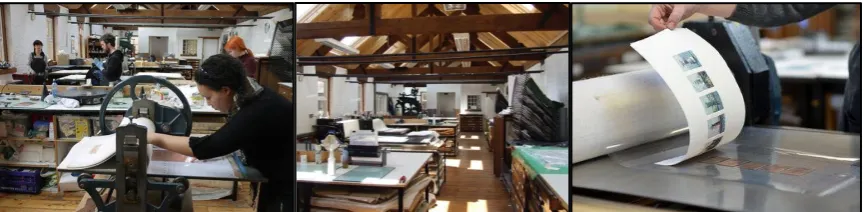
In Dublin, we examine a case of the oldest, largest and most prestigious fine art gallery and studio where most of the country’s best-known and successful visual artists both make, exhibit and sell their art. Graphic Studio Dublin is primarily a printmaking studio, established by artists over 60 years ago. It has facilities for woodblock, lino-print, silkscreen, intaglio and carborundum etching spread over four floors of a centrally located studio where the artists have access 24/7. But two years ago it found itself on the brink of collapse having borrowed heavily to invest in new facilities during the period of Ireland’s economic collapse. Its loans were sold to a vulture-fund who were about to foreclose in a move that would have seen a generation of Irish Artists displaced. A new board of directors was empaneled and they introduced some art thinking principles to bring the organisation back from the brink. They used an art-thinking mindset and design thinking tools to restore the fortunes of this venerable, artist-led institution and it worked.
Literature Review
The rise and rise of design thinking
Volatility, Uncertainty, Complexity and Ambiguity, the acronym VUCA, was first developed by the US war college to define conditions military leaders encounter on the battlefield. Recently, the concept has come to define the competitive environment of the digital economy (Bennett & Lemoine, 2014). The acronym itself was not created until the late 1990s, and it was not until the terrorist attacks of September 11, 2001, that the acronym really took hold. VUCA was subsequently adopted by strategic business leaders to describe the chaotic, turbulent, and rapidly changing business environment that has become the “new normal.” Volatility refers to large scale, frequent change or chaos having no predictable pattern (Bennett & Lemoine, 2014). Uncertainty indicates lack of knowledge related to the frequency and significance of environmental change (Ibid). In uncertain environments, cause and effect are known however, timing and magnitude are not. Complexity refers to elaborate networks of interconnected parts being convoluted and multiform. It describes iterations of simple patterns (Bartscht, 2015) combined in a multitude of interconnections creating potential for information overload (Bennett & Lemoine, 2014). Finally, ambiguity refers to our lack of capacity to read the signals from markets or consumers with any clarity, certainty or accuracy. Specifically, it identifies a lack of knowledge of cause and effect where there is no precedent on which to base predictions.
‘In this new era, smart corporate leaders are embracing the idea that design can be a crucial differentiator. Only a decade ago, senior business executives tended to dismiss design as a second-tier function - a matter of aesthetics or corporate image best left to the folks in marketing or public relations. Today design is widely acknowledged as a C-suite concern and a key element of corporate strategy.’ Chandler 2018, p16
Fortune Magazine (2018) reports that smart business leaders ‘are embracing the idea that design - channeling insight to delight and truly connect with customers and users can be a crucial differentiator.’ Kimbell (2009) notes the term “design thinking” has come to the fore amongst educators, academics, managers and the design community as a way to
distinguish between the technical, craft skills of actual designers, and a way of approaching business or management problems that reproduces, in a simplified way, the approach a designer might take . Businesses look at it as a way to balance the natural tension between ‘explore and exploit’ ( Martin 2009) or as a plug and play creative process to kick-start innovation ( Brown 2008).
Evidence of the arrival of Design Thinking as the preferred approach for business to successfully facilitate innovation isn’t hard to find. On the bookshelves, popular
design thinking being used by 59% of US firms in their innovation or new product/service development process.
Design Thinking has gained traction not just with the corporate sector but also with government bodies. Kimbell (2009) notes that:
‘In the UK, for example, the government-funded national Design Council, argues that design thinking plays a key role in innovation (Design Council 2009). In Denmark, a cross-ministerial innovation unit called MindLab combines design-centred thinking and social science approaches to create new solutions for society (Mindlab 2009).’
Ireland is also becoming a hotbed of design thinking as a consequence of hosting local operating units and sometimes R&D centres for many of these companies. But in case there could be any doubt of the all-pervasive nature of Design Thinking, this was dispelled when Bank of Ireland, the country’s oldest (230 years old) and, arguably, most conservative bank, hired a head of Design Thinking in 2015. Equally, when the practice of project management, traditionally focussed exclusively on the ‘solution space’ says they need to embrace Design Thinking’s approach, its capacity and tools to clarify and elaborate on the ‘problem space’; you can tell things are changing (Dijksterhuis and Silvius, 2017).
Professional services have also joined the party with Accenture snapping up Fjord, a global design agency, in 2013. PriceWaterhouseCoopers (PwC) acquired BGT, a digital creative consultancy while Ernst & Young (EY) bought a design agency called Seren. In Ireland, Deloitte acquired Red Planet and internationally, they bought Doblin and Monitor, both design-driven, innovation agencies. McKinsey bought Lunar, a design agency based in Silicon Valley in 2015.
But what exactly is Design Thinking?
The concept of design thinking has been variously interpreted to reflect, on one hand, the elements related to cognition (internal) and its external rules and tools. Design thinking is not yet fully defined or understood (Chen, 2016). Liedtka (2015) acknowledges that while a generally accepted definition of Design Thinking has yet to emerge; all definitions share one or more common elements. Lockwood (2009), a former President of the Design
Management Institute suggests Design Thinking is:
‘a human-centred innovation process that emphasises observation, collaboration, fast learning, visualisation of ideas, rapid concept prototyping and concurrent business analysis.’
Mootee’s (2013 p32) definition focuses more on the process and defines design thinking as: ‘the search for a magical balance between business and art, structure and chaos, intuition and logic, concept and execution, playfulness and formality and control and empowerment.’
Mintrom and Lieutjens (2016), whose emphasis is on the policy arena, assert:
that have the potential to illuminate problems in new ways and indicate effective client focused solutions. ‘
Like marketing, Design Thinking foregrounds the wants and needs of consumers but Curedale (2016) notes design thinking has moved past and is superior to marketing. Far from being merely a tool of the marketing armoury where it helped, through advertising and packaging, make people want things it is now about designing things people actually want. What connects the definitions is that Design Thinking is invariably user-centred and founded, ideally, on some actionable insight. It is highly visual and relies on customer observation: developing thick, rich ethnographic portraits of customer behaviour and trying to identify themes and patterns (unmet or under-served needs) from the observations.
Design thinking emphasises the importance of problem definition. The inclusion of customer, consumer or ‘end-user’ perspectives in finessing the problem facilitates a better
comprehension of the issue and when this superior understanding is coupled with creativity then it’s more likely that the solution will be based on higher ground rather than common ground (Chambers 2015; Fung 2004).
It classifies consumers into discrete segments and develops individualised persona’s for each segment and then uses techniques to generate, novel, original and radical ideas for each segment. The generation of ideas is a group, interdisciplinary exercise: it brings in multiple viewpoints and multiple stakeholders and challenges assumptions. Then ideas are prototyped as either simple, written or illustrated concept-boards or as more refined
artefacts. Then field experiments are designed to measure the appeal of the ideas and to discover whether they might find traction with the target market.
Table 1 - Conventional Elements of a Design Thinking Process or Approach
Problem Definition - one that accurately describes the problem the initiative is trying to resolve or the opportunity it is attempting to exploit.
Insights and Empathy - an ability to ‘walk in the users’ shoes’ and to understand their pains and gains is vital to being able to develop ideas likely to resonate with them. When the process uncovers genuine insights about what people do; why they do it and how their experience can be improved, this can lead to better design criteria, and ultimately, great work.
Iterative Approach with a bias towards experiment and action - unlike traditional
quantitative market research where a little information is gathered about a lot of people - design thinking thrives on the opposite. It builds an intimate and vivid portrait of just a few people and tries ideas out with them. Designers do not follow a direct route from problem to solution, but instead move to and fro between problem(s) and solution(s). For instance, Cross indicates that ‘designing does not proceed in a sequence of stages that targets each one of the (partial) problems initially identified or outlined. Instead, designing appears to proceed through an iterative form of interplay between partial problems and their
solutions’.
more than just ‘backing a hunch’. It is an approach in conventional problem solving when, according to (Dorst, 2011 p523) ‘we know both the value we wish to create, and the ‘how’, a ‘working principle’ that will help achieve the value we aim for. What is missing is a ‘what’ (an object, a service, a system), that will give definition to both the problem and the potential solution space within which an answer can be sought.’ Abductive reasoning is a key part of design thinking (Kolko, 2010; Dong et al, 2015).
This process is most often found using a visual observation example, in which a person makes hypotheses or tries to explain some behaviour they’ve seen. It is very often also associated with the “flash of insight” or the “eureka-moment” in a discovery, according to Pauwels et al (2013).
An Ethnographic approach - deep, rich, vivid observations are deemed more likely to reveal actionable insights hence design thinking favours close observation often in the form of actual participant diaries, video diaries, vlogs, photos, recordings where the emphasis is on capturing the customer behaviour at the key moments of truth in a customer experience.
Brainstorming and Ideation - finesse mild and wild ideas about potential opportunities. These tools encourage creative behaviours such as withholding judgment, avoiding debates and seeking higher order thinking by building on the ideas of others and
leveraging the diversity of the team. Cross (2006) noted that science investigates existing forms but design initiates new forms and it does this through brainstorming and other creative techniques.
Prototyping Techniques - these facilitate, according to Ogilvie and Liedtka (2011), making abstract ideas tangible and easy to understand and comment on by participants.
Techniques include, storyboarding, concept or mood boards, user scenarios, metaphor, experience journey maps and simple graphic illustrations.
Co Creation - incorporates tools and methods that allow consumers or users engage in the design of future product, service or experience ideas.
Learning launch, Pilot and Field Experiments - are designed explicitly to test underlying assumptions in the field. Ideally, these are done in controlled environments and latterly, crowdfunding sites like Kickstarter and Indiegogo are very helpful in gauging likely future interest in proposed new ideas.
Adapted from Iterations Design Research Journal 2018
ideas or solutions and also testing and modifying them in parallel. This parallel creation defines design thinkers as very separate from traditional managers who rely predominantly on logical reasoning, data and analysis.
Figure 1: The Darden Model of Design Thinking - an end to end sequence of tools (Liedtka & Ogilvie, 2011)
Academics and practitioners alike now coalesce around broad definitions of Design Thinking that see it as a creative, iterative, hypothesis-driven process that is focussed on both the problem and the solution. Relying on abduction and experimentation, it balances the twin drivers of possibility and constraint and works best in situations of high complexity, ambiguity and uncertainty. It has to navigate between customer wants and needs, client expectations, social circumstances, business models, opportunities in technology and contemporary aesthetic canons.
While some designers try to make their steps explicit, Cross (2011) observes that others are deliberately, even wilfully, obscure when it comes to revealing the processes they use to arrive at great designs. Philippe Stark suggested that his was a ‘magical’ process of
epiphany and, similarly, Alessi said ideas came to him in a ‘vision’. But a recurring theme in design research is the role of intuition and it is the quality of this intuition that probably separates the best designers from the rest. An additional characteristic commonly possessed by designers is a capacity to dwell in a problem space where there can be an uncomfortable degree of ambiguity and apparently conflicting demands. Design Thinking, on the other hand, has evolved to eliminate, or certainly reduce, both intuition and ambiguity by providing a series of simple, stepwise templates that give users the comforting illusion of control over the process. In design, the quest is first for options rather than solutions and this is not always the case with Design Thinking.
The `Way Designers Think
ideas. One of the interviewees, Jack Howe, an architect and designer, said ‘I believe in intuition. I think that’s the difference between a designer and an engineer.’ Today, a similar observation can be made about the difference between data-scientists and design thinkers. The latter use abductive thinking or intuition while the former rely merely on data. Cross (2011) suggests that the term intuition is really a convenient shorthand for what really happens in design thinking - which as opposed to inductive or deductive thinking - is abductive thinking. Deductive reasoning is the reasoning of formal logic. It begins with an hypothesis, perhaps one such as, all swans are white. Then, some fieldwork is designed to either prove or falsify that hypothesis. This is the dominant orthodoxy for business analysis. This is the bread and butter of all MBA trained executives. Inductive reasoning, however, aims to build theory from data. Hence, it does not begin with any firm hypothesis; it begins by observing how things actually are and then it builds theory accordingly. This is generally used in more qualitative contexts where the variable being studied is highly context dependent, like corporate innovation - how firms come up with winning ideas, for instance.
Abductive reasoning is the reasoning of design, it integrates intuition and acknowledges that knowledge is imperfect and hence some creative leap might be required to get to a solution. Dunne and Martin, (2006) refer to abductive reasoning as the logic of what might be whereas deductive and inductive are the logic of what should be or what is. Abduction is more than just ‘backing a hunch’. It is an approach in conventional problem solving when, according to (Dorst, 2011 p523) ‘we know both the value we wish to create, and the ‘how’, a ‘working principle’ that will help achieve the value we aim for. What is missing is a ‘what’ (an object, a service, a system), that will give definition to both the problem and the potential solution space within which an answer can be sought.’ Abductive reasoning is a key part of design thinking (Kolko, 2010; Dong et al, 2015).
Quantitative, big data, analytics are now synonymous with the digital business environment, but prevalent use of data mining methods rely solely on historical customer behavior and do not easily illuminate any path to competitive advantage (Cousins, 2018). In response to disruption, organizations are increasingly pioneering new models, frameworks, methods, structures and processes to engage with the customer to sense and seize (Augier and Teece, 2008) emerging patterns and future trends not easily defined from quantitative historical data. Design thinking has emerged as an absorptive capacity and integrative learning method to approach complex and often ambiguous problems from the perspective of the customer.
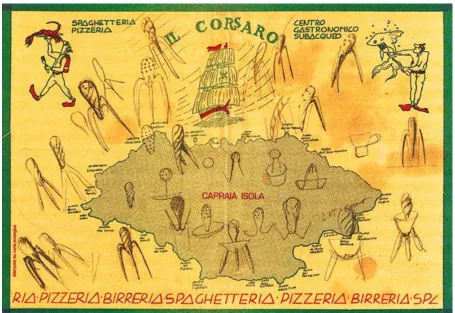
While there, he dined in a pizza restaurant, called Il Corsaro (translated as the buccaneer or Pirate). He mused over the lemon squeezer project as he waited for his food to arrive - he had ordered the squid. He began to sketch on the placemat in the restaurant and his first iterations (in the centre to the right of figure) reflected conventional squeezer designs. See figure 1. But as his food arrived, something else was triggered in his imagination and he began to create images of strange forms with big bodies and long legs. Ultimately, in the bottom left of the placemat, he arrived at the blueprint for what was to become one of the iconic designs of the 20th century.
Figure 2: Starck’s design sketches for the Alessi Lemon Squeezer
Lloyd and Snelders (2003) in describing the probable creative trajectory for this great design suggest that the squid-like concept was not a sudden flash of inspiration from out of the blue but that it arose from a form of analogy that probably began unconsciously but gradually became more deliberate. It is the intersection of three forms of parallel thought. The first is the problem of how to squeeze a lemon, the second involves creatively mining the possibilities offered by the shape of the squid and the third draws on Starck’s interest and liking for science-fiction comic books in his youth and the unmistakable resemblance to some shapes, possibly from HG Wells’ War of the Worlds.
are rarely gifted with imagination or insights about the future. They can’t anticipate unmet or unarticulated needs and they are rarely the source for radical ideas. Design thinking tends to anchor innovators in the incremental and hence, while it is a great set of tools for businesses, it can constrain breakthrough thinking.
Another shortcoming concerns design thinking’s core discipline being design. But design has historically concerned itself with the design of objects, artifacts, products - physical things (Brown and Martin, 2015). Famous designers are generally famous for designing in specific domains: Frank Gehry designed wonderful buildings; Coco Chanel designed beautiful clothes; Jonny Ive designed breathtaking phones and computers; Paul Rand designed memorable logos while Ray and Charles Eames designed stylish furniture. Hence, as design expands its operating remit into services, into experiences and even into strategy another problem can emerge. Brown and Martin (2015) note that when designers take a brief, an issue or a business opportunity and go away to work their magic on the problem at hand, inevitably they return to the boardroom with their proposed solution and when they do, one of four things often happen. This scenario increases in likelihood with the degree of difference between the designer’s proposal and the current operating model. The more the proposal deviates from the business as usual scenario, the more likely executives are to have this reaction: ‘(1) This doesn’t address the problems I think are critical. (2) These aren’t the possibilities I would have considered. (3) These aren’t the things I would have studied. (4) This isn’t an answer that’s compelling to me. As a consequence, winning commitment to the strategy tends to be the exception rather than the rule, especially when the strategy represents a meaningful deviation from the status quo ‘ (p60). Fortunately, the toolbox of design thinking has an approach to manage this disconnect. Instead of making the proposed change look like a small number of big steps, they do the opposite and by iteration and low-res prototypes, they make the change seem like a logical sequence of lots of small, incremental steps.
The Beginnings of an Art Thinking Movement
Whitaker (2016) notes that art thinking shares a number of similarities with design thinking. They both provide a framework and tools for facilitating the design of a new product or service. An important distinction she draws is that ‘whereas a framework originating in product design starts with an external brief - “What is the best way to do this?” - art thinking emanates from the core of the individual and asks, “Is this even possible?”’ Art thinking spends much more time in the problem space: it is not customer centred it is breakthrough oriented.
Coles (2005) notes that there has always been a rift between art and design in our culture. He notes that purists on both sides are keen to maintain their disciplinary differences while others believe that design is a suitable bedfellow for art and that art should be more ‘gregarious’ and reach out beyond its confines. Some see design merely as decorating art for human use and hence any such ‘decoration’ is undesirable. But, as early as 1859, Rushkin, showing little sympathy with this argument, insisted that:
In his series of essays, The Shape of Things, (Flusser, 1999) one essay was entirely devoted to the etymology of the word ‘design’. It stems from the Latin word signum meaning ‘sign’. Thus, etymologically, design means to ‘de-sign’. So, far from adding unnecessary decoration, it entails the removal of something: a simplification. In the same essay, Flusser went on to elaborate on other words often used in the same context - such as technology. The Greek word techne actually means ‘art’ and is a first cousin of tecton, a carpenter. The basic idea here is that wood is a shapeless material to which the artist, the technician, the carpenter gives some design and form.
So, in derivation and etymology, the words technology, art and design are very closely related. But what Coles (2005) calls ‘modern bourgeois culture of the mid-nineteenth century’ has created a very sharp distinction between the world of art and that of technology. This has split the culture and practice into two mutually exclusive branches: one scientific, data-driven and ‘hard’ and the other intuitive, aesthetic and ‘soft’. This unfortunate split became irreversible with the rise the machine bureaucracy organisation (Mintzberg XXX). Yet, the only discipline capable of bridging these two disparate worlds and of integrating them is design. In Flusser’s view design indicates the sweet spot where art and technology meet to produce new forms of culture and so the role of design is crucial to the vitality of the arts and similarly, the role of art is at the very heart of design.
Science and art are separate realms where one prizes data and the other aesthetics: it has long been noted that gifted practitioners of the former and very often equally talented at the latter. Metz (2016) notes that Einstein played the violin and piano: Max Planck composed songs and even a full opera. He also played the piano, organ and cello. Neuroscientist Santiago Ramon y Cajal was a renowned illustrator, draftsman and photographer. Raold Hoffmann is a published author and playwright. These Nobel prizewinners are not isolated examples. It turns out that Nobel laureates in the sciences are 17 times more likely than the average scientist to be a painter, 12 times more likely to be a poet, and 4 times more likely to be a musician (Pomeroy 2012). This fact, initially, sounds surprising but it shouldn’t. Apparently science and the arts both spring from the same deep well of human creativity and imagination. Renaissance artists like Leonardo da Vinci and Albrecht Durer were also scientists, and the field journals and drawings of scientists like Charles Darwin and James Audubon added much to our scientific understanding of nature. So science and art have much more connecting them than dividing them.
of different ideas and angles. He notes that the latin verb ‘cogito’ to think actually means to ‘shake together’ which is the creative act of making connections between previously unrelated things. In the business world, this is known as ‘kaleidoscope thinking’: the shaking together of known elements into previously unconsidered combinations.
Fresh perspective to this debate was brought when business and management guru, Daniel Pink said in a New York Times interview that the ‘Now the Master of Fine Arts, or MFA is the new MBA’. Pink sees that much of the work of analytics and mathematics that’s central to business can now be done better and more easily by computers and it’s now time, given that we now compete in a creative economy, to allow the right brain take centre stage. Pink later converted this assertion into a HBR article (Bell, 2008) in which he explained the reasons for the rise in demand for creative people coupled with the oversupply with people with MBAs explains why the ,MFA is now the hottest credential in the world of business.’
Amy Whitaker’s 2016 Book entitled Art Thinking is the first substantial effort to dimensionalised the notion of art thinking. In it, she has some practical insights. She describes the root of the concept to be Schumpeterian insofar as capitalism is entirely predicated on change and the need for disruption and reinvention to stimulate business growth. Schumpeter asserted that if firms keep doin the same thing, eventually they go out of business. ‘Following patterns rather than inventing new ones will only get you so far.’
For an organization to advance, the entrepreneur must develop new products, services or methods of production while continually examining and improving what the organization is currently doing. However, to innovate the company’s offerings, the entrepreneur needs both the money and the R&D capacity to produce or enhance the new products or services. Generally, the resources would come from extracting funds away from existing or obsolete products and services and funneling them to new ones. Therefore, the introduction of new products or services results in the obsolescence or failure of others. This process is described by Schumpeter (1942) as creative destruction. Drucker (2002 supported this definition, when he stated: Innovation depended on organized abandonment. When the French economist J.B. Say coined the word “entrepreneur” 200 years ago he meant it as a manifesto and a declaration of intent: the entrepreneur in his scheme was someone who upsets and disorganized. To get at the new and better, you have to throw out the old, outworn, obsolete, no longer productive, as well as the mistakes, failure and misdirection of effort of the past.
Art Thinking is for companies seeking this type of growth, possibly even transformational growth. ‘They can grow by scaling up to the most efficient level of production. Or they can grow artistically by the alchemy of invention.’ Whitaker recognises that this can be challenging for business because
Case Study
Strategic initiatives in the Arts include bringing in strategic frameworks or strategic management or generally importing approaches from the business world often at the behest of senior managers; of government funders or other stakeholders like Board directors. Hence, ‘Strategy’ in the arts is usually resented as something that is imposed from outside and something that needs to be tolerated temporarily till the recession or existential crisis recedes and the organisations get back on their feet.
The story of the recent history of Graphic Studio Dublin is the story of a very creative strategy being applied to an Arts organisation with profound and positive effects: a story of how strategy rescued a national arts organisation from the brink of closure and ruin and restored its place in the visual arts ecosystem as well as restoring its fortunes. But in order to tell the story, like all good research subjects, it needs a little context. This context requires a visit to 1960s Dublin. Ireland in the mid-twentieth century was delicately balanced between an economic isolationism imposed both by the end of the second world war and by a political leader who favoured self sufficiency and protectionism which turned into the twin drivers of economic stagnation for almost a decade. On the other hand and despite the economic stassis, the arts were seeing an expansion: a cultural revival.
A number of notable, even defining cultural initiatives took place in Ireland at this time in both public and private spheres; the establishment of the Wexford opera Festival; the Dolmen Press; the Arts Council; the Dublin Theatre Festival and the Irish Georgian Society. In terms of policy too, there was the launch of TK Whitaker’s 1958 Economic Development Plan (which was Ireland’s blueprint out of self-imposed economic atrophy); the launch of Ireland’s first national television broadcasting service called Telefis Eireann: the publication of Design in Ireland by the Scandinavian Design Group and the opening of the Kilkenny Design Workshops in 1965. Ireland was also opening up to international cultural influences. During the 1960s, the Beatles performed in Dublin as did Ella FitzGerald: the Rolling Stones: Oscar Peterson: Cliff Richard: Louis Armstrong and Bing Crosby.
One other remarkable development in Ireland occurred at this time: Shannon, the first new town founded in Ireland since the 17th century was established in 1963 and was based, not around a harbour or a fortress, nor a market (as all towns had been since Medieval times) but it was located at an airport. Shannon and the other institutions mentioned were all responding to significant gaps in the cultural, educational and economic landscape in Ireland at that time.
But while there was considerable change, the air was also heavy with continuity, certainly in the Arts. The fact that the Arts Council was overseen for over a decade by two priests in succession, Monsignor Padraig de Brún (1959-60) and Father Donal O’Sullivan (1960-73), now seems remarkable. There were nine board members of the Arts Council and all were male and as the leadership was coming from the most conservative pillar of Irish society, the Church, it’s hard to imagine anything but the most conservative projects and initiatives getting financial support.
its first three decades, it struggled to survive, sustained only by idealism and a grim determination to provide shared facilities so that talented artists could make important art. Chronicler of the organisation, Brian Lalor, in his book, Ink Stained Hands (2011) makes an insightful observation about the early years:
Ink Stained Hands is the story of this triumph - over the absence of an informed critical climate and the absence of a marketplace, over infighting, personal antagonisms and feuds, over ideological differences and intransigence disguised as high principle and through a web of official misunderstanding - it emerged half a century later, invigorated with idealism and optimism intact and a lengthy inventory of artistic achievement to its credit. (pXXlll)
The founders of Graphic Studio were a group of five well-intentioned, hugely-talented and diverse characters, each with a distinct and established profile in the arts. Their backgrounds spanned education, publishing, architecture, literary criticism and painting and printmaking. See Figure 2:
Figure 3: Founders of Graphic Studio Dublin 1960
Figure 4: A flavour of the work that takes place in the Graphic Studio Dublin
But raising money, especially for the Arts, in the cash-strapped Ireland of the 1960s was a far trickier proposition. The Irish Export Board came forward with £120 and while this was derisory when compared to US funding, in Ireland’s low wage and even lower-expectation economy, it was able to go a long way. But one of the early successes of GSD was an imaginative business model they developed through which generous individual sponsors were encouraged to make a modest annual contribution in return for which they would receive as a gift a small portfolio of prints. This ‘sponsors’ portfolio’ ideas still persists to this day some 50 years later. GSD became a thriving, successful, dynamic artistic community recognised by the Arts Council as part of the visual arts landscape in Ireland and recognised by artists as a commune where inexperienced and veteran printmakers; where master and pupil could work side by side.
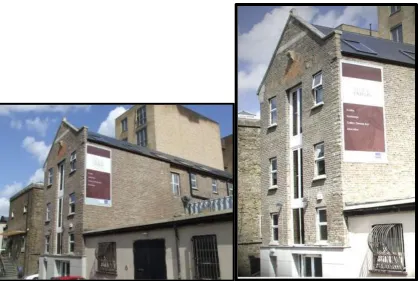
Figure 5: The four storey converted granary, new printmaking studio for GSD
While the idea might have been laudable, the timing was catastrophic. It coincided with Ireland’s first ever property ‘bust’ where property prices went into freefall precipitating the deepest and longest recession in Ireland’s history. The value of the property plummeted and the Board of GSD managed to negotiate a temporary ‘interest only’ payment arrangement on the property mortgage. However, the bank that owned the mortgage quickly sold it to a hard-nosed US vulture-fund who wanted to foreclose on the premises and to cast the artists out on the street. This would have left a generation of Irish printmakers without a place to work and without the facilities to make their art. The problems with the unsustainable mortgage were compounded by the fact that art purchases are the very first discretionary spend to get cut during a recession. People buy less art when their earnings are reduced and hence just when the organisation needed to show healthier revenues, its sales were drying up.
A new board of directors was empanelled in GSD to take up this daunting challenge and this is where the Art-thinking strategy took root. The Board has nine members of which the majority (5) are artists and the rest are volunteers, generally those interested in Art from the professions. In this instance there is a Chairman, a director of marketing and strategy (the author): a head of Legal ( a bank property lawyer) and head of Finance ( a chartered accountant in a large practice). The challenge for the new board was to restore GSD’s finances to the extent to which it could afford to service the full payments on a mortgage: a reduced mortgage from the one originally taken out. This meant not only getting the business back into a healthier shape, it also required that the mortgage be renegotiated with, ideally, some debt forgiveness.
to start with inventing what B might look like in terms of revenues, audience numbers and costs. The Board decided to get all the artists on board to co-create a new, winning strategy to pull the organisation back from the edge. A number of artists were invited to a Strategy Day in which a north star for the organisation was developed and a number of effort priorities were agreed. The North Star was the organisation’s guiding purpose and the effort priorities represented the key deliverables underpinning it. After that, the entire membership was invited to a brainstorming or ideation session which was run as a world-cafe format. The delegates were given a briefing on Art thinking and given problem statements - such as: wouldn’t it be great if… or how might we…? Each table had to work through the effort priorities and give them some dimensions and suggest revenue generating projects that could be implemented.
This yielded a surprising amount of good and useable concepts which the Board started to implement straightaway. Many were great sales ideas. One prompted a themed artist-led and very profitable promotion called 100 by 100 in which 100 members produced one piece which had to be inspired by something, an illustration from nature in Ireland’s National Botanical Gardens and they each made 100 prints of it. This was themed the Botanicals as the Botanical Gardens allowed the show to be exhibited there during their busy season thus providing GSD not only with a new audience for original art but with a new exhibition venue.
Another initiative was the selection of a street artist: a graffiti artist, (Dublin’s equivalent of Banksy) to come and make a series of prints in GSD. This was a groundbreaking partnership, the artist, Maser, was well known for urban street art and was an iconic figure with the youth market with a cult following on social media. To get Maser to make fine-art print was quite a coup for the studio and the prints he produced sold so well and so fast, they broke all prior records.
Others were that some of the artists’ larger works showcased in pop-up retail in some of Dublin’s busiest shopping thoroughfares such as the Powerscourt Townhouse Shopping Centre. New markets, new spaces and new audiences were being opened up through this strategy and the sales were really feeling a dramatic lift. In searching to open up new and larger markets for Irish printmaking, the sponsor’s portfolio was revived and sales were made to institutional buyers like Yale University, Oxford University and in Ireland to the National Gallery and Trinity College.
The organisation also strengthened its Business to Arts partnerships and forged a deal with one of Ireland’s biggest law firms to produce an original piece of art to go to their 750 best clients. This was a high ticket, prestigious and profitable programme, putting original art into the homes of hundreds of well paid business executives.
Conclusions
Through this creative combination of developing new markets; developing better, more targeted marketing; getting new exhibition spaces; forging new partnerships, stretching across conventional disciplinary boundaries - little by little the sales grew by over 100%. And, while all this activity was going on, the Chairman was renegotiating down the debt with the vulture fund to the degree that they did shave off some of the outstanding balance because they could see GSD really pulling out all the stops to get the organisation back on its feet.
This is a valuable and possibly revelatory case of using Art Thinking in the Arts. Using Whitaker’s (2016) approach, there was:
- Clear designation of roles
- Placement of milestones or wayposts
- ‘Sprint’ scheduling of work over a relatively short period of time - Flexible facilitation from the Board rather than close management
Had GSD used Design Thinking to try to resolve its problems, it would have merely amplified its marketing effort and put the customer at the heart of the strategy and finessed their needs in an attempt to find some promising route to an underserved or unmet need. The range of experiments that were tried using this approach wouldn’t have been as broad.
Laissez faire management, or a more facilitative style of management was key to the success of this project. Whitaker (2016) uses the metaphor of baking a souffle in the oven. Of course, the chef is tempted to open the oven door and see how the souffle is doing but the mere act of observation causes the souffle to collapse. Although there is a strong temptation to constantly check in on things to see how they’re going, there are periods of time when management is better advised to resist that impulse. In managing this process, the quest of the Board was primarily for imaginative options and not for finished solutions and in this was a number of ideas were prototyped, tested and either canned or implemented.
heartland of art thinking: when the boundaries are fuzzy and the outcomes uncertain. Madsbjerg (2017) issues a passionate cry for humanistic, liberal arts thinking: believing like many others that over-reliance on data and algorithms creates enormous risks for employees, business and society. What all the data fails to capture, he says, is the critical nuances of culture and context that ultimately drive behavior and lead the way to enduring innovation.
In summary, art-thinking, with its focus on options, not outcomes; on possibilities not certainty was the ideal way to approach the very grave problems threatening the very existence of a core pillar in the Irish visual arts ecosystem. Art thinking allowed the organisation, not simply to plot a path from Point A to a more desirable Point B - but to collaboratively imagine or invent the ideal destination and to put in field a sufficient number of imaginative initiatives to get there. It seems highly appropriate to pilot art thinking in the visual arts and according to this case-study - it really does have something worthwhile to offer.
Ends
Bibliography
Augier, M. & Teece, D.J. 2008, "Strategy as Evolution with Design: The Foundations of Dynamic Capabilities and the Role of Managers in the Economic System",
Organization Studies, vol. 29, no. 8, pp. 1187-1208.
Bell, K. 2008, "The MFA Is the New MBA", Harvard Business Review Digital Articles,
vol. April 14th, 2008.
Bennett, N. & Lemoine, G.J. 2014, "What VUCA Really Means for You", Harvard business review, vol. 92, no. 1, pp. 27-27.
Bilton, C. & Cummings, S. 2010, Creative Strategy: Reconnecting Business and Innovation, 1st edn, John WIley & Sons Ltd, United Kingdom.
Brown, T. 2008, "Design Thinking", Harvard business review, vol. 86, no. 6, pp. 84-92. Chambers, C. & Scaffidi, C. 2015, "Utility and accuracy of smell-driven performance
analysis for end-user programmers", Journal of Visual Languages & Computing,
vol. 26, pp. 1-14.
Chandler, C. 2018, The Meaning of Design is up for Debate and That's a Good Thing, March 1st edn, Time Magazine, New York.
Coles, A. 2005, "On Art's Romance with Design", Design Issues, vol. 21, no. 3, pp. 17-24.
Cousins, B. 2018, "Design Thinking: Organizational Learning in Vuca Environments",
Academy of Strategic Management Journal, vol. 17, no. 2, pp. 1-18. Cross, N. 2006, Designerly Ways of Knowing, 1st edn, Springer, London.
Cross, N. 2001, "Designerly ways of knowing: design discipline versus design science.",
Curedale, R. 2016, Design Thinking: process and methods manual, 1st edn, Design Community College Inc, California.
Dijksterhuis, E. & Silvius, G. 2017, "THE DESIGN THINKING Approach to Projects",
Journal of Modern Project Management, , pp. 32-41.
Dong, A., Lovallo, D. & Mounarath, R. 2015, "The effect of abductive reasoning on concept selection decisions", Design Studies, vol. 37, pp. 37-58.
Dorst, K. 2011, "The core of ‘design thinking’ and its application", Design Studies, vol. 32, no. 6, pp. 521-532.
Dorst, K. 2006, "Design Problems and Design Paradoxes", Design Issues, vol. 22, no. 3, pp. 4-17.
Drucker, P.F. 2002, "The Discipline of Innovation", Harvard business review, vol. 80, no. 8, pp. 95-103.
Dunne, D. & Martin, R. 2006, "Design Thinking and How It Will Change Management Education: An Interview and Discussion", Academy of Management Learning & Education, vol. 5, no. 4, pp. 512-523.
Kimbell, L. 2009, "Questions for: Lucy Kimbell", Rotman Management, , pp. 86-88. Kolko, J. 2015, "Design Thinking Comes of Age", Harvard business review, vol. 93, no.
9, pp. 66-9.
Kolko, J. 2010, "Abductive Thinking and Sensemaking: The Drivers of Design Synthesis", Design Issues, vol. 26, no. 1, pp. 15-28.
Lalor, B. 2011, Ink Stained Hands: Graphic Studio Dublin and the Origins of Fine Art Printmaking in Ireland, Lilliput Press, Dublin.
Liedtka, J. & Ogilvie, T. 2011, Designing for Growth: A Design Thinking Tool Kit for Managers, 1st edn, Columbia Business School Publishing, USA.
Liedtka, J. 2015, "Perspective: Linking Design Thinking with Innovation Outcomes through Cognitive Bias Reduction", Journal of Product Innovation Management,
vol. 32, no. 6, pp. 925-938.
Lloyd, P. & Snelders, D. 2003, "What was Philippe Starck thinking of?", Design Studies,
vol. 24, no. 3, pp. 237-253.
Lockwood, T. 2009, "Frameworks of Design Thinking", Design Management Journal,
vol. 4, no. 1, pp. 3-3.
Madsbjerg, C. 2017, Sensemaking - The Power of Humanities in the Age of the Algorithm, 1st edn, Little Brown Book Group, London.
Martin, R. 2009, "The Design of Business: Why Design Thinking Is the Next Competitive Advantage", Harvard Business School Press Books, , pp. 1.
Metz, S. 2016, "Science and the Arts", Science Teacher, vol. 83, no. 7, pp. 6-6. Mintrom, M. & Luetjens, J. 2016, "Design Thinking in Policymaking Processes:
Opportunities and Challenges", Australian Journal of Public Administration, vol. 75, no. 3, pp. 391-402.
Mootee, I. 2013, Design Thinking for Strategic Innovation, 1st edn, Wiley, Hoboken, New jersey, USA.
Pauwels, P., De Meyer, R. & Van Campenhout, J. 2013, "Design Thinking Support: Information Systems Versus Reasoning", Design Issues, vol. 29, no. 2, pp. 42-59. Pomeroy, S. 2012, August 22nd, 2012-last update, From STEM to STEAM: Science
and Art go hand-in hand [Homepage of Scientific American], [Online]. Available:
www.scientificamerican.com [2018, 16th August].
PwC Global Innovation Benchmark Report 2017, Reinventing Innovation: Five Findings to guide Strategy through Execution, PriceWaterhouseCoopers, USA.
Schumpeter JA 1942, Capitalism, Socialism and Democracy, First edn, Allen and Unwin, London, England.
Whitaker, A. 2016, Art Thinking - How to Carve Out Creative Space in a World of Schedules, Budgets and Bosses, 1st edn, Harper Collins, New York.