Metcalf, Ronald Carroll. Certified Nursing Assistants in long-term care facilities: Perceptions of their initial training program. (Under the direction of John M. Pettitt)
Throughout the country, long-term care (LTC) facilities are faced with the challenge of providing residents with the essential care that this growing
population deserves. One of the biggest challenges is the critical shortage of certified nursing assistants (CNAs) within the LTC industry. These essential frontline workers provide 90% of the care needed by residents living within these facilities.
CNA training programs struggle to provide the LTC industry with well qualified care providers. This critical shortage is compounded by a career track that has maintained an excessively high turnover rate. Effective training
programs could have a positive impact on this situation by preparing individuals with quality, realistic experiences during their initial training. Therefore, educators and regulatory agencies must be aware of the connection between the entire learning experience and the development of the CNA’s clinical care skills.
elements of effective teaching/learning. Interestingly, some CNAs felt that the length of the training program was “too short” in relation to the skills needed to care for residents living in LTC facilities. Other CNAs reported that the “clinical skills” was of most value to them, as related to the number of months since graduation. CNAs also identified components related to overall job satisfaction and the highest-ranking item was the “ability to work as a team”; followed by the “number of residents I care for each day”.
This study will provide a foundation for future research in using an
CERTIFIED NURSING ASSISTANTS IN LONG-TERM CARE FACILITIES:
PERCEPTIONS OF THEIR INITIAL TRAINING PROGRAM
by
RONALD CARROLL METCALF
A dissertation submitted to the Graduate Faculty of North Carolina State University
in partial fulfillment of the requirements for the Degree of
Doctor of Education
Adult and Community College Education
Raleigh, North Carolina 2002
APPROVED BY:
___________________________ ___________________________
PERSONAL BIOGRAPHY
Ronald Metcalf is a registered nurse teaching in the Department of Nursing at Western Carolina University and living in the city of Asheville, North Carolina. He graduated from Asheville-Buncombe Technical College in 1981 with an Associate in Applied Science Degree in Nursing. In 1986, he graduated from Western Carolina University with the degree of Bachelor of Science in Nursing. In 1991 he received the degree of Master of Science in Nursing from the
University of North Carolina at Charlotte.
Prior to his current position at Western Carolina University, Ronald worked in an acute care hospital in various clinical and administrative roles. He has also taught in a local community college, provided staff development for a multi-health care organization and worked under two grant-appointed research projects
ACKNOWLEDGEMENTS
The author would like to express his sincere appreciation to many who have been supportive and have played a significant role in making this study possible. The guidance and encouragement of Dr. John Pettitt throughout this research project, deserves a special expression of appreciation. It is also very important to thank Dr. Don Locke for his support during this research project, but also throughout the entire doctoral program. Sincere appreciation to Dr. Barbara Germino (University of North Carolina, Chapel Hill), Dr. Paula Berardinelli (North Carolina State University), Dr. Saundra Williams (North Carolina State
University), and Dr. Robbie Pittman (Western Carolina University) for their support, guidance and encouragement.
A special show of appreciation is also extended to Dr. Mitch Williams, Dr. Janice Gilliam, Rhonda Larimore and Garrett Hinshaw for providing support that was invaluable throughout the preparation of this dissertation. I will always be grateful for all the support and friendship from each member of the NCSU
TABLE OF CONTENTS
Page
LIST OF TABLES ... vi
CHAPTER I. Introduction... 1
Background of the Problem... 6
Statement of the Problem ... 16
Research Questions... 17
Purpose of the Study... 17
Significance of the Study... 18
Limitations of the Study... 21
Assumptions of the Study ... 22
Definitions ... 22
II. The Literature Review ... 24
History... 26
Health Professions Education ... 27
Federal Regulations ... 31
Value of CNA Training ... 33
Educational Concerns ... 34
Monitoring and Evaluation of Training Programs ... 36
Organizational Issues... 37
Teaching and Learning ... 42
Novice to Expert... 46
Elements of Teaching/Learning... 48
Conceptual Framework ... 57
Program Planning ... 57
Program Evaluation... 66
III. Methodology ... 70
Introduction ... 70
Setting for the Research ... 71
Sample... 71
Survey Instrument Development ... 73
Panel of Experts... 76
Pilot Study... 80
Measurement of Variables ... 83
Data Analysis ... 84
IV. Findings ... 87
Introduction ... 87
Demographics ... 91
Research Question One... 94
Research Question Two... 109
Research Question Three ... 131
Summary of Findings ... 152
Chapter Summary ... 155
V. Conclusions and Recommendations ... 157
Introduction ... 157
Nature of the Study ... 157
Findings... ... 160
Conclusions ... 161
Recommendations for Practice ... 178
Recommendations for Further Research.. ... 181
References. ... 185
Appendices ... 194
Appendix A. Relationship of Evaluation to Program Planning... 195
Appendix B. Certified Nursing Assistant Questionnaire ... 197
Appendix C. Letter to Panel of Experts ... 203
Appendix D. Letter to Certified Nursing Assistants... 205
Appendix E. Letter 2 to Certified Nursing Assistants... 207
Appendix F. Informed Consent Form ... 209
Appendix G. Frequency Distribution of CNA Responses ... 211
Appendix H. Permission Statement from NCSU Institutional Review Board for the Use of Human Subjects in Research... 214
Appendix I. Crosstabulation Analysis between months since graduation categories and areas identified as least valuable in the training program; with “no answer” eliminated from the statistical procedure... 216
LIST OF TABLES
Page Table 1. Content Validity – Panel of Experts Ratings of Each Item
in the Survey Instrument... 89 Table 2. Total number of CNAs employed at each long-term care facility
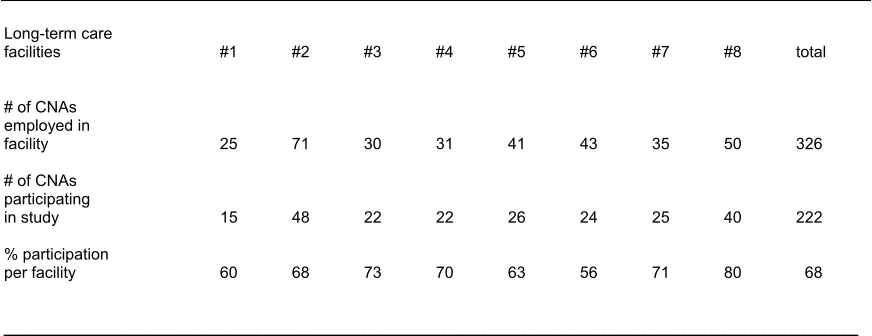
and the number of CNAs who participated in the study... 92 Table 3. Age and Gender of the CNAs participating in the study
and the type of state-approved training program the CNA attended... 93 Table 4. Lengths of time the CNAs have been employed in the current
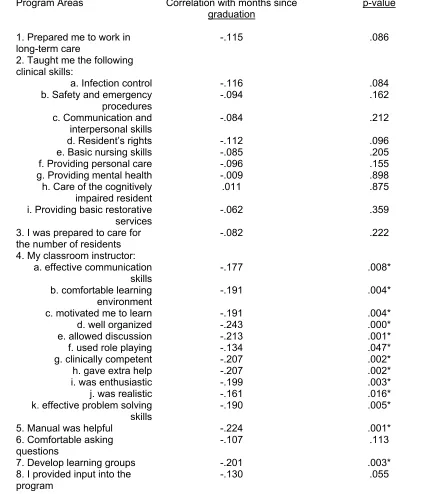
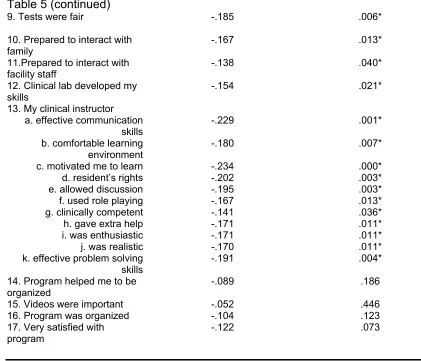
long-term facility... ... 94 Table 5. Spearman rho correlation coefficient between the number
of months since graduating from their initial training program (independent variable) and the CNA’s perceptions of their initial training program
in the identified program areas (dependent variable) ... 97 Table 6. Crosstabulation Analysis between the number of months
since the CNA graduated categories (independent variable) and areas identified by the CNAs as least valuable in their initial training program (dependent
variable)... 102 Table 7. Crosstabulation Analysis between the number of months since
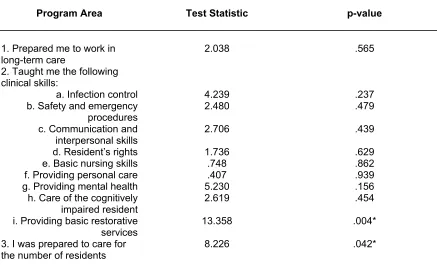
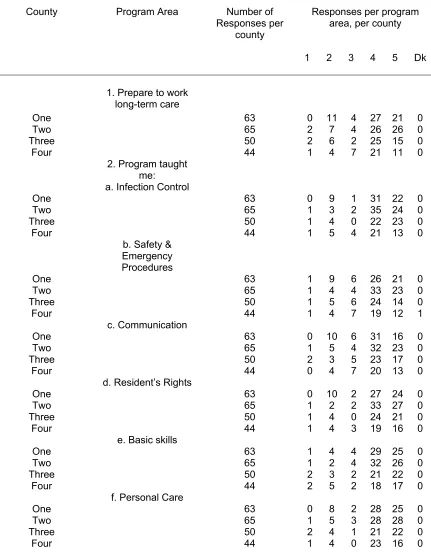
the CNA graduated categories (independent variable) and areas identified by the CNAs as most valuable in their initial training program (dependent variable)... 107 Table 8. Results from Kruskal-Wallis Analysis of Variance on the Program Area by the type of county the CNAs are currently employed... 111 Table 8a. Frequency Distribution of CNA responses per program area, by
county... ... 115 Table 9. Crosstabulation Analysis between the county in WNC the CNAs
are currently employed (independent variable) and areas identified by the CNAs as least valuable in their initial training program (dependent variable) ... 124 Table 10. Crosstabulation Analysis between the county in WNC that the
Table 11. Results from Kruskal-Wallis Analysis of Variance on the Program Area by the type of state-approved training program the CNAs attended... ... 134 Table 11a. Frequency Distributions of CNA’s responses per program area, by type of training program attended... 137 Table 12. Crosstabulation Analysis between the type of state-approved
training program the CNA attended (independent variable) and areas identified by the CNAs as least valuable in their initial training program (dependent
variable)... 146 Table 13. Crosstabulation Analysis between the type of state-approved
training program the CNA attended (independent variable) and areas identified by the CNAs as most valuable in their initial training program
(dependent variable)... 150 Table 14. Elements related to CNA’s overall job satisfaction ... 152 Table 15. Type of county as related to the 1998 median household income, 1998 estimated number and percent of people in poverty by county and the number of individuals receiving Medicaid benefits ... 172 Table 16.Frequency Distribution of the total number of responses related
CHAPTER I INTRODUCTION
One of the major social issues facing the country today is the accelerated aging of the overall population. This phenomenon has created a critical shortage in care providers for adults who live in long-term care facilities and can no longer exist without assistance. Long-term care (LTC) is a growth industry within the United States and the demand for frontline paraprofessional workers is
increasing (Feldman, 1994). As the population continues to age and develops more severe chronic illnesses, the need for long-term care will continue to grow. Wunderlich, Sloan and Davis (1996), reported that half of women and one-third of men who turned 65 years old in 1990 had entered a nursing home at least one time in their life.
care arena (Demody, 1993; Feldman, 1994; Foner, 1994; Garland & Schirm, 1998).
Appropriate and effective training programs can possibly impact this problem by preparing individuals pursuing this career interest with quality, realistic experiences during their initial training. Morgan (1996) reported that nursing assistants have the “need for courses to both correspond well with the level and range of tasks on the job and to present a realistic view of the work and expectations” (p.60). However, educators must be aware of the connection that exists between the CNA’s classroom and clinical learning experience and the development of their practice. As with the novice professional, the novice CNA has had informal care giving experience with real life clinical situations. They have to rely on structured rules and formal clinical experiences that they have learned in their educational preparation in order to develop and refine their clinical skills (Benner, 1984; Daley, 1999; Hartig, 1998).
The skill acquisition process of this paraprofessional’s practice can also be related to the novice-to-expert framework that Benner (1984) developed for professional nursing practice. Benner (1984) used the novice-to-expert levels of skill acquisition framework that was originally developed by Hubert Dreyfus and Stuart Dreyfus (1980). They initially studied the skill acquisition process of airplane pilots, chess players, automobile drivers and other adult learners
understanding of these levels through which skill acquisition develops, is
important for someone who is responsible for developing training programs and training materials which facilitate the acquisition of higher order-skills” (p. 6).
Benner (1984) established the applicability of the Dreyfus five stage model of skill acquisition to professional nursing practice through research that involved observations and interactions with many nurses in a variety of clinical settings. Benner verified that nurses advance through all five stages of skill acquisition through the course of their careers. This may occur with the help of nursing mentors or more often through the process of formal or informal
education. This same model of skill acquisition can be used to examine the paraprofessional nursing assistant and their novice-to-expert development throughout their careers. As the novice nursing assistant begins to develop their basic clinical skills during their initial training program, this training will be
essential for developing and building toward potential expert status. This expertise is continuous rather than discreet and is an acquired trait that begins with the developmental process of training and education (Stepich, 1991).
Other studies (Crawford, Waxman & Carner, 1983; Morgan, 1996) have provided information related to the concept of skill acquisition and how the initial program planning for nursing assistant training may not provide the skills
educational experience. The training program for nursing assistants is very brief and the short duration of the program may not allow enough time for the novice CNA to master basic nursing assistant skills. Overall, a state approved CNA training program is only required to provide a minimum of 75 hours of training in order to comply with federal regulations (Kelly, 1989). Additional information may be useful for program planning. Data about CNAs perception of training including course content, length of the initial training program, skill acquisition and clinical application will assist in planning more effective programs.
As CNAs gain experience in the actual work environment, certain clinical skills may not have been taught in the initial training program, which may be identified as needed to provide care to long-term care residents (Morgan, 1996). Burns (1995) supported the idea that future research should investigate the effectiveness of federally mandated education for improving task proficiency for nursing assistants. More specifically, future research should focus on a
relationship that may exist between course content and skill acquisition for certified nursing assistants. This is an important approach for educators to consider when developmentally, didactic and clinical experiences will have a direct effect on the CNA’s overall educational experience and outcome.
participants apply their learning to their work or daily life” (Vella, 2000, p. 36). Transfer of learning can be an effective application for program participants and is most likely to occur when:
• The learner can associate the new information with something they already know (association);
• The new information is similar to material learners already know (similarity);
• The learner’s degree of original learning was high (degree of original learning);
• The information contained elements that are extremely beneficial on the job (critical attribute element) (Cantor, 1992, p. 43).
In order for the transfer of learning process to occur, one of the key influencing factors deals with program content. Although there are many educational programs that focus on participants’ ability to learn the course
content, there are some programs that fail to make core content applicable to an individual’s situation (Caffarella, 1994). This has been the situation in many documented reports concerning CNA training programs (Crawford, Waxman, & Carner, 1983; Morgan, 1996; Schur, Noelker, Looman, Whitlatch, & Ejaz, 1998).
training programs are standardized based upon these federal regulations and specific criteria should be maintained. Furthermore, Morgan’s (1996) study, regarding the quality of training for nursing assistants, also emphasized the importance of adhering to federally regulated training requirements. Her findings did suggest that course content for nursing assistant training programs might be highly variable in how federal training requirements are met, in methods of instruction, as well as in the educational arena in which the programs are taught.
One of the key points to consider in the learning process is method of instruction. Method of instruction is one of the three phases within the learning process and will have an effect on the overall educational offering. Methods related to the learning process have been defined as the way in which the instructor chooses to take the content in the environment and relay the
information to the individual learner or to the learning community. The method of instruction is the way in which the instructor pulls together the elements to
produce the observable portion of the learning process (Heimlich & Norland, 1994). This approach to the learning process may play an important part in the development of skill acquisition of the CNA. It may also be a key component of the program planning process that relates to the CNA’s perception of their initial training program.
Background of the Problem
preparation and skill acquisition for this paraprofessional care provider is of the utmost importance. Unfortunately, poor preparation and clinical expectations beyond the scope and training of the nursing assistant present some very important concerns (Salmond, 1997). While CNA training requirements are mandated by federal regulations, monitoring of CNA training programs is regulated at the state level. This allows each state to individualize training requirements with provisions that include a training program at least 75 hours in length, the development of a competency evaluation component at the end of the formalized training program, and the establishment of a registry system for all certified nursing assistants (Kelly, 1989).
In today’s long-term care environment, the demand for qualified CNAs has captured the attention of legislators, health care administrators, and most
importantly, the residents living in long-term care facilities. As the medical complexity of these residents’ conditions continues to increase (Phillips & Baldwin, 1997), it is no longer acceptable for individuals enrolled in nursing assistant training programs to feel inadequately prepared to care for the
residents living in these facilities. Even though federal legislation mandates CNA training requirements, the quality of training for nursing assistants has been inconsistent and has been intensely scrutinized (Bowers & Becker, 1992; Crawford, Waxman, & Carner, 1983; Morgan, 1996).
impact on the quality of care in long-term care facilities (e.g., professional staffing, managerial and organizational support), it is still the nursing assistant that provides the majority of direct care to elderly residents. Therefore, it is important to consider the nursing assistant’s initial training program as an educational opportunity for improving quality of care.
Mercer, Heacock, and Beck (1994) also reported that CNA training has been inadequate for the demanding and difficult job responsibilities of this important health care provider. Interestingly, no comprehensive studies have been located that have asked nursing assistants about their perceptions regarding their initial training and competency evaluation program (Morgan, 1996). However, one descriptive study asked nursing assistants what additional training, if any, they feel would be helpful in caring for residents in long-term care facilities. The topics most frequently mentioned included the following: a)
providing care for the resident with dementia; b) improving communication skills with residents, families and co-workers; and c) enhancing basic clinical skills, such as lifting and turning residents and monitoring vital signs (Mercer, Heacock, & Beck, 1994).
The overall training and development of future nursing assistants is vital. The importance of relevant and high quality course content and skill acquisition for these adult learners is paramount. Equally important is the overall
setting. These were effective communication skills, maintaining a comfortable learning environment, a genuine concern for student learning and motivation, and well organized course content.
Experts in the field of CNA training have also identified essential traits that an effective nursing assistant instructor must possess. Morgan (1996) reported that an effective CNA instructor is someone who has, 1) had experience in the field of nursing, 2) knowledge of clinical practice standards, and 3) effective problem solving skills. The nursing assistant instructor must also make an extra effort in assisting students to become successful CNAs and always present a realistic approach to their job responsibilities. Phillips and Baldwin (1997)
Although an effective instructor is essential in the success of the CNA student, effective complementary teaching methods are also valuable in the overall educational experience. While the availability of visually represented content is limited within the CNA educational arena, the use of videos can be used to review clinical information. The use of videos or other visual media in a CNA training program can stimulate discussion and emphasize concepts that were experienced during the educational experience (Phillips & Baldwin, 1997).
A unique experience that is also important to all health care educational programs is the concept of a clinical practicum, which is closely associated with the traditional didactic instruction. The clinical practicum is an important part of all health care providers’ educational experience. As important as the classroom instructor is for assuring student success, an effective clinical instructor is also important in the success of the adult learner in the clinical practicum (Sieh & Bell, 1994). Most importantly in nursing assistant training programs is a clinical
instructor who will provide realistic supervised experiences. These experiences should provide the student nursing assistant with the opportunities to learn how to care for long-term care residents with a variety of problems and necessary care needs. The effectiveness of the clinical instructor can be a key element in the success of future nursing assistants (Morgan, 1996).
1983). Unfortunately, there is very limited information regarding the CNA’s perception of an effective clinical instructor. However, Sieh and Bell’s (1994) study did identify the associate degree nursing (ADN) student’s perception of an effective clinical instructor. According to their report, the top three characteristics that were identified by the ADN student included: a) effective communication skills when working with the students; b) clinical competence to perform essential nursing procedures; and c) the ability to clearly explain the educational material. These qualities of an effective ADN clinical instructor could also apply to clinical instruction within state-approved nursing assistant training programs.
The role of an adult educator is critical in the success of the nursing assistant student and vital in the process of assuring a clinically competent and emotionally confident certified nursing assistant. According to Knowles, Holton, and Swanson (1998), the role of the adult educator is to:
a) Help the learners diagnose their need for particular learnings within the scope of the given situation;
b) Plan with the learner a sequence of experiences that will produce the desired learnings;
c) Create conditions that will cause the learners to want to learn; d) Select the most effective methods and techniques for producing
the desired learnings;
f) Help the learners measure the outcomes of the learning experiences (p. 26-27).
In today’s health care environment, CNAs are a key resource in assuring that residents living in long-term care facilities receive the essential care they deserve. This requires that these front-line workers receive the training that is necessary for them to perform important clinical skills. It also requires that training programs must provide future nursing assistants with the appropriate course content and instruction that assures a successful outcome. While training programs have historically utilized input from the administrative staff within long-term care facilities for program improvement (Crawford, Waxman, & Carner, 1983), student input is vital in assuring future success of all training programs.
technical support for computer-assisted training, and access to a learning resource center.
Grandin (1990) found that the type of CNA training program had very little effect on the competency test scores of individuals completing a training
program. However, this study did note that individuals, who attended a community college or technical school did have higher mean scores on their competency tests than those who attended a program in a long-term care facility.
Morgan (1996) reported that there were concerns regarding the variability in content, emphasis and methods in relation to the type of nursing assistant training program. This variability may be related to the type of nursing assistant training facility (e.g., community college, proprietary agency or long-term care facility) that an individual attended. There has been a special concern regarding nursing assistant training programs provided through proprietary agencies. There is an impression that this type of training program may lack the realistic
expectations related to the demands of the nursing assistant job requirements. Graduates of this type of profit-based training program may find the actual job responsibilities and the work environment different than what they had
anticipated. Therefore,this study will explore the CNA’s perception of their initial training program and the type of state- approved program that they attended.
As previously mentioned, the aging of the population in the United States is having a direct impact on the entire health care system. This situation is
portion of the population is also more likely to have poorer health than the elderly living in urban settings. Compounded by the fact that there are more long-term care facilities in these rural areas and rates of institutionalization of rural elderly are higher, the less healthy state of the rural elderly could have a significant impact on direct care providers working in these long-term care facilities (Coburn & Bolda, 1999).
In rural areas, the development of appropriate long-term care services is negatively affected by a smaller economy of scale. There are also limited
resources that are accompanied by higher costs for providing services, as well as a limited pool of well trained health care providers. Therefore, the challenge will be to develop or enhance clinical training programs within these rural areas that already have restricted financial and human resources (Coburn & Bolda, 1999).
Interestingly, Kramer (1997) raised concerns about the geographic
services for the aging population (Nikolassy, 1995). Congdon and Magilvy (1998) noted that rural location and economic conditions often contribute to a different perspective on long-term care facilities. Therefore, while two of the counties in this study are more rural in nature and two are more urban, this study will explore the CNA’s perception of their initial training program and the county in which they are employed.
Statement of the Problem
Having the necessary skills to care for the elderly and disabled living in long-term care facilities is vital for the nursing assistant who is providing 90% of this essential care (Caudill, 1989). While state-approved training programs are monitored and regulated through federal legislation (Kelly, 1989), there are concerns regarding the lack of adequate training of these important frontline workers (Crawford, Waxman, & Carner, 1983; Mercer, Heacock, & Becker, 1993; Morgan, 1996; Salmond, 1997). The lack of training could be related to the
method of instruction, course content, or could be related to the didactic and clinical instruction. While program improvement opportunities for nursing assistant training programs have included input from the administrative staff working in long-term care facilities, primary participant (i.e., CNA) feedback has been missing.
graduation and after a period of time may reveal their perspectives on the adequacy of their preparation for clinical practice.
This research project was designed to address the educational needs and provide important data to improve CNA training and development. These data could ultimately lead to a better level of care for residents living in long-term care facilities and address the critical concerns that have been associated with CNA training programs.
Research Questions
1. Is there a relationship between CNA’s perceptions of their initial training program and the number of months since graduating from a state-approved CNA training program?
2. Is there a relationship between CNA’s perceptions of their initial training program and the county in which they are employed? 3. Is there a relationship between CNA‘s perceptions of their initial
training program and the type of state-approved training program that the CNA attended?
Purpose of Study
clinical practice may reveal opportunities for program improvement for which their training had not adequately prepared them for within certain clinical situations and this may not be recognized until they have gained experience.
Furthermore, this research project was also intended to determine if there was a relationship in the perceptions by the CNA of their initial training program and the county in which they are employed. Observations by professionals noted that certain counties have experienced fewer human resources (e.g., CNAs) within more rural areas, than those within urban areas. Wunderlich, Sloan and Davis (1996) reported that educational resources might also be lacking within rural areas.
Lastly, this study was designed to determine if there is a relationship in the perceptions by the CNA of their initial training program and the type of state- approved training program that the CNA attended. Morgan’s (1996) report stated that there were concerns regarding the variability in content, emphasis and methods in relation to CNA training programs.
Significance of the Study
Throughout the country, the need for well-educated and clinically
competent nursing assistants in long-term care facilities continues to grow. CNA educators, nursing leaders and other health care providers are faced with the challenge of assuring an appropriate and realistic training for CNAs through process improvement within state-approved training programs. Program
importance of seeking input from this key health care provider within an ever-growing field of long-term care. This research project will remind leaders of the importance in obtaining feedback from future and current health care providers when planning and implementing needed change in a chaotic and demanding health care system. As stated by Vella, Berardinelli and Burrow (1998), obtaining important information from program participants, will inform program planners whether the participants have learned the necessary information and if they are able to actually use what they have learned. For example, the nursing
assistant’s actual clinical practice may provide educators with specific concerns regarding their initial training program and when those concerns may have begun. This would provide educators and program planners with useful information that could enhance and further support clinical training programs.
This project was designed to provide information to state-approved training programs regarding the reaction from CNAs concerning their initial training program. This study was designed to provide insight into the CNA’s perceptions of their training, whereby state-approved training programs can improve upon their educational delivery. Participants within a state-approved CNA training program could benefit from standardization of essential program components, such as course content, methods of instruction and other key teaching-learning elements.
that currently have state-approved nursing assistant programs expand their training capacity, proper expansion must begin with participant feedback and evaluation of existing programs.
As previously noted, there were no studies found during the literature review that asked nursing assistants to extensively evaluate their initial training program. However, Morgan’s (1996) study did recommend that future research should address potential opportunities that could support and enhance current state-approved training programs. Therefore, the research questions in this study will address three important aspects for which to potentially modify and improve current training programs. The three aspects will include the number of months since graduating from a state-approved program, the type of county in which the nursing assistant is employed, as well as the type of state-approved training program that the nursing assistant attended.
The survey instrument used for this study asked participants who has completed a state-approved program, to report the number of months since graduating from their initial training program. This should provide educators and employers with information regarding specific concerns about certain
to note any variability in course content, emphasis or methods as per the perception of each study participant.
While extensive research on the certified nursing assistant is very limited, this study will further document the need for continued research and evaluation regarding an essential member of the long-term care industry. This research project also provided information to long-term care administrators in helping to develop and support facility-based orientation programs for new CNA employees. As the CNA transitions out of the role of student and into the role of healthcare provider, initial training and facility-based orientation initiatives will overlap and become essential in the success of the certified nursing assistant.
Limitations of the Study
While this project has been designed to focus primarily on CNAs within long-term care facilities in North Carolina, CNAs employed in other clinical
settings (e.g., acute care hospitals) may have a different perception of their initial training program. Traditionally, CNA training performed within the community college setting links all students to a clinical rotation within long-term care facilities. Therefore, students rarely experience the acute care or home care setting while in the student role. This aspect of CNA training will not be explored in this research project.
There is limited research on the effectiveness of community college based CNA training programs, as compared to long-term care facility based CNA
While CNA turnover within long-term care could have a negative affect on the development of an organization’s learning environment, Cohen-Mansfield (1997) identified many institutional factors that have been related to CNA turnover. For example, inadequate orientation for the CNA, lack of appropriate and adequate staffing and extended workday hours have all contributed to turnover of these frontline workers. However, this research project was designed to determine if a relationship exists in the perceptions of the CNA of their initial training program and has identified organizational issues as limitations for this study and opportunities for future research regarding this very important subject. Assumptions of the Study
The survey instrument used in this study was guided by three assumptions. They are:
1. The CNA can read the questionnaire and understand each item;
2. The CNA has the information in order to answer the questions on the survey instrument;
3. The CNA was willing to answer all the questions and answer them honestly (Wolf, 1990).
Definitions
The following terms are used throughout this study and are defined in order to ensure the understanding of their meaning.
upon the Omnibus Reconciliation Act (OBRA) of 1987 (Wunderlich, Sloan & Davis, 1996).
Omnibus Reconciliation Act of 1987 – legislation that requires nursing assistant training with a minimum length of 75 hours, also to include a
competency evaluation program and the establishment of a registry system within each state (Wunderlich, Sloan & Davis, 1996).
Long-Term Care Facility – (traditionally referred to as a Nursing Home) a facility that provides skilled nursing care to residents who are chronically ill or recuperating from an illness and needs skilled nursing care and other health care services (e.g., rehabilitation services) (Ignatavicius, 1998).
Skilled Nursing Facility (SNF) – a long-term care facility that is certified to participate in a federal reimbursement program, such as Medicare funding. SNFs are available for providing skilled care by professional health care providers, such as nurses, physical therapists and occupational therapists (Ignatavicius, 1998).
CHAPTER II LITERATURE REVIEW Introduction
It has been projected that by the year 2011, the first wave of baby
boomers will begin to reach the age of 65 (Cramer, Harmuth, & Gamble, 1999), with an estimated 9.7 million elderly having moderate to severe disabilities. As compared to 1986, this represents an estimated 85% increase of disabled elderly throughout the United States (Applebaum & Kunkel, 1995). Furthermore, it is inevitable that a certain portion of this population will experience catastrophic events, such as cancer, stroke or heart disease, leaving them totally dependent upon someone else to meet their basic needs of everyday living (e.g., eating, bathing, and toileting) (Wunderlich, Sloan, & Davis, 1996).
The current long-term care system and financial strategies will not be able to accommodate the estimated 14.8 to 22.6 million disabled elderly projected to need care in 2040 (Applebaum & Kunkel, 1995). Generally, the care that will be needed is provided within institutions that are referred to as nursing homes or long-term care facilities. These facilities are homes that generally house from 10 to 120 private to semi-private rooms in which residents live. These homes consist of a bedroom, a shared bathroom, a large community room utilized for recreation and physical activity, as well as a community dining room (Ignatavicius, 1998).
care facilities (Caudill, 1989) and also comprises 45% of the entire long-term care staff (Crawford, Waxman, & Carner, 1983; Dermondy, 1993). The nursing assistant evolved as an identified need to aid the nurse in caring for the elderly. They were utilized to provide care within a traditional medical model of care delivery, which may have misrepresented their actual job description of
performing tasks more representative of a resident aide, rather than a nurses’ aide (Dermondy, 1993). Initially, there were no federal or state training
regulations that would mandate a skill competency for the CNA. It wasn’t until 1961 when the United States Senate held hearings regarding the concern for appropriate care for the elderly in long-term care facilities, that attention to the training of CNAs was first investigated (Burns, 1995).
Therefore, the purpose of this report is to explore the history of CNA training and to discuss the various teaching/learning elements that are intrinsic to adult education and how they are related to CNA training programs. This report will also review organizational issues within institutions in which the CNA is employed and how they affect the overall success of the CNA.
The conceptual framework for this report is derived from three theoretical bases. Using programming as the foundation, an historical perspective
surrounding CNA training will be incorporated into the Boone (1992) model
(Appendix A), supporting the overall importance of evaluation in the programming process. In addition, the target public for this study will include the certified
situations will provide a foundation for support of Kirkpatrick’s (1998) approach to the importance for evaluating reaction related to program effectiveness. Lastly, the elements of teaching/learning (Cantor, 1992; Galbraith & Zelemak, 1991; Heimlich & Norland, 1994) will be incorporated into this methodology in order to identify critical elements and methods that support program design and the plan of action in anticipating educational outcomes.
HISTORY
With certified nursing assistants providing the most intimate of personal care for the growing elderly and disabled population in America, the nature of the work itself and low wages have contributed to the high levels of turnover. CNAs are responsible for assisting with a variety of daily needs of the long-term care resident. These responsibilities include such tasks as toileting needs of the resident, daily hygiene care, maintaining the nutritional status of the resident and also managing the confused and agitated resident (North Carolina Department of
Health and Human Services, 1997). Within the CNA workforce, turnover ranges from 50% to 400% annually,
with an average turnover rate of 55% to 75% (Wagnild, 1988). Comparatively, Cohen-Mansfield (1997) reported that turnover among all nursing staff ranges from 40% to 75%, with some reaching as high as 500%. As America is faced with caring for the elderly and disabled population in long-term care facilities,
National recognition regarding the lack of formalized training for the nursing assistant dates back as far as 1961 when the United States Senate held hearings regarding concerns for appropriate care for the elderly living within long-term care settings (Burns, 1995). Crawford, Waxman, and Carner (1983)
reported that even in the early 1980’s, many individuals were interested in the training requirements of nursing assistants, since these requirements seemed to have a direct affect upon the high turnover rate of these healthcare providers. They went on to report that many nursing assistants were not trained in regards to their job responsibilities, which included important tasks such as basic
personal care (e.g., hygiene, feeding, oral care) for the elderly. Additionally, they reported that nursing assistants were found to be inexperienced in caring for the special needs of the growing geriatric population.
Health Professions Education
To better understand the educational process that prepares the nursing assistant for their job responsibilities, it is important to have a perspective related to educational requirements for all long-term care nursing personnel. Generally, these personnel are referred to as a licensed practical nurse (LPN) or a
registered nurse (RN). The LPN is responsible for providing a significant
contribution to the care of the residents living in long-term care facilities. Some of the primary job responsibilities of the LPN includes the direct support and
majority of licensed nurses employed within the long-term care industry. Educational requirements for the LPN consist of a structured academic and clinical program that averages between 12 and 13 months, followed by a state regulated licensure examination. A primary focus of their training program has a considerable amount of time focusing upon the technical aspect of care, such as medication administration, wound and skin care and urinary catheterization. Certain programs may offer a specialized content area on the care of the geriatric population, however, not all LPN programs have content that is this specific (Wunderlich, Sloan, & Davis, 1996).
Historically, non-regulated nursing assistant training programs have typically been located in a vocational school or in a local community college. These training programs were established to provide training that was needed for nursing assistants to care for the elderly living within long-term care facilities. However, while they did provide basic training for nursing assistants to better care for the elderly, the programs also had many problems associated with their function (Crawford, Waxman, & Carner, 1983).
One such issue was that funding for these training programs was state and federally regulated. Therefore, when there are insufficient funds to support appropriate training for all nursing assistants, the consequence meant that training would not be available for nursing assistants currently employed in the long-term care industry. It was also noted that a major educational shortcoming for these earlier training programs was the lack of insight into the special
educational needs of the nursing assistant. Typically, these training programs have emphasized some of the basic skills needed for CNAs to provide better daily care for the elderly. However, the training needs for nursing assistants were emphasized by administrators and long-term care nursing staff, but input was not obtained from the nursing assistant regarding their specific training needs. Many nursing assistants were not appropriately trained in the delivery of basic physical care, as well as the special needs of the elderly population. However, CNAs are expected to provide basic care for long-term care residents that are often
Throughout the years, training issues for nursing assistants became much more involved. Other issues within the long-term care industry began to have a negative impact upon the training needs for assuring a well-educated nursing assistant. Phillips and Baldwin (1997) reported that the acuity (i.e., medical complexity) of residents living in long-term care facilities has increased over the last decade. More and more elderly residents are living in long-term care facilities that have multiple physical and mental problems. Mercer, Heacock, and Beck (1994) also reported that an estimated 1.5 million elderly residents were living within long-term care facilities. This growing number of residents to provide care for and the increasing medical complexity of these individuals, puts further strain upon the nursing assistant who is responsible for the daily needs of these
residents. It is unfortunate, however, that the majority of care for the elderly residents living in long-term care is often provided by under-trained and overworked nursing assistants.
didactic and clinical components of their training began to resemble the pattern established for the licensed professional nurse. There were an established number of hours required for didactic and clinical training, and competency testing that followed the successful completion of both of these educational components (Wunderlich, Sloan, & Davis, 1996).
Federal Regulations
In 1987, federal regulation mandated that nursing assistants were required to have a minimum number of training hours in order to provide care to residents living in long-term care facilities. “On December 21, 1987, The Congress of the United States passed the Omnibus Budget Reconciliation Act (OBRA), subtitle C, the Nursing Home Reform Act” (Kelly, 1989, p. 791). This law provided significant changes to the training requirements for nursing assistants and has been
considered one of the most important and significant nursing home reform legislation in many years (Burns, 1995).
Specifically, OBRA 1987 related new provisions to the nursing assistant training requirements and the following is an overview of these provisions.
1. The new federal requirements mandated the establishment of nursing assistant training programs that are a minimum of 75 hours in length. 2. Establishment of a competency evaluation methodology that would
3. The competency evaluation component of the federal regulations also applied to nursing assistants currently working in a long-term care setting (Kelly, 1989).
4. Nursing Assistants are required to have 12 hours of continuing education per year and work at least eight hours in long-term care every two years, to maintain state certification (Jette, Soreff, & Capriole, 2000).
5. Finally, the law established a registry system for nursing assistants within each state (Kelly, 1989).
OBRA 1987 also stated that timelines must be established for
implementation of these requirements and the new provisions must be in place by January 1, 1990 (Kelly, 1989).
Following the 1987 federal regulations that established laws to focus on the quality of care and the life of long-term care residents, the attention to nursing assistant training seemed to be a logical first approach (Dille, 1992).
their commitment to this career choice by virtue of their investment of time and effort (Brannon & Smyer, 1994).
Value of CNA Training
For many years, researchers have viewed nursing assistant training programs as an identified area to improve the quality of care for residents living in long-term care facilities. Even prior to the federal regulations of 1987 that mandated nursing assistant training requirements, several states begin to
recognize the fact that training individuals who provided 90 percent of the care to the elderly in long-term care was absolutely essential. States who have training programs for nursing assistants have provided these educational offerings in local community colleges and vocational schools and were designed to provide the basic training for entry-level health care providers (Crawford, Waxman, & Carner, 1983).
When the federal regulations regarding nursing assistant training went into law with the 1987 Omnibus Budget Reconciliation Act, a range of training
Morgan (1996) reported that CNAs felt that portions of the courses that they took were quality-training programs. They valued an instructor who was clinically competent, as well as academically challenging. They also identified quality instructors as those who had experience in the field of nursing and took extra effort in providing assistance to students who were struggling. T. Banks (personal communication, December 29, 2000), a nurse consultant for the North Carolina Division of Facility Services CNA training program, reported that the quality of a CNA instructor has become even more important. As the federal regulations made the job requirements for an instructor very stringent and limited the number of potential candidates qualified to be a CNA educator, the state regulatory agencies are required to monitor compliance with agencies hiring only qualified instructors.
According to a report by Brannon and Smyer (1994), the management team within long-term care facilities has also valued the implementation of quality training programs for CNAs. The administrative staff within long-term care views training as a social contract between the employer and the nursing assistant. This type of agreement further develops each of these groups and signifies a mutual investment that shows tremendous support for each other.
Educational Concerns
requirements. If the state agency that will be responsible for the training,
evaluation and registry of the federal requirements is a state entity other than the state board of nursing, then there are concerns that nursing could lose control as to the determination of nursing functions to be delegated by the licensed staff to the nursing assistant. Also, the 75-hour training requirement limits the knowledge of the nursing assistant and may pose greater liability to the licensed nurse who is ultimately responsible for care delivery and may also pose a greater risk to the community. The last concern is related to the evaluation requirement for the nursing assistant. Since the federal regulations require competency evaluation, the nursing community should assure an evaluation method that is based upon job relatedness of the CNA and only one competency method should be used within each state.
Jette, Soreff, and Capriole (2000) expressed similar concerns regarding the federal training requirements. One concern is that nursing assistants who were employed two years prior to OBRA 1987 implementation, were exempt from the requirements. Therefore, a significant number of practicing nursing assistants had not participated in a basic training program. The programs also focused on the technical or clinical skills related to resident care and failed to address basic nursing theory. Lastly, the continuing education stipulation had very limited
Monitoring and Evaluation of Training Programs
While each state has specific guidelines for monitoring CNA training programs, for the purpose of this report, only the responsibilities for North Carolina will be addressed. Currently, the state of North Carolina has the
monitoring responsibilities for the CNA training programs under the Department of Health and Human Services, within the Division of Facility Services (DFS). Within DFS, there are currently three nursing consultants who monitor approved training programs throughout the state. Each of the nursing consultants are assigned a specific region within the state to inspect, approve and monitor for federal compliance and provide consultative services for all training programs throughout North Carolina (T. Banks, personal communication, December 29, 2000).
While the federal regulations are the template for the minimum
The DFS also maintains the registry system for listing all nursing assistants who have successfully completed a state approved training and competency evaluation program. This registry system section of DFS is also responsible for notifying all nursing assistants when their current listing is about to expire. Lastly, the Division of Facility Services provides reciprocity among other states for individuals requesting state listing within North Carolina (T. Banks, personal communication, December 29, 2000).
ORGANIZATIONAL ISSUES
Long-term care has always been an important component of the health care industry within this county. One of the key players in providing care for the elderly and disabled living within long-term care facilities is the certified nursing assistant. Unfortunately, some organizational philosophies within this industry may have contributed to the severe shortage of these very important health care providers.
Organizational issues, such as values, beliefs and standards, are key in the overall success of any type of business, especially when the business is providing daily care to residents living in long-term care. These issues are key when organizations are effective in designing an organizational culture that is conducive to CNA training, development and retention.
As Knowles, Holton, and Swanson (1998) stated, “developing high
development. A well-established organizational culture will also have a direct relationship upon the overall organizational success (Knowles, Holton, & Swanson, 1998). Organizational culture is important to understand because it deals directly with the employee’s perception “and how this perception creates a pattern of beliefs, values and expectations” (Gibson, Ivancevich, & Donnelly, 1997, p. 30). That is why an organization that supports their employees and provides opportunities for their employees to become committed to the
organization, will have frontline workers that perform at a higher level and are much more effective overall. Furthermore, researchers have begun to pay close attention to organizational culture and the important role that the CNA has in the overall success of a long-term care facility. Many individuals have begun to see that nursing assistants who are committed to an organization ultimately will have less turnover within that work group. Lower turnover within the long-term care environment enhances job performance, produces a more stable work
environment and most importantly, improves the quality of care given to the residents (Schur, Noelker, Loorman, Whitlatch, & Ejaz, 1998).
However, there are circumstances and situations that could negatively affect the organizational environment within long-term care and further damage organizational integrity. One such situation is the effect that staff turnover has on a facility and more specifically, the effects of CNA turnover within an
more important to understand the current and projected situation of the certified nursing assistant.
The United States Bureau of Labor has projected that between 1996 and 2006, the certified nursing assistant will be among the top 10 occupations having the largest and fastest job growth within this country. This further illustrates the significance of this important work force. By the year 2011, the first wave of baby boomers will begin to reach age 65, causing continued demand for these
healthcare workers. It is not until the year 2030 that we can expect the last wave of baby boomers to reach age 65 (Cramer, Harmuth, & Gamble, 1999).
As part of the job description, the CNA must assist the resident with all aspects of daily care and personal hygiene, which can promote a stressful work environment. The shortage of workers willing to bathe, dress, feed, clean and care for the elderly, in long-term care facilities, has grown worse in the last two years as the economy has continued to soar. As the economic environment within the country continues to thrive, this has created many other jobs that pay as well, or better, for much less demanding work (“The Shortage of Health Aides,” 2000).
The cost of CNA turnover is also a key issue within a financially restricted long-term care industry. A study of nursing home staff turnover revealed that facilities could pay more than $2,200 to replace a nursing assistant. This cost to long-term care facilities includes expenses that range from hiring temporary agency staff, to advertising, interviewing and orienting new nursing assistants. This creates a financial burden on an industry already struggling with resources. Additionally, the high turnover rate of CNAs will affect continuity of care and the relationship between caregivers and residents; both of which are important determinants of quality of care (Cohen-Mansfield, 1997).
Turnover of CNAs within long-term care facilities has been attributed to many organizational and social issues. CNA turnover has long been an
organizational concern that this industry has faced for many years. Cohen-Mansfield (1997) reported that CNA turnover has presented the management staff within long-term care facilities with many problems and concerns. As
previously mentioned, CNA turnover has proven to negatively affect continuity of care and prevents the nursing assistant and the long-term care resident from developing a professional relationship. The following institutional factors have been identified as significant issues related to CNA turnover:
a) Insufficient reward and recognition program b) Limited promotional opportunities
All of these are important factors to consider when addressing turnover of the CNA workforce. Turnover within long-term care facilities can play an
important role in the recruitment and retention of CNAs, as well as the direct training of future CNAs. As Pillemer (1996) stated, turnover of nursing staff will lead to a vicious circle. As staff continues to leave, the less satisfied are those who choose to stay and then an increased workload is placed upon the nursing assistant, which then leads to increased job stress. This type of clinical work environment destroys staff morale, which further leads to a climate that does not promote a learning environment. This in turn promotes a negative atmosphere in which to encourage and support nursing assistant training and development.
An organization that promotes and supports a learning environment has the capacity to improve employee performance. Furthermore, as performance of each employee begins to improve, so will overall job satisfaction. Therefore, training and education within a long-term care facility that fosters a learning environment, symbolizes value for the employee and promotes concern for these important frontline workers (Atchley, 1996). Stricklan, Einhorn, and Jones’ (1987) earlier report, identified the importance of training and education for the nursing assistant. The value of encouraging a long-term care facility to have an
TEACHING AND LEARNING Andragogy
Throughout the years, there existed only one model related to the learning environment in which educators based their entire curriculum on, as well as their teaching practices. It evolved from the monastic schools of Europe through their experiences of teaching basic skills to young boys (Knowles, Holton, & Swanson, 1998). This philosophy began to emerge within the secular schools and later became dominant within the university setting, near the end of the twelfth century. This model became known as pedagogy, which is a Greek word that literally means, “the art and science of teaching children” (Knowles, 1980, p. 40). During the evolution of organized public schools in the nineteenth century, this pedagogical model was the only existing educational model within the classroom. Unfortunately, this model was the only one that educators of adults had to use, therefore, the adult learners were taught as if they were children (Knowles, Holton, & Swanson, 1998).
The pedagogical model provides the teacher with all the responsibilities for deciding what topics will be taught, when they will be taught, how the topic will be taught and if the information that has been taught, has actually been learned. This leaves the learner with only the submissive role of following every rule and instruction of the teacher. This type of delivery is very teacher-directed and leaves no room for learner input (Knowles, Holton, & Swanson, 1998).
an equal partner in the educational arena. This model is the andragogical model of instruction (Merriam & Caffarella, 1991).
The andragogical model of instruction is based upon six principles that differentiate it from the traditional pedagogical model. First of all, the core principle related to the adult learner is the need to know why it is important and essential in collaboratively preparing for the planning process. One of the key factors related to successful adult educational programs, is the shared control involved with program planning. When educator and learner have shared responsibility in the learning strategies, learning becomes much more effective (Knowles, Holton, & Swanson, 1998).
Second, the adult learner’s self concept is important in that they are responsible for decisions that affect their lives. Upon arriving at the point in their lives that they are fully aware of their direction, it becomes essential that others treat them as capable of having self-direction. If this does not occur, resentment and resistance develops and thus presents a serious problem related to adult education. It is only when adult educators become completely aware of this type of situation that all efforts are made to transition from dependent learners to self-directed learners (Knowles, Holton, & Swanson, 1998).
learner and therefore, an emphasis should be placed upon the experiential learning process. For example, specific techniques that utilize the adult learner’s past experiences, such as simulations, case studies and laboratory methods are highly effective (Knowles, Holton, & Swanson, 1998).
The adult educator interested in the andragogical model of learning must also be aware of the learner’s readiness to learn. As adults enter the world of education, they become ready to learn based upon issues and situations that help them to most effectively cope with real-life situations. The adult educator must be prepared to assist the learner when developmentally they are moving from one developmental stage to the next (Knowles, Holton, & Swanson, 1998).
The adult leaner has a very different approach to the learning process, in that the adult learner is motivated to learn based upon life-centered situations. The motivation comes from the fact that learning will aide in developing
necessary skills that will help the individual deal with every day life situations. Therefore, they learn new information when the process teaches them in the context of actual application to these real-life situations (Knowles, Holton, & Swanson, 1998).
available many opportunities and resources (Knowles, Holton, & Swanson, 1998).
These six educational principles are very important to include in nursing assistant training programs. Historically, there have been reports which state that some of these essential elements related to adult learning were missing in state- approved training programs (Crawford, Waxman, & Carner, 1983; Morgan, 1996; Turkington, 1992). Coupled by the fact that state-approved training programs were established with the pedagogical model of instruction in mind and very little attention to aspects related to and in support of the adult learner. For example, earlier training programs failed to recognize or address the educational needs of the student and rarely requested feedback from nursing assistant students (Crawford, Waxman, & Carner, 1983). Morgan (1996) also reported that other nursing assistants who had successfully completed a training program, failed to get the essential skills that would help them in real-life situations, such as correct lifting techniques and providing care for the incontinent resident. As previously mentioned, obtaining skills related to real-life situations is one of the basic principles of andragogy that differentiates it from the pedagogical model of instruction.
key focus for this type of instructional model and program practices, that includes setting goals, assessing the learner’s needs, determining educational objectives and a collaborative evaluation between the learner and the educator (Nielsen, 1992).
Novice to Expert
Skill acquisition for the nursing assistant can also be associated with the novice-to-expert framework that Benner (1984) developed for professional nursing practice. Benner (1984) used the novice-to-expert levels of skill acquisition framework that was originally developed by Hubert Dreyfus and Stuart Dreyfus (1980). The Dreyfuses initially studied the skill acquisition process of airplane pilots, chess players, automobile drivers and other adult learners involved in learning a second language. They observed general patterns among these specific groups that focused on the five levels of ability that were identified as: novice, advanced beginner, competent, proficient and expert. “A detailed understanding of these levels through which skill acquisition develop, is important for someone who is responsible for developing training programs and training materials which facilitate the acquisition of higher order-skills” (p. 6).
As Benner (1984) recognized the applicability of the Dreyfus five stage model of skill acquisition to professional nursing practice, the same concept can apply to the paraprofessional nursing assistant and their novice-to-expert
knowledge through the exposure to clinical experiences (Waddell, Durrent, & Avery, 1999).
To begin with, there are differences between the novice and the expert, which are in three interconnected areas. The first is the amount of information that is stored in memory, followed by the organization of that information, with the third difference between the novice and the expert being the methods for
application of the information (Stepich, 1991).
While it is important to understand the differences between the novice and the expert, it is also valuable to understand external conditions related to the development of expert clinicians.
External situations that support the conditions of expertise are closely tied to the amount of information, the organization of information and the application of information. The amount of information an individual receives is as essential as it is to provide as much practice as is reasonably possible. As practice is incorporated into the learning process, educators should incorporate methods for developing patterns along with actions that are closely associated with the
patterns. The practice should then focus on these essential patterns, which should then be followed by constructive feedback to the learner (Stepich, 1991).
When organizing information for the learner, it is important to review the information provided and then consolidate that information into a clear
program could provide a distinct overview of the entire clinical requirements associated with training development for this group of health care providers.
Finally, the application of information for the learner is to encourage, support and reinforce the use of the information. As the learner becomes much more competent with reasoning skills and knowledge development, the learner should then be encouraged to perform independently with additional
opportunities for practice, once again followed by constructive feedback (Stepich, 1991).
Benner (1984) also reported that the different levels of novice to expert reflect changes in three aspects of performance. The first is how the individual will move from a reliance on abstract principles to using more concrete past experiences. The second level is the learner’s shift from seeing situations in which certain parts are relevant, to seeing them as part of a whole. The third level is when the individual shifts from a detached observer to an involved performer and is now performing in the direct situation.
Elements of Teaching-Learning
process and method selection should be experienced-centered, in order to
maximize the learner’s previous experiences and then to further facilitate mastery of new information (Cantor, 1992).
Heimlich and Norland (1994) have identified a total of seven teaching-learning elements, within the adult teaching-learning environment, with five primary elements that include, content, environment, teacher, learning community and individual learner and two secondary elements that include the organization and culture.
Content has been referred to as the curriculum, program or subject matter, which indicates a very specific educational focus. It is also the domain of
knowledge, skills and abilities and is recognized by the objectives of the
teaching-learning exchange. An important component of content is the medium for which the content is delivered. Media is the sensory presentation that the educator uses to deliver the content. For example, visual presentation may be contained in the textbook the instructor chooses to use for a particular topic (Heimlich & Norland, 1994).
The environment involves both the physical surroundings and the psychological environment of a teaching-learning exchange. The physical environment would include the actual classroom, the building, the room