ABSTRACT
WILTSHIRE, DEBORAH SAIN. A Case Study Reflecting Faculty Perceptions on the Implementation of the Learning College. (Under the direction of Don C. Locke.)
This study examined the implementation process of the Learning College concept in a
small rural community college through its first nine years. Faculty members at Isothermal
Community College completed questionnaires (n=49) and participated in interviews (n=12)
designed to measure perceived support for the Learning College concept including both its
implementation and its future. The question for the future of the Learning College at
Isothermal Community College was whether or not it would become the next academic
management fad. Respondents, in aggregate, perceived high levels of support for the
Learning College concept, the use of the Learning College concept strategies in the
classroom, and that the Learning College concept would not become the next academic
management fad.
Perceptions did not vary much regarding the amount of teaching experience, but
provided some variance with years of employment at Isothermal Community College.
Faculty responses provided similar perceptions between faculty with fewer years of
employment at the community college and less teaching experience and faculty with more
years of employment at the community college and more teaching experience. Faculty with
more years of employment at the community college reported higher levels of overall support
for the Learning College concept. Faculty with less employment and less teaching experience
were less supportive for the Learning College concept. This lesser support reflected that
some areas of implementation could be strengthened for incoming faculty. Study findings
Management Fads, years of employment at the community college, and years of teaching
experience. Recommendations related to enhancing organizational support for the Learning
A Case Study Reflecting Faculty Perceptions on the Implementation of the Learning College
By
Deborah S. Wiltshire
A dissertation submitted to the Graduate Faculty of North Carolina State University
in partial fulfillment of the Requirements for the degree of
Doctor of Education
ADULT AND COMMUNITY COLLEGE EDUCATION
Raleigh, North Carolina
2006
APPROVED BY:
_________________________ _______________________
Alton J. Banks Edwin R. Gerler
_________________________ _______________________
John S. Levin Don C. Locke
BIOGRAPHY
Deborah Sain Wiltshire was born in Morganton, North Carolina. She graduated from
Freedom High School in 1974. She began employment at Broughton Hospital as a health
care technician in 1974, which led her to pursue a registered nursing degree.
In 1977, Wiltshire completed an Associate in Applied Science degree in nursing at
Western Piedmont Community College, at which time she began her tenure at Grace Hospital
in Morganton as a staff nurse. Over a period of eight years, she worked as a staff nurse in
medical-surgical nursing, postpartum nursing, and newborn nursing. For the next 17 years
she worked as a hospital-wide supervisor. During those 25 years of employment, she
furthered her education by obtaining a Bachelor of Science degree in nursing at
Greensboro in 1990 and a Master of Science degree in nursing administration at
UNC-Greensboro in 1993.
In 1993, Wiltshire joined the faculty at Isothermal Community College as the
Director of the Practical Nursing Program. Over a tenure of 12 years, she has worked to
make the program one of the best in the state by establishing high standards through
competency-based education. Her students continue to have a high rate of success on
licensing exams and placement in industry. She served as a member of the faculty senate at
Isothermal Community College and was elected president of the faculty senate for
1994-1995. She served as president of the North Carolina Council of Practical Nurse Educators in
2000-2001 at which time she became very actively involved in nursing issues at the state
level.
Community College Education at North Carolina State University. Wiltshire completed the
ACKNOWLEDGEMENTS
I wish to express my appreciation to Dr. Don C. Locke, who supervised this
dissertation and provided guidance and encouragement throughout the research process. I
want to thank the members of my committee- Dr. Alton Banks, Dr. Edwin Gerler, and Dr.
John Levin- for their time, assistance, and support. I also want to thank Dr. Robbie Pittman
for his statistical guidance.
I wish to express my gratitude to Isothermal Community College for permission to
both perform the study and to solicit faculty input; especially Dr. Willard Lewis, President,
and Bruce Waddingham, M. S., Dean of Applied Sciences and Technology.
I also wish to thank my family and friends for their support and encouragement
during my graduate study; particularly my husband, Robert, my two sons, Stephen and
Matthew, my mother, Ann Sain, and my doctoral cohort for their continued support and
TABLE OF CONTENTS
Page
LIST OF TABLES ... vii
LIST OF FIGURES……… ... viii
INTRODUCTION OF THE PROBLEM...1
Statement of the problem ...1
Purpose of the study...10
Significance of findings ...14
Research questions...16
Assumptions of the study...17
Limitations of the study ...17
Definition of study terms ...18
INTRODUCTION TO THE REVIEW OF THE LITERATURE ...20
Introduction ...20
Conceptual Framework ...22
Innovation versus fad...27
Organizational culture, leadership, and change ...37
Concepts relevant to the Learning College...47
Review of related research...55
Conclusion ...81
INTRODUCTION TO THE RESEARCH METHODOLOGY ...84
Introduction ...84
Isothermal Community College...85
Research design ...86
Site and sample selection ...88
Data collection ...90
Data management...92
Data analysis ...94
Investigative plan/timeline...99
Conclusion ...100
DATA DESCRIPTION AND ANALYSIS ...101
Research questions...101
Respondent characteristics...102
Page
Responses from the faculty with five years or less
employment at ICC ...121
Responses from the faculty with six or more years of employment at ICC ...130
Responses from the faculty with one month to 15 years of teaching experience...141
Responses from the faculty with 16 to 37 years of teaching experience ...150
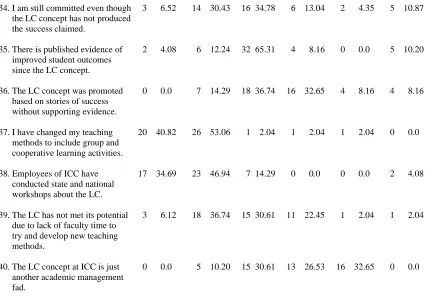
Questionnaire themes...159
Interview themes ...174
Review of the Learning College documents ...186
DISCUSSION AND INTERPRETATION OF FINDINGS...196
Context for change...196
Interpretation of the findings ...199
Research question conclusions ...200
Summary of recommendations ...211
Recommendations for future research ...213
Conclusion ...214
LIST OF REFERENCES...216
APPENDICES ...235
Document analysis for the implementation of the Learning College concept ...236
A questionnaire for the implementation of the Learning College...238
Interview questions for the implementation of the Learning College...248
Permission letter to perform the study at Isothermal Community College ...250
LIST OF TABLES
Tables Page
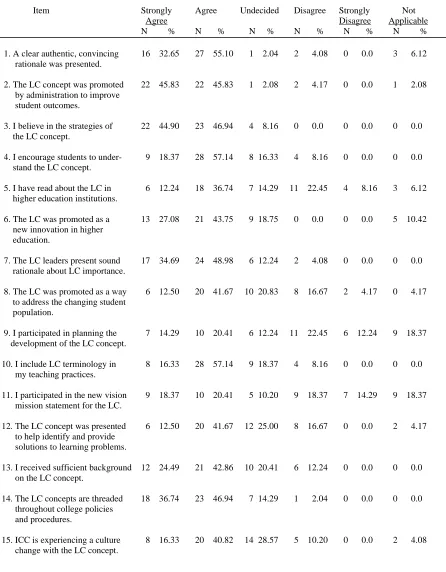
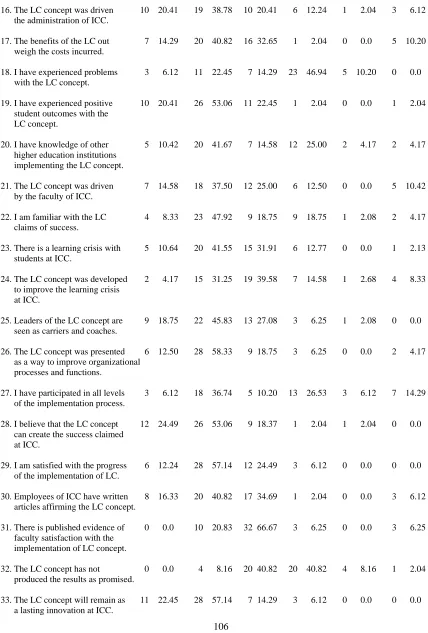
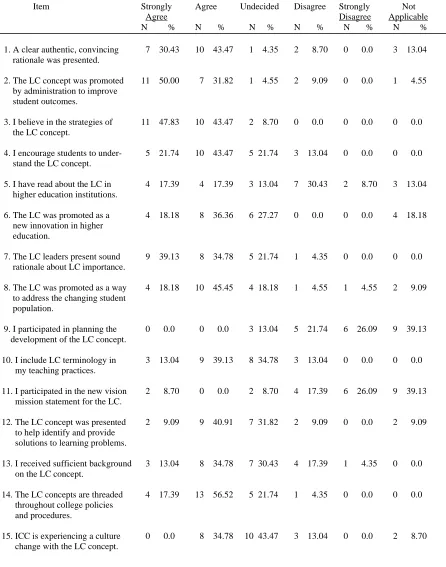
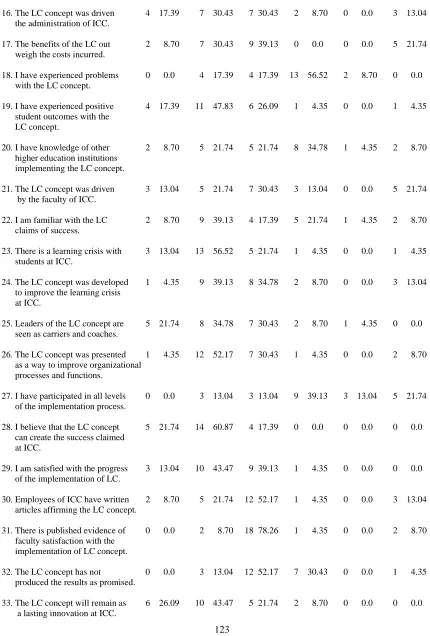
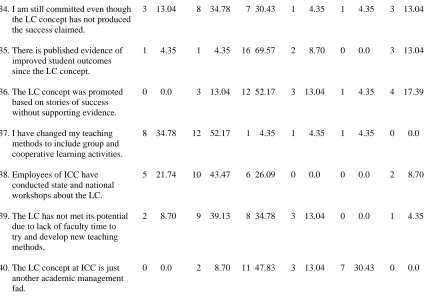
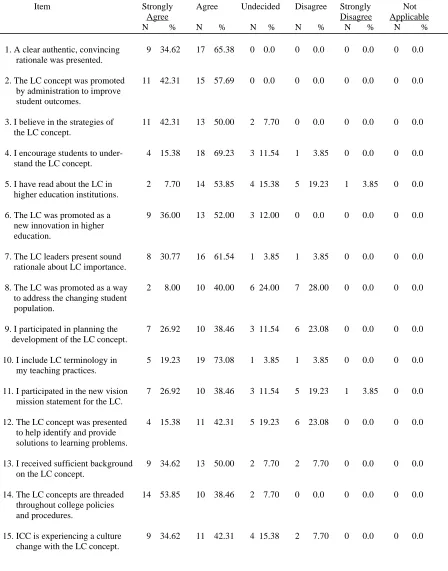
1. Responses of 49 faculty to the Individual Questionnaire Items ...105
2. Responses to the Questionnaire Items from 23 of the faculty
with five years or less employment at ICC...122
3. Responses to the Questionnaire Items from 26 of the faculty
with six or more years of employment at ICC...132
4. Responses to the Questionnaire Items from 26 of the faculty
with one month to 15 years of teaching experience...143
5. Responses to the Questionnaire Items from 23 of the faculty
LIST OF FIGURES
Figures Page
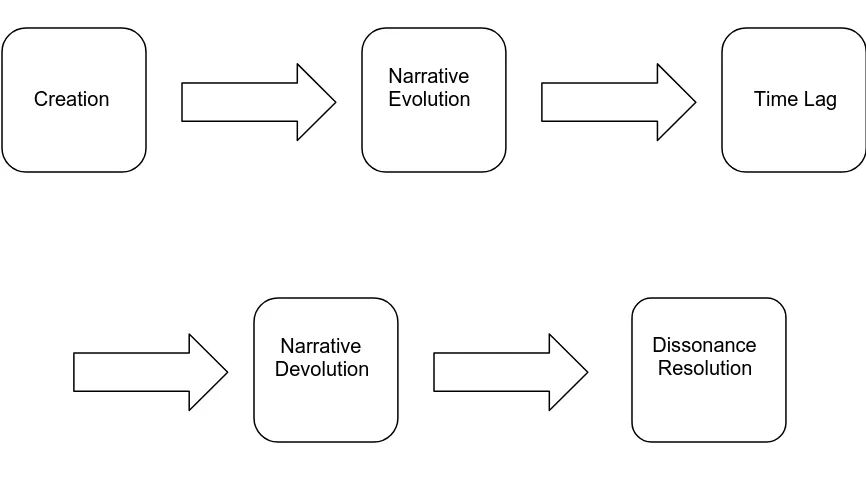
1. Birnbaum’s stages of the life cycle of academic management fads ... 24
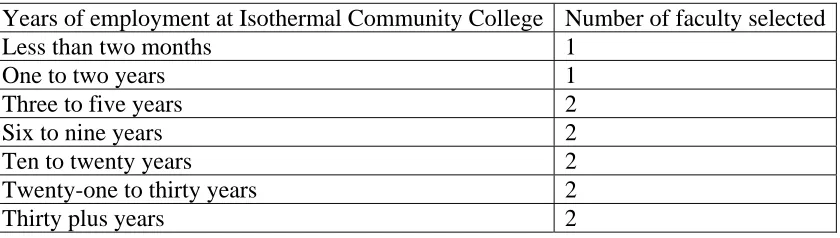
2. Faculty selection for the interview process...103
3. A comparison of the 40-item questionnaire statements to Birnbaum’s
stages of the life cycle of academic management fads ...114
4. Questionnaire Themes ...160
CHAPTER ONE Introduction of the Problem
The purpose of this study is to understand the effectiveness of the implementation
process through faculty perceptions of the Learning College concept at Isothermal
Community College as related to the stages of the life cycle of academic management fads.
This chapter outlines the problem as follows: (a) statement of the problem, (b) purpose of the
study, (c) significance of findings, (d) research questions, (e) assumptions of the study, (f)
limitations of the study, and (g) definition of study terms.
Statement of the Problem
Community colleges are adaptable, capable of change in response to new conditions
and demands, and operate with a continuing awareness of their communities (Gleazer, 1984).
In general, a community college’s programs and services tend to reflect the needs and
characteristics of the community that it serves (Taber, 1995, p. 35). Community colleges
remain close to the customer through extraordinary linkages and networks between and
among other college and community organizations (Peters & Waterman, 1982). In the 21st century, community colleges are at the center of economic workplace development with an
increased role as trainer of the masses for immediate employment (Forde, 2002). They are
challenged with responding to this role by anticipating necessary workplace changes,
creating new economic opportunities in order to remain competitive with other colleges,
addressing the shortage of skilled workers, and providing students and employees with the
content and tools necessary to interact with diverse populations (Forde, 2002; Forde, 2003;
Martin & Flynn, 2003; McCabe & Skidmore, 1989; Templin, 2002). Community colleges
technical-savvy workers will be in greater demand in order to compete in world markets
(Templin, 2002; Vaughn, 2000). One constant problem for community colleges is how to
implement increasingly effective levels of education that enable or equip students to compete
and succeed in the twenty-first century marketplace when the student population is often
under-prepared for college curriculums.
There are several prime elements that shape the context of this problem. Community
colleges have participated in many changes since their establishment in the late nineteenth
and early twentieth century. Historically, the mission of community colleges was to satisfy
the needs of the community (Bailey, 2002; Baker, 1998; Cohen & Brawer, 1996). State
legislation for curricular functions included academic transfer preparation,
vocational-technical education, continuing education, remedial education and community service
(Cohen and Brawer, 1996). Furthermore, the decade of the eighties led community colleges
to face issues dealing with declining enrollments, changing clientele, reduced resources,
imposed regulations by external agencies and public pressures for accountability (Richardson
& Rhodes, 1989). As community needs have evolved, the expectations of the community
college have increased through the embracement of access and equity issues, community
activism, and encouragement of life-long learning (Cohen & Brawer, 1996; Phillippe, 1995).
Community colleges have maintained an unwavering commitment to provide
educational access to all students including: the at-risk; the have-nots; high school graduates;
returning adult learners; and the increasing number of GED recipients (Santos, Santos &
Milliron, 2001). In addition, community colleges in the United States continue to be the
pathway to higher education for about half of all minority undergraduates through their
services, and quality learning opportunities (Phillippe, 1995; Santos et al, 2001). As
community colleges begin their second century of educational service, they will continue to
struggle with the recurring issues of securing adequate funding, meeting the needs of public
accountability, and identifying their role as part of a seamless education system (Boswell,
2002). Furthermore, issues of national security, diverse populations with varied expectations
and learning styles, rapidly evolving workplace needs, changes in demographic trends, the
impact of technology, demands from students for a variety of learning options, and a growing
emphasis on student learning as an outcome are also challenges that community colleges face
in the 21st century (Bellanca, 2002; Levin, 2002; Miles, 2002; Milliron, 2002; Phillippe, 1995). Part of the equation is that community colleges must face many of these challenges
for expanded future services at the same time with the same personnel and skill sets of the
past (Bellanca, 2002).
Community colleges provide a cost-effective, high-quality education that relates to
the needs of an increasingly diverse population (Phillippe, 1995, p. 31). The average age of
the community college student is twenty-nine (Phillippe, 1995). Many attend a community
college part-time while maintaining full-time employment. According to Phillippe (1995), 57
percent of students between the age of 25 and 34 work full-time and 54 percent of students
age 35 and older work full-time, while 12.5 percent of all of these students are full-time
students who work full-time. As open-access public institutions, community colleges
traditionally admit larger percentages of part-time students, non-traditional students, students
in need of remediation, and other high risk students (Baker, 1998; Cohen & Brawer, 1996;
Hoyt, 1999; McGrath & Spear, 1991; Phillippe, 1995; Roueche & Roueche, 1993; Vaughan,
Non-traditional students are twenty-five years of age or older (Cohen & Brawer, 1996) and
typically self-supporting or single parents who due to other life responsibilities are not
immersed in the academic environment as their primary life focus (Weiss, 1999). For
non-traditional students, college seems to be a place where they do no expect to succeed and
where they are repeatedly asked to do activities for reasons they do not quite understand
(McGrath & Spear, 1991). The high risk student can be identified as a first-generation
college student usually with a lower socioeconomic status, a cultural disadvantage, and/or are
low high school achievers who often have low self-esteem and higher expectations for failure
(Cohen & Brawer, 1996; Roueche & Roueche, 1993).
Community colleges pride themselves as open access institutions that register
students with little advance commitment and allow students to enroll in classes without
completing a plan of study. In addition, part-time attendance is encouraged and withdrawing
from classes without penalty and re-enrolling is typical (Cohen & Brawer, 1996). The
majority of students who enroll in community colleges will have some basic skills or
academic preparation deficiency. According to McGrath and Spear (1991), community
colleges need to make education more meaningful, intelligible, and attainable. This can be
accomplished by structuring educational activities in which students practice arguing,
analyzing, articulating issues, and resolving differences in perspective or fact.
Population trends suggest that by the year 2050, nearly half of the U. S. population
will be members of ethnic minorities while four out of five Americans will need some
postsecondary education to function successfully in the job market (McCabe, 2003).
Minority students are more likely to attend community colleges because they are usually
lower academic achievement (Cohen & Brawer, 1996). According to Phillippe (1995), every
ethnic and racial minority group is represented in community colleges making up more than
26 percent of all U. S. community college students. Although community colleges attempt
numerous administrative efforts such as requirements for advanced registration,
pre-enrollment counseling, development of matriculation plans, and mandatory testing to tighten
requirements, open-access policies still dominate (Cohen & Brawer, 1996). Thus, the issue
remains, if community colleges are going to continue to provide open access enrollments,
they need to create methods for assisting students toward completion of courses of study.
This will require community colleges to incorporate new and innovative educational
strategies unlike what they have utilized in the past.
Innovations in community colleges previously resulted in expansions of their
institution’s mission in response to the community needs (Baker, 1998). During the twentieth
century, the most common forms of change in the community college were piecemeal
changes such as: mandatory assessment and placement; eliminating language requirements;
adopting prior learning assessments; revising attendance policies; and creating peripheral
changes such as providing alternatives to attending classes on campus (Baker, 1998). In
response to the changing student population, colleges will have to implement creative and
innovative changes as a way to assist students toward successful completion of their courses
of study.
In the United States, the necessity for change in organizations has increased
tremendously over the past few decades due to the shifting marketplace demands. Kotter
(1996) states, “More organizations will be pushed to reduce costs, improve the quality of
Furthermore, the pace of organizational change is accelerating, driven by rapid advances in
information technology, transportation and logistics leading to radical increases in the rate of
globalization (Mariotti, 1999).
The process of globalization in particular is also accelerating organizational change
greatly. Globalization represents an expansion of capitalist production, market-based
consumption, and western culture along with the opportunity for mitigation of inequality,
human rights, environmental values, and feminism (Waters, 2001). With globalization,
populations are less regulated and controlled, global corporations reduce their capacity to
monopolize markets, worker division becomes problematic as routine and arduous jobs are
exported elsewhere, and the internet allows for exchange of commitments and information
almost instantaneously (Waters, 2001). Levin (2002) further agrees that globalization
includes the domains of economics, social and cultural processes, and the conceptualization
of the world as a single place. In the global economy, business and industry is already
moving from the United States to countries with lower wages (McCabe, 2003).
For institutions of higher education, the effects of globalization include moving
postsecondary institutions toward a more business-like orientation, creating a more corporate
environment with training emphases that are being driven by business and industry demands
as institutions are being placed in closer proximity to the marketplace (Levin, 2001). In a
study of the effects of the global economy on community colleges, Levin (2000) revealed
organizational behaviors such as reacting to the demands from students and business leaders
for employment skills training and altering curricula to fit marketplace demands. These
behaviors suggest that in the 1990s, the mission of the community college shifted by placing
needs and more on the economic needs of business and industry, less emphasis on individual
development and more on workforce preparation and training (Levin, 2000).
The workplace of tomorrow will be quite different from that of today. New jobs will
require markedly different and higher competencies; existing jobs will continue to evolve,
requiring different behaviors and job skills; simple jobs will become high performance jobs;
workers will need the capacity to reason through complex processes; and tomorrow’s
workers will need higher-order information skills as a foundation for life-long learning
(McCabe, 2003, p. 15). According to Drucker, schools and universities will change more and
more drastically in the next fifty years than they have since they assumed their current forms
more than 300 years ago (Drucker, 1992).
O’Banion (1997) and Barr and Tagg (1995) document and describe a Learning
Revolution that is spreading throughout North American higher education. The Learning
Revolution seems to be a culmination of a series of educational reforms started by the 1983
report, A Nation at Risk: the Imperative for Educational Reform. This report called for action
against a rising tide of mediocrity that threatens the future of the nation (The National
Commission on Excellence in Education, 1983, p.5). This was followed a decade later by An
American Imperative: Higher Expectations for HigherEducation, a report published in 1993
that focused on higher education. That report states that “society must hold higher education
to much higher expectations or risk national decline” (The Wingspread Group on Higher
Education, 1993, p.1). This report further highlights the threats to the United States
competitive advantage in a global economy and challenges higher education institutions to
Institutions of higher education are now under pressure to respond to the effects of
globalization by becoming more efficient and effective (Birnbaum, 2000b). Administrators of
higher education have often employed management techniques as the answer to their
problems (Allen & Chaffee, 1981). Many management techniques are identified in the
literature that include: a planning-programming-budgeting system (PPBS); costing; strategic
planning; benchmarking; management by objectives (MBO); zero-based budgeting (ZBB);
total quality management (TQM); continuous quality improvement (CQI);
responsibility-centered management (RCM); business process reengineering (BPR); and program
evaluation and review technique/critical path system (PERT/CPM) (Allen & Chaffee, 1981;
Birnbaum, 2000; Brigham, 1993; Brindle & Stearns, 2001; Bryant,1998; Cole, 1999; Ewell,
1999; McGill, 1988; Wind & Main, 1998). Previously, management techniques such as these
have not stood the test of time as a primary solution for institutions of higher education. For
example, according to Matejka and Dunsing (1995), both an incompleteness and basic design
flaw doomed MBOs and TQM from the start. Other management techniques are cited by
Lander (2001) from a 1999 conference, Reorganizing Knowledge; Transforming Institutions:
Knowing, Knowledge and the University in the XX1 Century. In this conference, management
researchers and higher education researchers met in order to look ahead and present their
research on the next innovation for transforming higher education. The next innovations
identified at this conference were systems thinking, storytelling, the learning organization,
and the virtual university. The learning organization or the Learning College concept seems
to be the current trend embraced by numerous institutions of higher education (Barr & Tagg,
1995; O’Banion, 1997). Therefore, this study will focus on the Learning College and its
Many reform efforts have been started by community colleges in an effort to become
more learning-centered institutions (O’Banion, 1997b). According to O’Banion (1997b)
some will extend current efforts in TQM to include more focus on improved and expanded
learning for students, while others will use information technology as the catalyst to direct
learning efforts. Still others will launch their initiatives with key innovations such as learning
communities or classroom assessment. The uncertainty of the future triggers concerns
regarding innovation and change (Rogers, 1983). The major challenge for the community
college is how to speed the rate of adoption and how to diffuse innovation throughout the
organization (Rogers, 1983). Therefore, the concern in adopting the Learning College
concept is whether the concept will become a lasting innovation or just another academic
management fad.
According to Birnbaum (2000b), the term fad refers to any higher education
management practice or interest followed for a time with exaggerated zeal. Management of
higher education is susceptible to adopting fads due to the pressure to become more
business-like, more rational, and more accountable while dealing with the increasing concern of
declining resources (Allen & Chaffee, 1981). The challenge for community colleges that
choose to pursue the Learning College concept is to implement the concept so that it
becomes part of the institution’s mission, values, policies, procedures, and teaching practices.
When the concept becomes embedded in the life and practice of the organization, it is less
likely to become the next fad. Therefore, this study will focus on implementation outcomes
Purpose of the Study
According to Milliron (2000), many community colleges are tackling the challenge of
providing education to an under-prepared student population by embracing a philosophy of
“learning first” and by working hard to ensure that their limited energies and efforts are
making a difference for learners and learning. Implementing the Learning College concept
requires what Senge, Kleiner, Roberts, Ross, Roth, & Smith (1999) call “profound change”.
Profound change is not just implementing a new concept, but building a capacity for
providing services a new way. Indeed, profound change builds the capacity for ongoing
change. In implementing profound change, the process requires more than just changing
strategies, structures, and systems; it also requires that the thinking that produced those
strategies, structures, and systems also has to change (Senge et al., 1999, p. 15).
The purpose of this study is to understand the effectiveness of the implementation
process through faculty perceptions of the Learning College concept at Isothermal
Community College as related to the stages of the life cycle of academic management fads.
Has the Learning College concept been implemented in such a manner as to allow it to
remain an innovation or will the concept become just another passing fad? According to
Birnbaum (2000a), an innovation is not known as a fad until it reaches an adoption peak and
then begins to fade. Research implies that many fads begin with enthusiasm and commitment
that wavers even though a fad can establish certain elements of behavior to be utilized with
the next passing fad (Brindle & Stearns, 2001; Cole, 1999; Hilmer & Donaldson, 1996;
McGill, 1988; Wind & Main, 1998). Thus, the ultimate goal of this study is to determine if
the Learning College concept has been implemented effectively so as to prevent it from
Organizations are a microcosm of the larger society in which they operate, and
organizations possess a culture, which reflects structure, patterns of interaction, and people
(Brown, 1999, p.6). Patterns of behavior, beliefs, attitudes, assumptions, values, norms, and
practices represent what is often referred to as the climate or culture of an organization
(Baird, 1990; Brown, 1999; Kuh & Whitt, 1988; Litwin & Stringer, 1968; Peterson &
Spencer, 1990; Tagiuri, 1968; Tierney, 1988). Culture remains an institutional choice, and
successful efforts to manage or change organizational cultures are complex (Smart & Hamm,
1992). Organizational leaders need to perform a self-reflection of their own cultures in order
to enhance the performance and effectiveness of the institution. According to Tierney (1988),
the lack of the leader’s ability to grasp the dimensions of organizational culture inhibits the
ability of an institution to address the problems and challenges in higher education. Schein
(1985) suggests that leadership and culture are two sides of the coin and that the only
important action that leaders perform is to create and manage culture (p.2).
Organizations transmit values to employees through training programs, work
experiences, and communications (Dailey & Fogel, 1988). Beliefs about how organizational
processes and practices work become shared employee expectations and, if accepted by the
employees, performance-oriented norms develop in the organization (Dailey & Fogel, 1998).
In general, culture originates from management assumptions about what motivates people to
work, perform, and demonstrate commitment. Dailey and Fogel (1998) list components of
conscious culture development through the use of an awareness checklist, which includes the
following: commitment to a common purpose; competence to deliver superior performance;
and consistency in perpetuating commitment and competence (p. 436). Leaders who
culture’s evolutionary process by consciously working to create a common value and belief
system that motivates commitment around a shared vision for the future (Baker, 1992, p. 15).
The leader of an organization has a direct effect on the culture of the organization.
Without an effective leader and leadership action, the culture of an organization cannot
effectively change. According to Baker (1992), an organization’s culture and its leadership
are integrally entwined, and organizational effectiveness is linked to the role of leadership in
creating and managing culture (p. 15). In discussing the role of the organization’s leader as
related to its culture, Schein (1996) states, “the leader is the creator of culture because the
leader’s beliefs, values, and basic assumptions are transferred to subordinates” (p. 59).
“Leaders are people who move organizations through their own personal credibility and
commitment that develops among those whom they lead” (Richardson & Rhodes, 1989, p.
204). Schein (1996) further implies that the successful leader is an animator and displays an
energy born out of strong personal convictions that breathe life into the organization. Leaders
who are successful at sustaining a culture through an organizational change have enough
personal insight to grow with the organization or change their own outlook and are able to
recognize their own limitations, allowing other leaders to emerge (Schein, 1996).
Although the leader is pivotal to the implementation of a successful change strategy,
faculty were chosen as the participants for this study. According to Richardson & Rhodes
(1989), “The commitment to be gained from faculty, the development of a sense of
professional responsibility, and the wealth of enthusiasm and talent that faculty can bring to
the implementation of institutional priorities is priceless” (p. 204). Faculty perceptions about
implementation of the Learning College were chosen for the following reasons: (1) the
essential to move an organization in transition; (3) the president is the pivotal community
college leader; and (4) faculty have the closest first hand experience of the leader’s work.
Furthermore, the faculty serve as the bridge between both the leadership and the students in
the institution.
Leaders must become managers of their own organizational change in order to make
successful transitions. Perspectives related to organizational change continue to recur: no
significant change will occur unless it is driven from the top; no point in starting unless the
CEO is on board; and nothing will happen without top-management buy-in (Senge, 1996, p.
41). Yukl (1998) states, “leading change is one of the most important, but difficult leadership
responsibilities” (p. 438). It takes strong vision, conviction, and energy to create and animate
an organization. It also takes great judgment, wisdom, and skill to pull people together as
well as personal learning ability and flexibility to evolve and change organizations (Schein,
1996). Change can be a difficult and stressful process, but by accepting it as a natural process
and choosing to manage it, the leader can become a creative force in the change process
instead of letting it run its own course (Heifetz, 1993).
Major participants for this study are defined as full-time faculty currently employed at
Isothermal Community College. This study, through the perceptions of faculty, will attempt
to understand the effectiveness of the implementation of the Learning College concept at
Isothermal Community College as related to the stages of the life cycle of academic
management fads. Some of the key factors for successful organizational change at Isothermal
Community College seem to be a clear vision, consistency of expectations, continuity and
focused on leadership, it is anticipated that this process will provide some insight regarding
the leadership and its effects on the culture of the organization.
Significance of Findings
In U. S. American higher education, numerous colleges are engaged in the
innovations of becoming a Learning College. Implementing a Learning College in a
traditional educational institution requires what Senge et al. (1999) term a profound change.
The impact of innovations in contrast to fads has been studied previously by evaluating the
implementation of management techniques. Although The Learning College concept is a type
of management technique, it requires a gradual process of modification and experimentation
for everyone in the college (Barr & Tagg, 1995). Therefore, the results of this study will help
to provide an understanding of how the Learning College concepts are integrated into all
aspects of the college through the engagement of all employees. This study will serve to
move forward the knowledge of the implementation of the Learning College by providing an
in-depth study of one institution in transition and analyzing strategies that could encourage
successful transitions to the Learning College implementation in other colleges.
Much literature generated from college presidents throughout the United States
reports how the Learning College concept was implemented at their institution
(Boggs, 1995-1996; O’Banion, 1997a). Most of that literature indicates a similar but different
process of implementation where institutions place more emphasis on certain aspects than on
others. However, none of the literature reviewed presents any research on whether the
Learning College concept was implemented in a manner that affected profound change to
prevent the concept from becoming the latest fad. The information from this study could be
College concept by assisting them with knowledge regarding possible strategies needed to
maintain the concept as an innovation. Educational leaders who start transitions to adopt the
Learning College concept could further use this information to gain a greater understanding
of how to institute and affect change in their own organizations in order to prevent the
Learning College from becoming a fad.
This study will further evaluate the implementation of The Learning College concept
as it relates to being an innovation or just another fad. According to Senge (1990), the
learning organization is likely to become the next management fad and like all fads the
interest will grow rapidly, level off, and then decline. With this study, the results obtained
will help to determine if Isothermal Community College has implemented the Learning
College in such as manner as to prevent it from becoming a fad. The failure to sustain change
occurs again and again despite the commitment of substantial resources and talented people
driving the change. Senge et al. (1999) advocates that most learning initiatives deal only with
the growth processes and not with the limiting processes, which is the reason so many
learning initiatives fail to sustain momentum. Therefore, sustaining any profound change
requires a fundamental shift in thinking: to understand the nature of growth processes; to
understand the forces and challenges that impede the progress; to develop workable strategies
for dealing with these challenges; and to appreciate the interplay between growth processes
and limiting processes (Senge et al., 1999, p. 10).
The Learning College concept has many implications for educational practice. The
concept influences how teaching and learning occurs, how students learn, and how an
institution functions (Barr & Tagg, 1995; O’Banion, 1997a; Senge, 1990; Senge et al., 1999).
reveal that students learn more when they are intensely involved in their education especially
when asked to apply what they are learning in different settings. Empirically the NSSE report
determines how well an institution fosters student learning (Kuh, 2003). Furthermore,
collaborating with others in problem-solving activities will enhance the skills needed to
succeed in the workplace. With the Learning College concept, teachers become facilitators
and coaches, students become responsible for their own learning, and institutions become
responsible for breaking down institutional barriers and assessing student outcomes. Because
this concept represents such a dramatic change from the traditional teaching and learning
strategies, it is important to evaluate whether it has been implemented in such a manner as to
create a cultural change.
The significance of this study to Isothermal Community College is to gain insight into
its process of implementing the Learning College concept. In order for the Isothermal
Community College learning initiative or any Learning College initiative to flourish, it
should be implemented throughout the institution by weaving the concepts into its mission,
policies, and practices. This study is designed to evaluate all aspects of the implementation
process and to identify any associated strengths and weaknesses.
Research Questions Research Question One
What are the faculty perceptions regarding the effectiveness of the implementation process of
the Learning College concept at Isothermal Community College?
Research Question Two
How does the implementation of the Learning College concept at Isothermal Community
Assumptions of the Study
1. It is assumed that study participants will respond to interview questions openly and
honestly without fear of retribution.
2. It is assumed that study participants will answer the questionnaire themselves.
3. It is assumed that most faculty are supportive of the Learning College concept.
4. It is assumed that the Learning College is an effective method for dealing with
non-traditional and at-risk students.
5. It is assumed that faculty, administration, and staff are involved in the Learning
College concept.
6. It is assumed that key leadership components (stability, collaboration, shared vision,
excellence, recognition, and engagement) assisted the transition toward acceptance of
the Learning College concept.
Limitations of the Study
1. Due to attrition, the total population surveyed at this time does not represent the
total population that began the process at Isothermal Community College eight
years ago.
2. Because the participants will be aware that they are part of an organizational
study, responses could be affected.
3. The researcher is on the faculty of Isothermal Community College and that
connection may introduce unintended bias by some participants to responses.
4. This study represents faculty perceptions of the implementation of The Learning
College, eight years after the process began at Isothermal Community College;
Definition of Study Terms
1. Learning-Centered Environment: An atmosphere of learning rather than teaching, in
which the most important people are the learners, and everyone else is there to facilitate
and support learning (O’Banion, 1997, p. 26).
2. Learning Organizations: Institutions of higher education in which people continually
expand their capacity to create the results they desire, new and expansive patterns of
thinking are nurtured, collective aspiration is set free, and people are continually learning
how to learn together (Senge, 1990, p. 3).
3. The Learning College: An educational concept that places learning first and provides
educational experiences for learners any way, any place, and any time (O’Banion, 1999).
4. Innovation: Ideas or practices perceived as new by the adopting organization regardless
of whether they are new (Rogers, 1995).
5. Fads: A practice or interest followed for a time with exaggerated zeal (Birnbaum, 2000b).
6. Profound change: Organizational change that combines inner shifts in people’s values,
aspirations, and behaviors with outer shifts in processes, strategies, practices, and systems
(Senge et al., 1999).
7. Faculty perceptions: The beliefs and values of faculty regarding the implementation of
the Learning College concept.
8. Globalization: A social process in which the constraints of geography on economic,
political, social and cultural arrangements recede, in which people become increasingly
aware that they are receding and in which people act accordingly (Waters, 1995, p. 5).
9. Community college: Any institution accredited to award the Associate in Arts or the
10.Isothermal Community College: A small, rural, public community college located in
Spindale, North Carolina.
11.Full-time faculty: All faculty at Isothermal Community College with nine to twelve
month full-time employment contracts.
12.Non-traditional students: Students who are twenty-five years of age or older and typically
self-supporting or single parents not immersed in the academic environment due to other
life responsibilities (Cohen & Brawer, 1996; Weiss, 1999).
13.Minority students: All students, other than Caucasian, enrolled in community colleges.
14.Organizational culture: Deeply embedded patterns of organizational behavior along with
shared values, assumptions, beliefs, or ideologies that members of the organization have
in common (Brown, 1999).
15.Organizational climate: The qualities of the internal environment of an organization that
influence members’ behavior as they conform to values and attributes of the organization
(Tagiuri, 1968).
16.Organizational leadership: The process wherein an individual member of the organization
influences the interpretation of events, the choice of objectives and strategies, the
organization of work activities, the motivation of people to achieve the objectives, the
maintenance of cooperative relationships, the development of skills and confidence by
members, and the enlistment of support and cooperation from people outside the
CHAPTER TWO
Introduction to the Review of the Literature
The purpose of this study is to understand the effectiveness of the implementation
process through faculty perceptions of the Learning College concept at Isothermal
Community College as related to the stages of the life cycle of academic management fads.
Understanding the implementation process of the Learning College concept will help to
determine if it has been implemented in such a manner as to prevent it from becoming
another fad. This chapter outlines the review of the literature as follows: (a) introduction, (b)
conceptual framework, (c) innovation versus fad, (d) organizational culture, leadership, and
change, (e) concepts relevant to the Learning College, (f) review of related research, and (g)
conclusion.
Introduction
Most community colleges continue to be faced with demands for increased
accountability, declines in traditional funding sources, demands for increased services,
greater sophisticated competition in the educational marketplace, diverse populations, and a
rapidly evolving workplace (Boswell, 2002; Bellanca, 2002; Levin, 2002; McGrath & Spear,
1991; Miles, 2002; Milliron, 2002; Phillippe, 1995; Roueche, Roueche, & Johnson, 2002;
Vaughan, 2000). Through reports such as, “A Nation at Risk: The Imperative for Educational
Reform” and “An American Imperative: Higher Expectations for Higher Education”, higher
education institutions were challenged to focus on higher educational expectations (The
National Commission on Excellence in Education, 1983; The Wingspread Group on Higher
Education, 1993). This challenge of increasing educational expectations and student
and responding to an ever changing global marketplace has led to the development of new
innovations in community colleges throughout the United States. The focal innovation for
this study is the Learning College concept.
Many colleges and universities throughout the United States have developed policies
and procedures that incorporate the Learning College concept (Barr & Tagg, 1995; Boggs,
1995-1996; O’Banion, 1997a). Indeed, other non-educational institutions have noted the
importance of incorporating learning throughout the organization in order to survive the
current global challenges affecting the workplace (Handy, 1995; Kanter, 1995; Kofman &
Senge, 1995; Thompson, 1995; Wind & Main, 1998). Even though many indicate that
adoption of the Learning College concept can lead to a successful organization in the 21st century, there are no actual guides for its implementation.
If the Learning College concept is one solution to an ever changing global economy,
then it becomes important to know if institutions can implement the concept in such a
manner as to prevent it from becoming the next academic management fad. Institutions need
to implement the concept so that it becomes embedded in the life and practice of the
organization, otherwise known as the organizational culture. According to Birnbaum (2000),
“even when a fad is temporarily adopted by a university, it is almost never incorporated into
the institution’s culture, and therefore remains uninstitutionalized” (p. 11). A commitment of
this magnitude requires profound change - “a change that combines inner shifts in people’s
values, aspirations, and behaviors with outer shifts in processes, strategies, practices, and
systems” (Senge et al., 1999, p. 15). The organization does not simply do something new;
Conceptual Framework
Many seek to build learning organizations through efforts of responding quickly to
external changes, thinking more imaginatively about the future, creating relationships with
more trust and openness, unleashing employees’ natural talents and enthusiasm, and relating
closer to their customers (Senge et al., 1999). The ongoing dilemma for implementing the
Learning College concept is how to sustain it and prevent it from becoming just another
“flavor of the month” or “passing fad” (Senge et al., 1999). The challenge is to restructure
the organization so that the Learning College once implemented is manifest as a profound
change of the organization. Profound change requires an investment of time, energy, and
resources along with a genuinely committed initial pilot group that supports the change
(Senge et al., 1999). Qualities inherent in the most important change initiatives include the
following: connection with real work goals and processes; connection with improving
performance; involvement of the people with the power to take action; a balance of action
and reflection; an opportunity to think and reflect without pressure to make decisions; a
method to increase people’s capacity, both individually and collectively; and a focus on
learning about learning (Senge et al., 1999).
It is unknown how fads are introduced into higher education, but it may be related to
the actions of legislators, board of trustees, or institutional presidents (Birnbaum, 2000, p.
145). In addition, as institutional leaders decide whether to adopt a management innovation;
their decisions are often influenced by regulatory bodies, professional groups, foundations,
businesses, and consultants. As a result, external agency pressure may cause institutions to
adopt an inefficient administrative technology or totally reject an efficient one (Birnbaum,
After forty years of studying innovations, Birnbaum (2000) developed a formal model
of the stages of the life cycle of academic management fads from the time they are
introduced into the higher education system until the time of their eventual abandonment,
reinvention, or partial incorporation. According to Birnbaum (2000) each of the higher
education management fads that he studied began in the business sector and was diffused into
academia. Fads can be diffused through coercive, mimetic, and normative processes
(Birnbaum, 2000). According to Birnbaum (2000), “Coercive processes of diffusion include
rules established by government, professional associations, accrediting bodies, or other
authoritative groups. Mimetic processes of diffusion are seen when organizations copy
routines they learn about through institutional contact, consultants, or the movement of
people between institutions. Normative processes of diffusion involve dissemination through
publications, experts, and educational activities” (p.146).
After extensive review of seven management fads as separate case studies and then
reviewing them using a process of explanation building, Birnbaum’s (2000) analysis led to
the development of stages in the life cycle of management fads. The framework developed
by Birnbaum (2000) is a consistent and predictable five-stage cycle that describes the
trajectory of management fads: creation, narrative evolution, time lag, narrative devolution,
and dissonance resolution (See figure 1). This cycle suggests lagged phases through which
fads move between the nonacademic and the academic sectors, and discusses some
similarities and differences in the fad adoption process in academic and nonacademic
systems.
Based on this five-stage cycle by Birnbaum (2000), this study will relate the
community college, to the trajectory of management fads cycle outlined in this model. This
five-stage cycle includes both a cycle for management fads in business and a cycle for
management fads in academia. However, this study will focus only on the cycle of
management fads in academia. By examining the processes involved in the implementation
process at Isothermal Community College, this study will examine whether the concept has
been implemented in such a manner that will establish it as an innovation or allow it to join
the list of previous management and academic fad failures. Even as failures, fads can be
important because of what they illustrate about our changing beliefs of what an organization
is and how it should function (Birnbaum, 2000a).
Figure 1: Stages of the Life cycle of academic management fads.
Adapted from: Management Fads in Higher Education: Where they come from, what they do, why they fail (p.126) by R. Birnbaum, 2000, San Francisco, Jossey-Bass. Copyright 2000 by R. Birnbaum.
Narrative Evolution
Narrative Devolution
Time Lag
Stage one of the academic management fad cycle, creation, begins with a crisis that
exists in an organizational sector and is usually related to a major change in the larger social
system or an organizational subsystem within it (Birnbaum, 2000, p. 126). The problem is
that the past operating assumptions no longer apply to this major social, economic,
demographic, or technical change. Therefore, the adoption of a new management technique
is proposed to solve the problem. This new technique is supported by advocates or
consultants, dramatic narratives of success by external champions, and enthusiastic
statements of early organizational adopters announcing the technique as a proven concept.
The narratives in this creation stage include claims of impressive success and dazzling results
(Birnbaum, 2000, p. 128). Based on these claims, organizations are encouraged to adopt the
new technique.
The technique is initially presented in simplified, commonsensical terms which make
counterarguments difficult. This new technique is presented as, “the answer to all managerial
problems that will significantly improve core organizational processes and functions”
(Birnbaum, 2000, p. 128). Promises of extraordinary outcomes are made when the technique
is presented as a necessary and sufficient organizational transformation. True believers
present their views with “messianic zeal” and suggest that organizational success or even
survival depends on the adoption of this new management technique (Birnbaum, 2000,
p.128).
Stage two of the academic management fad cycle, narrative evolution, begins with
elaborate and widely disseminated narratives (Birnbaum, 2000, p. 128). Stories of successful
implementation are distributed, and the new technique is hailed as highly effective. The
(Birnbaum, 2000, p. 129). Consultants, champions, and adopters declare this new technique
to be the innovation of the decade through written articles and presentations at professional
meetings. According to Birnbaum (2000), “organizations adopting the innovation are
applauded for acknowledging the existence of serious problems, engaging in efforts to
improve and reform, and conceding that system and social benefits outweigh selfish interests
of organizational participants; whereas, opponents to this new innovation are identified as
resistant to change, conservative, wasteful, and self-interested” (p. 130).
Stage three of the academic management fad cycle, time lag, occurs between the
creation and the dissemination of the new technique and the time at which user reactions and
independent analyses become widely available (Birnbaum, 2000, p. 130). Stories of
successful adoption are written by or about organizational members with vested interests in
their association with a successful program. The unavailability of data makes it possible to
exaggerate claims and advocate implementation based on theoretical grounds. Stories of
unfulfilled promises of previous innovations begin to surface. In addition, analysis of new
data not previously available is disseminated. During this time lag, the acceptance of the
innovation peaks, and the pace of new adopters slow down (Birnbaum, 2000).
Stage four of the academic management fad cycle, narrative devolution, occurs when
overly inflated claims of success encounter widespread signs of disappointment (Birnbaum,
2000, p. 130). Noticeable disenchantment and skepticism evolves. The enthusiasm based on
initial reports of success becomes tempered by countervailing reports of failure. Data
collected indicates that the new technique failed to produce its promised results. The original
claims of success are now seen as either overstated or not sustained, organizational
Surveys of users reflect increased dissatisfaction (Birnbaum, 2000, p. 131). Acceptance of
the new technique diminishes, and the new technique is declared a fad. Through journal and
newspaper commentaries, the fad is declared as a fraud that has failed. No new institutions
proceed to adopt the fad. However, previous adopters may continue the fad as they discount
new information that conflicts with previous beliefs. For true believers, their commitment
may increase rather than decrease with the conflicting evidence presented (Birnbaum, 2000).
Stage five of the academic management fad cycle, dissonance resolution, begins as
champions and adopters view the demise of the innovation. This acceptance of demise
reflects a need to account for its failure in ways that protect both the status of adopters and
their ideological credibility (Birnbaum, 2000, p. 131). Rationalizations for failure include
poor quality of leadership, intransigence of followers, improper implementation, and lack of
resources (Birnbaum, 2000). Fads are reported to have failed because the right methods of
structure and process were not followed or not properly implemented. Failure can also be
attributed to a “bad” version of the innovation, whereas success would be attributed to a
“good” version of the innovation (Birnbaum, 2000, p. 132). The least frequent response to
failure is to consider that the new technique may have been based on invalid premises.
Identifying the new innovation as a failure sets the stage for reinventing the innovation and
recycling it with minor modifications and a major change of name (Rogers, 1995).
Innovation versus Fad
Considerable research is available regarding the latest management fad or the types of
management fads prominent in each decade. However, research studies regarding their
effectiveness or sustainability are very limited. According to Birnbaum (2000a), there are
There seem to be a number of reasons that research may never be readily available regarding
management fads (Birnbaum, 2000a). First, fads seldom exist in pure form. They may have
looked similar to the adoption processes of other institutions, but institutions generally alter
the adopted fad for their own purposes. Furthermore, fads mutate and evolve over time as
consultants develop their own proprietary products. In addition, since there is often no
agreement on the desired outcomes of fads, they are difficult to measure. Fads promise to
make things better, but do not provide prior criteria that would make it possible to examine
them later to determine if they worked. Despite the inability to understand fully the
consequences of academic fads, it can be confidently stated that (1) all academic
management fads fail on their own terms and (2) all academic management fads leave
legacies that remain in higher education long after the fad has disappeared (Birnbaum,
2000a).
Management literature continues to present the consistent themes that fads have failed
to create the direct effects they claimed (Birnbaum, 2000a). Some of the criticisms made
include the following: planning has failed everywhere it has been tried (Wildavsky, 1973);
benchmarking failed because managers were trying to compare themselves in too many
directions (Birnbaum, 2000a); TQM has failed to produce its promised results (Brigham,
1993) BPR ventures failed because they were short-term and near-sighted (Bryant, 1998)
ZBB was time consuming and people ended up making decisions based on last year’s budget
(McGill, 1988). Not only do fads fail, but their failure gives rise to fads that criticize their
predecessors and claim to have corrected their errors (Birnbaum, 2000a). According to
Hammer and Champy (1993), “none of the management fads of the last twenty years, not
decentralization, quality circles, excellence, restructuring, portfolio management,
management by walking around, matrix management, entrepreneuring, or one-minute
managing, has reversed the deterioration of America’s corporate task. These fads have only
distracted managers from the real task at hand” (p. 25).
Even though the literature continues to reveal the failures of fads, many corporate
executives continue to pursue new management techniques. According to Allen and Chaffee
(1981), administrators have often seized management techniques as the answer to their
problems. Many organizations are pushed into adopting a new technique because a new
board member had a positive encounter with the technique at a previous place of employment
(Ewell, 1999). Furthermore, as more partnerships are formed between industry and colleges
or universities, corporate partners may strongly suggest that the partnering institution adopt a
particular management technique (Ewell, 1999).
The decision to adopt an innovation is difficult due to the lack of valid data. In
Bleakley’s article (1993), he reports that managers are more likely to overestimate the
benefits of adopting a fad. Surveys in the 1990s indicate that executives rated their
satisfaction with fads from 35 to 60 percent, while employees and customers rated the
effectiveness between 10 and 20 percent. When a new approach does not yield the desired
results, management often moves on to another seemingly more promising approach leading
employees to adopt a “this too will pass” philosophy (Cole, 1999). Fads can serve as building
blocks for future management activities, but not always in a conscious strategic fashion.
According to Cole (1999), purposive learning will likely occur at the tail end of a fad when
the decision makers realize the limitations of current practices and try to see how much can
fads can be deceiving and harmful if they turn out to be “all smoke and mirrors without
substance” because they can cast doubt on previous legitimate initiatives. However, the
remnants of fads can grow into successful initiatives if their concepts are incorporated into
work activities and previous successful initiatives.
McGill (1988) studied the rise and fall of fads over a forty year period. The forties
brought about a movement, the profession of management. A number of writers have focused
on legitimizing management as a worthy pursuit marketing them as professionals like
physicians and lawyers. The fifties seemed to be the era of formulas such as MBOs and
PERT/CPM. PERT/CPM was the program evaluation and review technique/critical path
management system used by the navy to control the development of the Polaris submarine.
MBOs seemed to be the corporate management fix of the fifties and focused on reducing the
processes of management to measurable activities. The sixties brought about the human side
of management leading to learning activities such as sensitivity training, laboratory training,
T-groups, and encounter groups. Also included are strategies such as McGregor’s Theory X
and Y, the management grid, participative management, and Matrix management. After the
1960s, managers were disenchanted with the sensitive, people-oriented fixes, and that led to
the strategic seventies. The 1970s led to the emergence of ZBB, portfolio management, and
the experience curve as well as the promotion of degree-granting MBAs. The 1980s provided
management fixes such as Theory Z, excellence, corporate culture, and the one-minute
manager. Further study looked at the Japanese promotion of quality products, and thus TQM
began to appear (McGill, 1988). Finally, it seems that the 1990s sparked interest with the
Scholars often react negatively to popular management movements and almost
gleefully report their demise (Cole, 1999). A related behavior is often found among
consultants, who are always looking for the next wave and a way to differentiate their current
product from their last one. Much of this marketplace behavior continues based on the lack of
empirical evidence to support the fad’s contribution.
American higher education experienced pressures during the 1970s and early 1980s
created by declining resources and the threat of declining enrollments (Astin, 1985). In
response to these pressures, higher education began experimenting with techniques borrowed
from the corporate world such as computerized management information systems, program
budgeting, and management by objectives (Astin, 1985). According to Matejka and Dunsing
(1995) the inherent incompleteness and flaws in their basic design and implementation
doomed MBOs, TQM, and other techniques from the beginning of their use in academic
settings. During this time, there was considerable talk of making higher education more
accountable since higher education was viewed as producing both knowledge and trained
manpower.
Businesses often adopt new techniques in an attempt to become a leading-edge
company (Birnbaum, 2000a). Institutions of higher education wanting to be on the
leading-edge are under pressure to do the same. Colleges and universities have continued contact
with businesses and are influenced by businesses in which they purchase supplies, services,
or employ their graduates (Birnbaum, 2000a). Part of the impetus for the Learning College is
the expectation from businesses that the educational facility has the responsibility to graduate
students with the skill and knowledge level to begin work with very little continued training.
them to class that make accomplishing such outcomes an extraordinary challenge. According
to Astin (1985), “graduates of institutions have been influenced in certain ways by their
educational experiences. Their talents, skills, and abilities have also been influenced by
heredity, by early family and school influences, and by the environment. In other words,
students are fully functioning organisms before they get to college; therefore, the purpose of
college is to enhance the student’s functioning” (p. 15).
Academic institutions are often criticized for both resisting change and being too
faddish. These positions are supported based on the loose coupling concept of academia.
According to Birnbaum (2000a, 2000b), colleges and universities are organized as loosely
coupled organizations where managers with limited authority provide support for relatively
autonomous specialists performing complex tasks within relatively stable structures. Because
of this loose coupling, control is provided by the routines and culture of the institution and by
the professional training and socialization of participants. What happens in one part of a
college or university often has little direct or immediate effect on other parts of the
institution. This loose coupling leads to the reality that many reforms seldom go beyond
getting adopted as policy. However, these reform policies often get implemented in word
rather than deed and without altering other cultural aspects of deep structure (Birnbaum,
2000a).
Fads follow a standard sequence in education: (1) the system will be widely
acclaimed in the higher education literature; (2) institutions will eagerly ask how to
implement it; (3) the publication of a number of case studies will appear, coupled with
testimonials to their effectiveness; and (4) both the term and the system will gradually
disseminated in colleges and universities through the development of powerful narratives.
They are often adopted in ways that recognize their symbolic importance while minimizing
their potential disruption and in practice they are eventually abandoned (Birnbaum, 2000a).
On a small number of campuses, the practice or new innovation may take hold and be
maintained long after others reject it. If it becomes integrated into an individual institution’s
culture, it becomes an exception by which the institution differentiates itself from others who
have failed (Birnbaum, 2000a). If the success of management fads over the past forty years is
measured by the extent of their adoption and maintenance in a recognizable form by
institutions of higher education, it can be said that these particular innovations have
uniformly failed (Birnbaum, 2000a).
Claims of crises such as financial concerns, slow responses of higher education to
unusual turbulence, institutional stagnation and lack of improvement, or teaching that does
not improve from one generation to the next all lead to moralistic calls for reform
(Birnbaum, 2000a). Institutions that uncritically accept these claims of crises or stagnation
become receptive to new innovations as an attempt to satisfy critics and symbolize their
intention to reform. Innovations are concepts that promise to affect relationships between
actions and outcomes, help the adopter to successfully achieve desired objectives, and reduce
uncertainty (Birnbaum, 2000a). Innovations have their own uncertainties: once implemented,
the outcomes from innovations are often not clear until the meaning of the innovation is
socially constructed by the organizational participants (Rogers, 1995). According to Rogers
(1995), innovations are more likely to be adopted when they exhibit five characteristics:
relative advantage (more economical, more prestige, and more satisfying); compatibility