DEFORMATION STUDIES ON SLOPE AREA USING A DIGITAL CLOSE RANGE PHOTOGRAMMETRY
SHARIFAH IZYANI BINTI SYED YUSOFF
A project report submitted in partial fulfilment of the requirement for the award of the degree of Master of Science (Geomatic Engineering)
Faculty of Geoinformation and Real Estate Universiti Teknologi Malaysia
DEDICATION
To my beloved father and mother My husband
ACKNOWLEDGEMENTS
In the name of Allah S.W.T, the most Beneficent, the most Merciful. I have completed for preparing this thesis and I would like to express thankful to Allah S.W.T as for everything that I being done with HIS blessing.
I would like to acknowledge the people who have contributed towards my understanding and thoughts. In particular, I wish to express my sincere appreciation to my thesis supervisor, Sr. Dr. Mohd Farid Mohd Ariff for the patience guidance and encouragement throughout this thesis. Without they continued support this thesis would not have been fully completed as presented here. I also would like to thankful for this two kind technician namely Mr. Mohd Shahrul Bin Baharom and Mr.Bakri Bin Mohd Dahalan which kindly spend their time and helped me at site during completed this thesis.
One or more personal note to my beloved family especially to my husband Mr.Wan Mohd Mazyan Bin Wan Abdullah, my beloved son, my family and family in - law and lastly for all my colleagues namely Mr.Syamsul Anuar Bin Abu Kassim and Mr. Raimi Bin Mohamed Fadzel for their support, love, encouragement, constant understanding, cooperation, and prayers through to the end of my thesis. Life would have been very difficult without all of you.
ABSTRACT
ABSTRAK
Kebanyakan pengawasan pergerakan bagi ketidakstabilan cerun boleh memberikan maklumat yang penting tentang ciri-ciri keadaan cerun yang boleh membawa bencana alam atau tanah runtuh. Fenomena ini selalu berlaku pada musim tengkujuh di mana hujan berterusan mencetuskan tanah runtuh atau banjir dan kerana keadaan ini menyebabkan semua aktiviti-aktiviti manusia, pembangunan dan penebangan hutan turut terjejas. Oleh itu, keselamatan dan proses penyelenggaraan adalah penting untuk memastikan kestabilan kawasan yang bercerun dipantau. Oleh itu, dalam usaha untuk mengawasi pergerakan kawasan cerun ini, fotogrametri jarak dekat
(CRP) telah diperkenalkan. Pembangunan bidang fotogrametri masa kini membolehkan
TABLE OF CONTENTS
CHAPTER TITLE PAGE
DECLARATION DEDICATION
ACKNOWLEDGEMENTS ABSTRACT
ABSTRAK
TABLE OF CONTENT LIST OF TABLES LIST OF FIGURES
LIST OF ABBREVIATIONS LIST OF APPENDICES
1 INTRODUCTION
1.1 Background of the Study 1.2 Problem Statement 1.3 Objectives of the Study 1.4 Scope of the Study 1.5 Significant of the Study 1.6 Chronology of the Study 1.7 Thesis Outline
1 4 6 7 8 9 11
2 LITERATURE REVIEW
2.1 Introduction of research 2.2 Photogrammetry Survey 2.3 Photogrammetric Sensor
2.3.1 Non-Metric camera 2.3.2 Metric camera 2.4 Camera Calibration
2.5 Photogrammetric Ground Control Point (GCP) 2.6 PhotoModeler Scanner Software
2.7 Agisoft PhotoScan Software
2.8 Statistical Package Social Science (SPSS) 2.9 Photogrammetric Application
2.9.1 Deformation Application
2.9.2 Types of Deformation Measurement 2.9.3 Deformation Studies on Slope Area using
a digital CRP 2.10 Chapter Summary
30 32 35
36
3 RESEARCH METHODOLOGY
3.1 Introduction of Research 3.2 Research Methodology 3.3 Preliminary Studies 3.4 Data Planning 3.5 Data Acquisition
3.5.1 Experimental Study 3.5.2 Study Area
3.5.3 Instrumentation 3.5.4 Field Data Collection
3.5.5 Close Range Photogrammetry Data Collection
3.6 Data Processing
3.6.1 Camera Calibration Processing 3.6.2 Marking Processing
3.6.3 Referencing Processing
37 38 39 39 42 43 44 44 45 48
3.7 Creating 3D Modelling
3.8 Hypothesis Analysis Test using SPSS 3.9 Chapter Summary
55 59 60
4 RESULTS AND ANALYSIS
4.1 Preliminary Result 4.2 Camera Calibration 4.3 Field Measurement
4.4 Analysis of Marking and Referencing Processing Result
4.5 Analysis of Easting Coordinate Movement 4.6 Analysis of Northing Coordinates Movement 4.7 Analysis of Direction Vector Displacement 4.8 Analysis of Elevation Coordinates Movement 4.9 Landslide Detection Based on Two Epoch 4.10 Analysis of 3D Modelling
4.11 T-Test Analysis using Statistical Package Social Science (SPSS) software
4.12 Chapter Summary
61 62 69 72
82 85 87 89 91 95 99
5 CONCLUSION AND RECOMMENDATION 5.1 Introduction
5.2 Conclusion
5.3 Future Work and Recommendation
107 108 110 REFERENCES
APPENDICES A – J
LIST OF TABLE
TABLE NO. TITLE PAGE
2.1 The image size or quality in terms of megapixels (http://www.Jeff Keller.com / Jeff Keller, 2014)
19
2.2 Specification of Sony DSC F828 camera (http://www.Jeff Keller.com / Jeff Keller, 2014)
20
4.1 The Results of camera calibration calculation 64 4.2 The specification for Sony DSC F828 camera 65 4.3 The differences between Largest and RMS residual by pixels 68 4.4 Result for each control points using Total Station 70 4.5 The Total Error for Epoch 1 and Epoch 2 72 4.6 The Precision / Standard Deviation for Epoch 1 and Epoch 2 77 4.7 The Residual Root Means Square (RMS) Between Epoch 1
and Epoch 2
80
4.8 The Overall Point Marking Residual for Epoch 1 and Epoch 2
81
4.9 Easting Coordinate Difference in meter between Epoch 1 and Epoch 2
and Epoch 2
4.11 Direction of Vector Displacement between Epoch 1 and Epoch 2
88
4.12 The Angle between Epoch 1 and Epoch 2 88 4.13 The Elevation Coordinate Difference between Epoch 1 and
Epoch 2
90
4.14 The camera location and overlapping image characteristic for epoch 1 and epoch 2
97
4.15 The reconstructed Digital Elevation Model for Epoch 1 and Epoch 2
99
4.16 Easting Paired T-Test for Epoch 1 and Epoch 2 100
4.17 Northing Paired T-Test for Epoch 1 and Epoch 2 100 4.18 Elevation Paired T-Test for Epoch 1 and Epoch 2 101 4.19 The Difference Paired Samples T-Test for Normal
Distribution
103
4.20 The Easting Non-Parametric Test 104
4.21 The Northing Non-Parametric Test 105
LIST OF FIGURES
FIGURE NO.
TITLE PAGE
1.1 The photogrammetry Process 2
1.2 The four phase’s operational framework 9
1.3 Operational Framework Design 10
2.1 Show the types of photogrammetry (Dankuchma, 2014) 15 2.2 Sony F2F 8 used in this study (3D Measurement Lab, FGHT
UTM Skudai, Johor)
19
2.3 Systematic diagram of a stereometric camera (Dursun et al., 2001)
21
2.4 Camera calibrations utilizing the convergence method, (PhotoModeler Software)
23
2.5 Standard of calibration Grid from PhotoModeler Scanner software
24 2.6 Traverse A to F. Minor link from A to B (Schofield and
Breach, 2007)
26
2.7 Types of deformation monitoring 32 2.8 The types of Geotechnical instruments (Savvaidis, 2003) 34 3.1 General Methodology of research 38
3.3 Camera position during calibration grid retrieval 41 3.4 First Position for Calibration grid using landscape and portrait
position
42
3.5 Second Position for Calibration grid using landscape and portrait position
42
3.6 Flow chart of Data Acquisition stage 43 3.7 Location of the study area in UTM, Skudai, Johor 44 3.8 The distribution of the control points and checks point on the
slope area
45
3.9 Overall layout of the control point, check points and observation station
46
3.10 The Target size (Zhou and Zhu, 2014) 47 3.11 RAD Target size (PhotoModeler Scanner software, 2013) 48 3.12 Camera calibration procedure steps on PMS 50 3.13 Data processing steps in PMS software 51 3.14 The Three main steps to generate 3D model 55 3.15 Data processing steps in Agisoft PhotoScan software 57
4.1 Eight images set are being calibrated using PhotoModeler Scanner software
62
4.2 The camera position station during camera calibration 63 4.3 The photo quality between largest residual and RMS residual 66 4.4 The RMS difference for Camera Calibration 67
4.5 The photo connectivity 68
4.6 Slope area detected on Faculty of Bioscience and Medical Engineering
4.7 Distribute target randomly on slope area 70
4.8 The radial error formula 71
4.9 The Total error for Epoch 1 and Epoch 2 73 4.10 The positive rotation values for each Euler angle 74 4.11 The Camera Orientation for Epoch 1 and Epoch 2 74 4.12 Overall Point Marking Residual 81 4.13 The Difference Easting Coordinate between Epoch 1 and
Epoch 2
83
4.14 The Percentages of Easting Coordinate for Epoch 1 and Epoch 2
84 4.15 The Percentage of Northing Coordinate difference between
Epoch 1 and Epoch 2
86
4.16 The Northing Coordinate between Epoch 1 and Epoch 2 87 4.17 The Percentage of Elevation between Epoch 1 and Epoch 2 91 4.18 The Cross Section of the slope area surface 92 4.19 The 3D model slope area for Epoch 1 and Epoch 2 93 4.20 The camera location and image overlap for Epoch 1 and Epoch
2
93 4.21 The Reconstructed Digital Elevation Model for Epoch 1 and
Epoch 2
94
4.22 The 3D model slope area for Epoch 1 and Epoch 2 95 4.23 The camera location and image overlap for Epoch 1 and Epoch
2
96
4.24 The Reconstructed Digital Elevation Model for Epoch 1 and Epoch 2
LIST OF ABBREVIATIONS CRP 3D 2D TLS UAV InSAR mm JMG JKR IKRAM PMS DEM GIS SLR IO RBM cm EO GCP PM DSM GPS - - - - - - - - - - - - - - - - - - - - - -
Close Range Photogrammetry Three Dimensional
Two Dimensional
Terrestrial Laser Scanning Unmanned Aerial Vehicle
Interferometry Synthetic Aperture Radar millimeter
Geology Survey Department of Malaysia Department of Public Worker
Malaysia Public Worker Institutes PhotoModeler Scanner
Digital Elevation Model
Geographical Information System Single Lens Reflex
Interior Orientation Range Based Modeling Centimeter
Exterior Orientation Ground Control Points PhotoModeler
PMV RMS eE eN DEM SPSS
- - - - - -
PhotoModeler Video Root Mean Square Easting of Error Northing of Error Digital Elevation Model
LIST OF APPENDICES
FIGURE NO.
TITLE PAGE
A The Camera Calibration Processing 116 B The Marking Processing Using PMS Software 122 C The Referencing Processing Using PMS Software 125 D 3d Creating Model Using Agisoft Software 127 E The Paired T-Test For Easting Coordinates For Epoch 1 And
Epoch 2
131
F The Paired T-Test For Northing Coordinates For Epoch 1 And Epoch 2
133
G The Paired T-Test For Elevation Coordinates For Epoch 1 And Epoch 2
135
H The QQ Plot For Normal Distribution For Easting (Epoch 1 & Epoch 2)
137
I The QQ Plot For Normal Distribution For Northing (Epoch 1 & Epoch 2)
139
J The QQ Plot For Normal Distribution For Elevation (Epoch 1 & Epoch 2)
CHAPTER 1
INTRODUCTION
1.1 Background of the problem
Malaysia is country located in tropical regions where have an extremely high annual rainfall which frequently triggered debris on slope area known as landslide (Jamaludin et al., 2013). Because of that, more catastrophe frequently occurred likes flooding and landslide especially on high risk slope area. Landslide can occur anywhere in Malaysia without any warning (Talib & Taha, 2005). The Malaysia Government has decided to include a lot of millions of Ringgit Malaysia in national budget to be presented in Parliament each year merely for manage landslide prone areas. The way to monitor or detected the movement of slope area is deformation survey. Various studies have been conducted to monitor landslide activities such as conventional, geotechnical and geodetic techniques.
the background of the research followed by problems statements, objectives and the scopes statement of the research.
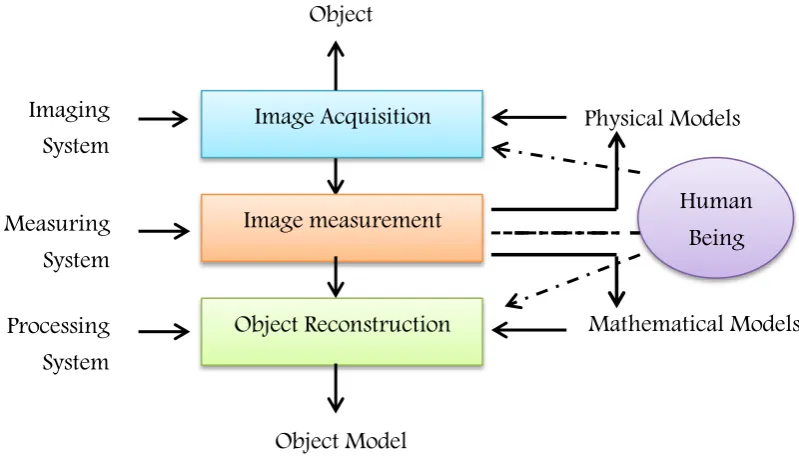
Photogrammetry is one method of image measurement and interpretation that abstract the shape and location of an object capturing on earth surface from one or more aerial images of that object. The principle of photogrammetry method can be implement for any situation or purposes where the object to be measured can be recorded directly. The primary of photogrammetry role is reconstruct of three-dimensional (3D) data comes from object acquired by any sources as well as digital images, drawings, map and others. The reconstruct of an object from images or photograph can be describe by the optical process which an image created using all elements that involve to this process such as light sources, properties of the surface object, the medium through which light travel, sensor, camera technology, image processing, film development and further processing as shown on Figure 1.1.
Figure 1.1: The photogrammetry process: From object to model (Luhmann et al., 2006) Physical Models Image Acquisition
Image measurement
Object Reconstruction
Object Model Object
Imaging System
Measuring System
Processing System
Mathematical Models Human
Because of wide varied application in photogrammetry field, exist one of new discipline field known as CRP. A CRP nowadays is towards the integration of photogrammetry components in oriented hybrid application system. The integration includes links to such as 3D AutoCAD system, database and information system, quality analysis and control system for production, navigation system for autonomous robot and vehicles, 3D visualization system, internet application, 3D animation and virtual reality. So that, this techniques capable for 3D measuring measurement because of its continued development long into the future. The CRP has become effectively as a tool for monitoring actively landslide and determines ground displacement over a long period of time by comparing of epoch data (Savvaidis, 2003).
This technique requires because of acquisition apparatus with high technology has been developed continuously and rapidly. Therefore, a real time observation data can be fully used with digital image technique rapidly and as a result, the stability and maintenance techniques for monitoring deformation on slope area can be easier, faster, save time and cost as well. Therefore, mostly new photogrammetry application increasingly to industrial metrology, quality control, monitoring, deformation survey which links have been created in other directions.
1.2 Problem Statement
Nowadays, many displacement monitoring points are usually set to obtain the displacement data to ensure slope stability. These data are typical nonlinear time series and it has high value about how to make use of displacement monitoring data to do the next step forecast analysis. Because of that, the suitable technique must be selected to monitor the slope displacement without directly measurement so that the real time data can be achieved. Photogrammetry has been used since long time to periodically control the evolution landslides either from aerial images (Casson et al., 2003) well as from ground (Cardenal et al., 2008) which combine with Global Positioning System (GPS) on the landslide body (Mora et al., 2003). For accurate landslide inventory and analysis of landslide properties the integration between information on landslide with other information such as aerial photo, geotechnical data and geodetic results are important because in-situ observation are needed to obtain detailed information on geological and mechanical properties of landslide.
The improvement of tools nowadays especially on monitoring and analyzing the instability of slope area will helps us to resolve a certain activity areas. The traditional measuring apparatus to check the stability of civil engineering structures and maintenance have being implement a long time because the result are applied for deformation and stability analysis of that structures. Junggeun Han concluded by the time, precision and micro measuring instrument has grown rapidly along with the advancement of technology today which changed from manual system to automatic. For example one of conventional and manual measuring method known as total station is transferred to digital photogrammetry with high technology development.
Chau as a typhoon shelter monitoring project, the survey division of Civil Engineering Department, Hong Kong Special Administrative Region has employed photogrammetric techniques to detect surface deformation of the rubble mound breakwater
Ground based or satellite based Interferometry Synthetic Aperture Radar (InSAR) (Leva et al., 2003; Colesanti and Wasimski, 2006) is also being used to monitor landslide which provide the kind of terrain allows for food coherence between multi temporal images and the main displacement component is along the line sight. Unfortunately, for a ground based needed a fixed and stable installation and monitoring so that the costing are relevant. However, the system is quite efficient and provides almost continuous monitoring over a large area with millimeter (mm) sensitivity.
Conventional technique as well as aerial photogrammetric mapping needed a good arrangement and planning for collecting data at field. So, time consuming very limited because of data collection took a long time and work to be completed as soon as possible. Thus, the selected technique bounded in CRP condition with the accuracy be assigned is more than adequate to evaluate slope displacement as well as quick enough in term of time limitation and not expensive. Besides that, today there is several low cost software’s that available on market that could be used in CRP application such as to calibrate the sensor, produce accurate measurement, generate 3D model and apply texture to the model. Rieke et al., (2009) reported that the latest digital camera types have included some features such as sensor vibration for removal of dust particles and sensor movement to reduce the effect of camera shaking during the image acquisition. Actually, these features could be possible caused instability of sensor position that not being allowed in photogrammetry field.
1.3 Objectives of Study
The aim of the study is to determine the effectiveness of digital CRP techniques to monitor slope displacement which causing landslide. Therefore, the following objectives are presented to achieve the aim:
a) To evaluate the effectiveness of a digital CRP in monitoring of the movement on slope area
b) To study the deformation characteristics in term of slope area using a digital close range and performed ground profiling which is cross section as well
1.4 Scope of Study
Monitoring of displacement for slope area is a crucial tool for the prevention of hazards. The choice of selecting an adequate monitoring system actually depends on the range of observed velocity, requires acquisition frequency, the desired accuracy and the financial constraint. Thus, the scopes of this study only focuses on deformation studies on slope area using a digital CRP and the details are described as follow:
a) In-Situ Data Observation
In this research, images are taken from different epoch by using a digital CRP to produce 3D image due to reasonable of costing and its suitability for measuring inaccessible and risky areas
b) Equipment
In this study, a non- metric camera Sony Cyber Shot DSC F828is selected to capture the slope area images by convergent technique retrieval image. The data from CRP has been used in this study because the accuracy of this technology is also acceptable for slope deformation monitoring.
c) Process
i. Camera Calibration
Camera calibration is the process of finding the true parameters of the camera parameters which consist a focal length (c), format size, principal point (Xp, Yp) and radial lens distortion (K1, K2, and K3).
ii. Software
Photo Modeler Scanner software is the special software that will be used in this study to undergo the process of calibration and other processing related to generate coordinate meanwhile Agisoft software being used for creating 3D model.
iii. 3D Modeling
The process of producing 3D image is undergoing after the calibration process is done. The parameter of the results will be used. The special software will be used to do the 3D image.
1.5 Significant of Study
The establishment of the CRP in deformation survey in real world of deformation survey is new and be able nation from its uses. Thus, there are several essential purposes of the study:
i. From the research, the effectiveness and useful of the digital CRP were determined and exposed especially on deformation studies of slope area.
ii. An alternative of low cost technique and tools for deformation studies on slope area and also to acquire digital images of a simulated model landslide.
iv. The suitability and effectiveness a digital CRP technique are utilize in deformation detection especially on monitoring slope movement also could be used for academic and scientific study especially for higher learning institution.
v. Implementation of non-metric camera in deformation studies also the use of PhotoModeler Scanner software as processing images could be used voted guideline for potential in the geological photogrammetry field.
1.6 Chronology of Study
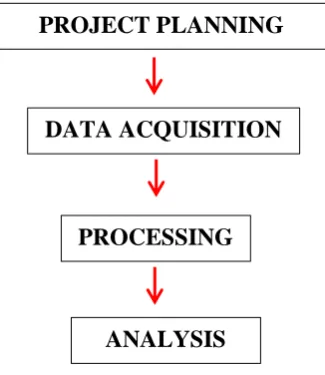
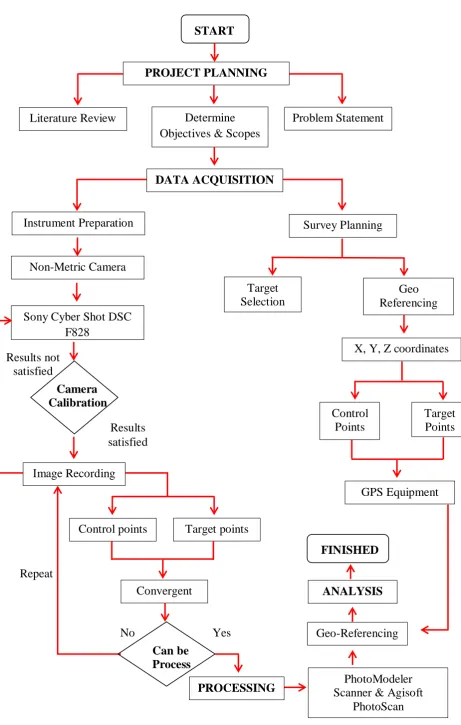
The operational framework is portrayed in four phases and detailed of the tasks are described shortly as Figure 1.2. The operational framework design is illustrated in Figure 1.3.
Figure 1.2: The four phase’s operational framework PROJECT PLANNING
DATA ACQUISITION
PROCESSING ][]’ ‘’[‘[‘’’ ANALYSIS
START Camera Calibration Can be Process PROJECT PLANNING Problem Statement Determine
Objectives & Scopes Literature Review
DATA ACQUISITION
Survey Planning Instrument Preparation
Non-Metric Camera
Sony Cyber Shot DSC F828 Geo Referencing ][]’ ‘’[‘[‘’’ Control Points Target Points X, Y, Z coordinates
][]’ ‘’[‘[‘’’ Image Recording Results satisfied Results not satisfied Control points ][]’ ‘’[‘[‘’’ Target points ][]’ ‘’[‘[‘’’ Convergent ][]’ ‘’[‘[‘’’ No ][]’ ‘’[‘[‘’’ Repeat ][]’ ‘’[‘[‘’’ Yes ][]’ ‘’[‘ [‘’’ PROCESSING ][]’ ‘’[‘[‘’’ PhotoModeler Scanner & Agisoft
PhotoScan Target Selection Geo-Referencing ][]’ ‘’[‘[‘’’ GPS Equipment ANALYSIS ][]’ ‘’[‘[‘’’ FINISHED
1.7 Thesis Outline
The thesis consists of five chapters and is describe briefly as follows:
Chapter 1:
This study is emphasizing of the deformation studies on slope area using a digital CRP. The natural disaster as well as landslide is an inevitable phenomenon in Malaysia. Therefore, this section has stated the introduction of this study including background of study, it objective in order to overcome the problem and discuss concisely about the study significant and the chronology of the operational framework.
Chapter 2:
This Chapter discusses about the overview of Deformation studies on slope area and the CRP techniques as a main issued according to study on the movements occurred at particular area. Then, discussion about the concepts used for detection of deformation on slope area. Since CRP is the main issue in this study, thus, this topic converse more in it including its parameter and survey application. Moreover, this topic confer the performance of CRP and processing workstation too.
Chapter 3:
The network design and designation of the monitoring points also cover in this section. This chapter also presents the observation procedure and analyses of processing CRP and ground profiling data for deformation studies on slope area phenomena using a non-metric camera Sony F2F 8, Photo Modeler Scanner software, Agisoft software and Statistical Package Social Science (SPSS).
Chapter 4:
These sections explain the analysis and discussion the work accomplished. The analysis consists of calibration results for CRP, elevation interpolation error, result for volume obtained by this technique, deformation studies detection of different epoch data and ground control profiling consist cross and long section for slope area
Chapter 5:
REFERENCES
Abdullah, C.H (2013). Landslide risk management in Malaysia. WIT Transcation on the Built Environment.
Atkinson, K.B. (1996). Close Range Photogrammetry and Machine Vision. Pp.1-52, Scotland: Whittles Publishing.
Bambang Kun Cahyono, Abdul Nasir Matori. Landslide Detection on Slope Area by using Close
Range Photogrammetry Data. Departmnet of Geodesy and Geomatic Engineering Gadjah Mada
University and Department of Civil Engineering, Univsiti Teknologi Petronas.
Bertacchini, E.Capra,Castagnetti, C.and Rivola, R.(2012). Investigating an Active Rockslide by
Long Range Laser Scanner: Alignment Strategy and Displacement Identification. FIG Working
Week 2012. May 6-10.Rome, Italy:FIG 1-13.
Bujakiewicz A, Kowalczyk M., Podlasiak P., Zawieska D., (2008). Automatic Maching of Sculpture Fragments as Modern Tool for Archeological verification of Hypotheses on their
Origin. International Archives of Photogrammetry and Remote Sensing, Volume XXXVII, B5,
Beijing.
Cardenal, Mate, Castro, Delgadi, Hernandez, M.A Perez, J.L, Ramos, M and Torres. (2004). Evaluation of a digital non metric camera (Canon D30) for the photogrammetric recording of historical building, International archives of photogrammetry, remote sening and spatial
Chong Luh Lau, Halim Setan, Zulkepli Majid, Mohd Azwan Abbas, Mimi Diana Ghazali, Albert K.Chong. (2014). An Investigation of the Optimal Resolution for Landslide Monitoring using
Terrestrial Laser Scanner. FIG Congress 201.
C.L.Zhou, H.H.Zhu. A Study of the Application of Digital Photogrammetry on Slope Monitoring
during Operating Period. Department of Geotechnical Engineering, Tongji University Shanghai,
China 74 .
Dimitar Jechev, (2004). Close Range Photogrammetry with amateur camera. Commission V, WG V/4. Bulgaria.
Efstratios Stylianidis, Petronas Patias, Vassilios Tsioukas, Lazaros Sechidis and Charalambos Georgiadis.(2003). A Digital Close Range Photogrammetric Technique for Monitoring Slope
Displacement. Proceeding 11th FIG Symposium on Deformation measurement, Santorini,
Greece.
Habrouk H.E., Li, X.P., Faig, W., (1996). Determination of Geometric Characteristics of a
Digital Camera by self-calibration, International Archives of Photogrammetry and Remote
Sensing, Volume XXXII, Part B1, Vienna, pp.60-64.
Han, J. G.; Bae, S. H. & Oh, D. Y. (2001). Application of photogrammetry method to measurement ground-surface displacement on the slope, J. Korean Env. Res & Reveg. Tech, Vol.4, no.3, pp. 10-18, ISSN 1229-3032 (in Korean).
Han, J. G.; Chang, K. H.; Jang, G. C.; Hong, K. K.; Cho, S. D.; Kim, Y. S.; Kim, J. M. & Shin, Y. E. (2008). Development of a Visual Monitoring System for Deformation Measuring of Welded
Members and Its Application, Materials Science Forum, Vols. 580-582, pp.557-560, ISSN
1662-9752.
Han, J. G.; Hong, K. K.; Kwak, K. S. & Cho, S. D. (2005). Simulation Evaluation of Visual
Monitoring System for The Dam Measuring, Proceedings of KSCE 2005 Conference, pp.
3982-3985, Jeju Special Self-Governing Province, Korea, October 20-21, 2005 (in Korean).
Han, J. G.; Hong, K. K.; Kim, Y. S.; Cho, S. D. & Kwak, K. S. (2007). Development of Automatic Displacement Measuring System using 3D Digital Photogrammetry Image and Its Application, Journal of the Korean Geotechnical Society, Vol.23, No.5, pp. 1-10, ISSN 1229-2427 (in Korean) 75.
Han, J. G.; Jeong, Y. W.; Hong, K. K.; Cho, S. D.; Kim, Y. S. & Bae, S. H. (2006). Displacement Measuring Lab. Test of Reinforced-Soil Retaining Wall Block using 3D Digital
Photogrammetry Image, Journal of the Korean Geosynthetics Society, Vol. 5, No. 3, pp. 45-52,
ISSN 1975-2423 (in Korean).
I.D.Wallace, N.J.Lawson, A.R.Harvey, J.D. Jones, A.J. Moore, (2005). High speed close range
photogrammetry for dynamic shape measurement in 26th International Congress on High Speed
Photography and Photonics, vol.5580.pp.358-366.
Jamaludin, S.Ali, F.H (2013). Overview of some empirical method to correlate rainfall and shallow landslide and application in Malaysia.
Junggeun Han, Kikwon Hong and Sanghun Kim. (2012). Application of a Monitoring Civil Engineering Structures, School of Civil and Environmental Engineering, University, Seoul Jing, W.(2012). Cell-Based Deformation Monitoring via 3D Point Clouds. Swiss Federal Institute of Technology – Lausanne (EPFL): Thesis Doctoral of Computer Science.
Karperski, J.Delacourt, C.Allemand.P.Potherat. P. Jaud .M and Varrel, E. (2010). Application of a Terrestrial Laser Scanner (TLS) to the Study of the Sechilienne Landslide (Isere, France).
Mangold, Schmidt, Christopher, Stephen N., Matthew W., (1995). Excavation of three historic family cemeteries in southwestern Indiana. Abstract of a paper presents at the 2nd Annual meeting of Midwest Bioarcheology and Forensics Anthropology association., University of Indianapolis Archeology and Forensics Laboratory.
Moore, J.F.A. (1992). Monitoring Building Structures. Blackie and Son Ltd.
Pan, M and Zhu, G. (2010). International Conference on Optoelectronics and Image Processing 76.
Paul R.Wolf and Bon A. Dewitt, (2000). Elements of Photogrammetry with application in GIS. Mc Graw Hill, new York.
P.D.Savvaidis. (2003).Existing Landslide Monitoring System and Technique. School of Rural and Surveying Engineering, The Aristotle University of Thessaloniki.
Remondino, F., and C.S. Fraser, 2006. Digital camera calibration methods: Consideration and comparison. In IAPRS & SIS. Vol. 36, part 5, pp.266-272.
Remondino, F and Fraser, C. (2006). International Archives of Photogrammetry Remote Sensing and Spatial Information Sciences. 266-272.
Rieke-zapp, D., Tecklenburg, W., Peipe, J., hastedt, H., Haig, C., (2009). Evaluation of the geometric stability and the accuracy potential of the digital cameras comparing mechanical stabilization versus parameterization. Institute of Geological Sciences, University of Bern, Switzerland.
Measurement For Engineering, Archiwum Fotogrametri, Kartografii I teledetekcji, vol. 11, pp.3/25 – 3/32
Sui, L.Li J.Wang, X and Zhao, D. (2009). Monitoring Landslide Dynamics using Multitemporal
Terrestrial Laser Scanning Data. Second International Conference on Earth Observation for
Global Changes. Proceeding of SPIE, Volume 7471. May 25-29. Chengdu, China: SPIE, 1-7
Talib. K.& Taha, M.R.(2005). Active Landslide Monitoring and Control in Kundasang Sabah,
Malaysia. Map Asia 2005.
Tiang Sheng Li. (2005). New Technique research of Digital Photogrammetry and Monitoring
data processing in Tunnel and Underground space structure distortion, Shanghai Jiao Tong
University 77.
T.Luhmann, S.Robinson, S.Kyle,.I.Harley, (2007). Close Range Photogrammetry principles,
Methods, and Appication, first ed. Whittles publishing, Dunbeath, Scotland.
Wolf, P.R, & Dewitt, B.A (2004). Elements of Photogrammetry with GIS application.
International Edition. Third Edition McGraw Hill, pp.307-409.
W.Bosemann.(2005).Advances in Photogrammetric Measurement Solution, Computers in Industry 56 (8) 886-893.
Yang, Z J Chen, F, Zhao, J and Zhao, H W. (2008). 3rd IEEE Conference on Industrial Electronics and Application. 2222-2227.
Z.Othman,W.A.Wan Aziz, Anuar.(2012) Landslide monitoring at Hillside Residential area
using GPS static and inclinometer techniques. Proc.SPIE 8334, Fourth international Conference