JDDJ!.!3117
QUALITY MANAGEMENT SYSTEM IN CONSTRUCTION
Abdul Hakim bin Mohammed1 dan Mat Naim bin Abdullah @ Asmoni2
1
Universiti Teknologi Malaysia, Skudai, 81310 Johor Bahru Johor, Malaysia
[email protected], [email protected]
ABSTRACT: This paper describes the Quality Management System (QMS) concept and its
application in the construction industry. A misunderstanding among the construction players on the QMS concept has become the stumbling block for its successful implementation. QMS could be implemented either at the company level or at the project level. The researches on the company-based QMS in construction can be considered as comprehensive in view of the various aspects of implementation have been studied. While many studies have been done on the company-based QMS, study on the project-based QMS is lagging behind. Notwithstanding the claims that the construction organisations enjoyed the benefits and advantages of being an ISO 9000 certified are literally proven, the main objective of QMS implementation namely the achievement of customer satisfaction in the construction projects is still at large. At the project level, QMS requires Project Quality Plan (PQP) as part of the system. PQP is also not well understood by the industry players and consequently the implementation of PQP faces a lot of problems. The significant information to be considered in developing, implementing and maintaining the PQP are the project policy and objectives, the process, the process owners and the work procedures. PQP could be developed either individually for each party of the project or as an integrated documents for all parties of the project team.
Keywords: Quality Management System, Project Quality Plan, Construction
1. INTRODUCTION
For the past decade, the Malaysian construction sector has been going through a
radical change driven by the (ISO) quality policy of the Malaysian government.
Recently, the number of contractors obtaining certification of ISO 9000 Quality
Management System (QMS) is ever increasing. However, this progress is seemed to
be a drastic response to the constant pressure and reminder made by the Ministry of
Works and quality awareness and Do It Yourself (DIY) programs organized by the
Construction Industry Development Board (CIDB). However, with insufficient
experience on ISO quality implementation within the Malaysian environment, the
construction participants are staggered with several performance-related problems.
The pressure also comes from the ongoing process of economic globalisation.
Experiences learned from other countries such as United Kingdom, Singapore and
Hong Kong revealed that QMS implementation was very encouraging at the initial
stage but over a time period became burdensome to all parties involved if the right
approaches were not adopted (Giles R. 1997, Chong 1994, Kam and Tang 1997, Low
and Goh 1994). In the United Kingdom, some of the construction industry clients
made it compulsory that the contractors implement ISO quality system in their
organizations to qualify for participating in the bids (Giles, 1997). As a result, a
JDDJ!.!3117
certification. Consequently, marketing and customers’ insistence have become the key
factors driving the ISO implementation, which are generally short-lived (Pateman
1994). The quality consultants might further worsen the situation as many of them are
not from the construction background, hence do not understand the construction
process (Giles, 1997). The organisations will normally trap in the vicious circle of
compliance that creates lack of flexibility, emphasis on bureaucracy and paperwork
and deficiency in quality improvement (Karapetrovic 1999). In addition, resistance to
change in implementing the new system will create a chaotic situation (Al-Nakeeb and
Mustapha 1994). As a result the implementation of the ISO system will not earn
benefit to the company and neither will bring satisfaction to the customer.
2. OBJECTIVES
This paper aims to explain the concept of QMS and PQP in the construction industry
as follows:
Quality Management System (QMS) in construction
i. Company based QMS
ii. Project based QMS
Project Quality Plan (PQP) in construction
i. Individual PQP
ii. Integrated PQP
3. QUALITY MANAGEMENT SYSTEM IN CONSTRUCTION
ISO 8402, the vocabulary of quality defined quality management as “all activities of
the overall management function that determine the quality policy, objectives and
responsibilities, and implement them by means such as quality planning, quality
control, quality assurance and quality improvement, within the quality system”.
Meanwhile, the definition of quality system according to ISO 8402 is “the
organizational structure, responsibilities, procedures and resources needed to
implement quality management”.
Combining the definitions of ‘quality system’ and ‘quality management’ thus
concludes that QMS is the interaction of people, processes and documentation to meet
both customers’ stated and implied needs. The result would be a reduction in
inefficiencies and waste, improved work practices, increased morale and the
JDDJ!.!3117
implementation of QMS which ones should perceive it as a wide-scale failure
prevention programme that will lead to costs savings.
3.1 Company Based QMS
The industry had lived in the quality programme of inspection and quality control for
years. Construction materials and construction works were accepted or rejected base
on the inspection and quality control. However, the introduction of BS 5750: Quality
Systems in the UK in 1980’s had changed the perception of the construction industry’s
peoples in managing quality in construction environment. The introduction of ISO
9000 in the same period had accelerated the process of introducing the quality
management concept to the construction world. ISO 9000, being an international
standard for quality system, has been very popular to be used as quality assurance
system. Many international construction clients especially the Europeans require their
construction team to be registered with the scheme that it is appeared as the ISO 9000
registration is a mandatory if an organisation wish to venture in Europe.
However as construction is a project-based industry, the success of QMS
implementation should not be measured at the company level rather the benefits
should be extended to the project level. The following sections discuss on the
implementation of QMS at company and project level. A review on the literature
regarding the QMS in construction over the last ten years showed many studies had
been focussed on the company-based QMS. The majority of the studies were on the
ISO 9000 QMS. The focal points of the study on the implementation of ISO 9000
QMS in construction organisations were on the applicability, benefit and obstacles of
implementing it. Another popular approach was many researchers reported the
findings of their study in their country such as Bray (1995) for the USA, Low and
Henson (1997) for Singapore, Kam et al (1997) for Hong Kong, Giles (1997) for the
UK, Hung (1999) for Taiwan, Abdulaziz and Tawfiq (1999) for Saudi Arabia and
Wan Yusof et al (1994) for Malaysia.
During the 1990’s many researchers reported the benefits and advantages
enjoyed by an ISO 9000 certified construction companies and some also highlighted
the problems encountered by the companies especially at the initial stage of ISO 9000
implementation (Low and Goh, 1994; Eltigani and Djebarni, 1996; Low and Henson,
1997; Hareton et al, 1999; Abdulaziz and Tawfiq, 1999 and Tat et al, 1999). In
JDDJ!.!3117
as communications would be improved; reduce rework; time and money would be
saved; increase work performance; and increase market share.
Various obstacles in the implementation of the ISO 9000 construction
industry had also been identified by the some researchers (Low and Goh, 1994; Wan
Yusoff et al, 1994; Oakland and Aldridge,1995; McCabe, 1996 Low and Hennie,
1997; Giles, 1997; Abdulaziz and Tawfiq, 1999). Some of the obstacles are
resistance to change; misconception of the ISO 9000 quality system; quality
perceived as something secondary to the business; scheme may have appeared too
complex; lack of understanding of the ISO 9000 quality standards; high cost
especially the initial cost; loss of productivity of the workforce due to the effort
exerted in learning and implementing the new system besides their regular duties;
absence of special regulation that make it incumbent upon contracting companies to
establish and implement QMS; no encouragement from the construction industry
clients; and difficult to apply to the construction industry.
The researches on the company-based QMS in construction can be
considered as comprehensive in view of the various aspects of implementation have
been studied, for instances measuring the effectiveness of the QMS in construction
organisations by Al Nakeeb et al (1998) and Low et al (1999); QMS and
productivity in construction organisations by Eltigani and Djebarni (1996); training
programme under QMS for construction organisations by Lo (1998); quality costs
for construction organisations by Low and Henson (1998) and Davis (1987); legal
implication of QMS on construction organisations by Netto et al (1997); and QMS
and quality culture in construction organisations by Low and Winifredo (2001).
While many studies have been done on the company-based QMS, study on the
project-based QMS is lagging behind. Notwithstanding the claims that the
construction organisations enjoyed the benefits and advantages of being an ISO 9000
certified are literally proven, the main objective of QMS implementation namely the
achievement of customer satisfaction in the construction projects is still at large. The
reason being and the detail explanation are provided in the next section.
3.2 Project-based QMS
In reality there is no such term as ‘Project-based QMS’. ISO 9000, TQM or any
quality programmes are organisation-based. The reason is all quality programmes are
JD
D
J!
.!
3
1
1
7
single entity. This situation is not typical in construction industry. Construction is a
project-based industry where different parties work together to achieve the quality of
the construction works. Barrett and Grower (1998) had figured out that for those
companies that have achieved certification, the actual impact on the quality of the
service from the client’s viewpoint has been only slightly positive and does not
correlate in any way to the importance of the factors such as accessibility of personnel,
appearance of staff, client’s technical input, frequency of communications, interest and
enthusiasm of professional, politeness of support personnel, professionalism
demonstrated, speed of response of client’s needs, standard of presentation, technical
correctness of service, understanding of client’s organisation and understanding of
client’s problems.
The traditional way of managing the relationship between the parties involved in
the construction works is through the contract agreement. The existing contract
agreement is normally based on the traditional roles and authorities that have been
accepted and recognised by the industry. The emerging of the QMS concept if
successfully adopted by the contractors (being an internal system) could indicate the
removal of external quality controls (inspection and testing by the architect, engineer
or clerk of works) traditionally practiced in building contracts (Netto et al, 1997).
Some researchers suggested that amendment should be done on the existing forms of
contract (Low and Goh, 1994 and Leon, 1994) and others such as Nesan (1995)
suggested a contract structure that fit the partnering arrangement should be
developed to cater the TQM environment. The above difficulties on the QMS
implementation in a construction project do not suggest that QMS should not be
implemented at the project level but rather reinforce its implementation as the
evidences are strong enough to support that the certified companies had enjoyed
benefits by implementing it at the company level. The next section discusses the
concept of project quality plan as a system that is essential for a construction project.
4. PROJECT QUALITY PLAN (PQP)
Being a project-based QMS document and originated from ISO 9000 standards, PQP
is designed to ensure the success of quality programme at project level. Therefore, it is
imperative to understand the concept of PQP and value it as a system rather then a
segment of a system. The PQP for the individual organisation is similar to the QMS
JDDJ!.!3117
QMS at project level, its successful and effective implementation in terms of quality
definition should be in tandem with the overall project objective and clear demarcation
of duties and responsibilities between the construction parties.
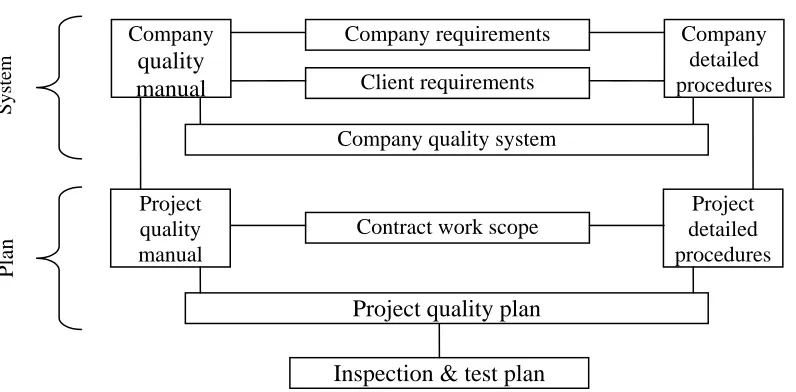
The overall concept of a quality management in an organisation is shown in
Figure 1 (Stebbing, 1993). As shown in Figure 1, Stebbing (1993) divided the QMS
into two tier namely the company quality system and PQP. Company quality system
comprises of company quality manual and procedures that are developed based on the
company and client’s requirements. A similar process is copied in order to develop the
PQP but the project quality manual and procedures are established based on the
company manual and procedures and as well as the contract work scope. As such the
PQP will have the same elements as the company quality manual, and apart from that
will contain additional documentation and procedures pertaining to that particular
project (Stebbing, 1993). Therefore it is essential to understand the quality manual in
order to develop the PQP.
It is a formal requirement of ISO 9000 to produce quality manual. It is usually
defined as a document setting out the general quality policy, procedures and practises
of an organisation (Stebbing, 1993). The main purpose of a quality manual is to
describe what to be done and how an organisation meets the requirements of ISO 9000
through the quality system in place, as well as providing a cross reference to other
parts of the system (Ashton and Jackson, 1995). Key elements in a quality manual are
quality policy statement, authority and responsibility, organisation structure and
objectives and the summary of the firm’s standard operational procedures. Because the
quality manual will be the basis of developing the PQP, the content should be similar
to the quality manual with emphasis given to project level. Thus, the general content
of the quality plan is project quality policy statement, project organisation structure
with specific authority and responsibility of each department and key personnel and
day to day standard operating procedures together with work instructions.
Thus, the project quality manual should contain the followings:
(a) The policy statement that will reflect the quality policy of the project and
will be signed by the project or contract manager;
(b) Responsibilities will be defined to reflect the requirements of the project
or contract;
(c) The organisation will relate to the project and may include customer
JDDJ!.!3117
(d) The amendments and reissue will conform to contract requirements;
(e) The system outlines will address the applicable criteria of the quality
standard specified in the contract; and
(f) The procedure index will identify only those procedures applicable to the
contract.
Company
quality
manual
Company requirements
Client requirements
Project quality manual
Company quality system
Inspection & test plan
Project quality plan
Contract work scope
Project detailed procedures
Company detailed procedures
System
Plan
Figure 1. Organisation Quality System and Plan (Source: Stebbing, 1993)
He added that besides the above features, the fundamental procedures for an
organisation to operate at the corporate level should also be included in the PQP.
The fundamental procedures should address the functions of administration; finance;
document control; record storage, retention and retrieval; planning (contract review);
corrective action; audits; Training; and customer liaison. To sum up, the significant
information to be considered in developing, implementing and maintaining the PQP
are the project policy and objectives, the process, the process owners and the work
procedures.
4.1 The Individual PQP
A PQP is normally prepared by the Project Manager and the Site Quality
Co-ordinator. The person in-charge of the quality system, usually the Project Manager
and/or the Site Quality Co-ordinator will initiate the preparation of a PQP. It will
involve changes to the existing Quality System with the advice from the contract staff.
Project inspection and test plan supplied by the client specifically for the project will
JDDJ!.!3117
After the PQP is prepared, it will be checked and reviewed by the Project
Manager where he will add check and witness points before he signs off for
acceptance. With the acceptance signature by the Project Manager, the PQP will be
implemented and upheld by the contract staff at site. Subsequent monitoring will be
carried out by the Site Quality Co-ordinator to verify that all staffs are following the
PQP on site. After verifying through inspection that the PQP is successfully
implemented, the Project Manger shall give the thumbs up for the PQP to be
documented into records.
4.2 The Integrated PQP
In general the process of the construction projects can be divided into five stages
namely briefing (conceptual), design, tendering (procurement), construction and final
inspection (Costantini et al, 1994). In order to manage quality, each stage of the
process through which the construction project evolves must be defined and their
influences upon quality determined. Judging on this basis, Hill (1987) divided the
quality aspects of construction project into four categories: Quality of the design
process; Quality of the construction process; Quality of the products; and Quality of
maintenance.
In terms of construction life cycle quality, the above quality requirements place
responsibility upon the above five main parties involved in construction to effectively
communicate with each other and work together as a team as the conceptual
framework and structure for promoting their strategy and efforts towards improving,
not only through their own excellence but also through the synergetic contribution
towards improving the quality of the project.
The responsibility to work as a team is more critical during the construction
stage because more parties participated in the construction works compared to
previous stages. For instance, under the traditional contract, at briefing and tendering
stages it is usual for the client, his representative and the design consultant to be
involved. However at the construction stage, the client, his representative, the
consultant, the contractors, the subcontractors and even the suppliers are participated
but subject to their degree of involvement. The interfaces between the individual
systems should be well planned, implemented and tightly controlled. This led to the
JDDJ!.!3117
Hence, the use of an explicit project quality plan (PQP) is called for. This PQP is a
document attributed to QMS for a particular project. Sjoholt (1995) illustrated the
arrangement of the PQP as shown in Figure 2.
Figure 2 shows that the customer’s QMS is the prime document to tie the
subsequence QMS from other parties. As QMS deals with goal congruent, synergetic
effort and clear processes and procedures, the customer shall set up his objectives,
his requirements for the quality system, line of communication and delegation of
duties and responsibilities clearly in his QMS. The rest shall institute their QMS
accordingly. For construction project this means the customer or his representative
shall be the champion and the maintainer of the PQP. He shall ensure the adequacy
of the PQP against the specified requirements and compliance of activities of the
parties against the PQP (Costantini et al, 1994).
Project Quality Plan (PQP)
Customer’s QMS
Designer’s QMS
Contractor’s QMS
Sub-contractor’s QMS
Supplier’s QMS
Figure 2. The Integrated Project Quality Plan (PQP) (Adopted from Sjoholt, 1995)
The PQP integrates the individual QMS of parties involved in the construction
project who are bound through a contractual agreement. Therefore besides
construction drawings and specification of a particular project, the PQP should also be
drawn up according to the contract document (Yeoh and Lee, 1996) in order to have a
common source of client’s requirements and to understand the obligations of and
relationships between the parties.
5. SUMMARY
This paper describes the Quality Management System (QMS) concept and its
JDDJ!.!3117
QMS and project based QMS. Project based QMS requires project quality plan (PQP)
as part of the system. At the end, the paper explains individual PQP and integrated
PQP.
6. REFERENCES
Abdulaziz A.B. and Tawfiq, H.A. 1999. ISO 9000 quality standards in construction. Journal of Management in Engineering, Nov/Dec, pp 41-45
Al Nakeeb, A.A.R. and Mustapha, F.H. 1994. Quality assurance in construction – does it really works?. Quality Management in Building and Construction: Proceedings of Eureka Conference, Hamar/Lillehammer, June, pp 242-247.
Barrett, P.S. and Grower, R 1998, Quality Assurance and Surveying Professional, 3 vols, RICS, London.
Chong, T.T. 1994. Quality management in the construction industry – the Singapore experience. Quality Management in Building and Construction: Proceedings of Eureka Conference, Hamar/Lillehammer, June, pp 55-60.
Eltigani, H. and Djebarni, R. 1996. Achieving quality and productivity in the house building sector. Property Management, Vol. 14 No. 1, pp 39-45.
Giles, R. 1997. ISO 9000 perspective for construction industry in the UK. Training for Quality, Vol. 5 No. 4, pp 178-181.
Griffith, A. 1990. Quality assurance in building. Macmillan. Basingstoke. UK.
Hareton, K.N.L., Keith, C.C.C. and Tat, Y.L. 1999. Costs and benefits of ISO 9000 series: a Practical Study. International Journal of Quality & Reliability Management, Vol. 16 No. 7, pp 675-690.
Hung C.C. 1999. A study of factors affecting the implementation of ISO 9000 in Taiwan’s construction industry (China), PhD Thesis, University of Iowa, Iowa.
Kam, C.W. and Tang, S.L. 1997. Development and implementation of quality assurance in public construction works in Singapore and Hong Kong. International Journal of Quality & Reliability Management, Vol. 14 No. 9, pp 909-928.
Karapetrovic, S. 1999. ISO 9000: the system emerging from the vicious circle of compliance. The TQM Magazine, Vol. 11 No. 2, pp 111-120.
Low, S.P. and Goh, K.H. 1994. Construction quality assurance: problems of implementation at infancy stage in Singapore. International Journal of Quality & Reliability Management, Vol. 11 No. 1, pp 22-37.
Low, S.P. and Hennie, F.O. 1997. The effective maintenance of quality management systems in the construction industry. International Journal of Quality & Reliability Management, Vol. 14 No. 8, pp 768-790.
Low, S.P. and Henson, K.C.Y. 1997. ISO 9000 Quality Assurance in Singapore’s Construction Industry: An Update. Structural Survey, Vol. 15. No. 3, pp 113-117. Low, S.P. and Henson K.C.Y. 1998. A construction quality costs quantifying system for the
building industry. International Journal of Quality & Reliability Management, Vol. 15 No. 3, pp 329-349.
Low, .P. and Winifredo, M.A. 2001. Cross-cultural influences on quality management systems: two case studies. Work Study Vol. 49 No. 4, pp. 134-144.
McCabe, S. 1996. Creating excellence in construction companies: UK contractors’ experiences of quality initiatives. The TQM Magazine. Vol. 8. No. 6, pp 14-1996. Netto, A.M., Low, S.P. and Lo, A.L. 1997. Legal implications of ISO 9000 in standard forms
of building contract. Training for Quality, Vol. 5 No. 4, pp 169-177.
JDDJ!.!3117
Oakland, J.S. and Aldridge, A.J. 1995. Quality management in civil and structural engineering consulting. International Journal of Quality & Reliability Management, Vol. 12 No. 3, pp 32-48.
Randall, R.C. 1995. Randall’s practical guide to ISO 9000 implementation, registration and beyond. Addison-Wesley Publishing Co. Massachusetts.
Sjoholt, O. 1995. From quality assurance to improvement management, Project Report 189, Norwegian Building Research Institute, Oslo.
Stebbing, L. 1993. “Quality Assurance: The Route to Efficiency and Competitiveness.” 3rd ed. Great Britain: Ellis Horwood Limited.
Tat,Y.L., Hareton, K.N.L. and Keith, C.C.C. 1999. Improving quality management on the basis of ISO 9000. The TQM Magazine, Vol. 11 No. 2, pp 88-94.