COMBINED EFFECT OF TRUST, COMMITMENT AND SUPPLIER DEVELOPMENT ON BUYER-SUPPLIER PERFORMANCE IN TEXTILE
INDUSTRY
AMER RAJPUT
A thesis submitted in fulfilment of the Requirements for the award of the degree of
Doctor of Philosophy (Management)
Faculty of Management
UNIVERSITI TEKNOLOGI MALAYSIA
COMBINED EFFECT OF TRUST, COMMITMENT AND SUPPLIER DEVELOPMENT ON BUYER-SUPPLIER PERFORMANCE IN TEXTILE
INDUSTRY
AMER RAJPUT
A thesis submitted in fulfilment of the requirements for the award of the degree of
Doctor of Philosophy (Management)
Faculty of Management Universiti Teknologi Malaysia
iv
ACKNOWLEDGEMENTS
Praise is due to ALLAH, the Compassionate, the Merciful, the Source of all knowledge and wisdom who bestowed upon me health and thought. During the preparation of my thesis, many persons, researchers, academicians and practitioners supported me to complete the task of research. Particularly I wish to express my sincere appreciation to my thesis supervisor, Professor Dr. Abdul Hamid Abu Bakar for encouragement, guidance, advices, valuable critics, motivation and friendship. Without the persistent guidance and support of my supervisor, it would not have been possible to complete this thesis.
ABSTRACT
vi
ABSTRAK
TABLE OF CONTENTS
CHAPTER TITLE PAGE
DECLARATION ii
DEDICATION iii
ACKNOWLEDGEMENT iv
ABSTRACT v
ABSTRAK vi
TABLE OF CONTENTS vii
LIST OF TABLES xiv
LIST OF FIGURES xvii
LIST OF ABBREVIATIONS xxiii
LIST OF SYMBOLS xx
LIST OF APPENDICES xxi
1 INTRODUCTION 1
1.1 Introduction 1
1.2 Background of the Problem 7
1.3 Statement of the Problem 10
1.4 Research Questions 13
viii
1.6 Research Scope 14
1.7 Significance of Study 15
1.8 Definition and Description of Terms 17
1.8.1 Supplier Development 17
1.8.2 Indirect Supplier Development 17 1.8.3 Direct Supplier Development 18
1.8.4 Buyer-Supplier Performance 19
1.8.5 Trust 20
1.8.6 Commitment 21
1.9 Layout of Thesis 21
1.10 Summary 23
2 LITERATURE REVIEW 25
2.1 Introduction 25
2.2 Theoretical Foundations 26
2.2.1 Goal-setting Theory 27
2.2.2 Influence Strategy 30
2.2.3 Transaction Cost Theory 31
2.2.4 Knowledge Based View 33
2.3 Overview of SCM 35
2.3.1 SCM in Various Industries 36
2.3.2 SCM in Textile Industry 37
2.3.3 Categories of SCM 38
2.4.3 Supplier Development in Various
Industries 46
2.4.4 Supplier Development in Textile Industry 48 2.4.5 Elements of Supplier Development 50 2.4.6 Benefits and Outcomes of Supplier
Development 53
2.4.7 Supplier Development Issues and Barriers 58 2.4.8 Supplier Development (ISD and DSD)
Approaches 60
2.5 BSP and Supplier Development 63
2.6 Trust and Commitment during Supplier
Development 77
2.7 Trust 78
2.7.1 Nature of Organizational Trust 80 2.7.2 Importance of Interorganizational Trust 82 2.7.3 Buying Firm’s Trust in Perspective of
Supplier Development 83
2.8 Commitment 89
2.8.1 Nature of Organizational Commitment 92 2.8.2 Importance of Interorganizational
Commitment 93
2.8.3 Buying Firm’s Commitment in
Perspective of Supplier Development 95
2.9 Synthesis of Literature Review 103
2.10 Summary 105
3 RESEARCH FRAMEWORK 107
x
3.2 Prior Research Frameworks of Supplier
Development 108
3.3 Research Framework 114
3.4 Theoretical Foundations of Research Framework 116
3.5 Hypotheses 121
3.5.1 Effect of Indirect Supplier Development
Approach on Buyer-Supplier Performance 121 3.5.2 Effect of Direct Supplier Development
Approach on Buyer-Supplier Performance 122 3.5.3 Combined Effects of Buying Firm’s Trust
with Indirect Supplier Development and Direct Supplier Development Approaches
on BSP 124
3.5.4 Combined Effects of Buying Firm’s Commitment with Indirect Supplier Development and Direct Supplier
Development Approaches on BSP 126
3.6 Summary 127
4 RESEARCH METHODOLOGY 129
4.1 Introduction 129
4.2 Quantitative Research Design 130
4.3 Operational Models of Research Framework 133
4.4 Instrumentation 134
4.4.1 Measures of Indirect Supplier
Development 135
4.4.4 Measures of Buying Firm’s Trust and
Commitment 137
4.5 Test of Survey Instrument 140
4.5.1 Reliability of Survey Instrument 140 4.5.2 Validity of Survey Instrument 140
4.6 Population and Sampling Procedure 142
4.7 Unit of Analysis 145
4.8 Data Collection Method 146
4.9 Data Analysis Techniques 148
4.9.1 Descriptive Analysis of Data 148
4.9.2 Factor Analysis 148
4.9.3 Correlation Analysis 148
4.9.4 Regression Analysis 149
4.9.4.1 Linear Regression Analysis 149 4.9.4.2 Hierarchical Regression
Analysis 150
4.10 Pilot Test 151
4.11 Results of Pilot Test 152
4.12 Summary 153
5 FINDINGS 157
5.1 Introduction 157
5.2 Responses and Descriptive Analysis 158 5.3 Assessment of Data Entry and Missing Data 159
5.4 Profile of Respondents and Firms 160
xii
5.5 Measurement Results of Research Variables 168
5.6 Normality Test 175
5.7 Non-Response Bias 176
5.8 Reliability Analysis 177
5.9 Validity Analysis 178
5.10 Results of Factor Analysis 180
5.11 Common Method Bias 186
5.12 Assessment of Multicollinearity 187
5.13 Results of Correlation Analysis 188
5.14 Results of Research Questions in Perspective of
Correlation 190
5.15 Hypotheses Testing 192
5.15.1 Hypotheses Testing for Effects of Supplier
Development Approaches on BSP 192 5.15.2 Hypotheses Testing for Combined Effects
of Buying firm’s Trust and Buying Firm’s Commitment with Supplier Development
Approaches on BSP 193
5.16 Summary 202
6 DISCUSSION AND CONCLUSION 204
6.1 Introduction 204
6.2 Description of Final Constructs for the Hypotheses
Testing 205
6.3 Discussion of Findings 207
6.4 Discussion for Effects of Supplier Development
6.4.1 Discussion for Effect of ISD Approach on
BSP 211
6.4.2 Discussion for Effect of DSD Approach
on BSP 212
6.5 Discussion for Combined Effects of Buying Firm’s Trust with Supplier Development Approaches on
BSP 214
6.6 Discussion for Combined Effects of Buying Firm’s Commitment with Supplier Development
Approaches on BSP 216
6.7 Contributions of Study 217
6.8 Implications 219
6.9 Limitations of Research 220
6.10 Future Research 221
6.11 Conclusion 222
6.12 Publications 224
REFERENCES 225
Appendices A – D 267-274
xiv
LIST OF TABLES
TABLE NO. TITLE PAGE
1.1 Growth performance of industries for Pakistan 4
1.2 Growth rate of LSM 5
1.3 Pakistan’s textile share in world trade 6
2.1 Supplier development in textile industry 49
2.2 Supplier development elements 55
2.3 Benefits of supplier development 57
2.4 Contrast of reactive and strategic approaches 62 2.5 Summary of buyer-supplier relationship studies 75
2.6 Conceptual perspective of BSR 79
2.7 Summary of studies on trust 90
2.8 Summary of studies on commitment 101
3.1 Summary of criteria for supplier development 110
4.1 Quantity of items for each variable 138
4.2 LSM firms as representative population 143
Factor analysis 154
5.1 Research questions 158
5.2 Overall response rate with each stratum 160
5.3 Profile of respondents and firms 162
5.4 Overall ANOVA results of mean differences among ISD, DSD, TRT and CMT on organization size 164 5.5 Tuky HSD multiple comparison of TRT with
Organization size 165
5.6 Overall ANOVA results of mean differences among ISD, DSD, TRT and CMT on relationship length 166 5.7 Tuky HSD multiple comparison of DSD with
Relationship length 167
5.8 Tuky HSD multiple comparison of TRT with
Relationship length 168
5.9 Respondents’ response about ISD 169
5.10 Respondents’ response about ISD 170
5.11 Respondents’ response about BSP 172
5.12 Respondents’ response about trust 173
5.13 Respondents’ response about commitment 174
5.14 Normality test and descriptive analysis 175
5.15 Non-response bias evaluation 177
5.16 Cronbach’s alpha of the variables 178
xvi
5.18 Factor loadings of ISD 181
5.19 Factor loadings of DSD 181
5.20 Factor loadings of BSP 183
5.21 Factor loadings of buying firm’s trust 185
5.22 Factor loadings of buying firm’s commitment 186
5.23 Diagnostic of multicollinearity 188
5.24 Correlation matrix between variables 189
5.25 Hypotheses testing method 192
5.26 LRA of BSP as criterion for ISD and DSD 193 5.27 HRA of combined effect of ISD X TRT on BSP 195 5.28 HRA of combined effect of DSD X TRT on BSP 197 5.29 HRA of combined effect of ISD X CMT on BSP 199 5.30 HRA of combined effect of DSD X CMT on BSP 201
5.31 Presentation of findings 203
LIST OF FIGURES
FIGURE NO. TITLE PAGE
3.1 Research framework 116
3.2 Research framework with direction of hypotheses 127
5.1 Combined effect of ISD X TRT on BSP 196
5.2 Combined effect of DSD X TRT on BSP 198
5.3 Combined effect of ISD X CMT on BSP 200
xviii
LIST OF ABBREVIATIONS
APTMA - All Pakistan textile mills association BCA - Buyer competitive advantage
BP - Best practice, process, and performance BSP - Buyer-supplier performance
BSR - Buyer-supplier relationship CICT - Corrected item-total correlation
CMT - Commitment
DSD - Direct supplier development GDP - Gross domestic product GNP - Gross national product
H - Hypothesis
LRA - Linear regression analysis LSM - Large scale manufacturing
RQ - Research question
SCM - Supply chain management
SD - Standard deviation
SDA - Supplier development activities SPF - Supplier performance
SPSS - Statistical package for social science SSM - Small scale manufacturing
TCT - Transaction cost theory TQM - Total quality management
xx
LIST OF SYMBOLS
β - Beta (Regression weight associated with predictors) α - Cronbach’s Alpha (reliability measure)
Y - Dependent variable
= - Equal
ε - Error term
X - Independent variable
XZ - Interaction/multiplicative term of independent and moderator
α0 - Intercept/slope
M - Mean
Z - Moderator variable
r - Pearson correlation coefficient
LIST OF APPENDICES
APPENDIX TITLE PAGE
A Questionnaire 267
B Data collection Letter 272
C Cover Letter for Respondents 273
CHAPTER 1
INTRODUCTION
1.1 Introduction
development improvement (Talluri et al., 2010). Furthermore, supplier development can bring in improvement in buyer-supplier performance (BSP) with three dimensions such as supplier performance, buyer’s competitive advantage and buyer-supplier relationship (Humphreys et al., 2004a).
Manufacturing organizations are engaged in supplier development practices due to increased competition and cost pressure. Manufacturing organizations are heavily depending on specialized competencies existing in supplier network in order to minimize costs, enhance customer value and improve buyer-supplier performance (Humphreys et al., 2011; Reuter et al., 2010). The utility of supplier development is discussed in various contexts such as cost reduction, delivery, new technology adoption and quality (Humphreys et al., 2011; Monczka et al., 1995; Siguaw and Simpson, 2004). Buying firm can employ supplier development practices directly or indirectly. Buying firm may invest resources to bring improvement in supplier performance. Despite supplier development the buying firm can engage itself in backward integration and start producing in house or to search for an alternative supplier. This study is concerned with development of supplier through ISD and DSD approaches despite the other two options.
Practice of indirect and direct supplier development approach tends to improve performance of the buyer and supplier. The improvement in buyer-supplier performance is considered a desired outcome when supplier development approaches are employed (Humphreys et al., 2011). This study has considered buyer-supplier performance as a dependent variable through functioning it with three indicators such as supplier performance, buyer’s competitive advantage and buyer-supplier relationship. These three indicators for buyer-supplier performance are considered as operational performance measures for the buying firm and supplier. Financial performance is not considered in this study (Venkatraman and Ramanujam, 1986).
3
practicing supplier development approaches (Humphreys et al., 2011). The presence of trust in inter-firm relationship can enhance performance (Sako, 1992). Buying firm’s trust is widely discussed in management, marketing and supply network research in the context of inter-firm relationship. However, very little research was found that discussed buying firm’s trust as the moderator variable on the relationship of supplier development with buyer-supplier performance. This scarcity has provided the impetus to investigate buying firm’s trust with conjunction of supplier development approaches on buyer-supplier performance. This study investigates buying firm’s trust as the moderator variable on relationship of supplier development approaches with buyer-supplier performance to advance the insights for supplier development approaches. This thesis canvases the effects of supplier development (ISD and DSD) approaches on buyer-supplier performance.
The importance of commitment in the context of inter-firm relationship is widely discussed in management and marketing research. Mostly studies have reported positive impact of buying firm’s commitment on various dependent variables (Saleh, 2006). However, very little research was found that discussed buying firm’s commitment as the moderator variable on the relationship of supplier development with buyer-supplier performance. This scarcity has provided the impetus to investigate buying firm’s commitment with conjunction of supplier development approaches on buyer-supplier performance. This study investigates buying firm’s commitment as a moderator variable on relationship of supplier development approaches with buyer-supplier performance to advance the insights for supplier development approaches. Furthermore, this thesis through empirical observation examines the combined effects of buying firm’s trust and buying firm’s commitment with supplier development (ISD and DSD) approaches on buyer-supplier performance.
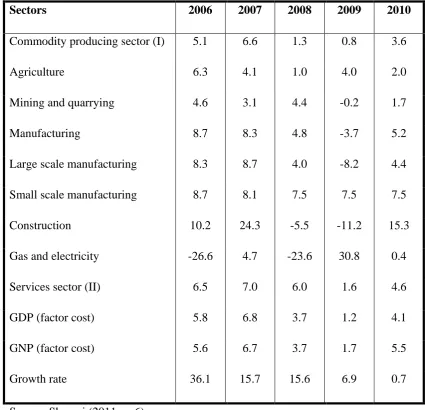
to the economy of Pakistan. Pakistan’s economy is twenty-eighth biggest in terms of purchasing power. The economy is divided into to two major sectors of commodity production and services. Commodity production sector contains the industries of agriculture, mining, large plus small scale manufacturing, construction, electricity and gas. The services sector comprises of wholesale and retail; transportation; storage and communication; insurance and public administration. Last five years’ growth performances with percent growth at constant factor cost for the commodity production sector and services sector represents a declining trend for gross domestic product (GDP) and gross national product (GNP). Growth performance of the industries in Pakistan with contribution to the economy over a period of five years till 2010 is presented in Table 1.1.
Table 1.1 : Growth performance of industries for Pakistan
Sectors 2006 2007 2008 2009 2010
Commodity producing sector (I) 5.1 6.6 1.3 0.8 3.6
Agriculture 6.3 4.1 1.0 4.0 2.0
Mining and quarrying 4.6 3.1 4.4 -0.2 1.7
Manufacturing 8.7 8.3 4.8 -3.7 5.2
Large scale manufacturing 8.3 8.7 4.0 -8.2 4.4
Small scale manufacturing 8.7 8.1 7.5 7.5 7.5
Construction 10.2 24.3 -5.5 -11.2 15.3
Gas and electricity -26.6 4.7 -23.6 30.8 0.4
Services sector (II) 6.5 7.0 6.0 1.6 4.6
GDP (factor cost) 5.8 6.8 3.7 1.2 4.1
GNP (factor cost) 5.6 6.7 3.7 1.7 5.5
Growth rate 36.1 15.7 15.6 6.9 0.7
5
The manufacturing sector contributes as third major player of the economy. It comprises the small scale manufacturing (SSM) firms and large scale manufacturing (LSM) firms. LSM sector surrounds thirteen industries such as textile and apparel; food-beverage and tobacco; petroleum; pharmaceutical; non-metallic mineral products; automobile; fertilizer; chemicals; electronic; leather products; paper and paper board; engineering products; tyres and tubes. The textile industry with maximum weights of 26.40 is leading other manufacturing industries. Negative and positive trends for industries are shown with growth and point of contribution for LSM in Table 1.2.
Table 1.2 : Growth rate of LSM
Categories Weights Contribution percentage
2008-09 2009-10
Textile and apparel 26.40 -0.18 -0.47
Food, beverage and tobacco 14.35 -1.51 -0.51
Petroleum group 5.23 -0.48 -0.31
Pharmaceutical 5.03 0.05 0.37
Non-metallic mineral products 4.19 0.20 0.46
Automobile 3.95 -1.54 1.25
Fertilizers 3.38 0.73 0.37
Chemicals 2.88 0.11 -0.01
Electronic 2.48 -0.78 0.58
Leather products 2.27 0.07 0.54
Paper 0.60 0.00 -0.02
Engineering products 0.44 0.00 0.03
Tyres and tubes 0.30 -0.01 0.09
Source: Habib-ur-Rehman (2011, p. 42)
prominent manufacturing category account for forty-six percent in the entire production (Maqbool, 2006). The textile industry contributes 8.5 percent of national income to the economy. It grants sixty-seven percent of merchandise exports earnings for the economy of the country. The textile industry gives work to thirty-eight percent of the manufacturing labour force with half production of output for industrialized sector. There is nine percent share of the textile industry in GDP of the country. This industry is rendered to be potentially capable to compete in a highly competitive global market (Rashid, 2011).
The textile industry is contributing for future growth of the economy. All the other industries have less contribution to support the economy through earnings of foreign currency. The textile industry showed significant performance in the global market for last several years (Habib-ur-Rehman, 2011). The textile industry’s proven performance in the global textile market over a period of five years is presented in Table 1.3. The effective role of the textile industry to the economy makes it worthy for research investigation in supply chain management contextualizing supplier development approaches. The textile industry is a major sector for both developed and developing economies to contribute for wealth generation as well as employment. However, supply chain management is neglected for the textile industry (Bruce et al., 2004). The effective role of the textile industry to the economy makes it worthy to investigate SCM contextualizing supplier development approaches.
Table 1.3 : Pakistan’s textile share in world trade (US $ million)
2004 2005 2006 2007 2008
7
Literature provides some reasons for negligence of supply chain research for textile industry. Several processes of textile make supply chain complicated. Textile supply chain is relatively complex (Cao et al., 2008). The complex nature of textile supply chain persisted in the negligence to investigate supply chain management for the industry (Fernie and Azuma, 2004). This discussion briefly introduces the textile industry and its part to the economy of Pakistan and the scarcity of supply chain management investigation in the textile industry. The subsequent discussion is to present background of the problem to investigate supplier development (ISD and DSD) approaches. It is based upon the problem of understanding supplier development approaches with conjunction of buying firm’s trust and buying firm’s commitment that needs to be sought and set forth in the context of the textile industry for improvement of buyer-supplier performance. This study tries to provide insights about supplier development (ISD and DSD) approaches with combination of buying firm’s trust and buying firm’s commitment as moderator variables on the relationship of supplier development approaches with buyer-supplier performance. This investigation endeavours to contribute to literature through enhancing insights about supplier development (ISD and DSD) approaches in conjunction with buying firm’s trust and buying firm’s commitment on improvement of buyer-supplier performance.
1.2 Background of the Problem
understanding the effects of supplier development (ISD and DSD) approaches with conjunction of buying firm’s trust and buying firm’s commitment on buyer-supplier performance for the textile industry of Pakistan. Firms in the twenty-first century are acclimatizing to modifications that happened during the last decade. A highly competitive global economy is created due to changes in technology, communication systems, political structures and organizational structures (Ireland and Hitt, 1999). The firms are continuously striving to improve performance to survive in a highly competitive global environment with improved management of supply chain. Importance and recognition of supply chain management is acknowledged globally (Cousins et al., 2006; Rajput and Bakar, 2011a, 2011b) whereas some aspects of supply chain management are emerging for several industries across the globe as well as for industries of Pakistan (Bhutta et al., 2007).
Supplier development is a particular aspect of supply chain management (Giunipero et al., 2008; Rajput and Bakar, 2011a). Firms are utilizing supplier development practices for a consistent supply base that can improve buyer-supplier performance i.e., supplier performance, buyer competitive advantage, and buyer-supplier relationship (Humphreys et al., 2011; Krause and Handfield, 1999). Furthermore, firms engage on supplier development practices either directly or indirectly to improve performance (Wagner, 2010). Supplier development is a narrowly studied category of supply chain management in comparison to other categories of supply chain management (Ghijsen et al., 2010; Giunipero et al., 2008). The buying firm expects improvement in buyer-supplier performance after the compliance to supplier development activities. Literature describes BSP with three dimensions such as supplier performance, buyer competitive advantage and buyer-supplier relationship (Humphreys et al., 2004a). Several eminent studies reported numerous substantial benefits for buying firm and supplier through utilization of supplier development (Humphreys et al., 2011; Krause et al., 2007; Krause et al., 2000; Rogers et al., 2007; Toni and Nassimbeni, 2000; Wagner, 2010; Watts and Hahn, 1993).
9
mostly conducted in developed economies of America and Europe (Bozarth et al., 2007; Bruce et al., 2004; Bruce and Moger, 1999; Cárdenas et al., 2009; Chen et al., 2007; Jørgensen et al., 2010; Kogg, 2003; Masson et al., 2007; Romano and Vinelli, 2001; Teng and Jaramillo, 2005, 2006; Thaver and Wilcock, 2006) while few studies are conducted in Asia (Au and Danny, 2002; Cao et al., 2008; Lam and Postle, 2006). There is scarcity of SCM studies for textile industry of a developing economy. Turkish textile industry was explored to examine the benefits and barriers linked to supply chain collaboration (Cetindamar et al., 2005). Recently, Bangladeshi textile industry is explored to create competitive advantage in business procedures with the utilization of SCM (Nuruzzaman et al., 2010). The literature depicts that SCM investigations are predominantly prevailing for the developed economies. There is dearth of discussion about SCM in textile industry of a developing economy like Pakistan (Ghouri et al., 2011; Majid et al., 2010); this dearth initiated the research project to expand insights for supplier development (ISD and DSD) approaches. In the new global economy, supplier development has become a central issue for investigation (Reuter et al., 2010). This study is an attempt to complete the empirical research gap of literature through investigation of supplier development (ISD and DSD) approaches in textile industry of Pakistan.
quality, performance and delivery time as well as minimizing cost in the textile industry. The study discussed the effective purchasing system for the buying firm. The study lacked the depiction of supplier development context. Additionally, Chen (2011) utilized enterprise competitive strategy to integrate various suppliers of Taiwanese textile industry to manage the suppliers for increasing product development capability to increase product marketability of the buying firm. Irrefutably, little research has been found that surveyed supplier development approaches with divergence of indirect and direct approach in relation to buyer-supplier performance for the textile industry of a developing country. Next part is to justify statement of the problem to discuss research gap that is to be completed with this study.
1.3 Statement of the Problem
LSM buying firms have recognized the importance of buyer-supplier performance improvement through supplier development. Buying firms have also recognized the importance of instituting and maintaining their competitive advantages, supplier performance improvement and buyer-supplier relationship. Purchasing research had the propensity to focus on supplier development approaches and to explore the impact of the indirect supplier development and direct supplier development approaches on buyer-supplier performance. Several attempts have been made to examine the use of supplier development activities, performance implications, the antecedents and influential factors (Krause and Ellram, 1997b; Watts and Hahn, 1993). The existing literature of supplier development is mainly descriptive and case-based, with fundamental focus on commonly used supplier development practices particularly in North America and European countries (Galt and Dale, 1991; Newman and Rhee, 1990).
11
overall buying firm’s effectiveness (Hartley and Choi, 1996; Monczka et al., 1993). However, little research has empirically investigated the effect of indirect supplier development approach on buyer-supplier performance with a relational approach grounded on goal-setting theory and influence strategy. Goal setting theory is selected as relationship approach for the theoretical foundation for ISD approach. Few authors had advocated the importance of goal setting for successful indirect supplier development approach (Krause and Scannell, 2002; Sako, 2004; Sánchez-Rodríguez et al., 2005; Taj and Berro, 2006). Moreover, concept of influence strategy is also used to describe indirect supplier development approach. Influence strategies are to be utilized to bring in improvement in suppliers’ performance and suppliers’ behavior. The indirect supplier development approach studied from pertinent literature corresponds with influence strategies. Thus, the effect of indirect supplier development approach on buyer-supplier performance improvement is grounded on relational approach of goal-setting theory and influence strategies to compensate research gap.
There is dearth of empirical investigation for the effect of direct supplier development approach on buyer-supplier performance with a relational approach grounded on transaction cost theory (TCT) and knowledge based view (KBV). Transaction cost theory provides more explanatory power for DSD approach. The long-term buyer-seller relationship is stronger than ‘the arms-length buy and sell’ relationship and it reduces the cost of transactions (Williamson, 1985). Collaborative relationships in the context of DSD approach are seen as powerful organizational arrangements that expose organizations to knowledge they did not possess earlier (Choi and Lee, 1997; Grant and Baden-Fuller, 2004). Direct supplier development approach is also grounded on KBV for its effect on buyer-supplier performance. Buying firm transfers the knowledge to the supplier through unitization of direct supplier development approach (Wagner, 2010). Therefore, the effect of direct supplier development approach on buyer-supplier performance improvement is grounded on relationship approach of transaction cost theory and knowledge based view to compensate research gap.
assumptions of transaction cost theory is the trust between partners because a situation of distrust is viewed as misleading, distorting and confusing as well as risking opportunism (Hill, 1990). Conversely, a trusting situation is viewed as one which reduces transaction cost (Kwon and Suh, 2004) and demonstrates strong commitment between partners (Coote et al., 2003). Trust and commitment prevail for interfirm relationships in perspective of supplier development (ISD and DSD) approaches (Humphreys et al., 2011; Humphreys et al., 2004b).
Trust is associated to relationship success (Nyaga et al., 2010), immutability (Handfield and Bechtel, 2002), and performance (Zaheer et al., 1998) in due course of supply chain partnership (Chen et al., 2011a). Wagner (2010) suggested a future direction for investigation of supplier development in association with classical moderator variables such as trust. However, no study has investigated the moderated effect of buying firm’s trust on relationship of supplier development approaches with buyer-supplier performance. This study compensates for this drawback through combining the buying firm’s trust with ISD approach and statistically testing combined effect on improvement of buyer-supplier performance with a sample of LSM buying firms from the textile industry of Pakistan. This study also compensates a research gap through combing the buying firm’s trust with DSD approach and statistically testing combined effect on improvement of buyer-supplier performance with a sample of LSM buying firms from the textile industry of Pakistan.
13
buying firm’s commitment with ISD approach and statistically testing the effect on improvement of buyer-supplier performance with a sample of large scale manufacturing firms from the textile industry of Pakistan. This study also compensates a research drawback through combining the buying firm’s commitment with DSD approach and statistically testing the effect on improvement of buyer-supplier performance with a sample of LSM buying firms from the textile industry of Pakistan. The following portion is to propose research questions for this investigation.
1.4 Research Questions
This investigation addresses the following four research questions. This study develops and tests a research framework to answer the following research questions.
1) Does buying firm’s indirect supplier development approach positively relate to BSP in textile industry?
2) Does buying firm’s direct supplier development approach positively relate to BSP in textile industry?
3) Does combined effect of buying firm’s trust with supplier development approaches result in improvement of BSP in textile industry?
4) Does combined effect of buying firm’s commitment with supplier development approaches result in improvement of BSP in textile industry?
1.5 Research Objectives
The elucidation of problem statement necessitates to state research questions and research objectives. The research questions and research objectives are put forward to understand the effects of supplier development (ISD and DSD) approaches on buyer-supplier performance in the textile industry, as well as to understand the combined effects of supplier development (ISD and DSD) approaches with buying firm’s trust and buying firm’s commitment on buyer-supplier performance in the textile industry. Therefore, four research objectives are initiated for this study in consideration to the research questions.
1) To investigate the effect of buying firm’s indirect supplier development approach on BSP.
2) To investigate the effect of buying firm’s direct supplier development approach on BSP.
3) To investigate combined effects of buying firm’s trust with supplier development approaches on BSP.
4) To investigate combined effects of buying firm’s commitment with supplier development approaches on BSP.
1.6 Research Scope
15
BSP in the textile industry. The combined effects of buying firm’s trust with supplier development (ISD and DSD) approaches on BSP were investigated to fill the research gap. As well as, the combined effects of buying firm’s commitment with supplier development (ISD and DSD) approaches on BSP were investigated for the textile industry to compensate the research gap.
This research focuses on LSM buying organizations of the textile industry to investigate buying firm’s supplier development (ISD and DSD) approaches. Small scale textile firms were not included. There are 991 large scale manufacturing firms in the textile industry of Pakistan. The survey for buying firm’s supplier development (ISD and DSD) approaches targets LSM organizations of the textile industry. Scope of this research covered LSM firms under categories of spinning, weaving, finishing, knitting and apparel/garments. There are 445 large scale spinning firms to produce yarn for the industry. Pakistan textile industry contains 140 large scale weaving manufacturing firms. Those firms are producing cloth for the industry. There are 106 finishing LSM firms. Those firms are providing their services to the industry. LSM knitting units comprise of one hundred firms and there are two hundred large scale apparel/garments firms performing in the textile industry. The proposed research framework for supplier development (ISD and DSD) approaches with conjunction of buying firm’s trust and buying firm’s commitment on buyer-supplier performance was tested to understand the moderation effect of buying firm’s trust and buying firm’s commitment for the textile industry of Pakistan.
1.7 Significance of Study
industry are employing various innovations along with SCM strategies so as to operate successfully in local and global settings with improved performance (Khan, 2010). Research on supplier development is conducted mostly for automobile and electronic industries of developed economies and it lacks the investigation for textile industry of developing economy (Rajput and Bakar, 2011a, 2011b). This study is conducted to investigate supplier development (ISD and DSD) approaches in the textile industry of Pakistan that contributes to knowledge enhancement. It is also the initiation of a new stream of research for supplier development (ISD and DSD) approaches particularly for the textile industry of a developing country. The textile industry of Pakistan is immensely contributing to the economy. The contribution to economic growth and utilization of supply chain management (Bhutta et al., 2007; Majid et al., 2010) by Pakistani textile industry makes it commendable for investigation of supplier development (ISD and DSD) approaches.
17
approaches with buyer-supplier performance in the context of buying firm. Finally, this research makes an effort to open up new avenues for future research in the field of supplier development approaches. Next section arranges some terms with brief explanation of variables which are being exercised in this study.
1.8 Definition and Description of Terms
This section is to define and describe supplier development, indirect supplier development, direct supplier development, buyer-supplier performance, trust, and commitment.
1.8.1 Supplier Development
Supplier development is an attempt of buying organization to develop a supplier for the sake of performance and capability enhancement to accommodate supply requirements. The definition of supplier development is adopted as “any effort of buying firm with a supplier to increase the performance and/or capabilities of supplier and to meet the buying firm’s short and/or long term supply needs” (Krause and Ellram, 1997b, p. 39 ).
1.8.2 Indirect Supplier Development
explained further through description of some practices which are undertaken by buying firm while developing the supplier. Indirect supplier development approach entails practices such as the buying firm sets improvement targets for its supplier and supplier firm is desired to achieve those targets set by the buying firm. The buying firm commits itself with its supplier to audit the supplier in context of quality and performance of the product delivered by the supplier. The buying firm can take on indirect supplier development by providing feedback about the performance of the supplier. Another practice of indirect supplier development approach can be when a buying firm obligates strong formal supplier evaluation of the supplier. The discussion of the practices related to supplier development introduces the concept of indirect supplier development approach.
1.8.3 Direct Supplier Development
19
an advice about the quality assurance processes of the supplier’s firm. Lastly, direct supplier development encompasses a practice when a buying firm transfers its implicit knowledge to the supplier’s firm. The description of these practices related to supplier development elucidates the understanding of direct supplier development approach.
1.8.4 Buyer-Supplier Performance
Buyer-supplier performance is explained with three indicators: supplier performance, buying firm’s competitive advantage and buyer-supplier relationship (Humphreys et al., 2004b). The buying firm expects improvement in these three areas after complying with any supplier development approach. Buyer-supplier performance is described further through description of supplier performance, buying firm’s competitive advantage and buyer-supplier relationship. Supplier performance is explained with seven indicators such as the circumstances for percentage of orders meeting design specification entail supplier performance. Supplier performance is described with the improvements in orders meeting quality requirements due to practicing supplier development. Supplier performance is described through indication of on-time deliveries. The improvement in cost of purchased products specifies supplier performance. Supplier performance can be described through indication of improvement in average investment in purchased parts inventory. Supplier performance is described through pointing out improvement in lead time for special/rush orders occurring. Lastly, supplier performance is described by signifying improvement in time requirement for supplier to take a new item from development to production after the inclusion of supplier development.
development. Buying firm’s improvement in quality of product is linked with buying firm’s competitive advantage. When buying firm is capable to produce the product faster due to supplier’s product quality improvement then buying firm can have competitive advantage. Additionally, buyer competitive advantage is described with a situation. When buying firm’s capability to respond to change in the market has been improved due to supplier development then the buying firm has competitive advantage over its competitors.
Third dimension of BSP is buyer-supplier relationship. To elucidate description of buyer-supplier relationship some indicators are explained. The relationship of buying firm with supplier’s firm can resemble a strong bond like a marriage and both of the parties try to strengthen their relationship. The strong relationship between buying firm and its supplier can generate renewal of agreements between both parties. In other words it can be said that buying firm tries to have an evergreen relationship with its supplier. Buying firm and its supplier try to continue their business relationship regardless of their current purchase transaction. These indicators of relationship grasp the understanding of buyer-supplier relationship. The following discussion is to elucidate buying firm’s trust with a definition and with description of some bases.
1.8.5 Trust
21
discussion is to define commitment as well as some bases of buying firm’s commitment with its supplier.
1.8.6 Commitment
The term of commitment is utilized for buying firm’s commitment during supplier development and it is defined as “an exchange partner believing that an ongoing relationship with another is so important as to warrant maximum efforts to maintain it. That is, the commitment party believes the relationship endures indefinitely” (Morgan and Hunt, 1994). Some bases are discussed to comprehend buying firm’s commitment while practicing supplier development such as buying firm really commits itself with the supplier.
Buying firm keeps high regards for its relationship with the supplier. Buying firm always tries to maintain the relationship definitely with its supplier. To some extent buying firm believes the relationship as of a family. In other words, buying firm really cares about its relationship with its supplier. Lastly, it can be said that buying firm considers the relationship very important and it gives maximum attention to maintain the relationship. These representations describe buying firm’s commitment. The following discussion is to document the layout of this thesis.
1.9 Layout of Thesis
Chapter 1: Introduction describes briefly supplier development approaches, an overview of textile industry of Pakistan, background of the problem, statement of the problem, purpose of the study, research objectives, research questions, research scope and significance of the study, definition of terms, summary and layout of thesis.
Chapter 2: Literature Review describes theoretical foundations of the study initially. It explores supplier development, buyer-supplier performance, trust and commitment with detailed literature survey. This chapter starts with an overview of theoretical foundations of the study grounded on relational approach of goal-setting theory, influence strategy, transaction cost theory and knowledge based view. SCM its existence in various industries was explained. Categories of SCM are presented, supplier development as a category of SCM is described for its background, definition, elements, benefits, outcomes, issues, barriers and its existence in various industries. Buyer-supplier performance is considered with three dimensions such as supplier performance, buying firm’s competitive advantage and buyer-supplier relationship. Additionally, trust and commitment are reviewed. Lastly, summary of the chapter is presented.
Chapter 3: Initially, previous frameworks of supplier development research are described from pertinent literature. Research framework is developed with hypothesised relationship of supplier development (ISD and DSD) approaches, buyer-supplier performance, buying firm’s trust and buying firm’s commitment. It presents a framework for investigation of supplier development (ISD and DSD) approaches with combination of buying firm’s trust and buying firm’s commitment as moderators on buyer-supplier performance on basis of quantitative data. Theoretical foundations are also provided for the research framework of this study.
23
Chapter 5: Findings presents descriptive analysis, assessment of data, profile of firms, normality test, non-response bias, reliability analysis, validity analysis, assessment of multicollinearity, correlation analysis, results of research questions and results of hypotheses testing.
Chapter 6: Discussion and conclusion describes findings for effects of supplier development approaches on buyer-supplier performance, combined effects of buying firm’s trust with supplier development (ISD and DSD) approaches on buyer-supplier performance, combined effects of buying firm’s commitment with supplier development (ISD and DSD) approaches on buyer-supplier performance, contribution of study, implications, limitation of research, future research and conclusion.
1.10 Summary
225
REFERENCES
Aaker, D. A., Kumar, V., Day, G. S. and Leone, R. (2009). Marketing Research. John Wiley & Sons.
Aguinis, H. (1995). Statistical Power with Moderated Multiple Regression in Management Research. Journal of Management. 21(6), 1141-1158.
Aiken, L. S., West, S. G. and Reno, R. R. (1991). Multiple Regression: Testing and Interpreting Interactions. Sage Publications.
Ali, F., Smith, G. and Saker, J. (1997). Developing Buyer-Supplier Relationships in the Automobile Industry a Study of Jaguar and Nippondenso. European Journal of Purchasing & Supply Management. 3(1), 33-42.
Allen, B. A., Wade, E. and Dickinson, H. (2009). Bridging the Divide - Commercial Procurement and Supply Chain Management: Are There Lessons for Health Care Commissioning in England? Journal of Public Procurement. 9(1), 79-108.
Allen, N. J. and Meyer, J. P. (1990). The Measurement and Antecedents of Affective, Continuance and Normative Commitment to the Organization. Journal of Occupational Psychology. 63(1), 1-18.
Alptekin, S. E. and Alptekin, G. I. (2009). Product Improvement by Selecting Appropriate Suppliers: A Case Study Information, Process, and Knowledge Management, 1-7 February (pp. ). Cancun: IEEE, 129-134.
Ambrose, E., Marshall, D. and Lynch, D. (2010). Buyer Supplier Perspectives on Supply Chain Relationships. International Journal of Operations & Production Management. 30(12), 1269-1290.
Anderson, E. and Weitz, B. (1992). The Use of Pledges to Build and Sustain Commitment in Distribution Channels. Journal of Marketing Research (JMR). 29(1), 18-34.
Anderson, J. C. and Narus, J. A. (1990). A Model of Distributor Firm and Manufacturer Firm Working Partnerships. Journal of Marketing. 54(1), 42-58.
Angle, H. L. and Lawson, M. B. (1993). Changes in Affective and Continuance Commitment in Times of Relocation. Journal of Business Research. 26(1), 3-15.
APTMA (2010). Pakistan Textile Statistics.
Araz, C. and Ozkarahan, I. (2007). Supplier Evaluation and Management System for Strategic Sourcing Based on a New Multi Criteria Sorting Procedure. International Journal of Production Economics. 106(2), 585-606.
Armstrong, J. S. and Overton, T. S. (1977). Estimating Nonresponse Bias in Mail Surveys. Journal of Marketing Research. 14(3), 396-402.
Artz, K. W. (1999). Buyer-Supplier Performance: The Role of Asset Specificity, Reciprocal Investments and Relational Exchange. British Journal of Management. 10(2), 113-126.
Asher, H. B. (1983). Causal Modeling. SAGE Publications.
Au, K. F. and Danny, C. K. H. (2002). Electronic Commerce and Supply Chain Managment: Value-Adding Service for Clothing Manufacturers. Integrated Manufacturing Systems. 13(4), 247.
Au, K. F. and Ho, D. C. K. (2002). Electronic Commerce Ans Supply Chain Management: Value-Adding Servie for Clothing Manufacturers. Integrated Manufacturing Systems. 13(4), 247-254.
Auramo, J., Kauremaa, J. and Tanskanen, K. (2005). Benefits of It in Supply Chain Management: An Explorative Study of Progressive Companies. International Journal of Physical Distribution & Logistics Management. 35(2), 82-100.
Autry, C. W. and Golicic, S. L. (2010). Evaluating Buyer–Supplier Relationship– Performance Spirals: A Longitudinal Study. Journal of Operations Management. 28(2), 87-100.
227
Azar, A., Kahnali, R. A. and Taghavi, A. (2009). Relationship between Supply Chain Quality Management Practices and Their Effects on Organisational Performance. Singapore Management Review. 32(1), 45-68.
Bai, J. and Ng, S. (2005). Tests for Skewness, Kurtosis, and Normality for Time Series Data. Journal of Business & Economic Statistics. 23(1), 49-60.
Bakar, A. H. A., Hakim, I. L., Chong, S. C. and Lin, B. (2010). Measuring Supply Chain Performance among Public Hospital Laboratories. International Journal of Productivity and Performance Management. 59(1), 75-97.
Barlett, J. E., Kotrlik, J. W. and Higgins, C. C. (2001). Organizational Research: Determining Appropriate Sample Size in Survey Research. Information Technology, Learning, and Performance Journal. 19(1), 43-50.
Barney, J. (1991). Firm Resources and Sustained Competitive Advantage. Journal of Management. 17(1), 99-120.
Barney, J. B. (1990). The Debate between Traditional Management Theory and Organizational Economics: Substantive Differences or Intergroup Conflict? Academy of Management Review. 15(3), 382-393.
Barney, J. B. and Hansen, M. H. (1994). Trustworthiness as a Source of Competitive Advantage. Strategic Management Journal. 15, 175-190.
Baron, R. M. and Kenny, D. A. (1986). The Moderator-Mediator Variable Distinction in Social Psychological Research: Conceptual, Strategic, and Statistical Considerations. Journal of Personality and Social Psychology. 51(6), 1173-1182.
Barringer, B. R. and Harrison, J. S. (2000). Walking a Tightrope: Creating Value through Interorganizational Relationships. Journal of Management. 26(3), 367-403.
Beamish, P. W. and Killing, J. P. (1997). Cooperative Strategies: Asian-Pacific Perspectives. New Lexington Press.
Benton, W. C. and Maloni, M. (2005). The Influence of Power Driven Buyer/Seller Relationships on Supply Chain Satisfaction. Journal of Operations Management. 23(1), 1-22.
Boer, L. d., Gaytan, J. and Arroyo, P. (2006). A Satisficing Model of Outsourcing. Supply Chain Management. 11(5), 444-455.
Bolumole, Y. A. (2001). The Supply Chain Role of Third-Party Logistics Providers. International Journal of Logistics Management. 12(2), 87-102.
Boyce, G. H. (2001). Co-Operative Structures in Global Business: Communicating, Transferring Knowledge, and Learning across the Corporate Frontier. New
York: Routledge Chapman & Hall.
Bozarth, C., Blackhurst, J. and Handfield, R. B. (2007). Following the Thread: Industry Cluster Theory, the New England Cotton Textiles Industry, and Implications for Future Supply Chain Research. Production and Operations Management. 16(1), 154-157.
Bradach, J. L. and Eccles, R. G. (1989). Price, Authority, and Trust: From Ideal Types to Plural Forms. Annual Review of Sociology. 15, 97-118.
Brown, R. B. (1996). Organizational Commitment: Clarifying the Concept and Simplifying the Existing Construct Typology. Journal of Vocational Behavior. 49(3), 230-251.
Brown, T. A. (2006). Confirmatory Factor Analysis for Applied Research. New York: The Guilford Press.
Bruce, M., Daly, L. and Towers, N. (2004). Lean or Agile: A Solution for Supply Chain Management in the Textiles and Clothing Industry? International Journal of Operations & Production Management. 24(2), 151-170.
Bruce, M. and Moger, S. T. (1999). Dangerous Liaisons: An Application of Supply Chain Modelling for Studying Innovation Withing the Uk Clothing Industry. Technology Analysis & Strategic Management. 11(1), 113-125.
Bryman, A. (1989). Research Methods and Organization Studies. Taylor & Francis. Bryman, A. and Bell, E. (2007). Business Research Methods. (Second Edition ed.)
Oxford: Oxford University Press.
Búrca, S. d., Fynes, B. and Marshall, D. (2005). Strategic Technology Adoption: Extending Erp across the Supply Chain. Journal of Enterprise Information Management. 18(4), 427-440.
Burgess, K., Singh, P. J. and Koroglu, R. (2006). Supply Chain Management: A Structured Literature Review and Implications for Future Research. International Journal of Operations & Production Management. 26(7),
229
Burt, D. N., Dobler, D. W. and Starling, S. L. (2003). World Class Supply Management. (7 ed.) New York: McGraw-Hill.
Butler, J. K. (1991). Toward Understanding and Measuring Conditions of Trust: Evolution of a Conditions of Trust Inventory. Journal of Management. 17(3), 643-663.
Cai, S., Yang, Z. and Jun, M. (2011). Cooperative Norms, Structural Mechanisms, and Supplier Performance: Empirical Evidence from Chinese Manufacturers. Journal of Purchasing and Supply Management. 17(1), 1-10.
Cambra-Fierro, J. J. and Polo-Redondo, Y. (2011). Post-Satisfaction Factors Affecting the Long-Term Orientation of Supply Relationships. Journal of Business & Industrial Marketing. 26(6), 395-406.
Campbell, D. T. and Fiske, D. W. (1959). Convergent and Discriminant Validation by the Multitrait-Multimethod Matrix. Psychological Bulletin. 56(2), 81-105. Cannon, J. P., Doney, P. M., Mullen, M. R. and Petersen, K. J. (2010). Building
Long-Term Orientation in Buyer-Supplier Relationships: The Moderating Role of Culture. Journal of Operations Management. 28(6), 506-521.
Cao, N., Zhang, Z., To, K. M. and Ng, K. P. (2008). How Are Supply Chains Coordinated? An Empirical Observation in Textile-Apparel Businesses. Journal of Fashion Marketing and Management. 12(3), 384-397.
Cárdenas, L. M., Shamey, R. and Hinks, D. (2009). Key Variables in the Control of Color in the Textile Supply Chain. International Journal of Clothing Science and Technology. 21(5), 256-269.
Carey, S., Lawson, B. and Krause, D. R. (2011). Social Capital Configuration, Legal Bonds and Performance in Buyer–Supplier Relationships. Journal of Operations Management. 29(4), 277-288.
Carr, A. S. and Kaynak, H. (2007). Communication Methods, Information Sharing, Supplier Development and Performance: An Empirical Study of Their Relationships. International Journal of Operations & Production Management. 27(4), 346-370.
Carr, A. S. and Pearson, J. N. (1999). Strategically Managed Buyer-Supplier Relationships and Performance Outcomes. Journal of Operations Management. 17(5), 497-519.
Cavusgil, S. T., Deligonul, S. and Zhang, C. (2004). Curbing Foreign Distributor Opportunism: An Examination of Trust, Contracts, and the Legal Environment in International Channel Relationships. Journal of International Marketing. 12(2), 7-27.
Cetindamar, D., Çatay, B. and Basmaci, O. S. (2005). Competition through Collaboration: Insights from an Initiative in the Turkish Textile Supply Chain. Supply Chain Management: An International Journal. 10(4), 238-240. Chan, F. T. S. and Kumar, N. (2007). Global Supplier Development Considering Risk Factors Using Fuzzy Extended Ahp-Based Approach. Omega. 35(4), 417-431.
Chang, S.-H., Wang, K.-Y., Chih, W.-H. and Tsai, W.-H. (2012). Building Customer Commitment in Business-to-Business Markets. Industrial Marketing Management. 41(6), 940-950.
Chang, S. C., Chen, R. H., Lin, R. J., Tien, S. W. and Sheu, C. (2006). Supplier Involvement and Manufacturing Flexibility. Technovation. 26(10), 1136-1146.
Chen, J. V., Yen, D. C., Rajkumar, T. M. and Tomochko, N. A. (2011a). The Antecedent Factors on Trust and Commitment in Supply Chain Relationships. Computer Standards & Interfaces. 33(3), 262-270.
Chen, Y.-J. (2011). Structured Methodology for Supplier Selection and Evaluation in a Supply Chain. Information Sciences. 181(9), 1651-1670.
Chen, Z., Huang, Y. and Sternquist, B. (2011b). Guanxi Practice and Chinese Buyer–Supplier Relationships: The Buyer's Perspective. Industrial Marketing Management. 40(4), 569-580.
Chen, Z., Murray, R. and Jones, R. M. (2007). Fashion Supply Chain Organisation and Management between the Uk and China. Journal of Fashion Marketing and Management. 11(3), 380-397.
231
Choi, C. J. and Lee, S. H. (1997). A Knowledge-Based View of Cooperative Interorganizational Relationships. Cooperative strategies: European perspectives. 2, 33.
Chuah, P., Wong, W. P., Ramayah, T. and Jantan, M. (2010). Organizational Context, Supplier Management Practices and Supplier Performance: A Case Study of a Multinational Company in Malaysia. Journal of Enterprise Information Management. 23(6), 724-758.
Chung, J.-E. and Jin, B. (2011). In-Group Preference as Opportunism Governance in a Collectivist Culture: Evidence from Korean Retail Buyer-Supplier Relationships. Journal of Business & Industrial Marketing. 26(4), 237-249. Churchill, G. A. and Iacobucci, D. (2009). Marketing Research: Methodological
Foundations. Cengage Learning.
Coakes, E., Bradburn, A. and Sugden, G. (2004). Managing and Leveraging Knowledge for Organisational Advantage. Knowledge Management Research & Practice. 2(2), 118-128.
Coase, R. H. (1937). The Nature of the Firm. Economica. 4(16), 386-405.
Cohen, J. (2003). Applied Multiple Regression/Correlation Analysis for the Behavioral Sciences. L. Erlbaum Associates.
Cohen, J. and Cohen, P. (1983). Applied Multiple Regression/Correlation Analysis for the Behavioral Sciences. L. Erlbaum Associates.
Conner, K. R. and Prahalad, C. K. (1996). A Resource-Based Theory of the Firm: Knowledge Versus Opportunism. Organization Science. 7(5), 477-501. Contractor, F. J. and Lorange, P. (2002). Cooperative Strategies and Alliances 2002.
Elsevier Science/Pergamon.
Cook, J. S., Bree, K. D. and Feroleto, A. (2001). From Raw Materials to Customers: Supply Chain Management in Service Industry. SAM Advanced Management Journal. 66(4), 14-21.
Cook, K. S. and Emerson, R. M. (1978). Power, Equity and Commitment in Exchange Networks. American Sociological Review. 43(5), 721-739.
Coote, L. V., Forrest, E. J. and Tam, T. W. (2003). An Investigation into Commitment in Non-Western Industrial Marketing Relationships. Industrial Marketing Management. 32(7), 595-604.
Inter-Organizational Identification in Automotive Relationships. Journal of Operations Management. 29(6), 549-560.
Cousins, P. D., Lawson, B. and Squire, B. (2006). Supply Chain Management: Theory and Practice – the Emergence of an Academic Discipline? International Journal of Operations & Production Management. 26(7),
697-702.
Cousins, P. D., Lawson, B. and Squire, B. (2008). Performance Measurement in Strategic Buyer-Supplier Relationships: The Mediating Role of Socialization Mechanisms. International Journal of Operations & Production Management. 28(3), 238-258.
Cronbach, L. (1951). Coefficient Alpha and the Internal Structure of Tests. Psychometrika. 16(3), 297-334.
Cronbach, L. J. and Meehl, P. E. (1955). Construct Validity in Psychological Tests. Psychological Bulletin. 52(4), 281-302.
Dagger, T. S., David, M. E. and Ng, S. (2011). Do Relationship Benefits and Maintenance Drive Commitment and Loyalty? Journal of Services Marketing. 25(4), 273-281.
Dalal, D. K. and Zickar, M. J. (2012). Some Common Myths About Centering Predictor Variables in Moderated Multiple Regression and Polynomial Regression. Organizational Research Methods. 15(3), 339-362.
Danese, P., Romano, P. and Vinelli, A. (2006). Sequences of Improvement in Supply Networks: Case Studies from the Pharmaceutical Industry. International Journal of Operations & Production Management. 26(11), 1199-1222.
Das, T. K. and Teng, B.-S. (2000). A Resource-Based Theory of Strategic Alliances. Journal of Management. 26(1), 31-61.
Daugherty, P. J. (2011). Review of Logistics and Supply Chain Relationship Literature and Suggested Research Agenda. International Journal of Physical Distribution & Logistics Management. 41(1), 16-31.
Davis, D. (2005). Business Research for Decision Making. Thomson/Brooks/Cole. De-Margerie, V. and Jiang, B. (2011). How Relevant Is Om Research to Managerial
233
de Ruyter, K., Moorman, L. and Lemmink, J. (2001). Antecedents of Commitment and Trust in Customer–Supplier Relationships in High Technology Markets. Industrial Marketing Management. 30(3), 271-286.
De Toni, A. and Nassimbeni, G. (2000). Just-in-Time Purchasing: An Empirical Study of Operational Practices, Supplier Development and Performance. Omega. 28(6), 631-651.
DeVellis, R. F. (2011). Scale Development: Theory and Applications. SAGE Publications.
Dillman, D. A. (1978). Mail and Telephone Surveys: The Total Design Method. Wiley.
Dillman, D. A. (2006). Mail and Internet Surveys: The Tailored Design Method -- 2007 Update with New Internet, Visual, and Mixed-Mode Guide. Wiley.
Dillman, D. A., Smyth, J. D. and Christian, L. M. (2008). Internet, Mail, and Mixed-Mode Surveys: The Tailored Design Method. Wiley & Sons.
Ding, H.-b. and Peters, L. S. (2000). Inter-Firm Knowledge Management Practices for Technology and New Product Development in Discontinuous Innovation. International Journal of Technology Management. 20(5), 588-600.
Doll, W. J., Xia, W. and Torkzadeh, G. (1994). A Confirmatory Factor Analysis of the End-User Computing Satisfaction Instrument. MIS Quarterly. 18(4), 453-461.
Doney, P. M. and Cannon, J. P. (1997). An Examination of the Nature of Trust in Buyer-Seller Relationships. Journal of Marketing. 61(2), 35-51.
Donk, D. P. v. and Vaart, T. v. d. (2005). A Case of Shared Resources, Uncertainty and Supply Chain Integration in the Process Industry. International Journal of Production Economics. 96(1), 97-108.
Dooley, K. J. (2009). The Empiricism-Modeling Dichotomy in Operations and Supply Chain Management. Journal of Supply Chain Management. 45(1), 38-43.
Drucker, P. (1946). The Concept of Corporation. New York: John Day.
Dunn, S. C. and Young, R. R. (2004). Supplier Assistance within Supplier Development Initiatives. Journal of Supply Chain Management. 40(3), 19-29. Dwyer, F. R., Schurr, P. H. and Oh, S. (1987). Developing Buyer-Seller
Dyer, J. H. (1996). Specialized Supplier Networks as a Source of Competitive Advantage: Evidence from the Auto Industry. Strategic Management Journal. 17(4), 271-291.
Dyer, J. H., Cho, D. S. and Chu, W. (1998). Strategic Supplier Segmentation: The Next "Best Practice" in Supply Chain Management. California Management Review. 40(2), 57-77.
Dyer, J. H. and Chu, W. (2000). The Determinants of Trust in Supplier-Automaker Relationships in the U.S., Japan, and Korea. Journal of International Business Studies. 31(2), 259-285.
Dyer, J. H. and Hatch, N. W. (2006). Relation-Specific Capabilities and Barriers to Knowledge Transfers: Creating Advantage through Network Relationships. Strategic Management Journal. 27(8), 701-719.
Dyer, J. H. and Nobeoka, K. (2000). Creating and Managing a High-Performance Knowledge-Sharing Network: The Toyota Case. Strategic Management Journal. 21(3), 345-367.
Dyer, J. H. and Ouchi, W. G. (1993). Japanese-Style Partnerships: Giving Companies a Competitive Edge. Sloan Management Review. 35(1), 51-63. Ellram, L. M. (1995). Partnering Pitfalls and Success Factors. International Journal
of Purchasing and Materials Management. 31(2), 35-44.
Erez, M. (1977). Feedback: A Necessary Condition of the Goal Setting – Perfromance Relationship. Journal of Applied Psychology. 62(1), 624-627. Evangelista, P. and Sweeney, E. (2006). Technology Usage in the Supply Chain: The
Case of Small 3pls. The International Journal of Logistics Management. 17(1), 55-74.
Fawcett, S. E. and Magnan, G. M. (2004). Ten Guiding Principles for High-Impact Scm. Business Horizons. 47(5), 67-74.
Feng, T., Sun, L. and Zhang, Y. (2010). The Effects of Customer and Supplier Involvement on Competitive Advantage: An Empirical Study in China. Industrial Marketing Management. 39(8), 1384-1394.
Fernie, J. and Azuma, N. (2004). The Changing Nature of Japanese Fashion: Can Quick Response Improve Supply Chain Efficiency? European Journal of Marketing. 38(7), 790-808.
Fink, A. (1995). How to Analyze Survey Data. SAGE Publications.
235
Flynn, B. B., Sakakibara, S., Schroeder, R. G., Bates, K. A. and Flynn, E. J. (1990). Empirical Research Methods in Operations Management. Journal of Operations Management. 9(2), 250-284.
Folinas, D., Manthou, V., Sigala, M. and Vlachopoulou, M. (2004). E-Volution of a Supply Chain: Cases and Best Practices. Internet Research. 14(4), 274-283. Forker, L. B. and Hershauer, J. C. (2000). Some Determinants of Satisfaction and
Quality Performance in the Electronic Components Industry. Production and Inventory Management Journal. 41(2), 14-20.
Forker, L. B., Ruch, W. A. and Hershauer, J. C. (1999). Examining Supplier Improvement Efforts from Both Sides. Journal of Supply Chain Management. 35(3), 40-50.
Forker, L. B. and Stannack, P. (2000). Cooperation Versus Competition: Do Buyers and Suppliers Really See Eye-to-Eye? European Journal of Purchasing & Supply Management. 6(1), 31-40.
Forman, M. and Jørgensen, M. S. (2004). Organising Environmental Supply Chain Management: Experience from a Sector with Frequent Product Shifts and Complex Product Chains: The Case of the Danish Textile Sector. Greener Management International. 45, 43-62.
Frazier, G. L. (1984). Interfirm Influence Strategies and Their Application within Distribution Channels. Journal of Marketing. 48(3), 43-55.
Frazier, G. L. and Rody, R. C. (1991). The Use of Influence Strategies in Interfirm Relationships in Industrial Product Channels. Journal of Marketing. 55(1), 52