Students’ Problem Solving Appraisal and Behaviour in Asynchronous Online
Discussion Forum
Noor Izzati Ariff
1*, Zaidatun Tasir
2, Nurul Farhana Jumaat
31, 2, 3 Universiti Teknologi Malaysia, Malaysia
ABSTRACT
This study is intended to identify student problem-solving appraisal and their problem-solving behaviour in asynchronous online discussion forums (AODF). Thirty students enrolled in Authoring Language (AL) participated in this study. This study intends to explore the relationship between students’ problem-solving appraisal in AODF with their actual AODF behaviour, and to determine whether there is any correlation between their academic performance of AL course. This study involved quantitative and qualitative data collection. Problem Solving Inventory (PSI) and students’ AODF transcripts were used as research instruments. Also, students’ performance scores of the AL course were gathered as part of the data for this research. The findings have revealed that a high PSI score reflects positive problem-solving skills, with an average PSI score being 97.43. The most dominant problem-solving behaviour in AODF is ‘providing information’ behaviour. Students’ problem-solving behaviour in AODF has been decreasing across time, and there is a moderately significant correlation between the PSI score and total marks for the AL course (r=0.449, p<0.05). The findings of this study may provide instructors with detailed information about students’ problem-solving appraisal and problem-solving behaviour in AODF and their impact on students’ academic performance.
Keywords
Problem Solving, Problem Solving Appraisal, Problem Solving Skills, Asynchronous Discussion, Online Forum
Introduction
Asynchronous online discussion forums (AODF) are widely used in higher learning institutions. AODF can be a medium to engage teacher and students in a way that promotes critical thinking, meaningful problem solving, and knowledge construction (Yeh, 2010). However, students’ cognitive abilities to involve in AODF are vary among them. Therefore, a study should be conducted to explore those abilities. One of the abilities that require further research is the problem-solving ability. Problem solving will result in students sharing ideas, reviewing others’ opinion, and exchanging help (Blumenfeld, Marx, Soloway & Krajcik, 1996; Hou, Chang & Sung, 2008). Along the processes, students will be exposed to the more complex skills of planning, monitoring, and evaluating progress (Blumenfeld et al., 1996; Hou et al., 2008). Students will be required to think, solve, and give reasons for their solution for a given task. Thus, to determine students’ problem solving in AODF, the researcher will determine students’ self-appraised problem-solving style and their problem-solving behaviour in AODF.
Problem Solving Inventory (PSI) by Heppner (1988) is one of the most widely used self-report measures of applied problem solving (Heppner, Witty & Dixon, 2004; Nezu, Nezu & Perri, 1989). Studies from various researchers found that self-appraised effective problem solving is significantly related to positive study habits and effective attitudes towards studying, test anxiety, as well as having better academic grades (Elliott, Godshall, Shrout & Witty, 1990; Blankstein, Flett and Watson, 1992; Heppner et al., 2004; Salami and Aremu, 2006). Considering this association, it may be an advantage for the instructors to be aware of their students’ problem-solving appraisal. This will not only give them an idea of their students’ confidence and style in solving problems, this will give instructors prior information that will help them guide the students throughout their learning.
In regards to mathematical problem solving, Zhu (2007) listed several factors that contribute to female’s lower rank compared to male in high school and in college. Factors such as cognitive abilities (both verbal and spatial), speed of processing information, learning styles and socialisation were discerned to have contributions to gender difference in mathematical problem solving (Zhu, 2007).Therefore, this has drawn the researcher interest to discuss further on this gender difference issue.
Additionally, sometimes people can be too confident with their problem-solving skills when in a real situation, their performance may not match their initial appraisal. Likewise, people also may be too humble and underestimate their problem-solving skills (Larson and Heppner, 1989). In view of this, this research utilised students’ problem solving appraisal and students’ transcripts of AODF to compare them with the actual behaviour in the online discussion. These two sources of data are triangulated to get a better picture of students’ problem solving. Other than that, students’ problem-solving appraisal is also compared with their academic performance to see whether any correlation exists.
Theoretical background
Assessment on Problem-Solving Appraisal
There are three factors within the PSI, which are Problem Solving Confidence (PSC), Approach-Avoidance Style (AAS), and Personal Control (PC) (Heppner, 1988). Each factor provides an appraisal for a specific dimension of an individual’s problem-solving style, and the total score reflects one’s overall appraisal of his or her problem-solving style. People who have a low PSI score (having confidence in solving problem, approaching problems, and have personal control), are those who perceive themselves as being effective problem solvers. Thus, lower scores on each factor, resulting from the total PSI score, are generally considered more functional. According to Heppner et al. (2004), Problem Solving Confidence is defined as an individual’s self-assurance, belief, and trust in his or her ability to effectively cope with a wide range of problems. Approach-Avoidance Style is defined as a general tendency to approach or avoid different problem-solving activities. A lower score in this factor is associated with a style of approaching the problems rather than avoiding the problems. On the other hand, Personal Control is defined as believing one is in control of one’s emotions and behaviours while solving problems. People with lower scores on PC may be individuals with more positive perceptions of personal control in handling problems. Sahin, Sahin and Heppner (1993) conducted a study to examine the psychometric properties of the PSI in a Turkish cultural context. The factor analyses performed by Sahin et al. (1993) revealed six factors: Impulsive Style, Reflective Style, Problem Solving Confidence, Avoidant Style, Monitoring Style, and Planfulness. In this study, this version of PSI has been used to assess how the students perceive their problem-solving appraisal. This version has been chosen because it is the recent version of PSI and had been tested at university level. Apart from that, the respondents in Sahin et al.’s (1993) study had a similar background with this study. The respondents were not an English native speaker, and the respondent age ranged from 19 to 21.
Content Analysis Scheme to Analyse Transcripts of AODF
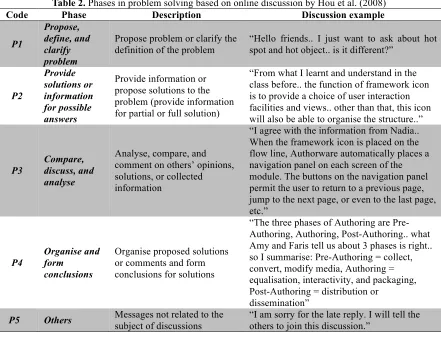
Hou et al. (2008) designed a coding scheme for problem-solving online discussion by organising and summarising research by Mayer (1992) and D’Zurilla and Goldfried (1971). The similarities had been identified and organised into four phases that are applicable to the analysis of problem-solving-based online discussions. The four phases by Hou et al. (2008) are related to propose problem, provide solutions, compare opinion, and organise.
Research Objectives
This research aims to achieve the following objectives:
i. To identify students’ problem-solving appraisal in their online learning. ii. To investigate students’ problem-solving behaviour in online learning.
iii. To analyse the relationship of students’ problem-solving appraisal in their online learning with their actual problem-solving behaviour in AODF.
iv. To analyse the relationship of students’ problem-solving appraisal in online learning with their academic performance.
Methodology
In this study, the sample used in this research was the whole population of 30-second year students that were taking the AL course. Students were given a souvenir as a token of appreciation for taking part in this research. A set of questionnaires containing items from PSI (Heppner, 1988) was used to obtain information on students’ problem-solving appraisal. The questionnaire is divided into two sections, Section A and Section B. Section A is concerned with demographical data of the respondents and contains five items, which are matrix number, gender, race, age, and experience in using the university’s e-learning system. Section B accesses students’ problem-solving appraisal through online learning. The items in Section B are adopted from the modified version of PSI by Sahin et al. (1993). Several changes are made to adapt them to the current respondent context. The items are changes to the 5-point Likert scale items. The Likert scale requires students to respond to a series of statements by indicating whether he or she strongly agree (SA), agree (A), somewhat disagree (SWD), disagree (D) and strongly disagree (SD) (Gay, Mills & Airasian, 2009). Each response is assigned a point value and each student’s score is determined by adding the point value of all the statements. In this study, the point values are SA=5, A=4, SWD=3, D=2, SD=1. Note that the response and point value use in this study contrasts with the response and point value used in PSI by Sahin et al. (1993). The response to the items in PSI by Sahin et al. (1993) is the scale between 1 (strongly agree) to 6 (strongly disagree). Section B is divided into six parts, which are Impulsive Style, Reflective Style, Problem-solving Confidence, Avoidant Style, Monitoring, and Planfulness.
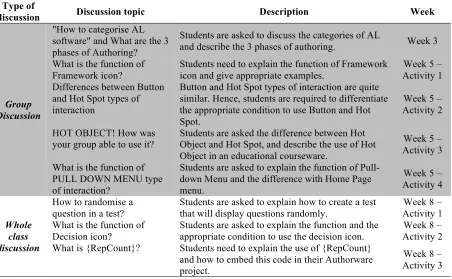
Table 1. Type of discussion, discussion topic, description of task and week
Type of
discussion Discussion topic Description Week
Group Discussion
"How to categorise AL software" and What are the 3 phases of Authoring?
Students are asked to discuss the categories of AL
and describe the 3 phases of authoring. Week 3 What is the function of
Framework icon?
Students need to explain the function of Framework icon and give appropriate examples.
Week 5 – Activity 1 Differences between Button
and Hot Spot types of interaction
Button and Hot Spot types of interaction are quite similar. Hence, students are required to differentiate the appropriate condition to use Button and Hot Spot.
Week 5 – Activity 2
HOT OBJECT! How was your group able to use it?
Students are asked the difference between Hot Object and Hot Spot, and describe the use of Hot Object in an educational courseware.
Week 5 – Activity 3 What is the function of
PULL DOWN MENU type of interaction?
Students are asked to explain the function of Pull-down Menu and the difference with Home Page menu.
Week 5 – Activity 4
Whole class discussion
How to randomise a question in a test?
Students are asked to explain how to create a test that will display questions randomly.
Week 8 – Activity 1 What is the function of
Decision icon?
Students are asked to explain the function and the appropriate condition to use the decision icon.
Week 8 – Activity 2 What is {RepCount}? Students need to explain the use of {RepCount}
and how to embed this code in their Authorware project.
Week 8 – Activity 3
To analyse the relationship of students’ problem-solving appraisal in online learning with their academic performance, students’ results for Authoring Language (AL) subject was used as a data for their academic performance. The marks used in this study consist of coursework marks, exam scores, and students’ total marks. The total marks are the summation of coursework score and exam score.
Data Analysis
Table 2. Phases in problem solving based on online discussion by Hou et al. (2008)
Code Phase Description Discussion example
P1
Propose, define, and clarify problem
Propose problem or clarify the definition of the problem
“Hello friends.. I just want to ask about hot spot and hot object.. is it different?”
P2 Provide solutions or information for possible answers
Provide information or propose solutions to the problem (provide information for partial or full solution)
“From what I learnt and understand in the class before.. the function of framework icon is to provide a choice of user interaction facilities and views.. other than that, this icon will also be able to organise the structure..”
P3
Compare, discuss, and analyse
Analyse, compare, and comment on others’ opinions, solutions, or collected information
“I agree with the information from Nadia.. When the framework icon is placed on the flow line, Authorware automatically places a navigation panel on each screen of the module. The buttons on the navigation panel permit the user to return to a previous page, jump to the next page, or even to the last page, etc.”
P4
Organise and form
conclusions
Organise proposed solutions or comments and form conclusions for solutions
“The three phases of Authoring are Pre-Authoring, Pre-Authoring, Post-Authoring.. what Amy and Faris tell us about 3 phases is right.. so I summarise: Pre-Authoring = collect, convert, modify media, Authoring = equalisation, interactivity, and packaging, Post-Authoring = distribution or
dissemination”
P5 Others Messages not related to the subject of discussions “I am sorry for the late reply. I will tell the others to join this discussion.”
For this research, Hou et al.’s (2008) coding scheme for problem-solving-based online discussions is used, because the coding scheme is designed especially for online discussion forum with problem-solving activity. Furthermore, the inter-rater kappa reliability of the coding is 0.624 (p< .01). With this value, it can be concluded that there is substantial agreement between the coders, and the coding scheme is reliable. To explore further on students’ problem solving appraisal, an independent sample t-test was conducted to investigate whether there is a statistical significance between the total of PSI score and each of the constructs in PSI among male and female students. Other than that, the Pearson Product-Moment Correlation Analysis was conducted to find out if there is any correlation between students’ PSI score and total problem-solving behaviour. This same correlation analysis was also conducted to assess the relationship between the PSI score and coursework score, the PSI score and exam score, and the PSI score and total marks. The results from this analysis will inform any significant relationship that exists between the variables and can also be the baseline for future studies.
Results
Respondents’ demographic profiles are presented in Table 3. The respondents are quite evenly divided between males and females. The respondents age are ranged from 20-23 years old and the average age is 21 years old. Majority of the respondents are experienced user of the university’s e-learning system.
Table 3. Demographic profiles of the respondents
Profile Category Percentage (%)
Gender Male 53.3
Female 46.7
Age 20 3.3
22 73.3
22 16.7
Experience in using university’s e-learning system
1 semester 3.3
2 – 3 semesters 6.7 4 – 5 semesters 70.0 6 – 7 semesters 20.0 More than 7 semesters 0.0
The results for Section B of the questionnaire which comprises the PSI items, are displayed in Table 4 according to the construct in the inventory. The students’ average PSI score is considered high, almost reaching three quarters of the maximum score. Furthermore, the total mean for positive problem-solving factors such as Planfulness, Reflective style and Monitoring are higher than the total mean for negative problem-solving factors such as Avoidant style and Impulsive style. It shows that the majority of the students have positive problem-solving appraisal.
Table 4. Problem-Solving Inventory
Scale/item Content Mean SD
Impulsive Style 3.78 0.55
Reflective Style 3.85 0.55
Problem-Solving Confidence 3.65 0.42
Avoidant Style 3.78 0.74
Monitoring 3.83 0.68
Planfulness 3.96 0.54
Total 3.14 0.25
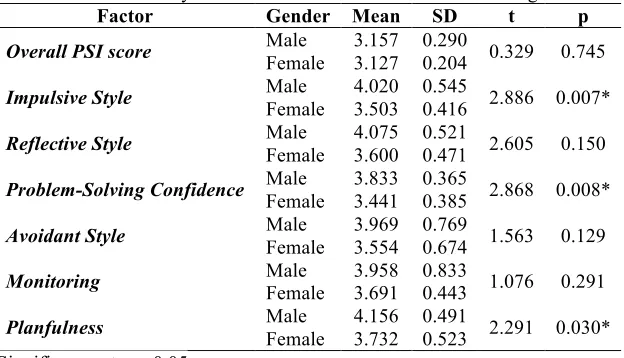
Students’ PSI scores have been calculated according to the Likert scale. The researchers intend to look further into the details of the PSI score and study whether students’ PSI scores are influenced by their gender factor. However, independent sample t-test analysis shows no significant difference between the mean for male students and female students, t(28) = 0.329, p = 0.745 > α = 0.050. The same analysis was done for each factor in PSI. Table 5 displays the result for independent-samples t-test analysis on the mean of students’ PSI scores between gender. Only Impulsive style, Problem Solving Confidence, and Planfulness show significant difference between the mean for male and female students. The other three factors show otherwise.
Table 5. T-test analysis on mean of student PSI score between genders
Factor Gender Mean SD t p
Overall PSI score Male 3.157 0.290 0.329 0.745
Female 3.127 0.204
Impulsive Style Male Female 4.020 0.545 3.503 0.416 2.886 0.007*
Reflective Style Male 4.075 0.521 2.605 0.150
Female 3.600 0.471
Problem-Solving Confidence Male Female 3.833 0.365 3.441 0.385 2.868 0.008*
Avoidant Style Male 3.969 0.769 1.563 0.129
Female 3.554 0.674
Monitoring Male Female 3.958 0.833 3.691 0.443 1.076 0.291
Planfulness Male 4.156 0.491 2.291 0.030*
Female 3.732 0.523 Significance at α = 0.05
decreasing drastically from Week 3 to Week 5, while from Week 5 to Week 8 the total frequency of problem-solving behaviour is shrinking to more than half of the original amount. However, if we compare the series of activities in Week 5, we see there is not much difference between the total frequency of problem-solving behaviour between each activity. For Week 8, the total frequency of problem-solving behaviour in each activity is constant for all three activities.
Table 6. Frequency of problem-solving behaviour that happens in each week and each activity
Week - Activity P1 P2 P3 P4 P5 Total
Week 3 6 49 10 5 33 103
Week 5 - Activity 1 4 28 11 0 11 54
Week 5 - Activity 2 0 32 9 3 1 45
Week 5 - Activity 3 5 27 9 3 7 51
Week 5 - Activity 4 1 36 7 1 6 51
Week 8 - Activity 1 0 18 4 0 0 22
Week 8 - Activity 2 0 22 0 0 0 22
Week 8 - Activity 3 0 21 0 0 1 22
Total 16 233 50 12 59 370
In this study, students are expected to present P1 until P4 except for P5, as this represents unrelated messages or off-topic messages that are not related to the subject of the discussion. However, the findings revealed that the most common problem-solving behaviour that has been displayed by the students is ‘providing information’ (P2) behaviour, whereby students often provide solutions or give information for possible answers. The second common problem-solving behaviour is ‘others’ (P5) behaviour, followed by ‘discussing’ (P3), ‘proposing problem’ (P1), and problem-solving behaviour, with the least frequency being ‘forming conclusions’ (P4) behaviour. To explore further for the correlation between PSI score and the problem-solving behaviour, the researchers computed a Pearson Product-Moment Correlation analysis. The findings from the analysis show that there is low negative correlation between the two variables (Cohen, 1988). This means that increases in PSI score correlate with decreases in the total problem-solving behaviour. However, further analysis shows that the correlation is not significant. Table 7 shows the findings of the Pearson Product-Moment Correlation Analysis between the PSI score and total problem-solving behaviour.
To obtain data that reflect their academic performance, students’ coursework score, exam score, and their total marks for AL subject are used. Table 7 shows the Pearson Product-Moment Correlation Analysis between the PSI score with coursework score, exam score, and total marks. There is no significant correlation between PSI score and coursework. However, the same analysis shows that PSI score and exam score have positive medium correlation with r = 0.470, n = 30, p = 0.009 (Cohen, 1988). There is also positive significant correlation between PSI score and total marks with r = 0.449, n = 30, and p = 0.013 even though Cohen (1988) interpret r = 0.449 as moderate correlation.
Table 7. Pearson Product-Moment Correlation Analysis between PSI Score and Problem-Solving Behaviour,
Coursework Score, Exam Score, and Total Marks
Problem-Solving Behaviour Coursework Score Exam Score Total Marks
PSI Score r = -0.138 r = 0.258 r = 0.470** r = 0.449*
p = 0.467 p = 0.169 p = 0.009 p = 0.013
n = 30
*Correlation is significant at the 0.05 level (2-tailed). **Correlation is significant at the 0.01 level.
Discussion
study. Overall, it can be concluded that majority of the students have positive problem-solving appraisal. It means most of the students believe that when confronting a problem, one of the first things they do is survey the situation and consider all the relevant information. They think about the problem before deciding on the next step and make plans to solve the problem. They also manage to solve most problems even though initially no solution is immediately apparent, and are satisfied with the decision they have made. Moreover, the item with the highest mean in this study proved that most of the students trust their own ability to solve new and difficult problems. They believe that, when confronted with a problem, they will consistently examine their feelings to find out what is going on in a problem situation. Other than that, they also believe that they will think of as many solutions to a problem as possible until they cannot come up with any more ideas; then, after solving a problem, they will compare the actual outcomes to what they thought should have happened.
However, even the average PSI scores of the students are high and show that the students have positive problem-solving appraisal, there are certain areas where the students appraise their problem-problem-solving negatively. More than half of the students agree, when they are confronted with a problem, they tend to do the first thing they can think of to solve it. It shows that quite a lot of students appraised themselves as a problem solver who makes hasty decisions. Moreover, the same number of students also claimed that, when confronting problems, they are unsure whether they can handle the situation. It shows that the students are not confident in facing difficulties. The high mean for the avoidant-style factor also shows that a lot of students negatively appraised their problem solving (Table 4). When looking into the relationship between the PSI score and gender, this study found that there is no significant difference between the mean for male students and female students, t(28) = 0.329, p = 0.745 > α = 0.050. This result is aligned with the findings from a study by Kahyaoğlu (2013) that found female respondents appraised themselves to have better problem-solving skills than male. However, the difference is not significant.
Further analysis explores the relationship between the mean for each problem-solving appraisal factors with gender. The findings show that, for Impulsive style factor, Problem Solving Confidence factor, and Planfulness factor, there is a significant difference between genders. The finding for Problem Solving Confidence factor is in line with the finding of a study by Wismath and Zhong (2012), who also found that males have significantly higher confidence in solving problems than females. This may be due to the fact that males demonstrate more creativity than females. A study by Stolitzfus Nibbelink, Vredenburg & Thyrum (2011) discovered that male students’ performance on creativity was better than females. A study by Urban and Jellen (1996) also proved that boys outperformed girls in boundary-breaking thinking.
As previously discussed, students’ problem-solving appraisal is not necessarily true and may not completely reflect students’ problem-solving skills and abilities. To figure out students’ problem-solving behaviour in the real situation, content analysis of their transcript of AODF was carried out. The low level participation in Week 5 is probably because there are four activities happening in the same week. Because there were many discussion activities occurring simultaneously, the students might not discuss the topic in detail. Thus, we can see the frequency for ‘proposing problem’, ‘discussing’, and ‘forming conclusions’ is very low. This is probably due to lack of interactions between the participants, resulting in the problem-solving behaviour such as discussion on peers posting, organisation of proposed solution and summarisation of the discussion being very low. The only behaviour that is frequently observed in Week 5 is ‘providing information’ behaviour. Most of the students simply gave short answer to the question that had been given by the moderator. A study by Vonderwell, Liang & Alderman (2007) supports the findings of this research. A respondent from their research stated that “If the discussions aren't repetitive or there aren't too many, then most students can and are willing to keep up [with the postings]. When the discussion becomes too large or takes place too frequently, I get bored, and I've seen others step back and do the minimum amount of work.” Thus, it proves that when the discussion is too frequent, the quality of the discussion may reduce.
strategy could prevent collaborative and progressive knowledge-building in online discussions. Furthermore, findings from Vonderwell et al. (2007) found that threaded discussions such as discussions in Week 3 and Week 5 had initiated more in-depth and diverse responses, which resulted in an interactive discussion pattern among the students, while the non-threaded discussion such as the discussion in Week 8 had led to redundant responses.
Other than that, it is also obvious that the total problem-solving behaviour that occurs in Week 8 is very low compared to Week 3 and Week 5. By comparing the numbers of respondents (30) with the total problem-solving behaviour in each activity in Week 8 (22), it can be concluded that at least eight students did not participate in the discussion in Week 8. From the observation by the researchers, the participation of the moderator of the AODF is also low in Week 8. The moderator should play a leading role to guide the discussion so that it is more comprehensive (Vonderwell et al., 2007). As AL is a course that focused on students’ computer skills, the nature of the tasks for each discussion topic is quite direct or well-structured. Jonassen (2000) describes well-structured problems as problems that require the application of a limited number of well-structured principles and the steps to solve the problems are predictive. Considering well-structured problems are quite simple, it is expected that the students will provide solutions straight away after clarifying the problem. Thus, that is why many students display ‘providing information’ behaviour and lack of other problem-solving behaviour.
To increase the quality of the discussion, or to ensure the students display various types of problem-solving behaviour, the instructor can use rubrics in the AODF. The rubrics should have a detailed description to inform students on what is expected from them in the AODF (Vonderwell et al., 2007). Overall, the most common problem-solving behaviour in the AODF is ‘providing information’ behaviour (Table 6). We can conclude that the students prefer to provide information, share their ideas, or propose solutions to the problem that had been presented by the moderator of the AODF. This is also supported by the quantitative data from the questionnaire, where the mean for item 26 is high. A high mean for item 26 shows that a lot of students agree that when they have a problem, they think up as many ways to handle it as possible until they cannot come up with any more ideas. Despite ‘Others’ behaviour reflects messages that are unrelated to the subject of discussions, it is the second most common problem-solving behaviour. Usually, the ‘others’ behaviour that the students display in the AODF is when they greet the other group member, or when they give their excuse for not being active in the group discussion.
The third most common behaviour in the list is ‘discussing’ behaviour. It shows that many students love to analyse, compare, and comment on others’ opinions. The moderate total frequency for ‘discussing’ behaviour is probably because ‘discussing’ behaviour is very beneficial to the students’ learning. Studies reported that students learnt a great deal from their peers through online discussions and sometimes someone can explain a concept in a way that the instructor may not (Wu and Hiltz, 2004; Vonderwell et al., 2007). The next on the list is ‘proposing problem’ behaviour, which has a very low frequency. ‘Proposing problem’ behaviour refers to a behaviour that proposes a problem or clarifies the definition of the problem. The low frequency of ‘proposing problem’ behaviour shows that not many students proposed a new problem, or clarified the problems that had been given by the moderator of the AODF. This is in contrast with the findings from quantitative data from the questionnaire, where the mean for Reflective Style factor is high. One of the items in Reflective Style factor, item 14, receives a high mean. The statement for item 14 is “when I become aware of a problem, one of the first things that I do is to try to find out exactly what the problem is.”
The least common problem-solving behaviour found in this study is ‘forming conclusions’ behaviour, which indicates the phase that organises proposed solutions or comments and forms conclusions for solutions. ‘Forming conclusions’ is the least common problem-solving behaviour. It shows that the students rarely make conclusions in their discussions in AODF. Usually, a discussion ended when there was no more participation from the students. Sometimes, the discussion ended halfway when the students were in the middle of a discussion. However, these findings contrast with those findings from the questionnaire, where item 10 has a high mean. The result for item 10 shows that, when making a decision, the students weigh the consequences of each alternative and compare them against each other. The high frequency of ‘providing information’ and ‘discussing’ compared with ‘proposing problem’ and ‘forming conclusions’ indicates that the students like to share their opinions, ideas and solutions, and they like to give comment or reflect on others’ opinions and solutions, more than proposing a problem or summarising the discussion.
which reflects positive problem-solving appraisal, it does not necessarily mean that the students have a high total of problem-solving behaviour in AODF. Logically, those students who have a high problem-solving ability are supposedly active in solving problems and offering a greater contribution to the group discussion. Here, we failed to prove that a student, who perceived him/herself as a good problem-solver, has a high total of problem-solving behaviour. It shows that the students’ appraisal about themselves does not really show the problem-solving skills and behaviour. This is aligned with the study by Larson and Heppner (1989), which proved that sometimes problem-solving appraisal, does not reflect problem-problem-solving effectiveness. Heppner et al. (2004) also emphasised that, although some research findings suggest that PSI score is related to problem-solving performance, it should not be considered synonymous with problem-solving effectiveness. The reason behind this is that PSI is more about the problem-solving process, while the problem-solving behaviour is the output of the probem-solving process. Even though the students appraise their problem-solving skills positively, there might be some other factors that interfere with the problem-solving process that result in low problem-solving behaviour. Jonassen (2011) points out that there are external and internal factors that affect problem solving. The external factors that might hinder problem solving are different perspective, dynamicity of problems, structure, level of difficulty and context of the problem.
This study also intends to investigate the relationship of students’ problem-solving appraisal in online learning with their academic performance. We can see that there is no significant correlation between PSI score and coursework score (Table 7). This result gives us a hint that students with high problem-solving skills do not necessarily perform well in their coursework score. This is probably because this coursework score is given for their marks in the Authorware project (the end-products) that had been accessed based on students’ computational skills rather than looking at the students’ learning process, which itself can be accessed based on students’ problem-solving skills. Thus, this explains why there is no significant correlation between the PSI score and coursework score. Hence, it is suggested that further research should consider the formative assessment, where achievement can be partly measured by an ongoing process, including students’ problem-solving skills. On the other hand, there is a significant correlation between students’ PSI score and their exam score (Table 7). This means that increases in PSI score correlate with increases in exam score. The exam question was designed with more problem-solving questions. Thus, it is only natural that students’ exam scores are significantly correlated with the students’ PSI score. The same conclusion can be applied to the relationship between the students’ PSI score and their total marks for Authoring Language subject. There is a significant correlation between the students’ PSI score and students’ total marks (Table 7). A few studies have associated students’ academic performance with their problem-solving appraisal. For example, Salami and Aremu (2006) found that students’ academic performance is significantly associated with their problem-solving appraisal. Likewise, a study by Flores et. al. (2006) also agreed with this notion and concluded that students with higher appraisals of their problem-solving abilities were more positive appraisals were related to have better academic grades. This is because students’ problem-solving appraisal seems to be related to study skills and habits that may have an impact on the students’ academic grades (Salami & Aremu, 2006).
Limitations and Future Studies
As this study has a long gap between the time the students participated in the discussion in AODF with the time when the students’ problem-solving appraisals were assessed, there might be some changes with the way the students perceived their solving ability/skills. Future research should consider the assessment of student problem-solving appraisal during the time when the students are active in the discussion to avoid any bias. Furthermore, the results from this study cannot be generalised as a larger sample size is recommended, so that the findings will be oversimplified to the population. Other than that, future research should consider studying the relationship between students’ problem-solving appraisal with age or education level. This study does not focus on finding ways to improve problem-solving performance among students. However, this facet is worth to be explored. In addition, despite accessing students’ performance based on the final projects, a formative assessment should be implemented where the learning process, including students’ problem-solving skills can be accessed. On the other hand, a future study may consider using various types of research instruments rather than depending on questionnaires and students’ transcripts of AODF only. Interviews with students and course instructor or observation may also be used to gain more valid results.
Conclusion
dimension is found to have the highest mean compared to the other dimension, followed by Reflective Style, Monitoring, Avoidant Style, Impulsive Style, and Problem Solving Confidence. There is no significant difference between the means of PSI scores for male and female students. However, only the dimensions Impulsive Style, Problem Solving Confidence, and Planfulness show any significant difference between the mean for male and female students. For the dimensions Reflective Style, Avoidant Style, and Monitoring, there is no significant difference between the mean for male and female students. The findings from the content analysis for students’ transcripts of AODF show that ‘providing information’ behaviour is the most common behaviour observed from the students. ‘Others’ is the second most common behaviour, followed by ‘discussing’, ‘proposing problem’ and ‘forming conclusions’. Generally, the number of problem-solving behaviours is decreasing across time. This is due to the different types of discussion between Week 3, Week 5 and Week 8, and because there are multiple discussions occurring simultaneously in Week 5. There is no significant relationship between students’ problem-solving appraisal and problem-solving behaviour. This means that a decrease in PSI score does not mean there will also be a decrease in the students’ problem-solving behaviour in AODF. However, there is a significant correlation between PSI score and students’ total marks for AL subject. On the other hand, if we look at each type of score, there is no significant correlation between PSI score and students’ coursework score, but there is a significant correlation between PSI score and the students’ exam score. It is important to note that the design of the test question is important and must implement a problem-solving strategy.
References
Blankstein, K. R., Flett, G. L., & Watson, M. S. (1992). Coping and academic problem-solving ability in test anxiety. Journal of Clinical Psychology, 48, 37-46.
Blumenfeld, P. C., Marx, R. W., Soloway, E. & Krajcik, J. (1996). Learning with peers: From small group cooperation to collaborative communities. Educational Researcher, 25(8), 37-40.
Cohen, J. (1988). Statistical Power Analysis for the Behavioral Sciences (2nd ed.), New Jersey: Lawrence Erlbaum Associates. Corich, S., Kinshuk, & Hunt, L. M. (2006). Measuring critical thinking within discussion forums using a computerised content analysis tool. Networked Learning, 1-8.
D’Zurilla, T. J., & Goldfried, M. R. (1971). Problem solving behavior modification. Journal of Normal Psychology, 78(1), 112– 119.
De Wever, B., Schellens, T., Valcke, M., & Van Keer, H. (2006). Content analysis schemes to analyze transcripts of online asynchronous discussion groups: a review. Computers & Education, 46(1), 6-28.
Elliott, T. R., Godshall, F., Shrout, J. R., & Witty, T. E. (1990). Problem-solving appraisal, self reported study habits, and performance of academically at-risk college students. Journal of Counseling Psychology, 37, 203-207.
Flores L. Y., Ojeda, L. Huang, Yu-Ping, Gee, D & Lee, S. (2006). The relation of acculturation, problem-solving appraisal, and career decision-making self-efficacy to Mexican American high school students’ educational goals. Journal of Counseling Psychology, 53(2), 260–266.
Gay, L. R., Mills, G. E., & Airasian, P. (2009). Educational Research.Competencies for Analysis and Applications. New Jersey: Pearson Education, Inc.
Ghafar, M. N. A. (1999). Penyelidikan Pendidikan. Skudai: Penerbit Universiti Teknologi Malaysia
Gunawardena, C., Lowe, C., & Anderson, T. (1997). Analysis of global online debate and the development of an interaction analysis model for examining social construction of knowledge in computer conferencing. Journal of Educational Computing Research 17(4), 397–431.
Henri, F. (1992). Computer conferencing and content analysis. In A. Kaye (Ed.), Collaborative learning through computer conferencing: The Najaden Papers. 117–136. London: Springer-Verlag.
Heppner, P. P. (1988). The Problem Solving Inventory (PSI): Manual. Palo Alto, CA: Consulting Psychologists.
Hewitt, J. (2005). Toward An Understanding Of How Threads Die In Asynchronous Computer Conferences. Journal of the Learning Sciences. 14, 567–589.
Hou, H.-T., Chang, K.-E., & Sung, Y.-T. (2008). Analysis of Problem-Solving-Based Online Asynchronous Discussion Pattern.
Educational Technology & Society, 11(1), 17-28.
Jonassen, D. (2000). Toward a design theory of problem solving. Educational Technology Research and Development, 48, 63–85. doi:10.1007/BF02300500
Jonassen, D. (2011). Supporting Problem Solving in PBL. Interdisciplinary Journal of Problem-Based Learning. doi:10.7771/1541-5015.1256
Kahyaoğlu, M. (2013). The Relationship Between Elementary Teacher Candidates’ Attitudes Towards Problem Based Learning And Problem Solving Skills. The Online Journal of New Horizons in Education, 4(1), 62-67.
Larson, L. M., & Heppner, P. P. (1989). Problem-solving appraisal in an alcoholic population. Journal of Counseling Psychology.
36, 73-78.
Mayer, R. E. (1992). Thinking, problem solving, cognition. New York, NY: W. H. Freeman and Company.
Nezu, A. M., Nezu, C. M., & Perri, M. G. (1989). Problem-solving therapy for depression: Theory,research, and clinical guidelines. New York: Wiley.
Sahin, N., Sahin, N. H. & Heppner, P. P. (1993). Psychometric Properties Of The Problem Solving Inventory In A Group Of Turkish University Students. Cognitive Therapy and Research,17 (4), 379-396.
Salami, S.O., & Aremu, A.O. (2006): Relationship between problem-solving ability and study behaviour among school-going adolescents in Southwestern Nigeria. Electronic Journal of Research in Educational Psychology Vol. 8. No. 4, 140 –154.
Stolitzfus, G., Nibbelink, B., Vredenburg, D., & Thyrum, E. (2011). Gender, gender role, and creativity. Social Behavior & Personality: An International Journal, 39(3), 425-432.
Urban, K. K., & Jellen, H.G. (1996). Test for creative thinking – drawing production (TTCT-DP). Lisse, Netherlands: Swets and Zeitlinger
Vonderwell, S., Liang, X., & Alderman, K. (2007). Asynchronous Discussions and Assessment in Online Learning. Journal Of Research On Technology In Education.39(3), 309-328.
Wismath, S. & Zhong, M. (2012). Gender Differences In University Students' Perception Of And Confidence In Problem-Solving Abilities. Journal of Women and Minorities in Science and Engineering. 1-10.
Wu, D., & Hiltz, R. S. (2004). Predicting Learning From Asynchronous Online Discussions. Joumal of Asynchronous Learning Networks, 5(2), 139-152.
Yeh, Y.-C. (2010). Analyzing Online Behaviors, Roles, and Learning Communities via Online Discussions. Educational Technology & Society, 13 (1), 140–151.