Jurnal Teknologi, 52 Mei 2010: 29–43 © Universiti Teknologi Malaysia
THE EFECTIVENESS OF INTERACTIVE MULTIMEDIA COURSEWARE IN DEVELOPING STUDENT’S
SELF-ENLIGHTENING LEVEL
ROHANA HAMZAH1 & KAMARUDZAMAN MD ISA2
Abstract. The Faculty of Art and Design (FSSR), UiTM Shah Alam was formed based on a holistic education mission. However, the main problem occurred especially in inculcating spiritual values among arts and design students. Therefore, the purpose of this study is to offer an alternative approach to conventional practice in teaching and learning of art and design by developing, integrating and evaluating spiritual-development interactive multimedia courseware and study its’ impact on students self-enlightening level. In order to measure the effectiveness of this interactive multimedia courseware an instrument has been developed and the alpha value is 0.93. The quantitative research method of true experimental pretest-posttest design has been applied. The under-graduate arts and design students in semester three have been chosen as the population of study because the actual design process only begins during this semester of their study program at FSSR. 101 students have been involved in the study. A comparison between the experimental group and the control group shows that there was a significant difference in the self-enlightening level. The mean values for experimental group (interactive multimedia approach group) (4.18) are higher compared to the control group (3.94). This finding also indicates that current practice in arts and design education at the faculty was unable to improve self-enlightening level among art and design students. However, using the interactive multimedia technology can help develop self-enlightening level among them.
Keywords: Holistic education; integrated; self-enlightening; spiritual; interactive multimedia
Abstrak. Fakulti Seni Reka dan Seni Lukis (FSSR), UiTM Shah Alam telah ditubuhkan berdasarkan misi pendidikan holistik. Namun, permasalahan utama dalam usaha mencapai misi pendidikan holistik ini ialah penerapan nilai spiritual dalam kalangan pelajar. Maka, tujuan kajian ini ialah untuk menawarkan pendekatan alternatif kepada amalan pengajaran dan pembelajaran sedia ada dengan membangunkan, mengintegrasikan dan menilai keberkesanan interaktif multimedia courseware ke atas tahap pencerahan diri pelajar. Satu instrumen telah dibina untuk mengukur tahap pencerahan diri pelajar dan nilai alfanya ialah 0.93. Kajian ini merupakan kajian kuantitatif dengan mengunakan reka bentuk kajian eksperimental pretest dan (post-test). Seramai 101 pelajar ijazah pertama pada semester tiga telah dipilih sebagai populasi kajian kerana proses pengajaran dan pembelajaran reka bentuk hanya bermula pada semester ini dalam tempoh pengajian mereka di FSSR. Dapatan kajian menunjukkan bahawa tidak terdapat perbezaan yang signifikan bagi tahap pembangunan pencerahan diri bagi kumpulan kawalan tetapi terdapat perbezaan yang signifikan bagi kumpulan interaktif multimedia. Perbandingan di antara kumpulan eksperimen pula menunjukkan terdapat perbezaan yang signifikan tahap pencerahan diri pelajar di antara kumpulan interaktif multimedia dan kumpulan kawalan, di mana min bagi kumpulan interaktif lebih tinggi daripada kumpulan kawalan. Dapatan ini membuktikan bahawa amalan sedia ada dalam pengajaran dan pembelajaran seni lukis dan seni reka tidak mampu meningkatkan tahap pencerahan diri pelajar. Penggunaan teknologi interaktif multimedia telah dapat
1&2
membangunkan kefahaman dan kepercayaan pelajar terhadap faktor-faktor pencerahan diri dengan lebih berkesan.
Kata kunci: Pendidikan holistik; integrasi; pencerahan diri; spiritual; interaktif dalam multimedia
1.0 INTRODUCTION
The awareness of having holistic approach in education has been a major concern to the Malaysian education system and it is always defines as an effort to nurture the development of the whole person. This includes physical, intellectual, emotional, social, aesthetic and spirituality with the purpose to reach self-actualization in their life (Ahmad Sabri, 2003). Although, there are a lot of learning theories which dealt with the first five factors but most generally ignored the spiritual dimension (Miller et al. 2005).
Meanwhile, Hasan Langgulung (1987) indicates that in order to educate people, we have to understand their spirituality because spirituality motivates human behaviour and how they respond to the environment. In addition, a muslim philosopher, al-Ghazali in Mohd Johari (2007) states that teaching art without focusing on the spiritual values of human development process will produce man kind who are imprisoned within the material world and will not achieve true happiness. Therefore, there is a need to analyze and understand human development process from their spiritual domain in order to exercise a holistic approach in our education system.
2.0 PROBLEM STATEMENT
Holistic education approach has become a major concern in the University Technology MARA (UiTM) philosophy. In line with UiTM’s philosophy, Faculty of Art and Design (FSSR) founded in 1967 is the oldest such faculty in Malaysia and has been developed based on the following mission:
(1) To provide excellent and distinguish teaching and learning programs in Art and Design.
(2) To develop and promote technologies and professionals in the Art and Design disciplines encompassing Islamic values; and
(3) With the current UiTM’s vision of becoming a world-class university, it inspires FSSR of becoming a world-class reference for Asian and International art.
(Retrieved June 10, 2008 from http://www.uitm.edu.my)
However, after almost three decades, the Faculty of Art and Design has successfully achieved two out of three of its main objectives but the inculcation of spiritual values in its 99% Muslim students population proved to be problematic (Khatijah, 2000).
and integrated approach were not very well defined. They add that many who were involved directly and indirectly such as educators, administrators and students were confused. As a result, only certain potentials have been well developed such as skill and knowledge but not in spiritual and emotional potentials.
There are a lot of research that has been done on self-development from external level to the internal level but there are very little research has been done to develop human being from inside which is spiritual level to external level (Korthagen, 2003). Thus, the main concern of this study is to develop, integrate and evaluate teaching and learning module for spiritual development process through art and design education. Since the use of interactive multimedia technology in teaching and learning activities has given a lot of impact on students achievement (Kim et al. 2000), the researcher decided used this technology as a tool to present the spiritual development process.
3.0 RESEARCH OBJECTIVE
The main purpose of this study is to develop, integrate and evaluate spiritual-development modules based on Islamic philosopher for arts and design education. The research objective of this study is:
To analyse any significant impact of the spiritual-development modules on students’ self-enlightening level.
There are two hypotheses which have been developed as the following:
HO1: There is no significant difference on respondents’ self enlightening levels HO2: There is no significant difference in self-enlightening level between the
experimental groups.
4.0 SPIRITUAL DEVELOPMENT AND SELF-ENLIGHTENING MODEL
The acknowledgement of the spiritual dimension of existence is one of the critical elements of holistic learning (Miller et al. 2005; Absar Ahmad, 1992). However, spiritual development only can develop through religion. A true knowledge of one’s deeper self necessarily leads to awareness of the Ultimate Self or God and vice versa (Absar Ahmad, 1992). That is the reason why education should aim at inducing in man an attitude based on God-consciousness and this only can be done through religion. Gordon Allport in Brink and Carmody (2002) stated that mature religion leads to personal growth and not discrimination against other groups. Therefore, referring to the religion of Islam, the researcher finds a way for spiritual development through education.
(nafs ammarah) which man shares with animals; in the second degree it is the conscientious or morally aware mind or the blaming soul (nafs lawwamah) struggling between good and evil and repenting for the evil done; in the third degree is the mind perfectly in tune with the divine will, the mind in peace (nafs mutma’innah).
However, with the combination of the soul and the body, man also carries dual nature. As a result, in spiritual development, man also having dual tendencies which is the tendency to become good or bad. The tendency to become good comes from the nature of soul which is pure submission to God. Meanwhile tendency to become bad comes from man’s body which is the basic instinct and impulse to fulfill his physical needs. These tendencies become two types of force which is positive and negative (Hasan Langgulung, 1987).
These two forces work in different directions in spiritual-development process. The positive force which work to the highest level is identified as self-enlightening force and the negative force which work to the lowest is the self-narrowness force (Wahid Bakhsh Shaikh, 1999). Figure 1 illustrates the spiritual-development model used in this study.
Therefore, the spiritual-development process just like the transformation process of the soul. If a person goes down the path of sin, his penalty gathers momentum, just as goodness brings its own capacity for greater goodness. In other words, when a person
Figure 1 The spiritual development model (adapted from Hassan Langgulung, 1987) Close to God’s attributes
The Rational Soul (al-Nafs al-Mutma’innah)
The highest stage of self-enlightening level
The Qalb (al-Nafs al-Lawwamah)
The middle stage of self-enlightening level
Nafs
(al-Nafs al-Ammarah)
The lowest stage of self-enlightening level
Animal soul (Man with dead heart) Worldly desire
Primitive close to animal attributes
Self-narrowness force (Attracted to the lower level)
Self-narrowness force (Attracted to the lower level) Self-enlightening force
(Attracted to the higher level)
persistently adheres to false beliefs and refuses to listen to the voice of truth, he gradually loses the ability to perceive the truth, so that finally, he falls into the lowest level of the self-development process. Sometimes this level of self can be called as man with a ‘dead’ heart but surely it happened as a consequence of man’s free choice and not an act of ‘predestination’ (Absar Ahmad, 1992).
Man reaches the highest level of self-development only when the animal soul that enslaves itself in submission and service to the power and authority of the rational soul. Only then the divine peace will descend upon him and the effusion of divine liberality will successively be diffused in him until he achieves tranquillity in the remembrance of God and abides in the knowledge of His divinity (Syed Naquib al-Attas, 2001). This is the soul that ‘returns’ itself willingly to its Lord. This is the soul of the servant who has fulfilled in constant affirmation his covenant with His Lord. In this way, one has put the animal soul and the rational soul in its proper place and this is ‘adab’ toward one’s self.
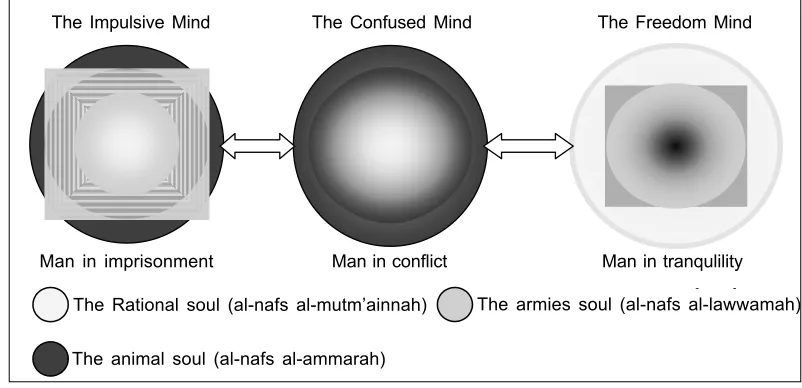
The submission of the animal soul to the rational soul is the only true meaning for man in his life. Therefore, man has to overcome al-nafs al-Ammarah (the animal soul) not by denying and shedding it but by understanding and controlling it. Therefore, the whole process of self-development is about the exercise of subordinating the faculty of the animal soul to those of the rational soul. This process requires man to exercise his freedom of choice or divine trust that God has given to him. Figure 2 illustrates the self-enlightening process and stages of human mind.
The self-enlightening force factors as identified by Ary Ginanjar Agustian (2005) are One God principle, slave principle, leadership principle, genuine principle and learning principle.
Man in imprisonment Man in conflict Man in tranquillity The Impulsive Mind The Confused Mind The Freedom Mind
Figure 2 The spiritual development stages and the stages of mind model as modified by researcher The Confused Mind The Freedom Mind The Impulsive Mind
Man in imprisonment Man in conflict Man in tranqulility
The Rational soul (al-nafs al-mutm’ainnah)
The animal soul (al-nafs al-ammarah)
According to Syed Naquib Al-Attas (2001), The Unity of God is proven in the unity of cosmic order which consists of the laws of nature that enables man to recognize the permanence of substances as things and the repetition of events as causal relations. Without the unity of cosmic order, neither things nor causes and consequences would be the same. Therefore, every being in the cosmos and every event that takes place is does so by the command of Allah (S.W.T.). Belief in One God is also the latent power of man and only can be achieved through self improvement to become a perfect man.
In addition, man owes his very existence to his Creator because every soul has already acknowledged God as his Lord (al-A’raf: 172). Therefore, man has sealed a covenant with God in his spiritual existence, so that every soul recognizes his Creator and puts it in indebtedness to Him. Consequently, man cannot regard either his soul or life or body as unqualifiedly his, and hence cannot dispense it howsoever he wishes. According to Syed Naquib Al-Attas (2001) the starting point in the Islamic concept of religion and religious sensibility in man (God’s Consciousness). In order to repay his debt, man must return himself to his Lord, sincerely and consciously enslaves himself for the sake of God and truly obeying His command.
Allah (S.W.T.) also announced man as His khalifah before the creation of the first human being, Adam (a.s.) as mention in the Al-Quran, al-Baqarah: 30. Therefore, to be a khalifah on the earth is the purpose for the creation of man on the earth and the goal of every person’s life. There are three principles of khalifah as identified by Muhammad al-Mahdi (2004) which is to perfect ourselves, to help the others and to perfect this physical world according to God’s will.
Meanwhile, genuine principle is about one belief that God create everything with His precise measurement and only for goodness. Man duty is only to exercise his freedom to choose for the better because the best choice only knows by God (Fazlur Rahman, 1999).
5.0 METHODOLOGY
This research involved 101 semester three art and design students from Faculty of Art and Design (FSSR), UiTM Shah Alam. The respondents have been chosen because one of the requirement for this study is the spiritual development process should be integrated into product design activities (creativity development process).
The true experimental pretest-posttest control group research design has been applied because this approach gives another extra quality for controlling the conditions of the experiment and its ability to enhance the experimental validity (Cavana et al. 2001). Therefore, the respondents are randomly assigned to control (conventional approach group) and experimental group (interactive multimedia approach group). The conventional group does not receive any treatment for spiritual development program. Meanwhile, the interactive multimedia group has been exposed to the spiritual development courseware.
The researcher has developed an interactive multimedia spiritual development courseware to present the self-enlightening concept to the students. According to Serig (2005) the metaphor method is frequently used to represent the meaning of concepts in an interactive multimedia program.
Therefore, the metophor of durian circle of life has been used to present the self-enlightening concept to the respondent and the researcher name the program as ‘the
Figure 3 The self-enlightening factors in spiritual development process One God
Genuine Slave
Leadership (Khalifah) Learning
hidden journey of yourself’. The whole research process took about one semester. It begins with one week for the administration of pretest questionnaire, four weeks for the implementation of spiritual development program and another four weeks were needed to administer the post-test questionnaire.
In order to measure the effectiveness of the interactive multimedia courseware the researcher has developed pre-test and posttest quantitative research instrument. The alpha Cronbach’ value for the instrument is 0.93, which means that this instrument was reliable used for the purpose of this research.
6.0 RESEARCH FINDING
The researcher use imputation if the overall mean method to handle the missing data since their method will not discard those in complete responses (Roziah, 2002). The findings will be discuss according to the following sub topic.
(1) Hypotheses One: There is no significant difference on respondents’ self-enlightening levels
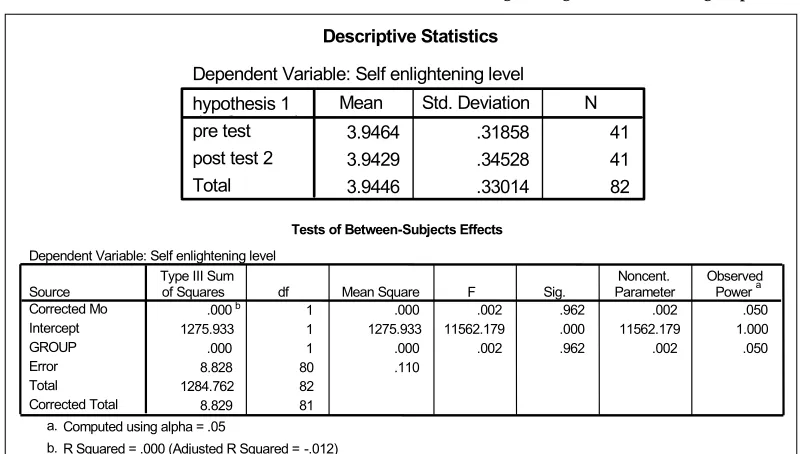
Table 1 illustrates the results of the hypothesis testing on the self-enlightening level for control and experimental group.
The results showed that F= 0.002 is significant at 0.962 level which is higher than 0.05. Therefore, there is no significant difference for the self-enlightening level for the
Table 1 UNIANOVA test on the difference of self-enlightening level for control group
Tests of Between-Subjects Effects Dependent Variable: Self enlightening level
.000b 1 .000 .002 .962 .002 .050
1275.933 1 1275.933 11562.179 .000 11562.179 1.000
.000 1 .000 .002 .962 .002 .050
8.828 80 .110
1284.762 82 8.829 81 Source
Corrected Mo Intercept GROUP Error Total Corrected Total
Type III Sum
of Squares df Mean Square F Sig. ParameterNoncent. ObservedPowera
Computed using alpha = .05 a.
R Squared = .000 (Adjusted R Squared = -.012) b.
Descriptive Statistics
Dependent Variable: Self enlightening level
3.9464 .31858 41
3.9429 .34528 41
3.9446 .33014 82
hypothesis 1 dan 2 group 1 pre test post test 2 Total
pre-test and post test for the control group. In other words, null hypothesis is accepted. The following table summarise the results of the hypothesis testing for the interactive multimedia approach group.
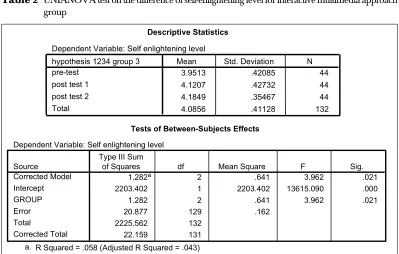
The output shows that the self-enlightening level is significantly different for the interactive multimedia approach. F = 3.962 is significant at 0.021 which is below 0.05. That means the null hypothesis is rejected. In order to locate the difference between the testing stages, the researcher run post-hoc test. The results suggest that there are significant differences in the self-enlightening level between pre-test and post test two. In other words, the self-enlightening level among the respondents from interactive multimedia approach group has significantly increased during the post test two after going through the design class activity.
(2) Hypotheses Two: The difference of self-enlightening level between the experimental groups
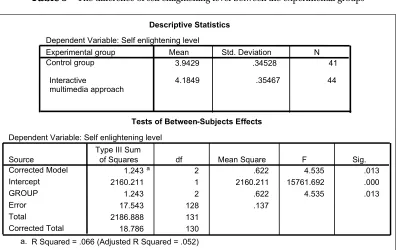
Table 3 illustrates the result for the hypothesis two, testing on the differences of self-enlightening level between the experimental groups.
The finding suggested that there are significant differences of the self-enlightening level between the experimental groups when F= 4.535 is significant at 0.013 which is lower than 0.05. Therefore the null hypothesis is rejected. Further analysis on mean value suggested that the mean value for interactive multimedia approach group (4.18)
Table 2 UNIANOVA test on the difference of self-enlightening level for interactive multimedia approach group
Descriptive Statistics
Dependent Variable: Self enlightening level
3.9513 .42085 44
4.1207 .42732 44
4.1849 .35467 44
4.0856 .41128 132
hypothesis 1234 group 3 pre-test
post test 1 post test 2 Total
Mean Std. Deviation N
Tests of Between-Subjects Effects
Dependent Variable: Self enlightening level
1.282a 2 .641 3.962 .021
2203.402 1 2203.402 13615.090 .000
1.282 2 .641 3.962 .021
20.877 129 .162
2225.562 132
22.159 131
Source Corrected Model Intercept GROUP Error Total
Corrected Total
Type III Sum
of Squares df Mean Square F Sig.
Table 3 The difference of self-enlightening level between the experimental groups
Descriptive Statistics
Dependent Variable: Self enlightening level
3.9429 .34528 41
4.1849 .35467 44
Experimental group Control group
Interactive
multimedia approach
Mean Std. Deviation N
Tests of Between-Subjects Effects
Dependent Variable: Self enlightening level
1.243a 2 .622 4.535 .013
2160.211 1 2160.211 15761.692 .000
1.243 2 .622 4.535 .013
17.543 128 .137
2186.888 131
18.786 130
Source
Corrected Model Intercept GROUP Error Total
Corrected Total
Type III Sum
of Squares df Mean Square F Sig.
R Squared = .066 (Adjusted R Squared = .052) a.
is higher than control group (3.94). Therefore, the improvement of self-enlightening level for interactive multimedia is better compared to the control groups.
7.0 DISCUSSION
In order to clarify the findings, the discussion has been arranged according to the following sub-topic:
(1) The self-enlightening level; a comparison between pre-test and posttest
Comparisons between pre-test and post-test shows that there was no significant difference in the self-enlightening level for the control group. This finding has proved that current practice in teaching and learning of arts and design education was unable to improve self-enlightening level among art and design students. This finding on the weaknesses of the current practice in teaching and learning of arts and design education in developing the spiritual domain was supported by Khatijah Sanusi (2000). She found that the inculcation of spiritual values in Muslim students through teaching and learning activities has proved to be problematic.
In addition, the International Institute of Islamic Thought (1988) indicates that the problems because the secular education system has been adopted and implemented in many colonized Muslim’s countries. The adoption has develops a confusion about the vision of education among educators and students. Therefore, the focus in arts and design education is not on human development but more on the process of producing arts and design product (Mohd Johari, 2004).
However, there was a significant differences in the self-enlightening level for the interactive multimedia approach group between pre-test and post-test two (at the end of semester). The mean for post-test two (4.18) is higher than the mean for pre-test (3.95). The difference in the self-enlightening level between pre-test and post-test one which was conducted right after the self-development program was also not significant. The implication of this finding is that the students who followed the self-development program through interactive multimedia approach were able to develop their belief in the self-enlightening factor on their own without continuous support from the lecturers during art and design class activities.
This finding was parallel to a research done by McNaught (1999). McNaught has carried out a study on the at impact of a multimedia approach on teaching and learning using Bloom taxonomy and found that students were more responsible for their own learning. There is also evidence that students’ awareness and interest in the subject increased. Therefore, the interactive multimedia approach can be used to develop students’ self-enlightening level. It is also the more effective approach compared to current practice in arts and design education. However, this approach is more effective to be implemented in a small number of students because the students need to be facilitated by a facilitator to clarify any confusion and for any further discussion activities.
(2) The self-enlightening level; comparison between the experimental groups
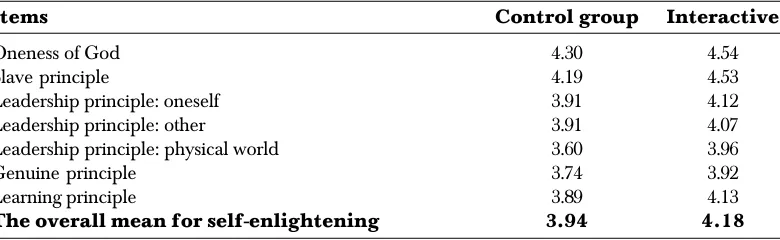
in arts and design education. Analysis on every the self-enlightening factor confirm that, the interactive multimedia group scores the highest in almost all of the factors. Table 4 summarizes the comparison of mean between the experimental groups.
Table 4 Mean comparison between the experimental group for the self-enlightening factors (Posttest two)
Items Control group Interactive
Oneness of God 4.30 4.54
Slave principle 4.19 4.53
Leadership principle: oneself 3.91 4.12
Leadership principle: other 3.91 4.07
Leadership principle: physical world 3.60 3.96
Genuine principle 3.74 3.92
Learning principle 3.89 4.13
The overall mean for self-enlightening 3.94 4.18
Finding shows that the mean values on the factor ‘Oneness of God’ and ‘slave principle’ for the interactive multimedia group is higher compared to the control group. Belief in one God and to enslave only to one God, according to Syed Muhammad Naquib al-Attas (2001), is the starting point in the Islamic concept of religion and religious sensibility in man. This is the foundation of the worldview of Islam. In other words, belief in One God and to enslave and submit only to Him is the ultimate vision in man’s life. Therefore, in the self-enlightening process, if these factors develop close together, it means that man is clear about his vision in his life. Therefore, this finding shows that the students from the interactive multimedia group are clearer about their vision and able to develop their certainty in the self-enlightening factors on their own without continuous support from the lecturers during art and design class activities.
Moreover, the faith in One True and Real God (Illah) which is that there is no God but Allah (Laa ilaaha illallaah) is the fundamental principle and core value of the latent power of man in the self-enlightening development process (Syed Muhammad Naquib al-Attas, 2001). In contrast, Michon (1997) defines artistic creativity as latent power in all individuals and he defined the latent power as related to the permanent quality in man’s life. The researcher found that there is similarity between the definition of latent power by Syed Muhammad Naquib al-Attas (2001) and by Michon (1997). Therefore, the researcher would suggest that belief in Oneness of God and enslavement only to Him as latent power for developing art and design students’ creativity.
arts and design education. According to H. Abuddin Nata (2005) the vision of life to enslave only to one God can be identified as the vision for spiritual potential will be incomplete without the manner and form of true submission as God’s khalifah. This is another vision related to man’s physical potential. Therefore, the purpose of education process is to develop the physical potential in order for man to fulfil his role as khalifah. In other words, developing man’s role as khalifah means to develop a sense of responsibility toward oneself, the others and this physical world (Muhammad al-Mahdi, 2004).
The finding also shows that students from interactive multimedia group understand the concept of learning better compared to the students exposed to current practice in arts and design education. It is important for student to understand the learning concept based on Islamic philosophy because man’s responsibility as khalifah is closely related to the concept of learning.
Since man has a dual nature, which is soul and body, therefore knowledge that purports to serve him best too would be of dual aspect; the prior is that which serves his more permanent, spiritual dimension or the core of knowledge and the other his secondary, material and emotion mode of existence (Wan Mohd. Nor, 2005 and Osman, 2006).
The first knowledge is related to man’s natural disposition towards goodness which is knowledge of God as the only Creator and the second is based on reason and empirical experience. The first knowledge manifested through the law of nature which expresses God’s command and His message that He is the only creator. Second knowledge is important for man to fulfil their responsibility as God’s khalifah and the exercise of the power of freedom as a challenge of being just toward God’s creation. Therefore, the learning concept is about a continuous effort to discover the truth hiding in the law of nature and the development of the sense of true obedience and real submission to God (spiritual dimension) not only in verbal professing but also in action as khalifah (physical dimension). In other words, the learning process should be developed according to man’s dual visions of life which is as God’s servant for his spiritual domain and khalifah for his physical domain.
Finding also shows that the respondents from interactive multimedia group have increased their level of self-genuineness compared to students exposed to the current practice in training and learning of arts and design education. The self genuine concept develops based on belief that everything from God has a purpose which its being serves and only for goodness.
In conclusion, after the students followed the spiritual-development courseware, the self-enlightening level increased and was higher compared to the current approach in arts and design education. Analysis on the individual factors shows that, the interactive multimedia group scores the highest in almost all of the factors. This research has opens up spaces for further research in spiritual domains through education. By analyzing and understanding human being from their spiritual potentials, the researcher has a better understanding what education is all about. The deeper meaning of education is not only to transform the knowledge, facts and skill but it is more towards to mould the human being to reach self-actualization as a servant to God and God’s khalifah. In other words, education is a process to humanize human being to civilize based on two unchanging visions of life which is to submit only to One God and fulfil man’s role as ‘khalifah.’
REFERENCES
Absar Ahmad. 1992. Qur’anic Concepts of Human Psyche. In The International Institute of Islamic Though and Institute of Islamic Culture, Islamization of knowledge; General Principles and Work Plan (3rd ed., pp. 15-37). Pakistan: The International Institute of Islamic Thought.
Ahmad Sabri Osman. 2003. Konsep Pendidikan Islam. Jurnal Intelek. First Edition: ( Julai- Disember). 22–37. Ary Ginanjar Agustian. 2005. ESQ: Emotional Spiritual Quotient. Jakarta: Penerbit Arga.
Brink, T. L. and D. L. Carmody. 2002. Ways to the Centre: An Introduction to World Religions. Belmont, USA: Wadsworth/Thomson Learning.
Cavana, R. Y., B. L. Delahaye, and Uma Sekaran. 2001. Applied Business Research; Qualitative and Quantitative Methods. Australia: John Wiley and Sons.
Fazlur Rahman. 1999. Major Themes of the Quran. Petaling Jaya: Islamic Book Trust.
H. Wrul Walidin AK, M.A. 2005. Konstelasi Pemikiran Pedagogik Ibnu Khaldun; Perspektif Pendidikan Moden. (Edisi Revisi). Yogyakarta: Suluh Press.
Hasan Langgulung. 1987. Asas-asas Pendidikan Islam. Jakarta, Indonesia: Pustaka Al-Husna.
Khatijah Sanusi. 2000. Visual Art Education in Malaysia (Doctoral Dissertation, Temple University, 2000). Kim, B., R. Williams, and J. Dattilo. 2002. Students Perceptions of Interactive Llearning Modules. Journal of
Research on Technology In Education. 34(4): 453–473.
Korthagen, F. A. J. 2003. In Search of the Essence of a Good Teacher: Towards a More Holistic Approach in Teacher Education. Teaching and Teacher Education. 20: 77–97.
McNaught, C. 1999. Evaluation Strategies for Developing and Using Effective Computer-facillitated Learning Environment in Science and Engineering. European Journal of Engineering Education. 24(1): 23–34. Michon, J. L. 1997. The Role of art in Human Development. In Wan Abdul Kadir and Yap Beng Liang (Eds.), Seni
dan Pendidikan Insan Madani. Kuala Lumbur: Akademi Pengajian Melayu University Malaya.
Miller, J. P., S. Karsten, D. Denton, D. Orr, and I. C. Kates. 2005. Holistic Learning and Spirituality in Education; Breaking New Ground. New York: State University of New York Press.
Mohd Johari Ab. Hamid. 2007. Falsafah dan Kritikan Seni. Tanjong Malim: Universiti Pendidikan Sultan Idris. Muhamad Al-Mahdi. 2004. Understanding the Concept of Khalifah; Khalifah Series no.1. Ampang Selangor: The
Kalifah Institute.
Osman Bakar. 2006. Classification of Knowledge in Islam. Kuala Lumpur: ISTAC Roziah Mohd Jonor. 2003. (Doctoral dissertation, University Malaya, 2003).
Serig, D. A. 2005. A Conceptual Structure of Visual Metaphors in the Practices and Exhibition of a Consortium of Artist. (Doctoral dissertation, Colombia University, 2005).
Tajul Ariffin Noordin and Nor ‘Aini Dan. 2002. Pendidikan & Pembangunan Manusia: Pendikatan Bersepadu. Bangi Selangor: As-Syabab Media.
Wahid Bakhsh Shaikh. 1999. Education Base on the Teaching of Holy Al-Quran. Delhi: Adam Publishers and Distributors.