Techniques of Data Analysis
(Basic Statistical Theory)
Assoc. Prof. Dr. Abdul Hamid b. Hj. Mar Iman
Objectives
Overall: Reinforce your understanding from the main
lecture
Specific:
* Some principles of data analysis * Some aspects of statistics
* Some uses of statistical methods
* Some exercises on statistical methods
What I will not do:
SOME PRINCIPLES OF DATA ANALYSIS
Goal of an data analysis
Basic guides to data analysis
Four elements of data analysis
Principles of analysis
Goal of an analysis:
* To explain cause-and-effect phenomena
* To relate research with real-world event
* To predict/forecast the real-world
phenomena based on research
* Finding answers to a particular problem
* Making conclusions about real-world
event
based on the problem
Principles of data analysis (contd.)
Basic guide to data analysis:
* “Analyse” NOT “narrate”
* Go back to research flowchart
* Break down into research objectives and research questions
* Identify phenomena to be investigated * Visualise the “expected” answers
* Validate the answers with data
Principles of analysis (contd.)
An analysis must have four elements:
* Data/information (what)
* Scientific reasoning/argument (what?
who? where? how? what happens?)
* Finding (what results?)
Data can’t “talk”. Thus, analysis must contain scientific reasoning/argument:
* Define * Interpret * Evaluate * Illustrate * Discuss * Explain * Clarify
* Compare * Contrast
Principles of data analysis (contd.)
When analysing:
* Be objective
* Accurate
* True
Separate facts and opinion
Avoid “wrong” reasoning/argument. E.g.
Principles of data analysis (contd.)
Shoppers Number
Male Old
Young
6 4 Female
Old
Young
10 15
More female shoppers than male shoppers
More young female shoppers than young male shoppers
What is Statistics
“Meaningful” quantities about a sample of
objects, things, persons, events, phenomena, etc.
Something to do with “data”
Widely used in various discipline of sciences.
Used to solve simple to complex issues.
Three main categories:
Descriptive Statistics
Use sample information to explain/make
abstraction of population “phenomena”.
Common “phenomena”:
* Association (e.g. σ
1,2.3= 0.75)
* Tendency (left-skew, right-skew)
* Causal relationship (e.g. if X, then, Y)
* Trend, pattern, dispersion, range
Used in non-parametric analysis (e.g.
Examples of “abstraction” of phenomena
Trends in property loan, shop house demand & supply
0 50000 100000 150000 200000
Year (1990 - 1997)
Loan to property sector (RM million)
32635.8 38100.6 42468.1 47684.7 48408.2 61433.6 77255.7 97810.1 Demand for shop shouses (units) 71719 73892 85843 95916 101107 117857 134864 86323 Supply of shop houses (units) 85534 85821 90366 101508 111952 125334 143530 154179 1 2 3 4 5 6 7 8
0 50,000 100,000 150,000 200,000 250,000 300,000 350,000 Batu Pah at Joho r Bah
ru Klua ng Kota Tin ggi Mer
sing Muar Pont ian Sega mat District N o . o f h o u se s 1991 2000 0 2 4 6 8 10 12 14 0-4 10-1 4 20-2 4 30-3 4 40-4 4 50-5 4 60-6 4 70-7 4
Age Category (Years Old)
Examples of “abstraction” of phenomena
Demand (% sales success)
120 100 80 60 40 20 P ri c e ( R M /s q .f t. b u ilt a re a ) 200 180 160 140 120 100 80
1 0 . 0 0 2 0 . 0 0 3 0 . 0 0 4 0 . 0 0 5 0 . 0 0 6 0 . 0 0 1 0 . 0 0
2 0 . 0 0 3 0 . 0 0 4 0 . 0 0 5 0 . 0 0
- 1 0 0 . 0 0 - 8 0 . 0 0 - 6 0 . 0 0 - 4 0 . 0 0 - 2 0 . 0 0 0 . 0 0 2 0 . 0 0 4 0 . 0 0 6 0 . 0 0 8 0 . 0 0 1 0 0 . 0 0
D ist a n c e fr o m R a k ai a ( k m )
D i s t a n c e f r o m A s h u r t o n ( k m )
% prediction
Inferential statistics
Using sample statistics to infer some
“phenomena” of population parameters
Common “phenomena”: cause-and-effect
* One-way r/ship
* Multi-directional r/ship
* Recursive
Use parametric analysis (α and
of a
regression analysis)
Y1 = f(Y2, X, e1) Y2 = f(Y1, Z, e2) Y1 = f(X, e1)
Examples of relationship
Coefficientsa
1993.108 239.632 8.317 .000 -4.472 1.199 -.190 -3.728 .000 6.938 .619 .705 11.209 .000 4.393 1.807 .139 2.431 .017 -27.893 6.108 -.241 -4.567 .000 34.895 89.440 .020 .390 .697 (Constant) Tanah Bangunan Ansilari Umur Flo_go Model 1
B Std. Error Unstandardized Coefficients Beta Standardized Coefficients t Sig.
Dependent Variable: Nilaism a.
Dep=9t – 215.8
Which one to use?
Nature of research
* Descriptive in nature?
* Attempts to “infer”, “predict”, find “cause-and-effect”, “influence”, “relationship”?
* Is it both?
Research design (incl. variables involved). E.g. Outputs/results expected
* research issue
* research questions * research hypotheses
Common mistakes in use of statistics
Wrong techniques. E.g.
Infeasible techniques. E.g.
How to design ex-ante effects of KLIA? Development
occurs “before” and “after”! What is the control treatment? Further explanation!
Abuse of statistics. E.g.
Simply exclude a technique
Note: No way can Likert scaling show “cause-and-effect” phenomena!
Issue Data analysis techniques
Wrong technique Correct technique To study factors that “influence” visitors to
come to a recreation site
“Effects” of KLIA on the development of Sepang
Likert scaling based on interviews
Likert scaling based on interviews
Data tabulation based on open-ended questionnaire survey
Descriptive analysis based on ex-ante post-ante
Common mistakes (contd.) – “Abuse of statistics”
Issue Data analysis techniques
Example of abuse Correct technique
Measure the “influence” of a variable on another
Using partial correlation
(e.g. Spearman coeff.)
Using a regression parameter
Finding the “relationship” between one variable with another
Multi-dimensional scaling, Likert scaling
Simple regression coefficient
To evaluate whether a model fits data better than the other
Using R2 Many – a.o.t. Box-Cox
2 test for model
equivalence To evaluate accuracy of “prediction” Using R2 and/or F-value
of a model
Hold-out sample’s MAPE
“Compare” whether a group is different from another
Multi-dimensional scaling, Likert scaling
Many – a.o.t. two-way anova, 2, Z test
To determine whether a group of factors “significantly influence” the observed phenomenon
Multi-dimensional scaling, Likert scaling
How to avoid mistakes - Useful tips
Crystalize the research problem → operability of
it!
Read literature on data analysis techniques.
Evaluate various techniques that can do similar
things w.r.t. to research problem
Know what a technique does and what it doesn’t
Consult people, esp. supervisor
Pilot-run the data and evaluate results
Don’t do research??
SOME ASPECTS OF STATISTICS
SOME ASPECTS OF STATISTICS
Introductory Statistical Concepts
Introductory Statistical Concepts
Basic concepts
Basic concepts
Central tendency
Central tendency
Variability
Variability
Probability
Probability
Statistical Modelling
Basic Concepts
Population: the whole set of a “universe”
Sample: a sub-set of a population
Parameter: an unknown “fixed” value of population characteristic
Statistic: a known/calculable value of sample characteristic
representing that of the population. E.g.
μ = mean of population, = mean of sample
Q: What is the mean price of houses in J.B.? A: RM 210,000
J.B. houses μ = ?
SST DST
SD
1
= 300,000 = 120,000
2
= 210,000
Basic Concepts (contd.)
Randomness
: Many things occur by pure
chances…rainfall, disease, birth, death,..
Variability
: Stochastic processes bring in
them various different dimensions,
characteristics, properties, features, etc.,
in the population
Statistical analysis methods have been
“Central Tendency”
Measure Advantages Disadvantages
Mean (Sum of all values ÷ no. of values)
Best known average Exactly calculable Make use of all data
Useful for statistical analysis
Affected by extreme values
Can be absurd for discrete data
(e.g. Family size = 4.5 person) Cannot be obtained graphically
Median
(middle value)
Not influenced by extreme values
Obtainable even if data
distribution unknown (e.g. group/aggregate data)
Unaffected by irregular class
width
Unaffected by open-ended class
Needs interpolation for group/ aggregate data (cumulative frequency curve)
May not be characteristic of group when: (1) items are only few; (2) distribution irregular
Very limited statistical use
Mode
(most frequent value)
Unaffected by extreme values Easy to obtain from histogram Determinable from only values near the modal class
Cannot be determined exactly in group data
Central Tendency – “Mean”
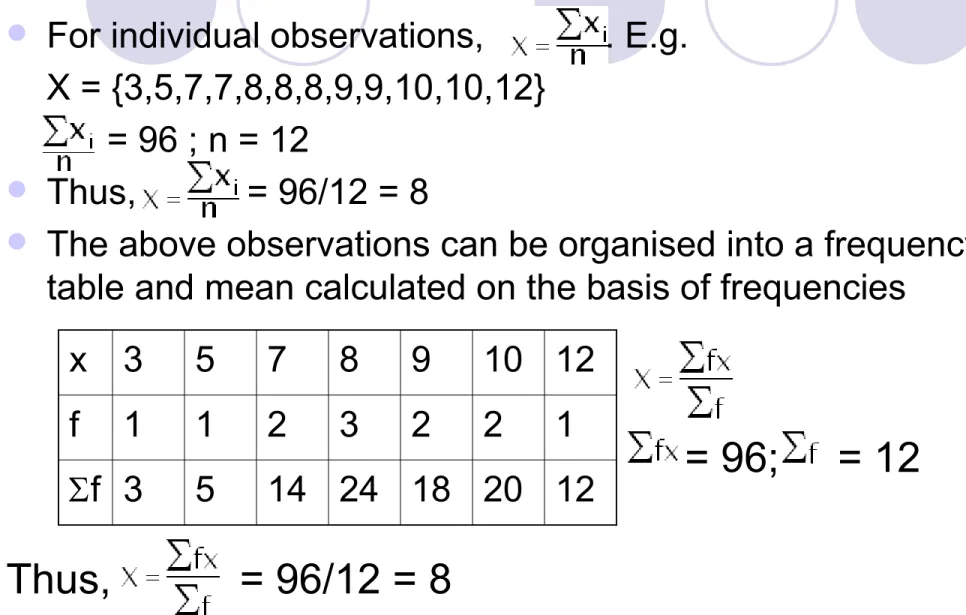
For individual observations, . E.g.
X = {3,5,7,7,8,8,8,9,9,10,10,12} = 96 ; n = 12
Thus, = 96/12 = 8
The above observations can be organised into a frequency
table and mean calculated on the basis of frequencies
= 96; = 12
Thus, = 96/12 = 8
x 3 5 7 8 9 10 12
f 1 1 2 3 2 2 1
Central Tendency - Mean and Mid-point
Let say we have data like this:
Location Min Max
Town A 228 450
Town B 320 430
Price (RM ‘000/unit) of Shop Houses in Skudai
Central Tendency - Mean and Mid-point
(contd.)
Let calculate as follows:
Town A: (228+450)/2 = 339
Town B: (320+430)/2 = 375
Central Tendency - Mean and Mid-point
(contd.)
Let say we have price data as follows:
Town A: 228, 295, 310, 420, 450 Town B: 320, 295, 310, 400, 430
Calculate the means?
Town A: Town B:
Are the results same as previously?
Central Tendency–“Mean of Grouped Data”
House rental or prices in the PMR are frequently
tabulated as a range of values. E.g.
What is the mean rental across the areas?
= 23; = 3317.5
Thus, = 3317.5/23 = 144.24
Rental (RM/month) 135-140 140-145 145-150 150-155 155-160 Mid-point value (x) 137.5 142.5 147.5 152.5 157.5 Number of Taman (f) 5 9 6 2 1
Central Tendency – “Median”
Let say house rentals in a particular town are tabulated as
follows:
Calculation of “median” rental needs a graphical aids→
Rental (RM/month) 130-135 135-140 140-145 155-50 150-155 Number of Taman (f) 3 5 9 6 2 Rental (RM/month) >135 > 140 > 145 > 150 > 155 Cumulative frequency 3 8 17 23 25
1. Median = (n+1)/2 = (25+1)/2 =13th.
Taman
2. (i.e. between 10 – 15 points on the vertical axis of ogive).
3. Corresponds to RM
140-145/month on the horizontal axis
4. There are (17-8) = 9 Taman in the range of RM 140-145/month
5. Taman 13th. is 5th. out of the 9
Taman
6. The rental interval width is 5
7. Therefore, the median rental can be calculated as:
Central Tendency – “Quartiles” (contd.)
Upper quartile = ¾(n+1) = 19.5th.
Taman
UQ = 145 + (3/7 x 5) = RM 147.1/ month
Lower quartile = (n+1)/4 = 26/4 = 6.5 th. Taman
LQ = 135 + (3.5/5 x 5) = RM138.5/month
Inter-quartile = UQ – LQ = 147.1 – 138.5 = 8.6th. Taman
IQ = 138.5 + (4/5 x 5) = RM 142.5/month
“Variability”
Indicates dispersion, spread, variation, deviation
For single population or sample data:
where σ2 and s2 = population and sample variance respectively, x i = individual observations, μ = population mean, = sample mean, and n = total number of individual observations.
The square roots are:
“Variability” (contd.)
Why “measure of dispersion” important?
Consider returns from two categories of shares:
* Shares A (%) = {1.8, 1.9, 2.0, 2.1, 3.6} * Shares B (%) = {1.0, 1.5, 2.0, 3.0, 3.9}
Mean A = mean B = 2.28% But, different variability!
Var(A) = 0.557, Var(B) = 1.367
“Variability” (contd.)
Coefficient of variation – COV – std. deviation as
% of the mean:
Could be a better measure compared to std. dev.
“Variability” (contd.)
Std. dev. of a frequency distribution
The following table shows the age distribution of second-time home buyers:
“Probability Distribution”
Defined as of probability density function (pdf).
Many types: Z, t, F, gamma, etc.
“God-given” nature of the real world event.
General form:
E.g.
(continuous)
“Probability Distribution” (contd.)
Dice1
Dice2 1 2 3 4 5 6
1 2 3 4 5 6 7
2 3 4 5 6 7 8
3 4 5 6 7 8 9
4 5 6 7 8 9 10
5 6 7 8 9 10 11
“Probability Distribution” (contd.)
Values of x are discrete (discontinuous)
Sum of lengths of vertical bars p(X=x) = 1
all x
“Probability Distribution” (contd.)
▪ Many real world phenomena take a form of continuous random variable
“Probability Distribution” (contd.)
P(Rental = RM 8) = 0 P(Rental < RM 3.00) = 0.206
“Probability Distribution” (contd.)
Ideal distribution of such phenomena:
* Bell-shaped, symmetrical
* Has a function of
μ = mean of variable x σ = std. dev. of x
π = ratio of circumference of a
circle to its diameter = 3.14
“Probability distribution”
“Probability distribution”
“Probability distribution”
There are various other types and/or shapes of
distribution. E.g.
Not “ideally” shaped like the previous one
“Z-Distribution”
(X=x) is given by area under curve Has no standard algebraic method of integration → Z ~ N(0,1) It is called “normal distribution” (ND)
Standard reference/approximation of other distributions. Since there
are various f(x) forming NDs, SND is needed
To transform f(x) into f(z):
x - µ
Z = --- ~ N(0, 1) σ
160 –155
E.g. Z = --- = 0.926 5.4
Probability is such a way that:
* Approx. 68% -1< z <1
“Z-distribution” (contd.)
When X= μ, Z = 0, i.e.
When X = μ + σ, Z = 1
When X = μ + 2σ, Z = 2
When X = μ + 3σ, Z = 3 and so on.
It can be proven that P(X1 <X< Xk) = P(Z1 <Z< Zk)
SND shows the probability to the right of any
particular value of Z.
Normal distribution…Questions
Your sample found that the mean price of “affordable” homes in Johor
Bahru, Y, is RM 155,000 with a variance of RM 3.8x10⁷. On the basis of a normality assumption, how sure are you that:
(a) The mean price is really ≤ RM 160,000
(b) The mean price is between RM 145,000 and 160,000
Answer (a):
P(Y ≤ 160,000) = P(Z ≤ ---) = P(Z ≤ 0.811)
= 0.1867
Using , the required probability is: 1-0.1867 = 0.8133
Always remember: to convert to SND, subtract the mean and divide by the std. dev. 160,000 -155,000
3.8x10⁷
Normal distribution…Questions
Answer (b):
Z1 = --- = --- = -1.622
Z2 = --- = --- = 0.811
P(Z1<-1.622)=0.0455; P(Z2>0.811)=0.1867
P(145,000<Z<160,000)
= P(1-(0.0455+0.1867) = 0.7678
X1 - μ σ
145,000 – 155,000 3.8x107
X2 - μ σ
Normal distribution…Questions
You are told by a property consultant that the
average rental for a shop house in Johor Bahru is RM 3.20 per sq. After searching, you discovered the following rental data:
2.20, 3.00, 2.00, 2.50, 3.50,3.20, 2.60, 2.00, 3.10, 2.70
“Student’s t-Distribution”
Similar to Z-distribution:
* t(0,σ) but σn→∞→1
* -∞ < t < +∞
* Flatter with thicker tails
* As n→∞ t(0,σ) → N(0,1)
* Has a function of
where =gamma distribution; v=n-1=d.o.f; =3.147
Test yourselves!
Q1: Calculate the min and std. deviation of the following data:
Q2: Calculate the mean price of the following low-cost houses, in various localities across the country:
PRICE - RM ‘000 130 137 128 390 140 241 342 143
SQ. M OF FLOOR 135 140 100 360 175 270 200 170
PRICE - RM ‘000 (x) 36 37 38 39 40 41 42 43
Test yourselves! (contd.)
Q3: From a sample information, a population of housing estate is believed have a “normal” distribution of X ~ (155, 45). What is the general adjustment to obtain a Standard Normal Distribution of this population?
Q4: Consider the following ROI for two types of investment:
A: 3.6, 4.6, 4.6, 5.2, 4.2, 6.5 B: 3.3, 3.4, 4.2, 5.5, 5.8, 6.8
Test yourselves! (contd.)
Q5: Find:
(AGE > “30-34”)
(AGE ≤ 20-24)
Test yourselves! (contd.)
Q6: You are asked by a property marketing manager to ascertain whether
or not distance to work and distance to the city are “equally” important factors influencing people’s choice of house location.
You are given the following data for the purpose of testing:
Explore the data as follows:
• Create histograms for both distances. Comment on the shape of the
histograms. What is you conclusion?
• Construct scatter diagram of both distances. Comment on the output. • Explore the data and give some analysis.
• Set a hypothesis that means of both distances are the same. Make
Test yourselves! (contd.)
Q7: From your initial investigation, you try to establish whether tenants of “low-quality” housing choose to rent particular flat units just to find shelters. In this context, you want to
determine whether these groups of people pay much attention to pertinent aspects of “quality life” such as accessibility, good surrounding, security, and physical facilities in the living areas.
(a) Set your research design and data analysis procedure to address the research issue
(b) How are you going to test your hypothesis as follows:
Ho: low-income tenants do not perceive “quality life” to be important in paying their house rentals.