A
Queueing Model of a Bufferless
Synchronous Clos
ATM
Switch with
Head-of-Line Priority and Push-Out
Arne A.
Nilsson
Fuyung
Lai
Center for Communications and Signal Processing
Department Electrical and Computer Engineering
North Carolina State University
TR-90j21
A Queueing Model of a Bufferless Synchronous Clos
ATM Switch with Head-Of-Line Priority and
Push-out
*
Arne A. Nilsson and Fuyung Lai
Department of Electrical and Computer Engineerillg, and
.Center for Communications and Signal Processing
North Carolina State University
Raleigh, N.C. 27695-7914
Harry G. Perros
Department of Computer Science, and
Center for Communications and Signal Processing
North Carolina State University
Raleigh, N.C. 27695-8206
1990
Abstract
We consider a synchronized bufferless Clos ATM switch with input cell processor queues. The arrival process to each input port of the switchisassumed to be bursty and it is modeled by an Interrupted Bernoulli Process. Two classes of cells are considered. Service in an input cell processor queue is head-of-line without preemption. In addition,
push-out is used. That is, a high priority cell arriving to a full queue takes the space occupied by the low priority cell that arrived last, as long as the cell is not in service. Each cell processor queue is modeled as a priority IBP /Geo/l/K+l queue with push-out. We first present an exact analysis of this priority queue.The results obtained are then used in an approximation algorithm for the analysis of the ATM switch. Validation tests using simulation data shows that the approximation algorithm has a good accuracy.
1
Introduction
Broadband ISDN is a promising communications infrastructure for the future. It is conceived as an all-purpose digital network, and it will provide an integrated access that will support a wide variety of applications for the customers. The Asynchronous Transfer Mode (ATM) has been strongly promoted as the target transfer mode solution for broadband ISDN. ATM is a high-bandwidth, low-delay, packet switching technique, capable of efficiently multiplexing a number of highly bursty sources, such as voice, file transfer, and video.
In recent years, several types of ATM switch architectures have been proposed. One important class of architectures is based on multi-stage interconnection networks. There are buffered or unbuffered switching elements in a multi-stage interconnection network. In the unbuffered case, there may be buffers at the input ports or at the output ports of the
switch.
This
type of structures have been reported in Turner[1],
Narasimha[2],
Huangand Knauer [3], Giacopelli, Littlewood, Sincoskie [4], and Tobagi and Kwok [5]. Some
switch architectures provide full connectivity between the input and output ports, such as
the bus-matrix switching architecture [Nojima [6]), the knockout switch (Yeh, Hluchyj, and
Acampora [7]), and the integrated switch fabric (Ahmadi [8]).
Other architectures that have been proposed are the shared memory and the shared
medium architectures. In the shared memory architecture, a single memory is shared by all
input and output ports. There is a single controller to process the incoming and outgoing cells which are stored in the same memory. Examples of this type of architecture are discussed
in Devault, Cochennec, and Servel [9], and Kuwahara, Endo, Ogino and Kozuki
[10].
In theshared medium architecture, arriving cells are multiplexed onto a parallel bus. An exa.mple of this architecture is discussed in Suzuki [11]. A good review of ATM switch architectures is given in Tobagi [12]. Approximate analytic studies of ATM switches can be found in
Karol, Hluchyj and Morgan
[13],
Hluchyj and Karol[14],
Patel[15],
Yoon, Lee, and Liu[16],
Shaikh, Schwartz, and Szymanski [17], Oie, Suda, Masayuki, and Miyahara [18], andYamashita, Perros and Hong [19].
Different classes of service provided by an ATM network will require different quality of service. In particular, voice and video are tolerant to cell loss but not to time delays. On the other hand, the transfer of bulk files is tolerant to time delays but not to cell loss. In view of this, it has been proposed to introduce priorities among cells. These priorities are known as space priorities, as they deal with priorities regarding the utilization of the space in a buffer. Space priorities can be also used in conjunction with congestion control at the call level.
Two different space priority schemes have been proposed, namely, push-out and
arrives to a full buffer, takes the place occupied by the low priority cell that arrived last , as long as this cell is not in service. A high priority cell is lost only if there are no low priority cells in the buffer waiting for service. In the partial buffer sharing scheme, both high and low priority cells are admitted to the buffer as long as the total number of cells in the buffer
is below a pre-defined threshold. Once the threshold is exceeded, only high priority cells
are admitted to the buffer. Garcia and Casals
[20]
analyzed a finite capacity single serverqueue with two classes assuming partial buffer sharing. The arrival process was modelled by a two-state Markov Modulated Poisson Process, and the service time was assumed to be constant. A similar model was considered by Le Boudec [21] assuming a number of identical arrival streams, each being modelled by a two-state Markov Modulated Bernoulli Process.
Kroner, Hebuterne, Boyer, and Gravey [22] compared the two space priority schemes, They
concluded that both schemes have a comparable performance, though the partial buffer sharing scheme is easier to implement. Their results, however, have been obta.ined under
the assumption of Poisson arrivals. Gravey and Hebuterne
[23]
analyzed an M/G/1/n queuewith head-of-line non-preemptive priority and push-out. The partial buffer sharing scheme was also considered by Yin, Li, and Stern [25]. Conservation laws for the push-out scheme were given in Sumita and Ozawa [24]. Finally, for a literature review of ATM related papers see Perros [26].
In this paper, we study a blocking ATM switch with finite buffer at the input ports. The switch fabric is a bufferless Clos three-stage interconnection network. The arrival process to each input port of the switch is assumed to be bursty, and it is modelled by an Interrupted Bernoulli Process (IBP). Each input queue is assumed to have space and service priority. In particular, we consider push-out for space priority and head-of-line with no preemption for service priority. We now proceed to describe the switch under study in detail.
2
Model description
Let us consider an N x N Clos cell switch, as shown ill Figure 1. There are three stages in
the switch. At each stage, there are n or
VN
number of bufferless switching elements. Eachswitching element is an n
x
n crossbar switch. For each input port, there is a finite queueserved by a cell processor. There are two classes of cells, high and low priority. If an arriving
high priority cell finds the buffer of the cell processor full, it will push out a low priority
cell with the least waiting time in the system, but not the one in service. An arriving low
priority cell is lost if it finds the buffer full. An arriving high priority cell is lost only if the
buffer is full with high priority cells. High priority cells have also priority for service over low priority cells. The service priority is head-of-line with no preemption.
The cell processor is responsible for determining the output port of a cell and
then transmitting the cell through the switch fabric. The operation of the
C10s
switch is1 -..[l]IJ- 1
2
.
.
12
0
n
-..0IIl-
nn+l
Sf
n+l
2n
2n
0
0
0 0
0 0
N-n+l
Efl
N-n+l.
.
.
00
n • n 0 0
0
-+-OID- 0 0 0
N N
launch a cell through the switch. A cell will successfully get through the switch if it finds a free path to the sought output port. No contention takes place at the 1st stage of the Clos ATM switch. The cells in the switch will compete for the output links at the 2nd and the
3rd stages. In a switching element, if more than one input link compete for the same output
Iink, one of the input links will get through. This input link is randomly selected. If a cell is blocked in the switch, the switching element notifies the cell processor, and transmission of the cell is aborted. The cell processor will retransmit the cell at the beginning of the next time slot. The retransmissions will continue until the cell is successfully transmitted through the switch.
The time required for a cell to pass through the switch fabric is equal to one slot. It is assumed that each incoming link is slotted. The length of a slot is equal to a slot of the ATM switch. Each incoming link is not synchronized with the other incoming links and with the switch. A cell that arrives at an idle cell processor in the middle of a slot of the ATM switch is not transmitted until the beginning of the next time slot of the ATM switch.
The arrival process to each input port of the ATM switch is modeled by an
Inter-rupted Bernoulli Process(IBP), as shown in Figure 2. No arrivals occur if the process is in
the idle state. If the process is in the active state, arrivals occur in a Bernoulli fashion. That is, a slot will contain a cell with probability cx. If the process is in the idle (active) state,
then in the next time slot it remains in the idle (active) state with probability
q (p)
or it willchange to the active (idle) state with probability1-q(1-p). It can be shown (see Nilsson,
1-p
p
1-q
q
Figure 2: TIle Markov chain of the IBP process.
Lai, and Perros [27]) that the z-transforrn of the probability distribution of the interarrival
time is
A(z)
(1 -a)(p
+
ZQq - l)z2 - [q
[p
+
Z(1 -
p - q)]
+
From this we have that the mean interarrival time
E(i)
is equal toE{l}
=
(2 -
p - q)0:(1 -
q) ,
(1)
and the squared coefficient of variation of the interarrival time, C2
, is
02
=
1
+
a((1 -
p)(3 -
q) _
2)
+
a?
(1 -
q)2
.
(2-p_q)2 (2-p_q)2
(2)
(3)
1 - 0-
=
Assuming that the destination of a cell is uniformly selected, it can also be shown that the
probability for a cell successfully passing through the Clos ATM switch ,1 - (T, is
Average number of busy output links at the 3rd stage
Average number of busy input links at the 1st stage
N
" [3]
LJPi
i=l N
LPi
i=l
where p~3] is the ith output link utilizations of the switching elements in the 3rdstage of the
Clos ATM switch.
In this paper, we analyze the buffer in front of a cell processor as a two-class IBP /Geo/l/K+l queue with head-of-line non-preemptive priority and push-out. In section 3, we obtain the queue-length distribution of the number of high and low priority cells that are waiting to be served, as seen by an arriving cell. We also obtain the distribution of the waiting time of a high priority cell. In section 4, we obtain the probability that a low priority cell will get served given that it entered the buffer. We also compute the mean waiting time
of a low priority cell given that it entered the buffer and it got served. In section 5, we
3
The IBP /Geo/l/K+l queue with head-of-line
pri-ority and push-out
Let us consider a cell processor queue. It is obvious from the previous section that the total time it takes for the cell processor to transmit successfully a high or low priority cell through
the switch fabric is geometrically distributed with probability a . Therefore, a cell processor
queue can be modeled as all IBP /Geo/ 1 queue with finite buffer, head-of-line priority, and
push-out , as shown ill Figure 3. In the analysis below, we will consider this queueing system
IBP
Figure 3: The IBP /Geo/l queueing system with finite buffer.
at successive arrival points as shown in Figure 4. These arrival points are the imbedded
Markov points of the queueing system. Our approach is to focus attention on arrival instants
and the number of high and low priority customers seen by an arriving customer.
(m,n)
So
~
. 0 _0• •0 " 0_ _.J
(i,j)
I slots
Figure 4: The evolution of the number of customers in the system.
Below, we distinguish between the queue that is allowed to be built in front of the
server and the system that includes the queue and the server. Let K be the queue size, and
K
+
1 be the system size. Let (i,j) be the state of the queue as seen by an arriving cell, wherei is the number of high priority cells and j is the number of low priority cells in the queue.
The state
(0,0)
means that there are no cells in the queue. Finally, state°
means that theentire system is empty.
{3 : the probability that an arriving cell is a high priority cell.
Pi,; : the probability that an arriving cell finds the queue in state (i,j).
Po :
the probability that an arriving cell finds an empty system.i :
the interarrival time of the cell.X : the service time of a cell.
We define
and
p[i
==
l]
1>
1P[x
==
i]==
(1 -
U)Ui-1, i ~1,
where al is the probability that an interarrival time is 1slots, and a is the probability that a cell is blocked in the C105 ATM switch.
Below, we obtain the probability
Pi,;
and we also obtain the waiting time distribu-tion of a high priority cell.3.1
TIle queue length distribution
Pi,i
We first note that in Nilsson, Lai, and Perros
[27],
the steady state probability'i
that anarriving cell sees j cells in the system was obtained for an IBP /Geo/l queue with finite
buffer. We observe that
Po
,0,
Po,O /1·
Let us define
b
o ==
A(u),
where
A(
z) is the z-transform of the probability distribution of the interarrival time. IIIorder to obtain Pi,i we need to study the system at instants of arrivals. In steady state, we
have
p ..
1.,3 fJa
K~-j
~ P, .n,3~
Z:: ( n - 1~.+
1 ) ul-(n-i+1)(1 _ a)(n-i+l)aland
K-1 00 ( 1 )
f3
:E
Pn,o:E . U'-(n-i+l)(l - U)(n-i+l)aln=i-l l=1 n - ~
+
1+f3(PK,o
+
PK-1,df (
K~
i ) ul-(K-i)(l - u)(K-i)acl=1
/3(Pi-1,obo
+
Pi,ob1+ ... +
PK-1,obK- i)
+(3PK,obK- i
+
fjPK-1,lbK -ifor K
>
i>
0, and j=
0,and
K-l-(j-l) 00 ( 1 )
Po,i
(1 -
(3)E
t;
Pn,i-l n u/-n(1 - u)n a/K-l K-l-n 00 ( 1 )
+
L. L L
Pm,n m+
1+
n _ . u/-(m+l+n-i)(1 - u)(m+l+n-i)a/n=1 m=O l=1 . J
+f3
t
PK-n,nf (
K ': · ) ul-(K-i)(l - u)(K-i)a,n=;+l 1=1 J
+(1 -
(3)t
PK-n,nf (
K ': . ) u'-(K-i)(l - u)(K-i)a,n=j [=1 J
(1 -
(3)(PO,i-l bO+
P1,i-lbl+ ...
+
PK-i,i-lbK-i)+Po,ibl
+
P1,jb2+ .,. +
PK-l-i,ibK-i)+
(1 -
(3)PK-i,i bK-i+PO,i+lb2
+
P1,i+lb3+ ..,+
PK-l-(i+l),i+lbK-i)+
PK-(i+l),i+lbK-i+...
+PO,K-1bK-i
+
P1,K-1bK -i+Po,KbK - j
for i
==
0, and K>
j>
0,For the case i
+
j==
K,
we have00 00 00
PK,O
=
PK,OL
u/a/+
f3PK- 1,oL
u/a/+
f3PK- 1,lL
u/a/and
00 00
PO,K
(1 -
/3)PO,K
:L
eT'a,
+
(1 -
/3)PO,K-l
L:
eT'a,
1=1 1=1
and
00 00
f3Pi-1,K-i
L:
utal+
j3
P i - 1,K - i+1L:
Utal+
1=1 [=1
00 00
(1 -
(3)Pi,K-iL
ulal+
(1 -
(3)Pi,K-i-1L
ulal1=1 l=1
for K
>
i>
o.
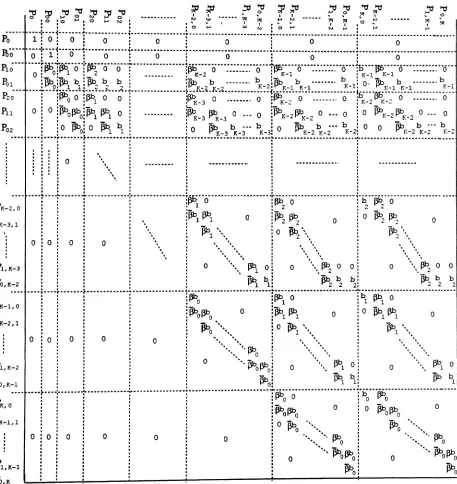
From the above equations, we obtain the transition probability matrix of the system shown
in Figure 5. Thus, the steady state probability, Pi,j, can be computed using a numerical
a
a
... J3bo
... Ph
o
J3bo
Pb
o o o o o o o o o , ,,, , o o o o o o o o o o o o~ ~
:;J~
:J' ::PJ1
?!
r
;sJ.~
'f
f!
"
:;0~:;'~
:F.:0
o :0 : 0 ~: 0 ~ '" : • t: ~ ~ ~ ~ • t"' i: ~ ~ •0 t"' ~ ~ " . • • 0 . . . . , W '" • 0 ...., " ' . . . . , . . . , ....
- . . -:.- .. i - . - -- ..~.- . - . - . - - - - . -~- . - - - -. --.. -..~- -. -- - -- -- - . - _. __ . :. _ _. _ __ .. : . _.. . _. _. _.. _
1 : 0 : 0 : 0 : 0 : 0 : 0 : a
....: i-···~··· ~ _..~ - ~ _ _ : _ _ _
0 : 1: 0 : 0 : 0 : 0 : a : a
••••~Ah-:-ti,;····.:-l'.a~•••••.... .:.••.•..•....•...•~••...•...•••••.•••••.••':'a~···.It_·· ••l:fl=\••••••••••••••••••••••
:..,-, :"'-1 a •~ 0 a : :~ a 0 :1-""': 0 0 :0 I-""': 0 0
o :_ 0:_ : _ 2 : • .... :_ K-2 :_ K-I : K-I_ K-I
:Ah :Ah b •Ah b b : .Ah b u _ _ b .Ah b · b : o. Ah b b
• ,.,....0.,.,....1 1:,.,....~ 2 ? ''''-K'-? K'_? K-2. """'K-I K-l x-.i: ..,....F~-I K-l K-l
...T·"1i3b
0"O·
:~I···O···~"·r···..··..
···r~~~3·~· ;.~.:::::::...
~. ··1~K··:··O···..:.:.:..
0·"
!bK·~ ·2·~~·"'···0···::::::::·0···
. . : • , K- • -.... • ...
• 0 ' A h ' - • '- .- , Ah
0:
pJ....
o(3bo:J3b1 J3b1 0 ~ ~~-3 ~-3 0 ... 0 ~J3bK-2 ~-2 0 ... 0 ~ 0 V'""K-2 J3bK- 2 0... a: : 0 Ah: 0 ~ b : : Ah b · · · b : 0 Ah b · · · b : 0 0
'Ph
b · · · b: : """'0: 1 1 : :0 tJ"""K-3 K-3 K-3: fJ"""K-2 K-2 K-2: K-2 K-2 f~-~
····I····r····.··~
..·· ·
"
_ _
: : :
: :
:
:
: : :
: :
:
:
: : 0 : ' , : : : :
: :
:
' : :
:
:
: : :
: :
:
:
' "
' .
.
.
~ :..---.. .:. --- u: -- -
!pli'.
i;
_u.--.. --.---'.t~··0"·----
----
~.b --j3i:i' --0- --
---.,.,
• 1 • 2 2 2
:i3b
1I3bI 0 1;3b2~
0 0 ;3b2~
PhI '
0 ;3b., \~2
• •.
'" ',...
.
Aha a \~OO 0 \~OO
"""'1 " 2 \ 2
PhI
bl , ';3b2~ ~.
i3b
2~ ~
.... ····r···~··· -:- .
~J3b0 ~f3b1 0 • b1 13b1 0
';3b0131'0 0 ~PhlJ3b1 0 0 ~lJ3b1
,
.
i3b
o """
~0PhI '
Ph
1-.
: , "... ' ' ' ' ' o A h : ..
... """"0 : \
... Ph
oJ3b0~ 0 J3b1 0
Pho~ phI b1 :
.
.
...~ ···T~··o··· ·b~···I3b~···_····
,Ph
ol3bo 0 0
i3b
ol3bo 0o
i3b
o .... ;3bo... ... ..., Po a~·" PI;·" POI P20
PI I
P
0 2P1 , K- 3
PO, K- 2 PK-I,O
*P=l-P
3.2
The Waiting Time Distribution of the High Priority Cell
Let Xo be the time interval between the arrival instant and the beginning of the next slot,
and let w be the waiting time in the system. We have
w=
Xo
1
+
Xo2
+
~o3
+
XoK - 1
+
Xo, l-~K.O
[Po
+
Po,o(l -u)]
[
K( l )
K-l(l) .
]
'l-~K.O
.r;
0 PO,ju(1 - u)+.r;
1 PIji - u)(l - u)[
K -IK -i ( K _ 1 ) . ]
'l-~K.O
?=?=
i pi,jUK-1-'(1 -u)i(l -
u)
t=O 1=0
The distribution of the waiting time is as follows:
l-~K.O
[Po
+
Po,o(l -u)] ,
n=
O.P[w
=
n+
Xo]=
The mean waiting time of a high priority cell can be obtained by the following
argument. Let Pi~ be the probability that an arriving high priority cell finds the system in
state (i,j) given that the high priority cell will be accepted into the system and let NQh be
the average number of high priority cells in front of the arriving high priority cell. We get
NQ h
==
K-l K-i
~L..J L..J' " ipfl."',3
i=O j=O
1 K-l K-i
1-
P
L L
iPi,j
K,O i=O j=O
The residual service time ltVo seen by the arriving high priority cell is found as follows:
W
o==
1
[xoPo
+
(1 -
Po - PK,O)
f(xo
+
i)(l _
(j)(ji]
1 - PK,O i=O
1 [xo(l _
PK,O)
+
(_0'_)
(1 -Po - PK,o)]
1 - PK,o 1 - 0'
Thus, WH, the mean waiting time of tile high priority cell is :
1
4
Computation of the probability that a low priority
cell will get served and mean waiting time.
In this section, we obtain exact results for the low priority cells. In particular, we calculate the probability that a low priority cell will get served given that it entered the queue. We also obtain the mean waiting time of a low priority cell given that it entered the queue and it got served. The main vehicle for obtaining these results is the one dimensional random walk consisting of the absorbing states 0 and K+l, as shown in Figure 6.
o
1
2
3
K-1
K
K+1
mJ :
Good absorbing state ( cell gets service).
ttl :
Bad absorbing state (cell gets pushed out of queue).
Figure 6: The states of the random walk.
TIle states of the ra.ndom walk are defined as follow. We tag a low priority cell
when it enters the queue. The state variable of the random walk indicates the position of this tagged cell throughout its residency in the queue immediately after a high priority cell arrives. We note that the positions in the queue are numbered from 1 to K. The position
in front of the server is numbered
o.
The tagged unit receives service if the random walkreaches the absorbing state 0, and it is pushed-out if the random walk reaches the absorbing
state
K+l.
If upon arrival the tagged unit sees i high priority cells and j low priority cells4.1
Computation of the transit ion probabilities
Let Pi--+j be the transition probability from state i to state j. Let S, be the probability of
having i cells served during the interarrival time of the high priority cell. Let P[ta
==
n]
bethe probability that the interarrival time of the high priority cell is n slots and 1 - a be the
probability of having a service completion in one slot. Then, for j
>
0, we havePi--+i
P[(i -
j+
1)service completions]Si-i+1
f (
i _~
+
1 ) (1 - u)i-i+1un-(i-i+1)P[ta==
n]
n=O J
( 1 )i-i+l 00 ,
- (j
L
n.
(jn-(i-i+l)P[t =n]
(i-j+l)!
n=i-i+l(n-(i-i+l))!
a(1 -
(j )i-i+l T(i-i+1 ) ((j)(i-j+l)! a
and, for j
==
0, we havei-I
Pi-+O
==
1 -L
Si i=Owhere
TJi-i+
1 ) is the(i
+
j - 1)th
derivative ofTa(z)
atz
==
a ,and00
Ta(z)
==
L
znp[ta
==
n].
n=l
The above generating function is computed as follows. Let ta be ~he t.ime interval from. an
active state to an arrival of the high priority cell and ti be the time interval from an Idle
state to an arrival of the high priority cell. We have
{
1+
1t
a ,po.(3,p(l - 0.(3)1
+
ti ,1-P{
1+
1ti , (1 -,q q)a(31
+
ta ,(1 - q)(l - 0.(3)Hence,
We get
Ta(z)
za,B[p
+
z(l -p - q)]
(1 -
a,B)(p
+
q -
1)z2 -[q
+
p(l -a,B)]z
+
14.2
TIle probability that a low priority cell will get served
Let U,be the probability that the random walk system reaches the absorbing state 0 given
that the system starts in state i. Let Sj be the probability of having j cells served ill an
interarrival time of the high priority cell. We have
Uo=landUK+1=O.
To find
Ui,
i=
1,2,· . ·,K, we have to solve the following linear equations :U
1SoU
2+
(1 -
So)Uo
1
U
2SoU
3+
SlU2+
(1 -
L
SI)UO1=0
K-2
U
K -1SoU
K+
SlU
K -1+ ... +
SK-2U
2+
(1 -
L
Sl)U
O l=OK-l
UK SOUK+1
+
SlUK+ ... +
SK-1U2+
(1 -
L
SI)UO. l=O
Thus, we get:
o
+
K-l
(1-
L
SI)UO[=0
The above system of linear equation is solved numerically ill order to obtain U2,U3, · · · ,UK.
Using
U
2 andU
owe can also calculateU
1 • Thus, P6~r1Jice'the probability that a low prioritycell will receive service given that it entered the queue is:
K-IK-l-·i
Po
+
L L
Pi,jUi
+
j+1 i=O j=OK-IK-l-i
Po+ ~
c: c:
~ p ..'1.,3i=O j=O
-4.3
Mean waiting time of a low priority cell
Let P
o(n,
i)
be the probability that the random walk system reaches absorbing state 0 afterexactly n high priority arrivals given that it sta~ts in state i. We have
Po(O,
i)
i-I
1-
LSi
;=0
i+1
Po(n,
i)L
Po(n - 1,j)Si+l-i
;=2
K
Po(n, K)
=
L
Po(n -
1,j)SK+l-jj=2
for n
2:
1and 1S
i< [{
Let
N
o(i)
be the expected number of high priority cells that arrived before the system reachedabsorbing state 0 given that the system starts in state i. We get
for i
==
1,2,···,K -1,
00
No{i) =
L
nPo(n, i)n=O i+1 00
L L
nPo(n -
1,j)Si+I-; j=2n=1f.
Si+l-i{~(n
- l)Po{n - 1,j)
+
~
Po{n - 1,j)}
i+l 00 i+l 00
L
Si+l-jL
nPo(n,j)
+
L
Si+l-jL
Po(n,j)
j=2 n=O j=2 n=O
i+l i+l
L
Si+l-jN
o(j )
+
L
Si+l-jU
j;=2
;=2
and
00
No(K)
=
L
nPO(n,
K)
n=O
K 00
L L
nPO(n - 1,j)SK+I-;j=2n=l
t.
SK+l-i{~(n
- l)Po{n - 1,j)
+
~
PO{n - 1,j) }
K o o K 00
:E
SK+l-i:E
nPO(n,j)
+
~
SK+l-i:E
PO{n,j)
K K
·L
SK+l-jNo(j)
+
L
SK+l-jUj
;=2
;=2
To find No(
i), i
== 1,2,· · · ,K, we solve the following linear equations numerically:No(l)
N
o(2)3
SlNo(2)
+
SoNo(3)
+
L
S3-
jU
jj=2
K
No(K -
1)
SK-2
NO(2)
+
SK-3
NO(3)
+ ... +
SoNo(K)
+
L
SK-jU
jj=2 K
No(K)
=
SK-
1No
(2)
+
SK-2 NO(3)
+ ... +
SlNo(K)
+
L
SK+l-
jUj
j=2
Thus, No(i), the expected number of high priority cells that arrive before the tagged low
priority cell gets served given that the tagged low priority cell will get served, is:
TIle mean waiting time of the low priority cell given that it gets served, WL , is:
K-l
K - l - iPo
+
L L
P
i,jUi+j+l5
Approximate analysis of the switch
In this section, we describe a simple approximation algorithm for the analysis of the ATM
switch. The approximation algorithm utilizes expression( 3) for a , and the exact results
obtained in sections 3 and 4. The algorithm is an iterative scheme. III each iteration we
need the cell loss probability for each packet processor queue irrespective of the priority of the lost cell. For efficiency purposes, we calculate this cell loss probability using an algorithm
for analyzing a single-class IBP /Geo/l/K+l queue that was presented in [27].
The iterative approximation algorithm involves the following steps:
step
o.
Set initial value of the utilization of the ith cell processor, p~O),i := 1,2· ..N.step 1. Compute the probability of retransmission of a cell due to contention ill the Clos
ATM switch, 00(0),using expression 3.
step 2. Solve the
IBP/Geo/1/K
+ 1 queue with a single class of cells using the solutionmethod in [27] in order to find the probability of cell loss due to the fact that the buffer
is full, IK.
step 3. Compute the utilization of the cell processor, pP) :
pP)
=
a(I -q) (I-,K)
2-p-q ,i=1,2.··N.
step 4. Use expression 3 to compute u(1) the probability of retransmission of a cell due to
contention in the Clos ATM switch with the new cell processor utilization,
p~l),
i=
1,···,N.
step 5. Iflu(l) - u(O)1
<
e then o=
u(1) and go to step 6, else set u(O) = u(1) and go to step2.
step 6. Solve the two-class I
BP/Geo/I/
K+
1queue with head-of-line with no preemptionand push-out to find the blocking probability of the high priority cell, PK,O'
step 7. Compute the probability that a low priority cell gets served and its mean waiting
6
Numerical Results
TIle approximation algorithm described in the previous section was employed to analyze a
16 X 16 bufferless Clos ATM switch. Each switching element was a 4 X 4 crossbar switch.
The system size of each cell processor queue was set equal to 32. The arrival process to
each cell processor was assumed to be an IBP with a == 1. That is, during the busy period
each slot contains a cell. The approximation results were compared against results obtained by simulation. TIle results are summarized in figures 7 to 19. Figures 7 to 11 are for a symmetric case, and figures 12 to 19 are for two different asymmetric cases.
In the symmetric case, we assume the same arrival process to each input link with an average arrival rate 0.3. Each arriving cell chooses one of the destination output links uniformly. In figures 7 and 8, we plot the approximate and simulation results for the mean
waiting time for high respectively low priority cells as a function of (3 for various 02 values.
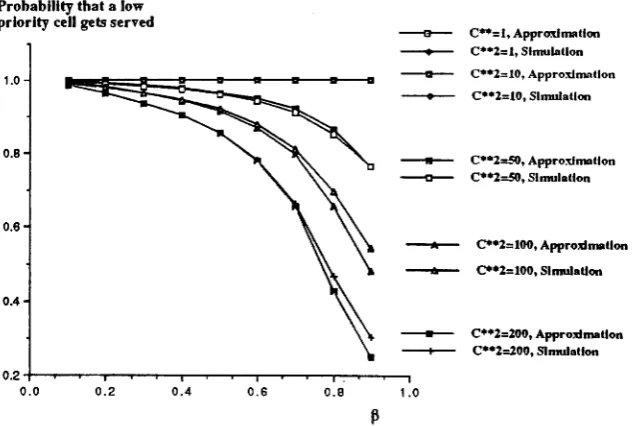
In figure 9, we plot the approximate and simulation results for the probability that a low
priority cell gets served given that it entered the queue as a function of (3 for various C2
values. The approximate and simulation results for tile cell loss probability for low priority
cells is given in figure 10 as a function of C2 for (3 equal to 0.3. We note that the cell loss
probability of the low priority cells comprises the probability a low priority cell will arrive
to a full queue and the push-out probability. In Figure 11, we plot the approximate and
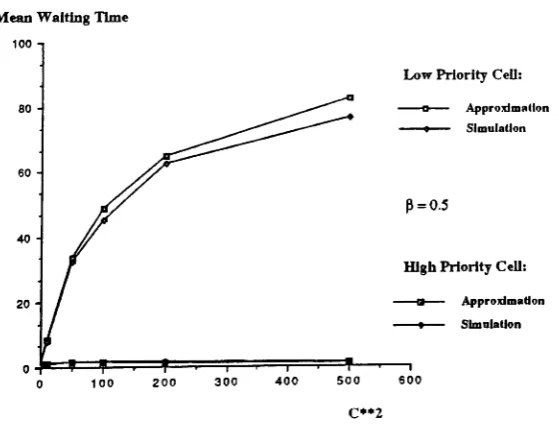
simulation results for mea.n waiting time for high and low priority cells as a function of C2
for (3 equal to 0.5.
In the results given in figures 7 to 10, the minimum relative error was 1
%,
themaximum relative error was 15%, and the average relative error was 7%. Most of the
approximate results had a relative error less than 5%. The curves given in figures 7 and
8 show how the mean waiting time is affected by 02 and {3. When C2 is high (i.e. bursty
arrivals), the mean waiting time of the low priority cells drops when f3
==
0.9. This is dueto the fact that most of the low priority cells are pushed-out of the buffer by high priority
cells. Figure 9 shows how the probability that a low priority cell gets served is affected by
the value of
C
2and (3. In particular, we note that this probability significantly drops as
C
2Increases.
In the two asymmetric cases considered here, the following assumptions were rnade regarding the arrival processes.
case 1:
Ai
== 0.4,i == 1,2,···,8 withC2
== 100,Ai
==
0.1,i == 9,10, · · · ,16 with C2==
10.case 2:
Al
== 0.4, Al6 == 0.1 , and the values of the remainingAi'S
were linearly distributedbetween 0.4 and 0.1. TIle value of
0
2was the same for all 16 arrival processes and it
Mean Waiting Time of tbe High Priority CeU
20
- - - C··2dO, Appro:dms.tlon
- - 0 - - C··2=50, Simulation
- - - - C...2=10, Approximation - - . - - C**2=10, SlnmJation - - - - 0·2=100, Approximation - - - . - - <:-"'1=100, Simulation
1.0 0.8
0.6 0.4
0.2
5
- m - - <:**2=1,Approximation - + - - <:*·2=1. Simulation
O-t-""'T""""'"'~--r---r----,-~--r--r---r---"--,.--,,...--,r--_
0.0 10
15
Figure 7: Mean waiting time of the high priority cell; symmetric case.
In both asymmetric cases, it was assumed that each arriving cell chooses one of the destina-tion output lines uniformly.
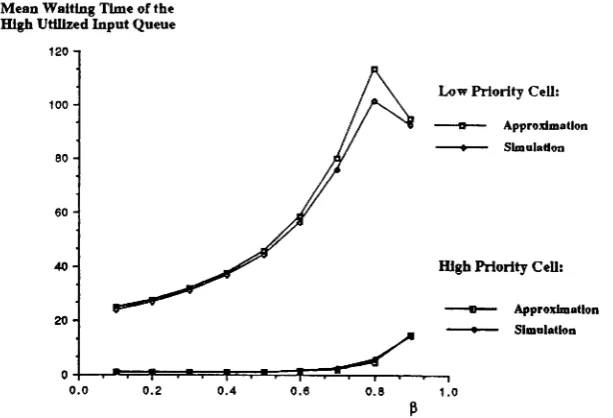
Figures 12 to 14 are for the asymmetric case 1, and the remaining figures a.re
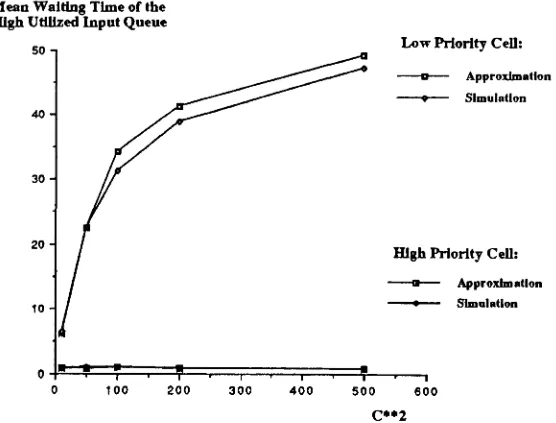
for the asymmetric case 2. In all the figures we give approximate and simulation results for the most utilized input queue and the least utilized input queue. The relative error of the approximate results is similar to the one observed in the symmetric case discussed above. Finally, we note that the behavior of the performance curves given in these figures is similar to the one observed in the symmetric case.
7
Conclusion
In this paper we presented a queueing model of a blocking bufferless synchronous Clos
ATM switch with input buffers. The arrival process to each input port was assumed to
Mean Waiting Time of theLowPriority Cell
100 80 60 40 20
•
•
•
- - A - C.·2=IOO, ApproxlrTUltion - . . . . - C"Z=lOO,Slmulatl~n
_____ C••Z=50, ApproxJmation
- - 0 - - C··Z=50, Simulation
- - a - - C••Z=10, Approximation
~ C.·2=10, Simulation _ _ _ _ e*·1=1, Approdmatlon - - . - - C ••Z=l, Simulation 1.0 0.8 0.6 0.4 0.2 o-l--.-JII::::;:~==;:::::II:=;=~~:R:;==tIl=::;::::II~=*:::;:a..,--., 0.0
Figure 8: Mean waiting time of the low priority cell; symmetric case.
~ C"=l,Apprmtmatlon
--...-
C··Z=l, Simulation----
C··Z=10, Approxfmntlon- . - - C··Z=10, Simulation
----
C··Z=-<G, Approximation- 0 - - C··Z=50, Simulation
--.-- e*·Z=l00, Approximation
- - - - 6 - - e*·Z=100, Simulation
- - I t - ' C**Z=ZOO,Appro~matlon
---+-- C··Z::200, Simulation 0.8 1.0 P 0.6 0.4 0.2 1.0 0.8 0.6 0.4 0.2-+---T-r--r----,r---r-~-or__r_...,.-.,.___r_-.,..___r____r~ 0.0
Probability that a low priority cell gets served
CellLossProbabUltyfor LowPrIority Cells
10 0
- - m - - Approximation - . . - Simulation
600 400
300 200 100
10 -5-t---r---~....,.--r---'r----r----
o
Figure 10: Cell loss probability for low priority cells; symmetric case, (3
==
0.3.Mean Waiting TIme
100
Low Priority Cell:
~ ApproximAtion
~ Simulation
p=o.5
High Priority Cell:
_____ Approximation
--+-- Simulation 600
ProbabWtythat alow priority cell gets served
LowUtlllzatlODInput Queue:
1.0 - + - - Slmal8tlon
- - a - - Approximation
0.8
0.6
Hlgh Utillzatlon Input Queue:
- + - - Simulation
- ' I t - - Approximation
0.4
1.0 0.8
0.6
0.4
0.2
0.2-J- -~--r---y-___r-r___r__~___r___,r__~~__,
0.0
Figure 12: Probability that a low priority cell gets served; asymmetric case 1.
MeaD Waiting Time of the HIgh UtillzedInput Queue
120
- - - Approximation - . . . - Simalation
HIghPrIority CeO: LowPriority Cell:
1.0
- a - - Approximation
- + - - Simulation
0.8 0.6
0.4
0.2
o.+-_a::;::::::::tI~::;:::II~=*==;:=-=;::=*=:::;:~- _
0.0
60
20
40
80 100
Mean Waiting Time of the
LowUtilized Input Queue
6 Low Priority Cell:
5
4
- - - - . - Simulation
- - a - Approximation
3
2
HIgh Priority Cell:
- . - - SlmulnUon
~ Approximation
1.0 0.8
0.6 0.4
0.2
O+-...,....--....~-..-~-r---.--....
...-....--_..._-....-0.0
Figure 14: Mean waiting time for the low and high priority cells of the low utilized input
queue as a function of{3; asymmetric case 1.
Mean Waiting Time of the Hlgb Utllized Input Queue
120 100 80 60 40
20
Low Priority Cell:
- a - - - Approximation
- - 0 - - Simulation
High Priority Cell:
--m-- Approximation
- + - - Simulation
1.0 0.8
0.6 0.4
0.2
oL.---!R::;::~==;::R::::;:::::~~*=;:=tlIt::::~~----r-~--r---, 0.0
Figure 15: Mean waiting time for the low and high priority cells of the high utilized input
High Priority CeU: Low Priority CeU:
--+-- Approximation
~ Simulation
---D- Approximation - + - - Simulatlqn
20 40 60
Mean Waiting Time of the Low UtUlzed Input Queue
80
1.0
0.8 0.6
0.4
0.2
o-l-~t::;=:=-=:::::;::::I1::;:~:::;::a:;~~~....--....-....--...--..
0.0
Figure 16: Mean waiting time for the low and high priority cells of the low utilized input queue as a function of (3; Asymmetric case 2.
Mean Waiting Time of the High UtUlzedInput Queue
50
40
Low Priority Cell:
- - . - Approximation ---...- Simulation
30
20
10
HIgh Priority Cell:
- - - Approximation
- - + - - Simulation
600
500 400
300 200 100
o~::::$:~~:;::::~==;:=:;::=::::;::::=;:=;::=:::e-_ _
o
Figure 17: Mean waiting time for the low and high priority cells of the high utilized input
Mean Waiting Time of the Low Utilized Input Queue
50
Low Priority Cell:
- - . . . - Simulation
- ' I t - Approximation
High Priority Cell:
- - . . . - SImulation
~ Appromn.tton
Figure 18: Mean waiting time for the low and high priority cells of the low utilized input
queue as a function of 0 2 with {3
=
0.3; Asymmetric case 2.Cell Loss Probability of theLow Priority Cell
10 0
600
500
C··2
400
- i i i ' - Approximation
- - + - - SImulation
300
Low Utillzed Input Queue:
- - 0 - - ApproxJm.tlon ---.--- 51ma.etlon
High Utilized Input Queue:
200 100
10·6+-J..L...,.-..,---r--r----r--r-__,._-~--,.--.._--r-___,
o
a good accuracy. Using the analytic techniques developed in this paper, various in teresting
performance measures such as cell loss probability, mean waiting time, probability that a
low priority cell gets served, were obtained.
References
[1] J.S. Turner "Design of a broadcast packet switching network ", IEEE Trans. Comrn.,
COM-36 (1988) 734-743.
[2] MJ. Narasimha "The Batcher-banyan self-routing network: university and
simplifica-tion", IEEE Trans. Cornm., COM-36 (1988) 1175-1178.
[3]
A.Huang and S. Knauer "Starlite: a wideband digital switch", Proc. IEEE GLOBECOM'84 (1984) 121-125.
[4] J. Giacopelli, M. Littlewood, and W.D. Sincoskie "Sunshine: a high performance
sel]-routing broadband packet switch architecture", Proc. Int. Switch Syrnp. '90.
[5] F.A. Tobagi and
T.
Kwok "Fast packet switch architectures and the tandem Banyanswitching fabric", Proc. NATO Advanced Workshop on Architecture and Perfor-mance Issues of High-Capacity Local and Metropolitan Area Networks, June 25-27,1990, Sophia-Antipolis, France.
[6] S. Nojima, E. Tsutsui, II. Fukuda and M.Hashimoto "Integrated services packet network
using bus matrix switch", IEEE
J.
SAC, SAC-5 (1987) 1284-1292.[7]
Y.-S.
Yeh,M.
Hluchyj, and A. Acampora" The knockout switch: a simple, modulararchitecture for high performance packet switching ", IEEE J. SAC, SAC-5 (1987) 1274-1283.
[8J H. Ahmadi, W.E. Denzel, C. A. Murphy, and E. Port "A high performance switch fabric
for integrated circuit and packet switching", Proc. INFOCOM '88 (1988) 9-18.
[9] M. Devault, J.Y. Cochennec, and M. Servel "The 'Prelude' ATD experiment:
assess-ments and future projects",
IEEE J. SAC, SAC-6
(1988),1528-1537.1528-1537,1988.[10] H. Kuwahara, N. Endo, M. Ogino, T. Kozaki "A shared buffer memory switch for an
ATil1 exchange", Proc. Int. Conf, Comm. (1989) 4.4.1-4.4.5.
[11]
H.
Suzuki,II.
Nagano, andT.
Suzuki "Output-buffer switch architecture foraSY1t-chronous transfer mode", Proc. Int. Conf. Comm. (1989) 4.1.1-4.1.5.
[12)
F.A.
Tobagi "Fast packet switch architectures for broadband integrated services[13] M.J. Karol, M.G. Hluchyj and S.P. Morgan "Input us. output queueing on a
space-division packet switch", IEEE Trans. Comm., COM-35 (1987) 1347-1356.
[14] M.G. Hluchyj and M.J. Karol "Queueing in high-performance packet switching", IEEE
J.
SAC, SAC-6, (1988) 1587-1597.[15] J. H.
Patel"Performance of Processor-Memory Interconnections for Multiprocessors" ,IEEE Trans. on Comp., COMP-30 (1981) 771-780.
[16]
H.
Yoon,K. Lee,
andM.
Liu "Performance analysis of multibuffered packet-switchingnetworks in multiprocessor sustems";IEEE Trans. Oil Comp., COMP-39 (1990) 319-327.
[17] S.Z. Shaikh, M. Schwartz, and T.R. Szymanski "Analysis, control and design of crossbar
and banyan based broadband packet switches for integrated traffic", IEEE Int, Conf. Comm., VOL. 2 (1990) 761-765.
[18] Y. Oie, T. Suda, M. Masayuki, and H. Miyahara "Survey of the performance of
non-blocking switches with FIFO input buffers", IEEE Int. Conf. Comrn., VOL. 2 (1990) 737-741.
[19] H. Yamashita, H.G. Perros, and S.-W. Hong "An approximate analysis of the shared
buffer switch with bursty arrivals", Proc. NATO Advanced Workshop on Architechure and Performance Issues of High-Capacity Local and Metropolitan Area Networks, JUlIe
25-27,
1990, Sophia-Antipolis, France.[20]
J.
Garcia and O. Casals, "Priorities in AT!vI networks", Proc. NATO AdvancedWork-shop on Architechure and PerformanceIssues of High-Capacity Local and Metropolitan
Area Networks, June 25-27, 1990, Sophia-Antipolis, France.
[21] J.-Y. Le Boudec "An efficient solution method for Marko» models of ATAl links with
loss priorities", IBM Research Rept.
RZ
2001, 1990.[22]
H. Kroner, G.
Hebuterne,P.
Boyer,A.
Gravey "Priority management in AT!v[ switching nodes", to appear in IEEE Journal on Selected Areas in Communication.[23] A. Gravey and G. Hebuterne"Mixing time and loss priorities in a single server queue",
Tech. Rept. C.N.E.T, France,
[24] S. Sumita and T. Ozawa "Achievability of performance objectives in AT!vI switching
nodes", Proc. International Seminar on Performance of Distributed and Parallel Sys-terns, Kyoto, Dec. 1988, 45-56.
[25] N. Yin,
S.-Q.
IIi and T .E. Stern"Congestion control for packet voice by selective packetdiscarding", IEEE Trans. COIIlm., VOL 38 (1990) 674-683.
[26] H.G. Perros "Performance issues in ATlIfnetworks - A literature review", Tech. Rept.,
[27] A. A. Nilsson, F.- Y. Lai, and H. G. Perros "An Approzitnate Analysis of a Bufferless