1. Introduction
The development of polymer nanocomposites (PNCs) can be regarded as a significant technologi-cal advancement in the plastics industry over the past few years. PNCs are formed from blends of nanometer sized fillers with either thermoplastics or thermosetting polymers. Numerous benefits of PNCs have been described which include improve-ments in mechanical properties, barrier properties, heat resistance, dimensional stability and flame
retardancy [1–4]. There are many types of nano-sized fillers being used among which include nanofibres such as carbon nanotubes or cellulose whiskers, nanoplatelets such as layered silicate and nano-sized isotropic particles such as silica or cal-cium carbonate (CaCO3) [5–8].
CaCO3is one of the most commonly used fillers in thermoplastics, especially polyolefins. It is inex-pensive and can be used at high loadings. Origi-nally used as a cheap extender, fine grades of
*Corresponding author, e-mail: [email protected] © BME-PT
Polypropylene/calcium carbonate nanocomposites – effects
of processing techniques and maleated polypropylene
compatibiliser
M. Y. A. Fuad
1*, H. Hanim
1, R. Zarina
1, Z. A. Mohd. Ishak
2, Azman Hassan
31Plastics Technology Group, Advanced Materials Research Centre, SIRIM Berhad, P.O. Box 7035, 40911 Shah Alam,
Malaysia
2School of Materials and Mineral Resources Engineering, Engineering Campus, Universiti Sains Malaysia,
Seri Ampangan, 14300 Nibong Tebal, Penang, Malaysia
3Faculty of Chemical and Natural Resources Engineering, Universiti Teknologi Malaysia, Skudai, Johor, Malaysia
Received 8 April 2010; accepted in revised form 17 June 2010
Abstract.The mechanical properties and crystalline characteristics of polypropylene (PP) and nano precipitated calcium carbonate (NPCC) nanocomposites prepared via melt mixing in an internal mixer and melt extrusion in a twin screw extruder, were compared. The effect of maleic anhydride grafted PP (PP-g-MAH) as a compatibiliser was also studied using the internal mixer. At low filler concentration of 5 wt%, impact strength was better for the nanocomposites produced using the internal mixer. At higher filler loading of more than 10 wt%, the extrusion technique was more effective to dis-perse the nanofillers resulting in better impact properties. The impact results are consistent with the observations made from Scanning Electron Microscope (SEM) morphology study. As expected, the flexural modulus of the nanocomposites increased with filler concentration regardless of the techniques utilised. At a same filler loading, there was also no signifi-cant difference in the moduli for the two techniques. The tensile strength of the mixed nanocomposites were found to be inferior to the extruded nanocomposites. Introduction of PP-g-MAH improved the impact strength, tensile strength and modulus of the mixed nanocomposites. The improvements may be attributed to better interfacial adhesion, as evident from the SEM micrographs which displayed better dispersion of the NPCC in the presence of the compatibiliser. Though NPCC particles have weak nucleating effect on the crystallization of the PP, addition of PP-g-MAH into the mixed nanocompos-ites has induced significant crystallization of the PP.
Keywords:nanocomposites, polypropylene, mechanical properties, nano-sized calcium carbonate, melt compounding
precipitated CaCO3is now being produced in nano-meter size and this nano precipitated CaCO3 (NPCC) has the potential to be an important func-tional filler in polypropylene composites [9–12]. The surface of the NPCC filler is usually treated with fatty acids such as stearic acid, to modify the filler surface to become hydrophobic. The main purpose for this surface coating is to reduce mois-ture absorption and hence particle agglomeration during storage, as well as to improve dispersibility of the polar filler when incorporated into non-polar polymer melts [13]. Improved dispersion of the nanofillers within the polymer matrix is a prerequi-site for any improvement in mechanical properties, particularly impact strength.
Polypropylene (PP) is a very versatile and adapt-able polymer whereby its properties can readily be enhanced with the inclusion of various types of fillers. The advantages gained in price/volume/per-formance relations have resulted in PP composites successfully penetrating fields traditionally occu-pied by other engineering materials [14]. Gener-ally, the properties of particle-filled PP are strongly dependent on the characteristics of the filler parti-cles. Due to its non-polar chemical structure, PP interacts poorly with the typically polar fillers such as CaCO3, and optimum dispersion is normally dif-ficult to achieve. Compatibilisers are frequently used to improve the interfacial adhesion between CaCO3 and PP, in order to gain the envisaged enhancement in mechanical properties. Bi-func-tional molecules such as maleic-anhydride grafted PP (PP-g-MAH) are commonly used as a compati-bilisers for PP and CaCO3[15, 16].
Besides filler surface modification and addition of suitable compatibilisers, the choice of processing techniques also plays an important role to achieve the desired improvement in the properties of inter-est. The efficiency of the processing techniques to disperse the fillers becomes critical, especially with nanofillers which have very strong tendency to agglomerate due to their high surface energies. The two common melt-processing techniques employed to produce nanocomposites are melt mixing using an internal mixer and melt extrusion using a twin screw extruder. Compared to an internal mixer, a twin screw extruder is more convenient to com-pound nanocomposites in larger quantity and con-tinuous process. It has been reported
nanocompos-ites of PP with nano-sized CaCO3 have been suc-cessfully prepared via melt mixing by Chan et al.
[17]. The good filler dispersion obtained using the internal mixer has resulted in significant improve-ments in modulus and impact strength with only a slight lowering of the tensile strength.
Wang et al.[18] used three kinds of compatibilizers to study the effect of interfacial interaction on the crystallization and mechanical properties of polypropylene (PP)/nano-CaCO3composites. The compatibilizers were PP grafted with maleic anhy-dride (PP-g-MA), ethylene-octene copolymer grafted with MA (POE-g-MA), and ethylene-vinyl acetate copolymer grafted with MA (EVA-g-MA). They noted that only the former compatibilizer resulted in significant improvement the dispersion of nano-CaCO3 particles, favoured the nucleation effect of nano-CaCO3, increased the tensile strength and modulus. The ductility and impact strength of composites were however compromised as trade-off to the improvement of the other mechanical properties.
The objective of this study is to compare the prop-erties of PP filled with NPCC prepared via two dif-ferent routes viz. melt mixing in an internal mixer and melt extrusion in a twin screw extruder. The mechanical properties of the nanocomposites are evaluated using impact, flexural and tensile tests. Thermal and crystallisation characteristics are analysed using a Differential Scanning Calorimeter (DSC) while filler dispersion is observed using a Scanning Electron Microscope (SEM). In addition, the effect of adding PP-g-MAH as a compatibiliser for the PP/NPCC nanocomposites is also studied using the internal mixer.
2. Experimental
2.1. Materials and sample preparation
Atofina, with a maleic anhydride content of 1%. The anti-oxidant used was Irganox 1010 from Ciba Specialty Chemicals Inc.
The NPCC and PP-g-MAH were dried in a vacuum oven at 80°C for at least 2 hours and allowed to cool down to room temperature in a desiccator prior to use. For the melt extrusion technique, the PP/NPCC was compounded in a Berstoff (ZE-25) co-rotating twin-screw extruder (L/D= 33) with a barrel temperature profile ranging from 180°C near the hopper to 200°C at the die and a screw speed of 150 rpm (rotation per minute). NPCC powder at 5, 10 and 15 wt% loadings and the anti-oxidant at 1 wt% of total compound weight were added into the molten PP via a secondary side feeder. Since the extruder is primarily designed to compound micron size fillers, the nanocomposites were com-pounded twice to improve and ensure homoge-neous mixing. The estimated total residence time for the nanocomposites during the melt extrusion process was about 8 minutes since the nanocom-posites were compounded twice by extruder. For the melt mixing technique, mixing was carried out in batches using a Haake Rheomix 3000p inter-nal mixer with a mixing temperature of 180°C and a rotor speed of 60 rpm. The PP and antioxidant were first mixed for 5 minutes before the NPCC at 5, 10 and 15 wt% was added slowly into the mixing chamber over a period of 10 minutes. Mixing was continued for a further 5 minutes and the homoge-neous mixture was discharged from the internal mixer and later reduced into small pieces using a crusher. For the experiments using compatibiliser, the PP-g-MAH was added at a fixed amount of 10 wt% into the mixing chamber together with the PP and the anti-oxidant. The total residence time of the mixing process was 20 minutes.
The crushed pellets from the melt mixing technique and the pelletised extrudates from the melt extru-sion technique were injection moulded into ISO multi-purpose test specimens using an Arburg 75 tonne injection moulding machine at 190°C melt temperature and 40°C mould temperature.
2.2. NPCC filler content and filler dispersion
The actual amount of filler present in the nanocom-posites was determined using a thermogravimetric analyser (TGA). The analysis was performed on the samples using a Mettler Toledo TGA 851. The
samples, obtained from the gate-section, mid-sec-tion and end-secmid-sec-tion of the tensile dumbell speci-men, were heated from 25 to 550°C in an inert atmosphere of nitrogen at a heating rate of 20°C/min. The average amount of NPCC which remained at the end of the TGA scan were obtained from the thermograms to compare the amount of filler added and the actual amount present in the tested specimens.
The filler dispersion in the nanocomposites was examined using a Hitachi S-2500 Scanning Elec-tron Microscope (SEM). The impact fractured specimens were coated with gold prior to examina-tion under the electron beam. An operating voltage of 10 kV and a magnification of 5000 times were used. The average size of the dispersed NPCC filler was measured on the micrographs using the Roen-tec ScanVision software.
2.3. Mechanical properties evaluation
Tensile properties were determined using an Instron 5556 Universal Testing Machine in accor-dance to ISO-527-1. The crosshead speed used for the modulus and tensile strength determination were 1 and 50 mm/min. respectively. Flexural prop-erties were also measured using the same machine in accordance to ISO 178 at a crosshead speed of 2 mm/min. The notched Izod impact strength was determined using a CEAST Resil Impactor accord-ing to ISO 180 at ambient temperature. All test specimens were conditioned in accordance to ISO 291 at 25 ± 2°C and 55 ± 5% relative humidity for at least 16 hours before being tested.
To calculate the predicted modulus of composites, the weight fraction is converted to the volume frac-tion indicated in Equafrac-tion (1):
(1)
where φf is filler volume fraction, ρc is density of
composite, ρf is density of filler and Wm is filler
weight fraction.
2.4. Thermal and crystallisation studies
The melting and crystallisation behaviour of the nanocomposites were studied using a Mettler Toledo Differential Scanning Calorimeter (DSC 822e). About 10 mg of each sample was scanned
m f c
f W
from 25 to 250°C at a heating rate of 20°C per minute in an inert atmosphere of nitrogen (N2). The N2 flow rate was set at 50 ml/min. The samples were then annealed at 250°C for 5 minutes before being cooled to 50°C at a cooling rate of 20°C per minute. A second heating scan was performed on the cooled samples using the same parameters as the first heating cycle. The peak melting tempera-ture (Tm) and the enthalpy of fusion (ΔH) for the
nanocomposites were obtained from the second heating curve while the peak crystallisation temper-ature (Tc) was taken from the crystallisation curve.
The relative crystallinity was calculated from the enthalpy value, ΔH and the enthalpy value for a theoretically 100% crystalline PP, taken as 209 J/g [19].
3. Results and discussions
3.1. NPCC filler content and dispersion The TGA results for the nanocomposites are given in Table 1. From the Table, the amount of NPCC measured on the specimens was also found to be close to the actual amount added during compound-ing and mixcompound-ing.
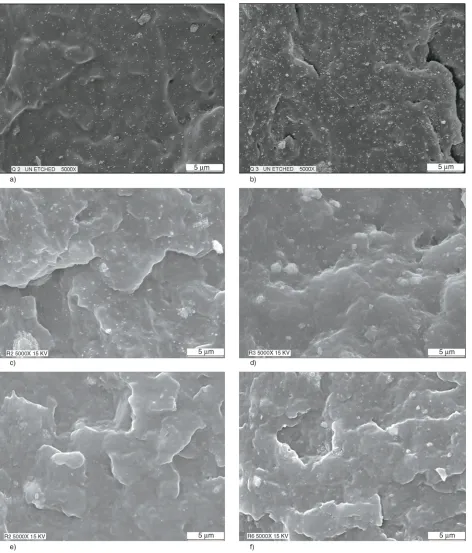
The evaluation of filler dispersion is important as only well dispersed nanoparticles can lead to the expected improvement in mechanical properties. For the nanocomposites to possess good impact toughness, it is critical that the filler dispersion in the polymer matrix be very uniform to avoid cre-ation of crack-initiating large agglomerates [20]. Figures 1a, 1b show the SEM micrographs of the impact-fractured surface of the nanocomposites prepared via the extruder while Figures 1 c, 1d are nanocomposites prepared via the internal mixer. At low NPCC content, the number of large agglomer-ates appeared more in the nanocomposites prepared via extrusion compared to that prepared via mixing. At higher NPCC levels, the reverse phenomenon was observed where the nanocomposites prepared by mixer have larger agglomerates compared to the extruded nanocomposites. One possible reason for this observation is that at high filler concentration,
the interparticle distance between the nanofillers becomes smaller, leading to flocculation of the NPCC nanoparticles after the mixing process in the internal mixer is stopped [16]. Thus, in this study, that melt extrusion appears to be a better technique for dispersing nanofiller when the filler concentra-tion used is high, while the internal mixer is effec-tive for preparing nanocomposites with low filler content.
Figures 1e, 1f shows the filler dispersion of the nanocomposites prepared using the internal mixer with 10 wt% of PP-g-MAH added as a compati-biliser. Overall, better filler dispersion was observed in the presence of PP-g-MAH, especially at low NPCC. With PP-g-MAH, the NPCC particles appeared more encapsulated within the PP matrix, indicating that better interfacial adhesion has possi-bly been established between the filler and the polymer phase with the aid of the compatibiliser. Without the compatibiliser, the NPCC in the micro-graphs appeared more as discrete particles within the PP matrix, as shown in Figures 1c, 1d. Never-theless, for both techniques used and even with the addition of compatibiliser, the average particle size of NPCC particles measured from the SEM micro-graphs were still much larger than the average pri-mary particle size of the NPCC used in this study.
3.2. Mechanical properties
Figure 2 shows the effect of NPCC content on the notched Izod impact strength of the nanocompos-ites prepared using the internal mixing and extruder. It can be seen that for both techniques, the addition of NPCC increased the impact strength of the neat PP. However, there is a difference in the trend of increment for the two techniques. At low NPCC loading of 5 wt%, greater increment was observed for the nanocomposites prepared via the mixer when compared to the extruder. The mixed nano-composites appear to have smaller agglomerates, resulting in better impact improvement when com-pared to the composites made by melt extrusion. Nevertheless, further increase in the filler content
Table 1.TGA results of PP nanocomposites
Sample composition [wt% PP/NPCC]
NPCC content [weight%]
Melt extrusion Melt mixing Melt mixing with 10 wt% PP-g-MAH
95/5 04.6 04.7 04.9
90/10 09.7 09.4 09.3
for the mixed nanocomposites caused no significant changes to the impact strength. For the extruded nanocomposites, increased in impact strength was observed until addition of up to 10 wt% of NPCC with no further improvement observed thereafter. The result of the impact strength is consistent with
the SEM micrographs results shown earlier in Fig-ures 1a–1d).
It can also be seen that addition of PP-g-MAH has improved the impact strength of PP at all filler loadings. However, the same trend is observed whereby after filler loading of 5 wt%, the impact
strength drops, even in the presence of the compat-ibiliser. As indicated earlier, at higher concentra-tions, the mixer does no longer provide effective mixing, thus the addition of the compatibizer does not improve the impact strength. The SEM micro-graphs as shown in Figures 1e, 1f support the impact results. At higher filler loading, the number of large agglomerates was more apparent and thus contributing to the lowering of the impact strength. The effect of NPCC on the flexural modulus of the mixed and extruded nanocomposites is shown in Figure 3. Predictably, the stiffness of PP increased gradually with increasing filler weight fraction. There also appears to be no significant difference between the flexural modulus of the nanocompos-ites prepared using the two different techniques, indicating that the modulus of the nanocomposites is not significantly affected by the presence of filler agglomerates. Presence of PP-g-MAH in the mixed nanocomposites has also significantly improved the modulus further, This may be attributed to the improved interfacial adhesion between the filler particles and the PP matrix.
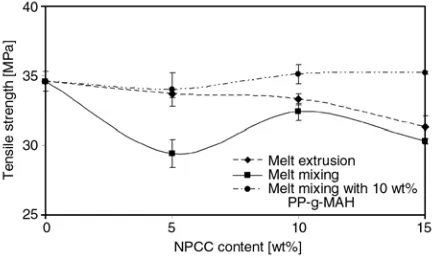
The effect of NPCC on the tensile strength of the nanocomposites prepared via mixing and extrusion
is shown in Figure 4. In general, the tensile strength of the nanocomposites prepared by both techniques decreases with increasing amount of NPCC and from among the two techniques, the drop in tensile strength was higher for the mixed nanocomposites compared to the extruded nanocomposites. In the presence of the 10 wt% PP-g-MAH as a compati-biliser, the tensile strength of the nanocomposites did not deteriorate with increasing NPCC concen-tration. According to Liang [24], the strength of particulate-filled polymer composites depends, to a great extent, on the interfacial adhesion between the matrix and the filler which will facilitate the transfer of a small section of stress to the filler par-ticle during deformation.
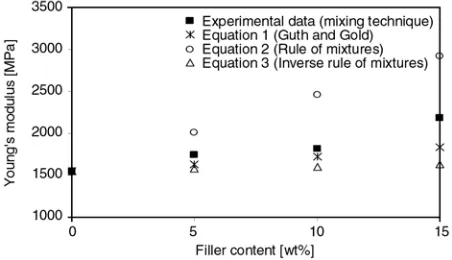
An equation which is commonly used to predict the modulus of composites containing a certain amount of spherical fillers developed by Guth [22] is shown as Equation (2):
(2)
where Ecis the Young’s modulus of the composite, Emis the matrix Young’s modulus and φfis the
vol-ume fraction of the filler. It has been reported that Equation (1) is only applicable to composites filled with a certain amount of spherical fillers. If the filler concentration is higher than 10 vol%, the modulus increases much more rapidly than Equa-tion (2) would predict, attributed to the formaEqua-tion of a network by the spherical filler chains [23]. The modulus of particle-filled composites may also be predicted using Equations (3) or (4) [18]:
(3)
(4)
p f f p
f p c
E E
E E E
φ + φ =
f f p p
c E E
E = φ + φ
) 1 . 14 5 . 2 1
( f 2f
m
c E
E = + φ + φ
Figure 3.Effect of NPCC and preparation techniques on the flexural modulus of nanocomposites
Figure 2.Effect of NPCC and preparation techniques on the impact strength of nanocomposites
where Ecis the modulus of the composites, Epand Ef are the moduli of the polymer matrix and the
filler respectively, φpand φfare the volume fraction
of the polymer and filler respectively. Equation (3), based on the rule of mixtures, is appropriate when strong adhesion exists between the filler and the polymer and the filler has a large aspect ratio.
Equation (4), the inverse rule of mixtures equation, is applicable to rigid spherical particles.
Figures 5–7 illustrate the experimental and calcu-lated modulus based on the above equations for the extruded, mixed and mixed with PP-g-MAH nanocomposites, respectively. It can be seen from Figure 5 that the experimental moduli of the extruded nanocomposites agree quite well with Equations (2) and (4) up till a filler content of 10 wt%. Equation (3) was found to be the most inaccurate to predict the moduli of the nanocom-posites, indicating that the law of mixtures is invalid in this case as the equation is only applica-ble when the filler has a large aspect ratio and there is a strong bonding between the matrix and the filler. A similar observation is made for the mixed nanocomposites in Figure 6, where the experimen-tal plots closely follow Equations (2) and (4), and deviate from Equation (3). However, it is interest-ing to note that the experimental moduli of the mixed nanocomposites still follow Equations (2) and (3) even at high filler loadings of 15 wt%. For the mixed nanocomposites with PP-g-MAH, the experimental moduli, as shown in 8, were found to deviate from Equations (2) and (4) and showed ten-dency to move towards Eqquation (3). These results indicate that better adhesion has occurred between the NPCC and the PP matrix, as Equation (3) is appropriate when strong adhesion exist between the filler and the polymer.
3.3. Thermal and crystallisation behaviour
The DSC melting curves for the nanocomposites are shown in Figures 8a–8c, and their correspon-ding melting temperatures (Tm) are listed in
Table 2. From the DSC curves, the Tm of the neat
PP was found to be 163°C while the Tm of the
nanocomposites ranged from 161 to 164°C. Thus, incorporation of NPCC did not result in a signifi-cant shift in the Tmof PP, as the small variation of
observed is within the experimental error of the instrument used.
However, it is interesting to note that the DSC curves for PP filled with 10 and 15 wt% of NPCC prepared with PP-g-MAH using the internal mixer displayed a small melting depression at about 150°C. This small endothermic transition is possi-bly associated with the melting of the β-phase crys-tallites of PP [17, 25, 26]. PP is a polymorphic
Figure 6.The calculated (theoretical) and measured (experimental)moduli of PP/NPCC nanocom-posites prepared via melt mixing as a function of filler content
Figure 7.The calculated (theoretical) and measured (experimental) moduli of PP/NPCC nanocom-posites prepared via melt mixing with PP-g-MAH as a function of filler content
material and is capable of crystallising in three dif-ferent crystal forms; the α, or monoclinic form, the
β, or pseudo-hexagonal form, and the γ, or triclinic form. The most stable and prevalent form is the
α-phase. This phase, which melts at around 160°C,
is the main crystalline structure formed under nor-mal processing conditions while the β-phase is obtained if the melt undergoes high shear forces during processing [26]. The β-phase PP could also be formed in the presence of nucleating agents. Thus, the PP-g-MAH compatibiliser has possibly improved the nucleating activity of the NPCC and hence promoting the formation of the β-phase PP, which was not present in the mixed compound pre-pared without the compatibiliser.
Results of the enthalpy of fusion (ΔH) obtained from the melting curves for the PP and the nano-composites are listed in Table 2. It should be noted that the ΔHvalues shown have been corrected for filler content, thus expressed in J/g polymer (PP). The relative crystallinity of the nanocomposites were then calculated using the ΔHvalues, taking 209 J/g as the theoretical enthalpy value for a 100% crystalline PP [19]. Overall, it is observed that the crystallinity of PP is not appreciably affected by the addition of the NPCC filler, as the ±2% variation in the crystallinity values observed is within the experimental error of the instrument used.
The DSC crystallisation curves for PP and the nanocomposites are shown in Figures 9a–9c and the peak crystallisation temperature (Tc) values are
listed in Table 2. For the nanocomposites prepared via extrusion and mixing without the presence of PP-g-MAH as compatibiliser, there appears to be minimal shift in the Tc, indicating again the weak
nucleating effect of NPCC particles on the crys-tallisation of PP. However, addition of PP-g-MAH into the mixed nanocomposites has induced crys-tallisation of PP to occur at higher temperatures resulting in higher Tc. Thus, these DSC results
sug-gest that PP-g-MAH has improved the nucleation
Figure 8.DSC melting curves for nanocomposites pre-pared via (a) melt extrusion, (b) melt mixing and (c) melt mixing with 10 wt% PP-g-MAH com-patibiliser
Table 2.DSC results for the nanocomposites
Sample composition [wt% PP/NPCC]
Melting temperature, Tm[°C]
Enthalpy of fusion corrected for filler content, ΔΔHc[J/g PP]
Percentage crystallinity, Xc[%]
Crystallisation temperature, Tc[°C]
100/0 163 78 37 109
Melt extrusion
95/5 161 74 35 110
90/10 161 73 35 111
85/15 162 73 35 112
Melt mixing
95/5 162 79 38 115
90/10 163 80 38 113
85/15 164 81 39 112
Melt mixing with PP-g-MAH
95/5 164 76 36 118
90/10 164 78 37 118
effect of the nano NPCC particles. In the presence of the compatibiliser, closer interaction between the NPCC particles and the PP matrix has possibly been established and the better dispersed particles has provided more sites for the nucleation of PP to begin.
4. Conclusions
The choice of processing technique has some influ-ence on the properties of the PP/NPCC nanocom-posites. The extrusion technique was found to be more effective to disperse the nanofillers when the filler concentration is high, resulting in slightly bet-ter impact and tensile strength. Betbet-ter impact strength was found to be associated with less amount of filler agglomeration as evident from the
SEM micrographs. The use of internal mixer was found to be more suitable when the filler concentra-tion used is low. There was no significant differ-ence in the flexural modulus of the nanocomposites using the two different techniques, indicating that the modulus is not significantly affected by the presence of filler agglomerates.
Introduction of PP-g-MAH as compatibiliser for the nanocomposites prepared via mixing improved the filler dispersion, resulting in better impact, modulus and tensile strength. The improvement in impact strength is most likely attributed to the bet-ter filler dispersion while the increased tensile strength and modulus may be due to better interfa-cial adhesion between the filler and the PP matrix. DSC results show that the PP-g-MAH has also improved the nucleating activity of the NPCC, inducing crystallisation of PP to occur at higher temperatures.
Acknowledgements
The authors would like to thank the Ministry of Science, Technology and Innovation (MOSTI), Malaysia for the IRPA research grant (project no.03-01-01-0052-EA001). The authors would also like to thank Zalena Saem and Azura Ruhan for their kind assistance in conducting the SEM analysis.
References
[1] Krawczak P.: Compounding and processing of poly-mer nanocomposites: From scientific challenges to industrial stakes. Express Polymer Letters, 1, 188 (2007).
DOI:10.3144/expresspolymlett.2007.29
[2] Jordan J., Jacob K. I., Tannenbaum R., Sharaf M. A., Jasiuk I.: Experimental trends in polymer nanocom-posites – A review. Materials Science and Engineering A, 393, 1–11 (2005).
DOI:10.1016/j.msea.2004.09.044
[3] Kaempfer D., Thomann R., Mülhaupt R.: Melt com-pounding of syndiotactic polypropylene nanocompos-ites containing organophilic layered silicates and in situ formed core/shell nanoparticles. Polymer, 43, 2909–2916 (2002).
DOI:10.1016/S0032-3861(02)00113-1
[4] Rong M. Z., Zhang M. Q., Zheng Y. X., Zeng H. M., Friedrich K.: Improvement of tensile properties of nano-SiO2/PP composites in relation to percolation
mechanism. Polymer, 42, 3301–3304 (2001).
DOI:10.1016/S0032-3861(00)00741-2
[5] Yang K., Yang Q., Li G., Sun Y., Feng D.: Morphol-ogy and mechanical properties of polypropylene/cal-cium carbonate nanocomposites. Materials Letters,
60, 805–809 (2006).
DOI:10.1016/j.matlet.2005.10.020
[6] López D. G., Picazo O., Merino J. C., Pastor J. M.: Polypropylene-clay nanocomposites: Effect of com-patibilizing agents on clay dispersion. European Poly-mer Journal, 39, 945–950 (2003).
DOI:10.1016/S0014-3057(02)00333-6
[7] Wu C. L., Zhang M. Q., Rong M. Z., Friedrich K.: Tensile performance improvement of low nanoparti-cles filled-polypropylene composites. Composites Science and Technology, 62, 1327–1340 (2002).
DOI:10.1016/S0266-3538(02)00079-9
[8] Kashiwagi T., Grulke E., Hilding J., Harris R., Awad W., Douglas J.: Thermal degradation and flammabil-ity properties of polypropylene-carbon nanotube com-posites. Macromolecular Rapid Communications, 23, 761–765 (2002).
DOI:
10.1002/1521-3927(20020901)23:13<761::AID-MARC761>3.0.CO;2-K
[9] Gorna K., Hund M., Vucak M., Gröhn F., Wegner G.: Amorphous calcium carbonate in form of spherical nanosized particles and its application as fillers for polymers. Materials Science and Engineering A, 477, 217–225 (2008).
DOI:10.1016/j.msea.2007.05.045
[10] Liang J. Z.: Evaluation of dispersion of nano-CaCO3
particles in polypropylene matrix based on fractal method. Composites Part A: Applied Science and Manufacturing, 38, 1502–1506 (2007).
DOI:10.1016/j.compositesa.2007.01.011
[11] Xie X-L., Liu X., Li R. K-Y., Zhou X-P., Zhang Q-X., Yu Z-Z., Mai Y-W.: Rheological and mechanical properties of PVC/CaCO3nanocomposites prepared
by in situ polymerization. Polymer, 45, 6665–6673 (2004).
DOI:10.1016/j.polymer.2004.07.045
[12] Di Lorenzo M. L., Errico M. E., Avella M.: Thermal and morphological characterization of poly(ethylene terephthalate)/calcium carbonate nanocomposites. Journal of Materials Science, 37, 2351–2358 (2002).
DOI:10.1023/A:1015358425449
[13] Gilbert M.: Surface treatments for particulate fillers in plastics. in ‘Plastics additives: An A-Z reference’ (ed.: Pritchard G.) Chapman and Hall, London, 590–603 (1998).
[14] Pukánszky B.: Particulate filled polypropylene: Struc-ture and properties. in ‘Polypropylene: strucStruc-ture, blends and composites’ (ed.: Karger-Kocsis J.) Chapman and Hall, London, 2–70 (1995).
[15] Roberts D., Constable R. C.: Chemical coupling agents for filled and grafted polypropylene compos-ites. in ‘Handbook of polypropylene and polypropy-lene composites’ (ed.: Karian H. G.) Marcel Decker, New York, 28–68 (2003).
[16] Chen J. H., Rong M. Z., Ruan W. B., Zhang M. Q.: Interfacial enhancement of nano-SiO2/polypropylene
composites. Composites Science and Technology, 69, 252–259 (2008).
DOI:10.1016/j.compscitech.2008.10.013
[17] Chan C-M., Wu J., Li J-X., Cheung Y-K.: Polypropy-lene/calcium carbonate nanocomposites. Polymer, 43, 2981–2992 (2002).
DOI:10.1016/S0032-3861(02)00120-9
[18] Wang Y., Shen H., Li G., Mai K.: Effect of Interfacial interaction on the crystallization and mechanical prop-erties of PP/nano-CaCO3 composites modified by
compatibilizers. Journal of Applied Polymer Science,
113, 1584–1592 (2009).
DOI:10.1002/app.30057
[19] Galeski A.: Crystallization. in ‘Polypropylene: An A-Z reference’ (ed.: Karger-Kocsis J.) Kluwer, Dor-drecht, 135–141 (1999).
[20] Thio Y. S., Argon A. S., Cohen R. E., Weinberg M.: Toughening of isotactic polypropylene with CaCO3
particles. Polymer, 43, 3661–3674 (2002).
DOI:10.1016/S0032-3861(02)00193-3
[21] Zhang Q-X., Yu Z-Z., Xie X-L., Mai Y-W.: Crystal-lization and impact energy of polypropylene/CaCO3
nanocomposites with nonionic modifier. Polymer, 45, 5985–5994 (2004).
DOI:10.1016/j.polymer.2004.06.044
[22] Guth E. J.: Theory of filler reinforcement. Journal of Applied Physics, 16, 20–25 (1945).
DOI:10.1063/1.1707495
[23] Wu Y-P., Jia Q-X., Yu D-S., Zhang L-Q.: Modeling Young’s modulus of rubber-clay nanocomposites using composite theories. Polymer Testing, 23, 903– 909 (2004).
DOI:10.1016/j.polymertesting.2004.05.004
[24] Liang J-Z.: Toughening and reinforcing in rigid inor-ganic particulate filled poly(propylene): A review. Journal of Applied Polymer Science, 83, 1547–1555 (2001).
DOI:10.1002/app.10052
[25] Mudra I.: Structure formation in crystalline polymers in presence of nucleating agents. PhD Thesis, Techni-cal University of Budapest, Hungary (1996).
[26] Lozano T., Lafleur P. G., Grmela M., Thibodeau C.: Effect of filler dispersion on polypropylene morphol-ogy. Polymer Engineering and Science, 44, 880–890 (2004).