Peer Tutoring Teaching Practice in Online Learning Environment:
A Review
Nurul Nadwa Zulkifli [email protected]
Department of Educational Science, Mathematics and Creative Multimedia, Faculty Of Education, Universiti Teknologi Malaysia, Malaysia.
Noor Dayana Abd Halim [email protected]
Department of Educational Science, Mathematics and Creative Multimedia, Faculty Of Education, Universiti Teknologi Malaysia, Malaysia.
Noraffandy Yahaya [email protected]
Department of Educational Science, Mathematics and Creative Multimedia, Faculty Of Education, Universiti Teknologi Malaysia, Malaysia
Abstract
Peer tutoring concept originates from classroom settings and has only recently be shifting to online learning environment (online discussion). Many studies reviewed on peer tutoring teaching practice particularly in face-to-face settings. However, few studies reviewed on peer tutoring teaching practice embed in online settings. Thus, this paper aim to review the peer tutoring teaching practice in terms of formats, participants, subjects used in online settings specifically in online discussion/forum and its findings regarding used of particular peer tutoring formats whether yield positive or negative outcomes to students’ learning. There are 9 researches have been reviewed; further the findings will be used to design the peer tutoring teaching practice in online learning environment specifically online discussions for encouraging active learning.
Keywords: Peer Tutoring; Online Learning; Review
1.0 Introduction
Peer tutoring has been established and extensived in educational research for the last 30 years. Most research on peer tutoring has been done in schools compared to higher education. However, the research on peer tutoring in higher education is increasingly growing (Marijke De Smet, Van Keer, and Valcke, 2009; Keith J. Topping, 1996, 2005). Peer tutoring is an example of peer learning. In this digital age, where Internet is easily accesible, supporting teaching and learning through peer interaction in online discussion is a typical types of learning whether the course delivery is fully online or blended learning. Generally, peer tutoring has been conducted in face-to-face (classroom) setting and recently peer tutoring teaching practice has been embed into online learning environment (online discussion).
Then, the researchers discussed its findings regarding used of the peer tutoring teaching practice in online setting whether yield positive or negative outcomes to students‘ learning. Throughout this review, the researchers focus on how online peer tutoring affects on students‘ learning for reference for future research.
2.0 Background
Literature presenting peer tutoring programs as effective, best-practice methodologies continues to grow, and the proof of their efficiency is becoming much stronger (Chen and Liu, 2011). Educators believe that peer tutoring may help students when learning new material or subject content. Peer tutoring is originates from classroom setting and recently has been embedded to online learning environment (online discussion). The peer tutoring teaching practice will be appropriate structured to suit the online learning environment.
The tutoring given by peers is in fact reflected by the zone of proximal development (ZPD) first introduced by Vygotsky (1978). ZPD has been defined as the difference between the actual developmental level as realized by independent problem solving and the level of potential development as it is revealed through problem solving with the assistance of either adults or more capable peers. He said that the ZPD is a learning state located somewhere between the learner’s real understanding and potential understanding (Vygotsky, 1978). In addition, he believed that the learners often find themselves in the ZPD for new learning under presence of knowledgeable person (Vygotsky, 1978). Thus, the learners’ difficulties in learning can be overcome with the assistance of a more expert peer
When defining peer tutoring, Topping (1996) described it as a situation in which non-professional teachers, who belong to a similar social group, help each other to learn while educating themselves through teaching. While, Falchikov (2001) claimed that peer tutoring involved student acting as surrogate teachers whose aim was the transmission of knowledge. Another view from Roscoe and Chi (2007) which described the tutor likely as more knowledgeable student supporting and directing the learning processes through active scaffolding, questioning, and explaining and the tutee is a less experienced student receiving help and guidance from the tutor. Generally, peer tutoring is often characterised as by specific role-taking as tutor or tutee with high focus on curriculum content and usually on clear procedure for interactions, in which participants receive generic and/or specific training (Topping, 2005)
Methods of peer tutoring can vary on at least 13 organisational dimensions (Topping, 2005):
(1) Curriculum content;
(2) Contact constellation – working with one helpers (tutor) or more, in a groups or pairs;
(3) Within or between institution;
(4) Year of study – helpers and helped may be from the same ages/year of study or different ages/year of study;
(5) Ability – same or across ability matching; (6) Role continuity – fixed or reciprocals roles; (7) Time – class time/unscheduled time; (8) Place – formal/informal;
(9) Helper characteristics – if the helpers are average or less, the challenge activities between partners should be done;
(11) Objectives – cognitive, social, attitudinal, self image and self concept gains, transferable skill gains;
(12) Voluntary or compulsory
(13) Reinforcement – extrinsic reward (certification, course credit, money)
Various forms of peer tutoring method have been described in previous research and the effects of implemented peer tutoring can yield significant gains in academic achievement in the targeted curriculum area. Both tutors and tutees can gain benefits from peer tutoring activities if the organisation is appropriate (Topping, 2005).
Peer tutoring has been observed as varying in tutoring formats/types according to peer tutoring scholars. Peer tutoring also may involve from all age groups including college, high school, middle school and elementary school. Peer tutoring can be done on one-on-one basis (pairs or dyads) where student which is more experienced, capable and knowledgeable act as a tutor and teach students with less experience, capability and knowledge act as tutee (Topping, 1996). In addition, peer tutoring can also be a one-to-many learning. Simply said it can be implemented in small groups (2-5 persons in a group) where students can collaborate and cooperate with their peers (Falchikov, 2001).
Roscoe and Chi (2007) distinguished peer tutoring in terms of the participants’ knowledge gap as well as the nature of their roles. Cross-age tutoring entails older and more advance student to teach younger and novice student and technically the role tutor and tutee remain ‘fixed’ (Roscoe and Chi, 2007). On the other hand, same-age tutoring involves participants equal in age or grade and the role tutor and tutee are often reciprocal (Roscoe and Chi, 2007). According to Falchikov (2001), the participants may come from the same institution or from different institution. When two institutions are involved, the tutoring is called ‘cross-level’ and ‘cross-institutional’. They also said tutoring may involve true “peer”, student with similar experiences and achievement levels of expertise and are at similar levels of development and the tutoring format is called “same-level”. The role of participants in “same-level” may be fixed or may change (Falchikov, 2001). Therefore, each peer tutoring format is different and is used by teachers according to the appropriate target audience and subject matter.
Peer tutoring has been observed across different subject matter domains such as math, reading, science, medical, social studies, language and other domain. Roscoe and Chi (2007) claimed that tutors are able to learn given any kind of subject matter to them for teaching, however, math and science subject reveal stronger benefits than reading subjects.
3.0 Methodology
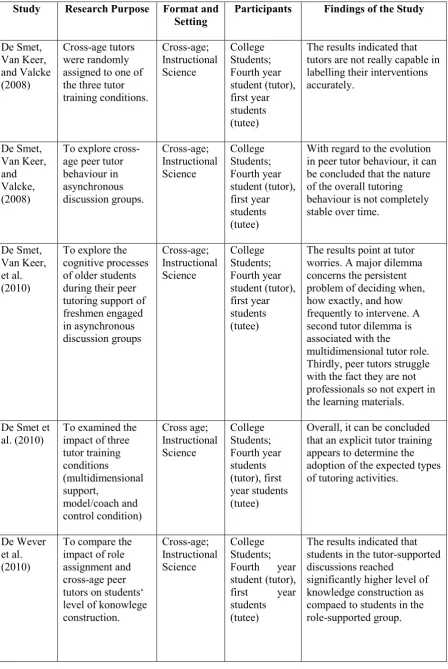
Table 1: Summary of Studies of Peer Tutoring in Online Learning Environment
Study Research Purpose Format and Setting
Participants Findings of the Study
De Smet, Van Keer, and Valcke (2008) Cross-age tutors were randomly assigned to one of the three tutor training conditions. Cross-age; Instructional Science College Students; Fourth year student (tutor), first year students (tutee)
The results indicated that tutors are not really capable in labelling their interventions accurately. De Smet, Van Keer, and Valcke, (2008)
To explore cross-age peer tutor behaviour in asynchronous discussion groups. Cross-age; Instructional Science College Students; Fourth year student (tutor), first year students (tutee)
With regard to the evolution in peer tutor behaviour, it can be concluded that the nature of the overall tutoring behaviour is not completely stable over time.
De Smet, Van Keer, et al. (2010)
To explore the cognitive processes of older students during their peer tutoring support of freshmen engaged in asynchronous discussion groups Cross-age; Instructional Science College Students; Fourth year student (tutor), first year students (tutee)
The results point at tutor worries. A major dilemma concerns the persistent problem of deciding when, how exactly, and how frequently to intervene. A second tutor dilemma is associated with the
multidimensional tutor role. Thirdly, peer tutors struggle with the fact they are not professionals so not expert in the learning materials.
De Smet et al. (2010)
To examined the impact of three tutor training conditions (multidimensional support, model/coach and control condition) Cross age; Instructional Science College Students; Fourth year students (tutor), first year students (tutee)
Overall, it can be concluded that an explicit tutor training appears to determine the adoption of the expected types of tutoring activities.
De Wever et al. (2010)
To compare the impact of role assignment and cross-age peer tutors on students‘ level of konowlege construction. Cross-age; Instructional Science College Students; Fourth year student (tutor), first year students (tutee)
The results indicated that students in the tutor-supported discussions reached
Study Research Purpose Format and Setting
Participants Findings of the Study
Gabarre and Gabarre (2012)
To developed a model of online peer tutoring for language profienciency. Cross age; Foreign Language (French) College Students; Final year students (tutor), second year students (tutee)
The findings were congruent with current research on peer-tutoring and validated the selection criteria (i.e., quantity of messages, quality of contributions, linguistic proficiency and accuracy of objectives). The peer-tutoring model was well received and benefited all participants
Topping et al. (2013)
This paper reports an online reciprocal peer tutoring project for improving language competence in Spanish and English. Same-ability tutoring, reciprocal; Foreign Language (Spanish and English) Elementary Students; 9-12 years
For Catalan students, pre-post test results indicated
statistically significant improvements in reading comprehension (while acting as tutors) and writing (while acting as tutees). Scottish students improved only their writing (acting as tutees).
Thurston et al. (2009)
The paper reports data from an on-line peer tutoring project. Same-ability tutoring, reciprocal; Foreign Language (Spanish and English) Elementary Students; 9-12 years
Results indicated that pupils tutored each other in using Piagetian techniques of error correction during the project.
Wu, Lin, and Yang (2013)
To examine the effects of two types of e-tutoring interventions (text-based vs. face-to-face
videoconferencing, TB vs. F2F) on the grammar
performance and motivation of low-achieving students. Cross age; Foreign Language (English) College Students; Fourth year students (tutor), First year students (tutee)
The findings reveal that although the two modes of tutoring were equally
effective (both groups showed improvement in their
grammar performance, with no discernible difference between the two groups), the F2F group members overcame their negative feelings toward English to a greater extent than the TB group members.
4.0 Results
Based on the meta-analysis, the common peer tutoring formats implemented in asynchronous online discussion is cross-age tutoring. Other than that is same-ability tutoring which the tutor have slightly high ability in academic or skills than the tutee. Furthermore, the online peer tutoring is more implemented in higher education than other context. In addition, it is observed that, subject matter domains such as Science and Foreign Language have been tutored using online discussion forum.
Marijke De Smet and friends has conducted a series of studies regarding implementing peer tutoring teaching practice in asynchronous online discussion (De Smet, Van Keer and Valcke 2008; 2008; De Smet et al., 2010; 2010). The studies by De Smet and friends were focused on tutor training conditions (De Smet, Van Keer, and Valcke, 2008), the peer tutor behaviour (De Smet, Van Keer and Valcke, 2008), the cognitive process of peer tutor (De Smet et al., 2010) and the impact of tutor training (De Smet et al., 2010).
An example of one study by De Smet et al. (2010), the study aim to explore the cognitive processes of older students during their peer tutoring support of freshmen engaged in asynchronous discussion groups. The study was set up during the first semester of the academic year 2006-2007. Fifty-seven fourth-year Educational Science students participated, of which 53 were female and 4 were male, aged between 22-25 years. The asynchronous discussion groups were a formal module of the subject ‘Instructional Science’ 7 credit course which is part of the first-year bachelor of Educational Science’ curriculum. The result of the study has yield six issues associated with peer tutors’ cognitive processing in relation to actual tutor behaviour which are (1) strategy use, (2) reasons for intervention, (3) experience with online discussions, (4) evaluation of faculty support, (5) satisfaction with tutor-tutee interaction, and (6) evolution over time. Moreover, the results more focus on tutor worries. A big concern within tutors is the persistent problem of deciding when, how exactly, and how frequently to intervene. Other than that is the tutor concern with the multidimensional role of tutor. And final concern within tutor is they struggle with the fact that they are not professional, means not expert with the subject matter domain. Thus, from this study, three major concerns within peer tutor can be identified when conducting peer tutoring teaching practice in online discussion. Therefore, the educators can be prepared and overcome the challenge that might occur when implementing peer tutoring teaching practice in teaching and learning.
All of the studies conducted by De Smet and friends embedded the cross-age peer tutoring formats in naturalistic higher education setting at Ghent University which tutored the same subject matter domain which is Instructional Science. However, the numbers of participants and research purpose of each study is varied with one another. Overall, the studies by De Smet focus more on peer tutor behaviour than the outcomes of peer tutoring teaching practice to students’ learning. For future research, the results of the studies regarding peer tutors behaviour can be refereed to conduct the peer tutoring teaching practice latter.
teaching practice yield positive impact on students’ learning in terms of construct new knowledge. Thus, for further research, peer tutoring teaching practice in online setting can be considered to foster students’ critical thinking as well since the construction of new knowledge can be achieved and the level of critical thinking is above the level of construct new knowledge. Thus, the researchers believe that by structuring appropriate peer tutoring teaching practice in online discussion may foster students’ critical thinking other than solely construct new knowledge.
Other studies implemented peer tutoring teaching practice in online discussion is focus on language subject matter domain (Gabarre and Gabarre, 2012; Topping et al,, 2013; Thurston et al., 2009; Wu, Lin and Yang, 2013). The studies involve foreign language such as French, Spanish and English for non-native speaker. Studies by Gabarre and Gabarre (2012) and Wu, Lin and Yang (2013) were used cross-age tutoring and the studies were conducted in higher education context for French and English language subject matter domain.
Gabarre and Gabarre conducted the study in Malaysian public university where the final-year undergraduates majoring in French as a foreign language reveals that they lacked confidence in their language proficiency. The participants in the study were nine final year students were selected as tutors for 18 second year students. The results yield that the participants satisfied with the implementation of peer tutoring teaching model and has given benefit to them. For further research, the peer tutoring teaching model can be implemented in online learning and can be researched more in Malaysian context since this type of peer learning considered not very common in Malaysian context than other western country (Ismail and Alexander, 2005).
While, studies by Topping et al., (2013) and Thurston et al., (2009) reported on the projects collaboration between Scotland and Catalonia elementary school. The projects were using reciprocal peer tutoring format for language competencies in Spanish and English. The participants involves in the projects were elementary students, aged 9-12 years old from Scotland and Catalonia. They were matched to act as tutor in their own language and tutee in a modern foreign language in online environment. The peer tutoring format used in these studies were same-ability tutoring where pair of students were formed by matching students at similar levels of ability. They will take turn tutored each other. A study by Topping et al., (2013) researched on improving language competence in Spanish and English and the results indicated that for Catalan students, there are statistically significant improvements in reading comprehension (while acting as tutors) and writing (while acting as tutees). However, for Scottish students, they only improved in their writing (acting as tutees). Although the Scottish students not improved as being tutors, but this problem could be overcome by adjusting the scaffolding support given by tutors to create a balance benefits for both members of the pair (Topping et al., 2013). Thus, for future research, the reciprocal tutoring format also can be embed in online learning other that cross-age tutoring format which typically being used in teaching and learning.
5.0 Conclusion
Acknowledgment
The authors would like to thank the Universiti Teknologi Malaysia and Ministry of Higher Education Malaysia for their support in making this project possible. This work was supported by the Research University Grant (R.J130000.7731.4J132) initiated by the Universiti Teknologi Malaysia and Ministry of Higher Education.
References
Chen, C., and Liu, C.-C. (2011). A case study of peer tutoring program in higher education, (11), 1.
De Smet, M., Keer, H. Van, Wever, B. De, and Valcke, M. (2010). Cross-age peer tutors in asynchronous discussion groups: Exploring the impact of three types of tutor training on patterns in tutor support and on tutor characteristics. Computers & Education, 54(4), 1167–1181. doi:10.1016/j.compedu.2009.11.002
De Smet, M., Van Keer, H., De Wever, B., and Valcke, M. (2010). Studying thought
processes of online peer tutors through stimulated-recall interviews. Higher Education, 59(5), 645–661. doi:10.1007/s10734-009-9273-2
De Smet, M., Van Keer, H., and Valcke, M. (2008). Blending asynchronous discussion groups and peer tutoring in higher education: An exploratory study of online peer tutoring behaviour. Computers & Education, 50(1), 207–223.
doi:10.1016/j.compedu.2006.05.001
De Smet, M., Van Keer, H., and Valcke, M. (2008). Cross-age peer tutors in asynchronous discussion groups: Studying the impact of tutors labelling their interventions. Journal of Computer Assisted Learning, 24(6), 462–473. doi:10.1111/j.1365-2729.2008.00284.x De Smet, M., Van Keer, H., and Valcke, M. (2009). Cross-age peer tutors in asynchronous
discussion groups: A study of the evolution in tutor support. Instructional Science, 37(1), 87–105. doi:10.1007/s11251-007-9037-2
De Wever, B., Van Keer, H., Schellens, T., and Valcke, M. (2010). Structuring asynchronous discussion groups: Comparing scripting by assigning roles with regulation by cross-age peer tutors. Learning and Instruction, 20(5), 349–360.
doi:10.1016/j.learninstruc.2009.03.001
Falchikov, N. (2001). Learning Together: Peer Tutoring in Higher Education. Routledge/Falmer. Retrieved from
http://books.google.com.my/books/about/Learning_Together.html?id=IYpkELfOYjkC& pgis=1
Gabarre, C., and Gabarre, S. (2012). Criteria for successfully recruiting online peer-tutors in foreign languages. Asia Pacific Journal of Education, 32(2), 197–223.
doi:10.1080/02188791.2012.684954
Ismail, H. N., and Alexander, J. M. (2005). Learning Within Scripted and Nonscripted Peer-Tutoring Sessions: The Malaysian Context. The Journal of Educational Research, 99, 67–77. doi:10.3200/JOER.99.2.67-77
Roscoe, R. D., and Chi, M. T. H. (2007). Understanding Tutor Learning:
Knowledge-Building and Knowledge-Telling in Peer Tutors’ Explanations and Questions. Review of Educational Research, 77(4), 534–574. doi:10.3102/0034654307309920
Topping, K. J. (1996). The effectiveness of peer tutoring in further and higher education : A typology and review of the literature Definitions and typology, 321–345.
Topping, K. J. (2005). Trends in Peer Learning. Educational Psychology, 25(6), 631–645. doi:10.1080/01443410500345172
Topping, K. J., Dehkinet, R., Blanch, S., Corcelles, M., and Duran, D. (2013). Paradoxical effects of feedback in international online reciprocal peer tutoring. Computers and Education, 61(1), 225–231. doi:10.1016/j.compedu.2012.10.002
Vygotsky, L. S. (1978). Mind and society: The development of higher mental processes. Wu, E., Lin, W. C., and Yang, S. C. (2013). An experimental study of cyber face-to-face vs.
cyber text-based English tutorial programs for low-achieving university students. Computers and Education, 63, 52–61. doi:10.1016/j.compedu.2012.11.018
Author(s):
Nurul Nadwa Zulkifli [email protected]
Department of Educational Science, Mathematics and Creative Multimedia, Faculty Of Education, Universiti Teknologi Malaysia, Malaysia.
Noor Dayana Abd Halim noordayanahalim@gmailcom
Department of Educational Science, Mathematics and Creative Multimedia, Faculty Of Education, Universiti Teknologi Malaysia, Malaysia.
Noraffandy Yahaya [email protected]
Department of Educational Science, Mathematics and Creative Multimedia, Faculty Of Education, Universiti Teknologi Malaysia, Malaysia.