73:5 (2015) 1–10 | www.jurnalteknologi.utm.my | eISSN 2180–3722 |
Full paper
Jurnal
Teknologi
Environmental Hostility Contingencies on the Relationship between
Knowledge Management Strategy and Firm Performance
Alizar Hasana, Abdul Hakim Mohammedb, Wardic, Nursyaifi Yuliusc, Heldid, Mat Naim Abdullahe*
aAndalas State Universiti, Padang, Indonesia
bFaculty of Geoinformation and Real Estate, Universiti Teknologi Malaysia, 81310 UTM Johor Bahru, Johor, Malaysia cBung Hatta University, Padang, Indonesia
dFaculty of Language and Art, Padang State University, Padang, Indonesia
eCentre of Real Estate Studies, Universiti Teknologi Malaysia, 81310 UTM Johor Bahru, Johor, Malaysia
*Corresponding author: [email protected]
Article history
Received :6 February 2014 Received in revised form : 21 December 2014 Accepted :26 February 2015
Graphical abstract
Abstract
This study aims to investigate the environmental hostility contingencies on the relationship between knowledge management strategy and firm performance. Knowledge management strategies are classified into two dimensions: Codification and Personalization. These studies cover the 192 completed and usable questionnaires were received from respondents which comprises of large size Indonesian manufacturing firms. The result via smartPLS revealed that knowledge management strategies positively and significantly influence the Indonesian manufacturing firm’s performance. Other findings display that environmental turbulences has only the contingency effect (the moderating effect) on the relationship between knowledge management strategy and manufacturing firm performance. Based on findings, the implications and future research also be discussed in this paper.
Keywords: Knowledge management strategy; firm performance; environmental hostility
Abstrak
Kajian ini bertujuan untuk mengkaji kontingensi permusuhan persekitaran terhadap hubungan antara strategi pengurusan pengetahuan dan prestasi firma. Strategi pengurusan pengetahuan diklasifikasikan kepada dua dimensi: Kodifikasi dan Keperibadian. Kajian ini meliputi 192 soal selidik yang lengkap dan boleh digunakan yang telah diterima daripada responden yang terdiri daripada syarikat pembuatan bersaiz besar di Indonesia. Hasil analisis SmartPLS menunjukkan bahawa strategi pengurusan pengetahuan secara positif dan signifikan mempengaruhi prestasi firma pembuatan Indonesia. Penemuan lain menunjukkan pergolakan persekitaran hanya mempunyai kesan luar jangka terhadap hubungan antara strategi pengurusan pengetahuan dan prestasi firma pembuatan. Berdasarkan hasil kajian, implikasi dan penyelidikan masa hadapan turut dibincangkan dalam kertas ini.
Kata kunci: Strategi pengurusan pengetahuan; prestasi firma; perseteruan lingkungan
© 2015 Penerbit UTM Press. All rights reserved.
1.0 INTRODUCTION
In the era of globalization and knowledge economic, where James J. Schiro was an American businessman and a director of number of multinational companies stated that “business environment, knowledge and how it is managed for competitive advantage will be the number one corporate priority”, and moreover, the main features and characteristics of knowledge economy can be defined through their key drivers such as: “information revolution, flexible organization, knowledge, skills and learning, innovation and knowledge networks, learning organizations and innovation systems, competition and production”[1]. Therefore, the companies will be successful in the era globalization and knowledge economic, they have to always
create their new knowledge through continuous learning for gaining their competitive advantage.
most admired knowledge enterprise, and they succeeded in application of knowledge management. Although scholars have suggested that knowledge management in general is critical to the company's performance in contemporary organizations, and very few studies on the extent to which specific knowledge management strategies affect performance[2]. Specifically for Indonesia,
i
t is also shown very little study of the relationship between knowledge management strategy and manufacturing performance, as an example, Maya Irjayanti[3] have only been examined knowledge management in the banking industry. Furthermore they found that knowledge management systems have “the valuable contribution to secure employees’ tacit knowledge through building of standard operating procedure. So then the company could perform with certain standard without rely on certain employees ability”. As in the context of a manufacturing company, they are very vulnerable to environmental factors, so it needs to be investigated environmental contingencies on the relationship between knowledge management strategy and firm performance [4]. Therefore, it is also important to examine the influence of the environmental hostility contingency on the relationship between knowledge management strategy and firm performance, especially for Indonesian manufacturing firm. Therefore, this study will attempt to investigate the relationship between knowledge management strategy and firm performance, and environmental hostility as contingency variable.The remainder of the paper is organized as follows. In the next section, the literature review and proposed model with hypotheses are discussed. Then, this study described the methodology, the sample and data collection, and the measurements of the constructs. This is followed by a test of a proposed model using SmartPLS-SEM model, where the reliability and validity of the measurement and the results of PLS-SEM are shown in this section. Finally, the discussion, conclusion and implications about the findings, and future studies are described in section four and five.
2.0 LITERATURE REVIEW
This literature review describes theoretical background, knowledge management strategy, firm performance, and link knowledge management strategy and firm performance where environmental hostility as contingency factor (moderating factor).
2.1 Knowledge Management Strategy
McInerney says that there are two kinds of knowledge strategy. The first relates to “a supply-side strategy that tends to focus on the distribution and deployment knowledge of the current organization” and the second is “the demand side that focuses on meeting organizational needs for new knowledge”. In other words, “the first strategy focuses on knowledge sharing and dissemination, and the second to the innovation of science and mechanics of each generation of knowledge”[5]. Furthermore, knowledge can be divided into two types: explicit and tacit knowledge. Both types of knowledge are significant to the organization. In most cases, “knowledge creation depends on the conversion between these types”[6];[7];[2]. Explicit knowledge management strategy can be categorized as codification strategy, in which focus to manage, use and store this corporate knowledge assets systematically (e.g., standards, procedures). Whereas, tacit knowledge strategies can also be categorized as personalization knowledge management strategy and it emphasis on “knowledge sharing through mutual interaction, dialogue that supports the sharing of knowledge by one-to-one connection and are
manifested through social networking group or team work is used”[8]. Therefore, Hansen and Nohria investigated several management consulting firms and found two very different knowledge management strategies in place in these firms; a codification strategy and a personalization strategy[9]. The researchers argued that companies should seek either a codification strategy or a personalization strategy in isolation to utilize corporate knowledge most effectively.
2.1.1 Codification Strategy
Codification strategy indicates that knowledge is carefully codified and stored in databases and then accessed and used easily by anyone in the company. The benefits of codification strategy indicate that sharing of codified knowledge can improve task efficiency and also can improve task quality and signal competence to clients[10]. Faster response to customers and lower cost per knowledge transaction are main goals of this strategy. With this strategy, it is aimed to increase the codification capability of the firm, thereby, reducing the complexity of access and reuse of knowledge vi a information technologies. Firms using explicit oriented KM strategy can achieve scale economies and organizational efficiency through reusing codified knowledge[11].
2.1.2 Personalization Strategy
Personalization strategy means that knowledge is closely tied to the person who developed that knowledge and is shared primarily through direct person-to-person contacts. In tacit oriented KM strategy or Personalization strategy context, the emphasize is on sharing knowledge through mutual interactions; dialogues that supports sharing knowledge by one-to-one connections and that eventuate through social networks occupational groups or teams are used[8]. Firms using this strategy protect themselves against being imitated by their rivals through keeping their strategic knowledge such as know -how in tacit form[12].
2.2 Firm Performance
The company's performance can be defined as "the process of quantifying the efficiency and effectiveness of the actions of the past through the acquisition, collection, sorting, analysis interpretation, and dissemination of appropriate information"[13]. Performance of the company can be translated in several dimensions, as suggested by most of the literature in the past such as: higher profits, sales volume and market share[14]. In addition, sales, asset growth, sales volume and market share growth can be categorized as business performance, and it is the facts which are often found in studies by scholars. In addition, performance indicators can be classified in the form of tangibles and intangible indicators. In this research will be used dimensional manufacturing performance such as profitability, ROI, customer retention, and sales growth as proposed by Powell & Dent-Micallef[15], therefore, these dimensions can also be classified as direct and subjective measures of financial and non-financial measurements.
2.3 Knowledge Management Strategy and Firm Performance
tacit knowledge management strategy. Furthermore, the study results show that tacit and explicit knowledge management strategies positively affect the firm performance. Furthermore, Keskin[4] also found that the impact of explicit knowledge is greater than tacit knowledge on firm performance.
Singh and Zollo[16] investigated the impact of tacit and codified knowledge accumulation strategies on the performance of corporate acquisitions. The authors showed that tacit-oriented knowledge management strategy had a positive influence on organizational performance if task characteristics are highly homogeneous or similar. However, Singh and Zollo[16] also found that codified knowledge management strategy appeared to be an important factor when task characteristics are categorized as low homogeneity. The study indicated that firms should align their knowledge strategies with their task characteristics. Then, Choi and Lee[17] stated that knowledge management strategies can be divided into two dimensions as declared by many researchers which focus on the system orientation and the human orientation. Furthermore, system orientations focused on codified knowledge through information technology, and try to share that knowledge formally. On the contrary, human orientation in knowledge management strategies, the emphasis focused on dialogue through social networks and person-to-person contact, so the acquisition of knowledge obtained through an experienced and skilled person, and seeks to share knowledge informally[17]. Choi and Lee[18] based on their study, said that the mix between system orientation and human orientation can produce better corporate performance. Furthermore, Mohamad Kazem Emadzade et al. stated that organizational structure, knowledge acquisition, knowledge application and knowledge protection were significantly related to organizational performance. This research also indicated that appropriate investments in knowledge management initiatives can enhance the Organizational performance. Then a recent study conducted by Jason F. Cohen and Karen Olsen[19], found that codification and human capital knowledge management capability are independently associated with increased firm performance outcomes. Therefore:
H 1: the greater Knowledge management strategy, the greater firm performance.
Corollary Hypothesis:
H 1.1: the greater codification strategy, the greater firm performance.
H 1.2: the greater personalization strategy, the greater firm performance.
2.4 Environmental Hostility as Contingency Factor
The possible relationships of contingency factors to manufacturing practices and performance can be classified as drivers, mediators, or moderators. The exact form may differ depending on the researcher’s approach, and the empirical results determine the validity or invalidity of the research models[20]. Several researchers have studied the characteristics of the environment hostility that plays as moderator role in the relationship between manufacturing practices and operations
performance. Furthermore, the organization's external environment is defined as contingency factors that are beyond the direct control of the company[21]. Atuahene et al.[22] and Keskin[4] argued that "competition in the market related to the markets in which the company operates, further it can be seen, in a weak intensity market competition, customers have little or no choice in products or services that offered by the company. But on other hand, in a high market competition, it is necessary for the company to be responsive to customer needs, so the companies need to adopt an orientation and repair their products and processes to prevent customers from switching to other more innovative competitors. Noordewier, John and Nevin[23] and Keskin[4] explained their findings that “turbulence can be identified as unexpected changes in environmental conditions. Obsolete developing products and processes on the market in a short time, the rapid turnover of products and processes, and changes in customer expectations and demands are basic indicators of environmental turbulence”. Keskin[4] also found “that explicit- and tacit-oriented knowledge management strategies positively affect firm performance”. Furthermore, both environmental turbulence and intensity of market competition also have moderating impact strongly on the relationship between explicit-oriented and tacit-oriented knowledge management strategies and firm performance. Liao Liefa et al.[24] stated that” different knowledge management strategy has different effects on organizations under different environments”. Moreover, when the firms use the wrong type of knowledge management strategy they cannot get their benefit of learning aim and will affect their performance. Therefore:
H 2: the greater the environmental hostility, the greater the positive relationship between Knowledge management strategy and firm performance.
Corollary Hypothesis:
H2.1: the greater the environmental turbulence, the greater the positive relationship between codification strategy and firm performance.
H2.2: the greater the environmental turbulence, the greater the positive relationship between personalization strategy and firm performance.
H2.3: the greater the intensity market competition, the greater the positive relationship between codification strategy and firm performance.
H2.4: the greater the intensity market competition, the greater the positive relationship between codification strategy and firm performance.
3.0 RESEARCH METHODOLOGY
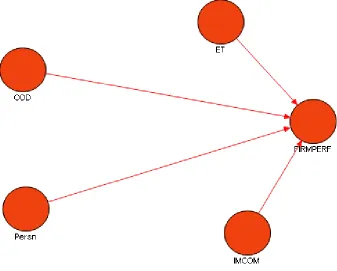
3.1 Research Framework
Figure 1 Conceptual framework
3.2 Population and Sample
This study used population of all large-sized companies in Indonesia. Furthermore, the target population for the study consisted of a manufacturing organization in ISIC code 26 (non-metallic mineral products), 27 (Primary Metals) 28 (Fabricated metal products, except machinery and equipment), 29 (machinery and equipment), 30 (office, accounting and computing machinery), 31 (electrical machinery and apparatus nec), 32 (Radio, television and communication equipment and equipment), 33 (Medical, precision and optical instruments), 34 (motor vehicles, trailers and semi-trailers)[25];.
3.3 Sampling Design
Organization is the unit of analysis of this study, according to Campbell, DT (1955) a good informant for the purpose of this research should be one that has access to all the issues under investigation. Therefore, the CEO is the single key informant. Type of sampling design is a limited probability sampling (random sampling technique) where the elements of the population has some probability of being selected as a sample subject. The sample of 1000 respondents drawn from a list of all the respondents in the population using computer generated random numbers.
3.4 Construct Measurement
Knowledge Management strategies as independent variable is adopted from Choi and Lee[18], and Keskin[4] construct. These dimensions are Codification strategy (cod), and Personalization strategy (persn). Moreover, firm performance (firmper) as dependent variable is adopted from Powell & Dent-Micallef[15], the Tippin and Sohi[26] construct, Environmental hostility in this study was measured by two factors namely: Environmental Turbulence (et) and Intensity of Market Competition (imcom) are adopted form Atuahene-Gima, K[22], Desphande et al.[27], and Keskin[4]. All constructs above are measured by using five-point Likert scales
4.0 FINDING AND DISCUSSION
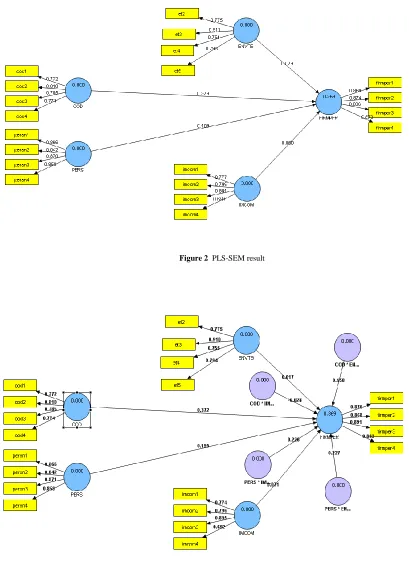
Figure 2 PLS-SEM result
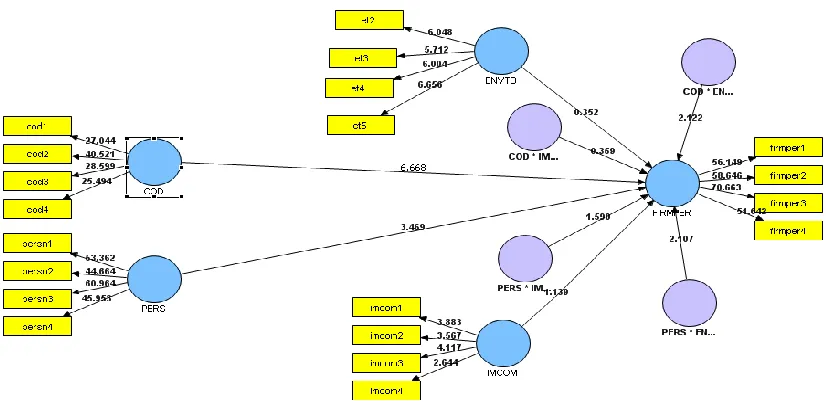
Figure 4 Structural path significance in bootstrapping
4.1 Indicator Reliability
The result of SmartPLS is presented in Table 1; indicate that all of the indicators have individual indicator reliability value that are much larger than the minimum acceptable level of 0.4 [28] and almost every item with ranging from .590 to .830. The indicator reliability value can be calculated by using the square each of the outer loading.
4.2 Internal Consistency Reliability
The internal consistency reliability traditionally can be measured
by using the cronbach’s alpha. On other hand, the cronbach’s alpha tends to provide the lower bound estimate reliability and conservative measurement in PLS-SEM, so that scholars have suggested the use of “composite reliability” as substitute [29]. Table 1 displays the values of composite reliability to be larger than 0,6, therefore the high levels of internal consistency reliability have been denoted among all five latent variables such as: codification strategy, personalization strategy, environmental turbulence, intensity market competition, and firm performance.
Table 1 Results summary for outer models
Latent Variable Indicator Loading Indicator Reliability Composite Reliabilty AVE
Codefication Strategy(COD) cod1 0.772 0.590 0.866 0.620
cod2 0.810 0.660
cod3 0.785 0.620
cod4 0.774 0.599
Personalization strategy (PERS) persn1 0.866 0.750 0.919 0.739
persn2 0.842 0.709
persn3 0.870 0.757
persn4 0.859 0.738
Environmental Turbulences (ENVTB)
et2 0.775 0.601 0.884 0.657
et3 0.911 0.830
et4 0.754 0.569
et5 0.793 0.629
Intensity Market Competition( IMCOM)
incom1 0.777 0.604 0.871 0.629
incom2 0.799 0.638
incom3 0.892 0.796
incom4 0.693 0.480
Firm Performance (FIRMPER)
Firmper1 0.869 0.755 0.919 0.765
Firmper2 0.874 0.764
Firmper3 0.886 0.785
4.3 Convergent Validity
In order to check convergent validity of the PLS_SEM model above, the average variance extracted (AVE) each latent variable should be evaluated. Looking at Table 1, it shows that all of the AVE values are greater than the acceptable threshold of 0.5, so convergent validity is confirmed.
4.4 Discriminant Validity
Discriminant validity of the measurement model with reflective indicators above can be assessed by measuring the construct cross loading. If the correlation between the constructs and measurement items is greater than the other latent constructs. Therefore this condition will indicate that the latent constructs
have the items measurement prediction is better than the items measurement prediction of the other latent constructs.
Another method for assessing the discriminat validity is to compare the value of the square root of average variance extracted (AVE) in each latent construct to the other correlation value among the latent constructs [30]. Moreover, if this value is larger than other correlation values among the latent construct, so this result indicate well established.
For example, Table 2 display the latent construct codification’s AVE is found to be 0.620 hence its square root becomes 0.787. This number is larger than the correlation values in the column of Cod (0.501, 0.101, 0.032, and 0.483). Similar observation is also made for the other latent constructs such as Pers, Envtb, Imcom, and Firmper, and the results indicate that discriminant validities are well established.
Table 2 Analysis for checking discriminant validity
COD PERS ENVTB IMCOM FIRMPER
COD 0.787
PERS 0.501 0.859
ENVTB 0.101 -0.012 0.810
IMCOM 0.032 -0.008 0.162 0.793
FIRMPER 0.483 0.377 0.125 0.084 0.875
4.5 Explanation of Firm Performance Variance
In order to test the hypothesis that postulated a positive and significant relationship between all dimension of knowledge management strategy(personalization, and codification)and firm performance, the SmartPLS results can be analyzed to determine the variance of firm performance explained by the two dimension of knowledge management strategy (personalization, and codification) that displayed in Figure 3 and Table 3. Furthermore, the result indicates the coefficient of determination, R2, is 0,369
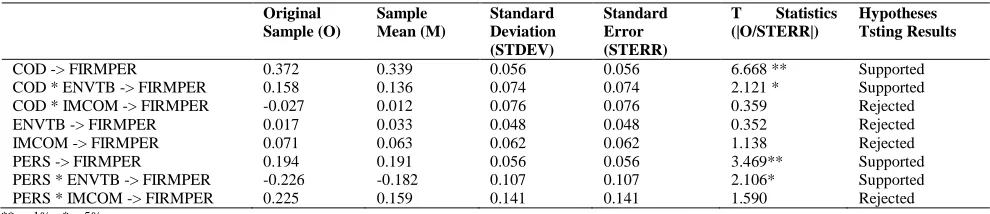
for endogenous latent variable. This means that the two dimension of knowledge management strategy (codification and personalization strategy) and environmental hostility (environmental turbulences and intensity market competition) jointly explained 36, 9% of the variance of overall firm performance. The SmartPLS results also indicate that the two dimensions of knowledge management strategy sequentially have path coefficient as follows: are 0.372 for the effect of codification strategy (cod), 0.194 for the effect of personalization strategy (pers), 0,017 for the effect of environmental turbulences (envtb), 0,071 for intensity market competition (imcom),0.158 for the interaction construct cod*envtb, -0,027 for cod*imcom, -0.226 for pers*envtb, and 0.225 for pers* imcom. This means that codification strategy has the strongest effect on firm performance. Table 3 and Figure 4 also display structural path significance in bootstrapping. Furthermore,the path coeffisient of the inner model can be checked if they are significant or not by using a two-tailed t-test with significant level of 5 %. The results indicate the hypothesized path relationship between codification strategy (cod)and firm performance is statistically significant with a significant level of 1 % (the T-statistics is 6.668, this means the number is larger than 2.58), as well as to the hypothesized path
Table 3 PathCoefficients (Mean, STDEV, T-Value) and Hypotheses testing result Original Sample (O) Sample Mean (M) Standard Deviation (STDEV) Standard Error (STERR)
T Statistics (|O/STERR|)
Hypotheses Tsting Results
COD -> FIRMPER 0.372 0.339 0.056 0.056 6.668 ** Supported
COD * ENVTB -> FIRMPER 0.158 0.136 0.074 0.074 2.121 * Supported
COD * IMCOM -> FIRMPER -0.027 0.012 0.076 0.076 0.359 Rejected
ENVTB -> FIRMPER 0.017 0.033 0.048 0.048 0.352 Rejected
IMCOM -> FIRMPER 0.071 0.063 0.062 0.062 1.138 Rejected
PERS -> FIRMPER 0.194 0.191 0.056 0.056 3.469** Supported
PERS * ENVTB -> FIRMPER -0.226 -0.182 0.107 0.107 2.106* Supported
PERS * IMCOM -> FIRMPER 0.225 0.159 0.141 0.141 1.590 Rejected
**p< 1% , *p<5%
4.6 Discussion
Based on the findings of this study above, displayed that knowledge management strategy (Codification and Personalization strategy) positively influences a firm performance. These findings also show that Indonesian manufacturing firms use a symbiosis between codification and personalization strategy, where, codification strategy has the strongest effect on firm performance. Then it can be concluded that manufacturing firms of Indonesian show their knowledge management style are the system oriented style. Therefore, this finding fully supports the hypothesis (H 1) and its corollary hypotheses, and can be concluded that this finding is also in line with a study of Keskin[4]. But, according to Choi and Lee[18], that manufacturing firms tend to use the knowledge management- human oriented style instead of using the knowledge management-system oriented style, so this contrast can be explained that the employees of Indonesian companies tend to use more manual or codified knowledge than their own experiences and networking relationships, or maybe other reason, because they more concerned with formalized and standardized business processes rather than knowledge sharing with the emphasis interpersonal interaction.
Furthermore, the findings of this study also indicate that only the moderating effects of environmental turbulence that strengthen the relationship between codification strategy and firm performance on a large scale manufacturing in Indonesia. But, the environmental turbulence weakens the relationship between personalization strategy and firm performance. The otherwise, it has no moderating effect of intensity market competition on the relationship between codification and personalization strategy and firm performance. Therefore, this finding shows that the hypothesis (H2) is only partially supported, and is not in line with a study of Keskin[4]. Where, Keskin[4] found that the greater the environmental hostility, the greater the relationship between knowledge management strategies (personalization and codification knowledge strategy) and firm performance. In large-scale manufacturing firms, especially in Indonesia in the face of high environmental turbulence, to maintain their business sustainability, they seem to consider more focused on the use of explicit –oriented level, which need the degree of codifying and storage of organizational knowledge, and so their employees more easily to use and access it[18]. On the contrary, the result of interaction between construct personalization strategy and environmental turbulence display a negative effect. That indicated, they attempt to reduce the orientation of the tacit knowledge, or means that they are attempting to reduce the acquisition and knowledge sharing through personal interaction, and more focus on strengthening the explicit knowledge they have previously mastered in case of turbulent environment.
On other hand, In the face of the intensity of market
competition, these findings demonstrate the manufacturing firms of Indonesian consistently use symbiosis between codification and personalization strategy, or in other words that market competition intensity has not effect on the strengthening of relationship between knowledge management strategies and firm performance.
4.7 Implication
The implications of this study can be demonstrated through how managers can improve their company's performance through knowledge management strategy. In general, companies using the mixture of codified and personalized knowledge strategy. For example in the companies of a system-oriented style as represented in this study, managers should pay attention more intensely on the codified knowledge in their companies such as know-how, technical skill, or problem solving methods. Furthermore, this codified knowledge can be acquired easily through formal documents and manuals. As well as each the results of project meetings shall be neatly documented. Table 1 shows the each of indicator of the codification strategy with loading of 0.772, 0.810, 0.785, and 0.774 respectively, they are good indicators of codification strategy. Whereas for personalized knowledge strategy, managers must also pay attention on how knowledge can be easily obtained from experts and co-workers, or gain knowledge through face to face advice from experts, as well as through informal dialogue and meetings used to share knowledge. Further, knowledge can be acquired by one-to-one mentoring in their company. Therefore, Table 1 also shows the each of indicator of the personalization strategy with loading of 0.866, 0.842, 0.870, and 0.859 respectively, they are good indicators of personalization strategy
5.0 CONCLUSION
Reference
[1] Houghton, J. and P. Sheehan. 2000. A Primer on the Knowledge
Economy.
[2] Mushref, A. M. and S. bin Ahmad. 2011. The Relationship Between Knowledge Management and Business Performance: An Empirical Study in Iraqi Industry.World Review of Business Research. 1(2): 35–50. [3] Irjayanti, M. and A. M. Azis. 2013. Knowledge Management for Banking
Industry Continuous Improvement.Jurnal Teknologi. 64(3).
[4] Keskin, H. 2005. The Relationships Between Explicit and Tacit Oriented KM Strategy, and Firm Performance. Journal of American Academy of
Business.7(1): 169–175.
[5] McInerney, C. 2002. Knowledge Management and the Dynamic Nature of Knowledge. Journal of the American Society for Information Science
and Technology. 53(12): 1009–1018.
[6] Earl, M. 2001. Knowledge Management Strategies: Toward a Taxonomy.
Journal of Management Information Systems. 18(1): 215–233. [7] Haanes, K. and B. Lowendahl. 1997. The Unit of Activity: Towards An
Alternative to the Theories of the Firm. Strategy, Structure and Style. 201–218.
[8] Swan, J., S. Newell, and M. Robertson. 2000. Limits of IT-Driven Knowledge Management Initiatives For Interactive Innovation Processes: Towards a Community-based Approach. In System Sciences, 2000.
Proceedings of the 33rd Annual Hawaii International Conference on.
IEEE.
[9] Hansen, M. T., N. Nohria, and T. Tierney. 1999. What’s Your Strategy
for Managing Knowledge? The Knowledge Management Yearbook
2000–2001.
[10] Haas, M. R. and M. T. Hansen. 2007. Different Knowledge, Different Benefits: Toward a Productivity Perspective on Knowledge Sharing in Organizations.Strategic Management Journal. 28(11): 1133–1153. [11] Markus, L. M. 2001. Toward a Theory of Knowledge Reuse: Types of
Knowledge Reuse Situations and Factors in Reuse Success. Journal of
Management Information Systems. 18(1): 57–93.
[12] Schulz, M. and L. A. Jobe. 2001. Codification and Tacitness as Knowledge Management Strategies: An Empirical Exploration. The
Journal of High Technology Management Research. 12(1): 139–165.
[13] Neely, A. D. 1998. Measuring Business Performance.
[14] Wheelwright, S. C. and K. B. Clark. 1988. Dynamic Manufacturing:
Creating the Learning Organization. Simon and Schuster.
[15] Powell, T. C. and A. Dent-Micallef. 1997. Information Technology as Competitive Advantage: The Role of Human, Business, and Technology Resources.Strategic Management Journal. 18(5): 375–405.
[16] Singh, H. and M. Zollo. 1998. The Impact of Knowledge Codification, Experience Trajectories and Integration Strategies on the Performance of Corporate Acquisitions.
[17] Choi, B. and H. Lee. 2002. Knowledge Management Strategy and Its Link to Knowledge Creation Process.Expert Systems with Applications.
23(3): 173–187.
[18] Choi, B. and H. Lee. 2003. An Empirical Investigation of KM Styles and Their Effect on Corporate Performance. Information & Management.
40(5): 403–417.
[19] Cohen, J. F. and K. Olsen. 2015. Knowledge Management Capabilities and Firm Performance: A Test of Universalistic, Contingency and Complementarity Perspectives. Expert Systems with Applications. 42(3): 1178–1188.
[20] Matyusz, Z. 2012. The Effect of Contingencies on the Use of
Manufacturing Practices and Operations Performance. PhD
Dissertation, Budapest.
[21] Bapuji, H. and M. Crossan. 2004. From Questions to Answers: Reviewing Organizational Learning Research. Management Learning. 35(4): 397–417.
[22] Atuahene‐Gima, K. 1995. An Exploratory Analysis of the Impact of Market Orientation on New Product Performance. Journal of Product
Innovation Management. 12(4): 275–293.
[23] Noordewier, T. G., G. John, and J. R. Nevin. 1990: Performance Outcomes of Purchasing Arrangements in Industrial Buyer-Vendor Relationships.The Journal of Marketing. 80–93.
[24] Liefa, L., J. JinHu, and W. KanLiang. 2011. Knowledge-management Strategy and Organizational Learning: An Agent-based Simulation.
African Journal of Business Management. 5(8): 3040–3046.
[25] Hasan, A. 2008. IT Competency and Firm Performance: The Role of Organizational Learning Capability in Indonesian Manufacturing Firm.
Unpublished thesis,
[26] Tippins, M. J. and R. S. Sohi. 2003. IT Competency and Firm Performance: Is Organizational Learning a Missing Link? Strategic
Management Journal. 24(8): 745–761.
[27] Deshpandé, R., J. U. Farley, and F. E. Webster Jr. 1993. Corporate Culture, Customer Orientation, and Innovativeness in Japanese Firms: A Quadrad Analysis.The Journal of Marketing. 23–37.
[28] Hulland, J. 1999. Use of Partial Least Squares (PLS) in Strategic Management Research: A Review of Four Recent Studies. Strategic Management Journal. 20(2): 195–204.
[29] Hair, J. F., et al. 2006. Multivariate Data Analysis. Vol. 6. Pearson Prentice Hall Upper Saddle River, NJ.
[30] Fornell, C. and D. F. Larcker. 1981. Evaluating Structural Equation Models with Unobservable Variables and Measurement Error. Journal of
Appendix A
Items in : Knowledge management strategy scale, environmental hostility scale, and firm performance scale.
Item in codification[18]
Cod1. Knowledge (Know-how, Technical skill, or problem solving methods) is well codified in my company. Cod2. Knowledge can be acquired easily through formal documents and manuals in my company.
Cod3. Results of projects meetings should be documented in my company.
Cod4. Knowledge is shared through codified forms like manuals or documents in my company.
Items in personalization [18]
Persn1. My knowledge can be easily acquired from experts and co-workers in my company. Persn2. It is easy to get face-to-face advises from experts in my company.
Persn3. Informal dialogues and meetings are used for knowledge sharing in my company. Persn4. Knowledge is acquired by one-to-one mentoring in my company.
Firm performance [15]
Firmper1. Over the past 3 years, we have been more profitable than our competitors Firmper2. Over the past 3 years, our return on investment has exceed our competitors Firmper3. Over the past 3 years, our sales growth has exceeded our competitors. Firmper4. Over the past 3 years, our customer retention has been outstanding.
Environmental turbulence[22],[27]and[4]
Et1. Competition in this product area is cut throat. Et2. There are many promotion wars in this product area
Et3. Anything that one competitor can offer in this product areas, others can match readily Et4. Price competition is a hallmark in this area
Et5. One hears of a new competitive move in this product area almost everyday
Intensity of market competition [22],[27], and[4].
Imcom1. Extremely aggressive competition Imcom2. Intense price competition