The Power of Implicit Social Relation in Rating
Prediction of Social Recommender Systems
Waleed Reafee1,3*, Naomie Salim2, Atif Khan1
1Department of Computer Science, Faculty of Computing, Universiti Teknologi Malaysia, Skudai, Johor, Malaysia,2Department of Information Systems, Faculty of Computing, Universiti Teknologi Malaysia, Skudai, Johor, Malaysia,3Department of Mathematics and Computer Science, Faculty of Pure and Applied Science, International University of Africa, Khartoum, Sudan
Abstract
The explosive growth of social networks in recent times has presented a powerful source of information to be utilized as an extra source for assisting in the social recommendation prob-lems. The social recommendation methods that are based on probabilistic matrix factorization improved the recommendation accuracy and partly solved the cold-start and data sparsity problems. However, these methods only exploited the explicit social relations and almost completely ignored the implicit social relations. In this article, we firstly propose an algorithm to extract the implicit relation in the undirected graphs of social networks by exploiting the link prediction techniques. Furthermore, we propose a new probabilistic matrix factorization method to alleviate the data sparsity problem through incorporating explicit friendship and implicit friendship. We evaluate our proposed approach on two real datasets, Last.Fm and Douban. The experimental results show that our method performs much better than the state-of-the-art approaches, which indicates the importance of incorporating implicit social relations in the recommendation process to address the poor prediction accuracy.
Introduction
Recommender systems (RS) have been widely studied and implemented in several directions, such as academia and industry. RS deal very well with information overload problems by sug-gesting to users the items that are potentially of interest to them, such as a product recommen-dation from Amazon. However, with the rapidly increasing number of users and items, the problem of data sparsity (the user rates a very few items from the total number of items in the database) has been increasingly intractable.
Traditional collaborative filtering (TCF) approaches mainly focus on utilizing users’ histori-cal preferences on the purchased products to predict users’interests [1,2]. TCF is very success-ful in the real world, and is easy to understand and implement [1], but does not consider any additional information, making it difficult to solve the sparsity problem and provide accurate recommendations.
Due to the increasing growth of social networks in recent years and the large amount of information generated, it has become necessary for RS to exploit this information to improve recommendation accuracy. Several social recommendation methods have been proposed and
a11111
OPEN ACCESS
Citation:Reafee W, Salim N, Khan A (2016) The Power of Implicit Social Relation in Rating Prediction of Social Recommender Systems. PLoS ONE 11(5): e0154848. doi:10.1371/journal.pone.0154848
Editor:Ye Wu, Beijing University of Posts and Telecommunications, CHINA
Received:July 22, 2015
Accepted:April 20, 2016
Published:May 6, 2016
Copyright:© 2016 Reafee et al. This is an open access article distributed under the terms of the Creative Commons Attribution License, which permits unrestricted use, distribution, and reproduction in any medium, provided the original author and source are credited.
Data Availability Statement:All relevant data are within the paper and its Supporting Information files.
Funding:The authors have no support or funding to report.
have started to use social network information as additional input in the recommendation pro-cess [3–11]. However, data sparsity and poor prediction accuracy problems still exist.
In order to exploit the social network information in the best way, we refer to the users’ rela-tionship according to two types, namely, explicit friendship and implicit friendship. An explicit friendship that is formed by users explicitly adds other individuals as‘friends’, while an implicit friendship is a weighted graph, in which edge weights are determined by the frequency, interac-tions and common neighbors between users in social networks. For example, in social networks such as Facebook, user A can create a friendship relation with user B by sending a request for him/her and wait until he/she accepts. This explicit friendship relation between users A and B may only represent part of the user relationship based on the social connectivity between them. On the other hand, user A might have a high probability with user C to be linked based on the common neighbors‘common friends’in the social network, so many users may be related to each other through an implicit friendship relation.
Most of the existing social recommendation methods [5,12] to the best of our knowledge, assume that the user preferences may be influenced by a number of explicit social friends. We believe that the social influence among people is not only determined by the social connectivity, but also by the amount of common neighbors between social network nodes and also the vol-ume of interactions between them. Therefore, in this paper, by exploiting all the social friend-ship relation types, both explicit and implicit, and the available data for rating prediction, we can achieve better rating prediction accuracy.
The big challenge in this work is how to extract the implicit relationships between users when we only have the social network structure. However, the link prediction techniques are the most successful methods to play this role. Therefore, in this article, our interest is related to two main questions:
• How can we exploit the link prediction techniques in the undirected graph to extract the implicit relationship?
• Can the implicit relationship be helpful in overcoming the sparsity problem and improving the recommendation accuracy?
In this paper, three data sources, users-item rating, explicit social relation and implicit social relation, fuse together, based on probabilistic matrix factorization. We focus on extracting the hidden relation, which we call implicit friendship and combine it with explicit friendship.
recommendation accuracy through our method will be improved by incorporating the explicit and implicit friendship relation into probabilistic matrix factorization.
The rest of this paper is organized as follows: we summarize the related work and back-ground of social network analysis and major methods based on a matrix factorization for social RS in Section 1. In Section 2, we describe and briefly introduce a review of the material and methods that we study in this paper. The results and discussion are presented in Section 3 fol-lowed by the conclusion in Section 4.
Theoretical Background
Our work is related to two research fields; social network analysis and RS. Therefore, we review the link prediction techniques of social networks. Furthermore, we review the approaches of RS, including TCF and social-based RS.
1.1 Link Prediction in Social Networks
With the explosion of Web 2.0 applications, such as forums, blogs, social networks, social bookmarking and several other types of social media, the analysis of networks has been the direction of many research studies. Link prediction, which refers to the task of predicting the edges that are currently missing, but will be added to the network in the future based on past snapshots of the network, has become one of the most important problems in the area of net-work analysis. Recently, there have been many investigations on netnet-work analysis, and the link prediction has been studied with various social networks such as biological interaction net-works [14,15], scientific co-authorship networks [16] and with e-commerce-like recommenda-tion systems [17,18]. Various relational learning methods have been proposed for the link prediction problem, typically exploiting both the link structure itself and the rich descriptive attributes of the data objects [19]. These methods can be divided into three types: link predic-tion based on features, link predicpredic-tion based on structure and a hybrid of the first two types.
The methods of link prediction based on features takes into account the information con-tent of the interactions between the nodes or their attributes and do not adopt any graph the-ory. Link prediction based on structure typically only uses the graph structure, the nodes and the edges to infer the future links. Many researchers only adopted the graph structure for link prediction problems [20–22]. Liben-Nowell and Kleinberg in [20] presented a comparative study of link prediction based on structure methods, studying the power of a topological graph by testing it on bibliographic datasets. For example, the probabilistic evaluation model pro-posed by Kashima and Abe [21] based on network structures, used a biological network dataset and the model appeared efficient compared with the link prediction methods based on the vari-ous topological networks. In 2006, Hasan et al.[22] extended their work and showed that the graph structure of social network acts as a good source of information for the prediction of new friendship links between the nodes. Some studies of the link prediction problem proposed hybrid methods by using a combination of both link prediction based on the structure and fea-tures methods, such as [23–25]; all of them focused on integrating the network structure and node attributes, and showed improved performance in the link prediction; however, the prob-lem is that the node attributes are not always available.
1.2 Traditional Collaborative Filtering
methods are mainly divided into two main categories: memory-based [29–31] and model-based [32–34] methods.
The memory-based approaches (also known as neighborhood-based approaches) focus mainly on finding the similarity between users or items. Memory-based approaches can be fur-ther classified as‘user-based approaches’[29,35,36] and‘item-based approaches’[30,37] to predict the recommendation of active users.
The model-based approaches are used to train a predefined model and then use a model to predict the recommendation, in other words, model-based algorithms aim to find behavioral patterns between users through reliance on data mining or machine learning techniques. Sev-eral models have been proposed to be used in model-based approaches, such as Bayesian mod-els [38], latent semantic models [32] and clustering models [33,39]. The big difference between the two types of memory-based and model-based algorithms according to their method of processing data, is that the model-based estimates the ratings by utilizing machine learning techniques and statistics to learn about a model from the basic data, while the mem-ory-based approach uses some heuristic rules to predict the ratings [40].
However, the traditional collaborative filtering techniques only utilize user-item interaction and those methods that depend on memory-based approaches still suffers from the cold-start and data sparsity problems, and have difficulty in dealing with large datasets.
1.3 Social Recommendation Methods
In this article we look at the concept of social RS based on social friendship relations between users in social networks, in which the relationship is exchanged between the parties in the social network. This represents how the concerned users indulge in mutual interaction on social networks; unlike the trust relationship that can be one-sided with different trust values. The social recommendation methods, especially those based on matrix factorization, which have drawn a lot of attention recently due to their efficiency in dealing with large datasets, will be reviewed.
There have been a few related works recently that deal with the social recommendation problems, and some methods have been proposed that incorporate the social information into probabilistic matrix factorization [5,7,9,12,41].
[5] proposed two social recommendation algorithms, SR1 and SR2 based on the similarity between users, which impose social regularization terms to constrain matrix factorization. The results show that users’explicit friendship information can help to improve the prediction accuracy of RS. Zhang et al. [9], based on the approaches in [5], proposed a method to deal with the cold-start scenario and improve the prediction accuracy. In [12], to be effective, the authors proposed a regularization-based method and used social network information in matrix factorization. They defined two social regularization terms, the friendship between users and the correlation between the item and user, which they fused into the matrix factoriza-tion objective funcfactoriza-tion. Huang et al.[7], based on the concept of the graph model theory, pro-posed a semi-supervised probabilistic model to address the sparsity problem in which they combined the user preference and the influence of the user’s friends and they proposed a gen-eral model. Based on the method proposed by Ma et al. [5], the authors in [41] proposed a sim-ilar approach to formula (10), but based on assumption that we don't have any additional information such as‘explicit friendship’and then presented a comparative study of the role of social relations. It showed modest improvement over matrix factorization on several movie rec-ommendation datasets.
approaches provided the impact of social relation for improve the recommendation accuracy. Recently some of the latest expansion of PMF to benefit from social networks information it have been proposed such as, [43] and [44].
However, the social RS problem has not been studied very well in previous work. Therefore, there are certain drawbacks among the previous studies. In the method proposed in [5] the authors worked based on the assumption that the user preferences may only be influenced by explicit friends. This assumption does not reflect the growth that occurs in the social network. In the approach proposed in [41], the social relationship information was not fully considered, and, essentially this approach suffers from the limitation that it cannot fuse the explicit and implicit friendship relation, with the author just utilizing the user-item rating to measure the similarity between users. Zhang et al. proposed a social recommendation method in [9], which the authors utilize as trust network information in the experimental process; simply, the trust relation always appears unidirectional, which is contrary to the friendship relation in the social recommendation methods. Huang et al. [7] and [12], only used the social context information, such as tagging and did not incorporate the situation of implicit friendship between users.
In contrast to the incorporation of the explicit friendship relation, unfortunately the major-ity of the literature on social recommendation totally ignores the role of the implicit friendship relation in boosting the accuracy of the recommendations.
In this paper, our method is a fully social recommendation method and differs from the pre-vious work because we focus on the leverage of the hidden social relations between users. Accordingly we have investigated the power of link prediction techniques to extract the implicit friendship and incorporate it with explicit friendship into probabilistic matrix factori-zation to improve the recommendation accuracy.
Materials and Methods
2.1 Problem Definition
We begin by providing a definition of the problem under investigation. The problem we inves-tigate in this paper considers three major data sources:
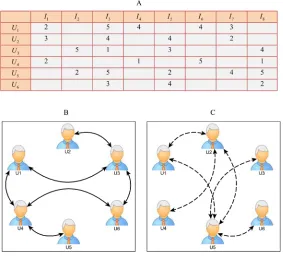
(1) the user-item rating matrix ofmusers andnitems is denoted as anm×nmatrixR whereRij(i= 1. . .. . .. . ..m;j= 1. . .. . .. . ..n) represents the rating of the userifor the itemj; (2) the explicit relation of social networkG1 = (V,E1), where (i,f)2E1 indicates that usersiandf are explicitly friends; (3) the implicit relation of social networkG2 = (V,E2), where (i,h)2E2 indicates usersiandhare implicitly friends. The illustration of our problem data sources is shown inFig 1;Fig 1Ashows the user-item rating matrixR,Fig 1Billustrates the explicit friends’network andFig 1Cshows the implicit friends’network.
Accordingly, the problem we investigate in this paper is how to extract and employ the dif-ferent types of friendship relations to predict the missing values from the user-item rating matrix.
2.2 Probabilistic Matrix Factorization
Before we introduce the proposed methods, we first give a brief review of the probabilistic matrix factorization methods (PMF) that work to identify something hidden under the data. PMF is usually more effective in the RS field because it allows one to discover the latent features underlying the interaction between users and items.
dimension of user feature vector and item feature vector denoted ask, which is much less than
mandnas illustrated inFig 2.
In the PMF [45], the conditional probability over the observed rating can thus be formu-lated as:
pðRjU;V;s2
RÞ ¼ Ym
i¼1
Yn
j¼1
h
NðRijjgðUT i VjÞ;s2RÞ
iIR ij
; ð1Þ
WhereN(x|μ,σ2) represents the probability density function of the Gaussian distribution with meanμand varianceσ2,IijRis the indicator function that is equal to 1 if userirated itemj and equal to 0 otherwise. The functiong(x) is the logistic functiong(x) = 1/(1 + exp(−x)) which Fig 1. Illustration of the three main data sources in our recommendation method.
doi:10.1371/journal.pone.0154848.g001
Fig 2. Approximate rating matrixRvia user and item feature vectors.
makes it possible to bound the range ofUiTVjwithin the range [0, 1]. The zero-mean spherical
Gaussian priors are placed on the user and item feature vectors:
pðUjs2
UÞ ¼ Ym
i¼1
NðUij0;s2UIÞ; ð2Þ
pðVjs2
VÞ ¼ Yn
j¼1
NðVjj0;s2
VIÞ: ð3Þ
Hence, through a Bayesian inference, we maximize the posterior distribution by minimizing the sum-of-squares of factorization error with quadratic regularization terms:
E¼12X
m
i¼1
Xn
j¼1
IijðRijgðUiTVjÞÞ2þl2U Xm
i¼1
UT i Uiþl2V
Xn
j¼1
VT
jVj ð4Þ
WherelU ¼s2R=s2UandlV¼s2R=s2V. The local minimum of formula (4) is found through
the gradient descent method.
PMF is the most popular method in RS due to its efficiency in dealing with large datasets and its success in terms of the speed-accuracy trade-off in the Netflix Prize competition. Although it has drawbacks, PMF assumes that user vectors and item vectors are independently and identically distributed and, in general, ignores the additional data sources such as social network information. We believe that the social network information, particularly the social relations among users, can alleviate the data sparsity problem and improve recommendation accuracy.
2.3 Social Regularization
In order to model the social recommendation problem more accurately, [5] proposed two social regularization (SR) models; average-based regularization and individual-based regulari-zation. They are general social recommendation models that, typically, have added a SR term to the objective function and minimized it to get more accurate recommendation results than NMF [46], PMF [45], RSTE [3] and other state-of-art models on large real datasets. In this paper, we only consider the individual-based regularization model.
The objective function of this model is formulated as:
E¼12X
m
i¼1
Xn
j¼1
IijðRijUiTVjÞ2þl2UkUk2Froþl2VkVk2Froþb2E Xm
i¼1
X
f2FðiÞ
simði;fÞkUiUfk2Fro ð5Þ
WhereβE>0 is the parameter to control the strength of the explicit relationship as SR,sim (i,f) is the similarity function to measure the similarity between useriand his/her explicit friends,F(i) is the set of explicit friends of useri, andk:k2Frodenotes the Frobenius norm.
Clearly, the SR method just cares about users’explicit social relations and has largely ignored the implicit social relations that can be established between users in social networks. Therefore, if we extracted the implicit social relations among users by adopting the link prediction methods, we believe the recommendation accuracy will be improved through incorporating the explicit and implicit social relations into PMF. Based on this idea, we propose our method.
2.4 Proposed Method
In this section, we present our proposed explicit and implicit social relation (EISR) model for social recommendation.
In our model, and based on the fact that the friend of a friend can become a friend, we assume that users with many friends pay more attention to creating new friendship relations in the future and the preferences of that user may be affected by the preferences of his/her explicit and implicit friends. Therefore, we propose a Possibility of Friendship between Non-Friends (PFNF) algorithm to extract the implicit friendship and incorporate both explicit and implicit friendship into the proposed model (EISR). In the sections below, we introduce the (PFNF) algorithm and our proposed model (EISR) in more detail.
2.4.1 Possibility of Friendship Between Non-Friends. In this section, we review the pro-posed algorithm“Possibility of Friendship between Non-Friends”(PFNF) to extract the hidden friendship on undirected graphs. We aim to predict the implicit relation between users even if they have no explicit relation before, based on the link prediction methods.
Suppose we have an undirected graphG= (V,E) that represents the topological structure of the social network, where the vertex setVrepresents all the users in a social network and the edge setErepresents the explicit relation between users denoted bye= (x,y)2Ewherex,y2
V. Our goal is to extract the implicit relation hidden behind the social network structure, so that for each two vertices (nodes)x,y2Vwe can predict the probability between them to be linked by using the link prediction methods that are usually exploited in the social network analysis. We use the link prediction methods (Jaccard coefficient [47], Common neighbors [16], Preferential attachment [48] and Resource allocation index [49]) which are based on node neighborhoods. If we take here the neighbors in an undirected graphGas a feature for two usersxandy, this approach leads to measure the similarity as follows:
Jaccard coefficient:
Simðx;yÞ ¼ jGðxÞ \ GðyÞj=jGðxÞ [ GðyÞj ð6Þ
Common neighbors:
Simðx;yÞ ¼1kðjGðxÞ \ GðyÞjÞ ð7Þ
Preferential attachment:
Simðx;yÞ ¼1kðjGðxÞjjGðyÞjÞ ð8Þ
Resource allocation index:
Simðx;yÞ ¼ X
z2jGðxÞ \GðyÞj
1
jGðzÞj ð9Þ
Algorithm 1. Computing of PFNF
1. Input: undirected matrixM, the number of usersU, the probability of choosingP
2. Output: implicit social relations matrixN 3. foru= 1:Udo
4. Determine the friendsFof useru 5. Determine the non-friendsNFof useru 6. end for
7. foru= 1:Udo
8. Calculate the similaritySbetweenuandNFaccording to formulas (6) or (7) or (8) or (9)
9. ifS>Pthen
10. ChooseuandNFto the matrixN 11. end if
12. end for 13. returnN
2.4.2 Explicit and Implicit Social Relation Probabilistic Matrix Factorization (EISR).
As already reviewed, most of the literature reviewed on social recommendation has pri-marily focused on the explicit social relation and ignored the implicit social relation among the users in the social network. Therefore, we focus on developing the EISR model based on matrix factorization by utilizing both the explicit and implicit friendship relation.
In section (2.2), based on one data source giving the user-item rating matrix, the observed ratingRijis interpreted by the useripreference on itemj, while in section (2.3), based on two data sources given the user-item rating matrix and user's social relation, the observed rating
Rijis realized as the preference of userion itemjbased on explicit friends’preferences. Hence, in order to define our model more flexibly, we use three data sources by considering the power of the implicit social relation. The objective function of formula (5) should be modified by incorporating explicit SR and implicit SR into PMF. We obtain the new objective function as below:
E¼12X
m
i¼1
Xn
j¼1
IijðRijgðUiTVjÞÞ2þl2UkUk2Froþl2VkVk2Fro
þbE
2
Xm
i¼1
X
f2FðiÞ
simði;fÞkUiUfk2Froþb2I Xm
i¼1
X
f2FðiÞ
simði;fÞkU
iUfk2Fro
ð10Þ
WhereβE,βI>0 are the parameters to control the strength of the explicit and implicit rela-tions as SRs, respectively,sim(i,f),sim(i,f) are the similarity functions to measure the similar-ity between useriand his/her explicit and implicit friends respectively,F(i) is the set of explicit friends of a useri,F(i) is the set of implicit friends of a useri, andk:k2Frodenotes the Frobenius norm. The functiong(x) is the logistic functiong(x) = 1/(1 + exp(−x)), which makes it possible to bound the range ofUiTVjwithin the range [0, 1].
@E @Ui¼
Xn
j¼1
IijðgðUiTVjÞ RijÞg0ðUiTVjÞVjþlUUi
þbE X
f2FþðiÞ
simði;fÞðUiUfÞ þbE X
g2FðiÞ
simði;gÞðUiUgÞ
þbI X
f2FþðiÞ
simði;fÞðU
iUfÞ þbI X
f2FðiÞ
simði;gÞðU
iUgÞ
ð11Þ
We represent the relationship between the users through an undirected graph in section (2.4.1). So, in formula (11), the out-link explicit friends equals the in-link explicit friends
F+(i) =F−(i) for each user and the out-link implicit friends equals the in-link implicit friends F+
(i) =F−(i) for each user. We can rewrite the formula (11) as follows:
@E @Ui¼
Xn
j¼1
IijðgðUT
i VjÞ RijÞg0ðUiTVjÞVjþlUUi
þbE X
f2FðiÞ
simði;fÞðUiUfÞ þbI X
f2FðiÞ
simði;fÞðU
iUfÞ
ð12Þ
@E @Vj¼
Xm
i¼1
IijðgðUiTVjÞ RijÞg0ðUiTVjÞUiþlVVj ð13Þ
Whereg0(x) = exp(x)/(1 + exp(−x))2is the derivative of the logistic functiong(x). The pro-cess of estimating the latent low-rank matricesUiandVjare described in algorithm 2.
Algorithm 2. Learning of EISR
1. Input: observed rating matrixR, explicit relationshipX, implicit rela-tionshipP, learning rateη, max iterationT, mini-batch sizeM, number of batchesS
2. Output: user and item latent factorsU,V 3. Initialize latent factors:U,V*N(x|0,I) 4. fort= 1:Tdo
5. fors= 1:Sdo
6. (i,j) sample random fromRsizeM
7. Calculate the gradient@R/@Uiaccording to formula (12) and usingR,U,V,
X,P
8. Calculate the gradient@R/@Vjaccording to formula (13) and usingR,U,V 9. Update:Ui=Ui−η(@R/@Ui)
10. Update:Vj=Vj−η(@R/@Vj) 11. end for
12. end for 13. returnU,V
2.5 Data and Metrics
In this section, we begin by introducing the data sets we use in our experiments, followed by the metrics we employ to evaluate the results.
Dataset: several datasets have been widely used to evaluate the performance of recommen-dation methods, such as Netflix, Movielens, Douban, Last.fm etc,. However, only Douban and Last.fm contain social network information. Hence, we choose them to evaluate our proposed method (datasets are free to download asS1 DataandS2 Data).
popular online music system (http://www.last.fm) founded in the United Kingdom in 2002. It has claimed over 40 million active users based in more than 190 countries. Last.fm allows users to listen to several types of music online in the system and allows users to establish friendship relations with other users. The Last.fm dataset only records the listening of each user for partic-ular artists. Therefore, for the purpose of effective testing, we use similar way to [6] to map the listening counts into integer values of 1 to 5 to represent the extent of favor of the artists. The mapping formula is given as:
r ¼
(
blog10lc þ1; ifblog10lc þ15
5; otherwise ð14Þ
Where r is the mapped value, l is the listening count andbgcis the operator of rounding towards zero.
Since the original Last.fm dataset is large, we construct a good subset by randomly choosing some users who have at least five friends for Last.fm and took all the movies they had rated. To conduct the coming experiments, we sample a subset of the dataset withn= 1,123 users and
m= 18744 different items, respectively. The total number of observed ratings in the sampled datasets isr= 55,140.
The Douban dataset is crawled by Ma Hao [5]. Douban is a Chinese social website launched on March 6, 2005, providing user rating, review and recommendation services for movies, books and music. It provides Facebook-like social networking services where users can make friends with each other through the email communication. The rating values in the Douban dataset are discreet values ranging from not helpful (1/5) to most helpful (5/5). We sample a subset of the dataset withn= 1,384 users andm= 58,402 different items, respectively. The total number of observed ratings in the sampled dataset isr= 411,623. The basic statistics of the datasets are shown inTable 1.
Evaluation metrics: we choose two most popular metrics that are well-known in the litera-ture of RS [50], the Mean Absolute Error (MAE) and the Root Mean Square Error (RMSE), to measure the prediction accuracy of our proposed model in comparison with other recommen-dation methods.
The MAE metric is defined as:
MAE¼T1X
i;j
jRijR^ijj ð15Þ
The RMSE metric is defined as:
RMSE¼
ffiffiffiffiffiffiffiffiffiffiffiffiffiffiffiffiffiffiffiffiffiffiffiffiffiffiffiffiffiffiffiffiffi
1 T
X
i;j
ðRijR^ijÞ2 s
ð16Þ
WhereRijdenotes the rating userigave to itemj,R^ijdenotes the rating userigave to itemj
as predicted by a method, andTdenotes the total number of tested ratings.
Table 1. Statistics of sample data from the Last.fm and Douban datasets.
Datasets Num. of users Num. of items Num. of ratings Sparsity Num. of explicit relation Num. of implicit relation
Last.fm 1123 18744 55140 2.619 × 10⁻³ 11064 166568
Douban 1384 58402 411623 5.092 × 10⁻³ 25361 597839
2.6 Experimental Design
In this section, to better evaluate the effect of utilizing the social relation information on pre-dicting recommendations, our aim here is to prepare the parameter values and experimental settings for implementing our method and all the compared methods.
Evaluate the prediction: we conduct experiments on the two real datasets Last.fm and Dou-ban to validate the effectiveness of our proposed method. We employ different amounts of rat-ings as training data (90%, 80% and 60%), and use the rest of the ratrat-ings as testing data. Training data 80%, for example, means we randomly select 80% of the ratings from the user-item rating matrix as the training data to predict the remaining 20% of the ratings. We imple-ment our proposed method in Matlab R2013a, and use the Gephi graph visualization software to depict the PFNF result. All the experiments are conducted on Windows Vista with Intel Xeon processors (E5420 @ 2.5 GHz 2.5 GHz) and 12 GB memory.
Comparative algorithms: in order to show the performance improvement of our recom-mendation algorithm with explicit and implicit social relations, we note that there is no algo-rithm in the literature that exploits both explicit and implicit friendship together in
factorization steps. We choose the following state-of-the-art methods for comparison.
• PMF: We compare our method with the baseline method PMF proposed by Salakhutdinov et al. [45], which only uses the user-item rating matrix for recommendation without consid-eration of any social factors.
• SR: This method is proposed by Ma et al. [5], SR is social recommendation algorithm formu-lated in the optimization problem in formula (5), which uses the social information for pre-dicting the missing value.
• HeatS: This method is represented by Zhou et al [51]. To facilitate comparison, we refer this method as HeatS. HeatS is a diffusion-based recommendation method, which exploits the heat-spreading algorithm to address the challenge of diversity.
• HP: This method is Hybrid of Heats and Probs methods which is the stat-of-the-art diffu-sion-based methods represented by Zhou et al [51]. we refer this method as HP.
Parameter setting: we depict the meanings and settings of all parameters of our experiments and tune the parameters of our method and all compared methods to reach their best performance.
• K: The dimension of the latent features. Here we setK= 50 on the Last.fm and Douban datasets. • λU,λV: Two regularization parameters in the second and third term of the objective function (10), respectively. Here we setλU,λV= 0.01 on the Last.fm dataset andλU,λV= 0.001 on the Douban dataset.
• βE: The weight of explicit friendship parameter in the fourth term of the objective function (10). We set the parameterβE= 0.0002 on the Last.fm dataset andβE= 0.001. on the Douban dataset.
• βI: The weight of implicit friendship parameter in the fifth term of the objective function (10). We set the parameterβI= 0.0002 on the Last.fm dataset andβI= 0.001. on the Douban dataset.
Results and Discussion
The random selection from the datasets was carried out five times independently and showed average results. We evaluate all the methods by both MAE and RMSE measures. There are in total four versions of our proposed method EISR by using the most common link prediction methods, EISR-Jaccard coefficient (EISR-JC), EISR-Common neighbors (EISR-CN), EISR-Pre-ferential attachment (EISR-PA) and EISR-Resource allocation index (EISR-RAI).
According to the result in Tables2and3, it can be observed that our method EISR-RAI out-performs the other EISR versions, (EISR-JC, EISR-CN and EISR-PA) on Last.fm and Douban datasets in the term of improved MAE and RMSE. For example, when the Resource allocation index Method (EISR-RAI) is used, the corresponding MAE is 0.4084 and RMSE is 0.5201 are more accurate than 0.4108 and 0.5221 related to MAE and RMSE respectively to the EISR ver-sion (JC-EISR) in the case of the 80% training data of Last.fm. We can mention that our method EISR that used the link prediction method RAI highly improves the prediction of rec-ommendation, due to the RAI extracting the new hidden implicit relations more than the remaining link prediction methods. At the same time, the other EISR versions outperform all the recommendation methods. Indeed, this is due to the novel way that we use to fuse the old and new links in our methods. As a result, below, we only report the result of the best one (EISR-RAI) compared with PMF, SR and diffusion-based methods (HeatS and HP).
Looking at the results reported in Tables2and3, we can see that our method consistently outperforms the other methods and obtains a lower MAE and RMSE than the PMF, SR, HeatS and HP under all settings of both datasets in the cases of (90%, 80% and 60%) training data. First, our proposed method EISR is more accurate than the PMF and diffusion-based methods (HeatS and HP) under the experimental design above, indicating that it is effective for incorpo-rating the social network information in the recommendation. On the other side the hybrid dif-fusion-based method (HP) it appears more accurate than the individual difdif-fusion-based method (HeatS) and showed modest improvement over PMF. Second, the EISR method out-performs the other social recommendation algorithm SR, as can be seen from Tables2and3; incorporating explicit and implicit friendship improves the result more than just utilizing the explicit friendship, indicating that it is effective by incorporating the implicit friendship infor-mation in the recommendation. This suggests that when the user has a large number of friends, Table 2. The performance comparison based on Last.fm dataset.
Training Metrics HeatS PMF (baseline) HP SR EISR-JC EISR-CN EISR-PA EISR-RAI
60% MAE 0.4474 0.4387 0.4386 0.4321 0.4279 0.4259 0.4251 0.4223
60% RMSE 0.5601 0.5482 0.5480 0.5394 0.5375 0.5355 0.5350 0.5342
80% MAE 0.4310 0.4253 0.4251 0.4214 0.4108 0.4068 0.4065 0.4048
80% RMSE 0.5491 0.5339 0.5337 0.5300 0.5221 0.5210 0.5209 0.5201
90% MAE 0.4229 0.4189 0.4188 0.4137 0.4025 0.4017 0.4015 0.4001
90% RMSE 0.5370 0.5230 0.5227 0.5212 0.5140 0.5120 0.5120 0.5110
doi:10.1371/journal.pone.0154848.t002
Table 3. The performance comparison based on Douban dataset.
Training Metrics HeatS PMF (baseline) HP SR EISR (JC) EISR (CN) EISR (PA) EISR (RAI)
60% MAE 0.6482 0.6378 0.6376 0.6282 0.6168 0.6084 0.5985 0.5927
60% RMSE 0.8024 0.7912 0.7911 0.7802 0.7681 0.7625 0.7558 0.7515
80% MAE 0.6370 0.6277 0.6274 0.6093 0.5937 0.5898 0.5783 0.5730
80% RMSE 0.7881 0.7794 0.7792 0.7615 0.7590 0.7545 0.7451 0.7435
90% MAE 0.6234 0.6163 0.6161 0.5983 0.5883 0.5862 0.5783 0.5741
90% RMSE 0.7764 0.7601 0.7600 0.7588 0.7501 0.7456 0.7386 0.7366
they tend to be more influenced by his/her friends’interests and that a large network of friends is more effective in improving the recommendation accuracy. For example, on average, com-pared with SR, EISR improves the predictive accuracy by (3.4% relative to MAE, 1.2% relative to RMSE on Last.fm dataset and by 4.2% relative to MAE, 3% relative to RMSE on Douban dataset) in the cases of 90% training data of both datasets. And the improvement even exists when less training data is used in the cases of 80% and 60% training data on Last.fm and Dou-ban datasets. This suggests that our proposed method is dealing very well with addressing the data sparsity problem.
3.1 The Impact of Utilizing PFNF Algorithm
We now turn to investigating the effect of utilizing a PFNF algorithm to extract the hidden friendship. In other words, we would like to experimentally evaluate whether our algorithm increases the social network density. We begin by showing the graphical result of the PFNF algorithm. This algorithm reveals the hidden structure in the social network, in which each node represents a user and each link represents a social relation between two users.Fig 3
depicts the PFNF output graph.Fig 3A and 3Care the synthetic social network containing a set of users and explicit friendship between them before we used the PFNF algorithm. InFig 3B and 3D, after applying a PFNF algorithm, we discover strong links of implicit friendship between users that were not linked directly before that. For example, in comparingFig 3A, 3B, 3C and 3D, we observe the PFNF algorithm improves the network density by discovering a new link in a social network and the number of links increases thanks to the application of link prediction methods. Tables4and5show the statistical results of using the PFNF algorithm depending on the link prediction methods. We can see that a large number of new links can be discovered when we used the Resource allocation index similarity metric.
3.2 The Power of Utilizing Explicit and Implicit Friendships
In this paper, we incorporate two types of social information, explicit and implicit friendships, to generate the recommendations. In the objective function of our proposed model, there are two
Fig 3. Result of PFNF discovering hidden friendship in a social network of Last.fm and Douban datasets based on RAI similarity metrics.A and C represent the user with his/her old explicit friends; B and D represent the same user with his/her new implicit friends.
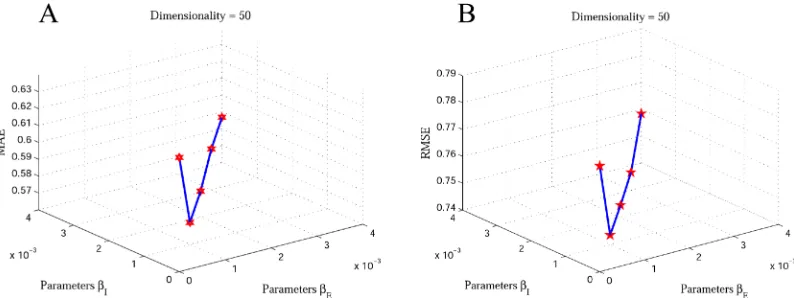
important parametersβEandβI, which play key roles in controlling the contribution of the SR. They control how much the proposed method should incorporate the explicit and implicit friendships. If the two parameters are equal to 0, we only use the user-item rating matrix for matrix factorization to generate the final recommendations. If the parameterβIequals 0, that means we use the user-item rating matrix and explicit and implicit friendships information for matrix factorization to generate the final recommendations. We note that the implicit friendship network is more dense than the explicit friendship network, as can be seen in Tables4and5. Therefore, we should find the suitable values for the parametersβEandβIto balance. Hence, for simplifying our learning model we makeβEandβIequal the same value. We tune the parameters βEandβIfor our proposed method EISR by grid search (βEandβI= 0, 0.0001, 0.0002, 0.0003, 0.0004) and (βEandβI= 0, 0.001, 0.002, 0.003, 0.004) on Last.fm and Douban datasets respec-tively to reach the best performance. Figs4and5depict the impact ofβEandβIon recommenda-tion accuracy. This clearly shows that the MAE and RMSE values decrease when we choose (βE, βI= 0.0002) and (βE,βI= 0.001) on Last.fm and Douban datasets respectively. We can observe that incorporating explicit and implicit friendship information on our method demonstrates that the social friendship factors are more effective for improving the recommendation accuracy.
3.3 Impact of Feature Dimensionality
K
on the Result
In addition to the power of the explicit and implicit friendship parameters to improve accuracy, feature dimensionality plays an important role in our proposed method EISR. We now turn to analyzing the effect of changing the dimension on the final recommendation. A different num-ber of feature dimensions on prediction error are observed in this experiment. Figs6and7
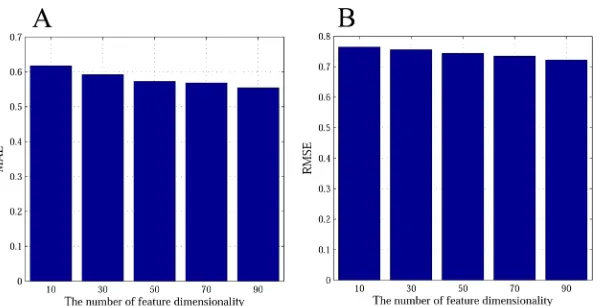
depict the prediction accuracy for the different values ofK. From the results, we observe that the MAE and RMSE values decrease whenKincreases, but we can also see that whenK>50 on Last.fm and Douban, the MAE and RMSE decrease rather slowly. Considering the time effi-ciency, we chooseK= 50 on Last.fm and Douban as the latent features dimension in our exper-iments. We can see that the increase in the feature dimensionalityKimproves the prediction Table 4. The basic statistics of using a PFNF algorithm on Last.fm dataset.
Matrics Before using PFNF algorithm After using a PFNF algorithm
JC CN PA RAI
Graph type Undirected Undirected Undirected Undirected Undirected
No. of users (nodes) 1123 1123 1123 1123 1123
No. of relations (links) 11063 150322 153341 153442 166568
Network density 0.018 0.239 0.243 0.244 0.264
Average degree 19.703 267.715 273.092 273.272 296.648
doi:10.1371/journal.pone.0154848.t004
Table 5. The basic statistics of using a PFNF algorithm on Douban datasets.
Matrics Before using PFNF algorithm After using a PFNF algorithm
JC CN PA RAI
Graph type Undirected Undirected Undirected Undirected Undirected
No. of users (nodes) 1384 1384 1384 1384 1384
No. of relations (links) 25361 306900 205300 597689 597839
Network density 0.026 0.321 0.182 0.625 0.625
Average degree 36.649 443.497 148.231 863.712 863.929
accuracy of EISR. This may indicate that our proposed method is more stable in a situation with high dimensions.
Conclusion
To deal with the sparsity problem, in this paper, we investigate the ability of adopting different social network relation types. We propose the PFNF algorithm to extract the hidden social rela-tion based on the link predicrela-tion methods. Furthermore, we propose an explicit and implicit social relation (EISR) method based on the social network information, which considers the effects of both explicit friendship and implicit friendship. We integrate them into PMF in order to obtain better recommendation results. The experimental results on two real-world datasets, Last.fm and Douban, show that our method EISR obtains more accurate recommendation results than state-of-the-art recommendation methods, such as PMF, SR, HeatS and HP. In addition, our PFNF algorithm that is based on Resource allocation index (RAI) similarity metric for extracting the implicit friendship is better predictive than the rest of the link prediction methods.
Notably, with the explosion of Web 2.0 applications, social network users generate large vol-umes of information, which opens new doors for the social recommendation systems to Fig 4. The impact of explicit and implicit friendships on Last.fm dataset with 80% of rating data.A: the MAE 3D plot of impact of explicit and implicit friendships; B: the RMAE 3D plot of impact of explicit and implicit
friendships.
doi:10.1371/journal.pone.0154848.g004
exploit. However, in this article we only provide a simple start for utilizing social network topology to extract the hidden relation. While an implicit friendship may be based on several user actions (likes, comments, opinions and tags) the activities between users in the social net-work remains open for future study. But one challenge is that, as far as we know, there is no publicly available dataset that includes user activities’information. Furthermore, since we only use the classical measurements to compute the similarity between users, how to design a more effective similarity function is another research direction. Also, our proposed method is general since it can easily incorporate different social network information, therefore, we plan to inves-tigate whether social tagging is useful for our proposed method to improve the recommenda-tion accuracy. Finally, as a continuarecommenda-tion of this work, we plan to extend our proposed method (EISR) by using additional link prediction methods, to assess the results if these methods are used.
Supporting Information
S1 Data. Last.fm Dataset.(RAR)
Fig 6. The impact of feature dimension on Last.fm dataset with 80% of rating data.A: the MAE histogram of impact of feature dimension; B: the RMAE histogram of impact of feature dimension. doi:10.1371/journal.pone.0154848.g006
S2 Data. Douban Dataset.
(RAR)
Acknowledgments
We acknowledge Dr. Ali Ahmed and Dr. Hafez Ibrahim for experimental help. We thank Ph.D M.Moumtaz for technical assistance.
Author Contributions
Conceived and designed the experiments: WR NS AK. Performed the experiments: WR. Ana-lyzed the data: WR NS. Contributed reagents/materials/analysis tools: WR AK. Wrote the paper: WR NS AK.
References
1. Adomavicius G, Tuzhilin A. Toward the next generation of recommender systems: A survey of the state-of-the-art and possible extensions. Knowledge and Data Engineering, IEEE Transactions on. 2005; 17(6):734–49.
2. Bell R, Koren Y, Volinsky C, editors. Modeling relationships at multiple scales to improve accuracy of large recommender systems. Proceedings of the 13th ACM SIGKDD international conference on Knowledge discovery and data mining; 2007: ACM.
3. Ma H, King I, Lyu MR, editors. Learning to recommend with social trust ensemble. Proceedings of the 32nd international ACM SIGIR conference on Research and development in information retrieval; 2009: ACM.
4. Ma H, Yang H, Lyu MR, King I, editors. Sorec: social recommendation using probabilistic matrix factori-zation. Proceedings of the 17th ACM conference on Information and knowledge management; 2008: ACM.
5. Ma H, Zhou D, Liu C, Lyu MR, King I, editors. Recommender systems with social regularization. Pro-ceedings of the fourth ACM international conference on Web search and data mining; 2011: ACM. 6. Liu J, Wu C, Liu W. Bayesian Probabilistic Matrix Factorization with Social Relations and Item Contents
for recommendation. Decision Support Systems. 2013; 55(3):838–50.
7. Huang L-w, Chen G-s, Liu Y-c, Li D-y. Enhancing recommender systems by incorporating social infor-mation. Journal of Zhejiang University SCIENCE C. 2013; 14(9):711–21.
8. Yelong Shen RJ. Learning personal + social latent factor model for social recommendation. Proceed-ings of the 18th ACM SIGKDD international conference on Knowledge discovery and data mining; Bei-jing, China: ACM New York, NY, USA ©2012 2012. p. 1303–11.
9. Zhang Y, Chen W, Yin Z. Collaborative filtering with social regularization for TV program recommenda-tion. Knowledge-Based Systems. 2013; 54:310–7.
10. Jamali M, Ester M, editors. A matrix factorization technique with trust propagation for recommendation in social networks. Proceedings of the fourth ACM conference on Recommender systems; 2010: ACM. 11. Liu F, Lee HJ. Use of social network information to enhance collaborative filtering performance. Expert
systems with applications. 2010; 37(7):4772–8.
12. Sun Z, Han L, Huang W, Wang X, Zeng X, Wang M, et al. Recommender systems based on social net-works. Journal of Systems and Software. 2015; 99:109–19.
13. Cantador I, Brusilovsky P, Kuflik T, editors. Second workshop on information heterogeneity and fusion in recommender systems (HetRec2011). RecSys; 2011.
14. Yamanishi Y, Vert J- P, Kanehisa M. Supervised enzyme network inference from the integration of genomic data and chemical information. Bioinformatics. 2005; 21(suppl 1):i468–i77. PMID:15961492 15. Airoldi EM, Blei DM, Fienberg SE, Xing EP, Jaakkola T, editors. Mixed membership stochastic block
models for relational data with application to protein-protein interactions. Proceedings of the interna-tional biometrics society annual meeting; 2006.
16. Newman ME. Clustering and preferential attachment in growing networks. Physical Review E. 2001; 64 (2):025102.
18. Liu Y, Kou Z. Predicting who rated what in large-scale datasets. ACM SIGKDD Explorations Newsletter. 2007; 9(2):62–5.
19. Huang Z, editor Link prediction based on graph topology: The predictive value of the generalized clus-tering coefficient. Workshop on Link Analysis (KDD); 2006.
20. Liben‐Nowell D, Kleinberg J. The link‐prediction problem for social networks. Journal of the American society for information science and technology. 2007; 58(7):1019–31.
21. Kashima H, Abe N, editors. A parameterized probabilistic model of network evolution for supervised link prediction. Data Mining, 2006 ICDM'06 Sixth International Conference on; 2006: IEEE. 22. Al Hasan M, Chaoji V, Salem S, Zaki M, editors. Link prediction using supervised learning. SDM’06:
Workshop on Link Analysis, Counter-terrorism and Security; 2006.
23. Bartal A, Sasson E, Ravid G, editors. Predicting links in social networks using text mining and sna. Social Network Analysis and Mining, 2009 ASONAM'09 International Conference on Advances in; 2009: IEEE.
24. Parimi R, Caragea D. Predicting friendship links in social networks using a topic modeling approach. Advances in Knowledge Discovery and Data Mining: Springer; 2011. p. 75–86.
25. Bayrak AE, Polat F, editors. Contextual Feature Analysis to Improve Link Prediction for Location Based Social Networks. Proceedings of the 8th Workshop on Social Network Mining and Analysis; 2014: ACM.
26. Linden G, Smith B, York J. Amazon. com recommendations: Item-to-item collaborative filtering. Internet Computing, IEEE. 2003; 7(1):76–80.
27. Koren Y, editor Factorization meets the neighborhood: a multifaceted collaborative filtering model. Pro-ceedings of the 14th ACM SIGKDD international conference on Knowledge discovery and data mining; 2008: ACM.
28. Resnick P, Iacovou N, Suchak M, Bergstrom P, Riedl J, editors. GroupLens: an open architecture for collaborative filtering of netnews. Proceedings of the 1994 ACM conference on Computer supported cooperative work; 1994: ACM.
29. Yang J, Kim J, Kim W, Kim YH. Measuring user similarity using electric circuit analysis: Application to collaborative filtering. PloS one. 2012; 7(11):e49126. doi:10.1371/journal.pone.0049126PMID: 23145095
30. Deshpande M, Karypis G. Item-based top-n recommendation algorithms. ACM Transactions on Infor-mation Systems (TOIS). 2004; 22(1):143–77.
31. Bellogín A, Castells P, Cantador I, editors. Improving memory-based collaborative filtering by neigh-bour selection based on user preference overlap. Proceedings of the 10th Conference on Open Research Areas in Information Retrieval; 2013: LE CENTRE DE HAUTES ETUDES INTERNATIO-NALES D'INFORMATIQUE DOCUMENTAIRE.
32. Hofmann T, editor Collaborative filtering via gaussian probabilistic latent semantic analysis. Proceed-ings of the 26th annual international ACM SIGIR conference on Research and development in infor-maion retrieval; 2003: ACM.
33. Ungar LH, Foster DP, editors. Clustering methods for collaborative filtering. AAAI Workshop on Recom-mendation Systems; 1998.
34. Bergner Y, Droschler S, Kortemeyer G, Rayyan S, Seaton D, Pritchard DE. Model-Based Collaborative Filtering Analysis of Student Response Data: Machine-Learning Item Response Theory. International Educational Data Mining Society. 2012.
35. Breese JS, Heckerman D, Kadie C, editors. Empirical analysis of predictive algorithms for collaborative filtering. Proceedings of the Fourteenth conference on Uncertainty in artificial intelligence; 1998: Mor-gan Kaufmann Publishers Inc.
36. Jin R, Chai JY, Si L, editors. An automatic weighting scheme for collaborative filtering. Proceedings of the 27th annual international ACM SIGIR conference on Research and development in information retrieval; 2004: ACM.
37. Sarwar B, Karypis G, Konstan J, Riedl J, editors. Item-based collaborative filtering recommendation algorithms. Proceedings of the 10th international conference on World Wide Web; 2001: ACM. 38. Yang X, Guo Y, Liu Y. Bayesian-Inference-Based Recommendation in Online Social Networks. Parallel
and Distributed Systems, IEEE Transactions on. 2013; 24(4):642–51.
39. Xue G-R, Lin C, Yang Q, Xi W, Zeng H-J, Yu Y, et al., editors. Scalable collaborative filtering using clus-ter-based smoothing. Proceedings of the 28th annual international ACM SIGIR conference on Research and development in information retrieval; 2005: ACM.
41. Ma H, editor An experimental study on implicit social recommendation. Proceedings of the 36th interna-tional ACM SIGIR conference on Research and development in information retrieval; 2013: ACM. 42. Ma H, Zhou TC, Lyu MR, King I. Improving recommender systems by incorporating social contextual
information. ACM Transactions on Information Systems (TOIS). 2011; 29(2):9.
43. Wang T, Jin X, Ding X, Ye X, editors. User Interests Imbalance Exploration in Social Recommendation: A Fitness Adaptation. Proceedings of the 23rd ACM International Conference on Conference on Infor-mation and Knowledge Management; 2014: ACM.
44. Zheng X, Luo Y, Sun L, Chen F. A New Recommender System Using Context Clustering Based on Matrix Factorization Techniques. Chinese Journal of Electronics. 2016; 25(2):334–40.
45. Salakhutdinov R, Mnih A, editors. Probabilistic Matrix Factorization. NIPS; 2007.
46. Lee DD, Seung HS. Learning the parts of objects by non-negative matrix factorization. Nature. 1999; 401(6755):788–91. PMID:10548103
47. Salton G, McGill MJ. Introduction to modern information retrieval. 1983.
48. Barabâsi A- L, Jeong H, Néda Z, Ravasz E, Schubert A, Vicsek T. Evolution of the social network of sci-entific collaborations. Physica A: Statistical mechanics and its applications. 2002; 311(3):590–614. 49. Ou Q, Jin Y- D, Zhou T, Wang B- H, Yin B- Q. Power-law strength-degree correlation from
resource-allocation dynamics on weighted networks. Physical Review E. 2007; 75(2):021102.
50. Reafee W, Salim N, editors. The Social Network Role in Improving Recommendation Performance of Collaborative Filtering. Proceedings of the First International Conference on Advanced Data and Infor-mation Engineering (DaEng-2013); 2014: Springer.