ABSTRACT
WANG, TAO. Compiler-based Auto-tuning and Synchronization Validation for HPC Applications. (Under the direction of Dr. Frank Mueller and Dr. Guoliang Jin.)
Modern high performance computing (HPC) architectures feature multi-core processors with deep memory hierarchies, complex out-of-order instruction pipelines, powerful single instruc-tion multiple data (SIMD) components, and heterogeneous accelerators. In practice, due to these architectural complexities, performance portability is a serious problem since programs tuned for one architecture usually achieve sub-optimal performance on another, which translates into excessive waste of energy and entails significant performance tuning efforts. Therefore, automatic performance tuning techniques are in high demand at DOE laboratories.
Existing tools are limited in different ways. On one side, traditional compiler-based auto-tuning approaches generate many functionally equivalent code variants and evaluate them on a tuning input to identify the best one. To generate a code variant, these approaches usually compile all program source files with the same compilation flags. Furthermore, after identifying the best code variants, the final performance evaluation is usually done on a small number of testing inputs. However, these experimental settings have limitations in two ways. First, different source modules may need specialized flags to achieve the best performance. Second, a program may have severe input sensitivity so that the tuned executable yields sub-optimal performance on many other inputs in practice.
Another problem is posed by multi-threaded HPC program correctness issues, such as dead-locks and data races, due to ad hoc synchronizations introduced by developers for performance purposes. There is also a need for novel tools to support bug detection and semantics validation for ad hoc synchronization constructs, e.g., ad hoc barriers. The state-of-art ad hoc synchronization analysis tools can only detect simple happen-before relationships between different program points and cannot detect complex synchronization constructs, such as ad hoc barriers, neither can they enumerate thread interleaving space to validate their dynamic semantics correctness.
Compiler-based Auto-tuning and Synchronization Validation for HPC Applications
by Tao Wang
A dissertation submitted to the Graduate Faculty of North Carolina State University
in partial fulfillment of the requirements for the Degree of
Doctor of Philosophy
Computer Science
Raleigh, North Carolina
2020
APPROVED BY:
Dr. James Tuck Dr. Min Chi
Dr. Frank Mueller
Co-chair of Advisory Committee
Dr. Guoliang Jin
DEDICATION
ACKNOWLEDGEMENTS
I owe great thanks to my academic advisors, Drs. Frank Mueller, Guoliang Jin, James Tuck, Min Chi, my PhD program advisor, Dr. George Rouskas, my Office of International Services (OIS) advisor Ms. Mollie LoJacono, and many of my close friends. Without their generous supports, I would not finish this dissertation.
Dr. Frank Mueller is extremely patient and allows me to argue with him freely most of the time. Such a high degree of academic freedom is the essential soil that supports my growth to do independent research. His integrity, diligence, optimism, and persistence are the genuine wealth that I inherit from him. He demonstrates to me what a good scholar looks like, how to approach a new problem both incrementally and out-of-box, and always be eager to explore new fields. He encourages me when I seriously doubted whether I could finish this degree. Without him, I may have stopped my PhD study.
I am blessed to have a great co-advisor, Dr. Guoliang Jin. He was my hand-holder at the beginning of PhD study. I still remember the early time that we spent together polishing our papers and presentations over and again. These experiences are indispensable to guide me into the right track. Over the years, he built up his own research team, strived to maintain the high quality of teaching and research, which are good examples for me to learn. It was my great honor to have Dr. Tuck and Dr. Chi in my PhD committee. Dr. Tuck is an expert in compiler and CPU architecture research while Dr. Chi specializes in machine learning technological innovations. They spent a significant amount of time in my oral exam and this defense. The tightness of my defense schedule put a lot of stress on them and they had to get up so early in the morning to make my defense possible.
My PhD program advisor, Dr. George Rouskas, offered many great suggestions and represented the fairness of our PhD program. He always considered possible solutions for me when I had troubles to make progress. Like the guardian of the Constitution, there is no way of over-estimating his contributions. My OIS advisor, Ms. Mollie LoJacono provided significant supports when I needed them most. Her considerate thoughts helped me avoid potential huge immigration and employment troubles related to my PhD program. Ms. Carol Allen, Ms. Kathleen Luca, and Ms. Linda Honeycutt in NCSU CSC department also provided a lot of services with the highest standard of professional spirits. Their smiles were the sunshine that warmed my heart then and forever.
I would like to thank the following collaborators, close friends, mentors and professors. All the time that we spent together is a valuable part of my merry memory. I picked up certain valuable wisdom from each of you. Your supports helped me overcome challenges in life and work, inspired me to be a better person who trusts others and is always willing to help others. You will never be forgotten!
Prof. Alex Aiken (Stanford University),
Prof. Alan Edelman (Massachusetts Institute of Technology), Dr. Amir Bahmani (Stanford University),
Dr. Anirudh Marathe (Lawrence Livermore National Laboratory),
Prof. Barbara Chapman (Stony Brook University and Brook Haven National Laboratory), Dr. Bin Cheng (NCSU),
Dr. Bin Yin (Duke University),
Prof. Chenyong Wu (Chinese Academy of Sciences),
Dr. Chunhua Liao (Lawrence Livermore National Laboratory), Mr. Chris Duke (Duke University),
Dr. Chris Rackauckas (Massachusetts Institute of Technology), Dr. David Beckingsale (Lawrence Livermore National Laboratory), Dr. David Boehme (Lawrence Livermore National Laboratory), Mr. Dylan Tuffel,
Mr. Edgar Sias,
Prof. Eric P. Xing (Carnegie Mellon University), Dr. Eva D. Wong (College of William and Mary), Dr. Feng Zhang (Tsinghua University),
Prof. Gang Zhou (College of William and Mary), Prof. Guojie Li (Chinese Academy of Sciences), Dr. Grigori Fursin (CTuning Foundation), Prof. Huiyang Zhou (NCSU),
Dr. Jidong Xiao (College of William and Mary), Ms. Julia Chu (MediaTek),
Dr. Lei Liu (Chinese Academy of Sciences), Ms. Linda Honeycutt (NCSU),
Dr. LinNan Gao (NCSU), Dr. Yang Song (NCSU),
Dr. M.Lee Alexander (College of William and Mary),
Dr. Mohamed Riyadh Baghdadi (Massachusetts Institute of Technology), Ms. Mollie LoJacono (NCSU OIS),
Dr. Nikhil Jain (Nvidia Corporation),
Dr. Nirmal Kumbhare (University of Arizona), JD. Phillip Lecky (College of William and Mary), Dr. Probir Roy (College of William and Mary), Mr. Qi Jia (NCSU),
Dr. Qinghua Wu (Chinese Academy of Sciences), Prof. Qikun Xue (Tsinghua University),
Prof. Qun Li (Collge of William and Mary), Prof. Ruiqi Lian (Chinese Academy of Sciences), Mr. Shaohu Zhang (NCSU),
Ms. Shiran Wang (Duke University), Mr. Shudi Shao (NCSU),
Dr. Silvio Rizzi (Argonne National Laboratory), Mr. Stan Kvasov (MediaTek),
Mr. Stephen Sechrist (College of William and Mary),
Dr. Todd Gamblin (Lawrence Livermore National Laboratory), Mr. Tongjie Chen (NCSU),
Prof. Xiaobing Feng (Chinese Academy of Sciences), Dr. Xiao Yu (NCSU),
Mr. Ya Cui (High School Affiliated to Nanjing Normal University), Dr. Yung-Chia Lin (MediaTek),
Mr. Yunfeng Wu (Tsinghua University),
Prof. Yungang Bao (Chinese Academy of Sciences), Mr. Vince Del Vecchio (MediaTek),
TABLE OF CONTENTS
LIST OF TABLES . . . .viii
LIST OF FIGURES. . . ix
Chapter 1 Introduction. . . 1
1.1 Motivation . . . 1
1.2 Background . . . 2
1.3 Hypothesis . . . 3
1.4 Solutions and Contributions . . . 4
Chapter 2 FuncyTuner: Auto-tuning Modern Scientific Applications With Per-loop Com-pilation . . . 5
2.1 Introduction . . . 6
2.2 Design of FuncyTuner . . . 8
2.2.1 Compiler Flag Space Construction . . . 8
2.2.2 Space Search Algorithms . . . 9
2.3 Experimental Design . . . 14
2.3.1 Systems and Benchmarks . . . 14
2.3.2 Compiler Flag Selection . . . 15
2.3.3 Loop Outlining and Caliper Instrumentation . . . 16
2.3.4 CV Independence Assumption . . . 16
2.4 Results and Analysis . . . 17
2.4.1 Overall Performance Comparison . . . 17
2.4.2 Comparison to the State-of-the-art . . . 19
2.4.3 Impact Of Different Inputs . . . 21
2.4.4 Deep Dive: Cloverleaf On Broadwell . . . 23
2.5 Related Work . . . 25
2.6 Conclusion . . . 26
Chapter 3 CodeSeer: Select Input-dependent Code Variants Via Machine Learning. . . 27
3.1 Introduction . . . 28
3.2 Tackling Type-III Sensitivity . . . 31
3.2.1 Problem Formulation . . . 31
3.2.2 Representative Code Variants Selection . . . 31
3.2.3 Algorithm Design . . . 33
3.2.4 Data Labeling . . . 34
3.3 Experimental Design . . . 34
3.3.1 Benchmarks and Code Variants . . . 34
3.3.2 Prepare Input Data Sets . . . 36
3.3.3 Build Machine Learning Models . . . 36
3.4 Results on Input Sensitivity . . . 37
3.4.1 Type-I Sensitivity . . . 37
3.4.2 Type-II Sensitivity . . . 38
3.4.3 Type-III Sensitivity . . . 39
3.4.4 Discussion on Type-III Sensitivity . . . 39
3.5.1 Precise Prediction . . . 41
3.5.2 Overhead Analysis . . . 43
3.6 Related Work . . . 45
3.7 Conclusion . . . 46
Chapter 4 BarrierFinder: Recognizing Ad Hoc Barriers . . . 48
4.1 Introduction . . . 48
4.1.1 Motivation . . . 48
4.1.2 Contribution . . . 51
4.2 BARRIERFINDERDesign . . . 52
4.2.1 Front End Preprocessing . . . 53
4.2.2 Instrumentation . . . 54
4.2.3 Tackling Space Explosion in the Middle End . . . 56
4.2.4 Optimizations for Execution Efficiency . . . 58
4.2.5 Mining Sync Traces for Knowledge in the Back End . . . 59
4.3 Experimental Evaluation . . . 60
4.3.1 Prototype . . . 60
4.3.2 Methodology and Experimental Settings . . . 60
4.3.3 Efficiency Results on Real-World Benchmarks . . . 61
4.3.4 Effectiveness Results on Synthetic Benchmarks . . . 64
4.3.5 Generalization to Any Number of Threads . . . 65
4.4 Related work . . . 66
4.4.1 Synchronization Characterization and Detection . . . 66
4.4.2 Runtime Invariant Detection . . . 66
4.5 Conclusion . . . 67
Chapter 5 Conclusions and Future Work. . . 68
5.1 Conclusions . . . 68
5.2 Future Work . . . 69
LIST OF TABLES
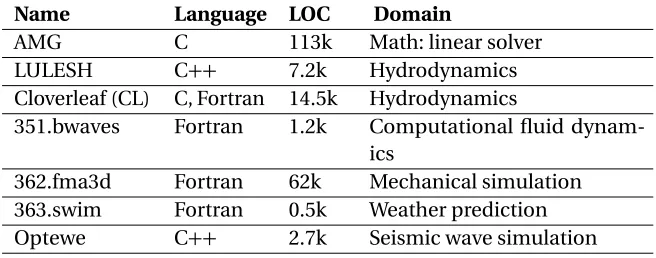
Table 2.1 List of benchmarks. LOC: lines of source code. . . 15
Table 2.2 Platform overview, runtime configurations, and benchmark inputs. . . 16
Table 2.3 Performance Statistics on Intel Broadwell . . . 18
Table 2.4 Performance Statistics on Intel Sandy Bridge . . . 18
Table 2.5 Performance Statistics on AMD Opteron . . . 19
Table 2.6 Comparison of optimizations for 5 Cloverleaf kernels on Broadwell. S(Scalar): not vectorized;{128,256}: vectorized with{128,256}-bit SIMD; unroll{2,3}: unroll 2/3 times; IO: instruction reordering; IS: instruction selection; RS: register spilling. . . 25
Table 3.1 List of benchmarks (LOC: lines of source code) . . . 35
Table 4.1 Overall results of BARRIERFINDERon SPLASH2 with slicing, intrusive tracing, and interleaving reduction . . . 61
LIST OF FIGURES
Figure 2.1 Combined Elimination does not improve performance significantly. . . 6 Figure 2.2 Comparison of compilation models. a) A traditional compilation model with
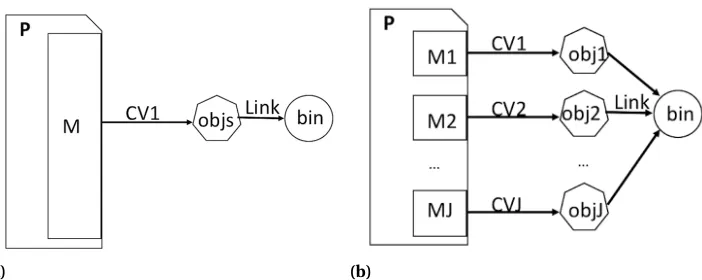
the sameCV to compile all modules; b) FuncyTuner’s compilation model with differentCVs to compile different modules. . . 8 Figure 2.3 Per-program random search.C Vk andPk with minimal runtimeTk is its
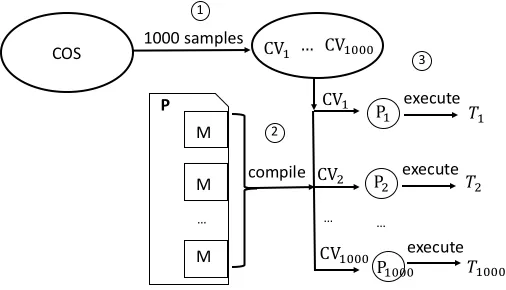
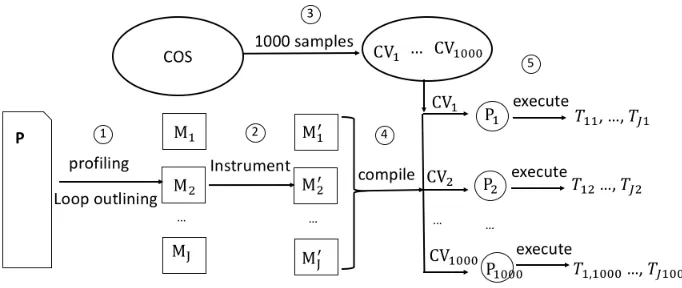
final result. . . 9 Figure 2.4 Per-function random search. Step 3is performed 1000 times. . . 10 Figure 2.5 FuncyTuner per-loop runtime collection framework is a part of both greedy
combination and Caliper-guided random search. . . 12 Figure 2.6 CFR outperforms other methods for most cases: geometric mean of speedups
relative to the O3 baseline 9.2%, 10.3%, and 9.4% on Opteron, Sandy Bridge and Broadwell, respectively. . . 17 Figure 2.7 FuncyTuner provides better performance than all variants of COBAYN(static,
dynamic, hybrid), PGO, and OpenTuner. . . 20 Figure 2.8 CFR shows little performance sensitivity on small and large inputs with
geometric mean of speedup relative to the O3 baseline 12.3% and 10.7% respectively. . . 22 Figure 2.9 For Cloverleaf on Broadwell, FuncyTuner CFR provides a stable performance
benefit than all others while scaling from 100 to 800 time-steps. . . 22 Figure 2.10 Normalized speedups for top-5 loops of Cloverleaf on Intel Broadwell. Note:
COBAYN(static),OpenTunerandRandomgenerate the same code. . . 24 Figure 3.1 Normalized speedups of 1000 Kripke code variants for a singular, identical
tuning input: No performance improvement for any under O3. . . 28 Figure 3.2 Normalized speedups of two Kripke code variants across 1,000 inputs show
1
type-II input sensitivity: The performance benefit of the same code vari-ant is sensitive to different inputs; and 2type-III input sensitivity: The best performing code variants depend on sets of many inputs. . . 29 Figure 3.3 Workflow of CodeSeer . . . 30 Figure 3.4 Normalized speedup distributions for 1000 (top) and 100 (bottom) code
variants on a single Kripke input indicating similar results: code variants in excess of the top 100 contribute little to performance (limited diversity). . . . 35 Figure 3.5 All benchmarks expose type-I sensitivity: Performance benefits of a tuned
program depends on the tuning input used. . . 37 Figure 3.6 All benchmarks expose type-II sensitivity: Performance benefits are different
for inputs inD1withC Vo p t; this achieves the best geometric mean speedup onD1. . . 38 Figure 3.7 Cumulative number of inputs inD1with different normalized speedup gaps
betweenC Vo p t andC Vo p ti . . . 38 Figure 3.8 360.ilbdc, 351.bwaves, and Lulesh expose type-III sensitivity: CV1 and CV2
Figure 3.9 Ratios (for Kripke only) to the per-input best speedup: higher is better. The per-input best speedup is the maximum speedup achieved by 100 code vari-ants for inputs inD1; top-K (1, 2, 5, 10) indicates the best per-input speedup achieved byK code variants identified by CodeSeer’s greedy algorithm. . . . 41 Figure 3.10 Prediction precision of six different models for the unbalanced (a) and
bal-anced (b) testing datasets: RandomForest (RF) achieves 92% and 90% geo-metric mean precision, respectively. . . 42 Figure 3.11 Speedups normalized of CodeSeer’s high-precision RF model for Kripke.
Figures for 351.bwaves, 360.ilbdc and Lulesh are similar (omitted due to space). . . 43 Figure 3.12 Speedups normalized to O3 for KripkeC V1,C V2, and the RF model. The
results for the balanced test set are similar (omitted). . . 44 Figure 3.13 CodeSeer model training overhead for all models onD2: training
Random-Forest (RF) takes less than 4 minutes for all applications. . . 44 Figure 3.14 RandomForest prediction precision converges with 1000 training inputs:
test set has 200 samples and is unbalanced. . . 45
Figure 4.1 An ad hoc synchronization example formed byS2andS3.
counter
andflag
are global variables.flag
is initialized totrue
. . . 49 Figure 4.2 Extracted code from SPLASH2 LU . . . 50 Figure 4.3 The architecture of BARRIERFINDER. IR: interleaving reduction. IA:interleav-ing avoidance. ET: early termination. . . 51 Figure 4.4 Sync Boundary Detection Algorithm . . . 54 Figure 4.5 Interleaving enumerations and reduction: An execution state in BARRIERFINDER
corresponds to an interleaving. . . 56 Figure 4.6 Interpreter-interpretee address space layout in BARRIERFINDER: An
appli-cation is interpreted in interpretee space while the interpreter itself uses native execution. . . 59 Figure 4.7 The effect of interleaving avoidance (IA) and early loop termination (ET)
CHAPTER
1
INTRODUCTION
1.1
Motivation
Theoretical analysis and experimental evaluation have been the two traditional methodological pillars to support the development of sciences and engineering since ancient Greece time. The advent of modern electronic computers during World War II has enabled fast and large-scale computation of complex mathematical models. To date, scientific computation and simulations carried out by super-computers and high performance computing (HPC) programs are playing such an essential role that researchers consider it as the third pillar of modern scientific discoveries, advanced manufacturing and engineering. Many super-computers have been built and deployed in US Department of Energy (DOE) laboratories. Scientists run HPC programs to evaluate their ideas on a daily basis. However, these computers usually consume tens of Megawatts power. Such a high cost is overwhelming and needs to be reduced urgently. Moreover, since HPC programs are part of the daily research cycle, their performance is critical. These situations are made worse due to the increasing complexity in modern super-computers, such as complicated hardware features and software stacks. Without careful performance tuning effort, a HPC program would suffer from poor performance compared to its full performance potential. Thus, it would consume more energy, produce fewer scientific results, and slow down scientific exploration.
program configurations[Yu18a; Thi18], algorithmic code variants, compiler optimizations, runtime parameters, and system configurations, etc. The objective is to reduce the end-to-end runtime of a HPC program without compromising correctness. In this dissertation, two frameworks that we propose, i.e., FuncyTuner and CodeSeer, are both auto-tuners. Besides performance concerns, correctness of HPC programs is also critical. Development tools like bug detectors and semantics verifiers are desirable to ease the burden of human programmers. Our third framework, BARRI
-ERFINDER, is a tool that can automatically identify ad hoc barriers and validate their semantics correctness.
1.2
Background
Extracting the peak performance of scientific applications becomes increasingly challenging on modern HPC architectures due to their diverse architecture features, such as deep memory hierar-chies and heterogeneous accelerators. The de facto compilation model compiles all source files of a program with a single set of compiler flags, typically O2 or O3. However, it is well-known that O2/O3 may not generate the most performant executables[Che10]. To identify the most performant opti-mizations for a program, researchers have proposed iterative compilation[Kis00]. Given a program, iterative compilation first generates code variants by compiling the source code with different com-piler flags, and then evaluates their performance either by execution[Che10]or prediction[Cav07; Pop16].
Iterative compilation techniques either treat a program as one compilation unit[Ans14; Che10; Ash16; Ash16; Cav07; Nob16; JK13], or in a fine-grained fashion[PE08; Pop16; Hal10; Yi12]. The former ones lose the opportunity to perform specialized optimization for different program modules while the latter aggressively assume that different modules can be compiled independently without any conflicting interactions. We designed and implemented a per-loop auto-tuning framework, FuncyTuner, which utilizes per-loop profiling information to guide fine-grained random search. Our evaluation on a suite of modern scientific programs shows that FuncyTuner outperforms the state-of-art approaches.
of program input sensitivities and to perform high-precision low-overhead online code variant selection for each input on the fly.
HPC programs are usually multi-threaded. Threads share the same code (control flows) but operate on different data and often shared which is significantly more complicated than a sequential program. Execution depends on proper synchronizations across threads to ensure correctness and efficiency. While a common set ofstandard synchronizations, such as muted and condition variable operations, are provided by different languages or libraries, a recent study[Xio10]finds that programmers frequently choose not to use these standard synchronizations but implement their ownad hoc synchronizationsfor functionality or performance reasons. Researchers were able to find 6 to 83 ad hoc synchronizations in each of the 12 studied program suites[Xio10].
Not only do programmers have difficulty in understanding the intended order relationship by ad hoc synchronizations and validate their correctness[Gu15], but also multi-threaded program development tools, such as data-race detectors[Bes10; Lee12], concurrency-bug finding tools[Par09; Zha10], automated bug-fixing tools[Jin11; Jin12], and synchronization-oriented performance pro-filers[YP16; CS12], cannot directly use ad hoc synchronization detection results of these existing tools.
State-of-art techniques can only detect sync pairs[Xio10]or simple busy-wait loops[JT14; Yua13], which is insufficient to understand complex ad hoc synchronizations. We propose a framework to automatically identify complex ad hoc synchronizations in full and infer their synchronization relationship for barriers. We instantiate the framework with a tool called BARRIERFINDER, which features various techniques, including program slicing and bounded symbolic execution, to effi-ciently explore the interleaving space of ad hoc synchronizations within multi-threaded programs with respect to their traces. BARRIERFINDERthen uses these traces to recognize ad hoc barriers. Our evaluation shows that BARRIERFINDERis both effective and efficient in recognizing ad hoc barriers automatically.
1.3
Hypothesis
The thesis hypothesis (H) is that HPC programs can benefit in performance and correctness verifi-cation from appliverifi-cation-specific auto-tuning and validation of ad hoc synchronization constructs, respectively. In particular,His refined by the following three sub-hypotheses:
H1 Different compilation modules of HPC programs may need different compilation flags to obtain the best performance due to their diverse code structures.
H2 HPC programs may expose various input sensitivity and can benefit from machine learning techniques to realize better per-input performance.
1.4
Solutions and Contributions
To evaluate our over-arching hypothesis and its three sub-hypotheses, we take an experimental approach to design and implement three frameworks, namely, FuncyTuner (see Chapter 2) , Code-Seer (see Chapter 3), and BARRIERFINDER(see Chapter 4). Then, we design and conduct several experiments for each of them and draw conclusion based on our observations.
1. In Chapter 2, we propose a fine-grained compilation framework, FuncyTuner, which utilizes per-loop profiling information to guide the search within the extremely large compilation flag search space. Compared to the state-of-art, FuncyTuner improves performance of modern parallelized scientific programs by 4.5% to 10.7% (geometric mean) relative to theO3baseline. We also show that greedily picking the best per-loop compiler flags often degrades program performance due to complex inter-module dependencies, and per-function random search without guidance of runtime information does not guarantee performance improvements.
2. In Chapter 3, we propose CodeSeer to evaluate several different types of program sensitivity and build six machine learning models to tackle the challenges presented by type-III sensitivity. Our experimental results show that so-called type-I input sensitivity could have significant performance impacts for certain programs and tuning inputs should be selected carefully. For programs with high type-III sensitivity, CodeSeer predictive models achieve 92% prediction accuracy while introducing less than 0.01 second online prediction overhead.
3. In Chapter 4, we propose a framework to automatically identify complex ad hoc synchro-nizations in full and infer their synchronization relationships. We instantiate the framework with a tool called BARRIERFINDER, which features various techniques, including program slicing and bounded symbolic execution, to efficiently explore the interleaving space of ad hoc synchronizations within multi-threaded programs for their traces. BARRIERFINDERthen uses these traces to characterize ad hoc synchronizations into different types, such as barriers. Our evaluation shows that BARRIERFINDERis both effective and efficient in doing this, and it is also helpful for programmers to understand the correctness of their implementations.
CHAPTER
2
FUNCYTUNER: AUTO-TUNING
MODERN SCIENTIFIC APPLICATIONS
WITH PER-LOOP COMPILATION
The de facto compilation model for production software compiles all modules of a target program with a single set of compilation flags, typically O2 or O3. Such a per-program compilation strategy may yield sub-optimal executables since programs often have multiple hot loops with diverse code structures and may be better optimized with a per-region compilation model that assembles an optimized executable by combining the best per-region code variants.
0.4 0.6 0.8 1 1.2
GCC ICC
Speedup
normalized
to
O3 LULESH Cloverleaf AMG
Figure 2.1Combined Elimination does not improve performance significantly.
2.1
Introduction
The de facto compilation model compiles all source files of a program with a single set of compiler flags, typically O2 or O3. However, it is well-known that O2/O3 may not generate the most performant executables[Che10]. This is because optimizations enabled by flags such as O2/O3 are empirically determined to maximize performance for certain benchmark suites, while other programs and architectural platforms may have different characteristics that require other optimizations. As a result, for a given program, other compiler flag combinations may exist that can produce more performant executables than the default O2/O3 choice.
In order to identify the most performant optimizations for a program, researchers have proposed iterative compilation[Kis00]. Given a program, iterative compilation first generates code variants by compiling the source code with different compiler flags, and then evaluates their performance either by execution[Che10]or prediction[Cav07; Pop16].
Several algorithms have been proposed for generating compiler flag combinations to create code variants, e.g., predictive machine learning models[Ash16; Cav07; Nob16; JK13]and optimization flag correlation-based combined elimination[PE08], both of which treat random search as their baselines. They perform compilation on a per-program basis. However, their effectiveness is limited. While machine learning based predictive models[Cav07]perform well on small training datasets, a recent study[Fur15]employing crowd-sourcing compilation shows that their prediction accuracy drops dramatically for large-scale datasets and exhibits close to random behavior.
random search.
Fine-grained per-region compilation techniques[PE08; Pop16; Hal10; Yi12]divide a program into different compilation modules and optimize each separately. Specifically, source-code level auto-tuners[Hal10; Yi12]focus on a single simple computation kernel without considering module interactions in real-world applications. As prior work in compiler flag selection[PE08; Pop16]also assumes that compilation modules are independent, they assemble an optimized executable by greedily picking the best code variant of each module. However, the modules of a program may not be independent due to cross-module interference, such as shared data structures and link-time inter-procedural optimizations across multiple modules. In particular, link-time optimizations can drive optimization decisions, such as loop unrolling, and may invalidate earlier transformations that were made independently for the compilation modules.
Contributions:Based on the observations above, we develop a fine-grained auto-tuning frame-work, FuncyTuner, that targets modern scientific applications. Our overall objective is to extract the best performance out of an application that is executed repeatedly, such as in high-performance computing (HPC) where scientists test their hypotheses in experiments repeatedly with similar in-puts using the same algorithms. To clarify, weneitherattempt to derive a better set of optimizations for O3, nor do we attempt to generalize a specific set of optimizations across region boundaries or select different algorithmic code variants according to input characteristics (in contrast to [Li13]). Instead, our objective is to 1) assess whether or not there are module interactions and, if so, 2) understand how to capitalize on such interactions.
Our target HPC applications exploit multi-core parallelism via OpenMP. Their hot-spots consist of OpenMP loops that account for a significant fraction of execution time. FuncyTuner outlines these loops and converts them into individual functions, whose compilation can be auto-tuned. The primary challenge is to identify the best per-loop compilation flags within a significantly larger space than any traditional per-program compilation techniques. To this end, FuncyTuner employs a novel and effective search space focusing technique to guide random search based auto-tuned compilation.
The contributions of this paper are:
• We develop a per-loop compiler flag selection framework, FuncyTuner, that combines program profiling with Caliper[Boe16]and search space focusing algorithms to tune hot loops of mod-ern scientific programs simultaneously without sacrificing the indispensable optimization context for production compilers.
• We demonstrate that FuncyTuner is able to improve program performance for a set of scientific benchmarks by 9.3% to 12.3% in comparison to the O3 baseline and 4.5% to 10.7% relative to prior work, both in geometric mean (up to 22% on certain programs), on several generations of HPC architecture, and thus refreshes the state of the art. Our FuncyTuner further has the potential to improve machine learning based predictive modeling techniques in the future.
(a) (b)
Figure 2.2Comparison of compilation models. a) A traditional compilation model with the sameCVto compile all modules; b) FuncyTuner’s compilation model with differentCVs to compile different modules.
with the Intel compiler tool chain to to elaborate how fine-grained compiler flag selection is affected by inter-module dependencies and demonstrate that it should not be performed greedily, but rather in a focused and targeted manner.
Our FuncyTuner implementation automates these steps, with the exception of Caliper[Boe16] profile instrumentation and collection of timing results, which are manual in our research prototype, but could be automated with further engineering efforts invested (but are of no research value).
2.2
Design of FuncyTuner
This section first defines terminologies and notations used throughout this work and then details the design of the FuncyTuner framework.
2.2.1 Compiler Flag Space Construction
Modern optimizing compilers feature many internal optimization passes and may expose several hundreds of command-line flags to parameterize them. Each flag could either be a binary switch to turn on/off a certain optimization, e.g., loop unrolling and loop tiling, or a multi-valued parametric option to set pass-specific parameters, e.g., thresholds for function inlining and algorithmic variants of register allocation. The set of all flags composes a space called the compiler optimization space (COS, size roughly 2.3e13 in this work since there are 33 selected flags while some have multiple val-ues), in which each point is a set of instantiated flags called a compilation vector (CV). Suppose there areN compiler flags, denoted asFi(1≤i≤N), and supposeFi hasnipossible valuesfi1,fi2, ...,fi ni. Then a sampleCVis represented as(F1=f1k1,F2=f2k2, ...,FN =fN kN), where 1≤ki≤ni. Thus, there are in totalC0=
QN
i=1ni CVs, each of which could be used to compile all source files of a program in a traditional compilation model (see Fig. 2.2a).
as shown in Fig. 2.2b, FuncyTuner divides programP intoJ compilation modulesM1,M2, ...,MJ (J is program-specific and ranges from 5 to 33 in this work). These modules are created based on the time spent in various regions, in particular loops, of the programP. FuncyTuner then compiles Mj with aCV, which could be determined independently from other modules and links all object files together to produce the executable. Our hypothesis is that different compilation modules may need differentCVs to obtain the best performance due to their diverse code structures. However, to identify the bestCVs, the primary challenge is that the new search space sizeC O Sn e w increases significantly fromC0toC1=C0J. (J is program-specific and ranging from 5 to 33 in this work), since each module can be compiled independently with a differentCV inCOS. Exhaustive search is not a viable option within such an excessively large space while machine learning-based predictive models require a significant amount of training data and meaningful features to begin with[Fur15]. To address this challenge, we propose several algorithms, as detailed in the rest of this section. We do not differentiate between a program source code module and its corresponding object/binary module. Therefore,Pk andMj k (j-th compilation module ofPk) may represent the source code module or compiled program object/binary module, depending on the context.
Figure 2.3Per-program random search.C Vk andPkwith minimal runtimeTk is its final result.
2.2.2 Space Search Algorithms
In this section, we introduce four different search algorithms. Note that per-program random search is a classical algorithm and is used as a reference to understand the other three algorithms.
2.2.2.1 Per-program Random Search
Algorithm 1:Per-program Random Search Input :COS,K,P,TO3
Output:speedup, CV
1 k =0,T = [],CVs= []
2 CVs=randomSample (COS,K) 3 while k<K do
4 compileP withCVs[k]to generatePk 5 runP to measureTk
6 T[k]=Tk
7 k++
8 k =argmink{T[k]|1≤k≤K} 9
10 CV =CVs[k]
11 speedup=TO3/T[k]
2
, eachCV is used to compileP to obtain a code variant,Pk (1≤k≤1000). In step 3, runtimes are collected for all code variants. In the end, the code variant with the least runtime is selected as the result. The size of its search space isC0, and the pseudo code is presented in Algorithm 1.
2.2.2.2 Per-function Random Search
Figure 2.4Per-function random search. Step 3is performed 1000 times.
the selection ofJ CVs and compilation is performed 1000 times in step 3to generate 1000 code variants, which are executed to collect runtimesT1, ...,T1000.FRreports the code variant with the minimum runtime as the best version.
FRuses Caliper[Boe16]profiling only for identifying hot loops, but it does not collect the per-loop runtime information for searching the best per-per-loopCVs. However, when such information is available, one may choose betterCVs for each compilation module. To this end, we introduce FuncyTuner, our per-loop runtime collection framework, shown in Fig. 2.5. As inFR, a programP is first divided intoJ compilation modules. In step 2, FuncyTuner instruments modules via Caliper’s light-weight[Boe16]APIs to measure per-loop runtimes. Then, in step 4, 1000 pre-sampledC V1, ...,C V1000are used to compileP such that all modules withinP are compiled with the same k-th CV to generatePk. In step 5, the generated 1000 code variants are executed to collect per-loop runtimes, denoted asTj k for the moduleMj of the code variantPk. This information is utilized in different ways by the next two algorithms, namely greedy combination (see Section 2.2.2.3) and Caliper-guided random search (see Section 2.2.2.4). The detailed algorithm is presented in Fig. 2.
Algorithm 2:Per-function Random Search (FR)
1 //For FR,C Vp r u n e d initially is empty
Input :COS,K,P,TO3 Output:speedup, CV
2 T = [],tempCVs= [][],CVs= []
3 //returns K random samples fromCOS 4 CVs=randomSample (COS,K)
5 fork=0;k <K;k++do
6 tempCVs[k][] =randomSample(CVs,J) 7 for j=0; j<J; j++do
8 compileMj with tempCVs[k][j] 9 linkM1, ...,MJ to generatePk 10 runPk to measureTk
11 T[k] =Tk
12 k =argmink{T[k]|1≤k≤K} 13 CV =tempCVs[k]
14 speedup=TO3/T[k]
2.2.2.3 Greedy Combination
Figure 2.5FuncyTuner per-loop runtime collection framework is a part of both greedy combination and Caliper-guided random search.
Algorithm 3:Greedy Combination (G) Input :COS,K,P,TO3
Output:speedup, CV
1 T = [][],CVs= [],C Vg r e e d y= [] 2 CVs=randomSample (COS,K)
3 //FuncyTuner per-loop runtime data collection 4 fork=0;k <K;k++do
5 compileP with CVs[k]to generatePk 6 runP to measureT1k, ...,TJ k
7 for j=0; j<J; j+ +do 8 T[j][k] =Tj+1k 9 //Greedy combination 10 for j=0;j<J; j+ +do
11 C Vg r e e d y[j] =argmink{Tj k|1≤k≤K}
12 compileMj withC Vg r e e d y[j]for object fileOj 13 linkOjs to generate target programPt
i =argmink{Tj k|1≤k ≤1000}, and then links all modules to produce the target executable. The pseudo code for both the FuncyTuner data collection framework and Greedy Combination is pre-sented in Algorithm 3.
2.2.2.4 Caliper-guided Random Search
Algorithm 4:Caliper-guided Random Search (CFR) Input :COS,K,P,X,TO3
Output:speedup, CV
1 k =1,K =1000,T = [],CVs= [],C Vp r u n e d = [][] 2 CVs=randomSample (COS,K)
3 //step-1: FuncyTuner per-loop data collection 4 fork=0;k <K;k++do
5 compileP with CVs[k]to generatePk 6 runP to measureT1k, ...,TJ k
7 for j=0; j<J; j+ +do 8 T[j][k] =Tj+1k
9 //prune pre-sampled 1000 CVs 10 for j=0;j<J; j++do
11 C Vp r u n e d[j][] ={CVs[i]|T[j][i]is among top−X smallest in T[j][0],..., T[j][K-1]} 12 fork=0;k <K;k++do
13 //re-sampling per-loop cv in pruned space. 14 for j=0; j<J; j++do
15 tempCVs[k][j] =randomSample(C Vp r u n e d[j], 1) 16 for j=0; j<J; j++do
17 compileMj with tempCVs[k][j] 18 linkM1, ...,MJ to generatePk
19 //Tk: end-to-end runtime forPk andTk=
J P
j=1 Tj k
20 runPk to measureTk 21 T[k] =Tk
22 k =argmink{T[k]|1≤k≤K} 23 CV =t e m p C V s[k]
24 //TO3: end-to-end runtime forP compiled with O3 25 speedup=TO3/T[k]
each hot loop before re-sampling per-loopCVs (line 13 of Algorithm 4). The intuition is that more performantCVs, which generate faster per-loop code variants, should be kept in the re-sampling search space, because they may have a higher chance to compose a performant target executable. Within a unified algorithmic framework,Gcan be considered as only selecting the top-1CVs, and thatFRselects all 1000 or the top-1000CVs, whileCFRselects the top-X (1<X <<1000)CVs, all on a per-loop basis.
To summarize,Randomis a traditional search algorithm that performs on per-program granular-ity, whileFR,G, andCFRperform on a per-loop basis but with different mechanisms and motivations: FRis to evaluate if random search with per-loop granularity alone is sufficient to achieve the best performance;Gis to assess if there are inter-module dependencies by evaluating the effectiveness of greedily combining the best per-loop code variants; andCFRis to see if a focused search space can improves the performance beyond that ofRandom,FRandG. Note thatFRandCFRare proposed by us, whileRandomandGare based on prior work[PE08; Pop16].
2.3
Experimental Design
In order to evaluate the efficacy of schemes presented in Section 2.2, we have performed experiments for seven modern scientific benchmarks on three architectures. This section describes the setup used in our experiments.
2.3.1 Systems and Benchmarks
We conducted our experiments on three platforms: AMD Opteron, Intel Sandy Bridge, and Intel Broadwell. The architectural details for these systems are provided in Table 2.2. Our benchmark suite (see Table 3.1) consists of seven HPC programs: AMG[Lab18], LULESH[Lab18], Cloverleaf (CL)[UM18], 351.bwaves, 362.fma3d, 363.swim and Optewe[Sou18]. 351.bwaves, 362.fma3d, and 363.swim are from the SPEC OMP 2012 suite, while the rest are widely used HPC proxy applications. These benchmarks have been selected based on two criteria. First, they are written in different languages and exploit multi-core parallelism suitable for HPC via OpenMP pragmas. Second, they feature more than one hot loop, which resembles realistic applications (unlike many other bench-marks with just a single hot loop). While multiple hot loops present difficulties for the compiler in coordinating various loop optimizations, they also provide an opportunity to optimize different parts of the code differently.
Table 2.1List of benchmarks. LOC: lines of source code.
Name Language LOC Domain
AMG C 113k Math: linear solver
LULESH C++ 7.2k Hydrodynamics
Cloverleaf (CL) C, Fortran 14.5k Hydrodynamics
351.bwaves Fortran 1.2k Computational fluid dynam-ics
362.fma3d Fortran 62k Mechanical simulation 363.swim Fortran 0.5k Weather prediction Optewe C++ 2.7k Seismic wave simulation
input sizes and time-steps (iteration counts of simulation outer loop) have been adjusted so that every single run is less than 40 seconds for the O3 baseline compilation. In the first experiments (Section 2.4.1 and Section 2.4.2), we use the same inputs for tuning and testing, whereas we evaluate the impact of different inputs (Section 2.4.3) in later experiments to reflect typical usage patterns of repeated HPC application runs with different scientific inputs. To account for run-to-run variability, each code variant is executed 10 times and their average is presented as the representative runtime.
2.3.2 Compiler Flag Selection
We experiment with 33 optimization-related compilation flags of the Intel compilers. For flags that support any value in a continuous range as input, we discretize the values in the given range. Then, for each flagFi, FuncyTuner selects a value fifromfi1,fi2, ...,fi ni with equal probability. ACV is constructed by concatenating the selected values for allFis. We had to consider several restrictions when selecting the flags. First, a flag must not prevent a program from running successfully on a given target architecture. For example, use of the-fpackflag generates code variants that cause a segmentation fault at runtime and thus-fpack is excluded. Second, for fair performance com-parison among different code variants, FuncyTuner enforces strict floating point reproducibility by discarding floating point related optimization flags, and always uses-fp-model sourcein the presented results. Last, optimized library options, such as Intel MKL and IPP related linkage options, are also excluded since they are not used by our benchmarks.
Table 2.2Platform overview, runtime configurations, and benchmark inputs.
Machine AMD
Opteron
Intel Sandy Bridge
Intel Broadwell
Processor Opteron 6128 Xeon E5-2650 0 Xeon E5-2620 v4
Sockets 2 2 2
NUMA nodes 4 2 2
Cores/Socket 4 8 8
Threads/Core 2 2 2
Core Frequency[GHz] 2.0 2.0 2.1
processor-specific flag default -xAVX -xCORE-AVX2
Memory size[GB] 32 16 64
OpenMP thread count 16 16 16
OpenMP thread proclist [0-15] [0-15] [0-15] LULESH: size, steps 120, 10 150, 10 200, 10 Cloverleaf: size, steps 2000,30 2000,30 2000,60
AMG: size 18 20 25
Optewe: size, steps 320, 5 384, 5 512, 5
bwaves: input, steps train, 10 train, 15 train, 50
fma3d: input train train train
swim: input train train train
2.3.3 Loop Outlining and Caliper Instrumentation
To identify hot loops that need to be outlined into individual modules, FuncyTuner uses Caliper
[Boe16]to profile the target application compiled with-O3 -qopenmp -fp-model source. Every loop whose runtime is at the least 1.0% of the baseline’s end-to-end runtime is outlined as an independent compilation module for maximum freedom ofCV selection. The runtime for code other than the hot loops (non-loop code) cannot be directly measured because such code tends to be scattered across many source files. Thus, the runtime of non-loop code is derived by subtracting the aggregate runtime of hot loops from the end-to-end runtime for each code variant of a program. Caliper instrumentations generally introduce less than 3% overhead and the per-loop runtimes are sufficiently informative to FuncyTuner so that measurement noise is tolerated with its search algorithms. To evaluate performance, we use-O3 -qopenmp -fp-model sourceas the baseline and report speedups relative to this baseline unless otherwise specified.
2.3.4 CV Independence Assumption
0.6 0.7 0.8 0.9 1 1.1 1.2
LULESH CL AMG Optewe bwaves fma3d swim GM
Speedup
normalized
to
O3
Random G.realized FR CFR G.Independent
1.52 1.52
(a)Normalized speedups on AMD Opteron
0.6 0.7 0.8 0.9 1 1.1 1.2
LULESH CL AMG Optewe bwaves fma3d swim GM
Speedup
normalized
to
O3
Random G.realized FR CFR G.Independent
(b)Normalized speedups on Intel Sandy Bridge. G.realized’s Optewe speedup: 0.34
0.6 0.7 0.8 0.9 1 1.1 1.2
LULESH CL AMG Optewe bwaves fma3d swim GM
Speedup
normalized
to
O3
Random G.realized FR CFR G.Independent
1.73 1.73 1.24
1.24 1.241.24
(c)Normalized speedups on Intel Broadwell
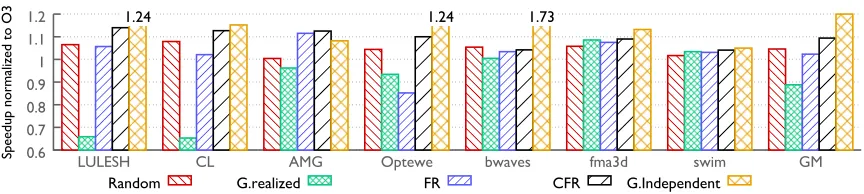
Figure 2.6CFR outperforms other methods for most cases: geometric mean of speedups relative to the O3 baseline 9.2%, 10.3%, and 9.4% on Opteron, Sandy Bridge and Broadwell, respectively.
if there is pairwise independence among different compilation modules.
2.4
Results and Analysis
In this section, we first present results of the four algorithms in Sec. 2.2 on three HPC architectures. We then compare FuncyTunerCFRwith prior work, and study their sensitivity on different inputs. To shed light on whyCFRperforms the best, we conduct a case study on Cloverleaf.
2.4.1 Overall Performance Comparison
Fig. 2.6 compares the performance for the four algorithms in Sec. 2.2, i.e.,Randomis the classical per-program random search;FRandCFRare the two per-loop algorithms proposed by us;G.realized
andG.Independent are results for greedy combinationGas explained in Sec. 2.3.4. Note that
Table 2.3Performance Statistics on Intel Broadwell
Algorithm Lulesh Cloverleaf AMG
Mean stdev Mean stdev Mean stdev G.expected 10.9 N/A 5 N/A 11.8 N/A G.realized 21.52 1.4 8.92 0.29 13.19 0.65 O3.origin 13.57 0.04 5.82 0.07 12.91 0.29 O3.caliper 13.91 0.05 5.91 0.08 13.4 0.48 O3.outlined 13.82 0.04 5.79 0.06 12.97 0.48
R 12.66 0.07 5.37 0.04 12.68 0.1
FR 12.76 0.07 5.7 0.05 11.24 0.06
CFR 12.11 0.42 5.05 0.04 11.3 0.08
Table 2.4Performance Statistics on Intel Sandy Bridge
Algorithm Lulesh Cloverleaf AMG
Mean stdev Mean stdev Mean stdev G.expected 5.7 N/A 3.7 N/A 6.1 N/A G.realized 9.3 0.16 6.38 0.22 5.91 0.03 O3.origin 7.22 0.05 4.63 0.01 6.64 0.17 O3.caliper 8.0 0.05 4.76 0.04 7.4 0.3 O3.outlined 7.39 0.08 4.65 0.03 6.66 0.13
R 6.31 0.17 4 0.02 6.58 0.18
FR 6.24 0.12 4.54 0.03 5.94 0.04
CFR 6.19 0.18 3.9 0.01 5.78 0.02
with their hot loops outlined. Moreover, Caliper instrumentations are needed only in the per-loop runtime collection but not in the final optimized executables. For all results over the 7 programs on both training and testing inputs, execution times were between 3 and 36 seconds with a standard deviation of 0.04 to 0.2 (except for two cases with 1.5 and 0.7 for longer LULESH runs) measured over 10 experiments, i.e., results are very uniform with high statistical significance. Detailed performance statistics are presented in Tables 2.3 to 2.5. From these results, we make the following observations.
From these results, we make the following observations.
1. FuncyTunerCFRprovides the best performing executables for most scenarios across bench-marks and architectures. It provides 9.2%, 10.3%, 9.4% geometric mean speedups for Opteron, Sandy Bridge and Broadwell, respectively. It also achieves the best case improvement of 18.1% for AMG on AMD Opteron (see Fig. 2.6a) in comparison to the O3 baseline. In contrast, the performance improvement due toRandomis only 3.4%, 5.0%, 4.6% on the same respective architectures. In certain cases,Randomdoes not improve performance at all whileCFRdoes much better, e.g., for AMG on Sandy Bridge and Broadwell.
Table 2.5Performance Statistics on AMD Opteron
Algorithm Lulesh Cloverleaf AMG
Mean stdev Mean stdev Mean stdev G.expected 9.7 N/A 5.73 N/A 9.4 N/A G.realized 14.52 0.37 11.01 0.15 9.6 0.07 O3.origin 11.1 0.08 6.88 0.16 10.27 0.25 O3.caliper 11.05 0.05 7.38 0.09 10.99 0.62 O3.outlined 10.84 0.03 6.89 0.14 10.13 0.25 R.origin 10.87 0.08 6.96 0.12 10.19 0.37
FR 10.27 0.05 6.7 0.07 9.73 0.92
CFR 10.16 0.05 6.06 0.08 8.7 0.27
is still inferior to that of FuncyTunerCFR. The huge differences betweenG.realized and G.Independentsubstantiate that there are inter-module dependencies for benchmarks in our experiment.
3. FR’s performance is inferior to that ofCFRand has high variance. For example, it achieves less than a 3% improvement for Cloverleaf on Opteron, Sandy Bridge and Broadwell, whileCFR achieves 13.6%, 15.2% and 12.7%, respectively. Such results demonstrate that random search with per-loop granularity alone is insufficient for achieving the best performance andCFR’s effective utilization of per-loop runtime information is critical.
2.4.2 Comparison to the State-of-the-art
We first introduce the state-of-art techniques and experimental settings to fairly compare with FuncyTunerCFRon Intel Broadwell. Then, we present the results and our observations thatCFR outperforms all of them.
2.4.2.1 The State-of-the Art
Prior techniques are either search-based[Pop16; Ans14]or predictive modeling-based[Ash16]. In particular, Cere[Pop16]performs a fine-grained compiler flag selection for hot code regions and generates the optimized executable in the same greedy fashion asGin our work. Our results in Fig. 2.6 show that this often degrades performance for the Intel compilers.
OpenTuner[Ans14]performs per-program search with an ensemble of search algorithms, in-cluding differential evolution, Torczon hillclimbers, Nelder-Mead and many others. It also employs a meta search (AUC Bandit) technique to coordinate different search algorithms for the best perfor-mance. To compare with FuncyTunerCFR, we runOpenTunerwith 1000 test iterations using the sameCV search space.
COBAYN[Ash16], a state-of-the-art machine learning-based approach, infers performantCVs for a new program by extracting static and dynamic program features and providing them as inputs to a
0.9 0.95 1 1.05 1.1 1.15 1.2
LULESH CL AMG Optewe bwaves fma3d swim GM
Speedup
normalized
to
O3 staticCOBAYN
dynamicCOBAYN hybridCOBAYNPGO OpenTunerCFR
Figure 2.7FuncyTuner provides better performance than all variants of COBAYN(static, dynamic, hybrid), PGO, and OpenTuner.
we select the top 100 performantCVs out of 1000 randomCVsamples for each cBench application to extract their static and dynamic features with Milepost-gcc[Fur11]and Mica[HE07]. We then train three models,static, dynamic, and hybrid, using static features, dynamic features and all features, respectively. SinceCOBAYNcan only perform inferences on binary compiler flags, we turn each multi-valued ICC flag into a binary one by allowing it to have two values. Then, we use each of the three models to generate 1000 code variants. The fastest code variant is considered as the result of each model.
Aside from the above meta-compilation techniques, Intel compilers support built-in profile-guided optimization (PGO), which utilizes an instrumentation run of a target program to collect profile information, such as loop trip counts and indirect function call targets. The comparison toPGOoffers a perspective to evaluate the trade-off between benefits and complexities for all approaches. We use-qopenmp -fp-model source -prof-gen -prof-dir/appfor an instrumented compilation (see recommendations forPGOin Intel’s compiler optimization manual) and then run the programs with tuning inputs in Table 2.2. Afterward, the programs are recompiled with-O3 -qopenmp -fp-model source -prof-use -prof-dir/app.
2.4.2.2 Observations
We make the following observations from the experimental results shown in Fig. 2.7.
1. OpenTunerachieves a 4.9% geometric mean speedup on our benchmark suite and is 4.5% inferior to that of FuncyTunerCFR. In particular,CFRachieves 12.7% speedup over O3 on AMG whileOpenTuneris only marginally (1.7%) better than O3. We notice thatOpenTuner’s performance benefit increases very slow after tens of test iterations.
show that a machine learning-based approach is able to reduce search overhead but does not perform better than traditional random search (Randomin our paper) when the sample size is sufficiently large, e.g., 1000 samples. The poor performance ofCOBAYN’s dynamic and hybrid models may be attributed to limited dynamic features, since MICA[HE07]only works with serial code while our target benchmarks are parallel. We also want to point out that FuncyTuner has little overhead to be ported onto different machines, while the re-training overhead can be prohibitively high for COBAYN. As an example, extracting dynamic features for cBench takes around 2 days on a 16-node Broadwell cluster.
3. PGOresults in only minor performance improvements relative to O3 and is not comparable to FuncyTunerCFR. WhilePGOis 1.8% better than O3 for AMG, it shows little improvement on six other programs. In fact,PGOinstrumentation runs fail for LULESH and Optewe.
In brief, FuncyTunerCFRdelivers significantly better performance than state-of-the-art tech-niques on our modern scientific simulation codes. It only relies on Caliper light-weight source-code level instrumentation[Boe16], entailing much less engineering complexities than others, especially COBAYNandPGO. Such simplicity is extremely noticeable when one considers the fact that Intel compilers are industry-quality production compilers and have been tuned for several decades, and COBAYNdepends on a variety of large tools, such as Milepost GCC[Fur11]and Mica. Nevertheless, their performance is inferior to FuncyTunerCFRand their robustness is limited.
2.4.3 Impact Of Different Inputs
The over-arching goal of our work is to auto-tune large scientific simulation codes with a given input. Results in Sec. 2.4.1 and Sec. 2.4.2 use the same input as both tuning and test inputs. These inputs capture the typical sizes of application work sets in practice, hence, their performance benefits can generalize to other inputs, e.g., for inputs with the same work-set size but different simulation time-steps. This is shown in Fig. 2.9 for Cloverleaf on Broadwell by varying the number of time-steps as part of the input.
Inputs with different work-set sizes are addressed as follows. We experimented on Broadwell with two sets of inputs that have different input sizes from those in Table 2.2. For 351.bwaves, 362.fma3d, and 363.swim, we use “test” and “ref” as their small and large inputs, respectively. For LULESH, AMG, Cloverleaf, Optewe, their small input sizes are 180, 20, 1000, 384, respectively, while their large input sizes are 250, 30, 4000, 768, respectively.
0.6 0.7 0.8 0.9 1 1.1 1.2 1.3 1.4
LULESH CL AMG Optewe bwaves fma3d swim GM
Speedup nor
malized to O3
Random G.realized COBAYN PGO OpenTuner CFR
(a)Normalized speedups for small inputs
0.6 0.7 0.8 0.9 1 1.1 1.2 1.3
LULESH CL AMG Optewe bwaves fma3d swim GM
Speedup nor
malized to O3
Random G.realized COBAYN PGO OpenTuner CFR
(b)Normalized speedups for large inputs
Figure 2.8CFR shows little performance sensitivity on small and large inputs with geometric mean of speedup relative to the O3 baseline 12.3% and 10.7% respectively.
0.6 0.7 0.8 0.9 1 1.1 1.2 1.3
100 200 400 800 GM
Speedup nor
malized to O3
Random
G.realized COBAYNPGO OpenTunerCFR
respectively. It is notable that the speedup of AMG underCFRover the O3 baseline is 22% while the benefit of other techniques is marginal.
The capability of generalizing performance benefits on tuning inputs to test inputs justifies the tuning overhead of all approaches, which is about 1.5 days forRandom/G, 2 days forOpenTuner, 3 days forCFRand 1 week forCOBAYN, for each benchmark. Specifically, forCFR’s target HPC applications, the overhead is amortized in repetitive production runs. Moreover, the tuning overhead may be dramatically reduced via various techniques[Cav07; Pop16]or by exploiting program-specificCFRconvergence trends, i.e.,CFRfinds the best code variant in tens or several hundreds of evaluations.
2.4.4 Deep Dive: Cloverleaf On Broadwell
Broadly speaking, CFR utilizes per-loop runtime information to direct the fine-grained search to-wards better performing CVs. Insights about the performance characteristics of different algorithms compared in this paper can be useful for further improving program performance. Specifically, we want to answer the following two questions:
• Q1: Why does G.realized often introduce slowdowns while expected to have performance improvements?
• Q2: Why does CFR perform better than others?
2.4.4.1 Case Study Design
To understand why FuncyTunerCFRperforms the best, we selected Cloverleaf to conduct an in-depth case study on Intel Broadwell with two considerations. First, its non-loop code is written in Fortran, and hot loops are in C. This may provide more challenges and opportunities for ICC’s inter-procedural optimizations (IPO). Second, its hot loops have neither complex control flows nor deep loop nests and thus provide more opportunities for ICC to perform optimizations related to loop unrolling and vectorization, which often have a significant impact on program performance and are friendly for manual inspection of generated code to understand how they have been performed. Five hot loops of Cloverleaf are selected since they have comparatively high per-loop runtime ratios (see Table 2.6, others are less than 3.0%) and were found to produce large performance differences (see Fig. 2.10) across different tuning techniques.
To identify performance-critical flags for the bestCVs, we design an iterative greedy algorithm to eliminate the flags that have low impact on the program runtime. Each iteration, the algorithm tries to remove one flag for a given loop’sCV(focused CV) while keeping all otherCVs intact. If excluding a flag fromfocused CVdoes not degrade program performance, the flag is removed; otherwise, it is kept for the current iteration. This process is performed iteratively until no more flags offocused CV
0 0.4 0.8 1.2 1.6
dt cell3 cell7 mom9 acc
Speedup nor
malized to O3
Random
G.realized G.IndependentCFR
Figure 2.10Normalized speedups for top-5 loops of Cloverleaf on Intel Broadwell. Note:COBAYN(static), OpenTunerandRandomgenerate the same code.
2.4.4.2 Observations
Fig. 2.10 shows the per-loop performance results for the five Cloverleaf hot loops on Broadwell. After greedy elimination,Random,COBAYNandOpenTunerretain-qopt-streaming-stores=always -no-ansi-alias -ipo -xCORE-AVX2as their critical flags; FuncyTunerCFRretains-no-vecfordtand mom9but no special flags for the other three loops;G.realizedalso has no special flags for mom9. Table 2.6 reveals which critical optimizations, such as loop unrolling and vectorization, are exploited by different algorithms in this case.
We make the following observations:
1. Vectorization is not always profitable. First,cell3andcell7experience a 27.7% and 13.6% slowdown, respectively, when 256-bit vectorization is performed byRandom. Other algo-rithms have similar performance benefits, yet they do not vectorize. O3 uses 128-bit SIMD (single instruction multiple data) instructions. Second, even thoughRandomachieves a 34.8% speedup fordtwith 256-bit vectorization, the performance is 12.8% worse than a scalar ver-sion. Inspection of assembly code (without access to ICC source code, this is the best that we can do) shows that there are many data permutations and mask operations to handle control flow divergence, which are known to degrade vectorization efficiency. Shorter loop trip counts caused by loop unrolling and OpenMP work sharing also contribute to the inferior performance of the vectorized loops.
2. FuncyTunerCFRhas more informed freedom (compared toG,COBAYNandOpenTuner) to select non-conflictingCVs and prioritize performantCVs (compared toFR). For instance, CFRis able to select-no-vecformom9to avoid vectorization-induced slowdown.
Table 2.6Comparison of optimizations for 5 Cloverleaf kernels on Broadwell. S(Scalar): not vectorized;
{128,256}: vectorized with{128,256}-bit SIMD; unroll{2,3}: unroll 2/3 times; IO: instruction reordering; IS: instruction selection; RS: register spilling.
Algorithm Kernel, O3 runtime ratio %
dt cell3 cell7 mom9 acc
6.3 2.9 3.5 3.5 4.2
G.realized S S S 256 256
IO unroll2 IS, IO
G.Independent S, RS, IO S S S 256, IS
O3 baseline S, unroll2 S S 128 S, unroll3
Random 256 256 256 256, IS 256, IS
CFR S S S S, IS 256
256-bit AVX2 instructions and further unrolls the vectorized loop twice whileG.Independent does not.
4. Other optimizations, such as loop unrolling and instruction selection, also matter, e.g., Fun-cyTunerCFRandG.Independentboth choose not to vectorize mom9, but their difference in instruction selection results in better performance forCFR.
In summary, we observe that such findings are difficult to derive manually for compiler writers while per-loop auto-tuning with FuncyTunerCFRis able to capitalize on them.
2.5
Related Work
The first order objective of compiler-based auto-tuning techniques is performance, while the second order objectives are code size, power draw, and energy consumption. To achieve peak performance and power efficiency for scientific applications on today’s HPC machines, it is necessary to tune various time and runtime configurations. On one side, configurations such as compile-time optimizations, runcompile-time library parameters, and architectural configurations, may have a significant impact[Kis00; Che10; Gho16a; Tiw12; Bar16; Sou17]. On the other side, settings effective for one program/machine combination may not achieve peak performance on another, and it is both tedious and challenging to manually find the best configuration[Par04]. To attain the best performance, it is vital to automate the space exploration in an efficient manner. We divide prior work into the following two categories
in worse performance than random search for OpenMP-based scientific applications. As the state-of-art search-based auto-tuning technique,OpenTuner[Ans14]coordinates many different search algorithms. Furthermore, to reduce the overhead of search-based approaches, researchers have also proposed schemes based on machine learning techniques[Aga06; Cav07; Ash16]. As the state-of-the-art,COBAYN[Ash16]infers compiler flags for a new program by representing them as static/dynamic features to a pre-trained Bayesian network. Our experi-mentation shows that FuncyTunerCFRoutperforms bothOpenTunerandCOBAYNfor Intel compilers while incurring similar cost.
2. Compiler phase ordering techniques[KC12; Kul04; JK13; Ash17]: given a set of compiler optimization passes, there are many valid orders, each of which may generate different runtime performance. Our work focuses on the Intel tool chain, which does not provide command-line flags to perform phase ordering.
2.6
Conclusion
CHAPTER
3
CODESEER: SELECT INPUT-DEPENDENT
CODE VARIANTS VIA MACHINE
LEARNING
In high performance computing (HPC), scientific simulation codes are executed repeatedly with different inputs. The peak performance of these programs heavily depends on various compiler optimizations, which are often selected agnostically on program input or may be selected with sensi-tivity to just a single input. When subsequently execution, often with different inputs, performance may suffer for all or all but the one input tested, and for the latter potentially even compared to the
O3baseline.
3.1
Introduction
In high performance computing (HPC) environments, scientists tend to test their hypotheses by running large-scale simulation codes repeatedly with different inputs. These applications occupies computing resources for a significant amount of time consuming an equally significant amount of power time and again when executed. Even a 1% performance improvement could translate into sig-nificant energy savings in such HPC production runs[Hal15]. To extract program peak performance, various compiler-based auto-tuning technologies have been developed. These techniques are either search-based [Wan19; Ans14; PE08; Pop16; Hal10; Yi12; Thi18]or machine learning-based[Ash16; Cav07; Nob16; JK13]. They generally are constrained to tuning with a single tuning inputs, which produces a single optimized executable evaluated on a small set of test inputs to report any perfor-mance improvements. As a result, their effectiveness may be limited by the tuning input and any performance tends to be localized to this input instead of generalizing to a larger set of inputs in production.
0.4 0.5 0.6 0.7 0.8 0.9 1 1.1
0 100 200 300 400 500 600 700 800 900 1000
Speedups nor
malized to O3
Code Variant IDs
Figure 3.1Normalized speedups of 1000 Kripke code variants for a singular, identical tuning input: No performance improvement for any under O3.