EXPLORING THE USE OF LEARNING CONTRACTS FOR LANGUAGE LEARNING
Normah Ismail1 & Masdinah Alauyah Md Yusof 2
1. Academy of Language Studies, UiTM Kampus Bandaraya Johor Bahru 2. Department of Modern Languages, Universiti Teknologi Malaysia
ABSTRACT
Although the concept of learning contracts is not new, it is only recently that the potential of this strategy has been recognized at the tertiary level education. It has gained some interest among language educators to use it as a way to encourage learners to be more involved in their learning. The rationale for using learning contracts in this study is based on the view that the learning contract allows the students to structure their own learning and become active participants in the educational process. Positive outcomes from recent studies reaffirmed that the learning contract is worth investigating as a strategy for promoting autonomy in language learning. This paper will explore the viability of using learning contracts among undergraduate language learners. First, it will examine the relationship between learning contracts, the attributes of resourcefulness and independent learning in developing autonomous language learners. Next, it describes the pilot study that was undertaken at a City Campus. Lastly, it will discuss the implications if language learning contracts are implemented at tertiary level.
1.0 Introduction
Although the concept of learning contracts is not new, it is only recently that the potential of this strategy has been recognized at the tertiary level education. It has gained some interest among language educators as a way to encourage learners to be more involved in their learning. What is a learning contract? It is a tool to personalize any learning experience. It is a written agreement between a learner and a teacher, lecturer or adviser that a particular activity will carried out in order to achieve a specific learning goal (Anderson, Boud & Sampson, 1996). The rationale for using learning contracts in this study is based on the view that the learning contract allows the student to structure their own learning and become an active participant in the education process (Codde, 2006). Furthermore, positive outcomes from recent studies reaffirmed that the learning contract was worth investigating as a strategy for promoting autonomy in language learning (see Boyer, 2003; Williams & Williams, 1999; Chan et al, 2003; Sysoyev, 2000; Albon, 2003; Carter, 2005). The paper will examine the relationship between learning contracts, attributes of resourcefulness and independent learning in developing autonomous language learners. Next, it describes the pilot study undertaken at a City Campus and finally, discusses the implications of implementing language learning contracts at tertiary level.
2.0 Context of The Study
encouraged to continue mastering the language through extensive reading, extra exercises and language arts activities like public speaking or drama. However, despite fervent encouragement from their lecturers to look for language learning opportunities outside the classroom, students are not taking on a more significant role in their learning. This is especially disturbing in this university that provides a rich environment for learning English. It seems that while a majority of the undergraduates at this campus acknowledged the benefits of taking more responsibility in their learning, most of them still relied heavily on their lecturers for notes and language practices as they are unsure how to handle learning English when left on their own. How can students be guided to be more open and flexible in the way they learn English? In what way can the students’ capacity to be more resourceful in their learning be increased? To answer these questions, this study will explore the method of using language learning contracts as a way to guide learners to become resourceful, independent learners. The contract emphasizes the facilitating of learning autonomy through greater learner involvement in self-monitoring and self-assessment. Because of this, it offers language educators and learners an alternative platform for teaching and learning in a learner-centered environment.
3.0 Review of Current Literature
3.1 Autonomy in language learning
In this study, the learning contract is explored as a method which learners use to facilitate the process of learner autonomy or independent learning. Knowles (1986) defined independent learning as a process in which individuals take the initiative, with or without the help of others, in diagnosing their learning needs, formulating learning goals, identifying human and material resources for learning, choosing and implementing appropriate learning strategies and evaluating learning outcomes. In the context of formal language learning, Little (2007) specifies independent learning as a process of language learning involving deliberate effort and conscious reflection because formal learning itself can happen only on the basis of explicit plans and intentions. Sliogerine (2006) further elaborates that it is a process of learning which the learners have primary responsibility for planning, implementing and even evaluating the effort they make in language learning. In other words, language learners decide on their learning goals, make plans of what to learn, decide on the learning resources, assess their own learning, and plan what to learn next. In summary, an important aim of independent language learning is to give learners more control over the resources they have to learn languages.
3.2 Resourcefulness in autonomous language learning
Carr (1999) described resourcefulness in independent learning as gathering the internal and external resources required for learning. He extended the concept of resourcefulness in autonomous learning by proposing that learner resourcefulness consists of four behaviours: anticipating the future rewards of learning, prioritizing learning over other activities, delaying immediate gratification, and solving problems in one’s learning. The degree to which a learner is deemed resourceful in autonomous learning is related to the degree to which these four behaviors are significant in enabling the learner to actively pursue his/her learning goals.
To explain further, the learner is said to be engaged in a resourceful behaviour when he anticipates future rewards (of learning). Because of this, the student will then prioritize learning over other activities even if it involves delaying the immediate gratification that may come from participating in non-learning activities. In addition, the development of learning and planning skills is essential if a student is expected to be actively involved in his/her learning activities because such skills are needed for the students to solve the problems they face when they try to complete a learning activity. To extend this in the context of language learning, it can be said that a resourceful language learner has the ability to assess the availability of internal and external resources necessary to accomplish language learning. This means that if learners placed importance on increasing their English Language proficiency, they would seek out for themselves more opportunities to learn English and consciously make well-informed decisions about their language learning. Therefore, resourcefulness would be a critical factor that can lead to successful language learning.
Some of the attributes of resourcefulness are mentioned in other studies relating to autonomy in language learning. The process syllabus (Breen & Candlin, 1987) and the learner-centered approach (Nunan, 1988) are some examples where the idea of learner resourcefulness takes a central place in the language learning. Some suggestions of resourcefulness are also found in Holec’s theoretical framework on learner autonomy (Holec, 1981). He defines learner autonomy as the ability to take charge of one’s own learning, showing that learner autonomy is an ability, not an action. This ability refers to the autonomous learner, after assessing the resources available to him, would have capacity to act in a given situation (learning). Little (2000) also mentions a certain amount of awareness or critical reflection involved in the learning. He goes on to say that autonomous learners, apart from detachment and critical reflection, are resourceful through their capacity for decision-making and independent action in their learning. Nunan (2001) gives a similar description of a autonomous language learner as having resourceful behaviours. He said that these learners have reached a point where they are able to define their own goals and create their own learning opportunities. Finally, for Huttunen (1986), resourcefulness plays a role in the act of learning. He explains that a fully autonomous learner, whether he is working individually or in a group, takes responsibility for the planning, monitoring and evaluating of his studies.
3.3 Learning contract as a strategy for learning autonomy
3.4 Learning contracts in language learning
The use of learning contracts for language learning has gained some ground during the past decade. Schwarzer, Kahn & Smart (2000) used learning contracts as a way to encourage self-directed learning and individual autonomy, while still balancing individual and group learning styles in a university ESL class of grammar and writing. They concluded that students saw their need for English proficiency because they wanted to reach a specific goal outside of the class itself, and English became the means to reach a desired end, rather than the end in itself. Little (2000) in his studies found that when carefully planned, the learning contract can have a transformative effect on learners as it provides a firm framework within which learners can plan, monitor and evaluate learning. In addition, it provides teachers as well as learners with a continuously moving reference point against which to plot the progress of learning. Lewis (2004) used learning contracts to study reading motivation among college students in a reading program. He found that the reading scores of students using the independent learning contracts were significantly higher than those of non contracts students. There was also a significant improvement in motivation level between the two groups. Among Asian learners, Masdinah and Abdul Halim (2004a, 2004b) used contracts to promote autonomous learning among undergraduates through self-access language centers. They found that apart from an improvement in the students’ overall language proficiency, the students’ perceptions towards autonomous learning language also improved. They concluded, given enough guidance and resources, students can plan to learn on their own. In a four-year study using learning contracts for an English for Special Purposes course, Lai (2007) found that learners’ awareness of language strategies were raised and their use of these strategies were improved. Apart from that, learners are better able to set their own goals as well as evaluate their progress. This in turn enabled them to experience greater overall autonomy in their language learning.
3.5 Limitations of learning contracts
4.0 Methodology
4.1 Objective
The objective of the investigation is to explore the viability of using the learning contracts to help learners become more resourceful language learners. The pilot study serves to test the design of investigation and provide proof of its potential to succeed.
4.2 Research questions
The study will be guided by the following questions:
1. What was the language learners’ experience in using learning contracts? 2. Is there evidence of learners’ resourcefulness with the use of learning
contracts?
4.3 Participants of the study
A total of 38 students participated in the pilot study. All were enrolled in their first year at UiTM Johor Bahru City Campus. 20 out of the 38 students or 52.6 % were from the Faculty of Accountancy. From this number 8 or 40% were males and 12 or 60% were females. The remaining 18 students or 47.3% of the total number of participants were from the Faculty of Business and Management. Out of the 18, 7 or 38.8% were males and 11 or 61.1 % were females. After obtaining score of 7 and below in the UiTM Placement test, they were placed in the BEL 120, Language Consolidation course which is designed to raise the level of English proficiency of students at the lower intermediate level. During the course of the study, the students participated in the student conferences, completed the questionnaires and learning contracts as fully informed, consenting volunteers.
4.4 Limitations of the study
This was a preliminary study which investigated a small group of students. Bearing in mind the size and the purposive, rather than random, nature of the sample, the results of the study may not be generalized to other situations. Thus, the findings here should be treated with caution. For the purpose of this paper, only data from the questionnaires and learning contracts were used and analyzed.
4.5 Questionnaire
presented in both English and Bahasa Melayu (BM). The BM translation was back translated to ensure consistency in meaning. The responses were tabulated and analyzed using SPSS 14.0 and presented in descriptive statistics.
4.6 Contracts
The class meetings during the first week were used to brief the students on the course syllabus. They were asked to think about their needs for learning English and their expectations from that course. Then they were given an explanation on language learning contracts and how these contracts can be used in conjunction with their syllabus to fulfil their learning needs. The researchers together with the students discussed the different resources available for language learning like novels in the library, websites on the Internet, newspapers in the reading room and even their friends to engage in a simple conversation in English. To assist the students in completing it, a form, based on Knowles’ contract (1986), was used and given out to each student. (Table 1).
Table 1 Components of the students’ learning contract
Specific language learning objectives
What am I going to learn?
Resources and strategies
How am I going to learn it?
Materials used
Comments
To help the students write out their contracts, the researcher drew guidance from Dam’s work on self-directed learning (Dam, 1995; 2004). The students were guided by the researcher in creating one language learning objective of their own based on the sample given. To start, the students were asked to complete the first three sections of the contracts: learning objectives, learning strategies and resources and materials used. Dam (1995) advocates that learners set their own goals and choose their own activities. Thus to assist the students in writing their learning goals, the following questions were used to prompt them: “What am I going to learn? How am I going to learn? What am I going to use?” The contracts were written in English, following another principle advocated by Dam (1995) that asked students and teachers to keep communication in the target language. The contracts were submitted during the second week of class meeting. The completed contracts then were read thoroughly and analyzed.
4.7 Student conference
5.0 Procedure
Student conferences were conducted throughout the semester. Each conference lasted between fifteen minutes to one hour. Each student attended at least one conference. Notes were taken during each conference. Students’ written objectives planned learning strategies and resources from their learning contracts as well as a transcription of the conferences would be scrutinized and analyzed for recurring themes. The students were called for a conference each time they submitted the contracts. The conferences were conducted in an informal atmosphere, so students were comfortable to talk about themselves. They were asked to bring along with them evidence of their completed work based on what they had planned in their contracts. During the conference, they were asked to share what they had done, the problems they faced in completing their work and their evaluation of their learning progress. During the ninth week, the students completed the questionnaires, administered during class time by the researcher. 38 questionnaires were given out. All 38 were returned to the researcher.
6.0 Findings and Discussion
6.1 Self-rate of English Language ability
To learn about the learners’ self-perception of their language ability, the students were asked what they thought about own their English Language skills. Questions 4 to 7 in the questionnaire asked them to self-rate their ability as excellent, good, average or poor in the following language skills: reading, writing, listening and speaking. Table 2 summarizes their responses.
Table 2 Self assessment of English Language proficiency
Language skills
Self-rating N % Min* Max* Mean SD*
Reading Excellent
Good Average Poor 1 24 13 0 2.6 63.4 34.0 0.0 2 4 2.74 .554
Writing Excellent
Good Average Poor 0 8 26 4 0.0 21.1 68.4 13.3
1 3 2.11 .559
Listening Excellent Good Average Poor 2 20 16 0 5.0 52.6 42.1 0.0
2 4 2.63 .589
Speaking Excellent
Good Average Poor 0 3 27 8 0.0 7.9 71.0 21.1
1 3 1.89 .606
Overall ability
From the results of the self-rate ability in English, many students were confident about their abilities in reading and listening skills but perceived that their weaknesses lay in the areas of writing and speaking skills. This is not surprising because writing and speaking require them to do constant practice. Furthermore, these skills offer results which the students see as tangible and measurable, unlike reading and listening, which students perceive to be less attributable to their success in language learning. The results of the self-rate ability will be referred to again later in the paper when the discussion turns to what the students’ contracts reveal.
6.2 Experience in using the language learning contracts
To answer the research question: What was the learners’ experience in using the contracts for language learning; the following questions were formulated and incorporated in the survey. Question 8 asked the students how frequently they used the learning contracts. The frequency ranged from one to two times, three to four times, five to six times and more than six times. 71% of the students answered “once to two times” and 29% answered “three to four times”. 66.7% of males said they used it once or twice while 91.4% of females said they used it once or twice.
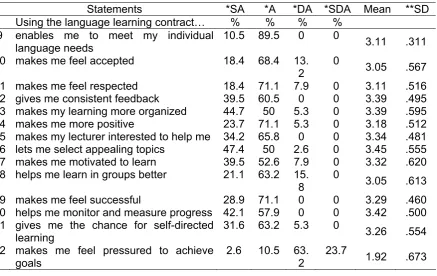
Questions 9 to 22 are statements referring to the students’ experience in using learning contracts for language learning. The students’ responses are shown in Table 3. The results showed an overall mean of 3.16. The students’ responses indicated that overall they had a positive encounter using the contracts to learn English. Many of them saw the contracts as a potentially useful tool for organizing their learning as well as monitoring and measuring their progress in language learning. Apart from that, their responses also revealed that they felt the contracts helped them in getting consistent feedback relating to their learning. On the other hand, about a third of the students did not feel that the learning contracts pressured them in achieving their learning goals. Neither do they feel that the contracts helped them work better in groups.
Table 3 Responses to statements associated with the use of language learning contracts (Statements 9 to 22)
Statements *SA *A *DA *SDA Mean **SD
Using the language learning contract… % % % % 9 enables me to meet my individual
language needs
10.5 89.5 0 0 3.11 .311
10 makes me feel accepted 18.4 68.4 13. 2
0 3.05 .567
11 makes me feel respected 18.4 71.1 7.9 0 3.11 .516 12 gives me consistent feedback 39.5 60.5 0 0 3.39 .495 13 makes my learning more organized 44.7 50 5.3 0 3.39 .595 14 makes me more positive 23.7 71.1 5.3 0 3.18 .512 15 makes my lecturer interested to help me 34.2 65.8 0 0 3.34 .481 16 lets me select appealing topics 47.4 50 2.6 0 3.45 .555 17 makes me motivated to learn 39.5 52.6 7.9 0 3.32 .620 18 helps me learn in groups better 21.1 63.2 15.
8
0
3.05 .613 19 makes me feel successful 28.9 71.1 0 0 3.29 .460 20 helps me monitor and measure progress 42.1 57.9 0 0 3.42 .500 21 gives me the chance for self-directed
learning
31.6 63.2 5.3 0
3.26 .554 22 makes me feel pressured to achieve
goals
2.6 10.5 63. 2
23.7
*(SA – strongly agree A- Agree DA – Disagree SDA – Strongly disagree) ** Standard deviation
6.3 Ability to be resourceful language learners
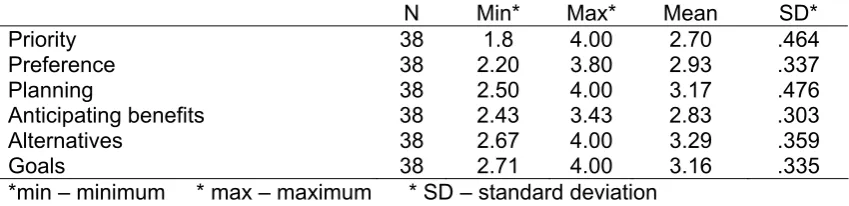
To answer the research question, “Is there evidence of learner resourcefulness with the use of learner contracts?”, the following statements were formulated. Questions 23 to 56 are statements concerning the students’ ability to be resourceful language learners through the use of learning contracts. Based on Carr’s (1999) description of resourcefulness behaviour, language learners who are resourceful would give priority to independent language learning, show preference to learn language over other activities, look forward to benefits of learning language, prepare ahead when they start language learning, have a set of alternatives for language learning problems they face and set language learning goals.
Table 4 Responses to statements associated with students’ ability to be resourceful
N Min* Max* Mean SD*
Priority 38 1.8 4.00 2.70 .464
Preference 38 2.20 3.80 2.93 .337
Planning 38 2.50 4.00 3.17 .476
Anticipating benefits 38 2.43 3.43 2.83 .303
Alternatives 38 2.67 4.00 3.29 .359
Goals 38 2.71 4.00 3.16 .335
*min – minimum * max – maximum * SD – standard deviation
Table 4 summarizes the responses given by the students regarding their ability to be resourceful in learning English. Student responses to statements about priority yielded a mean of 2.70 (SD .464). For preference, the mean response was 2.93. (SD .337). In response to statements that are associated with anticipating the benefits the mean was 2.83. (SD .303). Next, the mean for planning was 3.17 (SD .476) while the mean for goals was 3.16 (SD .335). The highest mean of these categories was alternatives, 3.29 (SD .359). Kennet (1994) has argued that high achievers are very academically resourceful. The analysis of the responses revealed a group of students with potential abilities to be resourceful language learners but do not yet have the belief that such learning endeavours would lead them to success in language learning.
6.4 What the contents of the contracts revealed
friends to complete the activity together, to check answers or to understand the meanings of words. A few mentioned they would refer to their lecturers or family members for help in their activities. As for learning materials, the students planned to use a range of things from newspapers, song lyrics and text books. The learning material that was mentioned in all the contracts was the dictionary. Many also mentioned the use of the Malay-English Dictonary ‘Kamus Dwibahasa’. Overall the entries in the contracts showed that the students, given enough support and training, were able to plan activities for themselves. However, the analysis also revealed some shortcomings. Some contracts were incomplete or written with contradictory objectives and resources. Some contracts were also copied from another contract. Other contracts had many interesting but ambitious activities which were not executed because of time management. In many ways this proves what Little (2005) had pointed out before, that learners do not become self-directed learners by simply being told that they were now in charge of learning.
7.0 Implications
full potential as autonomous language learners. In studies mentioned earlier, learning contracts have been shown to increase students’ awareness about their language learning while in the classroom or beyond the classroom. This is part of the training that educators stressed as an important step in preparing students to become independent learners.
8.0 Recommendations
The preliminary findings from the pilot study suggest that the learning contract has potential use in the language classroom to develop language learners who are resourceful and independent. The outcomes were based on the responses of first year students. More needs to be learnt about the effects of the contracts among students in their later years of study. Equally important is that these results cannot be attributed only to the learning contract alone. The lecturers or teacher in charge had a role in how effective the contract would be. It is worthy to find out how their motivation and perseverance throughout the implementation influenced the students towards the contracts and language learning. Lastly, further research is needed to learn how learning contracts can be integrated seamlessly in a university language learning programme where its suitability to Asian language learners, who are used to teacher-led activities, remains little known.
References
Albon, R. (2003) Contract-based learning : Is it effective? In Partners in Learning. Proceeding of the 12th Annual Teaching Learning Forum 11-12 February 2003 Perth Edith Cowan University Retrieved at http://lsn.curtin.edu.au on 27 January 2008
Anderson G., Boud D., & Sampson J. (1996) Learning Contracts. London:
Kogan Page, Benson, P. (2006) Autonomy in language teaching and learning . Language Teaching. 40, 21-40
Breen, M. P. and C. N. Candlin (1987). Which materials? A consumer's and designer's guide. In ELT textbook and materials: Problems in evaluation and development, ed. L. E. Sheldon. London: British Council. ELT Document 126. Boyer, N. R. (2003). The learning contract process, scaffolds for building socials,
self-directed learning. The Quarterly Review of Distance Education. 4 (4) 369-383 Carr, P.B. (1999). The measurement of resourcefulness intentions in the adult
autonomous learner. Doctoral Dissertation submitted to The George Washington University. Washington, D.C.
Carter, B. (2005) Reconceptualizing roles and responsibilities in language learning in higher education. Teaching in Higher Education. 10(4) 461-473
Chan, V., Spratt, M., Humphreys, G. (2002) Autonomous language learning : Hong Kong tertiary students attitudes and behaviours. Evaluation and Research Education. 16 (1) 1-18
Confessore, G.J. (1992). An introduction to the study of self-directed learning. In G.J. Confessore & S.J. Confessore (Eds.), Guideposts to self-directed learning: Expert commentary on essential concepts (pp. 1-6). King of Prussia, PA: Organization Design and Development, Inc.
Dam, L. (1995) Learner autonomy : From theory to classroom practice. Dublin : Authentik
Secondary School. Department of Teacher Education, University of Oulu, Finland.
Junaidah, J.(2007) Exploring readiness for language learning autonomy among distance learners in Sabah Malaysia. The Asian Society of Open and Distance Education. 5(1). pp16-26
Johnstone, J.W.C. & Rivera, R.J. (1965). Volunteers for learning. Chicago: Aldine Publishing Company.
Karlsson, L., Kjisik F., Nordlund, J. (2007) Language counselling : A critical and integral component in promoting an autonomous community of learning. System 35, pp46-65
Kennet, D. (1994) Academic self-management counselling : preliminary evidence foe the importance of learned resourcefulness. Studies in Higher Education .19, 3, 295 - 307
Knowles, M. S. (1986). Using learning contracts. Practical approaches to individualizing and structuring learning. San Francisco: Jossey-Bass.
Lai, C. (2007). The Influence of Learner Motivation on Developing Autonomous Learning in an English-for-Specific-Purposes Course. Asian Journal of English Language Teaching, 8
Lewis, J (2004) The independent learning contract system : motivating students enrolled in college reading courses. Reading Improvement, 4, (3) pp188
Little, D. (1991). Learner autonomy 1: definition, issues and problems. Dublin: Authentik.
Little, D. (2005) The Common European Framework and the European Language Portfolio: Involving learners and their judgements in the assessment process. Language Testing 22 (3),pp 321-336
Little, D. (2000). Learner autonomy and human interdependence: some theoretical and practical consequences of a social-interactive view of cognition, learning and language. In B. Sinclair & I. McGrath & T. Lamb (Eds.), Learner Autonomy, Teacher Autonomy: Future Directions (pp. 15-23). Harlow: Longman
Little, D. (2000). Learner autonomy: why foreign languages should occupy a central role in the curriculum. In S. Green (ed.), New Perspectives on Teaching and Learning Modern Languages, 24-45. Clevedon: Multilingual Matters.
Little, D.(2007) Language learner autonomy and the European Language Portfolio: two ESL case studies “Learner autonomy in language learning: widening the circle”, IATEFL Learner Autonomy SIG, CELTE,University of Warwick retrieved at www.warwick.ac.uk/go/circal/12mayevent/david_little
Littlewood, W. (2001). Students' attitudes to classroom English learning: a cross-cultural study. Language Teaching Research 5(1),pp 3-28.
Masdinah A. M. Y. & Abdul Halim A. R. (2004a) Autonomous Learning : Some Considerations. Paper presentation at Autonomy and Language Learning Maintainng Control 2004 HKUST & Zhejiang University
Masdinah A. M. Y. & Abdul Halim A. R. (2004b) Training students to be autonomous learners Paper presentation at the 1st International Language Learning Conference Universiti Sains Malaysia 16-18 December 2004
Masdinah A.M.Y (2005) The viability of learning contract in promoting independent learning Paper presentation at the Second Conference of Independent Learning Association of Oceania, Auckland, New Zealand, September 9-12, 2005
Merriam, S.B. and Cafarella, R.S. (1991). Learning in adulthood. San Francisco, CA: Jossey- Bass Publishers.
Mozzon-Mcpherson, M.(2007). Supporting independent learning environments : An analysis of structures and roles of language learning advisers. System 35, pp 66-92
Rosenbaum, M. (1989). Self-control under stress: The role of learned resourcefulness. Adverse Behavioral Therapy, 11, pp 249-258.
Schwarzer D., Kahn, R.E., & Smart K., (2000) Learning Contracts and Team Teaching in a University ESL Writing Class. The Internet TESL Journal. 6(10) Seung, Y. C. (2007) Invisible motivation of online adult learners during contract
learning The Journal of Educators Online .4(1)
Sert, N. (2006) EFL student teachers’ learning autonomy. Asian EFL Journal. 8(2) Šliogerienė, J. (2006). Learning contracts in Second Language Acquistion Santalka.
Filologija. Edukologija. 14, (2).
Sysoyev, P.V. (2000) Developing an English for specific purposes using learner centered approach: a Russian experience. The Internet TESL Journal VI (3) Retrieved at http : iteslj.org/techniques/sysoyev-esp.html on 22 august 2008 Thang, S.M. & Alias, A. (2006) Investigating readiness for autonomy : a comparison
of Malaysian ESL undergraduates of three public universities. Reflections on English Language Teaching, 6 (1), pp. 1-18
Thang, S.M. (2001). Malaysian learners’ conceptions of their learning processes and their perceptions of their English as a Second Language courses in a tertiary distance learning context. Unpublished PhD thesis, University of Nottingham, Nottingham.