ABSTRACT
ZHOU, YAJIN. Android Malware: Detection, Characterization, and Mitigation. (Under the direction of Xuxian Jiang.)
Recent years, there is an explosive growth in smartphone sales and adoption. The popularity is partially due to the wide availability of a large number of feature-rich smartphone applications (or apps). Unfortunately, the popularity has drawn the attention of malware authors: there were reports about malicious apps on both official and alternative marketplaces. These malicious apps have posed serious threats to user security and privacy.
The primary goal of my research is to understand and mitigate the Android malware threats. In this dissertation, we first presented a systematic study to gain a better understanding of malware threats on both official and alternative app marketplaces, by proposing a system called DroidRanger to detect malicious apps on them. Specifically, we first proposed a permission-based behavioral footprinting scheme to detect new samples of known Android malware families. Then we applied a heuristics-based filtering scheme to identify certain inherent behaviors of unknown malware families. This study showed that there is a clear need for a rigorous vetting process, especially for non-regulated alternative marketplaces.
After that, we characterized Android malware from various aspects to provide better insights of existing malware threats to the whole research community. That’s because without a deep understanding of Android malware, one can hardly imagine that effective mitigations could be proposed. The characterization and a subsequent evolution-based study of representative families revealed that they were evolving rapidly to circumvent the detection from existing mobile anti-virus software. The Android Malware Genome Project [11], spun off from this research, has helped researchers from more than 450 universities, research labs and companies all over the world to develop more effective solutions.
Android Malware: Detection, Characterization, and Mitigation
by Yajin Zhou
A dissertation submitted to the Graduate Faculty of North Carolina State University
in partial fulfillment of the requirements for the Degree of
Doctor of Philosophy
Computer Science
Raleigh, North Carolina 2015
APPROVED BY:
Huiyang Zhou Vincent Freeh
Kapil Singh Xipeng Shen
Xuxian Jiang
DEDICATION
BIOGRAPHY
ACKNOWLEDGEMENTS
First, I would like to thank my advisor, Dr. Xuxian Jiang, for his numerous help during my PhD study. I was inspired not only from his insights, but also his enthusiasm and the attitude of curiosity in research. I would like to thank Prof. Zhi Wang from Florida State University for his kind help and useful discussion. I am thankful to Prof. Vincent W Freeh, Prof. Huiyang Zhou, Prof. Xipeng Shen and Dr. Kapil Singh for their time and efforts severing in my PhD thesis committee and the insightful comments that helped to improve this dissertation.
Second, I am grateful to many persons for their support: Dr. Kapil Singh from IBM T.J. Watson Research Center who was the mentor during my internship there in summer 2012, Prof. Dongyan Xu from Purdue University who provided useful advise and help during my job searching, Prof. Zhenkai Liang from National University of Singapore who was acting as my referee and gave me constructive advise, Prof. Peng Ning from NC State University and all my academic brothers in the Cyber Defense Labs, Jinku Li, Michael Grace, Wu Zhou, Chiachih Wu, Lei Wu, Kunal Patel. I am thankful to my friends at NC State University, Pu Yang, Xiaoling Huang, Yi Xu, Rong Jin, Zhiming Shen, Cunfang Shen, Wenbo Shen, Juan Liu. Special thanks to my old friends from Suzhou University and University of Science and Technology of China, Yi Luo, Yan Zhang, Xuhui Li, Zhen Huang, Chunguang Tang, and all the brothers from 311, Tao Wang, Lei Jin, Anquan Zheng, Kun Shen, Mingdong Zhang. I really miss our good old times together.
Third, I am also grateful to organizations that generously funded my graduate research. The work in this dissertation was supported in part by US National Science Foundation (NSF) and the US Army Research Office (ARO) under several grants. As usual, any opinions, findings, and conclusions or recommendations expressed in this dissertation do not necessarily reflect the views of the NSF and the ARO.
TABLE OF CONTENTS
LIST OF TABLES . . . vii
LIST OF FIGURES . . . .viii
Chapter 1 Introduction . . . 1
1.1 Background and Problem Overview . . . 1
1.2 Our Approach . . . 2
1.3 Dissertation Contributions . . . 4
1.4 Terminology . . . 5
1.5 Dissertation Organization . . . 6
Chapter 2 Related Work . . . 7
2.1 Android Malware Detection . . . 7
2.2 Android Malware Defense . . . 8
2.3 Mobile Application Security . . . 9
2.4 Software Fault Isolation . . . 11
2.5 Mobile Application Sandbox . . . 11
Chapter 3 Detecting Malicious Apps in Official and Alternative App Market-places . . . 13
3.1 Introduction . . . 13
3.2 Design . . . 15
3.2.1 Detecting Known Android Malware . . . 16
3.2.2 Detecting Unknown Android Malware . . . 19
3.3 Evaluation . . . 21
3.3.1 Detecting New Samples of Known Malware . . . 22
3.3.2 Detecting Zero-day Malware . . . 26
3.3.3 Summary of Detected Malware . . . 28
3.4 Discussion . . . 28
3.5 Summary . . . 29
Chapter 4 Dissecting Android Malware: Characterization and Evolution . . . 31
4.1 Introduction . . . 31
4.2 Malware Timeline . . . 33
4.3 Malware Characterization . . . 35
4.3.1 Malware Installation . . . 35
4.3.2 Activation . . . 41
4.3.3 Malicious Payloads . . . 42
4.3.4 Permission Uses . . . 47
4.4 Malware Evolution . . . 48
4.4.1 DroidKungFu . . . 48
4.5 Malware Detection . . . 51
4.6 Discussion . . . 53
4.7 Summary . . . 55
Chapter 5 Sandboxing Third-party Android Apps with Hybrid User-level Sandboxes . . . 56
5.1 Introduction . . . 56
5.2 Background and Threat Model . . . 58
5.2.1 Dalvik Virtual Machine . . . 58
5.2.2 Java Native Interface . . . 59
5.2.3 Dynamic Loading and Linking . . . 59
5.2.4 Threat Model . . . 60
5.3 System Design . . . 60
5.3.1 Overview . . . 61
5.3.2 Dex Sandbox . . . 62
5.3.3 Native Sandbox . . . 63
5.4 Implementation . . . 69
5.4.1 Dex Sandbox . . . 69
5.4.2 Native Sandbox . . . 70
5.4.3 Native Sandbox Optimizations . . . 73
5.5 Evaluation . . . 74
5.5.1 Effectiveness of AppCage . . . 74
5.5.2 Security Analysis . . . 76
5.5.3 Compatibility of AppCage . . . 77
5.5.4 Performance Evaluation . . . 79
5.6 Discussion . . . 81
5.7 Summary . . . 82
Chapter 6 Conclusion and Future Work . . . 83
LIST OF TABLES
Table 3.1 The number of remaining apps after filtering the repository with RECEIVE
-SMS/SEND SMS permissions . . . 17
Table 3.2 The number (and percentage of) apps with native code not in the default location . . . 20
Table 3.3 Statistics of collected apps from existing app marketplaces . . . 21
Table 3.4 Ten known malware families used in this study . . . 22
Table 3.5 Essential permissions of 10 known malware families . . . 23
Table 3.6 The number of infected apps by 10 known malware families on 5 studied marketplaces . . . 24
Table 3.7 The missed known malware families by Lookout Security & Antivirus soft-ware . . . 25
Table 3.8 Two zero-day malware families detected by DroidRanger . . . 26
Table 3.9 The total number of malware samples detected by DroidRanger . . . 28
Table 4.1 The timeline of 49 Android malware in our collection . . . 34
Table 4.2 An overview of existing Android malware - Part I: installation and activation 36 Table 4.3 The (abbreviated) Android events/actions Of interest to existing malware . . 39
Table 4.4 The list of platform-level root exploits and their uses in existing Android malware . . . 42
Table 4.5 An overview of existing Android malware - Part II: malicious payloads . . . 44
Table 4.6 The overview of sixDroidKungFu malware families . . . 48
Table 4.7 Detection results from four representative mobile anti-virus software . . . 52
Table 5.1 Confined operations by the current prototype . . . 69
Table 5.2 AppCage successfully blocks malicious behaviors of samples in 15 malware families . . . 74
Table 5.3 AppCage detects malicious behaviors . . . 75
Table 5.4 Some apps used in compatibility test . . . 78
LIST OF FIGURES
Figure 1.1 An overview of the dissertation . . . 2
Figure 3.1 The overall architecture of DroidRanger . . . 15
Figure 3.2 The list of commands supported in Plankton . . . 27
Figure 4.1 The Android malware growth in 2010-2011 . . . 33
Figure 4.2 An update attack from BaseBridge . . . 38
Figure 4.3 An update attack from DroidKungFuUpdate . . . 40
Figure 4.4 An update attack from AnserverBot . . . 40
Figure 4.5 The comparison of top 20 requested permissions by malicious and benign apps . . . 47
Figure 5.1 ClassObject and Method in Dalvik . . . 59
Figure 5.2 System architecture of AppCage . . . 60
Figure 5.3 Dalvik hooking of SmsManager.sendTextMessage . . . 62
Figure 5.4 Instrumentation of native code by AppCage . . . 66
Figure 5.5 Memory layout of the native sandbox . . . 70
Figure 5.6 An example of indirect branch trampoline . . . 72
Figure 5.7 CaffeineMark with and without AppCage . . . 80
Chapter 1
Introduction
1.1
Background and Problem Overview
Recent years, there is an explosive growth in smartphone sales and adoption. The report from Gartner showed that there were over 968 millions of smartphones sold in the year of 2013, and this was the first time that smartphone sales surpassed sales of feature phones [47]. The popularity is partially propelled with the large collection of feature-rich smartphone applications (or apps) in various marketplaces. For example, the number of total apps on official app market, i.e., the Google Play, has reached 1.5 million in June 2014 [1]. Moreover, in addition to the official marketplaces, there also exist a number of third-party or alternative ones (e.g., Amazon AppStore for Android [7]), which further boost the popularity. These centralized marketplaces or app stores streamline the process of browsing, downloading and installing a variety of apps - therein facilitating the use of smartphones.
Unfortunately, such popularity has drawn the attention of malware authors. For instance, DroidDream [94] and DroidDreamLight [113] were detected from the official app market in March and May 2011, respectively. In September 2011, a highly sophisticated Android tro-jan using public, encrypted blog entries for command and control (C&C) was identified by researchers [16]. It has been highlighted [77] that “among all mobile malware, the share of Android-based malware is higher than 46% and still growing rapidly.” According to the latest report from Lookout, in year 2014 there was an astounding 75% increase in Android mobile malware encounter rates in the United States compared to year 2013 [2].
Detecting Malicious Apps in Official and Alternative
App Marketplaces
Dissecting Android Malware:
Characterization and Evolution
Sandboxing Third-party Android
Apps with Hybrid User-level Sandboxes
Figure 1.1 An overview of the dissertation
phones into a botnet controlled through Internet or short message. For instance, the Droid-Dream malware attempts to gain the root privilege of the system by exploiting a known system vulnerability. Then it downloads and installs more malicious apps in the background without user’s awareness, and performs further malicious operations. Because of the rapid growth of malicious apps and the serious consequences that could be caused, there is a pressing need to effectively mitigate or defend against them.
1.2
Our Approach
In this dissertation, we first presented a systematic study to understand the overall health of ex-isting app marketplaces in Chapter 3. Then to gain a better understanding of Android malware threats, we systematically characterized Android malware from various aspects, including their installation methods, activation mechanisms as well as the nature of carried payloads in Chap-ter 4. This study has provided insights and a comprehensive malware dataset to the research community to help develop more effective defense solutions. At last, in Chapter 5 we proposed a novel and practical system using hybrid user-level sandboxes to mitigate Android malware threats. This system is able to thoroughly confine the run-time behavior of third-party Android apps and block the malicious operations based on user provided policies. It does not need any framework modifications or the root privilege, thus can be readily deployed. Figure 1.1 shows the overview of this dissertation.
signatures, our scheme took a scalable design by initially filtering out these apps based on the inherent Android permissions required by the malware for its wrongdoings and then matching them with malware-specific behavioral footprints (that characterize the malware behavior). (2) Second, in order to detect unknown malware, we proposed a heuristics-based filtering scheme
that defines suspicious behaviors from possibly malicious apps and then used them to detect suspicious apps. Example heuristics include the attempts to dynamically fetch and execute code from a remote untrusted website. For each suspicious app, we further dynamically monitored its runtime execution to confirm whether it is truly malicious or not. If the app is malicious and does not appear in our (malware) database, we considered it as zero-day malware and then generated the corresponding permission-based behavioral footprint in a feedback loop to detect other samples in the collection.
Then, in Chapter 4, we characterized existing Android malware families based on the sam-ples collected through various channels to better understand Android malware threats and provide insights to the research community. First, we presented the first large collection of 1260 Android malware samples in 49 different malware families. Second, based on the collected malware samples, we performed a timeline analysis of their discovery and thoroughly character-ized them based on their detailed behavior break-down, including the installation, activation, and payloads. The timeline analysis is instrumental to revealing major outbreaks of certain Android malware in the wild while the detailed breakdown and characterization of existing An-droid malware is helpful to better understand them and shed light on possible defenses. Third, we performed an evolution-based study of representative Android malware, which showed that they were rapidly evolving and existing anti-malware solutions were seriously lagging behind. For example, it is common for Android malware to have encrypted root exploits or obfuscated command and control (C&C) servers. The adoption of various sophisticated techniques greatly raises the bar for their detection.
code. To address this challenge, AppCage relies on a second sandbox, native sandbox, to confine the app’s native code. The native sandbox leverages software fault isolation (SFI) [115] to ensure that the app’s native libraries (including the system libraries they depend on) cannot escape from the sandbox or directly modify the code or data outside the sandbox. The app thus cannot tamper with the dex sandbox using native code. In addition, native sandbox prevents the app’s native code from directly requesting sensitive data or performing dangerous operations via binder [22], the Android’s ubiquitous inter-process communication mechanism. Combining those two sandboxes, AppCage can comprehensively interpose the app’s access to key Android APIs and enforce user-defined policies to block malicious operations of Android malware. We have implemented a prototype of AppCage and evaluated its effectiveness, compatibility, and performance. Our experiments showed that AppCage can successfully detect and block attempts to leak the user’s private data by both malicious and benign-but-invasive Android apps, and the security analysis demonstrated that native sandbox can protect our system from being bypassed or subverted. Moreover, the prototype is shown to be compatible with the popular Android apps we downloaded from the Google Play, and it incurs negligible overhead for apps without native code and minor for ones with native code.
1.3
Dissertation Contributions
The contributions of this dissertation are threefold: the detection, characterization and mitiga-tion of Android malware.
• Detection of Android malware We have conducted the first systematic study to un-derstand the overall health of both official and alternative Android marketplaces. We collected 204,040 Android apps from various marketplaces and then proposed two differ-ent schemes to detect malicious apps among them. We believe this was one of the most extensive study ever performed at that time.
• Mitigation of Android malware We have proposed a system called AppCage to miti-gate the Android malware threats. This system thoroughly confines the run-time behavior of third-party Android apps without requiring framework modifications or root privilege. It leverages two complimentary user-level sandboxes to interpose and regulate the app’s access to sensitive APIs, and further block the malicious operations of Android malware. Our evaluation showed that AppCage can successfully detect and block attempts to leak private information by malicious apps, and the performance overhead caused by AppCage was negligible for apps without native libraries and minor for apps with them.
1.4
Terminology
This section establishes the terminology that is used in this dissertation.
• App Marketplace: An app marketplace is a centralized place for developers to upload their apps, and users to download and install the apps. There are two different types of app marketplaces, i.e., official ones and alternative ones. The official app marketplaces are the ones created by the smartphone platform vendors, including Google and Apple. They are usually pre-installed on the shipped devices. For instance, the Google Play is the official app marketplace that is pre-installed on most Android devices. Besides the official ones, there also exist some alternative app marketplaces, mainly due to regional or localization reasons. In this dissertation, we also use other terms app market, app store for same meanings.
• Android Malware: Android malware means malicious apps targeting the Android plat-form. These malicious apps could steal user private data without user awareness, cause financial loss to users or exploit system vulnerabilities to gain high privilege and perform further malicious operations. Malicious apps are defined by their malicious intentions, which are not the part of legitimate functionalities of apps.
• App Permission: Permissions of an app define the privileges of the app to perform system-wide operations. These permissions are requested by app developers and need to be approved by users during app installation.
• Update Attack: Update attack is one way used by attackers to trick users to install malicious apps. These malicious apps are usually disguised as the updated version of benign apps. After being installed, malicious payloads will be triggered and executed. • Dalvik Virtual Machine: Dalvik virtual machine is the one used by the Android
op-erating system to execute Android apps. The app is programed using the Java language and then transformed to the dex byte code executed on the Dalvik virtual machine. • JNI: JNI is the acronym of Java Native Interface. It is a framework that enables the byte
code running in Java virtual machine to invoke or to be invoked by native functions which are programed using native languages, including C, C++ and assembly. This technology is used in Android operating system to invoke functions from the byte code running on the Dalvik virtual machine to the native functions, or vice versa.
• Sandbox: Sandbox is a security mechanism to run untrusted code in an environment that could confine the behaviors of untrusted code. It has been proposed and widely used to isolate untrusted and potentially malicious software components.
• Software Fault Isolation: Software fault isolation is a technology that could be used to implement a sandbox. It usually leverages a software to instrument the original program to isolate untrusted components, so that the compromised or malicious components will not be used to compromise the whole system. Software fault isolation systems usually leverage hardware features to be effective.
1.5
Dissertation Organization
Chapter 2
Related Work
In this chapter, we introduce and compare related work in the areas of Android malware, mobile app security, software fault isolation and mobile application sandbox, the main components in this dissertation.
2.1
Android Malware Detection
The first category of related work includes the ones that leverage static, dynamic or hybrid program analysis techniques to detect malicious Android apps. RiskRanker [51] determined the risk category based on the dangerous behaviors of apps and then the selected apps were manually analyzed to detect malicious ones. WHYPER [80] used natural language processing to bridge the gap between user expectations and app functionality in order to aid the risk assessment of third-party apps. Penget al. used probabilistic generative models to rank the risks of Android apps [83]. Since malicious apps usually transmit private data in the background without user’s intention, it’s important to detect whether the data transmission is intended. AppIntent [123] was such a system. It used the symbolic execution to generate the event sequences that can lead to the data transmission, then the generated sequences can help an analyst to determine if the data transmission is user intended or not. FlowDroid [17] performed accurate static taint analysis on Android apps based on a precise model of Android app’s lifecycle. The context-, flow-, field- and object-sensitivity allowed the analysis to reduce the false alarms.
apps. It tracked the taint tags on the level of Dalvik virtual machine, and had a relatively small performance overhead compared with other taint tracking systems. Also it tracked the information flow in the file system. DataChest [142] tracked information flow of unstructured data, a type of private data whose semantics could not be inferred from the platform APIs. AppsPlayground [88] was a framework to automatically detect and analyze Android (malicious) apps by performing the dynamic taint tracking, API monitoring, and kernel-level monitoring. To increase the code coverage, it proposed mechanisms to trigger the execution of the app code. VetDroid [131] leveraged TaintDroid and implemented a permission-based taint analysis. The evaluation result showed that it could find more privacy leaks than TaintDroid and was able to find the causes of the leaks. Mobile-Sandbox [107] combined both static and dynamic analysis to detect malicious apps. It first used the static analysis to find the permissions requested by the app and then disassembled the code to find the dangerous methods, strings and etc. Then it leveraged the dynamic analysis model to log runtime information of the app. CopperDroid [90] and DroidScope [122] were two systems that dynamically analyzed the behaviors of malicious Android apps.
2.2
Android Malware Defense
To mitigate Android malware threats, researchers have proposed a number of systems to enable fine-grained and runtime control of Android apps. They roughly fall into the following two categories.
could strongly impair their practical deployment. Even the adoption of the official (experi-mental) permission manager [58] could take a long time due to the deep fragmentation of the Android platform [10, 120, 137].
The second category includes the “in-app” mechanisms that control the app’s access to sensi-tive APIs through (Dalvik) bytecode rewriting [20, 31, 61, 89] or nasensi-tive code interposing [121]. RetroSkeleton [31] was an app rewriting framework to intercept the method invocations. It could enforce the security policies for each target apps. By setting up proper policies, malicious behaviors of apps could be detected and blocked. I-ARM-Droid [30] identified a set of security-sensitive API methods and specified their security policies. Then the policies were enforced by rewriting the Dalvik code of the app. These systems do not require changes to the Android framework and thus can be readily deployed. However, dynamically loaded classes (e.g., classes loaded by DexClassLoader) could pose serious challenges to these systems. On the other hand, Aurasium [121] interposed the inter-process communication [22] between the app and remote Android services. Therefore, it can accommodate dynamic classes, but has to bridge the “se-mantic gap” by reconstructing high-level se“se-mantics from the exchanged raw messages, overall a tedious and error-prone task. For instance, Aurasium has to reconstruct the high-level seman-tics of detailed IPC calls to the remote system service to enforce the policies. More importantly, all those systems can be bypassed or subverted by a malicious app using a native library. For example, the app can leverage native code to tamper with the instrumented bytecode [12] or skip security checks by “restoring the global offset table entries” [121]. The limitations of these systems motivated us to propose a novel and practical defense mechanism in Chapter 5.
2.3
Mobile Application Security
were susceptible [140]. To effectively detect the confused-deputy problem, researchers have pro-posed various tools to statically analyze Android apps. For instance, CHEX [68], Epicc [78] and ComDroid [27] analyzed the communication between different components and found potential security risks existing in the apps. Accordingly, to deal with this problem, QUIRE [32] and Felt et al. [41] offered extensions to the Android IPC model that allow the ultimate imple-mentor of a privileged feature to check the IPC call chain to ensure unprivileged apps cannot launch confused-deputy attacks unnoticed. Similarly, Bugiel et al.[25] used a runtime monitor to regulate communications between apps.
The second category includes the ones that expose privacy risks due to in-app ad libraries. AdRisk was a system [53] that systematically identified potential risks posed by existing in-app ad libraries. Although the ad libraries identified by AdRisk do not seem to have malicious intentions, they usually contain potential risks ranging from leaking user’s private information to executing untrusted code from the Internet. Another work [23] took a sample of 114,000 apps and then extracted and classified their ad libraries. They found that the use of permissions has increased over the last several years, and more libraries were able to use permissions that pose particular risks to user privacy and security. To address the privacy concerns of the in-app ad libraries, several solutions have been proposed. AdDroid [82] was proposed to integrate the advertising libraries into the Android framework. The AdSplit approach [105] was proposed to separate the application and its advertisement library by running them in different processes. Zhanget al.proposed Activity Frame (AFrame) [130] to provide permission, display and input isolation of ad libraries.
virtualization-based mechanism to deal with the app repackaging threat. In encoded the instruction set of an Android app into different forms and leveraged the customized virtual machine to execute the encoded instruction set.
2.4
Software Fault Isolation
The third piece of this dissertation, i.e., the user-level sandboxes to confine runtime behaviors of Android apps, leveraged the software fault isolation (SFI) technology to sandbox native code. SFI has been widely researched and deployed [45, 63, 71, 81, 104, 115, 124, 129, 132]. Most of these systems targeted the x86 architecture [45, 63, 71, 81, 124, 129]. ARMor [132] was a system providing SFI for the ARM architecture. However it did not support dynamic linking, and has a high performance overhead which makes it impractical for real deployment. Native Client for ARM [104] provided a customized compiler to generate confined ARM binaries. It thus required source code access which is not available for the app’s native code. ARMlock [141] implemented an efficient fault isolation solution. However it required the support from kernel space and thus cannot be used without the change to the phone’s firmware.
Robusta [106] and Arabica [108] were two closely related systems. They leveraged Native Client and the JVMTI (JVM Tool Interface) to sandbox the native libraries of JVM, respec-tively. Robusta recompiled the source code of the native libraries, and Arabica needed the support of JVMTI that is unavailable in Dalvik VM. Klinkoff et al. proposed a SFI mecha-nism to protect managed code and the .NET run-time from the unmanaged code (or native code) [64]. It isolated unmanaged code in a separate process. Similarly, the NativeGuard [109] leveraged the process boundary to isolate untrusted native libraries.
2.5
Mobile Application Sandbox
Chapter 3
Detecting Malicious Apps in Official
and Alternative App Marketplaces
3.1
Introduction
In this chapter, we will present a systematic study to understand the overall health of existing app marketplaces. With the popularity of smartphones and mobile apps, these marketplaces have become the centralized places for developers to upload their apps and users to download and install apps. There are two types of app marketplaces, i.e., official app marketplaces pro-vided by platform vendors, e.g., Google and Apple, and alternative ones mainly for localization purpose. These marketplaces further boost the popularity of smartphones since they streamline the process of browsing, downloading and installing a variety of apps - therein facilitating the use of smartphones.
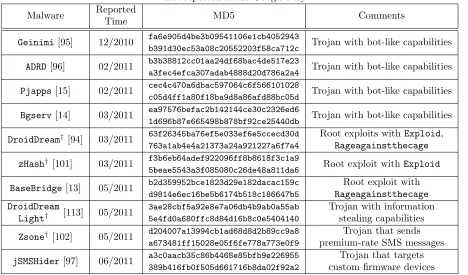
Unfortunately, such popularity has drawn the attention of malware authors. A few re-ports [94, 95, 113] already showed the presence of malicious apps in these marketplaces. For instance, DroidDream [94] and DroidDreamLight [113] were detected from the official app mar-ketplace, i.e., the Google Play, in March and May 2011, respectively. While these reports offer detailed analysis about the spotted (individual) malware, they do not provide a systematic view of the overall health of existing app marketplaces. Encket al.[38] studied 1,100 free apps from the Google Play and attempted to understand a broad range of security-related metrics among them (as an indication of the overall app security). However, the study is limited in only examining a small number of apps, i.e., top 50 free apps from the 22 app categories.
is to detect malicious apps on these marketplaces. To do that, we used a crawler to collect all possible (free) apps we can obtain from five representative marketplaces within a two-month period. In total, we have collected 204,040 apps. To detect malware infection among them, we took the following approach. (1) First, in order to detect the infection from known malware, we propose a scalable and efficient scheme calledpermission-based behavioral footprinting. Instead of taking a traditional approach with content invariants as malware signature, our scheme takes a scalable design by initially filtering out these apps based on the inherent Android permissions required by the malware for its wrongdoings and then matching them with malware-specific behavioral footprints (that characterize the malware behavior – Section 3.2.1). (2) Second, in order to detect unknown malware, we propose a heuristics-based filtering scheme that defines suspicious behaviors from possibly malicious apps and then uses them to detect suspicious apps (Section 3.2.2). Example heuristics include the attempts to dynamically fetch and execute code from a remote untrusted website. For each detected suspicious app, we further dynamically monitor its runtime execution to confirm whether it is truly malicious or not. If the app is malicious and does not appear in our (malware) database, we consider it zero-day and then generate the corresponding permission-based behavioral footprint in a feedback loop to detect other samples in the collection.
We have implemented both schemes in a system calledDroidRangerand used the system to detect infected apps in the collected 204,040 samples from five different marketplaces. Among the collected apps, 153,002 of them come from the Google Play and the rest 51,038 apps come from four other (alternative) marketplaces. To evaluate the effectiveness of our system, we have initially generated behavioral footprints from 10 known Android malware families1. Based on
these footprints, DroidRanger successfully detected 171 infected apps among our collection: 21 infected apps in the Google Play and 150 in four other alternative marketplaces. Moreover, we have implemented two additional heuristics to capture suspicious dynamic code loading behavior, either remotely or locally. These two heuristics effectively lead to the discovery of two sophisticated zero-day malware with 40 samples in our collection (Section 3.3)2.
Overall, by combining both schemes to detect known and zero-day Android malware, DroidRanger reported 211 infected apps in our collection. If we calculate the infection rate, about 0.02% of apps from the Google Play are infected while 0.20% to 0.47% of apps from alternative mar-ketplaces are infected. As a result, the infection rate in alternative marmar-ketplaces is an order of magnitude higher than the Google Play. Considering the recent trend in observing an
unprece-1
The list of known Android malware is shown in Table 3.4.
2
Detection Engine Heuristics−Based Detection Engine Footprint−Based
Repository App
Malware Samples
DroidRanger
M1
M2
M4 M3 Alternative
Official App Marketplace
App Marketplaces
Representative App Marketplaces
Heuristics Behavioral Footprints
Known Malware
Zero−day Malware Infection from Infection from Permission −Based
Figure 3.1 The overall architecture of DroidRanger
dented growth of mobile malware, we believe these results pose a clear call for better security protection in both official and alternative marketplaces.
The rest of this chapter is organized as follows: We first describe the overall system design of DroidRanger in Section 3.2. We then present the system prototype and related evaluation in Section 3.3. After that, we discuss possible limitations and future improvements in Section 3.4. Finally, we summarize our work in Section 3.5.
3.2
Design
a scheme called permission-based behavioral footprinting for scalable and efficient malware detection. For unknown malware, we choose to devise a few heuristics that define suspicious behaviors from possibly malicious apps and then use them to effectively identify suspect apps for runtime monitoring.
Figure 3.1 shows an overview of our approach. In essence, DroidRanger leverages a crawler to collect Android apps from existing app marketplaces and saves them into a local repository. For each collected app, DroidRanger extracts fundamental properties associated with each app (e.g., the requested permissions and author information) and organizes them along with the app itself in a central database for efficient indexing and lookup.
After that, in order to detect potentially malicious apps, we take an approach with two different detection engines. The first detection engine (or footprint-based detection engine) is tailored to detect known malware. Specifically, each known malware will be first pre-processed or distilled into a so-called permission-based behavioral footprint. Each footprint essentially con-tains necessary Android permissions requested by the malware and succinctly summarizes the wrongdoings. These footprints are essentially the key to meet the scalability and efficiency re-quirements. The second detection engine (or heuristics-based detection engine) aims to uncover malware that has not been reported before. In particular, it recognizes suspicious behaviors from possibly malicious apps and detects certain Android features that may be misused. By doing so, we can identify suspicious apps and each will then be executed and monitored to verify whether it indeed exhibits any malicious behavior at runtime. If so, the app will then be manually confirmed and the associated behavioral footprint will be extracted and included in the first detection engine. In the following, we examine each detection engine in detail.
3.2.1 Detecting Known Android Malware
To meet the scalability and accuracy requirements, our first detection engine is divided into two steps:permission-based filteringand behavioral footprint matching. The first step aims to quickly exclude unrelated apps to obtain a more focused set of apps, which will then be used in the second step for detailed malware behavior matching.
Table 3.1 The number of remaining apps after filtering the repository with RECEIVE SMS/SEND SMS permissions
Permission RECEIVE SMS SEND SMS RECEIVE SMS
& SEND SMS
Apps 5,214 8,235 3,204
Percentage 2.85% 4.50% 1.75%
our system can remain efficient even though our second step may involve expensive or time-consuming methods for deep scanning or thorough analysis.
For illustration, we use two functionalities that are often misused by Android malware: sending SMS messages and monitoring SMS messages. For instance, the Zsone malware [102] is designed to send SMS messages to certain premium numbers, which will cause financial loss to the infected users. To hide these SMS messages from users, the malware also monitors received SMS messages and removes billing-related notifications. In Android, to use these two functionalities, an app needs to request SEND SMS and RECEIVE SMS permissions, respectively.
Therefore, to detect this type of malware, we can first scan the app repository with these two permissions. In Table 3.1, we show the number of apps after we apply the filtering based on these two permissions in our collection: 5,214 apps request theRECEIVE SMSpermission, which means
97.15% of apps do not need to be considered further for this type of malware. Similarly, filtering the repository withSEND SMSremoves 95.50% of apps from consideration. Combining these two permissions together, only 1.75% apps remain. Our experience (Section 3.3.1) indicates that permission-based filtering is generally effective, even though the final results may depend on the popularity of the permissions of interest. In one case of our study, only 0.66% apps are needed to be processed in our second step.
We stress that in the selection of permissions for filtering, it is important to choose only essential ones. Including non-essential permissions will unnecessarily exclude apps, which leads to false negatives. For instance, considering a trojanized app with bot functionalities, we may select the permissions required for its command and control channel, but not those required by optional payloads (that could be easily changed from one variant to another). In our study, we have experienced one case with respect to the the Pjapps [15] malware. In particular, the malware requires the INTERNETpermission to support the communication with the remote bot server and theRECEIVE SMSpermission to intercept or monitor incoming SMS messages. However, some variants may have the payload to add bookmarks to the built-in web browser (requiring
WRITE HISTORY BOOKMARKS) and others do not. As such, we should only choose INTERNET and
Behavioral footprint matching Our first-step screening is effective in significantly reducing the number of apps for examination. However, it may leave thousands of apps, which means manual analysis is still not feasible. In our second step, we initially attempt to deploy and run off-the-shelf mobile anti-virus software [67]. However, the results are not satisfactory. In fact, an example run of a leading mobile anti-virus software missed about 23.52% of infected apps from our study (Section 3.3.1)3.
As our solution, instead of taking the traditional approach of extracting content invariants as malware signatures, we choose to take a behavior-based approach. Specifically, we manually analyze and distill essential malware behaviors into their behavioral footprints. Note that be-cause the first step has significantly reduced the number of apps for further processing, we can afford in the second step semantic-rich, but potentially time-consuming methods to express, summarize, and match malware behaviors. In particular, our behavioral footprinting scheme accommodates multiple dimensions to describe malware behaviors.
• First, the app-specific manifest file provides semantic-rich information about the app and the information is readily accessible for our purposes. For example, if an app needs to listen to system-wide broadcast messages, the broadcast receivers can be statically contained in the manifest file or dynamically registered in the code. We can then express the following rule to match any app that monitors incoming SMS messages: an app contains a receiver that listens to android.provider.Telephony.SMS RECEIVED.
• Second, the app bytecode contains a wealth of semantic information, which can also be used in our behavioral footprints. Specifically, in DroidRanger, we choose to focus on those APIs defined in the Android framework. Particularly, we can express what APIs are called, and their sequences in a single rule. Moreover, by leveraging the call graph, we can associate API calls to a specific component in the rule. As an example, by extending the previous rule with a call to theabortBroadcastfunction, we can obtain a rule to capture any app that monitors incoming SMS messages and may potentially intercept received SMS messages. Furthermore, we can also utilize a data flow analysis algorithm [38] to detect function parameters with static or fixed inputs. This rule can be used to express malware behavior such as sending SMS messages to premium numbers.
• Third, we can also express malware behaviors based on the structural layout of the app. As an Android app is essentially a compressed archive, we can decompress it to reveal its
3
internal tree structure and then correspondingly express rules such as what packages are used by the app, what kind of class hierarchies they have, and where a specific resource is located.
To illustrate, we again use theZsone[102] example, an SMS Trojan that sends short messages to premium numbers and removes billing-related notification messages from respective service providers. We can accordingly generate the following behavioral footprints to describeZsone: (1)
An app contains a receiver that listens to android.provider.Telephony.SMS RECEIVEDand calls
abortBroadcast; (2) An app sends SMS messages to certain specific premium numbers, includ-ing “10621900”, “106691819”, “10665123085”, “1066185829” and etc.; (3) An app intercepts SMS messages from certain numbers, including “10086”, “10000”, “10010”, and “1066134.” This behavioral footprint can then be efficiently applied to detect Zsone-infected apps in our collection. In practice, we found this scheme is rather effective and efficient, which leads to the discovery of 9 instances of Zsone-infected apps from the Google Play in our collection (Section 3.3.1).
3.2.2 Detecting Unknown Android Malware
Our first detection engine is designed to capture known malware. Next, we present the second detection engine to uncover unknown malware. Similar to the first one, our second detection engine also works in two steps: heuristics-based filtering and dynamic execution monitoring. The first step applies certain heuristics to identify potentially suspicious apps, which will then be confirmed in the second step.
Heuristics-based filtering Unlike the first detection engine that can have known malware samples as templates for detection, our second step has to rely on certain heuristics to uncover zero-day malware. Although we can potentially employ different types of heuristics, we in this work focus on certain Android features that may be misused to load new code, either Java binary code or native machine code. The reasoning is straightforward: dynamic loading of new (untrusted) code can always open the doors for misuse and it becomes hard to predict what kind of code will be executed next.
Accordingly, the first heuristic is related to the dynamic loading of Java binary code from a remote untrusted website. Typically, an Android app is self-contained in that itsclasses.dex
file contains all the Dalvik bytecode for execution. However, the Dalvik VM provides the
Table 3.2 The number (and percentage of) apps with native code not in the default location
Apps with Native Code
Native Code in Assets Directory
Native Code in Res Directory 8272 (4.52%) 313 (0.17%) 195 (0.11%)
indicates a potential threat to user privacy and security. Our measurement on the collected apps shows thatDexClassLoaderis used by 1055 apps (about 0.58%), and the vast majority of them are related to advertisement libraries, instead of the app itself. For example, one particular advertisement library, i.e., AdTOUCH [5], accounts for 40% of the uses ofDexClassLoader. By
considering the use of this feature by the app itself as suspicious, we further put the related apps under scrutiny, which essentially leads to the discovery of the zero-day Plankton spyware (Section 3.3.2).
Our second heuristic is about the dynamic loading of native code locally. Most of the Android apps are programmed in Java. However, for performance or compatibility reasons, about 4.52% Android apps we studied still use native code. Note that though each app may run with a separate UID, the OS (Linux) kernel’s system call interface is directly exposed to the native code, making it possible for malicious apps to exploit vulnerabilities in OS kernel and privileged daemons to “root” the system. In Android, the default directory to store the native code is in the app-specific lib/armeabi subdirectory. As such, we consider it unusual if an app attempts to keep (or rather hide) native code in a directory other than the default one. Table 3.2 shows that about 4.52% of the total apps contain native code. In addition, 0.17% save native code in the assets directory and 0.11% put native code in the res/raw directory. This heuristic leads to the discovery of the zero-day DroidKungFumalware (Section 3.3.2).
Dynamic execution monitoring Our heuristics effectively identify new untrusted code running in the app. Our next step deploys a dynamic execution monitor to inspect its run-time behaviors, particularly those triggered by the new code. In particular, for the dynam-ically loaded Java code, our dynamic monitor records any calls to the Android framework APIs (particularly these related to Android permissions) and their arguments. The arguments can provide rich semantic information about an app’s behavior. For example, a call to the
Table 3.3 Statistics of collected apps from existing app marketplaces
the Google Play Store
Alternative App Marketplaces
M1 M2 M3 M4
Number of Apps 153,002
(74.98%)
17,229 (8.44%)
14,943 (7.33%)
10,385 (5.09%)
8,481 (4.16%)
Total Apps 153,002 (74.98%) 51,038 (25.02%)
204,040
but instead focus on those used by existing Android root exploits and/or made with the root privilege (with the assumption that malware will use them to subvert the system integrity after gaining the root privilege). For instance, we are interested in thesys mount system call because it can be used to remount the (normally read-only) Android system partition for modification. After collecting the logs, we then analyze them to look for signs of suspicious runtime behaviors (e.g., sending SMS messages to premium numbers, executing certain system calls with root privilege and etc.). If so, we will further manually validate whether the app is indeed a zero-day malware. If yes, we will then extract the corresponding behavioral footprint and include it in the first detection engine to detect other samples infected by this malware.
3.3
Evaluation
In this section, we present our evaluation results by applying our system to the collected apps from existing app marketplaces. Specifically, we crawled five representative marketplaces, in-cluding the Google Play (maintained by Google), eoeMarket [39] , alcatelclub [6], gfan [48], and mmoovv [72] 4. The collection was made in a two-month period during May and June 2011 and the number of apps from each marketplace is shown in Table 3.3. In total, we collected 204,040 free apps. Among them,∼75% of apps (153,002) are collected from the Google Play and the rest 25% (51,038) come from the four alternative markets (with each having about tens of thousands of apps). Due to the fact that an app may be included in multiple markets, there are total 182,823 distinct apps5.
4
For simplicity, we use M1, M2, M3, and M4 to denote these four alternative marketplaces in the rest of this chapter.
5
Table 3.4 Ten known malware families used in this study
†: first reported in the Google Play
Malware Reported
Time MD5 Comments
Geinimi[95] 12/2010 fa6e905d4be3b09541106e1cb4052943
b391d30ec53a08c20552203f58ca712c Trojan with bot-like capabilities
ADRD[96] 02/2011 b3b38812cc01aa24df68bac4de517e23
a3fec4efca307adab4888d20d786a2a4 Trojan with bot-like capabilities
Pjapps[15] 02/2011 cec4c470a6dbac597064c6f566101028
c05d4ff1a80f18ba9d8a86afd88bc05d Trojan with bot-like capabilities
Bgserv[14] 03/2011 ea97576befac2b142144ce30c2326ed6
1d696b87e665498b878bf92ce25440db Trojan with bot-like capabilities
DroidDream† [94] 03/2011 63f26345ba76ef5e033ef6e5ccecd30d 763a1ab4e4a21373a24a921227a6f7a4
Root exploits with Exploid, Rageagainstthecage zHash† [101] 03/2011 f3b6eb64adef922096ff8b8618f3c1a9
5beae5543a3f085080c26de48a811da6 Root exploit withExploid BaseBridge [13] 05/2011 b2d359952bce1823d29e182dacac159c
d9814e6ec16be5b6174b518c186647b5
Root exploit with Rageagainstthecage DroidDream
Light† [113] 05/2011
3ae28cbf5a92e8e7a06db4b9ab0a55ab 5e4fd0a680ffc8d84d16b8c0e5404140
Trojan with information stealing capabilities
Zsone† [102] 05/2011 d204007a13994cb1ad68d8d2b89cc9a8 a673481ff15028e05f6fe778a773e0f9
Trojan that sends premium-rate SMS messages
jSMSHider[97] 06/2011 a3c0aacb35c86b4468e85bfb9e226955 389b416fb0f505d661716b8da02f92a2
Trojan that targets custom firmware devices
3.3.1 Detecting New Samples of Known Malware
To evaluate the effectiveness of our first detection engine, we obtained and analyzed known Android malware samples from 10 different families. Table 3.4 lists these ten malware families, which represent most Android malware reported in the first half of year 2011. For each family, we then extract the corresponding behavioral footprints from two samples (their MD5 values are also included in the table). Among these malware, three of them embed at least one of the following root exploits, i.e., Rageagainstthecage [86], Zimperlich [143], or Exploid [40]. Specifically,Rageagainstthecagetakes advantage of a vulnerability inadbd, a privileged daemon running as root;Zimperlich exploits a similar bug but in the privileged zygote daemon; while Exploidmakes use of the vulnerable udev(init) daemon (CVE-2009-1185) in Android. Among these exploits,Exploidneeds the triggering of certain udev events such as turning on or off the WIFI interface, which requires the CHANGE WIFI STATE permission. Accordingly, our detection
Table 3.5 Essential permissions of 10 known malware families
Malware Essential Permissions Apps
ADRD INTERNET, ACCESS NETWORK STATE
RECEIVE BOOT COMPLETED 10,379 (5.68%)
Bgserv INTERNET, RECEIVE SMS, SEND SMS 2,880 (1.58%)
DroidDream CHANGE WIFI STATE 4,096 (2.24%)
DroidDreamLight INTERNET, READ PHONE STATE 71,095 (38.89%)
Geinimi INTERNET, SEND SMS 7,620 (4.17%)
jSMSHider INSTALL PACKAGES 1,210 (0.66%)
BaseBridge NATIVE CODE 8,272 (4.52%)
Pjapps INTERNET, RECEIVE SMS 4,637 (2.54%)
Zsone RECEIVE SMS, SEND SMS 3,204 (1.75%)
zHash CHANGE WIFI STATE 4,096 (2.24%)
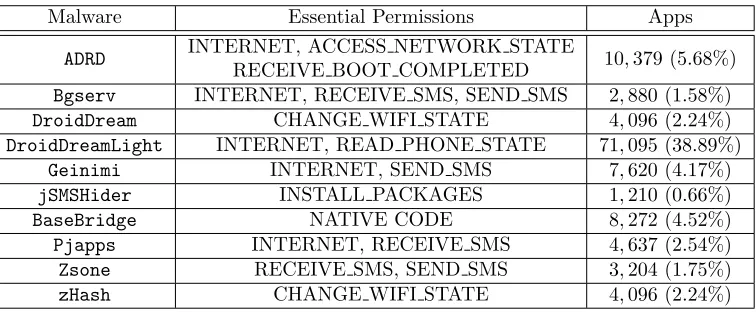
Effectiveness of permission-based filtering Based on the known Android malware samples, our first step is to extract the essential permissions required by the malware to perform its functionalities. In Table 3.5, we list the essential permissions for each malware family and also report the number of apps that survived the permission-based filter. From the table, the proposed permission-based filtering is rather effective for most of these malware families. Specif-ically, eight of them have less than 6% apps left after applying the essential permissions. Among the two exceptions,DroidDreamLightrequiresINTERNETandREAD PHONE STATEpermissions which are common in existing apps. In this particular case, we also observe it needs to register for a broadcast receiver for android.intent.action.PHONE STATE. Therefore, we also leverage it as a pre-condition for our behavioral footprint matching, which significantly reduces to 0.64% of apps (or 1175) for the second step. The another exception, i.e., BaseBridge, does not require any permission, but the fact that contains the native code to launch the Rageagainstthecage
immediately reduces to the 4.52% of apps (with native code) in our collection.
It is worth mentioning the essential permission of a particular malware, i.e., jSMSHider. It is special in that it requires INSTALL PACKAGES, a signatureOrSystem permission. This type of
permission by definition can only be granted to an app either signed by the same signing key as the system firmware or installed in the privileged /system/appdirectory. In other words, it will never be granted to third-party apps.jSMSHideris unique by targeting the popular third-party
custom firmware whose signing key is (inappropriately) publicly accessible. In other words, by signing the infected app with it, jSMSHider is able to gain this signatureOrSystem permission to install a package. As a result, we selected INSTALL PACKAGES as the essential permission for
Table 3.6 The number of infected apps by 10 known malware families on 5 studied marketplaces
Malware the Google
Play Store
Alternative Marketplaces
Total Distinct
M1 M2 M3 M4
ADRD 0 1 1 4 3 9 8
BaseBridge 0 2 2 0 2 6 4
Bgserv 0 0 0 0 1 1 1
DroidDream 0 6 6 0 0 12 6
DroidDreamLight 12 0 0 0 0 12 12
Geinimi 0 26 26 2 10 64 37
jSMSHider 0 3 3 0 6 12 9
Pjapps 0 12 9 14 8 43 31
zHash 0 1 1 0 1 3 2
Zsone 9 0 0 0 0 9 9
Total 21 51 48 20 31 171 119
Effectiveness of behavioral footprint matching After pruning the apps with essential permissions, our second step examines the resulting apps for ones that match known malware behaviors. Our experiments show that the detection of known malware (of 10 families) among these 204,040 apps only took about four and a half hours to complete. Our scanning results are shown in Table 3.6. In particular, we detected 171 malicious apps in our collection with 21 of them from the Google Play and 150 from the other four alternative marketplaces. Similarly, due to the fact that one sample may be submitted to multiple marketplaces, 119 of these 171 infected apps are unique.
Based on the detection results in Table 3.6, it is evident that the malware infection in alternative marketplaces is more serious than the infection in the Google Play. Specifically, the number (150) of infected apps in these four alternative marketplaces is more than 7 times of that in the Google Play (21) even though the total number of apps we collected from the former is only one third of the latter. Moreover, we also found that the Geinimi malware, which was publicly reported in November, 2010, is still spreading in alternative marketplaces. This is in sharp contrast to the timely removal of malware from the Google Play.
In this study, we also attempted to measure the effectiveness of existing mobile anti-virus software. Especially, we downloaded and installed the free version of Lookout Security & An-tivirus, one of the leading mobile security software from the Google Play. We first tested it in the first week of August 2011 and then tested it again in the first week of November6 to scan the samples reported by our system. In our experiments, we installed those malware samples
6
Table 3.7 The missed known malware families by Lookout Security & Antivirus software
T, D, and M represent the total, detected, and missed number of samples, respectively.
ADRD Bgserv jSMSHider BaseBridge Pjapps
T D M T D M T D M T D M T D M
version 6.3 (r8472) 8 3 5 1 0 1 9 6 3 4 1 3 31 15 16
version 6.11 (26cf47e) 8 3 5 1 0 1 9 9 0 4 4 0 31 31 0
one by one on a Nexus One phone (running Android version 2.3.3) with the Lookout Security & Antivirus software. The scanning results are shown in Table 3.7.
From the table, none of these two versions can detect all the samples. In particular, among these 119 distinct malware samples, the earlier version (6.3) reports 91 as malware and 28 sample as safe, leading to a high false negative rate 23.52%. To verify that these 28 samples are indeed malicious, we have manually examined these samples and confirmed each single of them. The recent version (6.11) performs better by reporting 113 as malware and 6 samples as safe with a reduced false negative rate 5.04%. We believe the improvement of scanning results is due to the active update of malware signatures.
False negative measurement Our previous experiments demonstrate the effectiveness of our scheme (especially in terms of false positives) for known malware detection. Next, we aim to measure the false negatives of our system. To do that, we first download (in the first week of August, 2011) the malware samples from the contagio dump [28], which seems to be the only publicly available repository of mobile malware samples. Within the downloaded data set, there are 27 samples falling in the 10 known families which we have the related behavioral footprints. Because our scheme requires known malware samples for behavioral footprint extraction, we take cautions in eliminating those duplicate samples in thecontagio dumpwith the same SHA1 values used in footprint extraction. As a result, there are 24 distinct samples in total for our measurement. Though the data set is not sufficient large, this seems to be the only available source for our study.
Based on these 24 samples, our system detected 23 of them, implying a false negative rate of 4.2%. A detailed analysis of the missing sample shows that it is the payload (com.android.providers .downloadsmanager) of the DroidDream malware, not the malware itself. This payload is also a
Table 3.8 Two zero-day malware families detected by DroidRanger
Malware the Google
Play Store
Alternative Markets
Total Distinct
M1 M2 M3 M4
Plankton 11 0 0 0 0 11 11
DroidKungFu 0 9 10 1 9 29 18
Total 11 9 10 1 9 40 29
3.3.2 Detecting Zero-day Malware
Next, we present the evaluation results for zero-day malware detection. As mentioned earlier, we have developed heuristics to identify suspicious apps that dynamically load untrusted code for execution. These heuristics effectively lead to the discovery of two zero-day malware:Plankton
andDroidKungFu. Table 3.8 shows the number of detected zero-day malware samples from each marketplace. In this section, we present in more detail on how we discovered these two malware and what are their malicious behaviors.
Plankton In the second detection engine, our first heuristic is to capture dynamic loading of untrusted code from remote websites. With that, we perform a query on the collected apps and found 1,055 apps that invoked theDexClassLoadersupport for Java class loading. A further inspection shows that most of such uses are actually by advertisement libraries. After a simple white-listing of advertisement libraries, we run the remaining 240 apps with a dynamic execution monitor (Section 3.2.2).
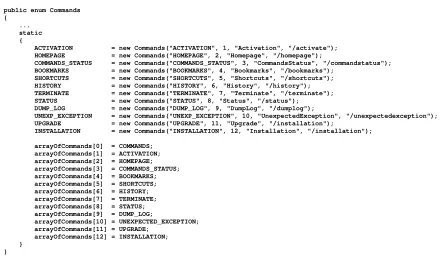
With a dynamic monitor, we can not only intercept the code-loading behavior, but also ob-tain thejar/apkfiles that are being actually loaded. In this particular case, when running a sus-pect app named Angry Birds Cheater (com.crazyapps.angry.birds.cheater.trainer.helper) in our dynamic monitor, our logs show the attempt to load one jar file named “plankton -v0.0.4.jar,” which is downloaded from a remote website. A more in-depth analysis shows that before downloading this jar file, the app transports the list of permissions granted to the app over to a remote server. This would presumably allow the remote server to customize the dynamically loaded binary based on the granted app’s permissions. For the downloaded plankton v0.0.4.jar
file, it turns out that it contains a number of bot-related functionalities or commands that can be remotely invoked. In Figure 3.2, we show the list of commands supported by this spyware. Specifically, the /bookmarks command manipulates the browser bookmarks, and the /history
public enum Commands {
... static {
ACTIVATION = new Commands("ACTIVATION", 1, "Activation", "/activate"); HOMEPAGE = new Commands("HOMEPAGE", 2, "Homepage", "/homepage");
COMMANDS_STATUS = new Commands("COMMANDS_STATUS", 3, "CommandsStatus", "/commandstatus"); BOOKMARKS = new Commands("BOOKMARKS", 4, "Bookmarks", "/bookmarks");
SHORTCUTS = new Commands("SHORTCUTS", 5, "Shortcuts", "/shortcuts"); HISTORY = new Commands("HISTORY", 6, "History", "/history"); TERMINATE = new Commands("TERMINATE", 7, "Terminate", "/terminate"); STATUS = new Commands("STATUS", 8, "Status", "/status");
DUMP_LOG = new Commands("DUMP_LOG", 9, "DumpLog", "/dumplog");
UNEXP_EXCEPTION = new Commands("UNEXP_EXCEPTION", 10, "UnexpectedException", "/unexpectedexception"); UPGRADE = new Commands("UPGRADE", 11, "Upgrade", "/installation");
INSTALLATION = new Commands("INSTALLATION", 12, "Installation", "/installation");
arrayOfCommands[0] = COMMANDS; arrayOfCommands[1] = ACTIVATION; arrayOfCommands[2] = HOMEPAGE; arrayOfCommands[3] = COMMANDS_STATUS; arrayOfCommands[4] = BOOKMARKS; arrayOfCommands[5] = SHORTCUTS; arrayOfCommands[6] = HISTORY; arrayOfCommands[7] = TERMINATE; arrayOfCommands[8] = STATUS; arrayOfCommands[9] = DUMP_LOG;
arrayOfCommands[10] = UNEXPECTED_EXCEPTION; arrayOfCommands[11] = UPGRADE;
arrayOfCommands[12] = INSTALLATION; }
}
Figure 3.2 The list of commands supported in Plankton
After we identified the Plankton malware, we generated its behavioral footprint and applied it to detect other incidents in our collection. As a result, we detect 10 more Planktonsamples; all of them could be downloaded at that time from the Google Play. We then reported these 11 apps to Google, which promptly removed them from the Google Play on the same day.
DroidKungFu Our second heuristic aims to detect suspicious apps that load native code in an unusual way (e.g., from non-standard directories). In fact, among 8,272 apps that contain native code, 508 of them keep native code in non-standard directories. As such, we monitored the runtime behaviors of these apps with our dynamic monitor. When analyzing the log, we find some particular apps that attempted to remount the system partition (with the sys mount
syscall) to make it writable. This is highly suspicious because remounting system partition can only be executed by users with the root privilege. For third-party apps, this almost certainly means that the app has successfully launched a root exploit.
Therefore, we further analyze these apps, which lead to the discovery of DroidKungFu mal-ware. The malware contains bothRageagainstthecageandExploidroot exploits in an encrypted
Table 3.9 The total number of malware samples detected by DroidRanger
Malware the Google
Play Store
Alternative Markets
Total Distinct
M1 M2 M3 M4
Total (Known) 21 51 48 20 31 171 119
Total (Zero-day) 11 9 10 1 9 40 29
Total 32
(0.02%)
60 (0.35%)
58 (0.39%)
21 (0.20%)
40
(0.47%) 211 148
modify any resources on the phone, including the installation and removal of another app. Our study shows that one particular app installed by DroidKungFu pretends to be the legitimate Google Search app by showing an identical icon. This app actually acts as a bot client that will connect to a remote server to retrieve and execute commands.
3.3.3 Summary of Detected Malware
Overall, our system detected 211 malicious or infected apps among the collected 204,040 apps from five studied marketplaces. The detailed breakdown is shown in Table 3.9: among these 211 apps, 32 of them are from the Google Play (∼0.02% infection rate) and 179 come from the other four alternative marketplaces (0.20%-0.47% infection rates). Due to the relative lack of regulation in alternative marketplaces, their infection rate is more than an order of magnitude higher than the Google Play. Considering the recent trend in observing an unprecedented growth of mobile malware, we believe a rigorous vetting process needs to be in place for both official and alternative marketplaces.
3.4
Discussion
marketplaces three months later after they were removed from the Google Play. Moreover, we notice that some malware have embedded the root exploits which allow them to obtain full access on compromised devices. In fact, among the 10 known malware families, four of them, i.e., BaseBridge, DroidDream, DroidKungFu, and zHash, have at least one root exploit. Last but not least, zero-day malware exist in both official and alternative marketplaces and they may be able to bypass most existing, if not all, up-to-date mobile anti-virus software.
With that, there is a clear need to instantiate a rigorous vetting or policing process in both official and alternative app marketplaces, which is currently lacking. In the same spirit, we argue the current model of passively waiting for the feedback or ratings from users and the community may not work as smoothly as we expect. In fact, to foster a hygienic mobile app ecosystem, there is a need for a vetting process that includes DroidRanger-like systems to examine uploaded apps and better protect mobile users.
From another perspective, our current prototype is still limited in the coverage of apps and marketplaces. For example, though the collected pool of apps may be useful to demonstrate the effectiveness of our current prototype, they are all free apps. A recent report from Androlib [33] shows that 36.2% of existing apps are paid ones. We have the reason to believe that paid apps could provide unique differences that may warrant necessary re-design or adaption of our system. Also, our current study only focuses on five different app marketplaces. Though our findings may not be directly applicable to other marketplaces including iOS-related app stores, the principles or key methodologies used in this study can still be applied.
Finally, we point out that our current study only explored two basic heuristics to uncover zero-day malware. There exist many other heuristics that could be equally effective. For exam-ple, a heuristic can be developed to capture apps that involve background sending of unautho-rized SMS messages to certain premium-rated numbers. Another heuristic can also be designed to detect bot-like behavior that is remotely controlled by SMS messages. The exploration of these heuristics to capture additional zero-day malware remains an interesting future work.
3.5
Summary
Chapter 4
Dissecting Android Malware:
Characterization and Evolution
4.1
Introduction
In previous chapter, we introduced a system called DroidRanger that detected the malicious Android apps in official and alternative app marketplaces. Our system successfully detected 211 malicious apps and uncovered two zero-day malware families in both official and alternative marketplaces. From another perspective, it has been highlighted [77] that “among all mobile malware, the share of Android-based malware is higher than 46% and still growing rapidly.” According to the latest report from Lookout, in year 2014 there was an astounding 75% increase in Android mobile malware encounter rates in the United States compared to year 2013 [2].
Given the rapid growth of Android malware, there is a pressing need to effectively mitigate or defend against them. However, without an insightful understanding of them, it is hard to imagine that an effective mitigation solution can be practically developed. To make matters worse, the research community at large is still constrained by the lack of a comprehensive mobile malware dataset to start with.
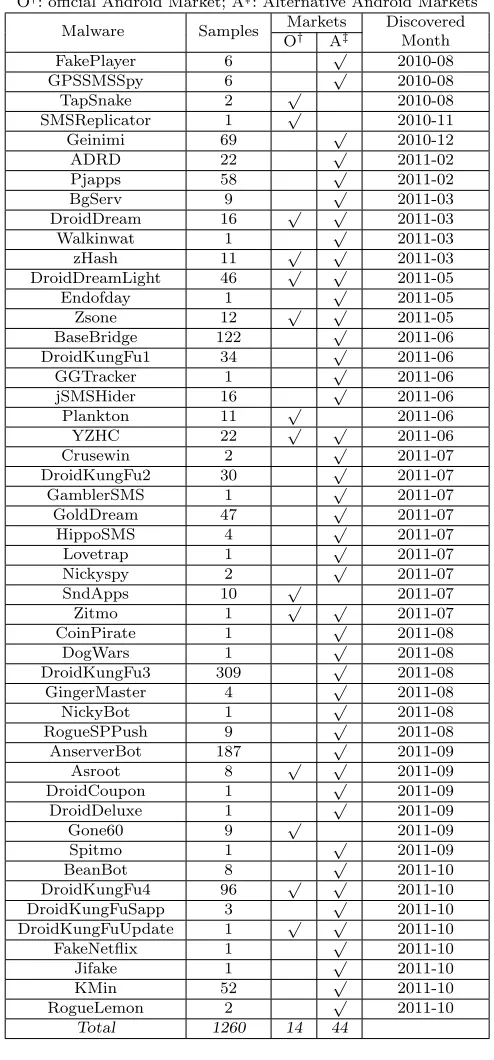
The goals and contributions of this work are three-fold. First, we fulfil the need by pre-senting the first large collection of 1260 Android malware samples1 in 49 different malware families, which covers the majority of existing Android malware at that time. The dataset is accumulated from more than one year effort in collecting related malware samples, includ-ing manual or automated crawlinclud-ing from a variety of Android Markets. To better mitigate mobile malware threats, we have released the entire dataset to the research community at
http://malgenomeproject.org/.2 Until now, we have shared the dataset with more than 450 universities, research labs and companies all over the world.
Second, based on the collected malware samples, we perform a timeline analysis of their discovery and thoroughly characterize them based on their detailed behavior break-down, in-cluding the installation, activation, and payloads. The timeline analysis is instrumental to re-vealing major outbreaks of certain Android malware in the wild while the detailed breakdown and characterization of existing Android malware is helpful to better understand them and shed light on possible defenses.
Specifically, in our 1260 malware samples, we find that 1083 of them (or 86.0%) are repack-aged versions of legitimate applications with malicious payloads, which indicates the policing need of detecting repackaged applications in the current Android Markets. Also, we observe that more recent Android malware families are adopting update attacks and drive-by down-loads to infect users, which are more stealthy and difficult to detect. Further, when analyzing the carried payloads, we notice a number of alarming statistics: (1) Around one third (36.7%) of the collected malware samples leverage root-level exploits to fully compromise the Android security, posing the highest level of threats to users’ security and privacy; (2) More than 90% turn the compromised phones into a botnet controlled through network or short messages. (3) Among the 49 malware families, 28 of them (with 571 or 45.3% samples) have the built-in sup-port of sending out background short messages (to premium-rate numbers) or making phone calls without user awareness. (4) Last but not least, 27 malware families (with 644 or 51.1% samples) are harvesting user’s information, including user accounts and short messages stored on the phones.
Third, we perform an evolution-based study of representative Android malware, which shows that they are rapidly evolving and existing anti-malware solutions are seriously lagging behind. For example, it is not uncommon for Android malware to have encrypted root exploits or obfus-cated command and control (C&C) servers. The adoption of various sophistiobfus-cated techniques greatly raises the bar for their detection. In fact, to evaluate the effectiveness of existing mo-bile anti-virus software, we tested our dataset with four representative ones, i.e.,AVG Antivirus Free, Lookout Security & Antivirus, Norton Mobile Security Lite, and Trend Micro Mobile Security Personal Edition, all downloaded from the official Android Market (in the first week of November, 2011). Sadly, wile the best case was able to detect 1,003 (or 79.6%) samples in our dataset, the worst case can only detect 254 (20.2%) samples. Furthermore, our analysis shows that malware authors are quickly learning from each other to create