TRIANGLE-BASED LEVEL OF DETAIL TECHNIQUE
MUHAMAD NAJIB BIN ZAMRI
A thesis submitted in fulfilment of the requirements for the award of the degree of
Master of Science (Computer Science)
Faculty of Computer Science and Information System Universiti Teknologi Malaysia
To
my beloved father and mother, Zamri Ismail and Rashidah Shariff; my brothers, Azainizam, Shahirman and Hanafi;
ACKNOWLEDGEMENT
First of all, thanks to Allah SWT, the Creator, for giving me the strength to complete this thesis. I would like to express my appreciation to the Ministry of Science, Technology and Innovation (MOSTI) for providing me the financial support to further my education to this level under National Science Fellowship (NSF)
program. Obviously, without their help, this journey would not have allowed.
I would like to express my sincere gratitude to my main supervisor, Associate Professor Safie Mat Yatim and my co-supervisor, Mr. Noor Azam Md. Sheriff, for their guidance and support through my studies as well as their constructive criticism of my research. This thesis would not have been possible without them. I would like to thank lecturers that involved and gave their brilliant ideas and solutions for this research especially Associate Professor Sarudin Kari, Associate Professor Daut Daman, Mr. Nik Isrozaidi Nik Ismail and Mr. Mohd Shafry Mohd Rahim.
Furthermore, I would also like to acknowledge my fellow postgraduate students, colleagues and housemates who have made my lives so enjoyable. They are Irwandi Hipni, Yusrin, Hamimah, Mun San, Weng, Baldave, Sandilian, Kim Heok, Adlur, Fendi, Amri, Mohd Hafiz, Asyraf and Asrulakmar. Special thanks go to foreign researchers that help me in explaining the related technical processes and developing the prototype system. They are Stefan Röttger, Mark Duchaineau, Peter Lindstrom, Chris Cookson, ZhaoYoubing, Thatcher Ulrich and Ulf Assarsson.
ABSTRACT
The massive volume of data involved in the development of a real-time terrain visualization and navigation system is inevitable. Based upon the current off-the-shelf hardware capability, it is impossible to process the amount of data using the conventional approach. This is due to the fact that the amount of data to be
processed exceeds the capacity that can be loaded into main memory. This problem is further compounded by other hardware constraints such as memory bus speed and data transfer bandwidth from the main memory to the graphics card. Consequently, this limitation has affected the total system performance. The triangle-based level of detail (LOD) technique has been developed in order to reduce the drawback but it still suffers from the main memory constraint and slow data loading. The purpose of this research is to design, develop and implement an algorithm for enhancing the rendering efficiency of triangle-based LOD technique. A prototype system has been developed using digital elevation data for testing purposes. The system was
evaluated based on the following criteria, namely: data size, processing time for data partitioning, memory usage, loading time, frame rate, triangle count and geometric throughput. According to the results obtained during the pre-processing, the
ABSTRAK
Data bersaiz besar yang terlibat di dalam pembangunan sistem visualisasi dan navigasi bentuk muka bumi secara masa nyata memang tidak dapat dielakkan. Berdasarkan kepada keupayaan perkakasan terkini yang berada di pasaran, adalah mustahil untuk memproses data tersebut menggunakan pendekatan biasa. Ini disebabkan oleh amaun data yang diproses melebihi kapasiti yang boleh dimuatkan ke dalam ingatan utama. Masalah ini ditambah pula dengan kekangan-kekangan perkakasan lain seperti kelajuan ingatan bas dan lebar jalur penghantaran data dari ingatan utama ke kad grafik. Kesannya, limitasi ini telah mempengaruhi keseluruhan prestasi sistem. Teknik aras keperincian berasaskan segi tiga telah dibangunkan dalam usaha untuk mengurangkan kelemahan tetapi masih perlu berhadapan dengan kekangan ruang ingatan utama dan pemuatan data yang perlahan. Tujuan
penyelidikan ini adalah untuk mereka bentuk, membangun dan mengimplementasi sebuah algoritma bagi meningkatkan keberkesanan perenderan teknik aras
keperincian berasaskan segi tiga. Satu sistem prototaip telah dibangun dengan menggunakan data ketinggian digital untuk tujuan pengujian. Sistem ini telah dinilai berdasarkan kepada kriteria-kriteria berikut: saiz data, masa pemprosesan bagi pemecahan data, penggunaan ruang ingatan, masa pemuatan, kadar kerangka, serta bilangan dan kadar penjanaan segi tiga. Berdasarkan kepada keputusan yang diperolehi semasa pra-pemprosesan, pemecahan data ketinggian digital kepada blok-blok data kecil telah berjaya mengurangkan saiz data walaupun proses ini
memerlukan masa pemprosesan yang lebih panjang. Semasa pemprosesan masa larian, gabungan skema pemuatan blok-blok data kecil yang dinamik, teknik penghapusan data berasaskan sudut pandangan dan teknik aras keperincian berasaskan segi tiga yang dipertingkatkan telah menghasilkan keputusan yang memberangsangkan dengan peningkatan keseluruhan yang signifikan jika
dibandingkan dengan teknik-teknik yang telah dibangunkan sebelum ini. Algoritma yang dicadangkan di dalam tesis ini adalah sangat praktikal di dalam membangunkan aplikasi-aplikasi grafik yang bersifat interaktif di mana mempertimbangkan
TABLE OF CONTENTS
CHAPTER TITLE PAGE
TITLE PAGE i
DECLARATION OF ORIGINALITY AND
EXCLUSIVENESS ii
DEDICATION iii
ACKNOWLEDGEMENT iv
ABSTRACT v
ABSTRAK vi
TABLE OF CONTENTS vii
LIST OF TABLES xii
LIST OF FIGURES xiii
LIST OF ALGORITHMS xvi
LIST OF ABBREVIATIONS xviii
LIST OF APPENDICES xx
1 INTRODUCTION 1
1.1 Introduction 1
1.2 Problem Background 5 1.2.1 Massive Terrain Dataset 5 1.2.2 Geometric Complexity 6
1.2.3 Limited Capability of Triangle-Based LOD
Techniques 8
1.3 Problem Statements 8
1.5 Objectives 9
1.6 Scopes 9
1.7 Organization of the Thesis 10
2 LITERATURE REVIEW 11
2.1 Introduction 11
2.2 Spatial Data Structures 12
2.2.1 Kd-Tree 13
2.2.2 Quadtree 15
2.2.3 R-Tree 16
2.2.4 Tiled Block 18
2.2.5 Comparative Studies 19 2.3 Visibility Culling Methods 20
2.3.1 Types of Culling Methods 21 2.3.1.1 Backface Culling 21
2.3.1.2 Small Feature Culling 22 2.3.1.3 Occlusion Culling 23
2.3.1.4 View Frustum Culling 24 2.3.1.5 Comparative Studies 25 2.3.2 Intersection Test Techniques 26 2.3.2.1 Axis Aligned Bounding Box 27 2.3.2.2 Oriented Bounding Box 27 2.3.2.3 Bounding Sphere 29 2.3.2.4 k-Discrete Orientation Polytope 30 2.3.2.5 Comparative studies 31 2.4 View-Dependent LOD Techniques 32 2.4.1 Terrain Representation 32
2.4.2 Geometric Primitives 35 2.4.2.1 Independent Triangles 35 2.4.2.2 Triangle Fans 36 2.4.2.3 Triangle Strips 36 2.4.2.4 Comparative Studies 37 2.4.3 Previous Works 37 2.4.3.1 Real-time Optimally Adapting
Meshes 38
2.4.3.2 Real-time Generation of
Continuous LOD for Height Fields 43 2.4.3.3 View-Dependent Progressive
Meshes 45
2.4.3.4 Out-of-Core Terrain Visualization 48 2.4.3.5 Comparative Studies 52
2.5 Summary 53
3 METHODOLOGY 55
3.1 Introduction 55
3.2 Partitioning Terrain Data 58 3.2.1 Extracting Data 58
3.2.2 Splitting Data into Tiles 59 3.3 Loading Terrain Tiles 63 3.4 Culling Invisible Terrain Tiles 64 3.4.1 Plane Extraction 64 3.4.2 Intersection Test 67 3.5 Simplifying Geometry of Visible Terrain Tiles 68 3.5.1 Distance Calculation 69 3.5.2 Subdivision Test 69
3.5.3 Generation of Triangle Fans 70
4 IMPLEMENTATION 72
4.1 Introduction 72
4.2 Pre-Processing 73
4.2.1 Reading a DEM File and Creating TXT
Files 73
4.2.2 Reading TXT Files and Creating TILE
Files 79
4.3 Run-time Processing 87 4.3.1 Creation of Classes 87 4.3.2 Initialization 89
4.3.3 Rendering 89
4.3.3.1 Configuring Information for
Camera 90
4.3.3.2 Loading and Unloading Terrain
Tiles 90
4.3.3.3 Calculating Frustum’s Planes 92 4.3.3.4 Removing Unseen Terrain Tiles 93 4.3.3.5 Generating Quadtree Traversal 94 4.3.3.6 Generating Triangle Fans 94
4.3.4 Interaction 96
4.3.5 Shutdown 96
4.4 Summary 97
RESULTS, ANALYSIS AND DISCUSSIONS 98
5.1 Introduction 98
5.2 System Specifications 99 5
5.3 Testing Data 100
5.4 Screenshots from the Prototype System 101
5.5.2 Run-time Processing 105 5.5.2.1 Memory Usage 106 5.5.2.2 Loading Time 108 5.5.2.3 Frame Rate 109 5.5.2.4 Triangle Count 111 5.5.2.5 Geometric Throughput 113 5.6 Comparison with Previous Techniques 114 5.6.1 Memory Usage 115 5.6.2 Loading Time 116
5.6.3 Frame Rate 117
5.6.4 Triangle Count 118
5.7 Summary 120
6 CONCLUSION 121
6.1 Conclusion 121
6.2 Recommendations 124
REFERENCES 126
LIST OF TABLES
TABLE NO. TITLE PAGE
1.1 Types of busses and the corresponding memory bandwidth and geometric throughput (Hill, 2002;
Peng et al., 2004) 7
2.1 Advantages and disadvantages of visibility culling
methods 25
2.2 Comparison of intersection test techniques 31 2.3 Comparison among the geometric primitives 37 2.4 Comparison of view-dependent LOD techniques 53 3.1 Clipping planes with corresponding co-efficients 66
4.1 Data structure 75
4.2 Declaration of variables 80
5.1 Hardware specifications 99
5.2 Software specifications 99
5.3 Testing data 100
5.4 Environment settings for testing the proposed
algorithm 101
5.5 The results of time required for converting DEM data and the corresponding file size for number of
LIST OF FIGURES
FIGURE NO. TITLE PAGE
1.1 Visualization of full resolution terrain model (number of vertices = 16,848,344,430 and number
of triangles = 33,695,786,468) 6
2.1 Kd-tree 14
2.2 Quadtree 15
2.3 R-tree 17
2.4 Partitioning data into tiles 18 2.5 Tree structure for tiles 19 2.6 Vector angle between view direction and
polygons normal 21
2.7 Small feature culling a) OFF, b) ON 22 2.8 Occlusion culling of occluded object 23
2.9 Camera’s view frustum 24
2.10 The red objects lie completely outside the view-frustum and will be discarded from rendering
when view frustum culling is performed 24
2.11 AABB of an object 27
2.12 OBB of a rotated object 28
2.13 BS of an object 29
2.14 Aircraft model and the corresponding k-dops
a) Level 1, b) Level 2, c) Level 3, d) Level 4 30 2.15 Variations of grid representations 33
2.16 TIN representation 33
2.17 Independent triangles 35
2.19 Triangle strip 36
2.20 Levels 0-5 of a triangle bintree 38 2.21 Split and merge operations on a bintree
triangulation 39
2.22 Forced splitting process 39
2.23 Wedgies in ROAM implementation 40 2.24 A sample triangulation of a 9 x 9 height field
a) quadtree matrix, b) the corresponding quadtree
structure 43
2.25 Measuring surface roughness 44 2.26 Vertex split and edge collapse operations 45 2.27 Steps in pre-processing block-based simplification 46 2.28 Interleaved quadtree structure 49 2.29 Four levels of longest-edge bisection operation 50
3.1 Research framework 56
3.2 Overlapping tile 62
3.3 Dynamic load management 63 3.4 Six planes of view frustum 64 3.5 Plane-sphere intersection test for view frustum
culling technique a) sample scene, b) intersection
test, c) result after culling 68
3.6 Distance (l) and edge length (d) 69 3.7 Generation of triangle fans 70
3.8 Terrain tiles after applying view-dependent LOD
technique 71
4.1 Menu for partitioning DEM data 73 4.2 Structure of a DEM file 74 4.3 First data point for DEM data a) West of the
central meridian b) East of the central meridian 77 4.4 Parameters after extraction of important header
information 78
4.5 The indices and the corresponding elevation
4.6 List of generated TILE files 85 4.7 Structure in a TILE file 86
4.8 Class diagram 88
4.9 Sixteen possibilities of generating triangle fans 95 5.1 Small dataset a) wireframe, b) textured 102 5.2 Moderate dataset a) wireframe, b) textured 102 5.3 Large dataset a) wireframe, b) textured 102 5.4 Total time for converting DEM datasets to TILE
files 104
5.5 Memory usage for the proposed system 106 5.6 The results of memory usage 107 5.7 The results of loading time 108 5.8 The results of average frame rate based on
different FOV 109
5.9 The results of average frame rate based on
different length of view frustum 110 5.10 The results of average triangle count based on
different FOV 111
5.11 The results of average triangle count based on
different length of view frustum 111 5.12 The results of frame rate versus triangle count 112 5.13 The results of average geometric throughput
based on different FOV 113 5.14 The results of average geometric throughput
LIST OF ALGORITHMS
ALGORITHM NO. TITLE PAGE
2.1 Pseudo code for split queue 41 2.2 Pseudo code for merge queue 42 2.3 Pseudo code for selective refinement 47 2.4 Pseudo code for force vsplit 48 2.5 Pseudo code for mesh refinement (
mesh-refine) 51
2.6 Pseudo code for sub mesh refinement
(submesh-refine) 51
2.7 Pseudo code for generating triangle strips
(trianglestrip-append) 52
4.1 Pseudo code for obtaining maximum number of vertices per side for original
terrain data 81
4.2 Pseudo code for assigning new maximum
number of vertices per side for terrain data 81 4.3 Pseudo code for determining the maximum
number of vertices per side for tiles in
vertical direction (Vt_v_max) 82
4.4 Pseudo code for obtaining starting point and
existence status for each tile 83 4.5 Pseudo code for partitioning data and
creating TILE files 84 4.6 Pseudo code for obtaining starting
4.7 Pseudo code for obtaining the current tile
index based on camera position 91 4.8 Pseudo code for obtaining the terrain
indices to be loaded 92 4.9 Pseudo code for detecting the visibility
LIST OF ABBREVIATIONS
ABBREVIATION DESCRIPTION
2D - Two-dimensional
3D - Three-dimensional
AABB - Axis Aligned Bounding Box API - Application Programming Interface
BS - Bounding Sphere
CBIS - Computer-based information system
CFD - Computational fluid dynamics CPU - Central processing unit
DEM - Digital Elevation Model DSS - Decision Support System DTED - Digital Terrain Elevation Data ESS - Executive Support System
FOV - Field of view
FPS - Frames per second
GIS - Geographic Information System GPU - Graphics processing unit
GRASS - Geographic Resources Analysis Support System
IS - Information system
KMS - Knowledge Management System LOD - Level of detail
MBB - Minimal bounding box MBR - Minimal bounding rectangle MIS - Management Information System
NW - Northwest OAS - Office Automation System OBB - Oriented Bounding Box
OS - Operating system
PC - Personal computer
RAPID - Rapid and Accurate Polygon Interference Detection ROAM - Real-time Optimally Adapting Meshes
SE - Southeast
SW - Southwest
TIN - Triangulated irregular network USGS - United States Geological Survey
LIST OF APPENDICES
APPENDIX TITLE PAGE
INTRODUCTION
1.1 Introduction
Computer-based information system (CBIS) has changed the people works from traditional manual system to an automation system that provides more effective and systematic way in solving specific problems. In addition, the works can be done and completed much faster than the previous approach. Thus, time consumption can be reduced and managed efficiently. This is due to the rapid development of
computer’s technology over the last few years. Several types of CBISs have been developed and those systems have contributed to the evolution of information system. Among of them are Management Information System (MIS), Office Automation System (OAS), Executive Support System (ESS), Decision Support System (DSS), Knowledge Management System (KMS), Geographic Information System (GIS) and Expert System (Gadish, 2004).
Geographic information system (GIS) is one of the important developments of CBIS that combines digital map and geographic data; and facilitate assessments of related characteristics of people, property and environmental factors. In general, GIS is a set of computer tools for collecting, storing, retrieving, transforming and
data (attribute data) in a single system. In current GIS applications, these two types of data are often stored in two separate databases. However, these databases are linked or joined together later depending on the particular characteristic.
Computer graphics disciplines are exploited in visualizing the GIS data. It is useful for analyzing and verifying the related activities in terms of accuracy,
efficiency and other factors. For this reason, GIS is becoming increasingly important to a growing number of activities in many sectors including urban planning, flood planning, oil exploration, evaluations of vegetation, soil, waterway and road patterns (Fritsch, 1996; Burrough and McDonnell, 1998).
Lacking in several aspects such as user interaction (limited to panning and zooming operations), presentation (points, lines and symbols) and interpretation in two-dimensional GIS (2D GIS) was lead to the development of higher dimensional GIS especially three-dimensional GIS (3D GIS), which is also known as Virtual GIS (Burrough and McDonnell, 1998). The use of colors and symbols representation in previous GIS is replaced with 3D photo-textured models, which improves the level of understanding of the system. Moreover, Virtual GIS has the ability to have detailed 3D views and provide real-time navigation whether fly-through or
walkthrough for analyzing large volumes of spatial data and related information. At the same time, the operations used in 2D GIS can be integrated easily into the system (Noor Azam and Ezreen Elena, 2003).
In this thesis, the research focuses on real-time 3D terrain data organization, visualization and on-the-fly navigation. There are two key issues have to be
encountered in developing terrain-based applications in GIS field: spatial database management and fast interactive visualization (Kofler, 1998). These two obstacles take into account with the capabilities of current hardware technology that supports the system to be developed. Large amount of terrain dataset need to be handled efficiently in real-time environment with restricted main memory capacity. These include the management of geometric and texture data. At the same time, the interactive frame rate needs to be achieved consistently when facing with too many polygons generated for each frame. The detailed information on problem
background is covered in Section 1.2.
There are many solutions have been proposed by a number of researchers in the last few years. Among of them are the implementation of hierarchical data structure, visibility culling methods and level of detail (LOD) techniques. Briefly, the most common types of data structures can be employed to manage data are Kd-tree (Bentley, 1975; Bittner et al., 2001; Langbein et al., 2003), quadtree (Samet, 1984; Röttger et al., 1998; Pajarola, 1998), R-tree (Guttman, 1984; Kofler, 1998; Yu et al., 1999; Zlatanova, 2000) and tiled block (VTP, 1999; Lindstrom et al., 1996; Pajarola, 1998; Ulrich, 2002). The difference is depending on how the space (data) is divided in hierarchical manner (Gaede and Günther, 1998).
LOD techniques are used to reduce the number of polygons and give details to the certain area in a scene. The examples of well-known techniques are Real-time Optimally Adapting Meshes (Duchaineau et al., 1997), Real-time Generation of Continuous LOD (Röttger et al., 1998), View-Dependent Progressive Meshes (Hoppe, 1998) and Out-of-core Terrain Visualization (Lindstrom and Pascucci, 2001). Although the LOD technique can reduce the problem complexity but lots of polygons that are out-of-sight still being rendered, thus deteriorating the system performance. Most of the abovementioned researchers have integrated their system with culling method at vertices or polygon level in order to solve the problem. However, lots of computations involved in implementing such method especially when facing with large amount of datasets.
In this thesis, a set of techniques has been designed and proposed for
handling massive terrain dataset in interactive rate. The idea behind this research is to expand the capability of triangle-based LOD technique and improve the
performance of real-time terrain visualization and navigation system. Triangle-based LOD technique has been chosen for this research because it has potential to remove lots of terrain geometry and capable to speed up the system at interactive rates without losing the visual appearance of visualization part (Duchaineau et al., 1997; Hoppe, 1998; Pajarola, 1998; Röttger et al., 1998; Lindstrom and Pascucci, 2001).
There are two separate phases involved, which are pre-processing and run-time processing. In first phase, the specific terrain data is converted to the internal data structure that is based on tile representation. The original terrain data is partitioned into several small tiles or patches. In run-time, several tiles are loaded depending on camera position. Then, these tiles are tested for determining the visibility status to remove the unseen block of data. Finally, the geometric
1.2 Problem Background
There are three challenging issues in developing terrain-based applications. These involve the massive terrain datasets, geometric complexity and capability of current triangle-based LOD techniques.
1.2.1 Massive Terrain Dataset
Various types of terrain datasets are widely being used in GIS applications, including Digital Elevation Model (DEM), Digital Terrain Elevation Data (DTED), satellite data and aerial photographs. Commonly, terrain consists of geometry and imagery data. Geometric data represents the location or coordinate of related terrain’s vertices, while imagery data represents as a texture map for producing realistic 3D model. In fact, large amount of this terrain dataset have to be faced when dealing with GIS applications. It is not surprising if the size of dataset will occupy a number of Gigabytes or even Terabytes of storage (Gaede and Günther, 1998).
1.2.2 Geometric Complexity
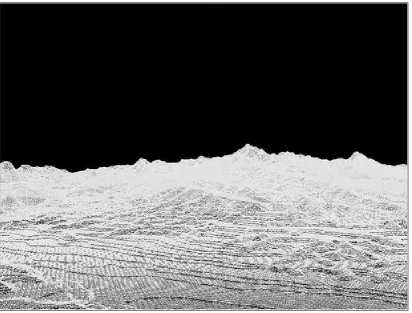
For any detailed terrain model, the number of triangles that must be rendered is prohibitively high. For instance, a 100 km x 100 km terrain sampled at 1-meter resolution and represented as a regular grid will contain roughly 20,000,000,000 triangles. At present, it is not be able to render anywhere near this full resolution data in real-time. According to the research that has been done by Hill (2002) in managing large terrains, rendering 20,000,000,000 triangles per second would not be feasible until 2010. Furthermore, rendering this many triangles at 60 frames per second would not be possible until 2016. Figure 1.1 shows an example of visualizing original terrain model with billion of vertices and polygons. The white line shows the triangles generated in wireframe mode and the black color is a background of a scene.
With current graphics hardware, all communications between the card and the CPU takes place over the memory bus. Presently, the primary bottleneck related to rendering performance is the memory bandwidth on the bus. The graphics hardware is capable of rendering substantially more geometry per second than can be read in over the bus. In order to render 60 million triangles per second, over 5 Gigabytes of data would need to be transferred to the card each second. According to the
maximum memory bandwidth and million triangles per second can be transferred to the graphics card as shown in Table 1.1, it is impossible to achieve the maximum rendering speed directly. Moreover, this bandwidth is also used for transferring texture data to the card, so the 60 million triangles per second target are even further out of reach (Hoppe, 1999; Hill, 2002).
Table 1.1: Types of busses and the corresponding memory bandwidth and geometric throughput (Hill, 2002; Peng et al., 2004)
Type of Bus Bandwidth Limitation (MB/s)
Geometric Throughput (Million triangles per second)
PCI 133 1.385
PCI64 533 5.552
AGP 1x 266 2.771
AGP 2x 533 5.552
AGP 4x 1066 11.104
AGP 8x 2150 22.396
1.2.3 Limited Capability of Triangle-Based LOD Techniques
In order to deal with so much dataset, level of detail (LOD) techniques need to be employed. Theoretically, terrain close to the viewer must be presented with more geometry than terrain that far away from the viewer; and rough terrain requires more geometry than flat terrain does. Frequently, triangle-based LOD algorithm is applied for simplifying the terrain geometry. Although this technique provides fast visualization through polygon simplification in real-time but it is not practical for very large terrain dataset because the amount of data to be loaded exceeds the data that can be stored into main memory. Even if the system is able to load the data, it is time expensive for waiting the loading process completed (Hill, 2002).
1.3 Problem Statements
According to the problems mentioned earlier, the following question needs to be solved in this research:
How to store and display large amount of terrain datasets efficiently
for real-time visualization and navigation system with restricted
capacity of current main memory and memory bus bandwidth?
1.4 Goal
The research goal is to expand the capabilities of triangle-based LOD technique by developing a set of techniques using hybrid method that will enhance the efficiency of real-time 3D terrain visualization and navigation for the
1.5 Objectives
In order to accomplish the main goal, several objectives have to be fulfilled. These include:
(i) To design and construct an efficient data structure that will be able to store arbitrary-sized terrain model.
(ii) To develop an algorithm that will be able to provide fast data loading and reduce the memory usage in run-time.
(iii) To develop a culling technique that will be able to remove large amount of terrain geometry.
(iv) To integrate aforementioned data structure, loading algorithm and culling technique with the chosen triangle-based LOD technique into the real-time terrain visualization and navigation system.
1.6 Scopes
The research focuses on managing large-scale terrain dataset in real-time. Several scopes need to be considered. These include:
(i) The system manages static terrain dataset. It does not include the buildings, trees, rocks and other related objects.
(ii) The system focuses on managing terrain geometry. Imagery terrain data is only used as a texture map for enhancing the visual
appearance.
(iii) Terrain datasets are the regular grid representation.
(iv) Triangle-based LOD technique is based on view-dependent LOD technique.
1.7 Organization of the Thesis
The thesis is organized into six chapters. Chapter 1 gives a general picture on related research fields, problem background and existing solutions involved in developing real-time terrain visualization and navigation in Virtual GIS. Besides that, the goal, objectives and scopes of this research have been specified.
Chapter 2 provides surveys on spatial data structures, visibility culling methods, intersection test techniques and view-dependent LOD techniques.
Chapter 3 presents the methodology of this research, which consists of four main steps. The explanations include partitioning original terrain data, loading tiles, culling invisible tiles and simplifying geometry of visible tiles.
Chapter 4 describes the implementation details of prototype system from pre-processing to run-time pre-processing. For pre-pre-processing, there are two pairs of steps have been explained, which are reading a DEM file and creating TXT files, and reading TXT files and creating TILE files. For run-time processing, the section has been divided into five subsections: creation of classes, initialization, rendering, interaction and shutdown procedure.
Chapter 5 presents and discusses the results obtained from the
implementation phase. System specifications and testing data have been specified. Subsequently, the evaluations of the system and comparison among the existing technique have been explained in further details.
Moore’s law for CPU. Thus, the implementation of real-time terrain system using this processing can be well-suited for the next few years.
(iv) Implementing parallel processing
The prototype system developed in this research can be expanded to the networking environment. By adopting the client-server
communication, parallel processing can be done in order to obtain higher level of system performance. The use of load balancing
Ahn, H.K., Mamoulis, N. and Wong H.M. (2001). A Survey on Multidimensional Access Methods. COMP630c - Spatial, Image and Multimedia Databases: Technical Report UU-CS-2001-14.
Assarsson, U. (2001). Detail Culling for Robotic Products. ABB. http://www.abb. com/global/abbzh/abbzh251.nsf!OpenDatabase&db=/global/seitp/seitp161.ns f&v=17ec2&e=us&c=76133777536BC959C12569CE006C6EE3
Assarsson, U. and Möller, T. (2000). Optimized View Frustum Culling Algorithms for Bounding Boxes. Journal of Graphics Tools. 5(1): 9-22.
Beckmann, N., Kriegel, H.P., Schneider, R. and Seeger, B. (1990). The R*-tree: an efficient and robust access method for points and rectangles. Proceedings of ACM SIGMOD International Conference on the Management of Data. May 23-25. New York, USA: ACM Press, 322-331.
Bentley, J.L. (1975). Multidimensional binary search trees used for associative searching. Communications of the ACM. 18(9): 509-517.
Bittner, J., Wonka, P. and Wimmer, M. (2001). Visibility Preprocessing for Urban Scene using Line Space Subdivision. Proceedings of Pacific Graphics 2001. October 16-18. Tokyo, Japan, 276-284.
Blekken, P. and Lilleskog, T. (1997). A Comparison of Different Algorithms for Terrain Rendering. Spring semester project. CS Dept., Norwegian U. of Science and Technology. unpublished.
Bradley, D. (2003). Evaluation of Real-time Continuous Terrain Level of Detail Algorithms. Charlton University: COM4905 Honours Project.
Burns, D. and Osfield, R. (2001). Introduction to the OpenSceneGraph. OSG Community. http://www.openscenegraph.com
CGL (2004). Backface Culling. CS488/688: Introduction to Interactive Computer Graphics. Computer Graphics Lab, University of Waterloo.
http://medialab.di.unipi.it/web/IUM/waterloo/node66.html
DeFloriani, L., Magillo, P. and Puppo, E. (2000). VARIANT: A System for Terrain Modeling at Variable Resolution. GeoInformatica. 4(3), 287-315.
Duchaineau, M., Wolinsky, Sigeti, D.E., Miller, M.C., Aldrich, C., and Mineev-Weinstein, M.B. (1997). ROAMing Terrain: Real-time optimally adapting meshes. Proceedings of the 8th Conference on Visualization ’97. October 18-24. Los Alamitos, CA, USA: IEEE Computer Society Press, 81-88.
Dunlop, R. (2001). Collision Detection, Part 1: Using Bounding Spheres. Microsoft DirectX MVP. http://www.mvps.org/directx/articles/using_bounding_spheres .htm
Fagin, R., Nievergelt, J., Pippenger, N. and Strong, R. (1979). Extendible Hashing: A Fast Access Method for Dynamic Files. ACM Transactions Database
Systems. 4(3): 315-344.
Faloutsos, C. (1988). Gray Codes for Partial Match and Range Queries. IEEE Transactions on Software Engineering. 14(10): 1381-1393.
Faloutsos, C. and Roseman, S. (1989). Fractals for Secondary Key Retrieval. Proceedings of the 8th ACM SIGACT-SIGMOD-SIGART Symposium on
Principles of Database Systems. March. New York, USA: ACM Press, 247-252.
Fritsch, D. (1996). Three-Dimensional Geographic Information Systems – Status and Prospects. Proceedings of International Archives of Photogrammetry and Remote Sensing. July 12-18. Vienna, Austria: ISPRS, 215-221.
Gadish, D. (2004). Information System for Management. CIS 500 Summer 2004: Slide show.
Gaede, V. and Günther, O. (1998). Multidimensional Access Methods. ACM Computing Surveys. 30(2): 170-231.
Gribb, G. and Hartmann, K. (2001). Fast Extraction of Viewing Frustum Planes from the World-View-Projection Matrix. unpublished.
Guttman, A. (1984). R-trees: A Dynamic Index Structure for Spatial Searching. Proceedings of SIGMOD ‘84. Jun 18-21. Boston, MA: ACM Press, 47-57. Haines, E. (2001). 3D Algorithmic Optimizations. California, USA: SIGGRAPH
2001 Course.
Hawkins, K. and Astle, D. (2002). OpenGL Game Programming. Ohio, USA: Premier Press.
He, Y. (2000). Real-time Visualization of Dynamic Terrain for Ground Vehicle Simulation. University of Iowa: Ph.D. Thesis.
Hill, D. (2002). An Efficient, Hardware-Accelerated, Level-of-Detail Rendering Technique for Large Terrains. University of Toronto: M.Sc. Thesis.
Hjaltason, G.R. and Samet, H. (1995). Ranking in Spatial Databases. Proceedings of the 4th International Symposium on Advances in Spatial Databases. August 6-9. London, UK: Springer-Verlag, 83-95.
Hoff, K. (1996). A Fast Method for Culling of Oriented-Bounding Boxes (OBBs) Against a Perspective Viewing Frustum in Large Walkthrough Models. http://www.cs.unc.edu/hoff/research/index.html
Hoppe, H. (1998). Smooth View Dependant Level-of-Detail Control and its
Application to Terrain Rendering. Proceedings of IEEE Visualization 1998. July 29-31. Los Alamitos, CA, USA: IEEE Computer Society Press, 35-42. Hoppe, H. (1999). Optimization of mesh locality for transparent vertex caching.
Proceedings of the 26th Annual Conference on Computer Graphics and
Interactive Techniques. New York, USA: ACM Press, 269-276.
Hubbard, P.M. (1995) Collision Detection for Interactive Graphics Applications. IEEE Transactions on Visualization and Computer Graphics. 1(3): 218-230. Jagadish, H.V. (1990). Linear Clustering of Objects with Multiple Attributes.
Proceedings of the ACM SIGMOD International Conference on Management
of Data. May 23-26. New York, USA: ACM Press, 332-342.
Klosowski, J.T., Held, M., Mitchell, S.B., Sowizral, H. and Zikan, K. (1998). Efficient Collision Detection Using Bounding Volume Hierarchies of k -DOPs. IEEE Transaction on Visualization and Computer Graphics. 4(1): 21-36.
Kofler, M. (1998). R-trees for Visualizing and Organizing Large 3D GIS Databases. Technischen Universität Graz: Ph.D. Thesis.
Kumler, M.P. (1994). An Intensive Comparison of Triangulated Irregular Networks (TINs) and Digital Elevation Models (DEMs). Cartographica Monograph 45. 31(2): 1-99.
Langbein, M., Scheuermann, G. and Tricoche, X. (2003). An Efficient Point
Location Method for Visualization in Large Unstructured Grids. Proceedings of 8th International Fall Workshop on Vision, Modeling and Visualization
2003. November 19-21. Munich, German: Aka GmbH, 27-35.
Larson, P.A. (1980). Linear Hashing with Partial Expansions. Proceedings of the 6th International Conference on Very Large Data Bases. October 1-3.
Washington, DC, USA: IEEE Computer Society, 224-232.
Laurila, P. (2004). Geometry Culling in 3D Engines. GameDev.net, LLC.
http://www.gamedev.net/reference/programming/features/culling/default.asp Lindstrom, P. and Pascucci, V. (2001). Visualization of large terrains made easy.
Proceedings of IEEE Visualization 2001. October 24-26. Washington, DC, USA: IEEE Computer Society Press, 363–371.
Lindstrom, P., Koller, D., Ribarsky, W., Hodges, L.F., Bosch, A.O. and Faust, N. (1997). An Integrated Global GIS and Visual Simulation System. Georgia Institute of Technology: Technical Report GIT-GVU-97-07.
Lindstrom, P., Koller, D., Ribarsky, W., Hodges, L.F., Turner, G.A. and Faust, N. (1996). Real-time, continuous level of detail rendering of height fields. Proceedings of the 23rd Annual Conference on Computer Graphics and
Interactive Techniques. New York, USA: ACM Press, 109-118.
Luebke, D., Reddy, M., Cohen, J.D., Varshney, A., Watson, B. and Huebner, R. (2002). Level of Detail For 3D Graphics. San Francisco: Morgan Kaufmann Publishers.
Martens, R. (2003). Occlusion Culling for the Real-time Display of Complex 3D Models. Limburgs Universitair Centrum, Belgium: M.Sc. Thesis.
Mokbel, M.F., Aref, W.G. and Kamel, I. (2002). Performance of Multi-Dimensional Space-Filling Curves. Proceedings of the 10th ACM International Symposium on Advances in Geographics Information Systems. November 8-9. New York, USA: ACM Press, 149-154.
Morley, M. (2000). Frustum culling in OpenGL. http://www.markmorley.com Mortensen, J. (2000). Real-time rendering of height fields using LOD and occlusion
culling. University College London, UK: M.Sc. Thesis.
Nievergelt, J., Hinterberger, H. and Sevcik, K. (1984). The Grid File: An Adaptable, Symmetric Multikey File Structure. ACM Transactions Database Systems. 9(1): 38-71.
Noor Azam, M. S. and Ezreen Elena, A. (2003). 3D Virtual GIS Architecture. Proceedings of Advanced Technology Congress 2003. May 20-21. Putrajaya, Selangor: The Institute of Advanced Technology (ITMA).
Ögren, A. (2000). Continuous Level of Detail In Real-Time Terrain Rendering. Umea University: M.Sc. Thesis.
Orenstein, J.A. and Merrett, T.H. (1984). A Class of Data Structures for Associative Searching. Proceedings of the 3rd ACM SIGACT-SIGMOD-SIGART
Symposium on Principles of Database Systems. April 2-4. New York, USA: ACM Press, 181-190.
Pajarola, R. (1998). Access to Large Scale Terrain and Image Databases in Geoinformation Systems. Swiss Federal Institute of Technology (ETH) Zurich: Ph.D. Thesis.
Peng, W., Petrovic, D. and Crawford, C. (2004). Handling Large Terrain Data in GIS. Proceedings of the XXth ISPRS Congress – Commission IV. XXXV(B4): 281-286.
Picco, D. (2003). Frustum Culling. FLIPCODE.COM, INC.
http://www.flipcode.com/articles/article_frustumculling.shtml
Röttger, S., Heidrich, W., Slusallek, P. and Seidel, H.P. (1998). Real-Time
Generation of Continuous Levels of Detail for Height Fields. Proceedings of WSCG ‘98. February 9-13. Plzen, Czech Republic: University of West Bohemia, 315-322.
Samet, H. (1984). The Quadtree and Related Hierarchical Data Structure. ACM Computing Survey. 16(2): 187-260.
Samet, H. (1990). The Design and Analysis of Spatial Data Structures. Reading, MA: Addison-Wesley.
Shade, J.W. (2004). View-Dependent Image-Based Techniques for Fast Rendering of Complex Environments. University of Washington: Ph.D. Thesis.
Shen, H.W. (2004). Spatial Data Structures and Culling Techniques. Slide Show - CIS 781.
Sheng, J.M. and Liu Sheng, O.R. (1990). R-trees for large geographic information systems in a multi-user environment. Proceedings of the 23rd Annual Hawaii International Conference on System Sciences. January 2-5. Washington, DC, USA: IEEE Computer Society Press, 10-17.
Stewart, A.J. (1997). Hierarchical Visibility in Terrains. Proceedings of the
Eurographics Workshop on Rendering Techniques ’97. June 16-18. London, UK: Springer-Verlag, 217-228.
Tamminen, M. (1982). The Extendible Cell Method for Closest Point Problems. BIT 22. 27-41.
Ulrich, T. (2002). Rendering Massive Terrains using Chunked Level of Detail Control. Course Notes of ACM SIGGRAPH 2002. July 21-26. Texas, USA: ACM Press, Course 35.
United States Army Topographic Engineering Center (2005). Survey of Terrain Visualization Software. Alexandria (U.S.): Technical Report.
USGS (1992). Standards for Digital Elevation Models. U.S. Department of the Interior, United States Geological Survey, National Mapping Division, USA: National Mapping Program Technical Instructions.
VTP (1999). Applying Ground Textures. Virtual Terrain Project. http://www.vterrain.org/Textures/ground_textures.html
Youbing, Z., Ji, Z., Jiaoyang, S. and Zhigeng, P. (2001). A Fast Algorithm for Large Scale Terrain Walkthrough. Proceedings of the International Conference on CAD & Graphics. August 20-22. Kunming, China.
Yu, H., Mehrotra, S. Ho, S.S., Gregory, T.C. and Allen, S.D. (1999). Integration of SATURN System and VGIS. Proceedings of the 3rd Symposium on the Federated Lab on Interactive and Advanced Display. February 2-4. Aberdeen, MD: Army Research Lab, 59-63.