ISBN: 1985-5826 AJTLHE, Vol. 2, No. 1, January 2010
,
30 – 40ACROSS AND BEYOND THE DEVIDE:
THE ROLE OF INTERDEPARTMENTAL TEACHING IN BIOINFORMATICS
Mohd Shahir Shamsir1 Zeti Azura Mohamed Hussein2 1Universiti Teknologi Malaysia, Malaysia 2Universiti Kebangsaan Malaysia, Malaysia
Abstract
Bioinformatics is a multidisciplinary field derived from computational and biological sciences. Its multidisciplinary nature has created a niche for specialists trained in both biology and computing, and it has required distinct teaching cooperation from experts in these two different areas. Consequently, teaching bioinformatics will require specialist educators with in-depth knowledge of the two different components -- biology and computer science. Because this is quite a daunting task, most universities lack the necessary specialists and experienced bioinformatics staff. They must therefore resort to the logical route of interdisciplinary and cross-faculty teaching. However, interfaculty teaching subsequently raises the issue of ‘ownership’, and consequently creates concerns regarding teaching and learning cultures, as it is obvious that each discipline has an its own inherent culture. In this article, we examined the curricula and their implementations at two Malaysian universities. Because both universities place their bioinformatics courses in opposing departments, we aimed to study how educators overcome the interdisciplinary barrier. In addition, we concisely explain the components that constitute the bioinformatics field, analyse the unique education criteria that are required to produce individuals with bioinformatics training and provide an overview of global bioinformatics education to further improve our implementation of bioinformatics education.
Keywords: bioinformatics, computational biology, interdisciplinary education, biological sciences, computer science
INTRODUCTION
G. 2005), the United States (Hemminger & Anne Bauers, 2005; Zatz, 2002), Australia (Cattley, 2004; Littlejohn, 2000), Israel (Samish, 2003), France (Danchin, 2000) and Germany (Schomburg & Vingron, 2002). In addition, international workshops have been conducted to discuss aspects such as the shape, design and components of bioinformatics courses, as well as the integration of bioinformatics elements into conventional biological science subjects (Ranganathan, 2005).
There are two objectives of this paper. The first is to examine the curricula and their implementation at two universities in Malaysia that place their bioinformatics courses in opposing departments. We will further examine how institutions overcome the interdisciplinary barrier. The second objective is to study the current scenario, challenges, requirements and future trends needed to ensure the successful teaching of bioinformatics.
Concerns about the need for an undergraduate curriculum in bioinformatics were initially raised by Altman in 1998 (Altman, 1998), with guidelines presented by Luscombe (Luscombe et al., 2001) and Cohen (Cohen, 2003). Subsequently, a significant number of papers have discussed and described a variety of bioinformatics programs, curriculum contents and methods of delivery (Ai et al., 2002; Bednarski et al., 2005; Burhans & Skuse, 2004; Campbell, 2003; Centeno et al., 2003; Cohen, 2003; Cooper, 2001; Doom et al., 2002; Dubay et al., 2002; Dyer & LeBlanc, 2002; Fetrow & John, 2006; Friedman et al., 2004; Hack & Kendall, 2005; Hughey & Karplus, 2001; Johnson & Friedman, 2006; LeBlanc & Dyer, 2003; LeBlanc & Dyer, 2004; Maojo & Kulikowski, 2003; Sahinidis et al., 2005; Wickware, P. 2001). Overall, the emphasis of bioinformatics training can be divided into three levels: (i) teaching the use of pre-existing tools; (ii) teaching basic programming with algorithm design and in-depth theoretical foundations; and (iii) teaching the principles behind bioinformatics (Counsell, 2003; Dyer & LeBlanc, 2002).
BIOINFORMATICS IN CONTEXT: INSTITUTIONAL BACKGROUND & BIOINFORMATICS CURRICULA
UTM
SUBJECT Credit
BIOLOGY
General Biology II 3
Cell Biology & Molecule 3 Cell Biochemistry & Metabolism 3
Genetic Engineering 3
Introduction to Bioinformatics 3 Biology Molecule Technique 2 Genomic & Proteomic 3
Gene Expression 3
Structure & Protein Function 3
TOTAL 26
CHEMISTRY
Organic Chemistry 3
TOTAL 3
MATHEMATICS
Linear Algebra 3
Algorithm Analysis 3
Statistic 3
TOTAL 9
COMPUTER SCIENCE
Citizen & Computer 2 Programming Technique II 3 Computer Architecture 3
Data Structure 3
Discrete Structure 3
Software Engineering 3
Artificial Intelligence 3 Basic Computer Graphic 3
Database System 3
Operation System 3
Networking 3
Simulation & Modeling 3 Computational Biology I 3 High Performance Computing and Parallel Computing
3
Project 1 2
Project 2 4
Industrial Practical 1 4 Industrial Practical II – report 8 Programming technique I 3 Computerise in Biology II 3
TOTAL 65
*OTHER SUBJECTS 22
TOTAL 22
OVERALL 125
TABLE 1: List of subjects taught at Universiti Teknologi Malaysia Bioinformatics Degree grouped according to similar
Universiti Teknologi Malaysia, located near Johor Bahru (at the southern tip of Peninsular Malaysia), began offering a Bachelor of Computer Science in Bioinformatics in 2006. The university has a niche and a strong tradition in engineering and technology. This course was offered by the Faculty of Computer Science and Information Systems, with its pioneer cohort currently in its second year. It is a four-year program with 125 credit hours of lectures and a six-month industrial training during the third year (Table 1). The curriculum consists of 65 credits (52%) of computer science, 26 credits (20.8%) of biological sciences, 9 credits of mathematics (7.2%) and 3 credits of chemistry (2.4%), with the remaining general subjects totalling of 22 credits (17.6%) (Table 3). These 22 credits consist of various elective subjects offered by the university, such as English Language, Management and Ethics-related courses similar to those offered by other universities in Malaysia.
UKM
SUBJECT Credit
BIOLOGY
Fundamentals of Molecular Biology
3
General Genetics 3
Fundamentals of Microbiology 3
Cell Biology 3
Biochemistry 3
DNA Recombinant Technology I
3
DNA Recombinant Technology II
3
Gene Expression 3
Microbial Genetics 2
Introduction to Bioinformatics 3 Bioinformatics Tools 3 Molecular Cell Biology 3
Genomics 3
TOTAL 38
CHEMISTRY
General Chemistry I 3
General Chemistry II 3
TOTAL 6
MATHEMATICS
Mathematics in Biology & Information Technology
3
Applied Statistics 3
Differential and Derivative Equations
3
TOTAL 9
COMPUTER SCIENCE
Introduction to Microcomputer and Information Technology
3
C++ Programming 3
TABLE 2: List of subjects taught at Universiti Kebangsaan Malaysia
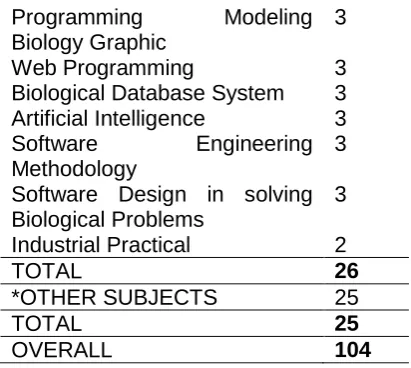
Universiti Kebangsaan Malaysia is located in Bangi, 45 minutes from Kuala Lumpur. It also offers a Bachelor of Science in Bioinformatics. The program is based in the School of Biosciences and Biotechnology, Faculty of Science and Technology, and has graduated their fourth cohort of students. The course commenced in 2002 as a three-year undergraduate degree programme. This programme consists of 104 credits, with 38 credits in biology (36.5%), 9 in mathematics (8.6%), 6 in chemistry (5.7%), 26 in computer science (25%) and 24 in others miscellaneous subjects and electives (Table 3).
Students are given preliminary work exposure through internship in industrial training (two credits) for eight weeks during the third semester of their second year. The majority of students are placed at bioinformatics companies and research institutes across Malaysia (mostly concentrated in the Klang Valley). During this period, students are given hands-on training and complete a mini-project within the duration of their training. During the second year, they are introduced to the fundamental principles of various bioinformatics algorithms. They also have hands-on, practical experiences during the sequential course in the next semester. Once they have completed these two core bioinformatics courses, they are able to apply the knowledge and techniques to sequence and protein structure analyses. They should also posses the ability to comprehend and infer the outputs of these analyses to answer the biological problems presented. The inclusion of computer science
Programming Modeling Biology Graphic
3
Web Programming 3
Biological Database System 3 Artificial Intelligence 3 Software Engineering Methodology
3
Software Design in solving Biological Problems
3
Industrial Practical 2
TOTAL 26
*OTHER SUBJECTS 25
TOTAL 25
OVERALL 104
Subjects Percentage (%)
UTM UKM
BIOLOGY 20.8 36.5
MATHEMATICS 7.2 8.6
CHEMISTRY 2.4 5.7
COMPUTER SCIENCE 52. 25
OTHERS 17.6 24
TABLE 3: Comparison of percentages of subjects grouped within a specific
courses provides them with the knowledge of computer science applications related to biology.
INTERDEPARTMENTAL TEACHING
The challenges of teaching undergraduate bioinformatics are inclusion and depth. The inclusion challenge results from the difficulty in incorporating the breadth of knowledge created by the fusion of multidisciplinary areas within bioinformatics (i.e., biochemistry, molecular cell biology, genetics, thermodynamics, biophysics and statistical mechanics). The multidisciplinary nature not only transcends established areas of sciences; it also requires the integration of knowledge and the cross-field utilisation of techniques (Campbell, 2003). This requires specialist educators with in-depth knowledge of all of the different components of the field: mathematics, biology and computer science.
Another challenge in teaching bioinformatics relates to the breadth of information that should be included in the curriculum. Pevzner (2004) raised the issue of depth, commenting that a broad introduction to bioinformatics without the necessary depth would produce bioinformatics technicians rather than bioinformatics scientists. Along with Pevzner, Pearson (2001) highlighted the importance of teaching the principles of algorithms and statistics and creating a biologically motivated problem-based learning environment in order to effectively teach bioinformatics. From our observations, we found that most biologists are comfortable using software (e.g., BLAST) and are content simply to either finding a match or not, regardless of whether they understand the underlying principles. This treatment of bioinformatics merely as a set of computational tools is prone to erroneous assumptions if derived from a flawed understanding of the algorithms behind the tools. This is further compounded by an increase in the publication of cookbook-style, protocol-centric bioinformatics textbooks (Pevzner, 2004). Thus, failure to create a program with the necessary depth will produce students severely lacking in the skills necessary for pursuing careers in bioinformatics. These challenges compel university administrations to follow the logical route of interdisciplinary and cross-faculty teaching. This technique raises the issue of ‘ownership’ and the placement of the course within an institution. The university management must then determine which faculty or department (i.e., biology, mathematics or computer sciences) should house the necessary courses and facilities.
adjustments and reemphasise the subject materials as needed. During their final year, students also have the benefit of direct and immediate support for their projects from the biology-based lecturers. Currently, there are no plans to hire biology lecturers in FSKSM and present arrangements manage to foster interdisciplinary cooperation between FSKSM and FBB.
Comparative studies of curricula in the US, for example, have shown a similar emphasis on the computer science element (Burhans & Skuse, 2004; Morrow & Wilkins 2004). Problems have occurred with regard to the teaching requirement of the individual lecturers. Additional teaching requirements are a contentious issue because the faculty prefers that its teaching staff focus on their own teaching requirements. The bioinformatics programme at UKM is based in the Faculty of Science and Technology (FST), with the first batch graduating in 2006. It also faces problems similar to those of UTM in terms of recruiting lecturers from the opposing faculty. However, a greater percentage of the biology lecturers are conversant with bioinformatics, at least at the level of tool utilisation. This allows for unhindered teaching and is reflected in the greater success of the course implementation in FST. Furthermore, the aim of UKM is to create researchers with bioinformatics knowledge to support wet lab research, rather than delving on the complexities of software design (as denoted by their shorter course duration and subject matter emphasis).
PAST & FUTURE TRENDS
Currently, bioinformatics is shifting away from a single discipline and into an integrative, multidisciplinary field - even within bioinformatics itself. This shift began after early investors realised that the yield obtained from isolated activities after 2001 did not meet expectations. This prompted anxiety over the sustainability of investments in the field of bioinformatics (Leite, 2004). The decline was signalled by the closure of bioinformatics companies, beginning as early as 2000 (Wickware, 2000). Some even consider demoting bioinformatics to a tools and application status (Black & Stephan, 2005; Counsell, 2003; Russell, 2006). As bioinformatics tools for biologists become more user-friendly, the applications become routine in laboratories, thereby eliminating a specialised need, akin to the commercialisation of kits used to standardise difficult laboratory procedures by biotechnology companies. The creation of bioinformatics workbenches as early as 1987 combined popular tools and further enhanced usability within the laboratory community (Bernstein, 1987; Oinn et al., 2004; Suter-Crazzolara, 2000). Universities offering bioinformatics courses have also declined in number due to decreasing demand from students. This phenomenon has been observed in Europe (Counsell, 2003) and the US (Black & Stephan, 2004; 2005). Studies have shown reductions in either the number of courses offered or in enrolment. Corresponding analyses on the number of bioinformatics vacancies advertised have also shown a marked decline. This consolidation and maturation of the education market mirrors the direction taken by the industry a few years earlier. Surprisingly, the opposite phenomenon is occurring in India; bioinformatics courses are ‘sprouting’ and becoming money-spinning enterprises that teach a mediocre curriculum (Balaram, 2002).
CONCLUSION
Both UTM and UKM have shown that fulfilling the teaching requirements of bioinformatics by recruiting teaching staff from opposing faculties is a feasible and adequate means of meeting each of programme’s goals. The placement of the course does not affect the delivery of the teaching material and will provide satisfactory learning outcomes. It is believed that the most critical aspect of interdepartmental teaching would be mutual research support between opposing faculties. Both faculties must reciprocate in order to ensure success in their bioinformatics courses. Only with this mutual support will interdepartmental collaborations not only survive, but thrive. Bioinformatics research has shifted from genomic sequences to integrative bioinformatics, such as proteomics, assimilated into areas like medical informatics and pharmacogenomics, and created new areas of interest, such as transcriptomics, metabolomics and systems biology. In the future, bioinformatics and the biological sciences will continue to become multidisciplinary fields that integrate approaches from engineering, mathematics and computer science (Tadmor & Tidor, 2005). The field of bioinformatics itself is very fluid; therefore, the curriculum must also be very adaptable and must be reflected by reciprocal teaching.
REFERENCES
Abbot, C. 2002. Teaching bioinformatics at the undergraduate level: Is it a form of problem based learning (pbl)? Presentation at the Workshop on Education in Bioinformatics.
Ai, Y., Firth, N. & Jermiin, L. 2002. Building bridges in teaching bioinformatics: The use of student-centred teaching and problem based learning in cross-discipline courses. In
Altman, R.B. 1998. A curriculum for bioinformatics: The time is ripe. Bioinformatics 14 (7):549-550.
Balaram, P. 2002. Bioinformatics: Blowing up a balloon. Current Science, 82 (10):1189-1190.
Bednarski, A.E., Elgin, S.C.R. & Pakrasi, H.B. 2005. An inquiry into protein structure and genetic disease: Introducing undergraduates to bioinformatics in a large introductory course. Cell Biology Education, 4 (3):207-220.
Ben-Dor, S., Butcher, S., Iyer, L.K., Kelso, J., Littlejohn, T., Shachak, A. & Rubin, E. 2003. Training and support for bioinformatics: Theoretical and practical aspects. Intelligent Systems for Molecular Biology (ISMB) Conference.
Bernstein, M. 1987. Reducing the man - machine barrier: The sequence analysis workbench.
Comput. Appl. Biosci, 3 (3):229-232.
Black, G.C. & Stephan, P.E. 2004. Bioinformatics: Recent trends in programs, placements and job opportunities. Alfred P. Sloan Foundation.
Black, G.C. & Stephan, P.E. 2005. Bioinformatics training programs are hot but the labor market is not. Biochemistry and Molecular Biology Education, 33 (1):58-62.
Boyer, R. 2000. The new biochemistry: Blending the traditional with the other. Biochemistry
and Molecular Biology Education, 28 (6):292-296.
Brass, A. 2000. Bioinformatics education-a UK perspective. Bioinformatics 16 (2):77-78.
Burhans, D.T. & Skuse, G.R. 2004. The role of computer science in undergraduate bioinformatics education. SIGCSE Bulletin, 36 (1):417-421.
Campbell, A.M. 2003. Public access for teaching genomics, proteomics, and bioinformatics.
Cell Biology Education, 2 (2):98-111.
Cattley, S. 2004. A review of bioinformatics degrees in Australia. Briefings in Bioinformatics, 5 (4):350-354.
Centeno, N.B., Villa-Freixa, J. & Oliva, B. 2003. Teaching structural bioinformatics at the undergraduate level. Biochemistry and Molecular Biology Education, 31 (6):386-391.
Cohen, J. 2003. Guidelines for establishing undergraduate bioinformatics course. Journal of
Science Education and Technology, 12 (4):449-456.
Cooper, S. 2001. Integrating bioinformatics into undergraduate courses. Biochemistry and
Molecular Biology Education, 29 (4):167-168.
Counsell, D. 2003. A review of bioinformatics education in the uk. Briefings in Bioinformatics,
4 (1):7-21.
Danchin, A. 2000. A brief history of genome research and bioinformatics in France.
Bioinformatics, 16 (1):65-75.
Doom, T., Raymer, M., Krane, D. & Garcia, O. 2002. A proposed undergraduate bioinformatics curriculum for computer scientists. SIGCSE BULLETIN, 34 ( 1):78-81.
Dyer, B.D. & LeBlanc, M.D. 2002. Meeting report: Incorporating genomics research into undergraduate curricula. Cell Biology Education, 1:101-104.
Feig, A.L. & Jabri, E. 2002. Incorporation of bioinformatics exercises into the undergraduate biochemistry curriculum. Biochemistry and Molecular Biology Education, 30 (4):224-231.
Fetrow, J.S. & John, D.J. 2006. Bioinformatics and computing curriculum: A new model for interdisciplinary courses. ACM SIGCSE Bulletin 38, (1):185-189.
Friedman, C.P., Altman, R.B., Kohane, I.S., McCormick, K.A., Miller, P.L., Ozbolt, J.G., Shortliffe, E.H., Stormo, G.D., Szczepaniak, M.C., Tuck, D. & Williamson, J. 2004. Training the next generation of informaticians: The impact of `bisti' and bioinformatics; a report from the american college of medical informatics. Journal of American
Medical Informatics Association, 11:167-172.
Galperin, M.Y. 2007. The molecular biology database collection: 2007 update. Nucl. Acids Res. 35 (suppl_1):D3-4.
Gibbons, N.J., Evans, C., Payne, A., Shah, K. & Griffin, D.K. 2004. Computer simulations improve university instructional laboratories. Cell Biology Education, 3:263-269.
Hack, C. & Kendall, G. 2005. Bioinformatics: Current practice and future challenges for life science education. Biochemistry and Molecular Biology Education 33, (2):82-85.
Hemminger, B.M. & Anne Bauers, T.L. 2005. Survey of bioinformatics programs in the united states. Journal of the American Society for Information Science and Technology, 56 (5):529-537.
Honts, J.E. 2003. Evolving strategies for the incorporation of bioinformatics within the undergraduate cell biology curriculum. Cell Biology Education, 2:233-247.
Hughey, R. & Karplus, K. 2001. Bioinformatics: A new field in engineering education. Frontiers in Education Conference, 2001. 31st Annual, hlm. F2B-15-19 vol.2.
Johnson, S.B. & Friedman, R.A. 2006. Bridging the gap between biological and clinical informatics in a graduate training program. Journal of Biomedical Informatics, In Press, Corrected Proof.
LeBlanc, M.D. & D.Dyer, B. 2003. Teaching together: A three-year case study in genomics.
Journal of Computing in Small Colleges, 18 (5):85-95.
LeBlanc, M.D. & Dyer, B.D. 2004. Bioinformatics and computing curricula 2001: Why computer science is well positioned in a post-genomic world. inroads – The SIGCSE
Bulletin, 36 (4):64-68.
Leite, M. 2004. Public sphere and the sustainability of the bioinformatics promise. Genetics
and Molecular Research, 3 (4):575-581.
Littlejohn, T. 2000. Bioinformatics in Australia. Bioinformatics, 16 (10):849-850.
Luscombe, N.M., Greenbaum, D. & Gerstein, M. 2001. What is bioinformatics? A proposed definition and overview of the field. METHODS OF INFORMATION IN MEDICINE, 40 (4):346-358.
Maojo, V. & Kulikowski, C.A. 2003. Bioinformatics and medical informatics: Collaboration on the road to genomic medicine? J Am Med Inform Assoc:M1305.
Oinn, T., Addis, M., Ferris, J., Marvin, D., Senger, M., Greenwood, M., Carver, T., Glover, K., Pocock, M.R., Wipat, A. & Li, P. 2004. Taverna: A tool for the composition and enactment of bioinformatics workflows. Bioinformatics, 20 (17):3045-3054.
Pearson, W.R. 2001. Training for bioinformatics and computational biology. Bioinformatics 17 (9):761-762.
Pevzner, P.A. 2004. Educating biologists in the 21st century: Bioinformatics scientists versus bioinformatics technicians. Bioinformatics, 20 (14):2159-2161.
Ranganathan, S. 2005. Bioinformatics education—perspectives and challenges. PloS
Computational Biology 1 (6):52.
Ranganathan, S. & Miyano, S. 2001. The asia-pacific regional perpective on bioinformatics.
IEEE Intelligent Systems, (19-20).
Russell, J. 2006. Bioinformatics moves from starring role to supporting cast. Bio-IT World
(Online) (available form http://www.bio-itworld.com/news/031003_report2164.html.).
Sahinidis, N.V., Harandi, M.T., Heath, M.T., Murphy, L., Snir, M., Wheeler, R.P. & Zukoski, C.F. 2005. Establishing a master's degree programme in bioinformatics: Challenges and opportunities. Systems Biology, IEE Proceedings, 152 (4):269-275.
Samish, I. 2003. Bioinformatics education programs in israel: Academic, private and unique professional-retraining programs. Workshop on Education in Bioinformatics, (WEB).
Schomburg, D. & Vingron, M. 2002. Bioinformatics research and education in germany. In
Silico Biology 2, (15).
Shachak, A., Ophir, R. & Rubin, E. 2005. Applying instructional design theories to bioinformatics education in microarray analysis and primer design workshops. Cell
Biolology Education, 4 (3):199-206.
Suter-Crazzolara, C. 2000. Bioinformatics, databases and systems. Brief Bioinform, 1 (4):417-418.
Tadmor, B. & Tidor, B. 2005. Interdisciplinary research and education at the biology-engineering-computer science interface: A perspective. Drug Discovery Today, 10 (17):1183-1189.
Wickware, P. 2000. Mag's demise signals trouble for bioinformatics firms. Nature
Biotechnology, 18:144.
Wickware, P. 2001. Training in a hybrid discipline. 413 (6858):6-7.
Yeo, L.C., Deris, S., Illias, R.M. & Zaki, N.M. 2003. Advancement of bioinformatics in malaysia. Advance Technology Congress.
Zatz, M.M. 2002. Bioinformatics training in the USA. Briefings in Bioinformatics, 3 (4):353-360.
Zauhar, R.J. 2001. University bioinformatics programs on the rise. Nature Biotechnology,
19:285-286.