The 4
thInternational Research Symposium on Problem-Based Learning (IRSPBL) 2013
Implementation of Project-Oriented Problem-Based Learning (POPBL) in
Introduction to Programming
Course
Noraini Ibrahim
a*, Shahliza Abd.Halim
b a-cFaculty of Computing, Universiti Teknologi Malaysia, Skudai 81310, Johor, MalaysiaAbstract
Project-oriented problem-based learning (POPBL) is one instructional methodology that has been widely applied in many other Teaching and Learning (T&L) activities. POPBL incorporates the development of students’ personal skills and also promotes creativity in any given T&L environment. In this work, a POPBL that would be implemented in Introduction to Programming course taught at Universiti Teknologi Malaysia is presented, as well as discussion concerning the students’ results and overall achievement. The results gained have depicted that POPBL is very much applicable to be implemented even for freshmen in Computing field; that is also intended to expose the students with more problem-solving skills especially in the real-world business application systems.
Keywords: Introduction to Programming, Project-oriented problem-based learning (POPBL), Teaching and Learning (T&L) activities, Teamwork;
1.Introduction
The Project-oriented problem-based learning (POPBL) model is believed to be originated from the Aalborg University, Denmark, and it is currently available for the past thirty years (Hussain & Rosenørn, 2008). POPBL approach is one kind of instructional methodology in teaching pedagogy model that was initially adopted from Problem-Based Learning (PBL) (Lehmann, Christensen, Du, & Thrane, 2008) (Uziak, Oladiran, Eisenberg, & Scheffer, 2010). Thus the POPBL implementation has its basis from the PBL model with the three important and inter-related components that make-up the POPBL model in T&L approach, namely i) problems, ii) project and iii) team work (Du & Jensen, 2010).
Upon relating POPBL and teaching pedagogy, the effective T&L activities should centre around students; by highlighting students-centred and active learning while encouraging students to learn how to learn (Moesby, 2005) regardless the lecturers’ ability to complete the syllabus in time (Ahmad & Jabbar, 2007; Du & Jensen, 2010; Yasin & Rahman, 2011). Nevertheless, implementation of POPBL should also expose the students on their roles and responsibilities to ensure that the level of understanding is not only based on “Just-in-Time” knowledge but also to motivate the learners to think aloud and “T hink-out-of-the-Box” (Abdul Ghafir, Hasnan, Khalid, & Mohd Ali, 2007; Ahmad & Jabbar, 2007; Mohamed, Mat Jubadi, & Wan Zaki, 2011). In addition to that, the technical skills in creatively providing solutions to solve the given problems according to the engineering, science and mathematics theories that the students have learnt prior, must also be accompanied with non-technical skills or soft-skills such as the ability to effectively cooperate and communicate with team-mates, as well as the ability to efficiently manage and plan for the project to ensure the success of POPBL adoption in T&L activities (Lehmann et al., 2008).
Currently, there are various numbers of POPBL implementation among teachers. Among the approaches are mainly applied on engineering courses as in Electrical Power Systems Engineering (Hosseinzadeh & Hesamzadeh, 2012), Switching-Mode Power Supplies (Lamar et al., 2012) and Wind Energy (Santos-Martin, Alonso-Martinez, Eloy-Garcia Carrasco, & Arnaltes, 2012) or hardware related subjects as in Programmable Logic Design and Computer Architecture (Kellett, 2012), Analog Electronic (Mohamed, Mat Jubadi, & Wan Zaki, 2012). Similarly, the POPBL implementation onto these kind of subjects have significant differences compared to Software Engineering (SE) related subjects (Qiu & Chen, 2010) ; as it deals with products related to SE which are easily changeable due to its malleable characteristics and complexity due to its relation with other domain (Richardson, Reid, Seidman, Pattinson, & Delaney, 2011). From computing and software engineering field, the importance of POPBL is also undeniable due to future scenarios that learners have to face in their workplace as computer scientist and software engineer; when they have to develop software as an effort to solve real-world problems, exploring creatively the possible solutions and independently undergoes lifelong learning to cope with rapid changing computing technologies nowadays.
This paper describes on our previous experiences in POPBL implementation and its outcome results for an undergraduate course taught at the Faculty of Computing, Universiti Teknologi Malaysia, titled “Programming Technique 1”. The POPBL experimentation was conducted recently during Semester 1, 2012/2013 session. Also, the test-bed was carried out with approximately 41 total students for the 2 participated sections from 8 sections of overall course enrolment. It is satisfactorily enough to collect the students’ perceptions when 40 from 41 participated students have completed the self-regulated questionnaire for the POPBL exit-survey at the end of the semester.
This paper is organised as follows. In Section 2, a brief introduction on the course and the POPBL adaptation are provided. Next, Section 3 presents the overview on the results of POPBL implementation, as well as the discussion on the outcome and students/lecturers reflections. Finally, some overall remarks are provided in Section 4.
2.Introduction to Programming Technique Course
In this section, the related course and the methodical process in POPBL implementation are presented. The following section 2.1 discusses the Programming Technique 1 course structure in details, while section 2.2 describes the planned tasks and activities in POPBL implementation accordingly.
2.1.Description
SCSJ1103 Programming Technique 1 course is the first Programming course offered to the first semester and first year students at Faculty of Computing in Universiti Teknologi Malaysia. The course is centred on an introduction to programming technique foundation using C++ language. Additionally, as a fundamental subject, this course equips the students with theory and practice on problem solving techniques by using the structured approach. Students are required to develop programs using C++ programming language, in order to solve simple to moderate problems.
The course covers the following: pre-processor directives, constants and variables, data types, input and output statements, text files, control structures: sequential, selection and loop, built-in and user-defined functions, one dimensional and two dimensional array.
The course is contextually designed so that by the end of the course, students should be able to achieve the following learning outcomes (LOs):
LO1 :
To solve problems systematically using problem solving methods.LO2 :
To construct a C++ program correctly from the analysed problems using structured approach.LO3 :
To construct or develop complete C++ programs for simple to moderate problems individually.LO4 :
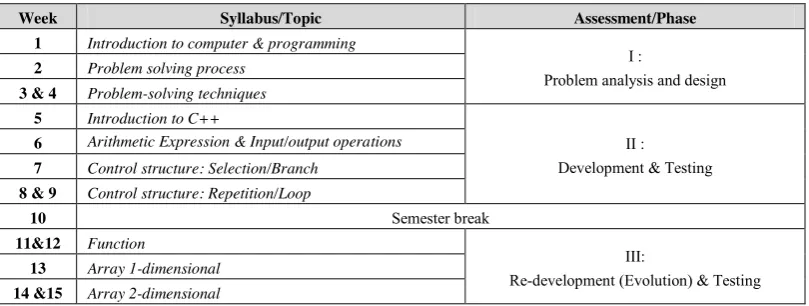
To solve problems in a given time frame using C++ programming language and tools.Table 1 shows the summary of current curriculum for the SCSJ1103 Programming Technique 1 course. Basically, in one particular week, lectures (2 hours) and lab tutorials (2 hours) are conducted approximately for 14 weeks. Students have to critically and analytically solve the same problems of the given case study application throughout the semester. There are 3 main assessments which to be performed according to the stated phases in Table 1.
Phase 1 covers from the very first topic until specific topic related to the problem solving process and techniques for 4 weeks. Later in phase 2, the related topics that focused on the C++ programming concepts such as variables, constants, arithmetic expressions, input/output operations, control structures (branch and loop) are covered for about 5 weeks. In this last phase 3, students are exposed to the 2 medium level concepts in C++ programming, namely; function and array (1- and 2-dimensionals).
Table 1. Course syllabus and POPBL stages
Week Syllabus/Topic Assessment/Phase
1 Introduction to computer & programming
I :
Problem analysis and design 2 Problem solving process
3 & 4 Problem-solving techniques 5 Introduction to C++
II : Development & Testing 6 Arithmetic Expression & Input/output operations
7 Control structure: Selection/Branch 8 & 9 Control structure: Repetition/Loop
10 Semester break
11&12 Function
III:
Re-development (Evolution) & Testing 13 Array 1-dimensional
2.2.Implementation of Project-Oriented Problem-Based Learning (POPBL)
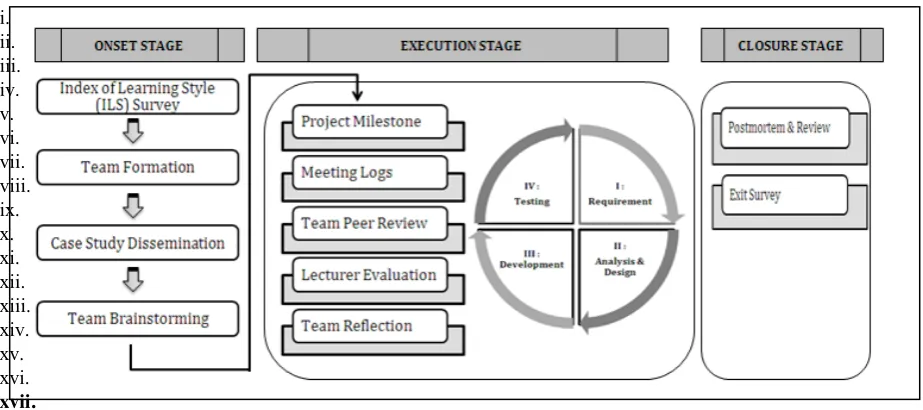
Our designed POPBL framework, as shown in Figure 1 below, basically consists of three main stages:
1. Onset : Setting the project context – team, defining the case study problems as well as collecting students learning style (correlation to students performance)
2. Execution : Implementation of three assessments based on software development life-cycle (SDLC) stages 3. Closure : Conducting post-mortem, review & exit survey (analyzing the end results of POPBL implementation)
i. ii. iii. iv. v. vi. vii. viii. ix. x. xi. xii. xiii. xiv. xv. xvi. xvii.
Figure 1. POPBL Framework Design
The proposed framework is tailor-designed so that it is similar to the basic stages in SDLC; requirement, analysis, design, development, and testing phases, as illustrated in Execution stage. Like other works similar to POPBL implementation, our students have been given a problem in the context of software application development project as a real-world case study. Students were allocated into a team with three/four members. Based on the designed POPBL framework, the project started from: i) eliciting requirements and analyzing the case study problems, ii) designing and proposing the applicable solutions for the given case study, iii) implementing and developing the software application based on the design product components, and finally iv) testing the developed project to ensure that the product meets the desired quality.
Every team was given different case study problems to be analyzed throughout the whole semester. There are three cycles/assessments for the given case study project. At the same time, the complexity of problems in the case study was gradually increased for each assessment. This is to ensure that complexity is mapped to the students’ exposure and knowledge are synchronized to the planned curriculum syllabus and course topics (Refer to Table 1).
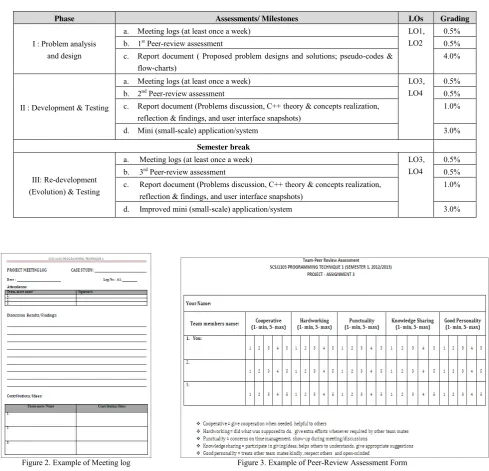
Generally, Table 2 depicts the mapping between the course syllabus (in Table 1) and the POPBL implementation in practices. The POPBL implementation contributes approximately 15% from the overall coursework. For all three stages, two mandatory milestones are the meeting logs and the peer-review assessment forms (Figure 1 and 2); which contribute for 3% from 15% total grading of the project.
Based on Table 2, in the first phase, each team should submit the first milestone namely; the proposed problem designs and solution for the case study report (4%). During the second phase, students are guided and monitored to ensure that the second milestone deliverability, which was a small-scale application for the given case study, is developed based on aforementioned C++ language concepts (Week 5 till 9 in Table 1). The success of the second milestone development is crucial to proceed to the next final phase of POPBL implementation. Within five weeks, each team should deliver their third milestone; the improvised application from second milestone that applied these two concepts (functions and arrays).
Table 2. POPBL stages and assessments
Phase Assessments/ Milestones LOs Grading
I : Problem analysis and design
a. Meeting logs (at least once a week) LO1,
LO2
0.5%
b. 1st Peer-review assessment 0.5%
c. Report document ( Proposed problem designs and solutions; pseudo-codes & flow-charts)
4.0%
II : Development & Testing
a. Meeting logs (at least once a week) LO3,
LO4
0.5%
b. 2nd Peer-review assessment 0.5%
c. Report document (Problems discussion, C++ theory & concepts realization, reflection & findings, and user interface snapshots)
1.0%
d. Mini (small-scale) application/system 3.0%
Semester break
III: Re-development (Evolution) & Testing
a. Meeting logs (at least once a week) LO3,
LO4
0.5%
b. 3rd Peer-review assessment 0.5%
c. Report document (Problems discussion, C++ theory & concepts realization, reflection & findings, and user interface snapshots)
1.0%
d. Improved mini (small-scale) application/system 3.0%
Figure 2. Example of Meeting log Figure 3. Example of Peer-Review Assessment Form
3.Outcome, Results and Discussion
In this section, the outputs in terms of the overall outcomes, the students’ feedbacks results and the discussion for the implemented POPBL experimentation in the previous SCSJ1103 course are presented. The survey questionnaires are developed and mapped to the previous designed POPBL implementation framework as mentioned in section 2.2. The questionnaires are designed to measure the three main perspectives to be achieved in the POPBL framework components, namely; i) cognitive learning, ii) collaborative learning, and iii) contents; with a total of twenty-seven questions being asked to assess the students’ feedbacks on these three components.
3.1. Discussion Results on Cognitive Learning Perspective
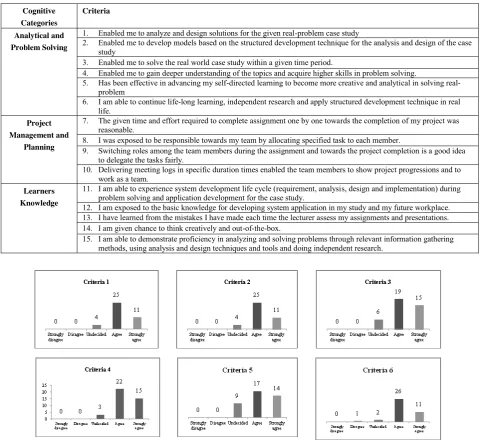
In terms of learners’ cognitive learning perspective, there are three main categories being measured, namely;; analytical and problem solving skills, project management and planning skills, as well as learners knowledge improvement. The following Table 3 presents the related questionnaires for the cognitive learning perspective respectively with the categories and the criteria. Additionally, the following Figure 3, 4 and 5 shows respectively the students’ response and the distribution frequencies (from N=40) for three categories of cognitive learning perspective; analysis & problem solving, project management & planning, and learners knowledge. In summary, almost 85% of the students agreed (from agree to strongly agree scales) that the POPBL implementation in the SCSJ1103 coursework is helpful in terms of analysing and providing solutions towards the given real-world problems, managing and planning their project progress, and improving learners’ experiences, knowledge and creativity in doing the project.
However, some remark notes can be observed for criteria no.3, which is related to the students’ ability to solve the case study problems in a specific time period. There are about 15% students who did not sure that they can commit on the given period and gave feedbacks that they are hoping for a longer duration in submitting the deliverable especially during third stage where the related topics of Function and Arrays (refer to Table 1) are quite difficult to understand for their level as first semester students. As for criteria no. 5, 22.5% students were undecided whether the POPBL implementation allows them to perform self-directed learning to become more creative and analytical.
Table 3. Cognitive learning categories and criteria
Cognitive Categories
Criteria
Analytical and Problem Solving
1. Enabled me to analyze and design solutions for the given real-problem case study
2. Enabled me to develop models based on the structured development technique for the analysis and design of the case study
3. Enabled me to solve the real world case study within a given time period.
4. Enabled me to gain deeper understanding of the topics and acquire higher skills in problem solving.
5. Has been effective in advancing my self-directed learning to become more creative and analytical in solving real-problem
6. I am able to continue life-long learning, independent research and apply structured development technique in real life.
Project Management and
Planning
7. The given time and effort required to complete assignment one by one towards the completion of my project was reasonable.
8. I was exposed to be responsible towards my team by allocating specified task to each member.
9. Switching roles among the team members during the assignment and towards the project completion is a good idea to delegate the tasks fairly.
10. Delivering meeting logs in specific duration times enabled the team members to show project progressions and to work as a team.
Learners Knowledge
11. I am able to experience system development life cycle (requirement, analysis, design and implementation) during problem solving and application development for the case study.
12. I am exposed to the basic knowledge for developing system application in my study and my future workplace. 13. I have learned from the mistakes I have made each time the lecturer assess my assignments and presentations. 14. I am given chance to think creatively and out-of-the-box.
15. I am able to demonstrate proficiency in analyzing and solving problems through relevant information gathering methods, using analysis and design techniques and tools and doing independent research.
Figure 4. Project Management &Planning : Criteria 6-10 Results
Figure 5. Learners Knowledge : Criteria 11-15 Results
3.1 Results on Collaborative Learning Perspective
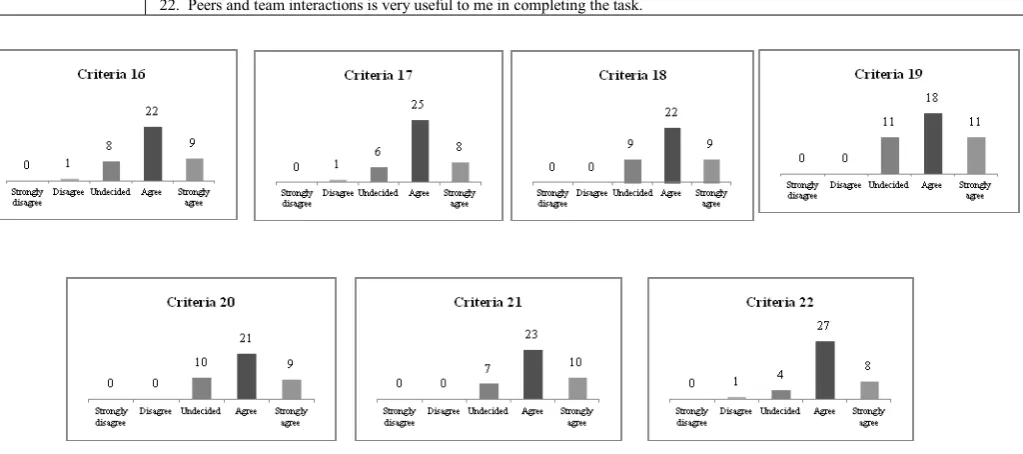
Table 4 presents the related questionnaires for the cognitive learning perspective. In overall, based on Figure 6, the frequency distribution ranging from the lowest 72.5%, average 77.5%, and highest 87.5% students agreed with the collaborative learning perspective for POPBL implementation in their projects. However, it is interesting to observe that there are several small frequency distributions especially for criteria 19 and 22. Approximately 27.5% or less than eleven students who were still struggling to cooperate with their peers (criteria no.19). This might be an indicator that the current activities should be integrated with newly interactive activities that allows team-working functions as planned to exist at beginning of the project.
A small portion of students’ distribution in criteria 22 were found disagreed (2.5%) and undecided (10%); that interaction between peers and his/her team helps in completing the task. From closed-observation based on questionnaires feedbacks, it is found that these students have commented that they could not voice out – verbally and directly – if any one of their team-mates were not giving commitment and cooperation while conducting the project.
Table 4. Collaborative learning criteria
Perspective Criteria Collaborative
Learning
16. I am actively participating in giving ideas, help others to understands, give appropriates suggestions during team discussions. 17. I am able to evaluate, communicate and express knowledge and ideas effectively, professionally and ethically.
18. I am able to compete with each other to find the best solutions.
22. Peers and team interactions is very useful to me in completing the task.
Figure 6. Collaborative Learning : Criteria 16-22 Results
3.2 Results on Contents Perspective
Table 5 presents the content perspective in terms of instructor monitoring and guidance role, the mapping on course syllabus with POPBL approach, the students’ understanding on given case study and the real-problems complexity level of the given case study criteria. As for survey results, Figure 7 portrays the 100% distribution of students who agreed that the lecturer (instructor) played a major role in monitoring and guiding towards the POPBL implementation. Additionally, all students also agreed that the Programming Technique 1 coursework syllabus is appropriately suitable to be adopted for POPBL approach.
Apart from that, it is found that from the frequencies recorded in criteria 26 and 27 which relate to the given case study and the real-problems under focus, the students generally understood the overall case and problems. Basically, for both sections 04 & 07 of this coursework, six case studies application (app.) were chosen, namely; i) Daily water intake app., ii) Priority quadrant app., iii) Know your learning style App., iv) GPA calculator app., v) Monthly budget planner app., vi) Calories counter app. The mentioned case studies were selected based on current experiences and students’ lifestyles. Students can search for similar app. from the Internet or simply observe the system functionalities based on their real needs as students. However, none of the students agreed that the real-problems complexity of the case study was indeed easy. Majority of the students chose average, while 42.5% of the distribution found the case study to be difficult.
Table 5. Content categories and criteria
Content Categories Criteria
Instructor Monitoring Role 23. The instructor/lecturer contributes and play roles in monitoring the teams progression and achievement. Instructor Guidance Role 24. The instructor/lecturer expresses and describes clear guidance about the implementation of POPBL in the
course.
Course Syllabus Mapping 25. The course syllabus is appropriate and suitable to be adopted for the POPBL approach.
Understanding Case Study 26. In overall, estimate how well you understood the given case study application; in terms of its environment and functionality.
Figure 7. Content Perspective : Criteria 23-27 Results
3.3 Students Responses and Feedbacks
Some significant positive and negative responses and feedbacks are presented in the following Table 6. From our closed observation based on the conducted survey, it is found that the students’ achievement is very much depending on numbers of factors such as: i) prior background intake (CGPA), ii) participation during teaching and learning (T&L) activities, and iii) motivation towards gaining more knowledge rather than achieving a good grade only. Also, it is observed that the excellent students (those who scored A+, A, A-) would give good comments and credits to the conducted T&L activities during POPBL implementation in their project. In contrast, the moderate or less-performing students would normally criticise the teaching methods and materials delivery which they regarded as the source contributors towards their achievement.
Table 6. Sample of students responses and feedbacks
Positive response & feedback Negative response & feedback
Create teamwork amongst student, generate skill in programming also as a software engineering student. As a practice of real case study when we going to face a job-time after this.
Some members does not try to give efforts and just follow the others members.
Enable students to work in teams of different personalities and able to manage time more seriously. Students can become more tolerant towards others as well as forced to prioritize project(which is in a good way) as the marking does not only concern oneself but the whole team.
Lecture should already given what part should each member do, so that we know he/she do his/her work. if like now, a good member need to backup the lazy member work because the assignment's mark is in group so by hock or by crook the good member need to complete the assignment.
Strength of this POPBL is know how to work in team mates and faces the attitudes of each person. also, learn a programming skill that need to be implement in the program.
Some of the group member doesn't show enough effort. This is because of their skill is weak and don't want to improve it. Also, the topic that we are given is not a student wish. We should be able to create own topic and refer to lecturer whether it suitable or not. Major strengths would be the type of application assigned to us, how
it is actually a real-life application. How we have to incorporate elements in programming throughout the assignments. It help us develop our skills progressively.
Some of the POBL task requires the implementation of complex function such as arrays which is only taught at the end of the semester. This makes it hard to start the project because lack of knowledge on given function.
Make me more cooperate in the group and share ideas to solve problem that we have faces. Beside, give me more knowledge about what I learn in class then apply to project that given to me. It work.
Student are not familiar with this POPBL so at the beginning of the project student are a bit loss about what to do. =)
POPBL prepared student with the overview of how real-life working environment when dealing with real life case study where the student will eventually face when they work later. this also help develop student critical thinking.
4. Conclusion and Future Works
This paper reports our very first experience of implementing POPBL approach in Introduction to Programming coursework. The previous experimentation with POPBL was initially aimed to provide student-centred and active learning environment which promotes improvement for students’ ability in analysing and solving real-world problems related to the current issues in software development. We have also targeted to induce motivation in terms of teamwork and other important soft skills such as communication and self-directed learning.
Based on high achievement for students’ results, it is proven that POPBL is suitable to be implemented in the programming course. POPBL approach was implemented as a project-based, where students were given a real-world problem for specific case study applications and current in-trend software which is complex enough for beginner students. Students were assigned in a team to solve the identified problems of the selected case study application throughout the three phases in POPBL. The results findings from the conducted survey have shown that students are highly motivated and satisfied with POPBL implementation towards improving their soft-skills (communication between teammates and planning) as well as their technical skills (analysing real-world problem, designing the structured solutions and developing the products). However, POPBL implementation will require enormous effort and preparation from instructor (lecturer). Thus, assistance from tutor or Teaching Assistant to give a hand in observing and tracking performance for each team member in terms of meeting log, peer-review evaluation, and project progress should take place to ensure the success of POPBL implementation.
In future, it is hoped that our experiences on POPBL implementation in the Introduction to Programming coursework for freshman students, could motivate ourselves as well as other instructors/teachers in Computing field especially, to apply this pedagogical approach in our T&L activities. Furthermore, the proposed POPBL procedural framework and its implementation should be custom-designed to be applied in other coursework in terms of the complexity level for the given real-world problem based on students’ year of studies and exposure.
Acknowledgements
This study is partially funded by the Instructional Development Grant (IDG) from Universiti Teknologi Malaysia (UTM) under Cost Centre No. R.J160000.4J062. The authors would like to express their deepest gratitude to UTM for their financial support in our research activities. In particular, the authors wish to thank the students of SCSJ1013 Programming Technique 1 (Section 04 & 07) who participated cooperatively in the POPBL implementation and their willingness to complete the questionnaires. The sample of meeting log documents, peer-review assessment forms, survey link and related documents on the POPBL implementation can be retrieved from the main author’s website at http://se.cs.utm.my/noraini/. The authors would also acknowledge the respective individuals and members of Software Engineering departments (http://comp.utm.my/department-of-software-engineering/) for the informative discussion, supportive suggestion and invaluable feedbacks during the time that this research was being conducted.
References
Abdul Ghafir, M. F., Hasnan, K., Khalid, A., & Mohd Ali, M. F. (2007). Cub prix experience: a case study on implementation of POPBL in UTHM. Paper presented at the 2nd Regional Conference on Engineering Education (RCEE), Johor Bahru.
Ahmad, A., & Jabbar, M. H. (2007). POPBL experience: a first attempt in first year electrical engineering students. Paper presented at the 2nd Regional Conference on Engineering Education (RCEE), Johor Bahru.
Du, X., & Jensen, L. P. (2010). Project-Organised and Problem-Based Learning [Electronic Version]. Retrieved December 2012, from http://www.control.aau.dk/~lpj/POL/Kursusnavn.html
Hosseinzadeh, N., & Hesamzadeh, M. R. (2012). Application of Project-Based Learning (PBL) to the Teaching of Electrical Power Systems Engineering. IEEE Transactions on Education, 55(4), 495 - 501
Hussain, D. M. A., & Rosenørn, T. (Eds.). (2008). Assessment of Student Competencies for a Second Year Operating System Course. Rotterdam The Netherlands: Sense Publishers.
Kellett, C. M. (2012). A Project-Based Learning Approach to Programmable Logic Design and Computer Architecture. IEEE Transactions on Education, 55(3), 378-383.
Lamar, D. G., Miaja, P. F., Arias, M., Rodriguez, A., RodrÃguez, M., Vázquez, A., et al. (2012). Experiences in the application of project-based learning in a switching-mode power supplies course. IEEE Transactions on Education, 55(1), 69-77.
Lehmann, M., Christensen, P., Du, X., & Thrane, M. (2008). Problem-oriented and project-based learning (POPBL) as an innovative learning strategy for sustainable development in engineering education. European Journal of Engineering Education, 33(3), 283-295.
Moesby, E. (2005). Curriculum development for project-oriented and problem-based learning (POPBL) with emphasis on personal skills and abilities. Global J. of Engng. Educ, 9(2), 121-128.
Mohamed, M., Mat Jubadi, W., & Wan Zaki, S. (2011). An Implementation of POPBL for Analog Electronics (BEL10203) Course at the Faculty Of Electrical and Electronic Engineering, Uthm. Journal of Technical Education and Training, 3(2).
Mohamed, M., Mat Jubadi, W., & Wan Zaki, S. (2012). An Implementation of POPBL for Analog Electronics (BEL10203) Course at the Faculty Of Electrical and Electronic Engineering, UTHM. Journal of Technical Education and Training, 3(2).
Qiu, M., & Chen, L. (2010). A problem-based learning approach to teaching an advanced software engineering course. Paper presented at the IEEE Second International Workshop on Education Technology and Computer Science (ETCS).
Santos-Martin, D., Alonso-Martinez, J., Eloy-Garcia Carrasco, J., & Arnaltes, S. (2012). Problem-based learning in wind energy using virtual and real setups. IEEE Transactions on Education, 55(1), 126-134.
Uziak, J., Oladiran, M. T., Eisenberg, M., & Scheffer, C. (2010). International team approach to Project-Oriented Problem-Based Learning in design. World Transactions for Engineering & Technology Education, 8(2), 137-144.