Volume3, Number1, March2009 pp.27—32
FUNCTION MINIMIZATION IN DNA SEQUENCE DESIGN BASED ON CONTINUOUS PARTICLE SWARM OPTIMIZATION
Noor Khafifah Khalid1, Zuwairie Ibrahim1, Tri Basuki Kurniawan1
Marzuki Khalid1, Nor Haniza Sarmin2 and Andries P. Engelbrecht3
1Center for Artificial Intelligence and Robotics (CAIRO)
Faculty of Electrical Engineering
2Faculty of Science
Universiti Teknologi Malaysia 81310 Skudai, Johor, Malaysia
[email protected]; [email protected]; [email protected] [email protected]; [email protected]
3Department of Computer Science
University of Pretoria, South Africa [email protected]
Received August 2008; accepted November 2008
Abstract. In DNA based computation and DNA nanotechnology, the design of good DNA sequences has turned out to be an essential problem and one of the most prac-tical and important research topics. Basically, the DNA sequence design problem is a multi-objective problem, and it can be evaluated using four objective functions, namely, Hmeasure, similarity, continuity, and hairpin. In this paper, particle swarm optimization
(PSO) is proposed to minimize those objective functions, individually, subjected to two constraints: melting temperature, Tm, and GCcontent. A model is presented in order to
minimize the objective functions using PSO. An implementation of the optimization pro-cess is presented using 20 particles. The results obtained verified that PSO can be used to minimize each objective individually.
Keywords: DNA computing, DNA sequence design, Particle swarm optimization
1. Introduction. Deoxyribonucleic Acid (DNA) has certain unique properties such as self-assembly and self-complementary, which makes it able to save an enormous amount of data and perform massive parallel reactions. With the view of the utilization of such attractive features for computation, DNA computation researchfield has been initiated [1]. Usually, in DNA computing, the calculation process consists of several chemical reactions, where the successful wet lab experiment depends on DNA sequences we used. Thus, DNA sequence design turns out to be one of the approaches to achieve high computation accuracy and become one of the most practical and important research topics in DNA computing.
The necessity of DNA sequence design appears not only in DNA computation, but also in other biotechnology fields, such as the design of DNA chips for mutational analysis and for sequencing. For these approaches, sequences are designed such that each element uniquely hybridizes to its complementary sequence, but not to any other sequence. Due to the differences in experimental requirements, however, it seems impossible to establish an all-purpose library of sequences that effectively caters for the requirements of all labo-ratory experiments [2]. Since the design of DNA sequences is dependent on the protocol of biological experiments, a method for the systematically design of DNA sequences is highly required.
Various kinds of methods and strategies have been proposed to date to obtain good DNA sequences. These methods are exhaustive search method [3], random search algo-rithm [4], simulated annealing [5], dynamic programming approach [6], graph method [7], template-map strategy [8,9], genetic algorithms [10,11], and multi-objective evolutionary optimization [12].
2. Objectives and Constraints in DNA Sequence Design. The objective of the DNA sequence design problem is basically to obtain a set of DNA sequences where each sequence is unique or cannot be hybridized with other sequences in the set. In this work, two objective functions, namelyHmeasure, andsimilarityare chosen to estimate the
uniqueness of each DNA sequence. Another two additional objective functions, hairpin
and continuity, are used to prevent the secondary structure of a DNA sequence.
DNA sequence design is actually a multi-objective optimization problem, where four objective functions have to be minimized simultaneously. However, in this paper, a model that is suitable for PSO computation is presented to minimize these four objective func-tions individually. Those objective funcfunc-tions are Hmeasure, similarity, hairpin, and
con-tinuity. Melting temperature and GCcontent are included as constraints in the PSO
com-putation. The formulations for all objective functions and constraints can be referred to [13].
This paper is divided into five sections. Section 2 gives an overview of the problem in DNA sequence. Section 3 introduces basic continuous PSO. Section 4 presents the proposed approach of DNA sequence design based on PSO. Experimental results obtained from the proposed approach are shown and discussed in Section 5. Section 6 concludes the paper.
3. Particle Swarm Optimization. Particle swarm optimization (PSO) is a population-based stochastic optimization technique developed by Kennedy and Eberhart in 1995 [14]. This methodfinds an optimal solution by simulating social behavior of birdflocking. The PSO algorithm consist of a group of individuals named “particles”. Each particle is a potential solution to an n-dimensional problem.
The group can achieve the solution effectively by using the common information of the group and the information owned by the particle itself. The particles change their state by “flying” around in ann-dimensional search space based on the velocity updated until a relatively unchanging state has been encountered, or until computational limitations are exceeded.
The velocity of each particle is calculated using
vki+1 =ωvki +c1r1(pbesti−s
k
i) +c2r2(gbestk−ski) (1)
wherevki, vki+1 and ski, are the velocity vector, modified velocity vector, and positioning vector of particle i at generation k, respectively. pbestki is the best position found by particle i and gbestk is the best position found by the particle’s neighborhood or the entire swarm. Parameter c1 and c2 are the cognitive and social coefficients, respectively, and w is the inertia weight, which is employed to control the impact of the previous history of velocities on the current velocity of each particle. r1 and r2 are two different random parameters. The modified position vector, ski+1, is obtained using
ski+1 =ski +vki+1 (2)
sequence. Thus, the search space is 4l
−1. As such, for 5-mer nucleic acid sequence, the size of the search space is 45−1, which is from 0 to 1023, and contains all sequences from AAAAA to TTTTT.
In this study, basic PSO is employed, which has been designed for continuous-valued search spaces. In order to eliminate the floating point in the computation, caused by the random values and coefficient factors, the floating values are approximated to the nearest decimal numbers. The decimal numbers are converted to binary, and binary representations are converted into sequences. For example, the decimal number of 908.8 is approximated to 90910, which is equals to 11100011012, in binary, and is then translated into “TGATC” DNA sequence.
Table 1. The value of PSO control parameters
Parameter Value
Cognitive factor, c1 1.4
Social factor, c2 1.4
Inertia weight, w 0.9 ∼ 0.4
Random values: r1,r2 [0,1]
No. of particles 20
Max iteration 400
5. Experimental Results and Discussions. The proposed approach has been imple-mented using Visual Basic 6.0. Table 1 shows the value of PSO parameters used in the experiments. A set of 10 DNA sequences with the length, l = 20, is chosen as a case study. The constraints are 30% ∼ 80% for GCcontent and 50˚C ∼ 80˚C for Tm. In this
study, a decreasing inertia weight is used, where
ωiteration =ωmax− µ
ωmax−ωmin iterationmax ×
iteration 
(3)
Table 2. The results obtained for Hmeasure, the standard deviations are
shown in parentheses.
DNA Sequences Hmeasure Similarity Continuity Hairpin
1. CTAAGTCAACCAAGCACACA 2. AAACACATATCGACTGGGAG 3. GACAACGTGGCGACTGTGCC 4. ATTCTGACGCCTTTAAGTTA
5. TCTCCGCAATTAAAAGGAGT 4.7 286.08 311.6 3.23
6. CATAGCCCTAGGTCCAGTAA (6.842) (80.316) (69.069) (3.494)
7. ATAAAAACGAACCAAAACCC 8. GCGGCTGGCAAACAAAATGC 9. CCCATTCAACTACCAGTTTT 10.TCCTCGCCGCAATACGCAAG
Table 2 shows the results for Hmeasure function, where the fitness value is the average
value for 10 sequences. Although PSO canfind the minimum value forHmeasure, the values
for other objectives, which aresimilarityand continuity,are high, except for hairpin. For
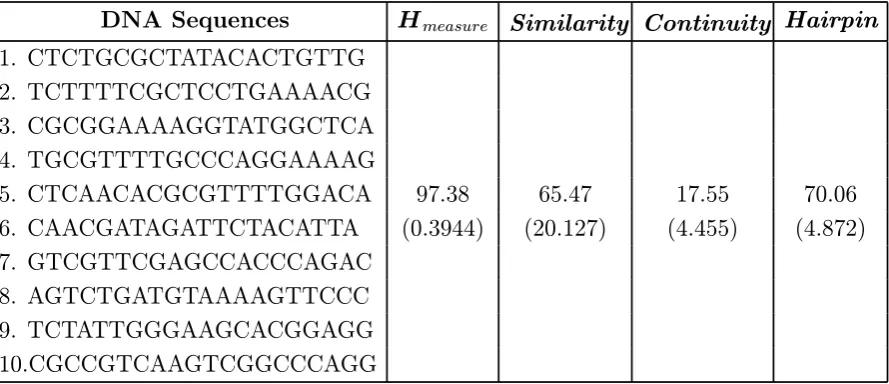
similarityfunction, the results are shown in Table 3. The minimized value for similarity
has been obtained but the values for other objectives are not minimized. In Table 4, the sample of the results ofcontinuityfunction is shown. Even though PSO is able tofind the minimum value forcontinuity function, the values for other objectives are not minimized.
Table 3. The results obtained for similarity, the standard deviations are shown in parentheses.
DNA Sequences Hmeasure Similarity Continuity Hairpin
1. CTCTGCGCTATACACTGTTG 2. TCTTTTCGCTCCTGAAAACG 3. CGCGGAAAAGGTATGGCTCA 4. TGCGTTTTGCCCAGGAAAAG
5. CTCAACACGCGTTTTGGACA 97.38 65.47 17.55 70.06
6. CAACGATAGATTCTACATTA (0.3944) (20.127) (4.455) (4.872)
7. GTCGTTCGAGCCACCCAGAC 8. AGTCTGATGTAAAAGTTCCC 9. TCTATTGGGAAGCACGGAGG 10.CGCCGTCAAGTCGGCCCAGG
Table 5 shows the results of hairpin function. The fitness value obtained is the lowest among the fitness functions. Although PSO has found the minimum value for hairpin, the values for other objective functions are high.
Table 4. The results obtained for continuity, the standard deviations are shown in parentheses.
DNA Sequences Hmeasure Similarity Continuity Hairpin
1. TGATAATGGAGCATGACACC 2. GTAGCGGATGATTCTCGCGT 3. ATGGATCTAGCTCATCTTCA 4. GTACCAAGTTGCGCTAGCAA
5. ATATAACATTCACTGTCCAT 75.02 19.44 0.45 107.9
6. GGTGCGCCCAGGAACGGAGC (1.369) (3.264) (0.45) (2.373)
7. CCAACACTCTCCGACAGTCG 8. TTCAGCCAGAAGCTCGCCAT 9. CTGTGACTATGAGTTGGCAC 10.TTACATAGCGTATGCGCATA
Table 5. The results obtained for hairpin, the standard deviations are shown in parentheses.
DNA Sequences Hmeasure Similarity Continuity Hairpin
1. CGACTTCTGGCAATGCGAAT 2. TCTTGTGAGTTAGTGTGCTG 3. CGAATAGTTGATCTGGGGAT 4. CAACGGGAGCTAATCGAACT
5. GGTCTCCCTCACTCCTAGAC 203.1 39.15 168.84 2.82
6. CATGTGTCGCTCAGGAGCGC (79.414) (13.176) (72.853) (2.033)
7. TTATTGCGGTTAAATTCTGC 8. CTCTAGGATCTGCATGACTT 9. TTAGGAAAAACGCGCACAGT 10.CGCCATATGCGGGAGGATGT
continuity. GCcontent and Tm constraints were embedded in the computation to ensure
that the DNA sequences obtained are within the acceptable range.
The results obtained prove that the minimum value of each objective function in DNA sequence design can be obtained using the proposed approach. However, DNA sequence design is multi objective problem, and the objectives should be optimized simultaneously. Therefore, future works will include the solution of multi-objective problem in DNA se-quence design using Pareto optimality concept and Vector Evaluated PSO (VEPSO).
Acknowledgment. This research is supported financially by the Ministry of Science, Technology, and Innovation (MOSTI), Malaysia, under eScienceFund Research Funding (Vot 79034).
REFERENCES
[1] M. Arita, A. Nishikawa, M. Hagiya, K. Komiya, H. Gouzu and K. Sakamoto, Improving sequence design for DNA computing,Proc. of the Genetic Evol. Comput. Conf., pp.875-882, 2000.
[2] L. Adleman, Molecular computation of solutions to combinatorial problems, Science, vol.266, pp.1021-1024, 1998.
[3] A. J. Hartemink, D. K. Gifford and J. Khodor, Automated constraint based nucleotide sequence selection for DNA computation,Proc. of the 4th DIMACS Workshop DNA Based Computer, pp.227-235, 1998.
[4] R. Penchovsky and J. Ackermann, DNA library design for molecular computation, J. Comput. Bio., vol.10, no.2, pp.215-229, 2003.
[5] F. Tanaka, M. Naktsugawa, M. Yamamoto, T. Shiba, and A. Ohuchi, Toward a general-purpose sequence design system in DNA computing,Proc. of the Congr. Evil. Comput., pp.73-78, 2002. [6] A. Marathe, A. E. Condon, R. M. Corn, On combinatorial DNA word design, Proc. of the 5th
International Meeting on DNA Based Computers, 1999.
[7] U. Feldkamp, S. Saghafi, W. Banzhaf and H. Rauhe, DNA sequence generator — A program for the construction of DNA sequences,Proc. of the 7th Int. Workshop DNA Based Computer, pp.179-188, 2001.
[8] M. Arita and S. Kobayashi, DNA sequence design using templates,New Generation Comput., vol.20, pp.263-277, 2002.
[9] A. G. Frutos, A. J. Thiel, A. E. Condon, L. M. Smith and R. M. Corn, DNA computing at surfaces: Four base mismatch word design,Proc. of the 3rd DIMACS Workshop DNA Based Computer, pp.238, 1997.
[11] R. Deaton, R. C. Murphy, J. A. Rose, M. Garzon, D. T. Franceschetti, S. E. Stevens Jr., Genetic search for reliable encodings for DNA-based computation,Proc. of the First Conference on Genetic Programming, 1996.
[12] S. Y. Shin, I. H. Lee, D. Kim and B. T. Zhang, Multi-objective evolutionary optimization of DNA sequences for reliable DNA computing,IEEE Transaction on Evolutionary Computation, pp.143-158, 2005.
[13] T. B. Kurniawan, N. K. Khalid, Z. Ibrahim, M. Khalid and M. Middendorf, An ant colony system for DNA sequence design based on thermodynamics, Proc. of the Fourth IASTED International Conference Advances in Computer Science and Technology, Langkawi, Malaysia, pp.144-149, 2008. [14] J. Kennedy and R. C. Eberhart, Particle swarm optimization, Proc. of the IEEE International