62:1 (2013) 85–94 | www.jurnalteknologi.utm.my | eISSN 2180–3722 | ISSN 0127–9696
Full paper
Jurnal
Teknologi
Performance Evaluation of Routing Protocols in Live Video Streaming
over Wireless Mesh Networks
Behrang Barekataina*, Mohd Aizaini Maarofa, Alfonso Ariza Quintanab, Hamid Reza Ghaeinic
a
Faculty of Computing, Universiti Teknologi Malaysia, 81310, UTM Johor Bahru, Johor, Malaysia bFaculty of E.T.S.I and Telecommunication, University of Malaga, Malaga, Spain
c
Faculty of Electrical and Computer Engineering, Tarbiat Modares University, Tehran, Iran
*Corresponding author: [email protected]
Article history
Received :14 February 2013 Received in revised form : 18 March 2013
Accepted :15 April 2013
Graphical abstract
Abstract
In recent years, live video streaming over Wireless Mesh Networks (WMNs) has been of great interest among users. However, node mobility, interferences and competition for the available resources are some important factors, to name a few, which can considerably affect the perceived video quality on wireless nodes. In this regard, employing an efficient routing protocol can address these challenges as much as possible. The fact of the matter is that the real performances of the most recently used routing protocols in live video streaming over WMNs is remaining as an open issue. Therefore, this study designs and implements a simulator using the OMNET++ framework and measure the performances of these routing protocols under various and different network conditions based upon the different performance metrics. To the best of our knowledge, this is the first study which precisely and comprehensively performs this evaluation. The obtained results not only do help interested researchers to select the most appropriate routing protocol for their proposed video streaming applications over WMNs, but also let them introduce more efficient hybrid protocols based upon the considered routing protocols in this study.
Keywords: Routing protocol; WMN; live video; performance evaluation
Abstrak
Dalam tahun-tahun kebelakangan ini, aliran video langsung dalam Wireless Mesh Networks (WMNs) telah manarik minat dikalangan pengguna. Walau bagaimanapun, mobiliti nod, gangguan dan persaingan ke atas sumber-sumber yang sedia ada adalah di antara beberapa faktor penting yang boleh menjejaskan kualiti video pada nod tanpa wayer. Dalam hal ini, menggunakan protokol routing yang efisyen boleh menangani cabaran-cabaran ini sebanyak yang mungkin. Hakikatnya prestasi sebenar protokol penghalaan terkini digunakan dalam alran video langsung WMNs kekal sebagai isu yang terbuka. Oleh itu, kajian ini merekabentuk dan melaksanakan simulasi menggunakan rangka kerja OMNET + + dan mengukur prestasi protokol penghalaan di bawah keadaan rangkaian yang pelbagai dan berdasarkan metrik prestasi yang berbeza. Untuk pengetahuan kami, ini adalah kajian penilaan pertama yang tepat dan menyeluruh pernah dilakukan. Keputusan yang diperolehi bukan sahaja membantu penyelidik yang berminat untuk memilih protokol penghalaan yang paling sesuai untuk aplikasi video aliran dalam WMNs, tetapi juga memboleh mereka memperkenalkan protokol hibrid yang lebih cekap berdasarkan protokol protokol yang dipertimbangkan dalam kajian ini.
Kata kunci:Routing protocol; WMN; video langsung; penilaian prestasi
© 2013 Penerbit UTM Press. All rights reserved.
1.0 INTRODUCTION
Nowadays, users are really interested in watching live video streams on their gadgets using wireless communication. However, existing challenges in wireless networks such as time-varying channels, intra-interferences, inter-interferences, competitions, limited available bandwidth and path failure due to node mobility considerably affect the performance of a video
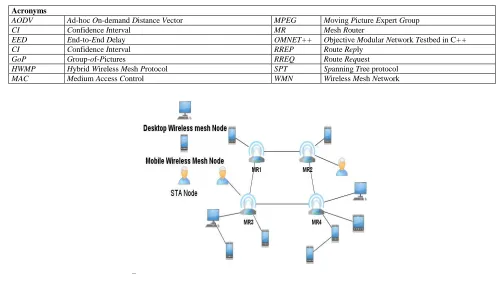
sensitive. Therefore, more reliable infrastructure is needed for disseminating a live video stream over a wireless network. Wireless mesh networks 4-5, which have emerged as an encouraging design paradigm for the next wireless networking generation, try to degrade the effects of existing challenges in a wireless network on the perceived video quality by introducing new advantages such as self-healing, self-configuration and multi-hopping technique. WMNs can be classified into 3 classes including Infrastructure, Cline-Based and hybrid 6. Figure 1 depicts a hybrid WMN consists of Mesh Routers (MRs), Desktop, Mobile Mesh (e.g. a gadget embedded in a car) and STA nodes (e.g. a gadget with a pedestrian). In this study, a STA node is a wireless node which directly connects to a MR and has low mobility speed. To provide high video quality over WMNs has been of great interest in the recent studies. These
studies have proposed different solutions for this purpose. This study categorizes them into four categories. First, as a simple solution, some studies such as 7 exploit the Internet backbone for efficient data dissemination between two wireless nodes. However, data communication over a public network such as the Internet cannot be as a secure method. Moreover, having reliable access to the Internet is another problem of this type of solution. Wired connections are employed in the second category. Some studies such as 8 considered wired communication in a WMN in which a part of a path between a source and a destination consists of wired instead of wireless links. The fact is that the amount of interference and competition exponentially increase when the number of wireless hops between a source and a destination linearly increases.
Acronyms
AODV Ad-hoc On-demand Distance Vector MPEG Moving Picture Expert Group
CI Confidence Interval MR Mesh Router
EED End-to-End Delay OMNET++ Objective Modular Network Testbed in C++
CI Confidence Interval RREP Route Reply
GoP Group-of-Pictures RREQ Route Request
HWMP Hybrid Wireless Mesh Protocol SPT Spanning Tree protocol
MAC Medium Access Control WMN Wireless Mesh Network
–
Figure 1 A hybrid WMN
Although this solution can be useful because of the decrease in the number of wireless hops between two nodes, it is necessary to encapsulate the received frame into another frame format (e.g. the Ethernet). As the third category, some recent studies exploited the benefit of network coding 9-11 for efficient video streaming over wireless networks. Network coding increases the resiliency and the throughput of a wireless mesh network. On the other hand, the imposed computational complexity and transmission overhead are two important challenges of this method.
Finally, some recent studies aimed to introduce hybrid routing protocols 12-14 to exploit the advantages of proactive and reactive schemes simultaneously. An efficient routing protocol can be one of the best solutions to cope with the mentioned challenges in WMNs. However, introducing efficient hybrid routing protocols is completely dependent on the full understanding the performance of the basic protocols. Hence, the main goal of this study is to perform a comprehensive evaluation on the performance provided by the most recently used routing protocols in WMNs, especially in live video streaming. To the best of our knowledge, this is the first study
which compares different routing protocols in WMNs in live video streaming completely and precisely.
The rest of this paper is organized as follows. Sections 2 and 3 explain related works and different routing protocols in WMNs in more details. Section 4 provides the experimental evaluation and discusses on the obtained results. Finally, the paper is concluded in section 5.
2.0 ROUTING PROTOCOLS IN WMNs
dynamic networks where wireless nodes move moment by moment and the probability of path failure can be very high. In this case, keeping predefined paths in the routing table has not any interest. Each node broadcasts a RREQ message into the network and an intermediate node either re-broadcasts it (if it is not the final destination) or sends a RREP message back to the source of the RREQ message (if it is the considered destination). The proactive spanning-tree method can be used in DYMO if it is selected as a spanning-tree routing protocol. In this sense, the root sends a RREQ message and then, all intermediate nodes broadcast this message and answer with a RREP message at the same time.
Finally, HWMP, which is considered by the IEEE 802.11s 18
standard as the default routing protocol in a WMN, is a hybrid scheme based upon AODV and tree-based protocols. Control-Flooding, Ad-hoc based, Opportunistic and Traffic-aware are other classifications of routing protocols in WMNs 4. The focus of this study is not to define and classify these routing protocols, because previous studies provided enough information on them. Therefore, we refer interested researchers to the mentioned references in this section such as 4-18-20 for more information about these routing protocols and employed routing metrics by them for finding the best possible path.
3.0 RELATED WORKS
Live video streaming over WMNs is a new subject which has been recently discussed in some previous studies. Some of these studies evaluated video streaming over ad-hoc21-22 networks and wireless sensor networks23-25. However, there is few studies on live video streaming over WMNs, while none of them evaluated the performances of routing protocols in WMNs in video streaming. A novel network route selection method and an
optimization algorithm for determining the compression rate of the video stream are proposed by 26 for providing better video quality on nodes in a WMN. The proposed method tries to find the path with the minimum interference. The effects of interference-aware metrics on video quality in WMNs is studied in 27. The results show that those metrics which consider interferences using accurate measurements provide better video quality on nodes. A quality control method that it automatically adapts the output rate of a layered video stream is proposed by28 and the results show that the video quality is improved on a wireless mesh node. In another study 29, the effects of different GoP size on the perceived video quality in WMNs are evaluated. The results depict that using larger GoP size (e.g. G12B2 and G16B1) can provide better quality on wireless mesh nodes, because the number of frame I will be smaller than that of a GoP which includes 8 frames. A load-balancing routing approach through multiple gateways over multi-paths which considers congestion is proposed by 30. The obtained results show that disseminating layered video on nodes leads to good video quality using the proposed approach.
The authors of 31 investigate the multisource VoD streaming in a multi-interface cognitive WMN. They introduce centralize and distributed channel assignment and routing, respectively, to increase the maximum numbers of concurrent sessions and better video quality, respectively. An extended layer resource assignment method is proposed by32 based upon a new cross-layer optimization strategy for efficiently resource allocation among users in a video streaming system. Finally, the benefits of the particle swarm optimization approach on the perceived video quality over multi-hop wireless networks is examined by 33 using an optimal bandwidth assignment framework.
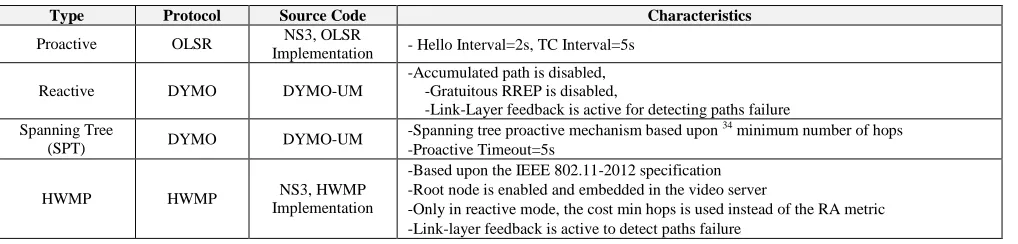
Table 1 Characteristics of the considered routing protocols in the simulation
Type Protocol Source Code Characteristics
Proactive OLSR NS3, OLSR
Implementation - Hello Interval=2s, TC Interval=5s
Reactive DYMO DYMO-UM
-Accumulated path is disabled, -Gratuitous RREP is disabled,
-Link-Layer feedback is active for detecting paths failure Spanning Tree
(SPT) DYMO DYMO-UM
-Spanning tree proactive mechanism based upon 34 minimum number of hops
-Proactive Timeout=5s
HWMP HWMP Implementation NS3, HWMP
-Based upon the IEEE 802.11-2012 specification -Root node is enabled and embedded in the video server
-Only in reactive mode, the cost min hops is used instead of the RA metric -Link-layer feedback is active to detect paths failure
Table 2 Simulation parameters and network conditions
Parameter Value(s) Parameter Value(s)
Simulation Time ~34 Minutes Number of STA nodes [8,12]
Node Distribution Model Uniform(15,36) Number of mobile Mesh nodes [10,14]
Mobile Mesh Mobility Speed Uniform[5..25] mps STA Mobility Speed Uniform[1..2] mps
Pause Time in STA Uniform[80,600] Packet Size 512 Bytes
Transmission Range 150 m Propagation Model Two Ray 35
Interference Model Additive 36 Infrastructure Network Hybrid WMN
Network Area Size 800×1200 m2 Video Stream Type Variable Bit Rate (VBR)
4.0 SIMULATION
Live video streaming over wireless mesh networks introduces some challenges to the systems due to this fact that this type of stream is delay sensitive. In addition, interference, contention and node mobility degrade the video quality over a WMN. Smooth video playback on nodes can be the most important goal of a video streaming application which can be increased using an efficient routing protocol. In this regard, the necessity of evaluating the performance of the currently used routing protocols in live video streaming over WMNs is inevitable. This evaluation should consider both low and high mobility rates and different number of nodes. Moreover, it is necessary to measure the effects of mentioned challenges (e.g. interferences) on the performance provided by them. Therefore, this study considers five important performance metrics as follows. (1) The total amount of successfully received bytes by a node: this metric shows how a routing protocol can be affected by existing challenges in a WMN (2) The averaged number of received video frames I, P and B by a node (3) EED (End-to-End Delay): it is the required time for transferring a video packet from the video source to a destination (4) Jitter: it can be defined as the packet delay variation and (5) Routing Overhead: This metric refers to the ratio of the useless to the total number of transmitted packets by a routing protocol. EED and Jitter are two important metrics for measuring the performance of a routing protocol in live video streaming. Suppose that a video frame is arrived in a node successfully, however, its playback time is passed. In this case, the media player will skip this frame which leads to low video quality. To measure these two metrics shows the performance of a routing protocol in live streaming. Finally, although a routing protocol may provide considerable performance in terms of the total amount of successfully received video frames, EED and Jitter, it imposes high routing overhead on the system. Therefore, to measure this metric is also important.
4.1 Simulation Parameters
In order to measure the performance provided by the most recently used routing protocols in wireless mesh networks in live video streaming, a precise simulator is designed and implemented using INETMANET framework in OMNET++ 37. The OMNET++ is a discrete-event-based simulator which includes various frameworks and C++ libraries. The INETMANET, which is based upon the INET framework, can be used for simulating various wireless networking such as WMNs. Tables 1 and 2 depict the technical aspects of the considered routing protocols and the network conditions in this simulation, respectively. A live video source disseminates 2000 seconds of the Silence of the Lamb live video stream, which is available from 38, to the network. Actually, it is a G16B1 GoP based 39 video stream based upon the VBR technique which is encoded using the MPEG-4 video compression standard. Figure 2 shows the structure of this GoP. Decoding frames P (Predictive) and B (Bi-directional) are dependent on the previous frame I (Intra) or P. Moreover, a frame B is dependent on the next frame P for successful decoding. In fact, frame I is a reference frame for decoding the whole GoP. According to Table 1, we disabled the path accumulation feature in DYMO 40, which is a successor to the AODV. Therefore, it behaves like the AODV routing protocol. Moreover, its behavior can be look like a spanning tree protocol when the proactive mechanism is employed in DYMO. In this case, the root sends a RREQ message and then, intermediate nodes either broadcast or reply
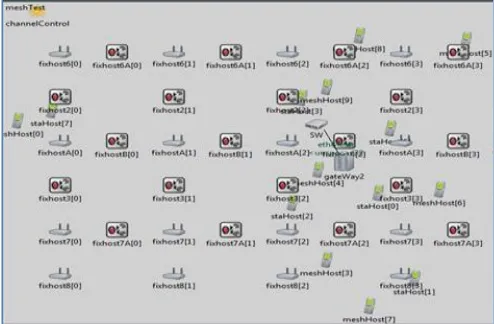
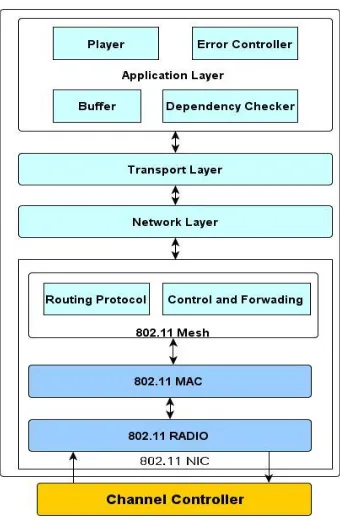
it with a RREP packet at the same time 34. Finally, it is necessary to mention that all STA and just 50 percent of Mesh nodes request the live video stream from the video source during the simulation. In this case, it is possible to measure the performance of a routing protocol comprehensively, because the competition among nodes increases which leads to more interferences in the network. We randomly selected those Mesh nodes which request the video stream among all existing Mesh nodes in the designed hybrid WMN. Figures 3 and 4 show the view of the designed hybrid WMN and the structure of a node in this study, respectively.
Figure 2 A GoP structure based upon G16B1
As can be seen in Figure 4, as soon as a node receives a video packet it checks for error and sends it to the upper layer. Then, the node buffers the received video packets and generates the video frame sequences before sending them to media player for playing. The dependency between the received frame and the related reference frame also performs in the application layer. As mentioned before, there are two types of nodes in this study including STA and mesh nodes. Actually, we consider STA nodes with low mobility, because it is necessary to evaluate the performance of different routing protocols for nodes with low and high mobility rates. Contrary to STA nodes, mesh nodes can handover between MRs and use multi-hop technique to connect to a MR. STA nodes can stop for a random time between 80 and 600 seconds before moving again in the network. In this case, the STA node behaves like a fixed node.
Figure 3 A View of the designed hybrid WMN in the simulator
4.2 Simulation Results and Discussions
Therefore, it is just possible to compare different routing protocols based upon each of these frames individually as depicted in Figures 5 and 6. At a glance overview over these figures, the reactive protocol provides the highest performance, whereas the HWMP delivered the smallest number of video frames to both STA and Mesh nodes. The main reason is that the HWMP is not originally designed for WMNs including mobile nodes, especially those with high speed.
Figure 4 WMN node module
Actually, the reactive routing protocol is more suitable for dynamic networks where the mobility rate is high, whereas HWMP relies on tree construction which can be a weak point in high dynamic networks. Recall that, the whole GoP can be skipped during playback if the frame I is not received in a node. In this regard, the importance of having an efficient routing protocol is more visible. Moreover, although the proactive protocol lets STA and Mesh nodes receive a large number of video frames, it performed it in return for considerable routing overhead as depicted in Figure 13. The behaviors of these routing protocols are the same for the second metric, the total amounts of successfully received bytes by STA and Mesh nodes, as shown in Figures 7 and 8. However, the proactive provides approximately similar performance to the reactive routing protocol for STA nodes, because these nodes move with very low speed in comparison with the Mesh nodes which have high mobility rate and speed.
Figure 5 Averaged number of received video frames in STA nodes
Figure 6 Averaged number of received video frames in mesh nodes
Figure 7 Total amounts of received video frames in byte in STA Nodes (95% CI)
Figure 8 Total amounts of received video frames in byte in mesh nodes (95% CI)
Figure 9 Experienced amounts of end-to-end delay in STA nodes in second (95% CI)
Figure 11 Experienced amounts of jitter in STA nodes in second (95% CI)
Figure 12 Experienced amounts of jitter in mesh nodes in second (95% CI)
Figure 13 Imposed routing overhead on mesh nodes in byte (95% CI)
This implies that using a proactive protocol for gadgets carrying by pedestrians is possible. The reactive outperforms the proactive routing protocol for Mesh nodes which have higher mobility speeds. Another deduction is that the performances of all routing protocols will degrade when the numbers of STA and Mesh nodes increase. Although an increase in the numbers of nodes will result in higher interferences and competitions in the system, the results show that none of these protocols can adapt itself with these issues.
End-to-End Delay (EED), the required time in second for transferring a packet from the video source to a node, is the third metric which is measured by this study. This metric clearly shows the performance of a routing protocol in live video streaming, because it is very important to deliver video frames to receivers before their playback times. Otherwise, the probabilities of video distortion and payback skip event increases. As depicted in Figures 9 and 10, proactive protocol, which routes the traffic on the predefined paths, introduces the least amount of EED, whereas the HWMP imposes the highest. According to these figures, an increase in the number of Mesh nodes, while the number of STA nodes remains constant, can increase the amount of EED more than that of the case in which the number of STA nodes increases while the number of Mesh nodes remains constant. It is necessary to mention that 20 milliseconds end-to-end delay is reasonable and acceptable for video streaming over WMNs. Therefore, all routing protocols can vindicate this requirement. Figures 9 and 10 clearly show
that the HWMP cannot guaranty low end-to-end delay when the network size increases.
According to Figures 11 and 12, all routing protocols show the same behaviors as EED for Jitter, the fourth measured metric in this study. Comparing Figures 9 to 10 as well as Figures 11 to 12 indicate that STA and Mesh nodes approximately experience the same amounts of end-to-end delays and Jitters using a specific routing protocol. The fact is that the performance of different routing protocols is more dependent on the total amounts of received bytes than other metrics.
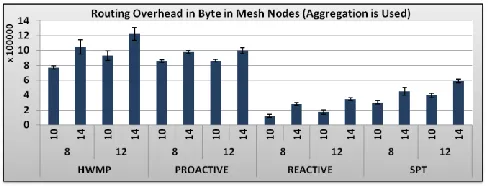
Finally, this study measured the imposed routing overhead on Mesh nodes. This metric is very important, because some routing protocols provide high performance, but in return for high routing overhead. Actually, STA nodes are directly connected to MRs and do not run any routing protocol. Mesh nodes run reactive scheme and it is possible to measure the routing overhead metric on them. Again, the HWMP provides the worst performance, whereas the reactive imposes the least routing overhead on Mesh nodes. Using the proactive routing protocol, contrary to others, the imposed routing overhead does not increase when the numbers of the STA and the Mesh nodes increase, because this protocol uses pre-defined paths for routing packets.
4.3 Complementary Discussion
In the previous section, each video packet included the whole or a portion of a video frame. In order to have a more comprehensive performance evaluation of the mentioned routing protocols in Table 2, we consider another scenario, named aggregation, so that the video source can encapsulate more than one video frame in a packet according to the maximum packet size. In this case, a video packet can consist of more than one video frame.
The main difference between this case and the previous section is that STA and Mesh nodes have more video frames when they receive a packet. On the other hand, missing a packet due to interference, noise and collision means more than one video frame is lost. This study considered the same simulation parameters and network conditions, as mentioned in section 4.1, in this new evaluation case. Again, the simulation ran for five times and the obtained results are consecutively depicted in Figures 14 to 22 with 95 percent confidence interval. What can be inferred from these figures is that different routing protocols have the same behaviors for considering performance metrics when aggregation is used in the network. However, there are some differences in the amounts of these metrics which are explained as follows:
Number of received video frame and bytes:
Comparing Figure 5 to Figure 16 and Figure 6 to Figure 17 indicate that both STA and Mesh nodes receive more number of video frames using different routing protocols, except the proactive, when the aggregation method is used in the video source. The proactive routing protocol, as mentioned before, routes packets on the pre-defined paths. In this case, a path failure causes more loss numbers of video frames, because each packet can include more than one video frame. As a result, the performance of the proactive protocol degrades.
End-to-End Delay and Jitter: The HWMP exploits the
required path selection operation can be decreased by using the aggregation method. In this case, those routing protocols such as the HWMP, which are not designed for dynamic networks, perform fewer numbers of routing operations which results in better performance. The introduced EED and Jitter by other routing protocols are decreased very slowly when the aggregation method is employed in the system.
Figure 14 Averaged number of received video frames in STA nodes (aggregation is used)
Figure 15 Averaged number of received video frames in mesh nodes (aggregation is used)
Figure 16 total amounts of received video frames in byte in STA nodes (aggregation is used - 95% CI)
Figure 17 Total Amounts of received video frames in byte in mesh nodes (aggregation is used - 95% CI)
Figure 18 Experienced amounts of end-to-end delay in STA nodes in second (aggregation is used - 95% CI)
Figure 19 Experienced amounts of end-to-end delay in mesh nodes in second (aggregation is used - 95% CI)
Figure 20 Experienced amounts of jitter in STA nodes in second (aggregation is used - 95% CI)
Figure 21 Experienced amounts of jitter in mesh nodes in second (aggregation is used - 95% CI)
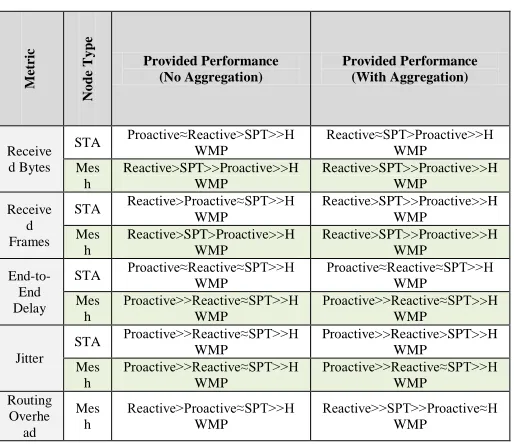
Table 3 Comparison of routing protocols in summary M et ric Node T yp e Provided Performance (No Aggregation) Provided Performance (With Aggregation) Receive d Bytes
STA Proactive≈Reactive>SPT>>H WMP Reactive≈SPT>Proactive>>H WMP Mes h Reactive>SPT>>Proactive>>H WMP Reactive>SPT>>Proactive>>H WMP Receive d Frames
STA Reactive>Proactive≈SPT>>H WMP Reactive>SPT>>Proactive>>H WMP Mes h Reactive>SPT>Proactive>>H WMP Reactive>SPT>>Proactive>>H WMP End-to-End Delay
STA Proactive≈Reactive≈SPT>>H WMP Proactive≈Reactive≈SPT>>H WMP Mes h Proactive>>Reactive≈SPT>>H WMP Proactive>>Reactive≈SPT>>H WMP Jitter
STA Proactive>>Reactive≈SPT>>H WMP Proactive>>Reactive>SPT>>H WMP Mes h Proactive>>Reactive≈SPT>>H WMP Proactive>>Reactive≈SPT>>H WMP Routing Overhe ad Mes h Reactive>Proactive≈SPT>>H WMP Reactive>>SPT>>Proactive≈H WMP
Routing Overhead: Interestingly, all routing protocols,
except the proactive, impose lesser amounts of routing overhead on Mesh nodes when the video source uses the aggregation method in packet encapsulation process. Using aggregation, less number of packets is routed over the network which means less routing information is required to be exchanged. As mentioned before, all packets can be routed on pre-defined paths using this protocol. Therefore, it is not necessary to perform the path selection operation repeatedly unless a link failure on the path occurs. This is why the imposed routing overhead of the proactive routing protocol does not change noticeably in case of using the aggregation method. Using the proactive protocol, the routing overhead is independent of the number of sources and just depends on the number of nodes in the WMN. On the other hand, the routing overhead in the reactive protocol depends on the number of sources.
Altogether, the aggregation method permits both STA and Mesh nodes to experience better video quality. To consider aggregation method is very important in order to precisely measure the performances of different routing protocols in a wireless network.
Actually, each mesh or MR needs to perform more numbers of routing operations when aggregation is not used in the network. Moreover, STA and fixed nodes should relay more number of packets. However, packet loss due to existing challenges in a WMN leads to missing just one video frame. On the other hand, using aggregation method, more than one video frame can be lost when a packet is corrupted, while fewer numbers of routing operations will be performed in the network which results in lower amounts of interferences and competitions.
Table 3 compares different routing protocols in terms of the considered routing metrics in summary. In this table, signs “≈”, “>” and “>>” mean approximately equal, larger and much larger than, respectively. For example, according to the EED, the proactive and the HWMP routing protocols provide the highest and the lowest performances in STA nodes, respectively. It means that the proactive protocol introduces the
least amount of EED to STA nodes. According to this table, proactive routing protocol is really suitable for delay sensitive live video stream, because it uses pre-defined paths for routing. However, it cannot guaranty smooth video playback if the network includes nodes with high mobility speeds. Proactive protocol imposes high routing overhead on the system. The reactive routing protocol outperforms the proactive if there are mobile nodes in a WMN. In the following, each performance metric is individually discussed in more details based upon Table 3:
Received Bytes: Mesh nodes move very fast which can
lead to high link failure rate. The reactive protocol efficiently addresses this challenge in a WMN. The proactive protocol provides the highest performance on STA nodes when aggregation is not used in the system, because they have very low mobility speed. In this case, the performance of the reactive protocol is approximately the same as the proactive. However, using aggregation, both the reactive and the SPT provide better performances than that of the proactive scheme on STA nodes, because missing one video packet leads to missing at least one video frame. The probability of link failure increases when there are mobile nodes in the network even if they move with low speed (STA nodes). In this sense, the performance of the proactive routing protocol decreases, because it uses pre-defined paths for routing and these paths can be failed due to node mobility. Although this is the same for the first scenario (no aggregation), only one video frame will be lost if a path fails.
Received Frames: Same as the received bytes metric,
the reactive protocol provides the highest performance on both STA and mesh nodes. Again, the performance of the proactive routing protocol decreases when aggregation method is used in the network.
End-to-End Delay and Jitter: The proactive scheme
introduces the least amounts of EED and Jitter, because it uses pre-defined paths for performing routing. Although the reactive scheme provides better performance in terms of the received bytes and frames metrics, it increases EED and Jitter, because this protocol needs to find the best path immediately after an explicit request.
Routing Overhead: Because of node mobility, the
probability of link failure can be high. Therefore, contrary to reactive scheme, the proactive routing protocol needs to update routing tables repeatedly. This increases the amount of routing overhead as depicted in Table 3. The reactive routing protocol imposes the least amount of routing overhead on the system; because it does not need to update any routing table due to link failure.
As mentioned before, the HWMP protocol is designed for moveless nodes. This is why it always provides the least performance in Table 3. The SPT is also based upon the proactive scheme which cannot distinguish STA and mesh nodes. Therefore, in all cases, it provides less performance than that of the reactive scheme. Again, we emphasize that all routing protocols introduce acceptable amounts of EED and Jitter. Therefore, the total number of received frames and video frames in byte point out which routing protocol has the highest performance.
move with low speed (e.g. STA nodes). The HWMP protocol, which is a simple modification of the AODV protocol, provides the least performance in all cases, because it is not designed for high mobility. Finally, we believe that the necessity of introducing an efficient hybrid routing protocol in inevitable. This hybrid scheme should exploit the advantages of both reactive and proactive protocols simultaneously. As a result, high video quality can be provided on Mesh and STA nodes.
5.0 CONCLUSION
Nowadays, live video streaming over wireless mesh networks has been of great interest among users. According to existing challenges in a wireless communication, an efficient routing protocol can improve the performance of the network, especially in delay sensitive live video streaming. This study precisely evaluates the performance of the most recently used routing protocols in WMNs to show the real efficiencies of them under various network conditions. The results show that the reactive protocol outperforms others when the mobility rate and speed are high in a WMN. Moreover, the proactive protocol can be the best choice for both fixed (moveless) and STA nodes, because they are either moveless or move with very low speed.
HWMP cannot provide good performance in a WMN with mobile nodes, because it is originally designed for moveless nodes. We measured the performances of these routing protocols when the video source was able to encapsulate more than one video frame in a packet, called aggregation method. The results show, except the proactive, other routing protocols provide better performances in terms of the number of received video frames and the total received video frames in byte. However, the proactive scheme introduces the least amounts of End-to-End delay and Jitter in second even if the video source uses aggregation method. According to the routing overhead metric, the reactive routing protocol provides the highest performance, because it finds the best path based upon a request for routing. What can be inferred from the obtained results is that reactive routing protocol lets STA and mesh nodes receive more number of bytes and video frames, whereas the proactive delivers the video frames in lower end-to-end delay.
In near future, we will analyze these protocols in a real testbed for both live and VoD streams. Moreover, we aim to introduce an efficient hybrid routing protocol in order to provide smooth video playback on both STA and Mesh nodes, even if their mobility rates and speeds of nodes increase.
References
[1] Wei, C., X. Sun, and Y. Li, Research on QoS Routing Protocols in Wireless Mesh Networks Frontiers in Computer Education, S. Sambath and E. Zhu, Editors. 2012, Springer Berlin / Heidelberg. p. 1165–1172.
[2] Yingnan, Z., et al. 2008. Supporting Video Streaming Services in Infrastructure Wireless Mesh Networks: Architecture and Protocols. in Communications, 2008. ICC '08. IEEE International Conference on.
[3] Ramzan, N., H. Park, and E. Izquierdo. 2012. Video Streaming over P2P Networks: Challenges and opportunities. Signal Processing: Image Communication. 27(5): 401–-411.
[4] Asri Bin Ngadi, M., et al. 2012. A Taxonomy of Cross Layer Routing Metrics for Wireless Mesh Networks. EURASIP Journal on Wireless Communications and Networking. 177.
[5] Akyildiz, I.F., X. Wang, and W. Wang. 2005. Wireless mesh networks: a survey. Computer Networks. 47(4): 445–487.
[6] Akyildiz, L.F. and X. Wang. 2009. Wireless Mesh Networks. John Wiley & Sons Ltd.
[7] Tu;, W., et al. 2008. Resource-aware Video Multicasting Via Access Gateways In Wireless Mesh Networks. In Network Protocols, 2008. ICNP 2008. IEEE International Conference on.: Orlando, FL. 43–52. [8] Fu, W. and D. P. Agrawal. 2013. Capacity of Hybrid Wireless Mesh
Networks with Random APs. IEEE TRANSACTIONS ON MOBILE COMPUTING,. 12(1): 136–150.
[9] Ahlswede, R., et al. 2000. Network Information Flow. Information Theory, IEEE Transactions. 46(4): 1204–1216.
[10] Barekatain, B. and M.A. bin Maarof. 2011. Network Coding Efficiency in Live Video Streaming Over Peer-To-Peer Mesh Networks. in Information Technology in Asia (CITA 11), IEEE 2011 7th International Conference.
[11] Chen, T., A. Bansal, and S. Zhong. 2011. A Reputation System for Wireless Mesh Networks Using Network Coding. ELSEVIER, Journal of Network and Computer Applications. 34: 545–541.
[12] Nenad, K., R. Irini, and R. Branimir. 2012. A Neural Networks-Based Hybrid Routing Protocol for Wireless Mesh Networks. Sensors. 12(6): 7548–7575.
[13] Bok-Nyong, P. and K. June-Hyuk. 2011. A Hybrid Mesh Routing Protocol for Ubiquitous Internet Connectivity in Hierarchical Wireless Mesh Networks. International Journal of Ad Hoc and Ubiquitous Computing. 7(2): 77–86.
[14] Le, A.-N., D.-W. Kum, and Y.-Z. Cho, An Efficient Hybrid Routing Approach for Hybrid Wireless Mesh Networks, J. Park, et al., Editors. 2009, Springer Berlin / Heidelberg. p. 532-542.
[15] Jacquet, P., et al. 2001. Optimized link State Routing Protocol for Ad Hoc Networks. In Multi Topic Conference, 2001. IEEE INMIC 2001. Technology for the 21st Century. Proceedings. IEEE International. [16] Chakeres, I. D. and E. M. Belding-Royer. 2004. AODV routing
Protocol Implementation Design. In Distributed Computing Systems Workshops. Proceedings. 24th International Conference on. 2004. [17] IEEE. 802.1w–Rapid Reconfiguration of Spanning Tree. 2001;
Available from: http://www.ieee802.org/1/pages/802.1w.html. [18] Hiertz, G.R., et al. 2010. IEEE 802.11s: The WLAN Mesh Standard.
Wireless Communications, IEEE. 17(1): 104–111.
[19] Siraj, M. and a.K. Abu Bakar. 2012. Load Balancing Interference Aware Routing Metric (LBIARM) for Multi Hop Wireless Mesh Network. International Journal of Physical Sciences. 456–461. [20] Kumar, S. 2012. Reactive and Proactive Routing Protocols for
Wireless Mesh Network using Multimedia Streaming. International Journal of Computer Applications (IJCA). 13–17.
[21] Fei, X., et al. 2007. Performance Study of Live Video Streaming Over Highway Vehicular Ad Hoc Networks, in Vehicular Technology Conference, VTC-2007 Fall. IEEE 66th: Baltimore, MD. 2121–2125. [22] Saravanan, V. and D. C. 2012. Chandrasekar, Passing VBR in Mobile Ad Hoc Networks – for effective live video Streaming. International Journal of Advanced Computer Science and Applications. 3(12). [23] Anisi, M.H., et al. 2012. Overview of Data Routing Approaches for
Wireless Sensor Networks. Sensors. 12: 3964–3996.
[24] Kandris, D., et al. 2011. Energy Efficient and Perceived QoS Aware Video Routing Over Wireless Multimedia Sensor Networks. Ad Hoc Networks. 9(4): 591–607.
[25] Dalei, W., et al. 2011. Video Surveillance Over Wireless Sensor and Actuator Networks Using Active Cameras. Automatic Control, IEEE Transactions. 56(10): 2467–2472.
[26] Qiu, X., et al. 2011. Enhancing the Performance of Video Streaming in Wireless Mesh Networks. Wireless Personal Communications. 56(3): 535–557.
[27] Borges, V.C.M., M. Curado, and E. Monteiro. 2011. The Impact of Interference-aware Routing Metrics on Video Streaming in Wireless Mesh Networks. Ad Hoc Networks. 9(4): 652–661.
[28] Liu, Y., X. Wang, and C. Liu. 2009. Scalable Video Streaming In Wireless Mesh Networks For Education. In IT in Medicine & Education, ITIME '09. IEEE International Symposium.
[29] Sousa, R., et al. 2010. GOP Size Influence in High Resolution Video Streaming Over Wireless Mesh Network, in Computers and Communications (ISCC), 2010 IEEE Symposium. Riccione, Italy. 787–789.
[30] Zhou , X., S. Li, and X. Wang. 2010. Development of a High Performance Wireless Mesh Network For Video Streaming. In Computer Application and System Modeling (ICCASM), 2010 International Conference on.: Taiyuan. V12-324- V12-328.
[31] Yong , D. and X. Li, 2013. Video On-demand Streaming in Cognitive Wireless Mesh Networks. Mobile Computing, IEEE Transactions on, 12(3): 412–423.
[33] Goudarzi, P., 2012. Scalable video Transmission Over Multi-hop Wireless Networks With Enhanced Quality of Experience Using Swarm Intelligence. Signal Processing: Image Communication.. 27(7): 722–736.
[34] Ramachandran, K., et al. On the design and Implementation of Infrastructure Mesh Networks. In WiMesh. 2005. Santa Clara, California, U.S.A.
[35] Lee, W. Y. 1982. Mobile Communications Engineering. McGraw-Hill.
[36] Gibson, J. D. 2013. Mobile Communications Handbook. Third ed.: CRC Press.
[37] OMNET++. OMNET++. 2010; Available from: http://www.OMNETPP.org/.
[38] Arizona, A.S.U. Video Traces Research Group on MPEG-4. 2009; Available from: http://trace.eas.asu.edu/mpeg4/index.html/. [39] Richardson, I.E. ed. 2010. The H.264 advanced video compression
standard.