ABSTRACT
GAFFNEY, AMY LYNN HOUSLEY. Communicating About, In, and Through Design: A Study Exploring Communication Instruction and Design Students’ Critique Performance. (Under the direction of Deanna P. Dannels.)
Communication is a skill set typically required of students as they complete their education and move into the working world. Disciplines typically require certain genres of oral communication from their students, which model the communication that will be expected of students post-graduation. Within landscape architecture, the most prominent genre is the critique. In this form of evaluation, students present their design ideas – developed in response to a given situation – to an audience of peers, faculty, and outside professionals. After presenting their work, students are asked questions and given feedback from the audience. Although this form of communication is ubiquitous in design education, students are not typically taught the communication genres in which they are expected to engage. In order to fill that gap, this study explored the development of students’
communication about their designs as they presented projects over the course of a semester. Then, communication instruction was implemented in two instructional models in order to examine the influence of instruction on students’ performance and affect about their performance.
content, while students who received more interactive, weekly instruction improved most on the competencies related to their relating to others.
Communicating About, In, and Through Design: A Study Exploring Communication Instruction and Design Students’ Critique Performance
by
Amy Lynn Housley Gaffney
A dissertation submitted to the Graduate Faculty of North Carolina State University
in partial fulfillment of the requirements for the Degree of
Doctor of Philosophy
Communication, Rhetoric, and Digital Media Raleigh, North Carolina
2010
APPROVED BY:
____________________________ ___________________________
Deanna P. Dannels William Jordan Chair of Advisory Committee
____________________________ ___________________________
ii
DEDICATION To Dr. Dannels
iii BIOGRAPHY
iv
ACKNOWLEDGEMENTS
The process of conceiving of and completing a dissertation is by no means solitary, and while I cannot imagine trying to list every person who contributed in some way to this project, I will certainly try here. Of course, I must begin with my committee: Deanna Dannels, Chris Anson, Bill Jordan, and Jason Swarts. I wholeheartedly believe that my committee is the best that was ever assembled. As my chair, Dr. Dannels provided not only excellent professional direction but also personal support in a way that helped me through the trials and tribulations of a dissertation. She helped me through the writing process as well as the job search, and also reminded me when I needed to just take a break (but also helped me stay on task when I would rather be writing haikus). Chris provided me with a
complementary perspective from the world of writing across the curriculum and his insights and guidance made me a stronger scholar. I must also thank Chris and Deanna for the opportunity to work with the Campus Writing & Speaking Program, and for their flexibility during the hectic application and interview season. As my resident quantitative expert, Bill provided helpful counsel on how to address the quantitative portions of my project and also served as a sounding board for ideas and possibilities. His dedication to his students is perhaps most clear in that he had open-heart surgery three weeks before my defense but still took part. Finally, Jason also provided a helpful alternative view that encouraged me to make this project stronger. I must also thank Troy Case for serving as graduate school
v
At the program level, I was fortunate enough to enter the CRDM program in the second cohort. Carolyn Miller and Vicki Gallagher provided guidance during my first years here, which helped set me on the right path. Jeremy Packer, Steve Wiley, and Jason Swarts followed in their footsteps to provide exceptional support through my later years here. Jan Raymondi provided helpful support on the paperwork and practical sides of navigating the graduate school. Thanks go to Chris, Chad, Adam, and Christian for laying a foundation of excellence as the first cohort, and especially to Christian for showing that it is possible to survive. The colleagues who started with me – Anna, Freddi, Shaun, Ruffin, Rebecca, and Heidi – deserve thanks for helping me survive the coursework and other nuances of a new program.
Various members of the communication department deserve special note, although all of the faculty have been supportive of my growth here. Kelly Albada and Kami Kosenko provided excellent mentoring in my pursuits of teaching Communication theory. Kelly was also helpful in my job search by serving as a reference and being a sounding board for my many questions and concerns. David Berube was always good at reminding me to get back to work (even if I didn’t usually need the reminder!). Furthermore, the administration of the Communication Department provided support for teaching, and the office staff – especially Donise and Laura – were helpful every time I popped in to pick up mail or ask a question
The project would not have been possible without the support of the College of Design at NC State. Dean Marvin Malecha was generous enough to support the
vi
especially Kofi Boone and Carla Delcambre, deserve prolific thanks for their cooperation with this project. I would also like to thank the students who took part in this project for their willingness to participate and their candidness with me during the project. My videographers – Jon, Mary Bridget, Adam, Anna, and Kelly – also deserve thanks for braving the world of design with me and for putting up with long hours of recording.
On a personal level, I have had the good fortune to be surrounded by a supportive community. Kelly Martin has been invaluable for her insights into design and her help in coding as well as her friendship. I could not imagine having survived this without the Kelster. Thanks also go to Kelly’s son, Garrett, who in the early months of his life helped with coding and later provided a sounding board for my writing. His ability to humor his mother’s friend – and to reward me with smiles and laughs – made my life happier. Mary Bridget Kustuch deserves thanks for her encouragement and study dates that helped keep me on track, as well as for her craftiness that helped keep me sane. Meghan West and Brian Friedlander deserve countless thanks for their friendship and support; I’m thankful that you two joined us in Raleigh. I would also like to thank the other members of the Physics Education Research and Development group – both graduate students and faculty – who provided great support during the fun of being a two-dissertation household. Liz Hilkert, though living on the opposite coast, provided support as well, building on a decade-and-a-half of friendship.
vii
Verberg, Carole Tyler, and Randy Holste. Robin and Jeff Miller provided coping
mechanisms and the friendship we share with Robin and Jeff and Tracy and Brack Brown was greatly appreciated.
My family also deserves great thanks for their support during this process as well as throughout my life. Mom and Joel and Dad and Michele gave me two loving homes in which to grow up. My mother, especially, was encouraging of my educational pursuits from a young age. My grandparents deserve particular notes of thanks as well. Grandma and Grandpa Landis shower me with love whether I’m in Ohio or North Carolina, and while I know they “ain’t never seen the likes” of this, their support has been amazing. I’m proud to be their favorite granddaughter (even if it’s only when my sisters aren’t around). Grandma and Grandpa Housley encouraged reading from a young age, and Grandma’s encouragement of my sewing and crafting has continued to be a source of joy in my life. I’m sorry they are not here to see the fruits of that work. My other grandparents – Granny and Frank, and Grandma and Grampy Furbee – also provided love and support from the time they entered my life.
viii
My extended family gained through marriage has also been extremely supportive. Mom, Dad, Paul, and Annie Gaffney deserve thanks for supporting Jon and I through the insanity of graduate school. I am also thankful to Gregory and Jessica Smith for their friendship and support, and also for allowing us to share in Carolyn’s life. Now that we’re done, I think you said you’d bake us a cake.
ix
TABLE OF CONTENTS
LIST OF TABLES ...xi
CHAPTER 1: INTRODUCTION ...1
CHAPTER 2: THEORETICAL GROUNDINGS ...6
Learning is a Situated Practice ...6
Communication is a Fundamental Source of Disciplinary Learning ...16
Communication Genres are Socially Negotiated ...25
Implications of the Assumptions ...32
CHAPTER 3: LITERATURE REVIEW ...37
Communication Across the Curriculum ...37
Student Variables ...64
Research Questions and Hypotheses ...73
CHAPTER 4: METHODS ...77
Methodological Rationale ...77
Quasi-Experimental Design ...79
Data Collection ...81
Analytical Procedures ...90
CHAPTER 5: BASELINE RESULTS... 98
Research Question 1 ...98
Quantitative Results ...115
x
CHAPTER 6: COMPARING FALL AND SPRING RESULTS ...121
Research Question 2 ...121
Conclusion ...146
CHAPTER 7: COMPARING INSTRUCTIONAL MODEL RESULTS ...149
Research Question 3 ...149
Quantitative Results ...173
Conclusion ...176
CHAPTER 8: DISCUSSION AND IMPLICATIONS ...182
Discussion ...182
Implications ...204
Limitations and Future Directions ...211
CHAPTER 9: CONCLUSIONS ...215
REFERENCES ...219
APPENDIX ...242
Instructor-Focused Lesson ...243
Student-Focused Lesson ...246
Communication in Design Survey ...247
Critique Coding Scheme ...251
xi
LIST OF TABLES
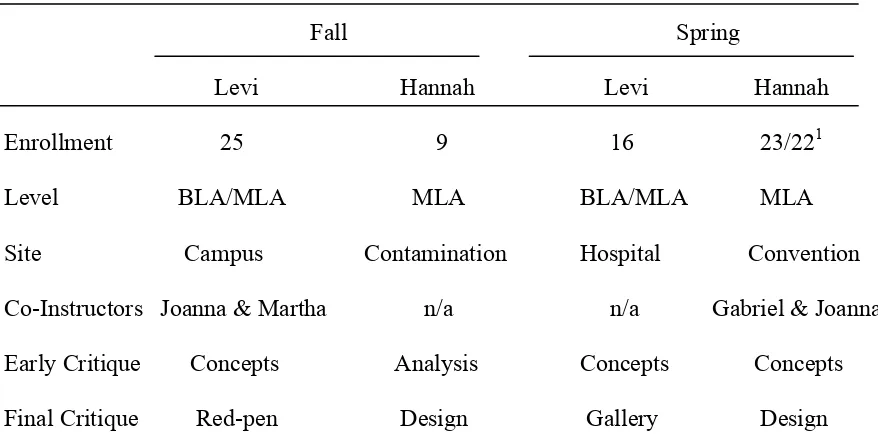
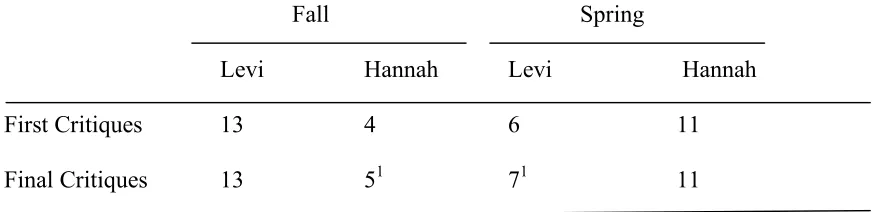
Table 4.1 Class characteristics ... 85 Table 4.2 Total number of projects sampled by semester, instructor, and time point .... 91 Table 4.3 Operational definitions of competencies ... 93 Table 5.1 Fall data comparing pre-test and post-test scores by competency ... 100 Table 6.1 Means and standard deviations for fall and spring data... 122 Table 6.2 U values and significance for each competence comparing pre-test
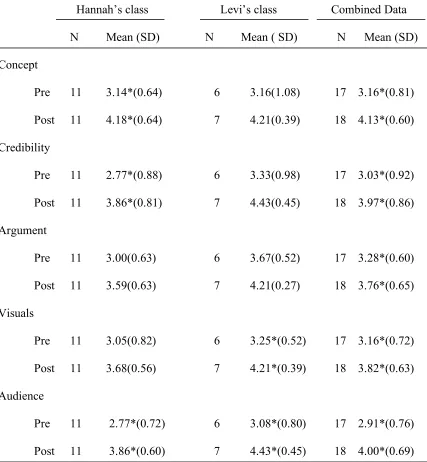
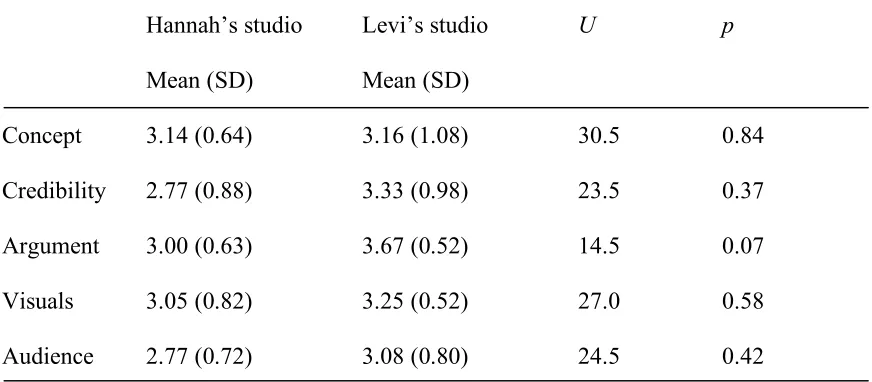
and post-test scores by semester... 122 Table 7.1 Spring data comparing the two classes and pre to post test data ... 150 Table 7.2 Means, standard deviations, U values and significance for each
competence comparing pre-test scores between the two spring classes... 151 Table 7.3 Means and standard deviations for critique self-efficacy out of 100
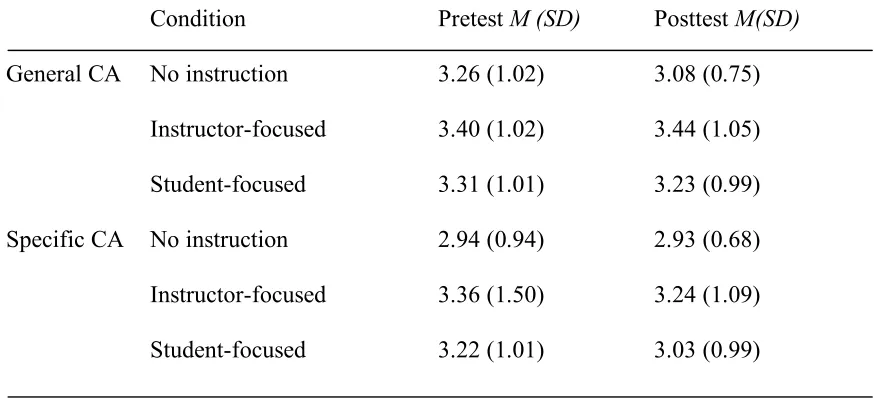
by condition and time ... 174 Table 7.4 Means and standard deviations for communication apprehension
1
CHAPTER 1: INTRODUCTION
I think what was surprising to me is that getting better at my communication makes
my design better because when I'm thinking about how to communicate it, I'm
actually thinking about the design and improving aspects that don't connect, that
don't make sense.
Jared was an undergraduate student in landscape architecture in both semesters I
worked in that department as part of this dissertation. Throughout those two semesters, Jared
had numerous opportunities to talk about his work – both formally and informally. At the end
of the spring semester, Jared made the above statement about how communicating about his
ideas helped his design. By taking part in the studio courses and engaging in the lessons I
shared with students, Jared was communicating in, about, and through design. He learned
that communication can – and did – have an impact on multiple fronts.
Although many students fulfill some type of communication requirement, most
students do not take more than one communication course (Cronin, Grice, & Palmerton,
2000), especially when their programs have highly intensive course requirements. This lack
of communication instruction is especially problematic in disciplines such as design where
communication is a key to success. As one design administrator stated in a research meeting,
“if you can’t communicate, you don’t eat.” Such statements underscore the vital role
communication plays in design students’ abilities to share their designs and make their mark
as designers.
The role of communication in not only daily life but also in educational settings is
2
movement is dedicated to integrating communication into classes outside of communication
departments, ideally within a discipline-specific framework (Dannels, 2001). Although CXC
as a movement is supported by a variety of avenues, there are several areas in which research
is lacking (Dannels & Housley Gaffney, 2009). The two arenas identified as key for the
future of CXC that are of particular interest here are a renewed commitment to empiricism
and a focus on theoretical sophistication. Within these two areas of consideration is a
renewed interest in gauging the success of instructional methods for CXC implementations
and the use of discipline-specific approaches.
With the relatively recent focus on discipline-specific approaches to CXC came an
interest in pre-professional programs such as engineering (e.g., Dannels, 2002) and design
(e.g., Dannels, 2005; Dannels & Martin, 2008). These disciplines ask their students to
regularly put on the metaphorical hat of professionals and communicate in ways that simulate
the workplace. However, the extent to which students are supported in these communicative
approaches varies wildly, and the instruction that does exist is often lacking in major ways.
In design particularly, there has only recently been a focus on determining communication
competencies required of students. This dissertation sought to take that understanding of
competencies beyond the theoretical into the practical application of the competencies in an
instructional implementation. The purpose of the dissertation is to understand the influence
of discipline-specific communication instruction on design students’ communication. By
examining how students communicate in design classes and through their designs, I sought to
help students learn about their communication.
3
communication-across-the-curriculum project focused on communication in design critiques.
In addition to establishing how students’ communication naturally evolves over the course of
the semester, I also implemented discipline-specific communication instruction. By
examining students’ communication both with and without instruction, I am able to explore
the impact of communication instruction on students’ communication in an empirically
grounded way.
Results of this study provide an aggregate view of students’ informal and formal
communication in design studios. Through systematic observations, recordings, and surveys,
I tracked students and how they changed over the course of a semester. This type of research
allowed for a closer look at these students’ experiences than would broad survey research,
while also taking into account that students work together in a studio. This latter observation
requires, then, for the data to reveal group trends rather than individual trends. The sample
described here is also small in order to allow for more a more in-depth exploration, but does
not allow for generalizations across other design studios, other pre-professional disciplines,
or other institutions. However, the trends examined here provide an initial look at what is
happening in one context, which can then be compared to work completed elsewhere.
The methodological decisions alluded to above and detailed more fully in the
methods chapter also have implications for how the data is interpreted here. The data is able
to speak to students’ performances and perceptions in a class in which they received no direct
communication instruction, as well those same factors when students received
communication instruction in one of two forms: instructor-focused and student-focused. This
4
and therefore results may have been affected by outside influences. Even with these caveats,
the research outlined here provides a unique perspective on CXC instruction and design
education.
This research contributes to multiple discussions with different implications. First, it
contributes to discussions within CXC about the role of disciplinarity in cross-curricular
work. In exploring comparisons of instructional models, this research examines the effects of
incorporating communication instruction into other disciplines; such research is currently
lacking, although there are theoretical discussions of the effect of such informal
communication. Finally, the research contributes specifically to design education literature
by providing more research focused on design studios and critiques in a way that uncovers
students’ progress and the effects of communication instruction on that progress through
careful examination of students’ performances and how performance is affected by
communication instruction. Such knowledge can aid in developing further communication
instruction in a manner that provides students with the knowledge and support they need to
be competent communicators in design.
The structure of this dissertation provides a framework for understanding the project
undertaken here. The dissertation is comprised of nine chapters, including the introduction
and conclusion chapters. First, I lay out the theoretical assumptions that I brought into the
project and that guided the development of the research. Next, I review literature pertaining
to the major foci of this project. With those foundational topics addressed, I then turn to the
methodological approach used to answer the research questions and address the hypotheses
5
demonstrates how students naturally evolve over the course of a semester. Next, I address the
comparisons between a semester with instruction and a semester without. The final results
chapter specifically compares the two instructional models. The dissertation is concluded
with a discussion of the results and their implications.
As a final preface to the body of this dissertation, one repeated experience I had in the
design studios speaks to the curiosity that sparked this investigation and helped fuel the
discussion of results. At numerous times through both semesters, I had students comment
about how bored I must be getting with hanging out in the design studios with them and
attending all of the critiques armed with a video camera. I would smile and say how
interesting I found the design process and that I liked spending time in the studio with the
students. While admittedly I was not always so positive through countless hours of coding
critiques after data collection, I realize that the students’ comments to me spoke to the
disciplinary distinctions that played a major role in this project. As an outsider to the
discipline, students saw me as someone who may not be interested in their projects and as
someone who would not necessarily be interested to learn about design. I brought my
communication expertise to the classes, but given how hidden communication was in the
classroom from an instructional standpoint, it should come as no surprise that students saw
me as being disconnected and not possibly interested. My hope was to change that
6
CHAPTER 2: THEORETICAL GROUNDINGS
The purpose of this dissertation is to explore what happens when students are
engaged in communication instruction as a means of improving their discipline-specific
communication competencies. This purpose evokes three assumptions that underlie this
work. First, I take the assumption that learning is a situated process. Secondly, I assume that
communication is a means of learning not only content, but also social aspects of a
discipline. Finally, I assume that the genres present in teaching and learning are socially
constructed. As I discuss each of these assumptions, I will provide examples of their
relevance to the landscape architecture students who were the focus of this study. After
discussing these assumptions, I will conclude this chapter by drawing on these three
assumptions to explain their implications for my research as well as for the outcomes of this
research.
Learning is a Situated Process
Situated learning, as a whole, is founded on the idea that learning is always situated.
Typically, learning in school settings is situated within the world of teachers, classmates,
textbooks, and classrooms (Sawyer & Greeno, 2009). However, in these school settings,
students learn material that is intended for use in other contexts (e.g., a future job). Therefore,
it is prudent to examine the role of situation on learning. In supporting my assumption that
learning is a situated process, I will draw on situated learning literature to highlight the nature
7
The Nature of Knowledge
Situated learning offers a perspective on knowledge that not only highlights the
importance of moving beyond memorization, but also notes the importance of how
knowledge is used. Situated learning scholars argue that knowledge is inextricably a part of
the situation in which it is produced (Brown, Collins, & Duguid, 1989). Knowledge is not
objective facts, but rather arises conceptually within social contexts, varies among and across
people, and is transformed by people (Clancey, 2009). Furthermore, knowledge as it is
conveyed in classroom settings also includes a “hidden curriculum” (Sawyer & Greeno,
2009) that includes the cultural norms and expectations underlying a class or discipline. In
the case of design education, students learn not only how to design a site and the practical
tools of their discipline, but also how designers should think and act.
The nature of knowledge is reflected in two implicit views of learning; the distinction
between these two views helps to illustrate the grounding of situated learning (Brown &
Duguid, 1996). Learning can be seen as the end result of the transmission of knowledge; in
this view, knowledge is unchanged, a measurable entity that is either successfully or
unsuccessfully learned. The second perspective on learning – and the perspective that is most
fully supported in situated learning – is that learning is a continuous process, where the
existing knowledge and newly acquired knowledge merge together to create something new.
Therefore, learning is not simply about what is taught by an instructor. For design education,
students need to know more than simply how to figure out the necessary grade (slope) for a
site. They need to be able to utilize that knowledge on a variety of sites and with a variety of
8
Knowledge can take multiple forms that are not stable. Oakshott (1962) distinguished
between technical knowledge (can be precisely formulated) and practical knowledge
(existing in use and cannot be formulated into rules). Practical knowledge, because it exists
only in use, cannot be taught, but must be acquired through apprenticeship. Furthermore,
knowledge can be conceived of as constantly in flux:
All knowledge is, we believe, like language. Its constituent parts index the world and
so are inextricably a product of the activity and situations in which they are produced.
A concept, for example, will continually evolve with each new occasion of use,
because new situations, negotiations, and activities inevitably recast it in a new, more
densely textured form (Brown, Collins, & Duguid, 1996, p. 22).
Additionally, meanings are always negotiable because meaning comes from the context. The
understanding that knowledge can take on multiple forms – both technical and practical – and
that the nature of knowledge is in flux speaks to the nature of learning. Design students can
learn facts, such as the requirements to make a park accessible to all people, but such
knowledge is always in the context of their larger project. Although access requirements
dictate the use of handrails at certain slopes, students may choose to design “around” the
problem and create a different path (e.g., slowly meandering with minimal slopes) that does
not require handrails. Their knowledge, then, is constantly being used in different ways.
Learning is about the appropriation of tools and practices, not rote knowledge
(Wertsch, 1998). Knowledge, rather than being abstract, can be thought of as tools (Brown et
al., 1996). Although tools can be acquired without an understanding of how to use them,
9
learning. Using, rather than simply acquiring, tools allows a user to build a deeper yet
implicit understanding of the tools and the contexts in which the tools can be used. The uses
of the tool will be affected by the context of the community in which the tool is used. For
example, a chisel may be used by both a carpenter and a cabinet maker but is used in
different ways. Likewise, mathematicians and designers utilize formulae in different
manners. Several times I heard design students mumble about thinking they would never
need the formula for slope (rise over run) again after geometry, but such a formula is integral
to designing in landscape architecture where the slope of a hill or walkway can make the
difference between a successful design and one that needs to be reworked.
Differences in knowledge are clearly delineated between students and practitioners.
Students, according to Brown et al. (1996), reason with laws and act on symbols in order to
resolve well-defined problems and produce fixed meaning. On the other hand, practitioners
reason with causal models and act on conceptual situations in order to resolve ill-defined
problems and produce socially constructed meanings. In the case of design education, we can
see this distinction in the projects that students approach compared to those undertaken by
practitioners. In design studios, students are assigned a site on which to respond to a given
design problem. Although this process may be analogous to professional designers bidding
on a project, the students are given a variety of constraints and information that otherwise
would not be available to professionals. For example, the class as a whole discusses the
analysis of the site (e.g., what is currently on the site, nearby buildings and their uses) in
order to clearly define the project; students then work individually or in teams to develop a
10
they will likely never touch after the end of the semester. For practitioners, they must
approach ill-defined problems and continually produce new ideas and adjustments in order to
meet clients’ needs.
Knowledge, according to situated learning, is about a deeper understanding and an
ability to engage in practice. This knowledge directly relates to the situations in which it is
pertinent, and – ideally – the situations in which it is acquired. Next, I turn my attention to
how such knowledge is acquired by learners as they move from novice to expert status.
The Transmission of Knowledge
In addition to speaking to the very nature of knowledge, the situated learning model
also explores how knowledge is transmitted. The successful transmission of knowledge,
according to situated learning ideals, depends more on context than instructional skill:
Even when individual instruction is extensive, if the social context is missing,
confusion and disillusion are likely. By contrast, even though instruction is minimal,
quite complex practices can be learned effectively and easily where the social context
is evident and supportive (Brown & Duguid, 1996, p. 51).
Furthermore, learning is diminished when knowing and doing are separated. Miller and
Gildea (1987) explain that children learn most of their vocabulary through interaction
naturally, and that vocabulary learned through dictionary definitions leads to inappropriate
uses of the vocabulary in real contexts. For example, a student who learned the dictionary
definition of meticulous as “very careful,” wrote a sentence about being meticulous about
11
cliff, but rather to avoid falling. Thus, the example illustrates that learning outside of an
appropriate context leads to misunderstandings.
In cultures both inside and outside of academia, learning practices evolve to meet the
needs of learners. These situated practices set the stage for learners (Sawyer & Greeno,
2009). Both the setting and the social practices that make up learning practices and
environments are unique from situation to situation, and even formal classrooms represent
socially constructed practices. Because knowledge is situated, the context in which
knowledge is transmitted matters to the successful acquisition and integration of knowledge.
In design classes, it is important to understanding how learning happens in order to consider
that classes are offered in studio space rather than lecture halls; these are the classes where
the bulk of students’ abilities as designers are developed. The importance of the relationship
between the content and the learning that happens within that context highlights the value in
examining situated learning.
An important part of learning is learning to communicate in culturally relevant ways,
which is problematic when the learning occurs in a context other than the one in which the
information will be used. Although much education regarding disciplines happens within
college classrooms, in practice:
there are no special forms of discourse aimed at apprentices or crucial to their
centripetal movement toward full participation that correspond to the marked genres
of the question-answer-evaluation format of classroom teaching or the lecturing of
12
substitute for legitimate peripheral participation; it is to learn to talk as a key to
legitimate peripheral participation (Lave & Wenger, 1991, p. 108-109).
Although communication in the classroom often simply reinforces classroom communication
norms, Lave and Wenger argue that communication is more than question-answer sequences;
well-designed communication opportunities can help students learn to talk as a means of
participating in their disciplinary community. The acquisition of knowledge, then, happens
through interactions, which ideally will be grounded within the ideals of a disciplinary
community. Design students learn how to communicate through the interactions they have
with each other and with their professors. In interviews, students regularly told me that they
learned how to communicate as a designer through observing classmates and through
discussion with faculty – not necessarily through explicit instruction.
Unlike traditional models of teaching and learning, situated learning offers an
alternative relationship for teachers and students. In a situated learning environment, the role
of the teacher is supportive, not directive (McLellan, 1996). Instructors guide students rather
than telling students what they need to know. Furthermore, learning takes place through
various levels of activity: private (e.g., journaling), local (e.g., small group), and public
(presentations; Hall & Rubin, 1998). These altered models of teaching and learning are also
reflected in the approach to evaluation. Evaluation in situated learning is about the learning
process and progress (McLellan) rather than having a focus on memorization of fact.
The situated learning perspective allows for a fuller understanding of how knowledge
is transmitted and acquired. For example, in a third-grade math class, students correctly
13
such as this, the situated approach revealed what was really occurring in the class, despite the
apparent success seen in worksheets. The disconnect between how the teacher told students
to complete problems and how students actually derived answers was only realized through a
situated approach. This example illustrates the ability to more fully understand how
knowledge is transferred by utilizing a situated approach than by simply looking at outcomes.
For design education, then, it is important to look at how students go through their design
process and not simply the final site plan they talk about in a critique.
In addition to a specific perspective on the nature of knowledge that represents
situated learning, this approach also acknowledges the importance of how knowledge is
shared and obtained. Through social means and a focus on context, students acquire the
knowledge that is integral to their future careers. At the same time, the situated learning
approach also emphasizes two key ideas: authenticity and apprenticeship.
The Authenticity of Apprenticeship
The emphasis situated learning places on “doing” rather than passively learning, is
also reflected in the value placed on authentic experiences. Situated learning also utilizes the
idea of apprenticeship to explore how students are brought into a new discipline or job.
Together, these ideas of authenticity and apprenticeship offer the rest of the picture of
situated learning.
The social aspect of learning helps reinforce the relationship between knowing and
doing, and requires students (as learners) to involve themselves completely in becoming a
full participant in their chosen community (Lave & Wenger, 1991). Brown and Duguid
14
They note that even people who otherwise have difficulties with machinery and appliances
are trusted to pilot machines that offer a “hazardous and changing environment and an
enormous array of increasingly sophisticated technology” (Brown & Duguid, p. 51) because
cars are so integrated into society that the learning is virtually transparent. People learning to
drive have, for the most part, already spent time in vehicles so they enter the task of learning
to drive with an implicit understanding of the task.
School activity is generally not perceived to be authentic (Brown et al., 1996). In
describing what makes activity authentic, Brown et al note that activities are framed by the
culture in which they occur. These activities’ meanings are:
socially constructed through negotiations among present and past members. Activities
thus cohere in a way that is, in theory, if not always in practice, accessible to
members who move within the social framework. These coherent, meaningful, and
purposeful activities are authentic (Brown et al., p. 25)
This notion of authenticity requires careful attention to the social contexts in which learning
occurs. Because clues about a culture derive from activity within that culture, it is vital to
consider the context in which activity is happening and the connection between that context
and what is intended. Design studio classes are purposefully scheduled in an environment
that breaks typical classroom contexts by providing work space and individual desks for
working. While the environment moves toward fitting into the authenticity of being a
designer, students (and faculty) readily acknowledge that the environment does not fully
15
Students, when learning in the classroom, learn in a way that is framed within the
culture of schools, but is attributed to outside cultures (Brown et al., 1996). For example,
students in design studios learn within classrooms on a university campus with all of the
cultural implications of being a student and having an instructor. However, students are
consistently taught about what it means to be a designer and direct connections are made to
them between their work in the studio class and the job they may have after graduation.
Unfortunately, in efforts to connect classroom activity to authentic activity, not all aspects of
the authentic activity are transferred. Furthermore, students may rely on classroom context
features that are not present or important in authentic activities. Therefore, students may
gather an unrealistic conceptualization of authentic activity by the very efforts intended to
develop authentic activity.
Cognitive apprenticeship moves students progressively toward expert standing. This
approach is characterized by beginning with tasks based within students’ familiar activities
(Brown et al., 1996). This starting point acknowledges students’ implicit knowledge and the
benefits of using that knowledge for scaffolding. Cognitive apprenticeship also points to the
need to assess heuristics in respect to specific tasks. Students are also encouraged to develop
their own solutions, which helps them acquire tools relevant to the culture. In design classes,
this process of cognitive apprenticeship can be seen in the progression of students’ classes.
Students’ early course work involves courses such as “design fundamentals” that build on
students’ experiences as students to transition them into design classes. Early projects in a
student’s design career are more constrained than later projects, which allow for more open
16
The use of the word “apprenticeship” in relation to learning highlights the role of
activity in learning and acknowledges the situated nature of learning (Brown et al., 1996).
The term also evokes images of a type of coaching or modeling where instructors either
model their strategies for students or make tacit knowledge explicit. After students have been
introduced to strategies, instructors support students’ initial attempts at the task before
empowering students to work individually. In design studios, instructors work closely with
students to guide them through the design process. As students progress through various
courses, they are given more and more freedom to explore their own identity as a designer,
with their instructors standing on the sidelines to coach as needed. For example, students in a
spring studio class talked to me about the amount of freedom they were given to shape their
design of a hospital site, noting that the professor gave them more freedom than had earlier
professors in lower-level classes.
Together, the ideas of the nature of knowledge, the transmission of knowledge, and
the authenticity of apprenticeship form the foundations of situated learning. The lessons of
situated learning form a core assumption of this dissertation. The idea of situated learning
also leads to the second assumption of this research, which is also focused on the nature of
learning and how it occurs.
Communication is a Fundamental Source of Disciplinary Learning
The second assumption underlying this dissertation is that communication is a mode
of learning content knowledge as well as a means of socialization into a discipline. In
supporting this assumption, I draw on research surrounding the idea that learning is social to
17
communication also serves as a means of learning about the discipline which one is
experiencing. This socialization process provides an integral part of learning about a
discipline. Before fully explicating this assumption, I would like to provide definitions for
three key terms: communication, discipline, and learning.
By communication, I mean the exchange of messages between students or among
students and instructors. Although written communication certainly plays a role in learning
(as seen throughout writing-across-the-curriculum literature), my focus here is on primarily
oral communication. This communication may be either formal or informal in nature and is
not directly restricted based on the number of people involved. The focus here is on
communication that occurs in classroom during class time rather than communication
occurring among instructors and students outside of class time.
By disciplines, I mean communities of knowledge that are differentiated not only by
topics of importance and focus, but also by the communication in which people engage. In
terms of distinguishing between related disciplines, I follow the perspective of Becher and
Trowler (2001) who argued that “What demarcates one disciplinary perspective from another
in a theme or topic which they share may vary between a distinction in style or emphasis, a
division of labour or a difference in conceptual framework” (p. 60). Each discipline can be
likened to a unique culture. Differences in argumentation, evaluation, and general discourse
highlight epistemological differences. Social interactions bind together disciplinary cultures.
By learning, I mean both content knowledge as well as social knowledge. In this
perspective, I once again draw on situated learning literature to highlight that simply the
18
learning here as taking two forms: content and social. The first form fits with what is
typically thought of with learning: the acquisition of knowledge, but in this case with an
emphasis on understanding. I also acknowledge a second form of learning: learning social
norms and values of a discipline.
Communicating for Content Learning
The first part of this assumption reflects my belief that communicating can help
improve content knowledge. Communication represents a fundamental mode of learning
(Modaff & Hopper, 1984). By communicating, either formally or informally, students
develop their critical thinking skills and are given the opportunity to relate speech and
thought. Speaking is an integral part of education: "Speech is the most human, the most
involving, the most active, the most supportive-of-learning of any student activity" (Modaff
& Hopper, p. 41). This importance traces back to the development of speaking abilities,
which, Vygotsky (1978) argues, provides a foundation for thinking. In design classes,
students actively engage with each other to talk about their projects and to get feedback from
each other.
Speech is an important part of learning because of the extent to which it ties to
activity (Modaff & Hopper, 1984). Speech is multi-sensory. It requires a physical action and
coordination of mind and body that inherently requires activity. Speech can not only guide
people’s own behavior (such as when people give themselves pep talks), it can also change
other people's behavior. The active aspect of speech connects oral communication to teaching
and learning.
19
higher conceptualization, facilitates task performance, and promotes literacy. According to
Modaff and Hopper, who build on Vygotsky, speaking helps children develop higher levels
of conceptualization. The use of speaking to help oneself in problem solving occurs
spontaneously (or naturally) in children; this use of self talk (whether in the mind or spoken
out loud) also occurs with adults. Furthermore speech helps promote literacy. Oral and
written skills interact to mutually improve learning. In design classes, students talk to each
other and to themselves about what they are designing and the connections that need to be
made.
Research spanning multiple disciplines illustrates the importance of talk to the
learning process. Vocalized stimuli are recalled more often than non-vocalized (Carmea &
Weir, 1967; Davis, 1968; Weir & Helgoe, 1968). Furthermore, students more effectively
restructure knowledge when interacting with others than when working individually
(Schmidt, De Volder, DeGrave, Joust, & Patel, 1989). Students who learn material in order to
be able to explain it to someone else learn that material more effectively than students who
simply try to learn the material (Bargh & Schul, 1980). Numerous review articles
demonstrate ongoing support for the idea that students who are more engaged in a class
and/or work collaboratively learn more than students who are not engaged or work
individually (e.g., Astin, 1993; Hake, 1998; Johnson, Johnson, & Smith, 1998; Springer,
Stanne, & Donovan, 1999). Active learning increases learning outcomes, particularly higher
order learning (Bonwell & Eison, 1991).
Language and talking are important because of the social interdependence of learning
20 language:
The power of language lies in its potential for concretization. It facilitates discoveries
by crystallizing experience – transforming discoveries into believable areas for
exploration by positing them as realities in their own right. (Nystrand, 1977, p. 101).
Britton (1982) argued that our understanding develops as we communicate it. Such an idea is
supported within situated learning literature as well, which emphasizes that when students
articulate their thinking or problem-solving process, they develop a better understanding of
their own thinking (McLellan, 1996). Furthermore, the close connection between language
and thought emphasizes that as students communicate, they also improve the quality of their
thinking (Boyer, 1990).
Research on learning demonstrates that communicating about content learning helps
improve understanding and memory of such knowledge. Communication, then, is an integral
part of learning. Not only can communication help with content learning, but it can also help
students learn about the more social aspects of their discipline.
Communicating for Social Learning
The second part of this assumption regards the learning of social information. That
which a culture symbolizes and how a culture symbolizes that information is key. Cultures
and speaking are linked in three main ways (Philipsen, 1992). First, speaking is structured.
By this, Philipsen means that speaking is patterned but not predetermined; such patterning
includes who communicates, to whom, through which channels, and for what purposes, etc.
21
Speaking is always speaking somewhere, with some group of people, in some
language, and it is always shaped by and a part of some social life. To understand
speaking in any particular instance is, in part, to understand a distinctive way of life.
Making sense of a particular communal conversation, then, requires local knowledge,
knowledge not only of speech sounds but of a local system of symbols and their
meanings, of community mores, and of indigenous patterns of message-making and
interpretation (Philipsen, pp. 11-12).
Thirdly, speaking is social. All speaking occurs in and contributes to the social. Both the use
and non-use of local speech customs is informative. In design classes, then, students are
exposed to not only the vocabulary of speaking like a designer, but also the nuances of
appropriate use (or non-use) of such conversation.
The connection between communication and culture is set forth in Philipsen’s (1992)
four principles on the topic. First, each distinct culture will have distinct communication.
Secondly, speech codes are perceived to show culturally distinct characteristics, such as the
unique aspects of communicating information in sociology. Thirdly, the significance of
speech depends on the speech codes used. Finally, culture and speaking are inextricably
woven together. Philipsen argues that speaking is always important, but the precise
importance placed upon messages is distinctive. Patterns of interaction are unique to each
culture and learning to be more effective within these patterns allows for fuller participation
within that culture (Lave & Wenger, 1991). Learning environments are complex social
systems and thus cannot be reduced to simply viewing the individual (Sawyer & Greeno,
22
situation. In design classes, there are unique patterns of communication that help explore
what it means to be a designer.
Disciplines can be distinguished by their communication patterns. Becher and
Trowler (2001) argue that a primary means of distinguishing between disciplines is through
an analysis of discourse. An academic culture and disciplinary epistemology are “mutually
infused: disciplinary knowledge forms are to a large extent constituted and instantiated
socially. Meanwhile their constitution has a reciprocal effect on the cultures from which they
spring” (p. 23). The give-and-take relationship of communication and disciplines reflects the
importance of considering the discipline from which communication originates.
As previously articulated, disciplines carry within themselves a variety of norms and
values to be learned by a newcomer to that discipline. Language helps this learning process
by helping the newcomer to construct and maintain new meanings (Nystrand, 1977, p. 99).
Along the way, newcomers are exposed to cultural patterns, seen as “historically created
systems of meaning in terms of which we give form, order, point, and direction to our lives”
(Geertz, 1973, p. 52). Through a process of socialization, newcomers encounter the “values
and attitudes, the interests, skills and knowledge – in short the culture – current in groups to
which they are, or seek to become a member” (Merton, Reader, & Kendall, 1957, p. 287).
Socialization is particularly pertinent because learning theories and methods (or other
disciplinary content knowledge) is not enough:
Any person entering a new group with the ambition of becoming a fully fledged,
competent member has to learn to comply with its fundamental cultural rules. This
23
teachers, fellow-students and secretaries, the student needs a considerable amount of
know-how. Most of it will be acquired slowly through the interaction with others and
without anyone ever making a deliberate effort to teach others and without anyone
ever making a deliberate effort to teach the newcomer the rules of the game
(Gerholm, 1990, p. 263).
This notion of communication as a means of helping students learn about their discipline is
further reflected in the understanding that dialogue – not transmission – is a means of helping
students adopt disciplinary perspectives (Scudder & Mickunus, 1985, p. 137). When
considering the role of interaction in learning, it is important to also remember that learning
is most enhanced when patterns of interaction are consistent with cultural communication
patterns (Jordan, Au, & Joesting, 1983; Olson, 1980). Therefore, design students, through the
process of engaging in conversation about design, are learning more about how to talk like a
designer than they would learn by simply being told what to say or do.
If we believe that communities of practice are developed via social interaction
(Brown & Duguid, 1996), it is important that newcomers learn not from talk but to talk
within that community (Lave & Wenger, 1991, p. 109). Oral genres are places for students to
learn to speak the cultural language of the discipline in which they are enmeshed (Philipsen,
1992), and such learning happens naturally:
Given the chance to observe and practice in situ the behavior of members of a culture,
people pick up relevant jargon, imitate behavior, and gradually start to act in
accordance with its norms. These cultural practices are often recondite and extremely
24
adopt them with great success…the ease and success with which people do this (as
opposed to the intricacy of describing what it entails) belie the immense importance
of the process and obscures the fact that what they pick up is a product of the ambient
culture rather than of explicit teaching (Brown et al., 1996, p. 24).
Although communication norms are not always explicit, they are closely tied to cultures.
Speaking and culture have a reflexive relationship: speaking as culturally distinct and is also
culturally rich (Phillipsen, 1992). Oral communication binds together social groups and this
connection is made in a way specific to that group. Culture is reflected within speaking in a
variety of ways including vocabularies, rituals, and jargon.
Becher & Trowler (2001) argue that it is through language that we can see
fundamental distinctions between disciplines. They say that through analysis of disciplinary
discourse, it is possible “to discern differences in the modes in which arguments are
generated, developed, expressed and reported” (p. 46). These distinctions are made even
more apparent through evaluative terms (e.g., referring to a design as elegant or persuasive)
that reflect the knowledge valued within that discipline. Therefore, critics’ responses to
design students reflect what is valued in the discipline; students are not being told what is
right or wrong, but the reactions to the site or the feelings evoked by the design.
Furthermore, disciplinary communities are brought together through communication
and socializing:
Social interaction, communication of all sorts and the partly socially constructed
25
sociological and the epistemological, giving shape and substance to the links between
knowledge forms and knowledge communities (Becher & Trowler, 2001, p. 105).
The importance of these social interactions is also reflected in the ways in which newcomers
are accepted into a community. According to Becher and Trowler, one must have more than
technical proficiency to be considered a member in an academic culture; adherence to norms
and a dedication to the social aspects of the group is also required. These norms are learned
primarily through socialization.
Students, when entering a new discipline, face two necessary types of learning. First,
they need to learn the content of the discipline. Secondly, they need to learn what it means to
be a part of that discipline, which focuses more on the social nature of being within a
discipline. Both of these types of learning can be greatly enhanced by communication, and in
the case of social aspects, communication is the primary means of learning. This assumption
emphasizes my belief in the ability of communication to aid in both types of learning. The
assumption also sets the stage for my third assumption, which emphasizes different types of
communication.
Communication Genres are Socially Negotiated
With the previous assumptions focused on the role of communication and learning, I
now turn to the idea that communication in teaching and learning occurs in different genres,
which are socially negotiated. First, I will define genres and provide insight into the
particular conceptualization of genre that I utilize here. Then, I will turn my attention to how
genres are learned. These two areas of focus are integral to the overall approach utilized in
26 Defining Genre
Genres, as a topic of interest for those ranging from literary theorists to rhetoricians,
are an integral part of both written and spoken communication. The power of genres is
explained by Devitt (2004):
Genre pervades human lives. As people go about their business, interacting with
others and trying to get along in the world, they use genres to ease their way, to meet
expectations, to save time... Genres have the power to help or hurt human interaction,
to ease communication or to deceive, to enable someone to speak or to discourage
someone from saying something different (p. 1).
Other than simply acknowledging the importance of genres to our communication, it is
important to more fully understand what is meant by genre. To that end, I will explore
various conceptions of genre while highlighting the particular position that underlies my
work here. These conceptions build toward my understanding of genre as socially negotiated
(Miller, 1984).
Devitt (2004) explained different views of genre and the shortcomings of each view.
First, genre is seen as simply naming and specifying formal features, which focuses on
writing (or speaking) as a product, not a process. Genre also is considered a classification
system, a view traced back to Aristotle. Although classifications are a part of genre, this view
unnecessarily limits the view of genres. Similarly, views of genre as simply form are narrow.
Genre is seen as a response to recurring situations (e.g., Miller, 1984), but again, this
perspective (according to Devitt) can be problematic. Instead, Devitt argued that saying genre
27
and genre. Devitt also argued that culture is not simply the context of genre, but influences
the construction of genres. Furthermore, Devitt argued for the need to acknowledge the
influence of other genres.
Based on such a background, I am using a perspective of genre that acknowledges
that genres are more than styles, in that they are central to the ways in which the world is
understood; such effects are not stable (Frow, 2006). Genres have specific structural elements
(Frow), which include formal features as well as a thematic structure. Furthermore, genres
have situations of address and structures of implication. There are rhetorical functions to
genres as well as a context or physical setting. Genres are also found in the patterns ways of
disciplinary knowledge (Bazerman, 1988; Latour and Woolgar, 1979). The knowledge of a
community is both determined by and influences on the genres valued within the community
(Bazerman, 1988; Winsor, 1990); this knowledge is not only content but also views of the
world (Berkenkotter & Huckin, 1995). Just as cultures have different purposes for and values
about communication (Philipsen, 1992, p. 124), disciplines have different argument fields
(Toulmin, 1958) and unique disciplinary discourse norms, which are “a textual feature or
some other convention deemed appropriate (that is, legitimate, useful) by the consensus of a
particular discipline” (Hagge, 1997, p. 131). To place these ideas into the specific context of
this discipline, communication in a landscape architecture class would be represented by
different knowledge and genres than in classes such as English or engineering.
The specific perspective of genre that I utilize foregrounds the importance of social
action. According to Miller (1984), genres should be defined by the actions they are used to
28
people (Devitt, 2004). These recurring actions occur within specific social structures and are
interpreted through the lens of that social structure (Devitt). The use of genres both
constitutes and reproduces social structures (Berkenkotter & Huckin, 1995; Devitt).
Genres are not static, but are dynamically created through interactions within a
community (Berkenkotter & Huckin, 1995). Genres do not exist separate from the people
who use them; they are created through interaction (Devitt, 2004). The reciprocal, dynamic
relationship between genres and the community in which they exist is further highlighted in
the ability of genres to influence the actions of people within that community (Devitt). For
design education, genres develop through interactions among instructors and students and
these genres directly affect what people (such as students) do, as evidenced by students’
continual striving to meet generic expectations in critiques.
Genres serve specific purposes and functions for community in which they exist.
Genres are separated from mere collections of communicative events by possessing a shared
purpose (Swales, 1990). Groups utilize genres in order to achieve the purposes of that group
(Devitt, 2004); social functions of genres are revealed through discourse (Devitt). For design
education, then, genres such as the critique exist to serve purposes such as providing
feedback to students as well as providing an opportunity for students to practice presenting
and defending their work. The exact format of critiques responds to these needs by
integrating both presentation and feedback.
Genres reflect norms and ideals of the community in which they develop
(Berkenkotter & Huckin, 1995; Devitt, 2004). This reflection is also evident in the naming of
29
community. For example, in design education, students take part in a variety of oral genres
(e.g., desk crits, reviews) that ultimately ask students to engage in similar skills, but the
distinctions made by that community highlight the differing value they place on those genres.
Furthermore, the reasons for varied genres reflect what constitutes acceptable discourse
within that community (Swales, 1990). Devitt extends these ideas to argue that genres are
also constructive of the values of a community.
Genres are socially developed and reinforced. By offering an ability to understand the
underlying values of a culture or discipline, genres serve an integral purpose in identifying
appropriate communication. However, genres are not inherent within people and must be
learned.
How Genres are Learned
The importance of genre to people’s ability to present and understand information
highlights the need to examine the manner in which genres are learned. Genre learning offers
an interesting dynamic to this research because much of this type of learning is implicit
rather than explicit. Therefore, I discuss here the ways in which we learn genres.
Genre knowledge is not explicitly taught, but is transmitted through socialization
(Berkenkotter & Huckin, 1995, p. 7). Genres are learned in the much same way as native
languages: not through grammar lessons but through experiencing interaction with others
(Bahktin, 1986). The learning of genres is important to students’ learning to become part of a
disciplinary community. As explained by Dias and Pare (2000):
Of crucial importance in the transition from school to workplace, from newcomer to
30
actions that operate as part of a community's activity system. Those genres have a
central role in determining the nature and production of knowledge in the community,
and thus the individual's participation in that knowledge-making. By engaging in the
communal enactment of those genres, newcomers are drawn into the beliefs, attitudes,
and values of the community, into its thought styles (pp. 4-5).
Genres offer an opportunity for newcomers to more fully understand the discipline into
which they are entering. Berkenkotter and Huckin (1995) go so far as to identify genre
knowledge as “a form of situated cognition embedded in disciplinary activities” (p. 3). Such
knowledge includes form and content, as well as the ability to communicate in ways
appropriate to specific situations. This perspective highlights that students in design would
learn the genres of design (such as critiques) through interactions. In fact, multiple students
told me in interviews that they learned how to communicate in critiques through trial and
error.
True genre knowledge is not limited to formal conventions, but includes appropriate
choices in topics and details (Berkenkotter & Huckin, 1995). As outlined in the definition of
genre above, genres are complex and therefore understanding genres is a complex task. That
complexity, however, offers rewards when genres are learned:
[W]hat we learn when we learn a genre is not just a pattern of forms or even a method
of achieving our own ends. We learn, more importantly, what ends we may
have…We learn to understand better the situations in which we find ourselves and the
potentials for failure and success in acting together (Miller, 1984, p. 165).
31
example, in a study of graduate engineering students' intercultural communication, Beer
(2000) argued that the students' process of acquiring new genres depends on their own
decisions about what and with whom they will associate. By learning design genres, then,
design students learn about the opportunities available to them through communication.
Furthermore, when students learn new genres, they are helping to develop their
professional identities (Spafford, Schryer, Mian, & Lingard, 2006). The genres are in and of
themselves a means of learning:
Genres are not just forms. Genres are forms of life, ways of being…They are
environments for learning. They are locations within which meaning is constructed.
Genres shape the thoughts we form and the communications by which we interact.
Genres are the familiar places we go to create intelligible communicative action with
each other and the guideposts we use to explore the familiar (Bazerman, 1997, p. 19)
The ability of humans to not only learn new genres, but also to learn through genres
highlights the importance of genres to the teaching and learning process, particularly when
considering the variety of genres present in academia.
The research cited here has been predominately based within written genres, a
balance reflected in what research exists. However, more recent work has begun to explore
oral genres, under the perspective that oral genres are fundamentally different than written
genres (Ong, 2002). Work on oral genres in teaching and learning includes work on genres
within engineering and design (e.g., architecture; Dannels, 2000, 2002). The importance of
considering oral genres – especially for classroom genres – is highlighted by Dannels’ (2009)
32
relationships – above genre, context, and related influences – on students’ understanding of
oral communication. In classes, students deal with both a situated audience (their professors)
and an idealized audience (the workplace setting invoked by the assignment). Students’ task,
then, is to negotiate the tensions between these different contexts, which is most productively
managed by managing the relationships involved. For design students, these tensions are
between their professors who want the students to demonstrate an understanding of particular
concepts or techniques and students’ idealized audience of a client who is open to new design
approaches.
As students learn genres through exposure to them, students are also learning about
what is expected of them in their chosen discipline. Genres represent complex
understandings of communication, which must be learned in order for a student to fully
engage in a chosen discipline. Based on the understanding of genre outlined here, along with
the earlier articulated assumptions regarding situated learning and the role of communication,
I can now turn to the implications of the assumptions for this research.
Implications of the Assumptions
The assumptions laid out in this chapter reflect both my starting point and primary
areas of concern for my research. These assumptions, therefore, have both tangible and
intangible effects on the research that follows. In this section, I outline how I used these
theoretical assumptions in applied ways in my research. Then, I discuss how I will move
from this application back into theoretical thinking. Finally, I use these assumptions to set the
33
From Theory to Application
The assumptions outlined here reflect my views on the nature of communication and
learning, along with the relationship between these two processes. Together these
assumptions form the foundation for the research undertaken and explored in this
dissertation. Not only do these assumptions reflect my thinking in approaching the project,
they also had a tangible effect on the research design and implementation here in several
specific ways.
First, my assumptions about the situated nature of learning led me to understand the
importance of not only what students learn in design classes, but also how students learn in
design classes. I approached this research with an open mind about what activities were used
in design classes to help students’ learning and those activities’ relationship to authenticity.
To that end, I explored what students were actually doing in class and with instructors, as
well as the full range of approaches students took to presentations. I sought to understand
more holistically what was happening in design classes and the process of students’ work
rather than solely focusing on the product of their work.
Secondly, my understanding of the importance of communication led me to focus on
the communication that occurred in these classes. My primary concern was with students’
presentations, but along the way, I also attended to their informal communication. When
presenting instruction on communication, I emphasized to students the communication skills
they already possessed and how they could utilize this knowledge. For my purposes, content
knowledge was important as well as social knowledge. I stressed with students both learning