Energy Efficient Cluster Heads Selection
based on Minimum Distance & Maximum
Energy for Wireless Sensor Networks
Rishab Kumar1, Pankaj Kumar Mishra2
P.G. Student, Department of Computer Engineering, G.B. Pant University of Agriculture and Technology,
Pantnagar, Uttarakhand, India1
Assistant Professor, Department of Computer Engineering, G.B. Pant University of Agriculture and Technology,
Pantnagar, Uttarakhand, India2
ABSTRACT: Wireless Sensor Network (WSN) is a collection of tiny sensor nodes with limited energy. These sensor nodes are used to monitor the physical and environmental parameters like pressure, temperature, humidity etc. One of the major problems with these sensor nodes are their limited lifetime and finite stability period. In order to overcome these problems, we introduced an energy efficient CHs selection scheme based on minimum distance and maximum energy. In this technique, the node with the minimum distance from reference point and maximum energy in a region becomes Cluster Head (CH) for that particular round and the number of the cluster heads in every round remains the same. This study outperforms LEACH which uses probabilistic approach for the selection of CHs. Finally our proposed work is verified by experimental results of MATLAB simulations and the results shows that our technique has 66% longer lifetime period and 23% longer stability period than LEACH.
KEYWORDS:WSN, Cluster Head, Stability Period, FDT, LDT
I. INTRODUCTION
In WSNs nodes are generally sensing devices which function on battery with finite energy supply. Thus power consumption become one of the important issues and to control or minimize this power consumption, designing power efficient protocols become one of the important goal to increase the lifetime of network. In WSN, plenty number of research has done with the aim to increase the lifetime of network by proposing protocol t o reduce energy consumption by the sensing nodes. Clustering is considered as one of the techniques to solve the problem of energy consumption. In this technique, the sensing nodes sense the data and after sensing pass their data to cluster head. The responsibility of cluster head is to receive the data from all the nodes and after receiving, aggregate the data and pass to base station.
Network stability period and lifetime can be increased by controlling the number of clusters formed during network operation. The lifetime of network counts till its last alive node which means if there is only one node in network which is alive, the lifetime of network will count.
Clustering can be of two types: 1. Static clustering 2. Dynamic clustering
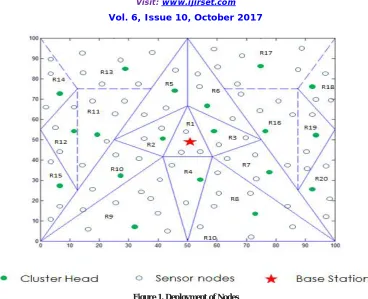
except the region R1. In each region, all nodes communicate with their respective CH while nodes in R1 communicate directly with BS. In our technique:
1. Nodes are deployed randomly. 2. Based on static clustering technique.
3. Homogeneous network i.e. all nodes have same energy level. 4. Multi-hop routing.
5. Single sink.
Rest of the paper is organized as follows: Section II presents the related work. Section III presents the motivation and objectives. Proposed algorithm is described in section IV. Section V presents the simulation results and section VI finally concludes the paper.
II. RELATED WORK
LEACH (Low-Energy Adaptive Clustering Hierarchy) [11] is a very first routing protocol proposed by W.Heinzelmanet al.which is based on cluster formation. It used Multi-hop communication scheme to provide communication between the sensing nodes. In this protocol, the selection of CHs is based upon probability. This leads to uneven distribution of CHs in the wireless network. As LEACH uses dynamic clustering scheme so it consumes more energy in cluster formation after every round.
A.Manjeshwaret al.proposed TEEN (Threshold-sensitive Energy Efficient Protocols) [19] protocol for temperature specific applications. In TEEN, sensing nodes sense the parameters con tinuously but does not transmit the sense data continuously. The sensors only transmit their sense data if and only if their sensed attribute crosses the threshold value.
Heinzelmanet al.proposed LEACH-Centralized (LEACH-C) [10]. It is an extended version of LEACH. In LEACH, nodes are able to self-configure themselves into clusters, whereas in LEACH-C it is the responsibility of base station to form cluster. Base station gathers the information about the location and energy level of each node during the setup phase of LEACH-C. After gathering the information, base station evaluates number of cluster heads and divides the network into clusters. The main advantage of this protocol is that, BS makes sure that the node which has less energy does not become CH.
W. Jun et al. proposed LEACH-Selective Cluster (LEACH-SC) [22]. The selection of CH in LEACH-SC is similar to LEACH.LEACH-SC operation is based on rounds. Each round includes setup phase and steady state phase. The formation of cluster is in such a way that node join the cluster before evaluating CH which is closest to the mid-point between itself and BS. In LEACH- SC, chosen CHs broadcast their IDs and information about their location to all other nodes which are in range. Nodes which are within communication range receive these information from all CHs.
NaumanIsraret al.proposed Multihop-LEACH [12].With the increase in network diameter beyond certain limit, distance between CH and BS also increased tremendously.This large network is no longer appropriate for LEACH in which BS is considering single-hop to all CHs. In this case cost of transmission energy of CHs is not moderate. In order to solve these problems Multi-hop LEACH is proposed.
As number of protocols are designed in the area of wireless network in order to prolong the network lifetime and stability period. But most of them such as LEACH [10], TEEN [19], APTEEN [20], SEP [8], DEEC [17] and LEACHC [9] do not minimize the energy utilization effectively. In LEACH, the whole area is treated as a single area. Because of this, some portion of area left uncovered. The criteria of selection of CHs in LEACH is based on the probability, therefore optimum number of CHs is not achieved. Also LEACH uses the dynamic clustering so the number of cluster and CHs changes in each round.
because of continuous transmission of data makes the node die quickly. So in our research we have focused on to develop the effective CHs selection scheme which fulfill these requirements and prolong the n etwork lifetime as well as stability period.
III. PROPOSED PROTOCOL DESIGN
We firstly describe the radio model of the system, and then come to division of the network into logical regions. After that, the communication architecture and proposed scheme of cluster head selection is described. Energy consumption by the nodes is explained at the end of this section.
A. Radio model
Wetake as an energy loss during data transmission where, is the distance between two sensing nodes. The amount of energy losses is taken into consideration whenever sensing nodes transmit the sensed data either to CHs or base station. In order to transmit k-bit of data at a distance d, the mathematical formula is:
= ∈∈ (1)
d< ( , ) = × + ∈ × × (2)
d> ( , ) = × + ∈ × × (3)
Receptionenergy: ( ) = × (4)
Where is the energy consume per bit to run the transmitter or receiver circuit. ∈ and∈ depend on the transmitter amplifier. B. Proposed Network Model The area of network field is taken as 100 × 100 with the Base Station (BS) located at the central reference point i.e. ( , ). The whole area is divided into 3 triangles. Total 100 nodes are deployed uniformly in the field. Number of clusters and CHs is fixed throughout the protocol operation. Cluster Formation: Firstly the whole network area has been partitioned into 3 triangles i.e. left triangle ( ), middle triangle ( ) and right triangle ( ). Then middle triangle is divided into n concentric triangles. The value of n varies with the change in the network field area and number of nodes deployed. Here value of n is taken as 2. The middle triangle is further divided into three parallelograms excluding its concentric triangle ( ). These parallelograms are named as: Left parallelogram ( ), Right parallelogram( ), and Lower parallelogram( ). Nodes are deployed randomly in each region. Following mathematical equations are used to divide the network area into concentric triangles: ( , ) = ( , + ), (5)
( , ) = ( + , − ), (6)
( , ) = ( − , − ). (7) Where = /3 is the distance from the center of network to the boundary of . , , are the top, bottom right, bottom left corners of respectively. By using above equations further concentric triangles can be formed from square network region. For multiplicative factor of β is 2.
Figure 1. Deployment of Nodes
C. Cluster Head Selection:
Our approach is based on static clustering which means number of clusters and CHs is fixed throughout the network operation. In each round, one CH is selected from every region except . Hence total 20 CHs are selected in each round. The criteria of CHs selection is the minimum distance of sensing nodes from the mid-point of their respective region. In other words, firstly in each region the distance between each sensing nodes and mid-point of its respective region is calculated. After calculating this, the node is selected as CH of that region in the ascending order of distances from the reference point. In addition to this if two or more sensing nodes has same distance, then the selection of CH among them will be based on maximum energy left i.e. node having maximum energy left will be chosen as CH
D. Communication Architecture:
In our approach, data sensed by the sensing nodes reach to the base station by using 3-tier communication scheme. In tier-1 all the non-CH sensing nodes in each region pass the sensed data to their respective CHs. In tier-2, CHs of outer triangles of and pass their collected data either to its or its depending upon the distance. If CHs pass the data to then CH of aggregate the data and send to either to its CH or outer triangle CH of depending upon the distance. If the CH of send the data to its CH then CH of further send the data to CH of
of . Now CHs of outer triangles of send their collected data either to its CH or directly to the BS depending upon the distance. Finally in tier-3, CHs of transmit their collected information to the base station (BS).
E. Protocol Operation:
According to our proposed work, in each region the sensing nodes pass the sensed data to their respective CH only when the sensed attribute crosses the some predefined threshold value. There are two types of thresholds value:
Hard threshold: This is the first threshold value with which each normal sensor compares its sensed attribute. Whenever a node crosses this value, turns its transmitter on and reports to its CH.
IV. SIMULATIONS AND RESULTS
In this section we discuss the simulation result of our proposed work. The results are compared with the LEACH protocol by considering following metrics: number of alive nodes, stability period, network lifetime, number of packets sent, number of packets dropped and number of packets received.
Table 1: Radio Parameters
Operation Energy Dissipated
Transmitter/Receiver 50nJ/bit
Data Aggregation Energy 50nJ/bit/signal
Transmit Amplifier ∈ ( < ) 10pJ/bit/4
Transmit Amplifier ∈ ( ≥ ) 0.0013pJ/bit/
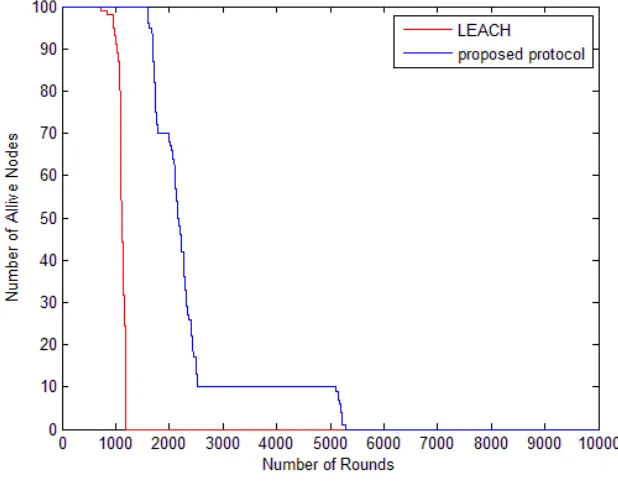
Figure 2and figure 3shows the experimental result for network lifetime and stability period. Here we compare the network lifetime and stability period of our proposed workwith the existing traditional LEACH protocol in terms of nodes alive and dead nodes. The network lifetime of ourproposed work is 2500 rounds more than LEACH protocol. The First node die time (FDT) of our proposed work is around 1800 rounds whereas that of LEACH is around 800. Last node die time (LDT) of proposed work is around 5200 rounds whereas that of LEACH is around 1200.
Figure 3. Stability Period
Figure 5. Total Packets Drop at BS
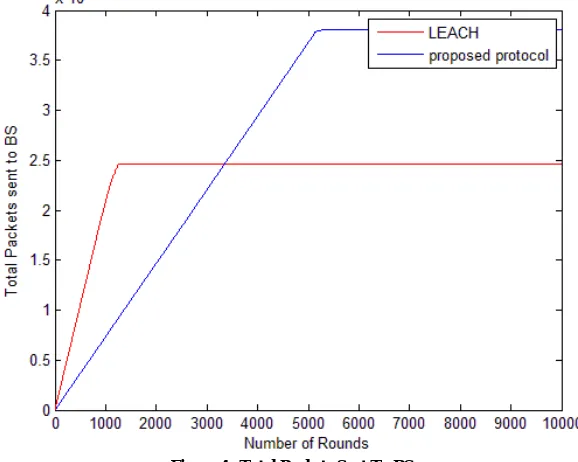
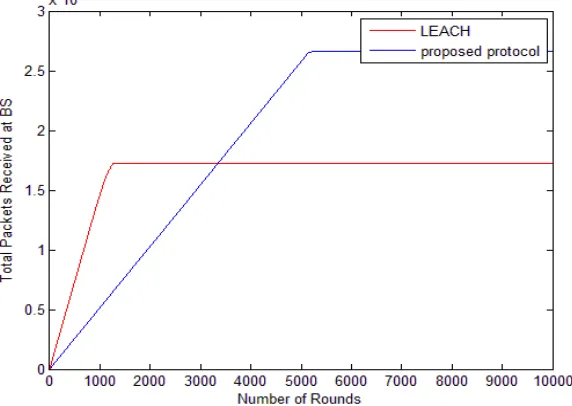
Ideally, when all CHs and non CHs nodes send their packet to BS, the number of packets sent and number of packets received are equal i.e., BS receives all packets without any loss. But in reality it does not happens, the number of packets sent to BS and number of packets received by BS are not equal. Some packets do not reach to the BS. Our proposed work implements the uniform random distribution to show this packet loss. In order to evaluate the packet drop, weimplement the uniform random distribution. Here 0.3 as packet drop probability is used. In our proposed work, the average number of packets sent in each round by the CH to BS is 5. By applying 0.3 as packet drop probability, the average number of packet drop is 2. Therefore the average number of packets received at BS is around 7. Whereas in LEACH protocol, the number of packets sent by the CH to BS is 10, average number of packets received at BS is around 3 and the average number of packet drop is 3. This result can be seen in figure 6 as number of packets received at BS in our proposed work is less than the number of packets received at BS in LEACH protocol.
Table 2: Comparison with Respect to Network Lifetime and Stability Period
Protocols Network
Lifetime (FDT) (in rounds)
Stability Period (LDT) (in rounds)
LEACH 800 1200
Proposed Work 1800 5200
Table 3: Comparison with Respect to Number of Packets Sent to BS
Protocols Number of Packets Sent to BS till 1000th
round (in rounds)
LEACH 18000
Proposed Work 6000
V. CONCLUSION
The idea to partition the network area into sub regions is introduced in this paper to remove the coverage holes and communication distance between nodes and CHs and between CHs and sink. A threshold dependent communication is used in order to remove the unnecessary communication. Static based clustering is used which results in fixed number of CHs and number of nodes in each cluster throughout the network lifespan. The idea of introducing static based clustering is used to obtain balanced load distribution which results in longer network lifetime period. The criteria to select the CHs is based upon the minimum distance and maximal energy which means the node which has minimum distance from the reference point is selected as CH and if two or more nodes has same distance then the selection of CH depends upon maximum energy left i.e. the node which has maximum energy left become CH.
REFERENCES
[1] Ahmad, A., Latif, K., Javaidl, N., Khan, Z.A. and Qasim, U., 2013, May. Density controlled divide-and-rule scheme for energy efficient routing in Wireless Sensor Networks. In: Electrical and Computer Engineering (CCECE), 2013. pp. 1-4.
[2] Akshay, N., Kumar, M.P., Harish, B. and Dhanorkar, S., 2010, December. An efficient approach for sensor deployments in wireless sensor network. In: Emerging Trends in Robotics and Communication Technologies (INTERACT), 2010. pp. 350-355.
[3] Amjad, N., Javaid, N., Haider, A., Awan, A.A. and Rahman, M., 2013, October. DREEM-ME: distributed regional energy efficient multi-hop routing protocol based on maximum energy in WSNs. In: Broadband and Wireless Computing, Communication and Applications (BWCCA), 2013. pp. 43-48.
[4] Aslam, M., Shah, T., Javaid, N., Rahim, A., Rahman, Z. and Khan, Z.A., 2012, June. CEEC: Centralized energy efficient clustering a new routing protocol for WSNs. In: Sensor, Mesh and Ad Hoc Communications and Networks (SECON), 2012. pp. 103-105.
[5] Behzad, M., Javaid, N., Sana, A., Khan, M.A., Saeed, N., Khan, Z.A. and Qasim, U., 2014, November. TSDDR: Threshold Sensitive Density Controlled Divide and Rule Routing Protocol for Wireless Sensor Networks. In: Broadband and Wireless Computing, Communication and Applications (BWCCA), 2014. pp. 78-83.
[6] Elrahim, A.G.A., Elsayed, H.A., Ramly, S.E. and Ibrahim, M.M., 2010. An energy aware WSN geographic routing protocol.Universal Journal of Computer Science and Engineering Technology. 1(2): 105-111
[8] G. Smaragdakis, I. Matta, A. Bestavros“SEP: A Stable Election Protocol for clustered heterogeneous wireless sensor networks” Boston University Computer Science Department (2004).
[9] Haider, A., Javaid, N., Amjad, N., Awan, A.A., Khan, A. and Khan, N., 2013, October. REECH-ME: Regional energy efficient cluster heads based on maximum energy routing protocol for WSNs. In: Broadband and Wireless Computing, Communication and Applications (BWCCA), 2013. pp. 88-92.
[10] Heinzelman, W.B., Chandrakasan, A.P. and Balakrishnan, H., 2002. An application-specific protocol architecture for wireless microsensor networks. Transactions on wireless communications. 1(4): 660-670
[11] Heinzelman, W.R., Chandrakasan, A. and Balakrishnan, H., 2000, January. Energy-efficient communication protocol for wireless microsensor networks. In: System sciences, 2000. pp. 10-10.
[12] Israr, N. and Awan, I.U., 2007. Multihop clustering algorithm for load balancing in wireless sensor networks. International Journal of Simulation. 8(3):13-25
[13] Javaid, N., Mohammad, S.N., Latif, K., Qasim, U., Khan, Z.A. and Khan, M.A., 2013, April. HEER: Hybrid energy efficient reactive protocol for wireless sensor networks. In: Electronics, Communications and Photonics Conference (SIECPC), 2013. pp. 1-4.
[14] Javaid, N., Qureshi, T.N., Khan, A.H., Iqbal, A., Akhtar, E. and Ishfaq, M., 2013. EDDEEC: Enhanced developed distributed energy-efficient clustering for heterogeneous wireless sensor networks. In: Procedia Computer Science, 2013. pp. 914-919.
[15] Khan, M.Y., Javaid, N., Khan, M.A., Javaid, A., Khan, Z.A. and Qasim, U., 2013. Hybrid DEEC: Towards efficient energy utilization in wireless sensor networks. World Applied Sciences Journal (WASJ). 1303-5364.
[16] Lindsey, S. and Raghavendra, C.S., 2002. PEGASIS: Power-efficient gathering in sensor information systems. In: Aerospace conference proceedings, 2002. pp. 3-3.
[17] Liu, A., Jin, X., Cui, G. and Chen, Z., 2013. Deployment guidelines for achieving maximum lifetime and avoiding energy holes in sensor network. In: Information Sciences, 2013. pp. 197-226.
[18] L. Qing, Q. Zhu, M. Wang“Design of a distributed energy-efficient clustering algorithm for heterogeneous wireless sensor networks ” Computer communications ,2006
[19] Manjeshwar, A. and Agrawal, D.P., 2001, April. TEEN: a routing protocol for enhanced efficiency in wireless sensor networks. In: International Parallel and Distributed Processing Symposium, 2001. pp. 30-189.
[20] Manjeshwar, A. and Agrawal, D.P., 2002, April. APTEEN: A hybrid protocol for efficient routing and comprehensive information retrieval in wireless sensor networks. In: International Parallel and Distributed Processing Symposium, 2002. pp. 1530-2075.
[21] Manzoor, B., Javaid, N., Rehman, O., Akbar, M., Nadeem, Q., Iqbal, A. and Ishfaq, M., 2013. Q-LEACH: A new routing protocol for WSNs. In: Procedia Computer Science, 2013. pp. 926-931.