ISSN (Online): 2319-8753 ISSN (Print) : 2347-6710
I
nternational
J
ournal of
I
nnovative
R
esearch in
S
cience,
E
ngineering and
T
echnology
(A High Impact Factor, Monthly, Peer Reviewed Journal)
Visit: www.ijirset.com
Vol. 7, Issue 1, January 2018
A Survey on
“
Mitigating Cold-Start
Recommendation Problem by Rating
Comparison”
Bhagyashree Bendale, Hiralal Solunke
Department of Computer Engineering, G. H. Raisoni Institute of Engineering, and Management, Jalgaon, India.
ABSTRACT: As of late, recommender framework is one of key segments in numerous internet business sites. One of the significant difficulties that to a great extent stays open is the cool begin issue, which can be seen as a boundary that keeps the frosty begin clients/things far from the current ones. In this paper, we expect to get through this boundary for frosty begin clients/things by the help of existing ones. Specifically, propelled by the exemplary Elo Rating System, which has been generally, received in chess competitions; we propose a novel rating examination procedure (RAPARE) to take in the idle profiles of frosty begin clients/things. The intermediate bit of our RAPARE is to give a fine-grained collusion on the latent profiles of coldstart clients/things by investigating the contrasts between cold start and existing clients/things. As a nonexclusive procedure, our proposed technique can be instantiated into existing strategies in recommender frameworks. To disclose the capacity of RAPARE technique, we instantiate our methodology on two common strategies in recommender frameworks, i.e., the matrix factorization based and neighbourhoodbased KNN. Exploratory assessments on five genuine informational collections approve the predominance of our approach over the current techniques in coldstartproblem.
KEYWORDS: Recommender systems, Cold-start problem, Rating comparison strategy.
I. INTRODUCTION
The idea of recommender frameworks was proposed for both industry and the scholarly world have given their commitment to the change of value and productivity for recommender frameworks. As one of the significant segments of web based business and social sites, recommender framework has turned into a basic piece of these sites. Amid the most recent decade, numerous standard web based business organizations have revealed noteworthy benefit development by coordinating recommender frameworks into their applications. In spite of the accomplishment of existing recommender frameworks everywhere throughout the world, the chilly begin issue [1]. i.e., how to make legitimate recommendations for frosty begin clients or icy begin things; to a great extent remains an overwhelming issue. On one hand, chilly begin clients (e.g., who have evaluated close to 10 things) and frosty begin things (e.g., which have gotten close to 10 appraisals) possess an expansive extent in numerous genuine applications, for example, Netflix [2]. Then again, the viability of the current suggestion approaches (e.g., communitarian sifting) generally relies on upon the adequate measure of chronicled appraisals, and thus these methodologies may rapidly end up plainly insufficient for chilly begin clients/things that exclusive have couple of evaluations.
a) Background:-
ISSN (Online): 2319-8753 ISSN (Print) : 2347-6710
I
nternational
J
ournal of
I
nnovative
R
esearch in
S
cience,
E
ngineering and
T
echnology
(A High Impact Factor, Monthly, Peer Reviewed Journal)
Visit: www.ijirset.com
Vol. 7, Issue 1, January 2018
i.e., they need to retrain the model when new ratings arrive which may be computationally expensive [3]. Therefore, special treatments are needed for the cold-start users/items to adjust their latent profiles dynamically and efficiently.
b) Motivation:-
In particular, inspired by the classic Elo Rating System, which has been widely adopted in chess tournaments; wepropose a novel rating comparison strategy (RAPARE) to learn the latent profiles of cold-start users/items. The center-piece of ourRAPARE is to provide a fine-grained calibration on the latent profiles of cold-start users/items by exploring the differences betweencold-start and existing users/items.
c) Objective And Scope:-
The preferred standpoint is that these techniques could be pertinent for another client/thing with not rating by any stretch of the imagination. In any case, they depend on the entrance of such side data.
The inactive list of products will get eliminated.
The product vendor and the seller will get benefited as every product is recommended uniformly.
d) Goal:-
The advantage is that these methods could be applicable for a new user/item with not rating at all. However, they rely on the access of such side information.
II. LITERATURE SURVEY
P. Resnick and H. R. Varian [1]Today, there is a major variety of various methodologies and calculations of information separating and proposals giving. In this paper we portray customary methodologies and clarify what sort of present day approaches have been created recently. All the paper long we will attempt to clarify approaches and their issues in view of motion pictures proposals. At last we will demonstrate the fundamental challenges recommender frameworks gone over.
J. Davidson, B. Liebald, J. Liu, P. Nandy, T. Van Vleet, U. Gargi [2]. We examine the video suggestion framework being used at YouTube, the world's most prominent online video group. The framework prescribes customized sets of recordings to clients in view of their action on the site. We talk about a portion of the exceptional difficulties that the framework faces and how we address them. We give subtle elements on the experimentation and assessment structure used to test and tune new calculations. We additionally introduce a portion of the discoveries from tests.
A. S. Das, M. Datar, A. Garg, and S. Rajaram [3].In this venture, we depict our way to deal with cooperative sifting for producing customized proposals for clients of Google News. We create suggestions utilizing three methodologies: cooperative separating utilizing Min-Hash grouping, Probabilistic Latent Semantic Indexing (PLSI), and co visitation numbers. We join proposals from various calculations utilizing a direct model. Our approach is content freethinker and subsequently area autonomous, making it effectively versatile for different applications and dialects with insignificant exertion.
ISSN (Online): 2319-8753 ISSN (Print) : 2347-6710
I
nternational
J
ournal of
I
nnovative
R
esearch in
S
cience,
E
ngineering and
T
echnology
(A High Impact Factor, Monthly, Peer Reviewed Journal)
Visit: www.ijirset.com
Vol. 7, Issue 1, January 2018
however they can likewise utilize different properties, including things saw, statistic information, subject interests, and most loved craftsmen.
B. Sarwar, G. Karypis, J. Konstan, and J. Riedl [5]. We examine the utilization of dimensionality decrease to enhance execution for another class of information examination programming called "recommender frameworks". Recommender frameworks apply learning disclosure methods to the issue of making item proposals amid a live client connection. These frameworks are making broad progress in E-business these days, particularly with the coming of the Internet. The colossal development of clients and items postures three key difficulties for recommender frameworks in the E-trade area. These are: delivering fantastic proposals, performing numerous suggestions every second for a great many clients and items, and accomplishing high scope even with information sparsity. One fruitful recommender framework innovation is community sifting, which works by coordinating client inclinations to different clients in making suggestions.
A. MerveAcilar and A. Arslan [6].A framework is truly required for helping clients to discover their way on the shopping and excitement sites where the measures of on-line data endlessly increment. Along these lines, recommender frameworks, new kind of web based programming instrument, showed up, and turned into an engaging subject for scientists. Cooperative separating (CF) procedure in light of client is the one of the technique broadly utilized by recommender frameworks however they have a few issues for holding up to be created arrangements that are more effective. One of these basically issues is information sparsity. While the quantity of items is increment, the proportion of basic evaluated items is diminishing so figuring the calculations of neighbourhood wind up noticeably troublesome. The other one is versatility which is the execution issue of the current calculations on the datasets has a lot of data.
J. B. Schafer, D. Frankowski, J. Herlocker, and S. Sen [7]. Recommender frameworks are an essential piece of the data and online business biological community. They speak to an effective technique for empowering clients to channel through expansive data and item spaces. About two many years of research on cooperative sifting have prompted a differed set of calculations and a rich gathering of apparatuses for assessing their execution. Research in the field is moving toward a wealthier comprehension of how recommender innovation might be inserted in particular spaces.
A. Toscher, M. Jahrer, and R. M. Bell [8]. The group "BellKor in BigChaos" is a consolidated group of group BellKor and BigChaos. The arrangement with a RMSE of 0.8616 is made by a straight mix of the outcomes from both groups. In the accompanying paper we portray the consequences of Big-Chaos.
A. M. Rashid, I. Albert, D. Cosley, S. K. Lam, S. M. McNee, J. A. Konstan, and J. Riedl [9].Recommender frameworks have turned out to be profitable assets for clients looking for keen approaches to seek through the huge volume of data accessible to them. One vital unsolved issue for recommender frameworks is the means by which best to find out about another client. In this paper we examine six strategies that shared separating recommender frameworks can use to find out about new clients. These strategies select an arrangement of things for the shared separating framework to present to each new client for rating. The strategies incorporate the utilization of data hypothesis to choose the things that will give the most incentive to the recommender framework, total measurements to choose the things the client is well on the way to have a conclusion about, adjusted methods that look to boost the normal number of bits learned per exhibited thing, and customized procedures that foresee which things a client will have a sentiment about.
ISSN (Online): 2319-8753 ISSN (Print) : 2347-6710
I
nternational
J
ournal of
I
nnovative
R
esearch in
S
cience,
E
ngineering and
T
echnology
(A High Impact Factor, Monthly, Peer Reviewed Journal)
Visit: www.ijirset.com
Vol. 7, Issue 1, January 2018
execution by utilizing the specific situation, we propose a semi-directed gathering learning calculation. The calculation builds diverse (powerless) expectation models utilizing cases with various settings and after that utilizes the containing system to permit each (feeble) forecast model to gain from the other forecast models.
III. EXISTING SYSTEM APPROACH
In recommender frameworks, it is moderately hard to draw appropriate inactive profiles for the chilly begin clients/things because of the absence of adequate authentic evaluations from them. We give careful consideration to the new coming appraisals from these cold-start clients. Naturally, these new appraisals are more essential for coldstartclients/things. Notwithstanding, many existing techniques treat the current clients/things and coldstart clients/things similarly. Furthermore, these strategies are normally static, i.e., they have to retrain the model when new evaluations arrive which might be computationally costly. In this manner, exceptional medications are required for the coldstart clients/things to change their idle profiles powerfully and proficiently.
Existing system Disadvantage
The main disadvantage of methods in this class is the additional burdens incurred by the interview process.
A system is seriously required for helping users to find their path on the shopping and entertainment web sites where the amounts of on-line information vastly increase.
We believe these results will hold for many similar recommender systems.
Cold start is one of the most challenging problems in recommender systems.
IV. PROPOSED SYSTEM APPROACH
In this Project the Concept of RAPARE strategy is proposed which eliminates the cold start problem.The cold start will make the system halt available. Theinactive products are eliminated with the help ofexisting users, products by studying the characteristicsof existing products and inactive products. Now theproducts are recommended uniformly to the userswhich make the flow of products to recommend uniformly by making the cold products list go high andthe active product no longer.We proposed the RAPARE-MF (instantiating with lattice factorization strategy) and RAPARE-KNN (instantiating with closest neighbourhood technique) models and in addition calculations to tackle them.
Proposed system Advantage
Generic strategy can be instantiated to many existing methods for recommender.
We proposed the RAPARE-MF (instantiating with matrix factorization method) and RAPARE-KNN (instantiating with nearest neighborhood method) models as well as algorithms to solve them. Experimental.
Data overload has increasingly become a significant issue in the use of information systems.
We investigate the use of dimensionality reduction to improve performance for a new class of data analysis software called “recommender systems”.
ISSN (Online): 2319-8753 ISSN (Print) : 2347-6710
I
nternational
J
ournal of
I
nnovative
R
esearch in
S
cience,
E
ngineering and
T
echnology
(A High Impact Factor, Monthly, Peer Reviewed Journal)
Visit: www.ijirset.com
Vol. 7, Issue 1, January 2018
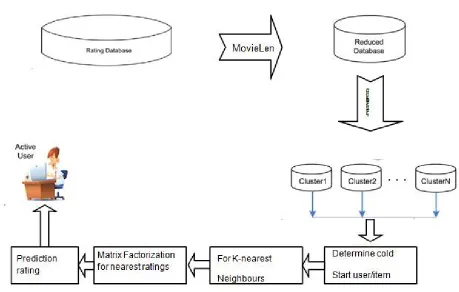
Proposed system architecture
Figure 1 : System Architecture Explanation
Rating Database:
In this database all information of user and also information of the rating of all movies. The rating is between to 0 to 5. All ratings are contained in the file.Represents one rating of one movie by one user, and has the following format: userId,movieId,rating,timestamp
The lines within this file are ordered first by userId, then, within user, by movieId. Ratings are made on a 5-star scale, with half-star increments (0.5 stars – 5).
MovieLen:
We download the dataset from movie lens. We work on this dataset to find the cold start user and cold start item. We solve this problem on that database. Firstly we download this dataset and process on this dataset to convert into MySQL.
Clustering:
ISSN (Online): 2319-8753 ISSN (Print) : 2347-6710
I
nternational
J
ournal of
I
nnovative
R
esearch in
S
cience,
E
ngineering and
T
echnology
(A High Impact Factor, Monthly, Peer Reviewed Journal)
Visit: www.ijirset.com
Vol. 7, Issue 1, January 2018
A server cluster is a collection of servers, called nodes that communicate with each other to make a set of services highly available to clients. ... The otherclustering technology is Network Load Balancing. Server clusters are designed for applications that have long-running in-memory state or frequently updated data.
V. CONCLUSION
In this paper, we have proposed a non-specific rating examination system (RAPARE) to make legitimate recommendations for chilly begin issue. Specifically, the RAPARE methodology gives an extraordinary, fine-grained treatment for chilly begin clients and cool begin things. This nonexclusive procedure can be instantiated to many existing techniques for recommender frameworks. We proposed the RAPARE-MF (instantiating with framework factorization strategy) and RAPARE-KNN (instantiating with closest neighbourhood technique) models and in addition calculations to comprehend them. Test assessments on five genuine informational indexes demonstrate that our approach outflanks a few benchmark shared sifting and internet refreshing techniques as far as forecast precision, and RAPARE-MF can give quick suggestions straight adaptability.
REFERENCES
[1] M. Zhang, J. Tang, X. Zhang, and X. Xue, “Addressing cold start in recommender systems: A semi-supervised co-training algorithm,” in SIGIR, 2014.
[2] J. Davidson, B. Liebald, J. Liu, P. Nandy, T. Van Vleet, U. Gargi, S. Gupta, Y. He, M. Lambert, B. Livingston et al,“The YouTubevideo recommendation system,” in RecSys. ACM, 2010, pp. 293– 296.
[3] A. MerveAcilar and A. Arslan, “A collaborative filtering method based on artificial immune network,” Expert Systems with Applications, vol. 36, no. 4, pp. 8324–8332, 2009.
[4] A. Toscher, M. Jahrer, and R. M. Bell, “The big-chaos solution to the netflix grand prize,” Netflix prize documentation, 2009.
[5] J. B. Schafer, D. Frankowski, J. Herlocker, and S. Sen, “Collaborative filtering recommender systems,” in The adaptive web.Springer, 2007, pp. 291–324.
[6] Source A. S. Das, M. Datar, A. Garg, and S. Rajaram, “Google news personalization: scalable online collaborative filtering,” in WWW. ACM, 2007, pp. 271–280.
[7] G. Linden, B. Smith, and J. York, “Amazon. Com recommendations: Item-to-item collaborative filtering,” Internet Computing,IEEE, vol. 7, no. 1, pp. 76–80, 2003.
[8]A. M. Rashid, I. Albert, D. Cosley, S. K. Lam, S. M. McNee, J. A. Konstan, and J. Riedl, “Getting to know you: learning new userpreferences in recommender systems,” in IUI. ACM, 2002, pp. 127–134.
[9] B. Sarwar, G. Karypis, J. Konstan, and J. Riedl, “Application of dimensionality reduction in recommender system-a case study,”DTIC
Document, Tech. Rep., 2000.