Adnan M. Alattar
and
Sarah A. Rajala
Center for Communications and Signal Processing
Department of Electrical
&Computer Engineering
Box 7914
NCSU
Raleigh, NC 27695-7914
CCSP-TR-89/4
Adnan M. Alattar and Sarah A. Rajala
Department of Electrical and Computer Engineeringand
Center for Communications and Signal Processing P.O. Box 7914, North Carolina State University
Raleigh, NC 27695-7914
ABSTRACT
A new image coding technique for achieving an extremely high
compression ratio while producing good image quality is described. The idea is
analogous to that used in forensic applications when constructing a composite
image of a criminal from a collection of images of facial features. Simply, the input
image is segmented into complicated primitives that are coded using a previously
constructed database of primitives. A duplicate database is used at the receiver to
decode the primitives. The decoded primitives are assembled as in computer animation to produce a faithful reconstruction of the original image. The technique
has been applied to head and shoulders images and compression ratios over
1000: 1 have been achieved.
1. INTRODUCTION
Most traditional image coding techniques follow one of two basic coding
strategies: transform or predictive [1]. Both techniques concentrate on coding
messages that are algebraically calculated from the pixel values of the image.
Hence, these techniques may be classified as algebraic techniques. Recently, a
new class of techniques known as second generation techniques [2,3] have
utilized image segments of uniform properties as messages, rather than numerical
messages [2,3]. This utilization has allowed a compression ratio of 100:1 to be
achieved. This ratio is amazingly high compared to those obtained from traditional
An extremelyhigh compression ratio can beachieved by extending second generation techniques to include segments of non-uniform properties and
complicated primitives. The idea used is similartothat used in composing pictures
from pieces of other pictures as in animation [4], computer graphics [5] and forensic [6] applications. Simply, any still picture, such as a head and shoulders
photograph, is segmented into complicated primitives that are coded using a
previously constructed database of primitives. A priori knowledge is used in
constructing a set of filters and a dynamic model of the head and shoulders
images, which allow fast and accurate segmentation of the head in the image into
its primitives.
The paper is organized into five sections, including the introduction.
Section (2) discusses the general methodology of the primitive-based image coding
technique. Section (3) applies the primitive-based technique to head and shoulders
images. Section (4) discusses the implementation and simulation results. The last
section contains a conclusion and final remarks.
2. PRIMITIVE-BASED IMAGE CODING: THE
GENERAL APPROACH
For each class of images, there is a universal set Sof primitives of which the set P f of primitives in any image f in the class, is a subset.IfP f= (P1U1),
P 2
U2),... ,P JUn-/p Un)}, where the superscriptj. indicates the state of the
lh
n- n I
primitivePi' then the image f canberepresented as the union of its primitives; i.e.,
(1)
Ifthe universal set S is known and the subset P f for an image f is identified from S, then the imagef can be easily reconstructed from the primitives of set S and some information about the sizes, orientations, and locations of the original
primitives in f.
Since the type of primitives that might appear in a given class of images is
database can be used to code any image in the given class. The coding process starts by using image analysis techniques to extract the primitives Pf of the input
image. Each of the extracted primitives is normalized with respect to size and
orientation, and is then matched to the database, which is assumed to be available
before coding. When the best match is found, its orderin the database, along with
the primitive's normalization factors and locationin the original image, is coded and transmitted. Ifa good match for a primitive cannot be found, the primitive itself is transmitted and the databases at both the transmitter and the receiver are updated to include the new primitive.
The receiver uses the transmitted information and a duplicate database to
construct a faithful replica of the original image. The idea is very similar to that
used in computer animation [4]. First, each primitive is decoded from the database
using its order. It is then re-scaled and re-oriented using its normalization factors
so that it assumes its original size and orientation. Finally, each primitive is
projected onto its original placein the image and any artifacts that might appearin
the transition region between primitives are removed with a smoothing filter.
Image compression is achievedinthis technique through transmission of a small number of parameters rather than transmission of the primitive itself. These
parameters include the order of the primitive in the database, its normalization
factors, and its locationinthe original image.
3. PRIMITIVE-BASED IMAGE CODING:
APPLICATION TO HEAD AND SHOULDERS IMAGES
In forensic applications, thousands of head and shoulders images of previously apprehended criminals are collected in mug-shot files. In spite of the
recent advances in image compression techniques and electronic storage
technology, the tremendous amount of data forming these files is a major obstacle
in the way of realizing a fully computerized archiving system with storage and
transmission capabilities. However, since users are often more concerned with the
general view of a picture than with its details, these files can now be efficiently
Applying the primitive-based image coding technique to a given class of
images requires: (1) an accurate defmition of the primitives of the images in that
class, (2) a fast and accurate primitive extraction algorithm, (3) the construction of
a representative database of reasonable size, and (4) a way to compare primitives.
3.1 Primitives of Head and Shoulders Images
The primitives of head and shoulders images are well-defined; they
correspond to image segments containing facial features of the human face.
Therefore, image segments which contain the eyes, nose, mouth, ears, chin,
mustache, eyebrows, or hair sections are considered to be the primitives of head
and shoulders images. Each of these primitives may have more than one state. For
instance, the mouth may be closed, slightly opened, opened, or widely opened.
Location of the facial features in a given input image is based on a simple
model in which the shape of the human head in a photograph is approximated by
an ellipse. The geometry of the ellipse and knowledge from the artof drawing the
human head are combined to derive simple mathematical relations to locate the
facial featuresin a quick and accurate way. These relations and a complete
feature-location algorithm are detailed in [7]. The orientation of the ellipse and the
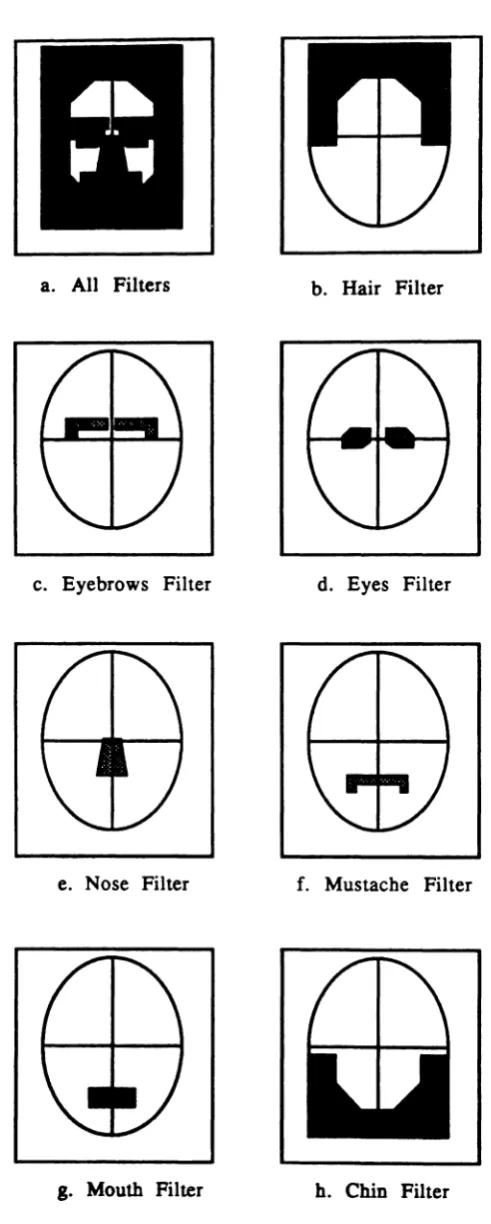
calculated positions of the facial features are used with a set of filters such as those
depicted in Fig.l to extract the facial features. Facial feature extraction is describedin the next subsection.
3.2 Facial Feature Extraction
The facial features can be extracted from the input image by using a set of
filters similar to those used by Wiederhold [8]. Some possible shapes for these
filters are shown in Fig. 1. Each filter can be thought of as a mask of zeros and
ones. The pixels corresponding to the shaded areas in Fig. 1 have the value of 1,
and those outside the shaded area have the value of
O.
When a filter is multiplied by the input image, the values of the image pixels that correspond to the shadedvalues of the other pixels become zero. This is the basis for primitive extraction
from the input image.
Before it can be used to accurately extract a given primitive of the input
image, the appropriate filter's size, orientation, and center of operation must be
determined by applying the algorithm for facial feature location which was
discussed in the preceding subsection.
3.3 The Database
The database that represents the universal set S for head and shoulders
images can be easily constructed from a collection of primitives extracted from
prototype photographs. These photographs must be selected to be
highly-representative of the class of head and shoulders images. A representative database of reasonable size would contain about the same number of primitives as
the Identikit andPhotofit kits used in forensic applications [6], which contain
around 150 hair sections, 60 ears, 100 eyes and eyebrows, 50 noses, 100 mouths,
and 70 chins.
The primitives must be normalized with respect to size and orientation and
grouped in the database under their respective feature types. Each group would
contain primitives representing the various shapes and states that may be assumed
by its corresponding facial feature. For instance, the eye group would contain
picture segments of eyes of different people. These eyes would be in various
states, e.g., closed, slightly opened, and fully opened. The database should also
contain a group of average pictures to be used as base imagesin the reconstruction process.
Singular-value-decomposition [9] can be used to construct a compact
database. Since facial features of the sametype look alike, it is possible to store
the primitives of each group in terms of a single primitive from that group. First, a
prototype primitive is selected to represent each group. Then, the
singular-value-decomposition of the selected primitive is calculated. The basis vectors of this
differences between the transformation coefficients of these primitives and those
of the prototype primitive are stored in the database.
3.4 Feature Matching
Feature matching is a major obstacle inrealizing the primitive-based image
coding technique. The difficulty lies in the fact that feature matching is more
subjective than mathematical. However, mathematical error measures such as the
mean-square-error are usually adequate for finding the best match when comparing
a given image to others in a set of images. Therefore, the mean-square-error
measure is used to find the best match of an extracted feature to the features that
have been pre-stored in the database. Since there may be a slight mis-alignment
between the extracted feature and the features in the database, it is necessary to displace the feature one or two pixels in the vertical and horizontal directions
during the comparison. Then the feature from the database which produces the
least error is taken as the best match, provided that this
mean-square-error is less than a specified threshold.
Another method of feature matching utilizes a dedicated neural network.
Stonham [10] developed a self-adapting machine called Wisard as a general
purpose pattern recognition system. He also described its application to human
face recognition. The central component ofWisardis a neural network that adapts
to a particular training set during a learning process. The network is then able to
recognize patterns that are very similar to those of the training set. The Wisard
machine is of parallel nature and is easily fabricated using the currently available
VLSI technology. Therefore, such a network could be used to match an image
primitive of a given type to a similar primitive in the database.
4.
IMPLEMENTATION OF THE PRIMITIVE-BASED
CODER
AND SIMULATION RESULTS
Several steps were taken to implement the primitive-based image coder.
stored in a separate file for each filter. The size of each filter was normalized to fit
within a square of size 1 by 1.This square was centered at the origin. Second, the centers of the facial features in the input image were determined by applying the
facial feature location algorithm [7]. Third, the located features were extracted
using the defined filters. The center of each filter was first shifted to coincide with
the center of the corresponding feature inthe image, then it was scaled and re-oriented according to the size and orientation of the head inthe input image. The filter was then multiplied with the input image to extract the corresponding feature.
The shifting, scaling, and orienting factors used in adjusting the filter were all provided by the facial feature location algorithm.
A real database has not yet been constructed, so a hypothetical one was
used in the coding/decoding process. Simply, the extracted features were
manually compared with the features of other images and the best matches were
selected subjectively. The selected features were projected onto an average face
that was constructed from another image of the same person in the input image.
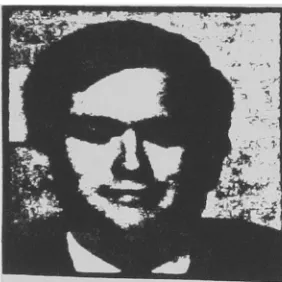
For example, the average face of Fig. 3 was constructed from the image of Fig. 2.
This was done by blurring the head in the image of Fig. 2 with an 11 by 11
average filter, and then rotating and shifting it so that its center and orientation
coincided with those of the input image of Fig. 4. When the selected primitives
were projected onto this average face the image of Fig. 5 was obtained. The
previously described filter set was used to extract the primitives from the original
image and from the other images. It also was used to project the primitives of best
match onto the base image. Finally, the boundaries of the primitives were
smoothed with a smoothing filter that replaced the value of each pixel on the
boundary with the average of the values of the pixels in a 3 by 3 window around
the boundary pixel.
It should be noted that only the five parameters of the ellipse and nine
database indices corresponding to the nine facial features extracted from the input
image would be needed to reconstruct the image of Fig. 5.If16 bits were allocated to the orientation parameter of the ellipse, and 8bits to each of the four other
parameters and the nine indices, then a total of 120 bits would be required to
transmit the image of Fig. 4 and obtain the image of Fig. 5. Since each pixel in the
pixels, a compression ratio of 1092:1 is achievable using this technique.
However, with full implementation of the primitive-based coder, this compression
ratio is expected to be somewhat less, because when a best match can not be found
in the database, the original primitive itself has to be transmitted.Inany case, the expected compression ratio is extremely high compared to those which were
achievable by the earlier image coding techniques (maximum of 100:1 by second
generation techniques[6]).
Replacing the original primitives in a head and shoulders image with
similar ones from a database introduces image degradation. This degradation,
however, canbereduced with careful selection of the entries of the database. With
such a selection, the recognizability of the face can be maintained. In fact, Haig
[11] performed a set of experiments that produced strong evidence to indicate that
some facial features can be replaced with similar ones without affecting face
recognizability. Similar studies show that the general shape of the head, including
hair style, is the most salient feature, and that the eyes are the second most salient
feature. Other facial features such as the nose and the mouth are much less
significantinface recognition.
5. CONCLUSION
Primitive-based image coding can achieve an extremely high compression
ratio by using a priori knowledge about an input image and a highly-representative
database of primitives. The new technique is well-suited to coding of head and
shoulders images of the type commonly found in mug-shot flies and "face-to-face"
telecommunications. Other classes of images can also be coded using this
technique. This requires well-defined primitives, primitive location and extraction
algorithms, and a representative database for the given class of images. It is also
possible to extend the new technique to sequences of images, such as those
encountered in
Picture Phone
and teleconferencing. The achievable compression ratio in these cases is expected to be high enough to allow real-time transmission6. REFERENCES
[1] A.N. Netravali and J.O. Limb, "Picture Coding: A review," Proc. IEEE, vol. 68, pp. 366-406, March 1980.
[2]
[3]
M. ~un: A. Konomopoulos and M. Kocher, "Second-Generation Image Coding, Proc. IEEE, vol. 73, pp. 549-574, April 1985.
S.A.Rajala, M.R. Civanlar and W.M. Lee, "A Second Generation Image Coding Technique Using Human Visual System Based Segmentation," Proc. ICASSP'87, pp. 1362-1365, April 1987.
[4]
N. Magnenat and D. Thalmann, Computer Animation, Springer-Verlag, Tokyo 1985.[5] M.L. Gillenson and B. Chandrasekaran, "A Heuristic Strategy for Developing Human Facial Images on a CRT," Pattern Recognition, vol. 7, pp. 187-196, 1975.
[6]
[8]
[9]
[7]
G. Davies, H. Ellis, and J. Shepherd, Perceiving and Remembering Faces, Academic Press, London 1981.
A.M. Alattar and S.A. Rajala, "A Model-based Algorithm for Facial Feature Extraction from A Photograph," Computer Vision, Graphics, andImage Processing, submitted for publication.
T.P. Wiederhold, Facial Image Generation By Computer, Master's Thesis, University of Houston, Dec. 1976.
H.C. Andrews and C.L. Petterson, "Singular Value Decomposition (SVD) Image Coding," IEEE Trans. Commun., COM-24, 4, April 1976, 425-432.
[10] T.J. Stonham, "Practical Face Recognition and Verification With Wisard," in Aspects of Face Processing, Edited by H.D. Ellis, M.A. Jeeves, F. Newcombe, and A. Young, Martinus Nijhoff 1986.
c. Eyebrows Filter
e. Nose Filter
g. Mouth Filter
d. Eyes Filter
f. Mustache Filter
h. Chin Filter
Fig.3. Average Face ConstructedFrom the Image in Fig. 2