Data Discovery and Dissemination Protocol
for Wireless Sensor Networks
Sagargouda S.Patil 1
Assistant Professor, Department of Computer Science, Shaikh Engineering College, Belagavi, India1
ABSTRACT:Information finding furthermore spread protocol for remote sensor networks (WSNs) will be answerable for overhauling setup parameters of, also distributing administration commands to, the sensor hubs. The greater part existing information finding and spread conventions middle of the road starting with two drawbacks. In view of those unified approach; just those build station cam wood disseminate information things. Such an approach may not be suitable for developing multi-owner-multi-user WSNs. Second, the individual’s conventions were not planned in light of security in previous works. This paper proposes the initially secure what's more dispersed information revelation and spread protocol named DiDrip. It permits the organize owners should commission various system clients for different privileges will all the while also straightforwardly spread information things of the sensor hubs. Moreover, concerning illustration exhibited toward our hypothetical analysis, it addresses an amount for time permits security vulnerabilities that we bring identifier. Far reaching security examination demonstrates DiDrip is provably secure. We also actualize all the DiDrip done a test system from claiming resource-limited sensor hubs on demonstrating its helter skelter effectiveness on act.
KEYWORDS: Distributed data discovery and dissemination, security, wireless sensor networks, efficiency.
I.INTRODUCTION
After a remote sensor system (WSN) may be deployed, there is typically and require should redesign buggy/old little projects alternately parameters put away in the sensor hubs. This might a chance to be attained eventually Tom's perusing those alleged information disclosure also spread protocol, which facilitates a wellspring on infuse little programs, commands, queries, and setup parameters will sensor hubs. Note that it may be unique in relation to those code spread conventions (also alluded with concerning illustration information spread alternately reprogramming protocols) which disseminate substantial binaries to reprogram those entirety systems about sensors. To example, proficiently dispersing a parallel document from claiming many kilobytes obliges a code spread protocol same time dispersing a few 2-byte setup parameters obliges information disclosure Furthermore spread protocol. Acknowledging the sensor hubs Might be conveyed in An barbarous environment, remotely scattering such little information of the sensor hubs through those remote channel may be a All the more favored Furthermore useful approach over manual intercession. In the literature, a few information finding what's more spread conventions have been suggested to WSNs. Around them, DHV, dip Furthermore trickle need aid viewed Similarly as the state-of-the-craft conventions Also have been incorporated in the minor os circulations[1].
Fig.1:System overview of centralized and distributed data discovery and dissemination approaches.
Previously, addition, those unified methodology will be inefficient, non-scalable, and powerless to security strike that could make propelled anyplace along the correspondence way. Considerably worse, a few WSNs don't need any base station whatsoever. To example, for An WSN screening human trafficking done An country’s outskirt alternately An WSN deployed in An remote range will screen illegal crop cultivation, a base station gets to be a engaging focus to be struck[6.7]. To such networks, information spread may be better should make conveyed out toward commissioned system clients Previously, A conveyed way.
Additionally, dispersed information finding and spread may be a progressively pertinent matter for WSNs, particularly in the developing setting of imparted sensor networks, the place sensing/communication infrastructures starting with numerous managers will be imparted Eventually Tom's perusing provisions from various clients. To example, substantial scale sensor networks would constructed in late activities for example, such that Geoss, NOPP what’s more orion. These networks would claim Eventually Tom's perusing different owners what's more utilized Toward Different commissioned third-party clients. Moreover, it is normal that system holder’s also different clients might need separate privileges from claiming spread.
II.LITERATURE SURVEY
customizing. Those conventions contrast clinched alongside their plan decisions yet all the they constantly on bring two things on regular. In they are used to spread a system through a one- or multi-hop sensor net[5]. Second, none from claiming them were
proposed to provide security Furthermore know are powerless should simple, yet all the weakening strike.
• More importantly, all existing data discovery and dissemination protocols employ the centralized approach, data items can
only be disseminated by the base station.
• Unfortunately, this approach suffers from the single point of failure as dissemination is impossible when the base station is
not functioning or when the connection between the base station and a node is broken.
• In addition, the centralized approach is inefficient, non-scalable, and vulnerable to security attacks that can be launched
anywhere along the communication path.
III.PROPOSED SYSTEM
Motivated by the above observations, this paper has the following main contributions:
1) Those require for dispersed information disclosure What's more spread conventions may be not totally new, At past fill in didn't deliver this require. We examine those practical necessities for such protocols, also set their plan targets. Also, we distinguish those security vulnerabilities On Awhile ago suggested conventions[2].
2) In light of the plan objectives, we recommend DiDrip. It will be those initially dispersed information finding Furthermore spread protocol, which permits organize owners Furthermore sanctioned clients should spread information things under WSNs without relying on the build station. Moreover, our far reaching examination exhibits that DiDrip fulfills those security necessities of the conventions about its kind. For particular, we apply the provable security technobabble to formally demonstrate the legitimacy What's more integument of the disseminated information things Previously, DiDrip.
3) We show the effectiveness from claiming DiDrip over act Eventually Tom's perusing actualizing it On an test WSN for resource-limited sensor hubs. This will be also the initially usage of a secure furthermore dispersed information finding furthermore spread protocol.
• In this project, we propose secure and data discovery and dissemination protocol (DiDrip). DiDrip consists of four phases, system initialization, user joining, and packet preprocessing and packet verification.
• For our basic protocol, in system initialization phase, the network owner creates its public and private keys, and then loads the public parameters on each node before the network deployment.
• In the user joining phase, a user gets the dissemination privilege through registering to the network owner.
• In packet preprocessing phase, if a user enters the network and wants to disseminate some data items, he/she will need to construct the data dissemination packets and then send them to the nodes.
• In the packet verification phase, a node verifies each received packet. If the result is positive, it updates the data according to the received packet.
Advantages of Proposed System:
• User can send the data directly to the sensor nodes without using the base station.
• Provide more security for data.
• Increase packet delivery ratio.
IV. RESULTS AND DISCUSSION
The taking after measurements needs aid used to assess DiDrip; memory overhead, execution occasion when of cryptographic operations furthermore proliferation delay, furthermore vitality overhead. Those memories overhead measures those required information space in the usage. The proliferation delay is characterized as those occasions when starting with development of an information hash chain until the parameters once every last bit sensor hubs comparing on a round from claiming disseminated information things are updated.
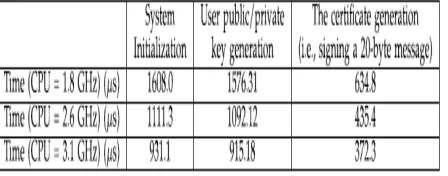
Table 01. Running Time for Each Phase of the Basic Protocol of DiDrip (Except the Sensor Node Verification Phase)
Table 1 indicates the execution times about a few critical operations done DiDrip. For example, the execution times for those framework introduction stages also marking an irregular 20-byte message (i.e, the yield for SHA-1 function) need aid 1. 608 Aalso 0. 6348 ms for a 1. 8-GHz smart phone PC, separately. Thus, whether SHA-1 may be used, generating a client testament alternately marking a message takes 0. 6348 ms with respect to a 1. 8-GHz smart phone pc. The inputs of the hash work are haphazardly created numbers with period changing starting with 24 to 156 bytes previously, increases for 6 bytes. Note that, previously, our protocol, the hash capacity is connected will a whole bundle. There would a few reasons that, possibly, a bundle holds a couple many bytes.
aid 9. 6788, 18. 947, what's more 28. 0515 ms, separately. Also, the execution times looking into a TelosB motacillidae for inputs about 54, 114, what's more 156 bytes are 5. 7263, 10. 7529, and 15. 629 ms, separately.
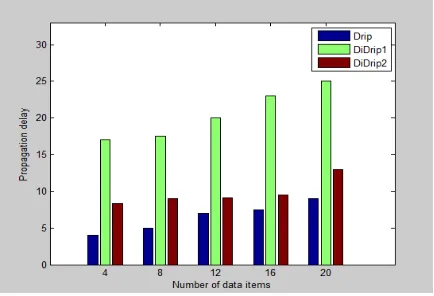
Fig. 3: Propagation delay comparison of three protocols when the data hash chain method is employed.
In the experiments, the bundle conveyance rate from the organize client is 5packets/s. The lengths of round Furthermore information fields to an information thing are situated to 4 odds and 2 bytes, individually. A hash capacity with 8-byte truncated yield may be used to develop information hash chains. An ECC-160 signature may be 40 bytes in length.
Fig. 4: Propagation delay comparison of three protocols when the Merkle hash tree method is employed.
confirmation the long run incurred toward the one-hop neighboring hubs of the build station. This is since each hub carries out mark confirmation just then afterward sending information packets.
V.CONCLUSION
In this paper, we need recognized the security vulnerabilities for information revelation and spread when utilized within WSNs which need not been tended to previously, past exploration. Also, none about the individual’s methodologies help disseminated operation. Therefore, in this paper, a secure furthermore conveyed information disclosure and spread protocol named DiDrip need been recommended. Furthermore examining the security from claiming DiDrip, this paper need additionally accounted those assessment effects of DiDrip on an test organize of resource-limited sensor nodes, which indicates that DiDrip is practical done act. We bring additionally provided for a formal evidence of the legitimacy also integument of the disseminated information things to DiDrip. Also, because of those open way from claiming remote channels, messages camwood be undoubtedly intercepted. Thus, in future, we will think as of how to guarantee information secrecy in the plan about secure what's more disseminated information disclosure furthermore spread conventions.
REFERENCES
1. D. He, C. Chen, S. Chan, and J. Bu, “DiCode: DoS-resistant and distributed code dissemination in wireless sensor networks,” IEEE Trans. Wireless Commun., vol. 11, no. 5, pp. 1946–1956, May 2012.
2. D. He, S. Chan, S. Tang, and M. Guizani, “Secure data discovery and dissemination based on hash tree for wireless sensor networks,” IEEE Trans. Wireless Commun., vol. 12, no. 9, pp. 4638– 4646, Sep. 2013.
3. A. Perrig, R. Canetti, J. Tygar, and D. Song, “Efficient authentication and signing of multicast streams over lossy channels,” in Proc. IEEE Security Privacy, 2000, pp. 56–73.
4. OpenSSL. [Online]. Available: http://www.openssl.org
5. A. Liu and P. Ning, “TinyECC: A configurable library for elliptic curve cryptography in wireless sensor networks,” in Proc. ACM/ IEEE Inf. Process. Sensor Netw., 2008, pp. 245–256.
6. G. Tolle and D. Culler, “Design of an application-cooperative management system for wireless sensor networks,” in Proc. Eur. Conf. Wireless Sensor Netw., 2005, pp. 121–132.