A Model for Evaluation of Delays in
Construction Projects
Ghada Taha1, Mohamed Badawy 2, Omar El-Nawawy 3
M. Sc Student, Department of Structural Engineering, Faculty of Engineering, Ain-Shams University, Cairo, Egypt Dr., Department of Structural Engineering, Faculty of Engineering, Ain-Shams University, Cairo, Egypt Professor, Dr., Department of Structural Engineering, Faculty of Engineering, Ain-Shams University, Cairo, Egypt
ABSTRACT: This study aims to identify the main causes of delay in construction projects. The study depends on a questionnaire survey list for determining the probability and the severity for the main causes of delay in construction projects. The questionnaire consists of total factors of ten groups. These ten groups have been consisted of total 63 delay factor.
In this study, the authors found that most five important factor which effect on delay of the construction project are "Delay in progress payments by owner", "Poor site management and supervision by contractor", "Lack in qualified labours", "Difficulties in financing project by contractor", and "Ineffective planning and scheduling of project by contractor".
A CPD Evaluation Model to evaluate the importance of each cause according to its importance index (IMP.I) and then ranking all causes was designed. The model was designed by using Virtual Basic.net.
KEYWORDS:Construction industry, causes of delay, Probability Index, Severity Index, CPD Evaluation Model .
I. INTRODUCTION
The construction industry is considered as one of strategic industries in Egypt, where construction occupies third place in the number of employment after agriculture and industry [15]. Delays are one of the biggest problems in construction companies all over the world. According to the World Bank (2007) the delays varied between 50% - 80% for many projects completed worldwide between 1999 and 2005 (Sambasivan and Soon, 2007; Kaliba et al., 2009) [21]. According to American Arbitration Association (AAA) over the past 74 years the number of allegations caused by delays reached almost 25% of the 1.7 million allegation (Kassab et al., 2006)[16]. In Malaysia, at 2005,about 17.3% of 417 government contract projects have more than 3 months delayed or abandoned (Alaghbari et al., 2007) [20]. In India, at 2004 the infrastructure and Project Monitoring Division of the Ministry of Statistics and Programmed Implementation report that out of 646 central sector projects that cost about 2500 Cr, approximately 40% are delayed from 1 to 252 months [27]. In the United Kingdom (U.K), at 2001 the National Audit Office made a report entitled “Modernizing Construction”, according to this report 70% of the projects undertaken by Government department and agencies were delivered late, and recently Building Cost Information Service (BCIS) made a research that found that nearly 40% of all studied projects had overrun the contract period (Lowsley and Linnett, 2006) [17]. In Nigeria, at 2000 Odusami and Olusanya reported that most projects in Lagos city faced an average delay of 51% on their planned duration (Iyer and Jha, 2006) [18].
II. RESEARCH OBJECTIVE
The main objectives of this study are:
1- Identifying the main causes of delay in construction projects from the point of view of contractor and consultant.
III. LITERATURE REVIEW
Assaf and Al-Hejji (2006) defined the delays in construction as "the time overrun either beyond completion date specified in a contract, or beyond the date that parties agreed upon for delivery of a project" [13]. Zack 2003 defined the delays in construction as "an act or event which extends required time to perform or complete work of the contract manifests itself as additional days of work”[12]. Aibinu and Jagboro (2002) defined the delays in construction as "a situation where non completion of a project within the original or stipulated or agreed contract period" [11].
A lot of national and international studies of literatures were done; many researchers have conducted surveys on the causes and impacts of delay in the construction industry by asking the advice from experienced civil construction parties including owners, consultants, and contractors.
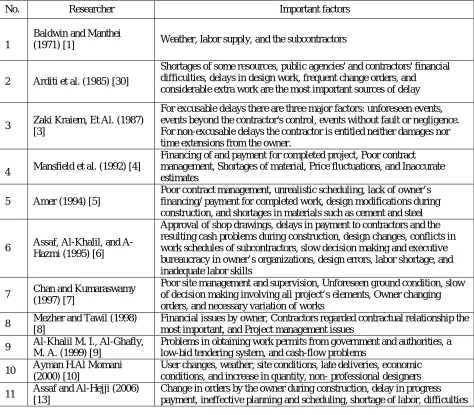
Table (1) presents a summary of the national and international research studies finding out the factors causing delays. These Researches was carried out from 1970-2014 t different countries (United States, Turkey, Nigerian, Egypt, Hong Kong, Lebanon, Saudi Arabia, Jordan, UAE, Malaysian, Sri Lanka, Kuwait, Ghana, Pakistan.
Table 1 – Important factors causing delays identified in past researches. No. Researcher Important factors
1
Baldwin and Manthei
(1971) [1] Weather, labor supply, and the subcontractors
2 Arditi et al. (1985) [30]
Shortages of some resources, public agencies' and contractors' financial difficulties, delays in design work, frequent change orders, and
considerable extra work are the most important sources of delay
3 Zaki Kraiem, Et Al. (1987) [3]
For excusable delays there are three major factors: unforeseen events, events beyond the contractor's control, events without fault or negligence. For non-excusable delays the contractor is entitled neither damages nor time extensions from the owner.
4 Mansfield et al. (1992) [4]
Financing of and payment for completed project, Poor contract management, Shortages of material, Price fluctuations, and Inaccurate estimates
5 Amer (1994) [5]
Poor contract management, unrealistic scheduling, lack of owner’s financing/ payment for completed work, design modifications during construction, and shortages in materials such as cement and steel
6 Assaf, Al-Khalil, and A-Hazmi (1995) [6]
Approval of shop drawings, delays in payment to contractors and the resulting cash problems during construction, design changes, conflicts in work schedules of subcontractors, slow decision making and executive bureaucracy in owner’s organizations, design errors, labor shortage, and inadequate labor skills
7 Chan and Kumaraswamy (1997) [7]
Poor site management and supervision, Unforeseen ground condition, slow of decision making involving all project’s elements, Owner changing orders, and necessary variation of works
8 Mezher and Tawil (1998) [8]
Financial issues by owner, Contractors regarded contractual relationship the most important, and Project management issues
9 Al-Khalil M. I., Al-Ghafly, M. A. (1999) [9]
Problems in obtaining work permits from government and authorities, a low-bid tendering system, and cash-flow problems
10 Ayman H.Al Momani (2000) [10]
User changes, weather, site conditions, late deliveries, economic conditions, and increase in quantity, non- professional designers 11 Assaf and Al-Hejji (2006)
[13]
in financing on the part of the contractor 12 Faridi, A. S., & El Sayegh,
S. M. (2006) [14]
Slow in drawing preparation and approval, inadequate and poor planning, lack of quick decision making from the owner, shortage in qualified labour, and lack of proper supervision and management
13 Sambasivan and Soon (2006) [19]
Inaccurate planning contractors, contractor’s poor site management, unqualified contractor, inadequate client’s finance and payments for completed work, problems with subcontractors, shortage in material, shortage in qualified labor, equipment availability and failure, lack of communication between parties, and mistakes during the construction stage 14 Sweis et al. (2007) [21]
Financial difficulties faced the contractor, many changes in orders from the owner, poor planning and scheduling from contractor, unskilled labour, and lack of skilled labour.
15 Abd El-Razek, Bassioni, and Mobarak (2008) [22]
Financing by contractor during construction, delays in payment by owner, changes in design by owner or his agent during construction, partial payments during construction, and poor management.
16 Pathiranage and Halwatura (2010) [23]
Financial problems of owner and contractor, poor site management by the contractor, poor weather condition, contract modification, lack of quick decision making, shortage of site labour and material, lack of
sub-contractor’s skill/ poor skills, construction mistakes, and poor site condition 17 Ehab Soliman (2010) [24] Financial and design causes are the most important and frequent delay
causes
18 Fugar and Agyakwah-Baah (2010) [25]
Delay in honoring certificates, minimize of the costs of projects, minimize of the complexity of projects, difficulty in accessing bank credit, poor supervision delay in completion of projects by contractors, shortage of materials, poor management, fluctuation of prices/ rising cost of materials, and poor site management
19 Haseeb et al. (2011) [26]
Natural disaster in Pakistan like flood and earthquake and some others like financial problems, improper planning, poor site management, poor experience, and lack of materials, and equipments
20 Jeykanthan and
Jayawardena (2012) [28]
Inaccurate feasibility studies, errors in detail designs, short comings in contract document, disputes, variation and scope changes, land acquisition and resettlement, extreme weather, and shortage of bitumen
21 Remon Fayek Aziz (2013) [29]
Inadequate experience of consultant , delay in approving major changes in scope of work by consultant, delay in performing inspection and testing, poor communication between owner and contractor, poor communication between owner and consultant
22 Samad M E Sepasgozar et al. (2014) [2]
contractor organization attributes, lack of experienced labor, external factors, material deficiency, design issues,
IV. RESEARCH METHODOLOGY
The questionnaire composed of two parts. The first part was a collection of general information concerning respondents. While the second part include the list of identified causes of delay in construction projects. The respondents were requested to give their response to each factor based on their experience. Two questions should be answered for each factor. First, what is the probability of occurrence of this cause? Second, what is the degree of severity of this cause on project delay? Both probability and severity were categorized on a six-point scale as follows: (0: no effect / not going to happen, 1: very low, 2: low, 3: Medium, 4: High, 5: very high).
One hundred and fifty questionnaires were distributed in Egypt, Saudi Arabia, United Arab Emirates, and Qatar. Hundred and fifteen of them responded correctly. The questionnaire survey was 55 consultants (47.8%) and 60 contractors (52.2%).
V. DATA ANALYSIS
The following indices were computed from the data collected through the questionnaire survey
:
Probability index (P.I): A formula is used to rank the causes of delay based on frequency of occurrence and it was computed for each factor using Equation 1
.
Probability Index (P.I.) (%) =Σ (a n/ 6 N) x 100 --- (1)
Where a: Value representing weighting given to each response, ranging from (0: not going to happen, 1: very low, 2: low, 3: Medium, 4: High, 5: very high), n: The number of responses choosing a value, N: Total no of responses.
Severity index (S.I): A formula is used to rank the causes of delay based on degree of severity and it was computed for each factor using Equation 2.
Severity Index (S.I.) (%) =Σ (a n/ 6 N) x 100--- (2)
Where a: Value representing weighting given to each response, ranging from (0: not going to happen, 1: very low, 2: low, 3: Medium, 4: High, 5: very high), n: The number of responses choosing a value, N: Total no of responses.
Importance index (IMP.I.): The importance index of each cause is calculated as a function of both probability and severity it was computed for each factor using Equation 3:
Importance Index (IMP.I.) (%) = [P.I. (%) * S.I. (%)]/100--- (3)
Spearman rank correlation
The Spearman’s rank correlation coefficient "rs" is used to measure and compare the association between the rankings of two parties. Spearman’s rank correlation is a non-parametric test. The test compare medians rather than means and, as a result, if the data have one or two outliers, their influence is neglected. It is calculated using Equation 4:
rs = 1- [(6 Σ d2)/ (n3-n)] --- (4)
rs - Spearman rank correlation coefficient between two parties, d is the difference between ranks assigned to variables for each cause, and n is the number of pairs of rank. The correlation coefficient varies between +1 and −1, where +1
implies; a perfect positive relationship (agreement), while −1 results from a perfect negative relationship
(disagreement). It might be said then that sample estimates of correlation close to unity in magnitude imply good correlation, while values near zero indicate little or no correlation
VI. RESULTS AND DISCUSSION
Table (2) shows the factors which cause delays in construction projects, their importance index, their ranking from the point of view of contractor and from the point of view of consultant, and then the Importance Index from overall view and its rank.
Table 2- Ranking factors
G
rou p No. Factor
From consultant point of view
From contractor
point of view Total IMP.I Rank IMP.I Rank IMP.I Rank
P
roj
ec
t 1 Project location 30.25 10 31.14 5 30.71 6
2 Lack of time allowed for the preparation of
schedule 16.46 56 34.59 2 25.92 30
3 Legal disputes between various parties 29.35 13 24.11 46 26.62 23 4 High quality requirements 23.65 29 27.70 26 25.76 31
6 Delay to deliver the site to the contractor by
the owner 28.50 16 29.78 11 29.17 13
7 Legal disputes between various owners 23.51 32 22.52 52 22.99 42
8 Delay in approving shop drawings and sample
materials 23.08 34 29.33 12 26.34 27
9 Slowness in decision making process by owner 22.31 39 27.44 28 24.99 36 10 Suspension of work by owner 24.38 27 30.67 7 27.66 18
11 Poor communication and coordination by
owner and other parties 23.30 33 23.61 48 23.46 40 12 Change orders by owner during construction 22.78 36 30.34 8 26.72 21
C
ons
u
lt
an
t
13 Inadequate experience of consultant 22.35 38 29.25 13 25.95 29
14 Late in reviewing and approving design
documents by consultant 21.06 45 27.08 30 24.20 39
15 Delay in performing inspection and testing by
consultant 15.74 57 25.15 38 20.65 52
16 Complexity of project design 14.57 61 21.30 55 18.08 60
17 Mistakes and discrepancies in design
documents 19.49 48 24.12 45 21.91 46
18 Insufficient data collection and survey before
design 22.47 37 23.42 50 22.97 43
19 Unclear and inadequate details in drawings 19.86 46 21.90 53 20.92 51
20 Misunderstanding of owner’s requirements by
design engineer 13.47 62 17.13 62 15.38 62
21 Delays in producing design documents 15.07 60 21.82 54 18.59 58
22 Delay in approving major changes in the scope
of work by consultant 19.28 49 24.31 42 21.90 47
C
ont
ra
ct
o
r
23 Ineffective planning and scheduling of project
by contractor 31.69 8 30.70 6 31.17 5
24 Delay in site mobilization 23.82 28 25.47 35 24.68 37
25 Poor site management and supervision by
contractor 34.07 3 34.03 3 34.05 2
26 Difficulties in financing project by contractor 34.09 2 29.81 10 31.86 4 27 Inefficient pricing tender 22.19 40 30.25 9 26.40 26
28 The bad relationship between the Staff and the
administration 28.29 17 24.16 44 26.14 28
29 Bad relationship between owner
representatives and contractor representatives 23.57 31 25.52 33 24.59 38 30 Disputes between labour in site 19.09 50 18.61 61 18.84 57 31 Rework due to errors during construction 24.78 24 28.09 22 26.51 25 32 Conflicts between contractor and other parties 26.62 22 24.90 39 25.72 32
33 Improper construction methods implemented
by contractor 31.69 7 27.44 27 29.47 10
34 The control of the contractor to subcontractors
is not sufficient 24.67 25 28.74 18 26.79 20
S
ub
-cont
ra
ct
or 35 The quality do not fulfill project requirements a result of the quality of materials and tools
used by the sub-contractor
26.47 23 29.05 17 27.82 17
36 Delay in the project depends on the financial
stability of the sub-contractor 29.88 12 28.55 20 29.19 11
la
bo
ur
37 Lack in qualified labours 32.47 6 31.89 4 32.17 3 38 Low productivity level of labours 31.00 9 29.10 16 30.01 8 39 Personal conflicts among labours 19.63 47 21.27 56 20.49 53
40 A labor strike 17.53 52 19.19 60 18.40 59
42 Lack of incentives for the contractor to finish
ahead of schedule 21.62 42 24.30 43 23.02 41
M
at
er
ia
l
43 Late procurement of materials 28.66 15 27.37 29 27.99 15 44 Delay in material delivery 28.05 18 25.33 37 26.63 22
45 Delay in manufacturing special building
materials 27.78 19 25.47 34 26.57 24
46 Damage of sorted material while they are
needed urgently 21.07 44 24.36 41 22.79 44
47
Late in selection of finishing materials due to availability of many types in
Market
17.14 53 23.45 49 20.43 54
48 Changes in material types and specifications
during construction 18.18 51 24.44 40 21.45 49
E
qui
p
m
ent 49 Shortage of equipment 29.98 11 29.23 14 29.59 9
50 Equipment breakdowns 33.25 4 27.71 25 30.36 7 51 Low level of equipment-operator’s skill 29.03 14 28.35 21 28.68 14 52 Low productivity and efficiency of equipment 27.19 20 28.09 24 27.66 19
E
xt
er
na
l
53 Changes in government regulations and laws 15.36 58 26.91 31 21.39 50 54 Delay in obtaining permits from municipality 33.23 5 25.47 36 29.18 12 55 Effect of social and cultural factors 8.11 63 16.38 63 12.42 63
56 Unavailability of utilities in site (such as,
water, electricity, telephone, etc.) 22.91 35 28.09 23 25.61 33
57 Delay in providing services from utilities (such
as water, electricity) 21.63 41 28.64 19 25.29 34 58 Rain effect on construction activities 21.61 43 22.76 51 22.21 45 59 Traffic control and restriction at job site 16.48 55 23.74 47 20.27 55 60 Accident during construction 15.12 59 20.46 58 17.91 61
61 Effects of subsurface conditions (e.g., soil,
high water table, etc.) 26.66 21 2.13 15 27.95 16
62 Delay in performing final inspection and
certification by a third party 23.60 30 19.70 59 21.57 48 63 Differing site (ground) conditions 24.46 26 25.63 32 25.07 35
As it shown from table (2), from the point of view of consultant; the first important factor is
"Delay in progress payments by owner" with an importance index of 40.79. The second factor is "Difficulties in financing project by contractor" with an importance index of 34.09. The third ranking factor is "Poor site management and supervision by contractor" which has an importance index of 34.07. From the point of view of the contractor the most three important factors are; (1) "Delay in progress payments by owner" with an impotence index of 36.04, (2) "Lack of time allowed for the preparation of schedule" which has an importance index of 34.59, (3) "Poor site management and supervision by contractor" which has an importance index of 34.03.
The calculated value of the correlation coefficient between consultant and contractor was (0.62) and it's considered a strong relationship between the point of view of consultant and contractor.
From data analysis, the most important factor which effect on delay of the construction project is "Delay in progress payments by owner" with an impotence index of 38.31. The second factor is "Poor site management and supervision by contractor" which has an importance index of 34.05. In the third place, the factor "Lack in qualified labours" which has an importance index equal to 32.17. The fourth factor is "Difficulties in financing project by contractor" with an importance index of 31.86. The fifth factor is "Ineffective planning and scheduling of project by contractor" which has an importance index of 31.17.
VII. A MODEL FOR EVALUATION THE CAUSES OF DELAY
probability index. While the severity index is a stored value in the program. The model is designed to identify the importance of each cause according to its importance index (IMP.I) and then ranking all causes. The model was designed by using Virtual Basic.net.
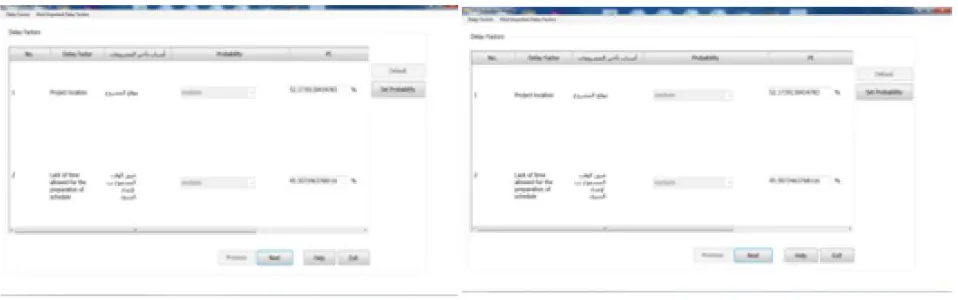
As shown in figure (1), In the first screen the severity index is stored and the user can choose the a proper probability or use the default one and then in the next screen the final result will be the top five factor which the user will give attention to them to reduce project delay.
Figure 1- A Model for evaluation of the causes of delay
As shown in figure (1), In the first screen the severity index is stored and the user can choose the a proper probability according to his experience or he can use a questionnaire analysis of his own survey and if the user has no idea about
the probability of a specified factor he can use the default one
AND THEN IN THE NEXT SCREEN THE FINAL RESULT WILL BE THE TOP FIVE FACTOR WHICH THE USER WILL GIVE
ATTENTION TO THEM TO REDUCE PROJECT DELAY,THIS SCREEN ALSO TRANSLATED TO ARABIC IN ORDER TO
GIVE MORE PEOPLE WHO WORK IN THE CONSTRUCTION THE OPPORTUNITY TO USE THE PROGRAMME
VIII.CONCLUSION
This study summarize some major causes of delays that facing construction projects. Based on literature study and from interview of experts, 63 causes were identified under 10 major groups. These factors causing the delays analysed using Importance index as a function of frequency index and severity index, and ranked from contractor point of view and from consultant point of view.
The most important factor which effect on delay of the construction project is "Delay in progress payments by owner" followed by the factor "Poor site management and supervision by contractor". In the third place, the factor "Lack in qualified labours" then the factor "Difficulties in financing project by contractor". The fifth factor is "Ineffective planning and scheduling of project by contractor".
A model was designed by using Virtual Basic.net to evaluate the top five factor which the user will give attention to them to reduce project delay. The model allow user to change the probability if he want.
REFERENCES
[1] John R. Baldwin, James M. Manthei, Harold Rothbart, and Robert B. Harris, "Causes of Delay in the Construction Industry", Journal of the Construction Division and Management, Vol. 97, No. 2, pp. 177-187, November 1971.
[2] Samad M E Sepasgozar, Mohamad Ahmad zade Razkenari, Khalegh Barati, "The Importance of New Technology for Delay Mitigation in Construction Projects", American Journal of Civil Engineering and Architecture, Volume 4, Number 2, pp 15-20,2015 3 (1).
[3] Zaki M. Kraiem, and James E, "Concurrent Delays In Construction Projects", Journal of Construction Engineering and Management, Volume 115, Issue 2 , pp. 163-173, June 1989.
[4] Mansfield N.R., Ugwu O.O., Doran T. "Causes of delay and cost overruns in Nigerian construction projects", International Journal of Project Manager, 12 (4), 254–260,1994.
[5] Amer, W. H.,“Analysis and evaluation of delays in construction projects in Egypt.” Master thesis, Zagazig Univ., Zagazig, Egypt, 1994.
[6] Assaf SA, Alkhalil M, Al-Hazmi M. "Causes of delay in large building construction projects", Journal of Management and Engineering, ASCE; 11 (2), 45 – 50, 1995.
[7] Chan D.W.M., Kumaraswamy M.M., "A comparative study of causes of time overrun in Hong Kong construction projects", International Journal of Project Manager; 15 (1), 55– 63, 1997.
[8] T. Mezher, W. Tawil, "Delay causes in the construction industry in Lebanon", Engineering Construction and Architectural Management', , pp. 251– 260,5 (3) (1998).
[9] Al-Khalil M.I., Al-Ghafly M.A. "Important causes of delays in public utility projects in Saudi Arabia", Journal of Construction Management and Economic; 17 (5), 641–655, 1999.
[10] Ayman H. Al-Momani, "Construction delay: A quantitative analysis", International Journal of Project Management, 18 (1), 51- 59,02/2000. [11] Aibinu A.A. and Jagboro G. O., "The effect of construction delays on project delivery in Nigerian construction industry", International Journal of
Project Management, Volume 34, Issue 3, 593- 599, 2002.
[12] Zack JG., "Schedule delay analysis; is there agreement?", In: Proc. PMI-CPM college of performance spring conf, Project Management Institute – College of Performance Management, New Orleans, US; 2003
[13] Assaf SA, Al-Hejji S., "Causes of delay in large construction projects", International Journal of Project Management; 24 (4), 349 –357, 2006. [14] Faridi, AS, & El-Sayegh, SM, "Significant factors causing delay in the UAE construction industry", Journal of Construction Management and
Economics, 24 (11), 1167-1176,2006.
[15] Al Ahram Newspaper year 43 665 130-number, "Building and construction industry and project development and development Amend existing laws to encourage private and foreign sectors of the industry", 2006 of June 2529 May 1427 Sunday.
[16] Kassab, M., Hipel, K., & Hegazy, T., "Conflict resolution in construction disputes using the graph model", Journal of construction engineering and management, 132 (10), 1043- 1052, 2006.
[17] Lowsley, S., & Linnett, C., "About time-: delay analysis in construction: RICS Books, p.55, 2006.
[18] Iyer, K., & Jha, K., "Critical factors affecting schedule performance: Evidence from Indian construction projects", Journal of construction engineering and management, 132(8), 871-881, 2006.
[19] Murali Sambasivan Yau, "Causes and effects of delays in Malaysian construction industry", University Putra, Malaysia, 43400 UPM, Serdang Selangor, Malaysia International Journal of Project Management; 25 (5), 517- 526, 07/ 2007.
[20] Alaghbari, W. e., Kadir, M. R. A., & Salim, A., "The significant factors causing delay of building construction projects in Malaysia", Engineering, Construction and Architectural Management, 14(2), 192-206, 2007.
[21] Sweis G., Sweis R., Abu Hammad A., Shboul A., "Delays in construction projects: the case of Jordan", International Journal of Project Manager; 26 (6): 665– 674, 2008.
[22] Abd El-Razek M.E., Bassioni H.A., Mobarak A.M., "Causes of delay in building construction projects in Egypt", Journal of Construction and Engineering Management; 134 (11), 831– 841 , 2008.
[23] Pathiranage Y.L., and Halwatura R.U., , "Factors Influencing the duration of Road Construction Projects in Sri Lanka", Engineer-Journal of Institution of Engineers Srilanka, XXXXIII(04), 17-30, 2010.
[24] Ehab Soliman "Delay causes in Kuwait construction projects" in: Proceedings of the 7th Alexandria International Conference on Structural and Geotechnical Engineering, AICSGE 7, (MG), pp. 57–67 , 2010.
[25] Fugar, F.D.K. and Agyakwah‐Baah, A.B., “Delays in building construction projects in Ghana”, Australasian Journal of Construction Economics and Building, pp. 103‐116, 2010.
[26] Haseeb et al "Problems of projects and effects of delays in the construction industry in Pakistan" Australian Journal of Business and Management Research, 1 (5), pp. 41–50, 2011.
[27] Annual report (2010-2011) of “Government of India Ministry of Statistics And Programmed Implementation” Sardar Patel Bhawaan.
[28] Jeykanthan J. and Jayawardena A.K.W., , "Mitigating Delays in Donor Funded Projects in Sri Lanka", Engineer-Journal of Institution of Engineers Sri Lanka, XXXXV (01), 65-75, 2012.
[29] Remon Fayek Aziz; "Ranking of delay factors in construction projects after Egyptian revolution", Alexandria Engineering Journal September 2013, Pages 387–406, 2013.