Pressure–volume properties of endlinked hard-chain polymer networks
N. R. Kenkare, C. K. Hall,a)and S. A. Khan
Department of Chemical Engineering, Box 7905, North Carolina State University, Raleigh, North Carolina 27695-7905
~Received 5 November 1998; accepted 22 January 1999!
Equilibrium molecular dynamics simulations are used to obtain the pressure and configurational chain properties of near-perfect, off-lattice, trifunctional hard-chain networks of chain lengths 20, 35, 50, and 100, and of tetrafunctional hard-chain networks of chain lengths 20, 35, and 50 over a range of packing fractions. Our simulation results show that the variation of network pressure with density is similar to that of uncrosslinked chain systems of the same chain length, except at low densities where the network pressure shows a negative region, as first observed by Escobedo and de Pablo. We present a theoretical treatment leading to an analytical expression for the network pressure as the sum of liquid-like and elastic contributions. The liquid-like contribution is obtained by extending the generalized Flory-dimer theory to networks, and the elastic contribution is obtained by treating the network as a set of interpenetrated dendrimers and using an ideal chain-spring analogy to calculate the free energy. The theoretical predictions for network pressure are in good agreement with simulation data. © 1999 American Institute of Physics.
@S0021-9606~99!51615-2#
I. INTRODUCTION
The immense technological importance of polymer net-works and gels in the automobile, plastics, and medical equipment industries is due primarily to their striking elastic properties. As a consequence, a great deal of theoretical and experimental research has been conducted over the past fifty years in an attempt to understand the nature of the stress– strain relations of polymer networks.
In this article, we investigate the molecular mechanisms underlying polymer network behavior by performing discon-tinuous molecular dynamics simulations. A comprehensive study of the pressure–volume properties of trifunctional and tetrafunctional networks is conducted and the resulting data are used to evaluate the predictions of several existing work theories. We also propose an analytical mean-field net-work equation of state based on a simple netnet-work model; this equation of state yields good agreement with the data from our simulations.
The earliest molecularly based theories for crosslinked polymers are the affine model of Flory and Rehner,1 and Wall,2 and the phantom model of James and Guth.3,4 Both models are based on mean-field approaches in which the analogy between the elastic properties of an ideal, Gaussian chain and a classical elastic spring is used to calculate the network free energy. By considering the network to be a collection of such chains, assuming that the chain vectors deform proportionally with macroscopic deformation~the af-fine assumption!, and neglecting excluded volume interac-tions, the affine and phantom models arrive at a simple stress–strain relationship for network deformation. These
models are successful in predicting the behavior of real net-works at small deformations, but are unsuccessful at large deformations.
A number of other theories of network behavior have been developed in an attempt to overcome some of the short-comings of the affine and phantom models. These include the constrained junction models of Flory and Erman,5,6 and Ronca and Allegra6,8as well as several localization, slip-link and tube models.7–22These theories partially account for the excluded volume interactions in networks ~which are ne-glected by the affine and phantom models!, and have been qualitatively successful in predicting the stress-strain relation of real networks in the small and intermediate deformation regimes.
Much of the theoretical work on crosslinked systems ap-plies to ‘‘perfect’’ networks, i.e., networks with constant chain length between the junctions and few structural irregu-larities~dangling chains, loops, or junctions of varying func-tionality!. The validation of network theories is best done using ‘‘model’’ near-perfect networks with well-characterized molecular structure. Experimental efforts in this direction are, however, hampered by the difficulty asso-ciated with obtaining precise information about the network structure. In the last decade, computer simulations have proved to be an excellent method for investigating network behavior since they allow the investigator to construct and study near-perfect model networks with well-characterized structure.
Most simulation studies of polymer networks to date have focussed on the kinetics of crosslinking or on network dynamics.23–31Simulation studies of the pressure–volume– temperature ~P–V–T! properties of networks are relatively rare, even though such investigations would yield valuable insights into the elastic response of a network undergoing a!Author to whom correspondence should be addressed; electronic mail:
7556
isotropic deformation, and would enhance our understanding of the molecular mechanisms underlying gel swelling.
To our knowledge, the only investigations of the P–V–T behavior of networks are those of Escobedo and de Pablo,32–34and Sommer.35Escobedo and de Pablo conducted NPT ensemble~constant number of particles, N, pressure, P, and temperature, T!Monte Carlo simulations of short chain
~chain lengths from 1 to 32!, tetrafunctional, athermal, and square-well networks having a diamond-like junction con-nectivity. The networks were created in such a way that the systems contained no trapped entanglements. Owing to the limitations of conventional Monte Carlo methods for simu-lating branched and crosslinked systems, Escobedo and de Pablo invented a set of complex system-specific Monte Carlo moves, the extended continuum configurational bias
~ECCB!, ‘‘slab,’’ and ‘‘cluster’’ moves for relaxing the net-work and for making the volume changes necessary in a NPT simulation. They found that the P–V behavior of net-work systems did not differ substantially from that of linear or star polymers except at very low packing fractions where a region of negative pressure was seen. They also presented a semitheoretical method to calculate the network free en-ergy from the sum of the free enen-ergy of a system of reference polymer molecules~e.g., octahedral molecules!and the free energy associated with network elasticity, thus dividing the network energy into liquid-like and elastic components as suggested originally by James and Guth.3 The elastic free energy of the network was obtained from a ‘‘computer ex-periment’’ in which the entropy of an isolated chain was calculated by enumerating all of the self-avoiding walks pos-sible between the chain ends when they were maintained a fixed distance apart in space. This single chain entropy was then used in conjunction with the affine assumption to obtain the elastic contribution to the network free energy. The theory showed good agreement with their simulation data in the very low packing fraction regime, but overpredicted the data at intermediate to high densities. Escobedo and de Pab-lo’s approach is an improvement over many existing network theories in that the elastic term clearly accounts for the ex-cluded volume of the network chains. However, the fact that a set of computer simulations must be conducted at each chain length in order to calculate the elastic contribution to the network free energy means that network properties can-not be obtained analytically. This precludes the use of this approach for predicting the properties of an arbitrary net-work.
Sommer35 conducted bond-fluctuation Monte Carlo simulations of a large randomly crosslinked athermal net-work consisting of approximately 50 000 segments arranged on a cubic lattice. To simulate an isotropic deformation pro-cess, the network was simply allowed to diffuse into a larger lattice, and the chain deformation and the network pressure were calculated as a function of the resulting macroscopic deformation of the network. Sommer observed that the net-work chain deformation was dependent on molecular weight, i.e., the shorter chains in the randomly crosslinked network were generally less deformed than the longer chains at a given macroscopic deformation. The pressure of the crosslinked system was observed to be different from that of
an uncrosslinked system particularly at large deformations; the difference in pressures was related to the disparity in the fractal-like properties of the two systems.
Our study of network behavior is motivated partly by the paucity of simulation data on the P–V–T and structural prop-erties of crosslinked systems, and partly by the need for an analytical network equation of state. The purpose of this ar-ticle is to investigate the pressure–volume properties of model athermal trifunctional and tetrafunctional networks using equilibrium molecular dynamics simulation tech-niques, and to propose an analytical equation of state for networks that is valid over a wide range of densities.
We use discontinuous molecular dynamics simulations to construct near-perfect, off-lattice, monodisperse, trifunc-tional hard-chain networks ~i.e., networks in which the chains consist of strings of hard spheres!of chain lengths 20, 35, 50, and 100, and tetrafunctional hard-chain networks of chain lengths 20, 35, and 50. The networks are created from melts of linear tangent hard-sphere chains ~chains in which successive hard-sphere segments are tangential to each other! by endlinking, i.e., by allowing bond formation between chain ends that collide with each other in the course of the simulation, up to a maximum of two bonds per chain end in a trifunctional network or three bonds per chain end in a tetrafunctional network. Our crosslinking process is similar to the experimental procedure used to develop ‘‘room tem-perature vulcanizates,’’ as well as the method used by a number of researchers36–39 to synthesize model networks with a known chain molecular weight distribution between crosslinks. Even for these model experimental systems, how-ever, the difficulty of obtaining a sufficiently monodisperse precursor system remains. In addition, it is difficult to obtain a precise knowledge of the extent of crosslinking of the sys-tem, and the proportion of irregularities, which is necessary in order to investigate the thermophysical properties of net-works. In comparison, computer simulations offer a greater control over the crosslinking process, allowing us to create monodisperse networks ~with a constant chain length be-tween junctions!, as well as giving us a precise knowledge of the network structure.
In our systems, the P – V and structural properties of the endlinked networks are investigated over a range of packing fractions ~0.45–0.005! by expanding the network from its initial packing fraction of 0.45 to successively lower densi-ties. The network expansion is done by using an algorithm that utilizes the variable bond-length attribute of the Belle-mans chain to conduct isotropic volume changes. The advan-tage of using this algorithm is that it allows us to simulate network expansion/contraction without introducing complex, system-specific moves, and without imposing an affine trans-formation on the chain ends.
fur-ther (h,0.01), there is a sharp downturn in the network pressure, that is, the pressure drops suddenly towards the highly negative region. These observations are in agreement with the results of Escobedo and de Pablo.33,34We find that the sharp downturn in network pressure observed at very low packing fractions occurs when the average end-to-end dis-tance of the network chains is between 50% and 70% of its maximum extended length. We also observe that the P – V properties and chain dimensions of tetrafunctional networks do not differ appreciably from those of trifunctional net-works.
We present a model based in statistical thermodynamics that predicts the pressure–volume behavior of athermal poly-mer networks. The network is modeled as a set of interpen-etrated dendrimers, whose branches are the network chains. Following James and Guth,3the network pressure at a given packing fraction is taken to be the sum of a liquid-like term which arises from the repulsive part of the intermolecular interaction, and an elastic term which arises from the retrac-tive force exerted by the chains opposing the network defor-mation. The liquid-like term is obtained from the generalized Flory–Dimer equation of state40–42by considering each den-drimer to be made up of a number of connected star-like molecules. The elastic term is obtained by calculating the free energy of a dendrimer in terms of the free energies of its component chains using the simple ideal-chain/spring anal-ogy. The dendrimer chains are treated in two ways: ~1! as having a Gaussian chain vector distribution ~the Gaussian dendrimer model!, and ~2! as having a non-Gaussian chain vector distribution of the form suggested by Kuhn and
Grun43,44~the non-Gaussian dendrimer model!. We find that
while the Gaussian dendrimer model predicts the network pressures fairly well over a wide range of packing fractions, it is unable to predict the sudden drop in pressure that occurs at very low densities. In comparison, the non-Gaussian den-drimer model predicts the network pressures over the entire range of packing fractions and is remarkably successful in the extremely low density region.
The organization of our article is as follows: Section II describes the molecular model and the general simulation technique, as well as the simulation methods used for net-work construction and for netnet-work volume changes. In Sec. III, our theoretical model is outlined, and in Sec. IV, our simulation and theoretical results are discussed. A brief sum-mary and some further discussion are given in Sec. V.
II. MOLECULAR MODEL AND SIMULATION TECHNIQUE
In this article, the discontinuous molecular dynamics technique that we have used previously to treat polymer melts45,46has been adapted to the case in which linear melt chains are endlinked to form a polymer network. We begin this section by reviewing the discontinuous molecular dy-namics technique as it is applied to a polymer melt. We then outline our method for constructing and relaxing polymer networks, and finally we describe our technique for conduct-ing network volume change moves.
The basic unit of the polymer network is a polymer chain which we represent as a freely jointed tangent
hard-sphere chain. The potential energy of interaction between any two beads on the same or neighboring chains in the network is given by
U~r!5
H
0, r.s
`, r<s, ~1!
where r is the bead-bead distance andsis the bead diameter. The treatment of a system of tangent hard sphere chains using standard molecular dynamics techniques is difficult due to the tangency requirement and flexible nature of such chains. To circumvent this problem, Rapaport47,48and Belle-mans, Orban, and Belle49 suggested an approach in which the bond length, l, between successive segments of the chain is not kept constant, but is instead allowed to vary freely over a range,s(12d),l,s(11d) whered!1. The chain then effectively becomes a collection of segments connected by sliding links~the Bellemans chain!. Asd→0, the Belle-mans chain approximates the tangent hard-sphere chain model. The relaxation of the constant bond length require-ment allows the chain segrequire-ment trajectories to be partially decoupled, resulting in linear trajectories between collisions. The system dynamics can then be treated using the discon-tinuous molecular dynamics techniques developed by Alder and Wainwright50–52for hard-sphere systems.
Molecular dynamics simulations of systems with discon-tinuous potentials, such as the hard-sphere potential, take advantage of the fact that the equations of motion for these systems can be solved analytically at successive ‘‘colli-sions.’’ A collision ~or event!occurs when the distance be-tween any two segments becomes equal to a point of discon-tinuity in the potential. Thus the dynamics of a system of molecules governed by the hard-sphere potential evolves on a collision-by-collision basis. For a Bellemans chain, colli-sions can be of two types: core collicolli-sions and bond stretches. Core collisions can occur between any pair of segments, i and j , in the system when the distance between two bonded segments becomes equal to s(12d), or when the distance between two nonbonded segments becomes equal to s. Bond stretches occur between pairs of bonded segments when the distance between the segments becomes equal to the maximum stretch of the Bellemans bond, s(11d). The simulation proceeds by locating the next event, advancing all the segments until the event occurs, and calculating collision dynamics for the colliding pair of segments. This process is performed repeatedly. A number of time-saving techniques are used to improve the algorithm efficiency based on the work of Smith, Hall, and Freeman,46including neighbor lists, linked lists, binary trees, and delayed position updates.
In order to construct trifunctional or tetrafunctional net-works, we endlinked melts of linear Bellemans chains. The endlinking was done at an initial system packing fraction of h50.3 after which the packing fraction was increased toh
50.45, where h is defined by
h5p
6
Ncns3
V , ~2!
publication30 for details! because it is relatively easy to achieve near-complete extents of reaction at lower densities, particularly for the longer chains. This crosslinking proce-dure is found to impact network elastic properties, causing the elastic behavior of networks that are crosslinked at low densities and then compressed to the~high!density of inter-est to be somewhat different from those of networks that are crosslinked at high densities.30This is attributed to topologi-cal differences between these networks; for instance, net-works that are crosslinked at low initial densities are less interpenetrated and contain fewer trapped entanglements than networks crosslinked at high densities. Also the chains in the networks crosslinked at low densities are somewhat collapsed relative to the chains in the networks crosslinked at high densities, even after the system density is increased. The decreased chain dimensions and changed entanglement topology associated with networks crosslinked at low densi-ties are expected to affect the elastic properdensi-ties of these net-works so that they have ‘‘superelastic’’ properties ~see Ob-hukov, Rubinstein, and Colby53!. That is, networks crosslinked at low initial density~which are akin to solution-crosslinked experimental systems from which the solvent is extracted!can be elongated to much larger deformations be-fore they rupture than networks crosslinked at a high initial density ~which are akin to melt-crosslinked networks!. Al-though we have chosen a fairly high initial density for crosslinking (h50.3), in order to ensure that the network topology is not greatly affected by our crosslinking proce-dure, we expect that the network’s elastic properties will be influenced to some extent.
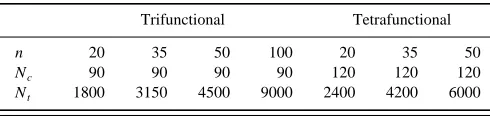
In this article, four trifunctional networks of chain lengths 20, 35, 50, and 100 and three tetrafunctional net-works of chain lengths 20, 35, and 50 are studied. As shown in Table I, each trifunctional network contains 90 chains, and each tetrafunctional network contains 120 chains, the num-bers being chosen so that the number of junctions, Nf, in all of the networks is approximately the same (Nf52Nc/ f
;60, where f is the network functionality!. The chain seg-ment diameter, s51, the Bellemans bond variation factor, d50.05, and the box length varies with the packing fraction. The structural characteristics of the networks, displayed in Table II, are described in terms of the elastically active frac-tion, %elastic, the number of trifunctional junctions, N3, the number of tetrafunctional junctions, N4, the number of bi-functional~unsaturated!junctions, Nunsat, the number of dan-gling ends and loops, Nendand Nloop, and the number of free chains, Nfree. The elastically active fraction is an important measure of the ‘‘perfectness’’ of our networks, and is defined to be the fraction of chains that are connected at both ends to junctions with at least three independent paths to the
network.54,55 It is calculated in Table II by subtracting the number of unsaturated junctions, dangling chains, and loops from the total number of network chains, and dividing by the total number of network chains. Since the elastically active fraction is close to 1 for all the networks considered, and the number of dangling chains, loops and unsaturated junctions is low, we consider these networks to be near-perfect sys-tems.
Once the networks attained their final packing fraction of 0.45, they were relaxed for 500 million collisions. The com-pressibility factors were then evaluated from the Clausius virial theorem in the following form:
Znet[ PV Nnetk
BT
5Ncn2
ms(collri j–Dvi j 3kBTte
, ~3!
where P is the network pressure, Nnetis the number of ‘‘net-work molecules’’ (Nnet51 since the network is considered to be one large molecule!, te is the elapsed simulation time over which the sum is calculated, kB is the Boltzmann con-stant, T is the temperature, msis the mass of a segment, ri jis the vector between segment centers at a collision, andDvi jis the velocity change for the colliding pair. In this article, the simulation results are reported mostly in terms of the reduced pressure, P*[Ps3/kBT5ZnetNnet6h/(pNcn). We also calculated the mean-squared end-to-end distance of the net-work chains,
^
R2&
, which is defined by^
R2&
5^~
r12rn!2
&
, ~4! where r1and rnare the coordinates of the first and last chain segments, respectively, and the ensemble average is taken over all the chains in the network.In order to obtain the properties of networks at different packing fractions, we devised a novel algorithm to isotropi-cally expand or contract the network from its initial, equili-brated state ath50.45 to a final deformed state at any other packing fraction. This algorithm takes advantage of the vari-able bond length of the Bellemans chain and allows us to conduct network volume changes without having to break and regrow the chains, and without causing segment over-laps. The procedure for network expansion is as follows: When the system undergoes a core collision, we conduct a search among all the bonded pairs of segments in the system for the pair of segments, i and j, that have the largest
inter-TABLE I. The chain length, n, number of chains, Ncand the total number of segments, Ntfor each simulation system.
Trifunctional Tetrafunctional
n 20 35 50 100 20 35 50
Nc 90 90 90 90 120 120 120
Nt 1800 3150 4500 9000 2400 4200 6000
TABLE II. The network elastic fraction, %el, the number of trifunctional
and tetrafunctional junctions, N3and N4, the number of unsaturated
junc-tions, Nunsat, the number of dangling ends, Nend, the number of loops, Nloop, and the number of free chains, Nfreein the trifunctional and
tetrafunc-tional network systems.
Trifunctional Tetrafunctional
N 20 35 50 100 20 35 50
%el 0.99 0.96 0.90 0.84 0.96 0.94 0.93
N3 60 59 58 57 3 4 7
N4 ¯ ¯ ¯ ¯ 57 56 52
Nunsat 0 1 2 3 0 1 3
Nend 0 2 2 3 3 2 5
Nloop 1 1 3 5 6 4 1
segment distance, Rmax. Since the maximum allowable dis-tance between a pair of bonded segments is s(11d), the bond length li jbetween that pair, i and j , could be increased until li j5s(11d). Accordingly we scale the positions of all the segments in the box, as well as the box length by the factor, k5s(11d)/Rmax>1. This does not cause bond breakage or overlaps, since i and j are the bonded pair that are the furthest apart in the system. The procedure for net-work contraction is similar: When the system undergoes a bond stretch, we conduct a search among all bonded and unbonded pairs of segments in the system for the pair of segments, i and j, that have the smallest intersegment dis-tance, Rmin. Since the minimum allowable distance between a pair of segments is either s(12d) or s, depending on whether the segments are bonded or nonbonded, the distance li j between i and j could be decreased until li j5s(12d)
~bonded pair! or li j5s ~unbonded pair!. Accordingly we scale the positions of all the segments in the box, as well as the box length by the factor,k5s(12d)/Rmin, if i and j are bonded, or by k5s/Rmin if i and j are nonbonded, without causing segment overlaps. After the segment positions and box length are scaled, the system neighbor lists and time lists are regenerated. This procedure is repeated every Ncoll colli-sions~for e.g., Ncoll51000), until the required packing frac-tion ~or volume!is achieved.
The use of the algorithm described above to expand/ contract the network to the required packing fraction repre-sents a considerable computational saving over the alterna-tives of either constructing a network at each required density or using complex chain breakage and regrowth moves to maintain the network topology during volume changes. This method also offers us the advantage that the network structural characteristics are the same at each den-sity, allowing us to ignore variations in the network structure in our analysis of network static properties. The disadvantage of this algorithm is that it is inefficient when applied to large
~.10 000 segments!systems, the reason being that all of the segment positions and collision times have to be recalculated after a volume change move is carried out, causing a com-plete rescheduling of events.
We have used this algorithm to expand the network from an initial packing fraction of h50.45 to successively lower packing fractions of h50.35,0.25, . . . ,0.003. Since the net-work ath50.45 is the starting point for all expansions of the system, the network is considered to be undeformed at this packing fraction. At any lower packing fraction (h,0.45), the network is considered to be deformed. An additional cri-terion on which to base the description of the h50.45 net-work as being undeformed is that the mean-squared end-to-end distance of the network chains ath50.45 is equal to the mean-squared end-to-end distance of uncrosslinked system chains at the same packing fraction ~this will be shown in Sec. IV!. Hence the configurational entropy of the network chains at a packing fraction of 0.45 is approximately the same as that of the equivalent uncrosslinked system chains at the same packing fraction. At any lower packing fraction (h,0.45), the mean-squared end-to-end distance of the net-work chains is greater than the mean-squared end-to-end dis-tance of uncrosslinked system chains at this sameh, and the
configurational entropy of the network chains is lower than that of the uncrosslinked system chains, again at the sameh. For all of these reasons the network is considered to be un-deformed at the initial packing fraction of h050.45. The deformation ratio of a network at any packing fraction h
<h0 is defined as
l5lx5ly5lz5
F
h0h
G
1/3
5
F
0.45hG
1/3
5
F
VV0
G
1/35L
L0 , ~5!
whereh0, V0, L0, andh, V, L, are the packing fractions, simulation cell volumes, and lengths for the undeformed and deformed networks, respectively. Once the network has at-tained its final packing fraction, h, it is relaxed for 500 mil-lion collisions, and the compressibility factor and chain di-mensions are calculated.
We also conducted simulations of uncrosslinked chain systems containing 20 chains each of chain lengths 20, 35, 50, and 100, over a packing fraction range of h
50.45– 0.01. Our purpose in conducting these simulations was to obtain accurate data for the pressure–volume behav-ior and the chain dimensions of uncrosslinked systems which could be compared to our network data. The 20-mer un-crosslinked chain systems were relaxed for 100 million col-lisions each, and all the other systems were relaxed for 500 million collisions each. The compressibility factors were evaluated using the Clausius virial theorem in the following form:
Zchain[ PV
NckBT
5n2ms(collri j–Dvi j 3 NckBTte
. ~6!
The chain dimensions were evaluated using Eq.~4!.
III. THEORY
In this section, we propose a new equation of state for polymer networks which is based on modeling the network as a set of interpenetrated dendritic structures. The network free energy is taken to be the sum of a liquid-like contribu-tion and an elastic contribucontribu-tion. The liquid-like contribucontribu-tion is obtained from the generalized Flory-dimer ~GFD!theory, and the elastic contribution is obtained by extending the for-malism of the affine model to the dendrimer-network model. Although the assumption that the network free energy can be divided into liquid-like and elastic contributions has been the subject of debate ~Gee, Herbert, and Roberts,56 Eichinger and Neuburger57!, we have used it in this work because the simplicity of the assumption allows us to obtain an analytical expression for the network free energy.
To help us explain the physical basis for our model and to point out its similarities and differences with existing theories of network elasticity, we begin Sec. III with a brief description of the affine1,2and phantom3,4theories. Next, we outline the network theories of Duiser and Staverman,58and of Graessley59 who modeled the polymer network as an en-semble of micronetworks, and obtained results that deviate somewhat from the affine and phantom predictions. Last, we describe our theory in detail.
proper-ties are similar to those of classical elastic springs. Thus the forces exerted by the network are the same as would be produced if each chain were replaced by an elastic spring. This means that each pair of chain ends in the affine or phantom network is under the action of a force tending to pull the chain ends together, and that, in the absence of other forces, the network would collapse to a zero volume.44In a real rubber-like network, this tendency to collapse is bal-anced by the mutual repulsive forces between molecules. Thus, in a real rubber, two different forces can be distin-guished ~James and Guth3!, the first being the elastic force that is related to the configurational entropy of the chains and the second being the internal ‘‘hydrostatic’’ or liquid-like force that is associated with the interatomic forces between the network segments. The latter force is the same as that which exists in an ordinary liquid.
We now briefly review the steps taken in the affine theory to calculate the free energy of a deformed ideal chain network when the network undergoes an isotropic expansion/ contraction from an initial volume, V0, to a final volume, V5l3V0. The theory rests on a number of premises. Each network chain is assumed to be ideal, which means that the probability distribution associated with its end-to-end vectors is Gaussian at all deformations. The probability distribution, p(R), of the chain end-to-end vectors, R, is expressed as the product of the probability distributions of the components of the chain end-to-end vectors along each of the coordinate axes,
pchain~R!5pchain~X!pchain~Y!pchain~Z!
5C exp
S
2 3R 22
^
R02&
D
, ~7!where C is a constant and
^
R02&
is the mean squared end-to-end distance of the undeformed chain, which is taken to be equal to the mean squared end-to-end distance of a chain in the equivalent melt, i.e.,^
R02&
[ns2. The chain entropy, S(R) is given bySchain~R!5kBln pchain~R!5kBln C2
3kBR2
2
^
R02&
, ~8!and the chain Helmholtz free energy is given by
Achain~R!5Uchain~R!2TSchain~R!
52kBT ln C1kBT 3R 2
2
^
R02&
, ~9!where Uchain(R) is the chain internal energy ~equal to zero for the ideal chain!. Equation~9!can be rewritten as
Achain~R!1C
8
5kBT 3R2
2
^
R02&
, ~10!where C
8
5kBT ln C, and is a constant. By comparing Eq.~10! to the equation for the elastic energy of a classical spring of length R, Aspring5kspringR2/2, where kspring is the classical spring constant, we can recover the equivalent ‘‘spring constant’’ of the ideal chain,60 kchain53kBT/
^
R02
&
. The chain Helmholtz free energy can then be written asAchain~R!1C
8
5kchain
2 R
2. ~11!
If the network is assumed to consist of Ncsimilar, parallel, and indistinguishable chains which exert equal restoring forces, then the total ~elastic! free energy of the athermal network is simply the sum of the individual chain energies,
Aaffinenet 1C
9
53NckBT^
R2
&
2
^
R02&
, ~12!where
^
R2&
is the mean-squared end-to-end distance of the network chains and C9
is a constant.When the network is deformed, the chain vectors are assumed to transform affinely with macroscopic deforma-tion, i.e.,
^
R2&
5l2^
R 02
&
, ~13!where
^
R2&
is the mean of the squared end-to-end vectors of the deformed network chains, averaged over all the chains. The assumption underlying Eq. ~13!is that the chain vector transformation with deformation is independent of the pres-ence of its neighbors. The free energy of the deformed ather-mal network in the affine model can be obtained by substi-tuting Eq. ~13!in Eq.~12!,Aaffinenet 1C
9
53NckBTl2
2 . ~14!
In addition to the free energy resulting from the loss of chain configurational entropy, Flory61 suggested that another free energy term should be added to Eq.~14!which accounts for the change in entropy of the crosslinks due to the increased volume available to them in an expanded network. The total network free energy is then61
Aaffinenet ~l!1C
9
53NckBTl2
2 2NfkBT log~l
3!, ~15!
where Nf is the number of crosslinks of type f ( f53,4, etc.!. This equation can be rewritten in terms of the network pack-ing fraction uspack-ing the relation @cf. Eq.~5!#,l35h0/h,
Aaffinenet ~h!1C
9
53NckBT2
S
h0
h
D
2 32NfkBT log
S
h0h
D
. ~16!The pressure of the deformed network in the affine model is given by
Paffinenet ~h!52]Aaffine
net
]V uT52 NckBT
V0
S
h h0
D
1/3
1NfkBT V0
S
h h0
D
.
~17! We can express Nc/V0 and Nf/V0 in the pressure equation above in terms of the network packing fraction using the packing fraction definition, h05p(Ncn)s3/6V0, and the relation, Nf52 Nc/ f , between the number of crosslinks, Nf, and the number of chains, Nc, in a perfect network. Then,
Paffine
net ~h!s3
kBT 5
6h0
pn
F
2S
h h0D
1/3
12f
S
hh0
DG
. ~18!
The restoring force per unit initial area ~stress!is given by
t5 1
L02
]Aaffinenet
]L
U
T53NckBTl V0
23NfkBT
lV0
~19! ts3
kBT5 6h0
pn
F
3S
h0h
D
1/3
26f
S
hh0
D
1/3
G
.A bridge between the affine and phantom chain models, and the dendrimer-network model proposed in this article, is provided by the work of Duiser and Staverman58 and Graessley59 who both modeled crosslinked polymers as mi-cronetworks of ideal chains. These mimi-cronetworks are en-sembles of small networks having mobile inner junctions
~central junctions!and fixed outer junctions. A statistical me-chanical approach based on the affine and the phantom mod-els is employed in conjunction with the affine assumption
@Eq.~13!#to obtain the restoring force per unit initial area to be
t kBT5
~f22! f
3Ncl V0 5
~f22! f
18h0 pns3
S
h0
h
D
1/3
, ~20!
which has the same form as the first term of Eq.~20!with the exception of the prefactor, ( f22)/ f .
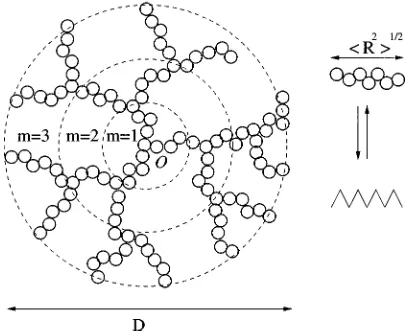
We now describe our approach to calculating network properties. Following James and Guth, we assume that the network free energy, and hence the pressure, is the sum of an elastic contribution and a liquid-like contribution. The elastic contribution is calculated by modeling the network as a set of interpenetrating dendritic structures, each of whose branches is either an ideal, gaussian chain, or a non-Gaussian chain~i.e., a chain having a non-Gaussian end-to-end vector probability distribution!. Figure 1 is an example of a single such dendritic structure. It consists of concentric layers of branches, where each branch represents a network chain of end-to-end distance
^
R2&
1/2~as shown by the right hand sideof Fig. 1!. The total number of concentric layers is called the rank of the dendrimer. The first~innermost!layer of the den-drimer contains f branches or chains, the second layer con-tains f ( f21) branches or chains, the third layer consists of f ( f21)2 branches or chains, and so on. The total number of chains in a dendrimer of rank m is given by
nden5f1f~f21!1f~f21!21¯1f~f21!~m21!
5f
F
~f21! m21~f22!
G
, ~21!where f is the functionality of the dendrimer ( f53,4 . . . ). The spatial dimension or diameter of the dendrimer of rank m is denoted by D, and is given by the relation, D2
52m
^
R2&
, i.e., D2is the square of the distance covered by a random walk beginning at any point on the circumference of the dendrimer, passing through each layer and through the origin of the dendrimer, and ending at another point on its circumference.The elastic free energy contribution for our dendrimer model is first calculated for the case in which the network chains are modeled as ideal Gaussian chains ~the Gaussian dendrimer network!. The same approach is subsequently ex-tended to the case in which the network chains are modeled as non-Gaussian chains ~the non-Gaussian dendrimer net-work!.
We now derive the free energy for a Gaussian dendrimer network. The free energy of a network of interpenetrated dendrimers can be obtained by replacing each dendrimer
~composed of nden ideal gaussian chains of ‘‘spring con-stant,’’ kchain53kBT/
^
R02&
) by a single equivalent chain, of spring constant, kdendrimer. Using a simple spring-resistor analogy, kdendrimercan be obtained by treating the dendrimer as a set of springs arranged in series and in parallel confor-mations, as described in Appendix A. For a dendrimer of rank m, containing nden chains, the spring constant is given bykdendrimer5kchainf~f22!
F
~f21!~m21!
~f21!m21
G
53kBT
^
R02&
f~f22!F
~f21!~m21!
~f21!m21
G
. ~22!The Helmholtz free energy of the dendrimer,
Adendrimer(h), can then be obtained in a form similar to Eq.
~10! by replacing the term kchainin Eq. ~11!with kdendrimer, and by replacing the squared end-to-end distance, R2, of the chain, with the squared spatial dimension, D252m
^
R2&
, of the equivalent dendrimer spring. The term,^
R2&
, represents the mean-squared end-to-end distance of a constituent chain within the dendrimer, averaged over all the nden dendrimer chains. When the network deforms we assume that the den-drimer also deforms affinely, that is, D25l2D02, where D0252m
^
R02&
denotes the mean-squared spatial dimension ofthe undeformed dendrimer. The Helmholtz free energy of the deformed dendrimer of rank, m, can be written as
Adendrimer~h!1C
8
5kdendrimer
2 D
2
5kdendrimer
2 D0
2l2
53kBT 2
^
R02
&
f~f22!F
~f21!~m21!
~f21!m21
G
2m^
R0 2&
l253kBTm f~f22!
F
~f21! ~m21!~f21!m21
G
S
h0h
D
2/3
. ~23!
Thus far we have focused on the free energy of a single dendritic structure in the network. Since the network consists of identical dendritic structures, the free energy of the net-work is simply taken to be the sum of the free energies of these individual dendritic structures. The free energy of a network composed of NDdendrimers is then given by
Adendrimernet ~h!1C
9
5ND@Adendrimer~h!1C8
#5ND3kBTm f~f22!
F
~f21!~m21!
~f21!m21
G
3
S
h0h
D
2/3
, ~24!
where NDis obtained from the undeformed network packing fraction, h0, using the relation,
h0[pNDndenns3/6V0. ~25!
The quantity, ndenis given by Eq.~21!. The reduced pressure of a network composed of dendrimers of rank m is then given by
Pdendrimernet ~h!s3
kBT 52
]Adendrimernet ~h!
]V
s3 kBT
5212h0
pn m~f22! 2
3
F
~f21! ~m21!~~f21!m21!2
G
S
h h0D
1/3
. ~26!
Next, we derive the free energy for a non-Gaussian den-drimer network. Although the probability distribution for the end-to-end distances of the network chains is adequately de-scribed by the Gaussian distribution @Eq. ~7!#for small de-formations, at large deformations approaching the maximum extensibility of the chains, this distribution is expected to show significant deviations from the Gaussian form. Kuhn and Grun43 suggested the following non-Gaussian form for the probability distribution of the chains, based on the con-cept that a chain has finite maximum extensibility:
pchain~R!5C1exp
H
2nF
3 2
S
R ns
D
2
1209
S
nRsD
4
1 99
350
S
R nsD
6
1¯
GJ
, ~27!where C1 is a constant, and n is the chain length. As in the case of the Gaussian distribution, this non-Gaussian distribu-tion is also based on the assumpdistribu-tion that the chains have no excluded volume~i.e., that the chains can pass through each other!. The non-Gaussian distribution reduces to the Gauss-ian form@Eq.~7!#when the higher order terms, (R/ns)4and (R/ns)6, in the above equation are small enough to be ne-glected, and when ns2 is taken to be equal to
^
R02&
~the relation between the end-to-end distance of an ideal, Gauss-ian chain and its chain length!. Deviations in p(R) from the Gaussian are about 8% when the end-to-end distance of the chain is 0.5 times its fully extended length, and about 20% when the end-to-end distance of the chain is 0.7 times its fully extended length.We now outline the steps by which the network free energy can be obtained for the dendrimer-network model with a non-Gaussian chain vector distribution. The general method is based on the approach described by Treloar44 in which many of the assumptions of the affine model ~with Gaussian chains!are applied to the non-Gaussian chain case. Our method for the non-Gaussian dendrimer network is simi-lar to our approach in the Gaussian dendrimer-network case, and involves making similar assumptions, including the ne-glect of the chain excluded volume, and the use of the affine assumption. We begin by obtaining the free energy of a single non-Gaussian chain in analogy with the method de-scribed earlier for the single Gaussian chain @cf. Eqs. ~7!–
~11!#
Achain~R!52TSchain~R!
52kBT log pchain~R!
52kBT logC11kBT n
F
3 2S
R ns
D
2
1209
S
nRsD
4
1 99
350
S
R nsD
6
1¯
G
. ~28!By comparing this to the equation for the elastic free energy of a classical spring, the spring constant for the non-Gaussian chain can be written as
kchain5kBT n
F
3
~ns!21 9 10
R2
~ns!4 1 99 175
R4
~ns!61¯
G
. ~29! Thus the spring constant of a non-Gaussian chain depends on the chain end-to-end distance, unlike that of a Gaussian chain.en-ergy of the non-Gaussian dendrimer network in the same way as for the Gaussian dendrimer network. The Helmholtz free energy of the non-Gaussian dendrimer network is ob-tained by evaluating the free energy of a single non-Gaussian dendrimer, Adendrimer(h), in analogy with the treatment of the Gaussian dendrimer network in Eq. ~23!. To do this, the effective spring constant for each dendritic structure is again taken to be kdendrimer5kchainf ( f22)@( f21)(m21)/( f21)m
21#, as in Eq.~22!. Again, as in the Gaussian dendrimer-network case, we average the chain dimensions over all the network chains, i.e., we replace the chain end-to-end distance R2 with
^
R2&
, and R4 with^
R4&
. Using the affine assump-tion,^
R2&5
l2^
R02&
, and assuming further that^
R4&
5l4
^
R 0 4&
, the Helmholtz free energy of a deformed non-Gaussian dendrimer can be written in a form analogous to Eq. ~23!as
Adendrimer~h!1C1
8
5kdendrimer
2 D
2
53kBT
2 f~f22!
F
~f21!~m21!
~f21!m21
G
3
F
1ns21 3 10
^
R02&
l2 n~ns2!21 33
175
^
R04&
l4n2~ns2!31¯
G
2m^
R02
&
l2. ~30!We use the relation,
^
R02&[
ns2 ~since the undeformed net-work chains are Gaussian!, the approximation,^
R04&
'^
R02&
2[(ns2)2, to recast the equation in the following form:
Adendrimer~h!1C1
8
53kBTm f~f22!F
~f21!~m21!
~f21!m21
G
3
F
l21 3 10l4 n 1
33 175
l6
n2¯
G
. ~31!The free energy of the non-Gaussian dendrimer network is obtained by summing the free energies of NDdendrimers@as done in Eq.~24!#, and is given by
Adendrimernet ~h!1C1
9
5ND~Adendrimer~h!1C18
!, ~32!where NDis related toh0as shown in Eq.~25!. The reduced pressure of the network composed of non-Gaussian dendrim-ers of rank m is then
Pdendrimernet ~h!s3
kBT 52
]Adendrimernet
]V s3 kBT
526h0
pn m~f22!
2
F
~f21!~m21!
~~f21!m21!2
G
3
F
2S
h h0D
1/3
1 6
5n
S
h h0D
21/3
1 198
175n2
S
h h0D
21
1¯
G
. ~33!This equation reduces to the Gaussian dendrimer-network pressure equation@Eq.~26!#when the second and third terms in the square bracket on the right side are negligible, i.e., at small deformations of the network.
Finally we calculate the liquid-like contribution to the free energy of a network. Since our networks are athermal, this term arises from the intersegment repulsions between the network monomers. It can be obtained by using an approach based on the GFD theory of Dickman, Honnell, and Hall,40–42which has been successfully used to evaluate the thermodynamic properties of a variety of hard-chain sys-tems. We begin by briefly reviewing some pertinent results of the GFD theory for uncrosslinked, linear hard-sphere chains.
The GFD prediction for the compressibility factor of a fluid of hard-chain n-mers is given by
ZGFD~h!5
F
ve~n!2ve~1!
ve~2!2ve~1!
G
Z2~h!2
F
ve~n!2ve~2!ve~2!2ve~1!
G
Z1~h!, ~34!
where Z1(h) and Z2(h) are the compressibility factors of fluids composed of hard sphere monomers and dimers, re-spectively, at the same packing fraction as the n-mer fluid,
ve(1),ve(2) are the monomer and dimer excluded volumes, and ve(n) is the volume excluded by an n-mer to a mono-mer. The excluded volumes of a monomer, dimer, and trimer can be evaluated exactly, and are given by ve(1)
5(4p/3)s3, ve(2)5(9p/4)s3, and ve(3)59.826 05s3. The excluded volume of an n-mer linear chain is difficult to evaluate exactly; the following approximate form was used by Dickman and Hall40
ve~n!5ve~3!1~n23! @ve~3!2ve~2!#. ~35! The compressibility factor for the monomer fluid, Z1(h), is obtained from the Carnahan-Starling equation of state62
Z1~h!5
11h1h22h3
~12h!3 , ~36!
and the compressibility factor for the dimer fluid, Z2(h), is obtained from the Tildesley–Streett equation of state63
Z2~h!5
112.456 96h14.103 86h223.755 03h3
~12h!3 . ~37!
Thus, from the GFD equations of state, we can obtain the pressure of a chain fluid at any packing fraction based on knowledge of the hard-monomer and dimer compressibility factors and the excluded volume of the chain molecule.
es-sentially a set of connected f-functional star molecules, as illustrated in Fig. 2. To calculate the excluded volume of the dendrimer we need to evaluate the total excluded volume of this set of connected star molecules. In this context it is useful to consider the expression developed by Yethiraj and Hall64for the excluded volume of a star in a fluid of uncon-nected star molecules
ve~nstar, f!5vcenter~f!1f
S
nstar21
f 22
D
@ve~3!2ve~2!#,~38! where nstar is the number of segments in the star, and
vcenter( f ) is the excluded volume of the star center. In Eq.
~39!, the star center consists of 2 f11 segments — two seg-ments from each arm of the star and one central bead. The excluded volume of the star center is not obtained analyti-cally, but is calculated from a Monte Carlo simulation in which a monomer is inserted successively at many randomly chosen points in a box containing random configurations of the star center ~Alejandre and Chapela,65 Yethiraj and Hall64!.
We can employ an equation similar to Eq.~38!to calcu-late the excluded volume of a dendrimer of rank m. To do so we subdivide the dendrimer into a set of star centers con-nected by arms which are simply linear chains. Figure 2 shows a portion of a dendrimer consisting of three connected star molecules~the left side of Fig. 2!and a single star mol-ecule enlarged to show the constituent beads ~the right side of Fig. 2!. For each star molecule on the left side, the dark lines denote the star centers and the lighter lines denote the chains connecting them, while for the enlarged star molecule on the right side, the dark beads denote the star centers and the light beads denote the chain segments connecting them. Each star center is composed of 2 f segments, i.e., two seg-ments from each arm of the star ~there is no central bead since the chains are endlinked!. Each connecting chain is composed of (n24) segments, where n is the length of the network chains. The chains in the last layer of the network, being connected to star centers only at one end, are com-posed of (n22) segments each. A dendrimer of rank m will contain 11f@( f21)m2121#/( f22) star centers and nden
chains@cf. Eq.~21!#of which f ( f21)(m21)chains are in the last layer of the network. The total dendrimer excluded vol-ume will be
vdendrimer~n,m, f!5
F
11f~f21!~m21!21
~f22!
G
vcenter~f!1~n24!
F
f~f21! m21~f22!
G
3 @ve~3!2ve~2!#12 f~f21!~m21!
3@ve~3!2ve~2!#. ~39! The excluded volumes, vcenter( f ), of the trifunctional and tetrafunctional star centers are calculated using the Monte Carlo algorithm mentioned above.64,65 For a trifunctional network ( f53), the star center contains six segments and
vcenter(3)518.0160.05; for a tetrafunctional network ( f
54), the star center contains eight segments and vcenter(4)
523.0660.03.
The compressibility factor of the fluid of dendrimers, each of excluded volume, vdendrimer(n,m, f ), and rank, m, can then be calculated from
ZGFD
net ~h
, f!5
F
vdendrimer~n,m, f!2ve~1!ve~2!2ve~1!
G
Z2~h!2
F
vdendrimer~n,m, f!2ve~2!ve~2!2ve~1!
G
Z1~h!. ~40!
The liquid-like contribution to the network pressure is ob-tained from the relation, PGFDnet (h, f )/kBT[ZGFD
net ND/V
5ZGFDnet (h, f )6h/ps3(ndenn) where (ndenn) is the number of segments in a dendrimer, and ndenis obtained from Eq.~21!. The reduced liquid-like contribution to the network pressure is given by
PGFDnet s3 kBT 5ZGFD
net
~h, f!6h pn
H
~f22!
f~~f21!m21!
J
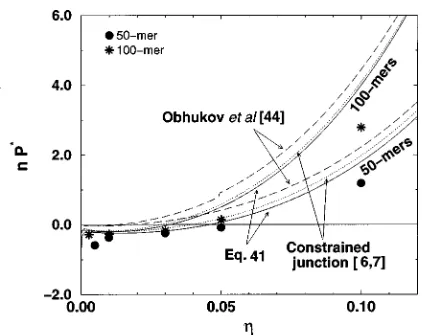
. ~41!The total reduced pressure of the network is the sum of the liquid-like contribution @Eq.~41!#and the elastic contri-bution. The elastic contribution to the pressure has been cal-culated for the cases, ~1! a dendrimer network of Gaussian chains @Eq. ~26!#, and ~2! a dendrimer network of non-Gaussian chains ~chains that are Gaussian at low deforma-tions and non-Gaussian at large deformadeforma-tions! @Eq. ~33!#. The total reduced network pressure, Pnets3/kBT
5PGFDnet s3/kBT1Pdendrimer
net
s3/k
BT is given for the Gaussian dendrimer network by
Pnets3 kBT
5ZGFDnet ~h, f!6h pn
H
~f22! f@~f21!m21#
J
212h0
pn m~f22!
2
H
~f21!~m21!
@~f21!m21#2
J
S
h h0D
1/3 ,
~42!
and for the non-Gaussian dendrimer network by
Pnets3 kBT
5ZGFDnet ~h, f!6h pn
H
~f22! f@~f21!m21#
J
26h0
pn m~f22!
2
H
~f21!~m21!
@~f21!m21#2
J
F
2S
h h0D
1/3
15n6
S
hh0
D
21/3
1175n198
S
hh0
D
21
1¯
G
. ~43!IV. RESULTS AND DISCUSSION
In this section, we present our simulation results for the pressure–volume properties of trifunctional and tetrafunc-tional networks. The simulation results for the network pres-sure are compared with the predictions of the constrained junction model,5,6 the Obhukov, Rubinstein, and Colby model,53 the affine model, and our Gaussian and non-Gaussian dendrimer-network models. Finally we compare our results for the pressure and chain dimensions for the trifunctional networks with those for tetrafunctional net-works, and with those for uncrosslinked chain systems.
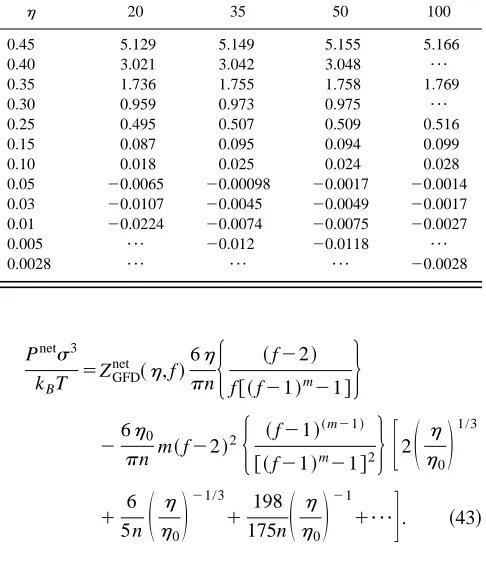
Table III shows the simulation results for the reduced pressure, P*5Ps3/kBT, for trifunctional networks of chain length 20, 35, 50, and 100, over a packing fraction range of 0.45–;0.003. Each value of the pressure shown in Table III is calculated from simulation runs of between 500 million and a billion collisions ~depending on the system size!. It was not possible to repeat these runs for each of the data points because of the large system sizes in this study ~ be-tween 1800 and 9000 segments!, and because long simula-tion runs are required for network systems. For selected sys-tems three or more runs were performed in order to estimate the standard deviation for the data. From our sampling of the data, the error associated with the pressure was found to be less than 0.1%.
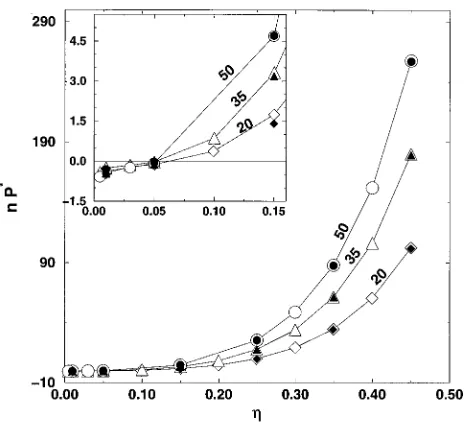
Figure 3 shows our simulation results for the reduced pressure of the trifunctional networks as a function of pack-ing fraction. Since the magnitudes of the pressure for the different chain length networks are similar ~see Table III!, the network pressure is multiplied by the chain length for clarity. We observe that the pressure shows the expected continuous increase with increasing packing fraction, which
would also be the case for uncrosslinked chain systems. Table III shows us that the network pressure becomes nega-tive at very low packing fractions. Although the scale of the graph in Fig. 3 does not permit us to observe the low packing fraction region, this will be more apparent in the later fig-ures.
The similarities and differences between the pressure– volume behavior of networks and uncrosslinked chain sys-tems are clearly illustrated in Fig. 4, which shows simulation results for the compressibility factor of an uncrosslinked 20-mer chain system, Zchain @cf. Eq.~6!#, and the scaled com-pressibility factor of a 20-mer trifunctional network, ZnetND/Nc, as a function of packing fraction,h. The curve represents the prediction of the GFD theory40–42for the com-pressibility factor of the uncrosslinked chain system. The scaled form of the network compressibility factor, ZnetND/Nc[PnetV/NckBT5P*pn/6h, is used in order to facilitate comparison with the uncrosslinked chain system compressibility factor, Zchain[PV/NckBT5P*pn/6h. We see that the variation in the scaled network compressibility
TABLE III. Simulation results for the reduced pressure, P*5Ps3/kBT, as
a function of packing fraction,h, for trifunctional networks at chain lengths, n520, 35, 50, and 100.
h 20 35 50 100
0.45 5.129 5.149 5.155 5.166
0.40 3.021 3.042 3.048 ¯
0.35 1.736 1.755 1.758 1.769
0.30 0.959 0.973 0.975 ¯
0.25 0.495 0.507 0.509 0.516
0.15 0.087 0.095 0.094 0.099
0.10 0.018 0.025 0.024 0.028
0.05 20.0065 20.00098 20.0017 20.0014
0.03 20.0107 20.0045 20.0049 20.0017
0.01 20.0224 20.0074 20.0075 20.0027
0.005 ¯ 20.012 20.0118 ¯
0.0028 ¯ ¯ ¯ 20.0028
FIG. 3. Reduced pressure, P*, multiplied by the network chain length, n, vs the packing fraction,h, for trifunctional networks of chain lengths, 20, 35, 50, and 100. Lines are added solely to guide the reader’s eye.
FIG. 4. Compressibility factor, Z[P*n/h, vs packing fraction,h, for a trifunctional network ~filled circles! and an uncrosslinked chain system
factor with packing fraction is similar to that of the un-crosslinked chain system compressibility factor at high to moderate packing fractions. The compressibility factor of the network is always lower than that of the uncrosslinked chain system due to the elastic retractive force exerted by the net-work chains as they oppose netnet-work deformation. At very low densities (h,0.1), the uncrosslinked chain compress-ibility factor tends to a value of 1, while the network com-pressibility factor becomes negative. This negative region in the network compressibility factor was first observed by Es-cobedo and de Pablo.33The reason for its existence is that at these low densities, the liquid-like contribution to the total pressure of the network is negligible, but the~negative! elas-tic contribution is relatively large.
We now compare our simulation results with the theo-retical predictions for network pressure described in Sec. III. The elastic component of the pressure is obtained from the following models: ~1! the affine model @Eq. ~18!#, ~2! the Gaussian dendrimer-network model @Eq. ~26!#, and ~3! the non-Gaussian dendrimer-network model @Eq. ~33!#. The liquid-like component of the pressure is obtained from the GFD theory for chains @Eq. ~34!#for the affine model, and from the GFD theory for networks@Eq.~41!#for the Gauss-ian and non-GaussGauss-ian dendrimer-network models. For all three models, the packing fraction of the undeformed net-work, h0, is taken to be equal to 0.45. For the dendrimer-network models ~Gaussian and non-Gaussian! the value of the network rank, m, is chosen so as to give the best agree-ment with simulation results. The value of m is taken to be 2 for all the networks considered in this article.
Figure 5 shows the simulation results~symbols! for the reduced network pressure scaled by the chain length, n P*, versus the packing fraction for the four trifunctional net-works, (n520, 35, 50, and 100! in the packing fraction re-gion, h50.1– 0.45. The lines in Fig. 5 show the predictions of the affine model ~dashed line!, and the Gaussian den-drimer and the non-Gaussian denden-drimer models~solid lines!.
The predictions of the three models lie on top of each other except in the high packing fraction region for the 20-mer, 35-mer, and 50-mer networks where there is a slight discrep-ancy between the affine and dendrimer model predictions. The three theories are in good agreement with our simulation results for all chain lengths at high to intermediate densities. Figure 6 shows the simulation results for the scaled net-work pressure, n P*, versus packing fraction, for the four trifunctional networks in the low packing fraction region (h,0.1) along with the prediction of the affine model
~dashed line!, the Gaussian dendrimer model~solid line!, and the non-Gaussian dendrimer model~bold solid line!. At these low packing fractions, the network pressure becomes nega-tive, and the network models have different degrees of suc-cess. We first consider the 20-mer trifunctional network shown in Fig. 6~a!. As the packing fraction decreases, a downturn in the network pressure is evidenced, which is not predicted by either the affine or the Gaussian dendrimer-network models. In fact these two models predict a slight increase in the pressure at very low densities. However the non-Gaussian dendrimer-network model is strikingly suc-cessful in predicting the downturn in pressure, as well as in providing generally good agreement with our simulation re-sults in the low packing fraction region. Since the theoretical basis for the non-Gaussian dendrimer-network model is the deviation in the network chain probability distribution from the Gaussian form at large network deformations, the success of this theory in predicting the network pressure at very low packing fraction ~i.e., large deformations! and the failure of the affine and Gaussian dendrimer-network theories strengthen the supposition that non-Gaussian chain extension
FIG. 5. Comparison of simulation results and theoretical predictions for the reduced pressure, P*, multiplied by the network chain length, n, vs the packing fraction,h, for trifunctional networks of chain lengths, 20, 35, 50, and 100. Models represented are the affine model~dashed line!, Gaussian dendrimer-network model, and non-Gaussian dendrimer-network model
~solid lines!. The predictions of all three models lie on top of each other over the entire packing fraction range shown.
effects are significant in highly deformed networks.
The non-Gaussian statistical theory of Kuhn and Grun43
@Eq. ~33!# which forms the basis for our non-Gaussian dendrimer-network model, predicts that for a freely jointed chain, departures from the Gaussian statistical theory first become important when the chain extensibility, defined to be the ratio of the chain end-to-end distance, R, and the fully extended chain length, ns, is between one third and one half. In light of this prediction, it is of interest to calculate the chain extensibilities at the packing fractions at which the pressure downturn shown in Fig. 6 occurs. We observe that the downturn in the pressure occurs at a packing fraction of approximately 0.01 for the 20-mer network @Fig. 6~a!#, and at packing fractions of approximately 0.005 for the 35-mer and 50-mer networks@Figs. 6~b!and 6~c!#. The downturn in pressure does not occur at all in the 100-mer network @Fig. 6~d!# over the packing fraction range studied ~down to h
50.002 8). To obtain the chain extensibilities at these pack-ing fractions, we calculate the mean-squared end-to-end dis-tances of the network chains,
^
R2&
/s2 from our simulations, and then set the chain extensibility to be R/n5^R2&
1/2/n. The simulation results for the network chain mean-squared end-to-end distance^
R2&
/s2 are shown in Table IV. From the results in Table IV we see that for the 20-mer network, the packing fraction of 0.01, which is where the pressure downturn occurs, corresponds to a chain extensibility of;67%, i.e., the average end-to-end distance of the 20-mer chains is approximately 67% of its fully extended length. For the 35-mer and 50-mer networks, the packing fraction of 0.005, which is where the pressure downturn occurs, corre-sponds to chain extensibilities of;70% and;65%, respec-tively. For the 100-mer network, there is no downturn in pressure and the chain extensibility is only 54% at the lowest packing fraction of 0.002 8. The chain extensibilities at which the downturns in pressure are observed are larger than those suggested by Kuhn and Grun43~between one third and two thirds!, but are in excellent agreement with the experi-mental results of Andrady, Llorente, and Mark,66 who ob-served non-Gaussian effects to begin at approximately 60%– 70% of the maximum chain extensibility.
From Fig. 6, we also see that the downturn in pressure occurs at lower packing fractions as the chain length
in-creases. This is related to the inverse dependence of the chain extensibilities on chain length, i.e., at a constant pack-ing fraction, the chain extensibility decreases with increaspack-ing chain molecular weight. This inverse dependence arises from the fact that for all ideal or real chains, the chain end-to-end distance, R, is related to the chain length as, R}na, where a,1. The chain extensibility, R/ns, then takes the form, R/ns}1/n(12a); thus the extensibility decreases with in-creasing chain length, and a 20-mer chain at a given packing fraction is extended to a higher fraction of its fully extended length than a 100-mer chain at the same packing fraction. Hence the 20-mer chain shows departures from Gaussian sta-tistics at higher packing fractions ~smaller deformations! than the 100-mer chain, and as a result, the Gaussian net-work theories will be successful over an increasing range of packing fractions as the network chain length rises. Thus for the 100-mer network, both the affine and Gaussian-dendrimer models predict the network pressure fairly well even at low densities, while for the shorter chain length net-works, the Gaussian theories work well only at high and intermediate densities, and fail at low densities.
The success of the non-Gaussian theory in predicting network behavior over such a wide range of packing frac-tions is intriguing because of two assumpfrac-tions that were made in arriving at Eq.~33!: the neglect of excluded volume interactions in the elastic term, and the assumption that the mean end-to-end distances of the chains deform affinely with macroscopic strain. These two assumptions are related in the sense that the neglect of excluded volume allows the affine assumption to be made, since chains that do not exclude volume could deform freely by passing through each other
~being ‘‘phantoms’’!, and their motion would not be con-strained by neighboring chains or crosslinks. Here we ex-plore the implications of the neglect of excluded volume by comparing our simulation results to theories developed by other researchers5,6,53 in an attempt to account for excluded volume effects.
Although the complex nature of real chains makes it difficult to incorporate excluded volume interactions into the elastic free energy expression in a simple manner, several theoretical approaches have been proposed that account for specific consequences of the monomer–monomer repulsion. We focus on two such models: ~1!the constrained junction model of Flory and Erman,5,6in which the damping effects on junction motion due to the presence of the neighboring network chains are concentrated in a domain of constraint, and ~2! the work of Obhukov, Rubinstein, and Colby53 in which stress–strain relations are proposed for deswollen net-works based on the Pincus blob model67for real chains. Both models assume that the crosslink mean positions~and hence the chain vectors!deform affinely with strain. The theoretical details of these models are given elsewhere;5,6,8,53 here we only show the final expressions for the network elastic free energy.
The constrained junction model ~Flory and Erman,5 Ronca and Allegra68!was proposed to incorporate the damp-ing effect of chain entanglements on the spatial fluctuations of the junctions. In this model, the free motion of the junc-tions in a phantom domain ~i.e., in a purely phantom
net-TABLE IV. Simulation results for the chain mean-squared end-to-end dis-tance,^R2&/s2, at each packing fraction,h, and corresponding deformation
ratio,l, for trifunctional networks at chain lengths n520, 35, 50, and 100.
h l 20 35 50 100
0.45 1.0 28.54 54.50 79.40 166.58
0.4 1.04 31.92 58.14 87.29 ¯
0.35 1.09 34.25 65.23 96.22 190.66
0.3 1.14 37.35 69.10 103.92 ¯
0.25 1.22 41.16 75.55 114.24 231.85
0.15 1.44 52.42 100.67 156.97 314.42
0.05 2.08 82.73 168.81 280.84 597.40
0.03 2.47 212.94 361.97 770.87 ¯
0.02 2.82 123.44 ¯ ¯ ¯
0.01 3.56 181.94 382.46 667.25 1389.77
0.005 4.48 ¯ 592.41 1033.05 ¯