Optimization of Electrocoagulation (EC)
Process for the Purification of Water from
2,4-Dichlorophenoxyacetic Acid (2,4-D) Using
Sacrificial Anodes
Nasser M. A. Ghalwa1, Ahmed Z. Musabeh2, Nader B. Farahat3
Professor, Department of Chemistry, Faculty of Science, Al-azhar, Gaza strip, palestine1
Research Assistant, Department of Chemistry, Faculty of Science, Al-azhar, Gaza strip, palestine2
Research Assistant, Department of Chemistry, Faculty of Science, Al-azhar, Gaza strip, palestine3
ABSTRACT: The present study provides an electrocoagulation process for the adsorption of 2,4 dichlorophenoxyacetic acid (2,4-D) from aqueous solution using sacrificial anodes. The effects of operational parameters such as initial pH, initial concentration, current density, type of electrolyte, salt concentration and temperature on the herbicide and COD removal efficiency have been studied. The optimal operating condition for removal of 2,4-D herbicide were : initial pH of 10, an initial herbicide concentration of 200 mg/L, temperature of 30
o
C, current density (62.5, 12.5 and 37.5 mA/cm2) and salt concentration of 1.5g/L by using Fe, S-S and Al respectively. The results showed that the removal percentage for 2,4-D and COD were (88.7% and 71 %), (94.4% and 74.9%) and (93.4 % and 75.3%) by using Fe, S-S and Al electrodes at 60 min respectively. The adsorption equilibriums were analyzed by Langmuir and Freundlich isotherm models. It was found that the data fitted to Langmuir (R2 = 0.9970) better than Freundlich (R2 = 0.9966) model. The removal of 2,4-D exhibited a pseudo second order reaction with rate constant (0.0861, 0.4224 and 0.1903 mol-1dm3 min-1 ) for Fe, S-S and Al electrodes respectively.
KEYWORDS: Electrocoagulation; Electrodes, 2,4-D; Thermodynamics, adsorption; Kinetics.
I. INTRODUCTION
During the last several decades, the worldwide use of herbicides has resulted in residues that have been frequently detected in soil systems as well as surface and ground waters [1,2]. One of the most common herbicides is 2,4-Dichlorophenoxyacetic acid (2,4-D) has been proved to be toxic to human, animals [3-5] and being considered as moderately toxic (class II or III) by the World Health Organization (WHO). Their widespread use in industrialized and developing countries for agricultural and non-agricultural purposes generates continuously reinstate, waste product and contaminated soil at hundreds of thousands of application sites. They are found as pollutants in natural waters; with contamination levels up to 10–30 mg/L in ground and surface water resulting millions of people are affected [6]. For this reason, there is great interest in the development of environmentally clean methods to destroy such compounds in aqueous medium for avoiding their dangerous accumulation in the aquatic environment. Many conventional methods have been successfully applied for the efficient removal of 2,4-D from water sources, such as adsorption [7] , advanced oxidation [8], photo Fenton [9] , UV/H2O2 [10,11] , UV/TiO [12,13] and biological treatment [14]. In recent years,
herbicides by electrochemical coagulation such as Malathion [31], methyl parathion, atrazine and triazophos [32], Malathion, imidacloprid and chlorpyrifos [33,34], and abamectin [35].
This work aims to study the possibility of using different sacrificial anodes for adsorption of (2,4-D) herbicides from aqueous solution by electrocoagulation method.
II. EXPERIMENT
A. Chemicals
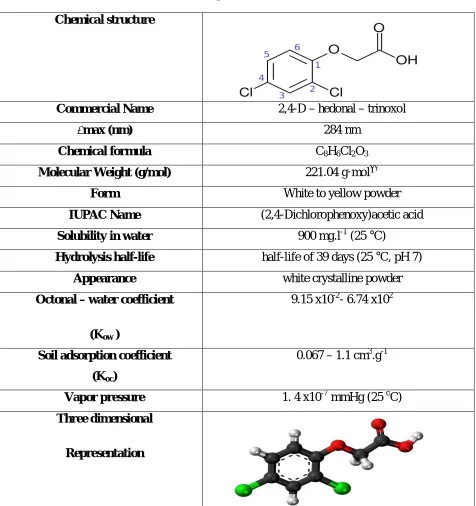
The herbicides used in the present work was (2,4-D) solutions which were prepared from the commercially available herbicide at a concentration of 335 g L−1 from (Mkhchim ) . This concentration is the same as that used by farmers during strawberry cultivation. The properties of the (2,4-D) is given in Table 1. Sodium chloride, calcium chloride, potassium chloride, potassium fluoride, sodium hydroxide, sulfuric acid, potassium dichromate, were of analytical grade and purchased from Merck. Distilled water was used for the preparation of solutions. Standard solutions of potassium dichromate (K2Cr2O7), sulfuric acid (H2SO4) reagent with silver sulfate (Ag2SO4),Mercurysulfate (HgSO4)
and were prepared to measure the COD. A stock solution of herbicide (1000 mg/L) was prepared by dissolving an accurate quantity of the herbicide in distilled water and suitably diluted to the required initial concentrations. Different standard solutions of herbicide with concentration from 50–250 mg L-1 were prepared to measure its removal at different conditions. The pH of the working solution was adjusted to the desired values with 0.1N HCl or 0.1N NaOH.
B. Equipments and procedures
The electrocoagulation unit consisted of an 100 ml electrochemical reactor with stainless steel, iron and aluminum electrodes (anode and cathode) with an effective surface area of 4 cm2 . The electrodes were 20 mm×10 mm and inter electrodes distance was 1 cm. The electrodes were positioned vertically and parallel to each other . The current density was maintained constant by means of a precision DC power supply, model (DZ040019) EZ Digital CO. Ltd. (Korea). The herbicide concentration was determined using a double - beam UV-Vis spectrophotometer, model UV 1601 is from Shimadzu (Japan) at 284 nm. Hot Plate , model (HB502), BIBBY STERILIN LTD .(U.K.) . A pH meter model AC28, TOA electronics Ltd., (Japan) . Water bath model SB-650 , Tokyo Kikakkai CO. Ltd. , (Japan). A closed reflux titrimetric unit was used for the COD determination. Chemical Oxygen Demand (COD) , HANNA instruments ,Thermo reactor , model C9800 Reactor in Hungary – Europe .
C. Analysis
Two main parameters were measured to evaluate the electrochemical treatment efficiency, the remaining pollutant concentration and the COD. Remaining pollutants (2,4-D) concentration was measured with the double-beam UV-visible spectrophotometer at λmax=284 nm using calibration curve with standard error ±0.5%. The COD was determined
using a closed reflux colorimetric method [36]. The equation used to calculate the herbicide removal efficiency in the treatment experiments was:
%E =[ (A0 - A) / A0 ]× 100 (1)
Where A0 and A are absorbance values of herbicides solutions before and after treatment with respect to their λmax[37]
.
The calculation of COD removal efficiencies after electrocoagulation treatment were performed using the following formula [38] .
CR(%) = [(C0 – C) / C0] × 100 (2)
Where C0 and C are concentrations of wastewater before and after electrocoagulation.
III. RESULT AND DISCUSSION
A.Effect of The main parameters on 2,4-D
(i) A brief description of Electrocoagulation
(a) electrolytic reactions at electrode surfaces (b) formation of coagulants in aqueous phase
(c) adsorption of soluble or colloidal pollutants on coagulants, and removal by sedimentation or floatation [39]. Electrocoagulation of herbicide solution using iron (Fe), stainless steel (S-S) and aluminum (Al) electrodes takes place according to the following mechanisms [34].
EC using iron electrodes Mechanism 1:
At a node :
4 Fe (s) → 4 Fe2+(aq) + 8 e– (3)
4 Fe2+(aq) + 10 H2O (l) + O2(g)→ 4Fe(OH)3(s) + 8 H+(aq) (4)
At cathode :
8 H+(aq) + 8 e–→ 4 H2 (g) (5)
Overall :
4 Fe (s) + 10 H2O (l) + O2(g)→ 4 Fe(OH)3(s) + 4 H2(g) (6) Mechanism 2:
At anode :
Fe (s)→ Fe2+ (aq) + 2 e- (7)
Fe2+(aq) + 2 OH- (aq)→ Fe(OH)2(s) (8)
At cathode :
2 H2O (l) + 2 e-→ H2(g) + 2 OH–(aq) (9)
Overall :
Fe (s) + 2 H2O (l)→ Fe(OH)2 (s) + H2(g) (10)
EC using aluminum electrodes
the electrochemical reaction with Al anode can be summarized as follows : At anode:
Al (s) → 2Al3+ (aq) + 6e- (11)
2Al3+ (aq)+ 6H2O(l) →2Al(OH)3(s)+ 6H+(aq) (12) At cathode:
6H+(aq)+ 6e-→ 3H2(g) (13) Overall:
2Al(s)+ 6H2O(l) → 2Al(OH)3(s)+ 3H2(g) (14) The chemistry behind the EC process in water in such that the positively charged ions are attracted to the negatively charged hydroxides ions producing ionic hydroxides with a strong tendency to attract suspended particles leading to coagulation.
(ii) Effect of current density (mA/cm2)
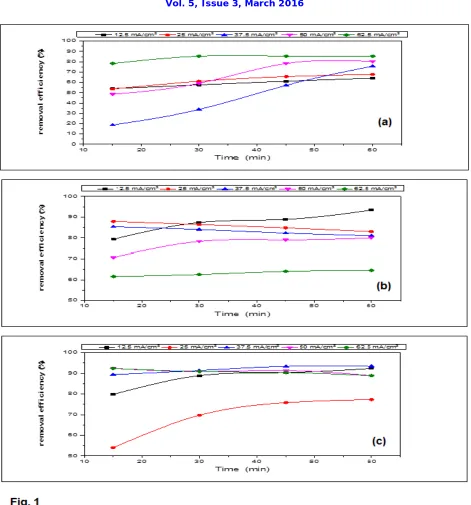
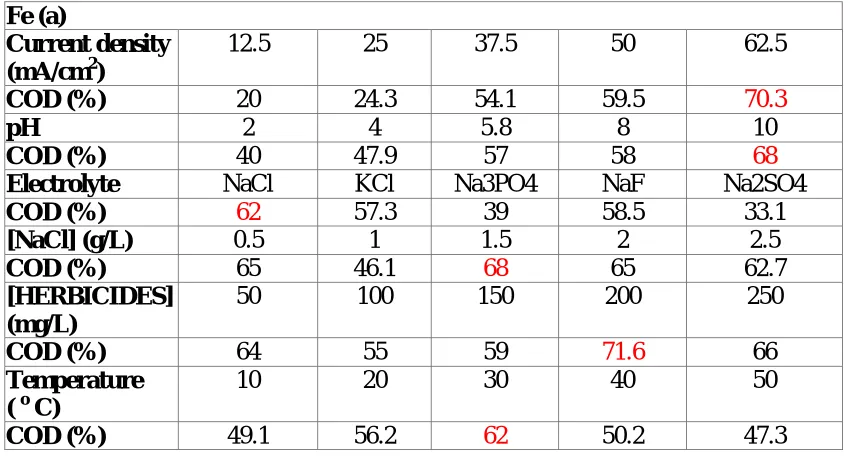
The current density determines the coagulant dosage rate. This parameter should have a significant impact on the removal efficiency of the herbicide. To examine the effect of current density on 2,4-D and COD removal efficiency, a series of experiments were carried out with the current density ranging from ( 12.5 - 62.5 mA/cm2) at a pH of 10, initial concentration of 200 mg/L, inter-electrode distance of 1 cm, NaCl concentration of 1.5 g/L and temperature of 30 oC. Figure (1) and Table (2) show the optimum current densities were 62.5 mA/cm2, 12.5 mA/cm2 and 37.5 mA/cm2 for Fe, S-S and Al electrodes respectively. The removal efficiencies of 2,4-D were 85.4%, 94.4% and 93.4% while the COD removal efficiencies were 70.3%, 73% and 72.2% using Fe, S-S and Al electrodes at 60 min respectively. The increase of coagulant and bubbles generation rate lead to the increase number of H2 bubbles and decrease their size
with increasing current density resulting in a faster removal of herbicides [48, 49, 50, 51]. Further increase in current density above optimal condition did not lead to an increase in herbicide and COD removal efficiencies. But the sufficient amount of flocs needed to coagulate the herbicide might be available at optimal current density and further formation of flocs which did not change herbicide and COD removal efficiency [52].
(iii) Effect of initial pH
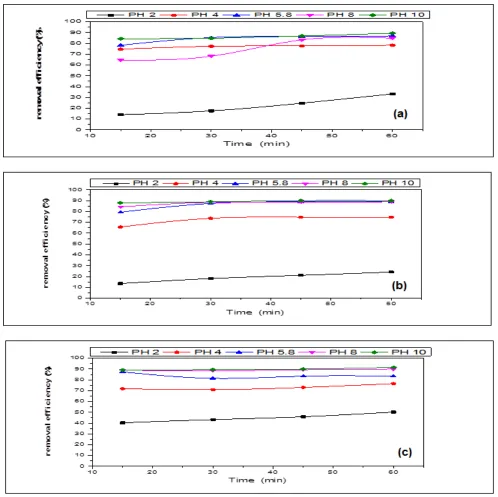
varying in the range ( 2-10 ) at initial concentration of 2,4-D 200 mg/L, inter electrode distance of 1 cm, NaCl concentration of 1.5 g/L, temperature of 30 oC and current density of 62.5 mA/cm2, 12.5 mA/cm2 and 37.5 mA/cm2 for Fe, S-S and Al electrodes respectively at time 60 min. Figure (2)and Table (2) display that the removal efficiencies of the 2,4-D and COD were low in acidic medium, meanwhile, in neutral and alkaline medium the removal efficiencies were much higher using all working electrodes due to the formation of metal hydroxide species which adsorb the herbicide molecules and causes the increase of the removal efficiency [41] .
The percentage removal increased by increasing pH. It was observed that below pH 5.8 there was decreasing trend in adsorption, this may be due to:
1. In case of iron anode the oxidation of ferrous iron Fe (II) to ferric iron Fe (III) diminishes, resulting decreased removal efficiency in acidic pH values. Neutral and slightly alkaline pH, however, tends to favor Fe(II) to Fe(III) oxidation as well as complex polymerization. Finally, hydroxylated colloidal polymers and an insoluble precipitate of hydrated ferric oxide were formed and the removal efficiency was increased. The decrease of removal efficiency when the pH is higher than 10, and more acidic was observed by many investigators [57] and was attributed to an amphoteric behavior of M(OH)3 which leads to soluble metal cations (at acidic pH) and to monomeric anions (at
alkaline pH).
2. In case of aluminum anode the removal efficiency of the herbicide and COD is high in neutral and moderate alkaline electrolyte. The decrease of removal efficiency at more acidic and alkaline pH was observed by many investigators [53, 54] and was attributed to an amphoteric behavior of Al(OH)3 which leads to soluble Al3+ cations
(at acidic pH) and to monomeric anions Al (OH)-4 (at alkaline pH). It is well known that these soluble species are
not useful for water treatment. When the initial pH was kept in neutral, all the aluminum produced at the anode formed polymeric species Al13O4(OH)7+24) and precipitated as Al(OH)3 leading to more removal efficiency [54].
(iv) Effect of initial 2,4-D concentration (mg/L)
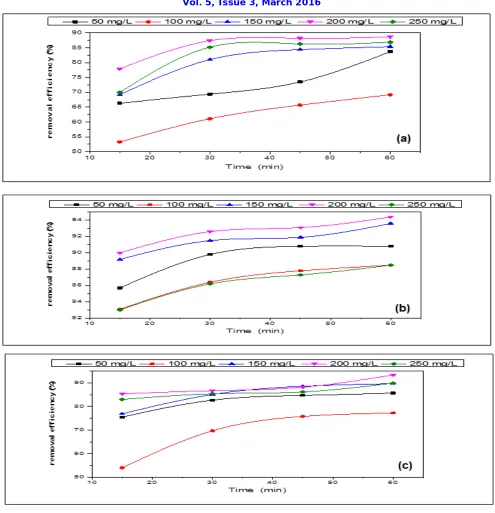
Effect of the initial concentration on removal efficiencies of 2,4-D and COD by EC was investigated in the range of 50 to 250 mg/L, at time 60 min, pH of 10, inter-electrode distance of 1 cm, NaCl concentration of 1.5 g/L, temperature of 30 oC and current densities of 62.5, 12.5 and 37.5 mA/cm2 using Fe, S-S and Al electrodes respectively. From Figure (3) and Table (2) it may be seen that increasing initial 2,4-D concentration above 200 mg/L results decreas the adsorption because the amount of produced flocs is insufficient to adsorb all herbicide molecules.
According to Faraday’s law, a constant amount of metal hydroxides is dissolved from the Fe, S-S and Al anode and passes to the solution for the same current density and electrolysis time for herbicides concentrations. Consequently, the same amount of metal hydroxides is produced in the aqueous solution. This is probably why the amount of hydroxyl and metal ions produced on the electrodes was not sufficient to adsorb at high 2,4-D concentrations at a constant current density.
(v) Effect of temperature (oC)
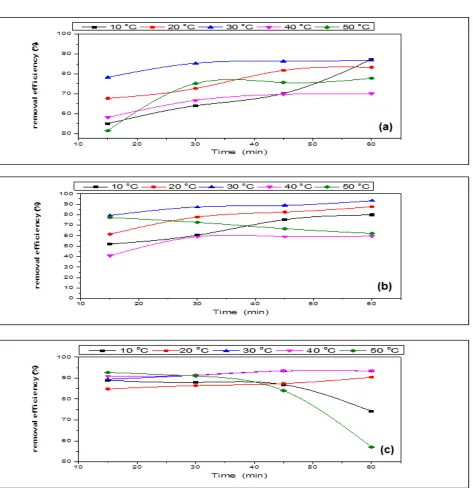
The effect of temperature on the removal of pollutants through EC has been studied in a few articles. Effect of temperature from 10 to 50 oC has been studied for the removal efficiencies of 2,4-D and COD as shown in Figure (4) and Table (2) at time 60 min, initial concentration of 200 mg/L, pH of 10 and NaCl concentration of 1.5 g/L and current densities of 62.5, 12.5 and 37.5 mA/cm2 using Fe, S-S and Al electrodes respectively. The figure indicate that the 2,4-D and COD removal efficiencies decrease with increasing temperatures above 30 oC due to the volume of colloid M (OH)3 will decrease and pore production on the metal anode well be closed [42]. where at 30°C the herbicide
removal and COD% reached to maximum.
(vi) Effect of electrolyte concentration (g/L)
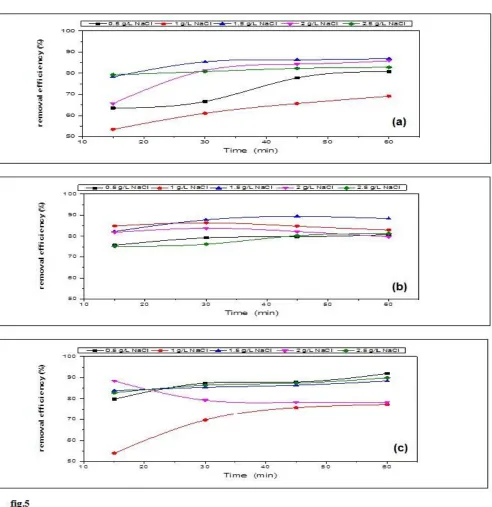
It can be attributed that the increase of the conductivity by the addition of sodium chloride is known to reduce the cell voltage at constant current density due to the decrease of the ohmic resistance of solution [55] and the produced amount of metallic hydroxide this leading to a reduction of the oxide layer and an enhancement of the anodic dissolution of the electrode material and herbicide removal increases [56]. However, with the increase in NaCl concentration ˃ 1.5 g/L for 2,4-D the removal efficiency decreased using all electrode.
(vii) Effect of type of electrolyte
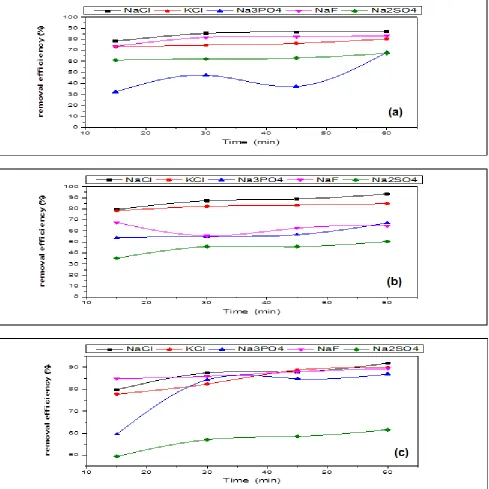
Figure (6) and Table (2) explain the effect of electrolyte types on the removal efficiencies of 2,4-D and COD at 60 min, pH of 10, at initial concentration of 2,4-D 200 mg/L, inter-electrode distance of 1 cm, temperature of 30 oC and current densities of 62.5, 12.5, 37.5 mA/cm2 using Fe, S-S and Al electrodes respectively. Electrolytes of 1.5 g/L of the following salts: NaCl, KCl, Na3PO4, NaF and Na2SO4 were studies by three electrodes. According to Figure (6) and
Table (2) the higher elimination of herbicide and COD in the presence of NaCl Due to formation of hypochlorite (OCl -) and hypochlorous acid (HOCl-). It is well known that Cl− anions can destroy the formed passivation layer on electrode and therefore enhance anodic dissolution rate of metal which lead to produce more metal hydroxide [43].
B. Analyses of adsorption data.
(i) Kinetic modeling
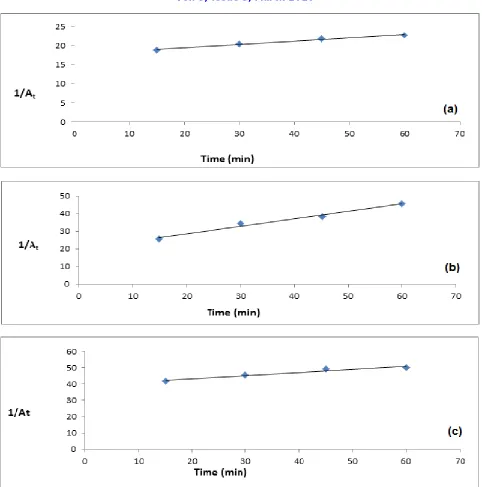
Kinetics studies have important role in determining the rate constant and the order of reaction of this treatment removal [44]. So, rate constant is very significant in the process of wastewater treatment units. It is very essential to know the type of reaction rates in the process. Rate of reaction describes the rates of change in concentration of reactant per unit time. Figs. (7) represent the removal efficiencies of 2,4-D which exhibit pseudo-second order with using Fe, S-S and Al electrodes according to following equation:
1/At – 1/Ao = Kt ( 15)
Where Ao, At, t and K are the 2,4-D absorbance at initial concentration, 2,4-D absorbance at each time, time of reaction (min), and reaction rate constant respectively. The calculated k values from the plot (straight line) of Figures 7 were 0.0861, 0.4224 and 0.1903 mol-1dm3min-1 using Fe, S-S and Al electrodes respectively.
(ii) Isotherm modeling
Since the removal of pollutant is similar to conventional adsorption, except the generation of coagulants, adsorption isotherm models can be extended to describe experimental isotherm data and identify the mechanism of the adsorption process. Isotherm models with two and three parameters have been therefore considered to establish the relationship between the amounts of 2,4-D adsorbed onto the methal hydroxides and its equilibrium concentration in the aqueous solution containing 2,4-D. The general forms of both these models were described as follows.
The Langmuir equation
This describes quantitatively the formation of a monolayer adsorbate on the outer surface of the adsorbent, and after that no further adsorption takes place. Thereby, the Langmuir represents the equilibrium distribution of metal ions between the solid and liquid phases [45]. The Langmuir isotherm is valid for monolayer adsorption onto a surface containing a finite number of identical sites. The model assumes uniform energies of adsorption onto the surface and no transmigration of adsorbate in the plane of the surface. Based upon these assumptions, Langmuir represented the following equation:
Ce/qe = 1/qmb + Ce/qm (16)
where qe (mg/g) is amount adsorbed at equilibrium, Ce (mg/L) equilibrium concentration, qm is the Langmuir constant representing maximum monolayer adsorption capacity, and b is the Langmuir constant related to energy of adsorption.
Freundlich Adsorption Isotherm:
log qe = log kf + n log Ce (17)
where kf (mg/g) and n (dimensionless) are constants that account for all factors affecting the adsorption process, such as
the adsorption capacity and intensity. The Freundlich constants Kf and n are determined from the intercept and slope,
respectively, of the linear plot of log qe versus log Ce.
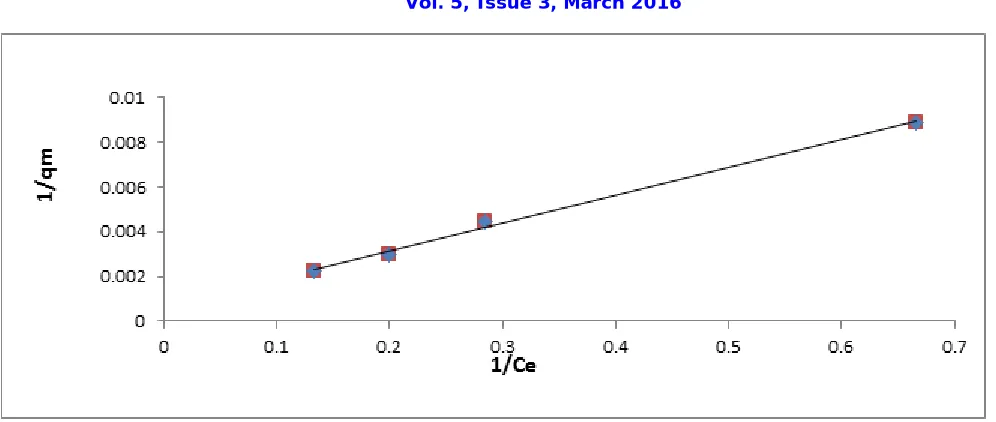
According the equation (16 and 17) the contaminants are usually adsorbed at the surface of the metal hydroxides generated during the electrocoagulation process. In order to explain the mechanism of the adsorption process, it is important to establish the most appropriate correlation for the equilibrium curves. In this study, Two adsorption isotherms (Langmuir and Freundlich) models were applied to establish the relationship between the amounts of 2,4-D adsorbed on to the metal hydroxides and its equilibrium concentration in the electrolyte containing contaminant ions [47]. Figures. (8-9) and table 3represent the Langmuir and Freundlich Isotherms studies of equilibrium.
C. Energy consumption
In an electrochemical process, the most important economical parameter is energy consumption E (kWh/m3). This parameter is calculated from the following expression:
E = I V t / volume . 1000 (18)
where V, I and t stand for average voltage of the EC system (V), electrical current intensity (A) and reaction time (h), respectively.
D. Mass of loss from anode electrode
The maximum possible mass of Fe and Al electrochemically generated from sacrificial anodes for a particular electrical current was calculated using Faraday’s law of electrolysis (Mechelhoff et al. 2013):
m = I.A.M.t / V.Z.F (19)
where m is the mass of the anode material dissolved (g), I the current density (A m−2), A the active electrode area (m2), M the molar mass of the anode material (g mol−1), t electrolysis time (s), V volume of the reactor (m3), z the number of electrons transferred, and F the Faraday’s constant (96,485 C mol−1). The maximum possible mass of Fe and Al electrochemically generated from sacrificial anodes in table (5).
E. Determine the residual concentration of iron in herbicides samples
It appears to be more of a nuisance than a potential health hazard. Iron in water 0.1 mg/L for ferrous iron and 0.2 mg/L ferric Iron. Water used in industrial processes usually contain less than 0.2 mg/L iron [58]. According to following equation Beer-lambert:
A=ε b C (20)
Where A is absorbance, ε is the molar absorptivity, b is the path length of the sample and C is the concentration of the compound in solution. The concentration measurements of iron (II) was found 0.059 ppm for 2,4-D.
IV. CONCLUSION
1. Electrocoagulation is a fast, effective, clean process and requires simple equipment to remove of herbicides from aqueous solution.
2. The treating of 2,4-D herbicides in aqueous solution using different electrodes was affected by different types of parameters such as current density, initial pH, initial type electrolyte, salt concentration, initial herbicide concentration and temperature.
3. 2,4-D herbicide and COD removal were (88.7 and 71.6), (94.4 and 74.9) and (93.4 and 73.8) using Fe, S-S and Al respectively at 60 min.
4. Electrical energy consumption (37.5, 7.15 and 20.85 KWh/m3) using Fe, S-S and Al electrodes respectively for 2,4-D, with typical operating conditions: a current density 62.5 mA/cm2, 37.5 mA/cm2 and 12.5 mA/cm2 using Fe, S-S and Al respectively, pH 10, NaCl concentration 1.5 g/L, 2,4-D concentration 200 mg/L, inter-electrode distance 1 cm and temperature 30 oC.
6. The electrocoagulation process was modeled using adsorption isotherm models, Langmuir and Freundlich. The 2,4-D adsorption was best fitted by the Langmuir adsorption isotherm, and the results were in good agreement with the experimental data.
7. The Mass of loss from anode electrode was (0.003, 0.002 and 0.0005 Kg m-3) for Fe+2, Fe+3 and Al+3. The concentration measurements of iron (II) was found 0.059 ppm.
REFERENCES
[1] Mitchell, C., Brodie, J., and White, I., "Sediments, nutrients and pesticide residues in event flow conditions in streams of the Mackay Whitsunday Region", Australia Marine Pollut. Bull, Vol.51, pp. 23–36, 2005.
[2] Macur, R.E., Wheeler, J. T., Burr, M. D., and Inskeep, W.P., "Impacts of 2,4-D application on soil microbial community structure and on populations associated with 2,4-D degradation", Microbiol. Res, Vol. 162, pp. 37- 45, 2007.
[3] Garabrant, D. H., Philbert, M. A., "Review of 2,4- dichlorophenoxyacetic acid (2,4-D) epidemiology and toxicology", Critical Reviews in Toxicology, Vol. 32, pp 233–257, 2002.
[4] James, S. B., Larry, E. H., "Regulatory progress, toxicology, and public concerns with 2,4-D: Where do we stand after two decades", Crop Protection, vol. 26, pp. 266–269, 2007.
[5] Munro, I. C., Carlo, G. L., Orr, J. C., Sund, K. G., Wilson, R. M., "A comprehensive, integrated review and evaluation of the scientific evidence relating to the safety of the herbicide 2,4-D", Journal of the American College of Toxicology, vol. 11, pp. 559–664, 1992.
[6] Aaron, J. J., Oturan, M. A., "New photochemical and electrochemical methods for the degradation of pesticides in aqueous media-environmental applications" Turk J Chem, vol. 25, pp. 509–20, 2001.
[7] Aksu, Z., Kabasakal, E., "Adsorption characteristics of 2,4- dichlorophenoxy acid (2,4-D) from aqueous solution on powdered activated carbon", Journal of Environmental Science and Health Part B, vol. 40, pp. 545–570, 2005.
[8] Rabindra, R. G., Hiroaki, O., Takehiro, I., Ryohei, T., Shogo, T., "Synergy of ozonation and photocatalysis to mineralize low concentration 2,4-dichlorophenoxy acetic acid in aqueous solution", Chemosphere, vol .66, pp. 1610–1617, 2007.
[9] Sun, Y. F., Pignatello, J., "Photochemical reactions involved in the total mineralization of 2,4-D by Fe3+/H2O2/UV", Environ. Sci. Technol, vol. 27, pp. 304–310, 1993.
[10] Alfano, O.M., Brandi, R.J., Cassano, A.E., "Degradation kinetics of 2,4-D in water employing hydrogen peroxide and UV radiation", Chem. Eng. J, vol. 82 , pp. 209–221, 2001.
[11] Chu, W., "Modeling the quantum yields of herbicide 2,4-D decay in UV/H2O2 process", Chemosphere vol.44, pp. 935–941, 2001.
[12] Trillas, M., Peral,J., Domeneah, X., "Redox photodegradation of 2,4 dichlorophenoxyacetic acid over TiO2", Appl. Catal. B: Environ, vol. 5, pp. 377–387, 1995.
[13] Trillas, M., Peral, J., Domeneah, X., "Photocatalyzed degradation of phenol, dichlorophenol, phenoxyacetic acid and 2,4-dichlorophenoxyacetic acid over supported TiO2 in a flow system", J. Chem. Technol. Biotechnol, vol. 67, pp. 237–242, 1996.
[14] Santacruz, G., Bandala, E. R., Torres, L. G., "Chlorinated pesticides (2,4-D and DDT) biodegradation at high concentrations using immobilized pseudomonas fluorescens", Journal of Environmental Science and Health, Part B, vol. 40, pp. 571-583, 2005.
[15] Centi, G., Perathoner, S., Appl Catal B Environ, vol. 41, pp. 15–29, 2003.
[16] Tajeddine, L., Nemmaoui, M., Mountacer, H., Dahchour, A., Sarakha, M., "Clay and Soil Photolysis of the Pesticides Mesotrione and Metsulfuron Methyl", Applied and Environmental Soil Science 2014.
[17] Vlyssides, A., Karlis, P., Loizidou, M., Zorpas, A., Arapoglou, D., "Treatment of leachate from a domestic solid waste sanitary landfill by an electrolysis system", Environ Technol, vol. 22, pp. 1467-1476, 2001.
[18] Naumczyk, J., Szpyrkowicz, I., De, Faverri, D. M., Zilio- Grandi, F., Environmental Water: Advances in Treatment, Remediation and Recycling. Trans IChemE, vol. 74, 1996.
[19] Vlyssides, A. G., Karlis; P. K., Zorpas, A. A.; Environ. Int, vol. 25, pp. 663; 1999. [20] Rajeshwar, K., Ibanez, J. G., Swai, G. M., J Appl Electrochem, vol. 24, pp. 1077, 1994.
[21] Vik, E.L., Carlson, D.A., Ekum, A.S. and Gjessing, E.T. , "Electrocoagulation of potable water", Water Res, vol. 18, pp. 1355–1360, 1984. [22] Mameri, N., Yeddou, A.R., Lounici, H., Belhocine, D., Grib, H., and Bariou, B., "Defluoridation of septentrional Sahara water of North Africa by electrocoagulation
process using bipolar aluminum electrodes", Water Res, vol. 32, pp.1604–1612, 1998.
[23] Lin, S.H. and Wu,C.L., "Electrochemical removal of nitrite and ammonia for aquaculture", Water Res, vol. 30, pp. 715–722, 1996. [24] Lin, S.H., and Peng, C.F., "Continuous treatment of textile wastewater by combined coagulation", Water Res, vol. 30, pp.587–592, 1996. [25] Lin, S.H ., and Chen, M.L., "Treatment of textile wastewater by chemical methods for reuse", Water Res, vol. 31, pp. 868–876, 1997.
[26] Ramirez, E.R., "Physicochemical treatment of rendering wastewater by electrocoagulation", in: Proc. 36th Purdue Industrial Waste Conference, Lafayette,
Indiana, 1981.
[27] Lin, S.H., Shyu, C.T., and Sun, M.C., "Saline wastewater treatment by electrochemical method", Water Res, vol. 32, pp. 1059–1067, 1998. [28] Lin, S.H., and Chang, C.C. , "Treatment of landfill leachate by combined electro-Fenton oxidation and sequencing batch reactor method", Water Res, vol. 34, pp. 4243–4249, 2000.
[29] Awad, Y.M., and Abuzaid, N.S., "The influence of residence time on the anodic oxidation of phenol", Sep. Purif. Technol, vol. 18, pp.227–236, 2000.
[30] Ciorba, G.A., Radovan,C., Vlaicu, I., and Pitulice, L., "Correlation between organic component and electrode material: consequences on removal of surfactants from wastewater", Electrochem. Acta, vol. 46, pp. 297–303, 2000.
[32] Babu, B. R., Meera, K. M. S., Venkatesan, P., "Removal of pesticides from wastewater by electrochemical methods A comparative approach", Sustain Environ Res, vol. 21, pp. 401-406, 2011.
[33] Abdel-Gawad, S. A., Baraka, A. M., Omran, K. A., Mokhtar, M. M., " Removal of Some Pesticides from the Simulated Waste Water by Electrocoagulation Method Using Iron Electrodes", Int J Electrochem Sci, vol.7, pp. 6654-6665, 2012.
[34] Nasser, M., G., Nader, B. F., "Removal of Imidacloprid Pesticide by Electrocoagulation Process using Iron and aluminum Electrodes", J Environ Anal Chem vol. 4, pp. 2380-2391, 2015
[35]. Nasser, M,G., Nader, B. F., "Removal of Abamectin Pesticide by Electrocoagulation Process Using Stainless Steel and Iron Electrodes", J Environ Anal Chem vol, 3, pp. 1-7, 2015.
[36]. Greenberg, A. E., Clesceri, L. S., Eaton, A. D., "Standard methods for the examination of water and wastewater", 18th Edition, 6-10 1992). [37] Mohana, N., Balasubramanian , N., Basha,C. A., "Electrochemical oxidation of textile wastewater and its reuse", J. Hazard. Mater, vol. 147, pp.644– 651, 2007.
[38] Carneiro, P. A., Fugivara, C. S., Nogueira, F. P., Boralle, N., and Zanoni, V. B., "A Comparative on Chemical and Electrochemical Degradation of Reactive Blue 4 Dye", Portugaliae Electrochimica Acta, vol. 21, pp. 49-67 2003.
[39] Mehmet, K., Orhan, T. C., Mahmut, B.," Treatment of textile wastewaters by electrocoagulation using iron and aluminum electrodes ", Journal of Hazardous Materials B, vol. 100, pp. 163–178, 2003.
[40] Ogutveren, U.B., Koparal, A. S., "Colour removal from textile effluents by electrochemical destruction", J. Environ. Sci. Health, A, vol. 29, pp. 1– 16, 1994.
[41]. Ghosh, D., Medhi, C. R., Solanki, H., Purkait, M. K., " Decolorization of Crystal Violet Solution by Electrocoagulation", .J environ Protect, Sci., vol. 2, pp. 25 –35, 2008.
[42] Liu, H., Zhao, X., Qu J., (2010) Electrocoagulation in Water Treatment. In: C. Comninellis and G. Chen, (eds). Electrochemistry for the Environment. New York:Springer Science + Business Media pp: 245-262.
[43] Golder, A. K., Hridaya, N., Samanta, A. N., Ray, S., "Electrocoagulation of methylene blue and eosin yellowish using mild steel electrodes", J Hazard Mater, vol. 127, pp.134-140, 2005.
[44] Dash, B. P., Chol. audhari, S., " Electrochemical denitrificaton of simulated ground water", Water Res, vol.39, pp.4065-4072, 2005.
[45] Vermeulan, T. H., Vermeulan, K.R., and Hall. L.C., Ind. Eng. Chem, vol. 5 , pp. 212–223, 1966. [46] Hutson, N. D., and Yang, R.T., adsorption. J. Colloid Interf Sci, pp .189, 2000.
[47] Kamaraj, R.., Davidson, D. J., Sozhan, G., Vasudevan, S., " Adsorpt ion of 2,4-dichlorophenoxyacetic acid (2,4-D) from water by in situ generated metal hydroxides using sacrificial anodes", Journal of the Taiwan Institute of Chemical Engineers, vol.45, pp. 2943–2949, 2014.
[48] Mollah, Mohammad; Y. A., et al. "Fundamentals, present and future perspectives of electrocoagulation.", Journal of hazardous materials, vol. 114.1, pp.199-210, 2004.
[49] Holt, Peter, K., et al. "A quantitative comparison between chemical dosing and electrocoagulation.", Colloids and Surfaces A: Physicochemical and Engineering Aspects, vol. 211.2, pp. 233-248, 2002.
[50] Golder, A. K., Samanta, A. N., and Ray. S., "Removal of trivalent chromium by electrocoagulation.", Separation and Purification Technology , vol. 53.1, pp.33-41, 2007.
[51] Daneshvar, N., Sorkhabi, H. A., and Tizpar.A., "Decolorization of orange II by electrocoagulation method", Separation and purification Technology, vol. 31.2 pp.153-162, 2003.
[52] Khandegar, V., and Anil, K., Saroha. "Electrocoagulation for the treatment of textile industry effluent–A review", Journal of environmental management, vol. 128, pp. 949-963, 2013.
[53] Calvo, Sánchez, L., "An electrocoagulation unit for the purification of soluble oil wastes of high COD", Environmental Progress , vol. 22.1, pp. 57-65, 2003.
[54] Kobya, Mehmet, Orhan T. C., and Mahmut B., "Treatment of textile wastewaters by electrocoagulation using iron and aluminum electrodes", Journal of hazardous materials, vol.100.1, pp.163-178, 2003.
[55] Kobya, M., et al. "Adsorption of heavy metal ions from aqueous solutions by activated carbon prepared from apricot stone", Bioresource technology , vol. 96.13, pp.1518-1521, 2005.
[56] Dalvand, Arash, et al. "Dye removal, energy consumption and operating cost of electrocoagulation of textile wastewater as a clean process", CLEAN–Soil, Air, Water , vol. 39, pp.665-672, 2011.
[57] Vasudevan, S., and Lakshmi. J., "Effect of alternating and direct current in an electrocoagulation process on the removal of cadmium from water", Water Science & Technology , vol.65, pp.353-360, 2012.
Fig. (2) Effect of initial pH and EC time on the removal efficiency of 2,4-D using using S-S (a), Fe (b) and Al (c) electrodes. Initial concentration of the 2,4-D = 200 mg/L, [NaCl] = 1.5 g/L, a current density (62.5, 12.5 and 37.5 mA/cm2 using Fe, S-S and Al
Fig. (3) Effect of initial 2,4-D concentration and EC time on the removal efficiency of 2,4-D using S-S (a), Fe (b) and Al (c) electrodes. [NaCl] = 1.5 g/L, pH = 10, a current density (62.5, 12.5 and 37.5 mA/cm2 using Fe, S-S and Al respectively) and
Fig. (4) Effect of temperature and EC time on the removal efficiency of 2,4-D using S-S (a), Fe (b) and Al (c) Al electrodes. Initial concentration of the 2,4-D = 200 mg/L, [NaCl] = 1.5 g/L, pH = 10 and a current density (62.5, 12.5 and 37.5 mA/cm2 using Fe, S-S
Fig. (5) Effect of electrolyte concentration and EC time on the removal efficiency of 2,4-D using S-S (a), Fe (b) and Al (c) Al electrodes. Initial concentration of the 2,4-D = 200 mg/L, pH = 10, a current density (62.5, 12.5 and 37.5 mA/cm2 using Fe, S-S and
Fig. (6) Effect of type of electrolyte on the COD removal efficiency of 2,4-D using S-S (a), Fe (b) and Al (c) Al electrodes. EC time = 60 min, initial concentration of the 2,4-D = 200 mg/L, pH = 10, a current density (62.5, 12.5 and
Fig. 7: Relation between 1/At against the time for 2,4-D removal using S-S (a), Fe (b) and Al (c) electrodes. EC time = 60 min,
Fig. 8: Langmuir plot (Ce/qe) vs. (Ce) for 2,4-D adsoprtion using S.S electrodes. EC time = 60 min, initial concentration of the 2,4-D = 200 mg/L, pH = 10, a current density (12.5 mA/cm2), [NaCl] = 1.5 g/L and temperature 30 oC.
Fig. 9: Freundlich plot (log qe vs. log Ce). for 2,4-D adsoprtion using S.S electrodes. . EC time = 60 min, initial concentration of
Table 1 : Properties of 2,4-D.
Chemical structure
Commercial Name
2,4-D – hedonal – trinoxol
λ
max (nm)
284 nm
Chemical formula
C
8H
6Cl
2O
3Molecular Weight (g/mol)
221.04 g·mol
−1Form
White to yellow powder
IUPAC Name
(2,4-Dichlorophenoxy)acetic acid
Solubility in water
900 mg.l
-1(25 °C)
Hydrolysis half-life
half-life of 39 days (25 °C, pH 7)
Appearance
white crystalline powder
Octonal – water coefficient
(Kow )
9.15 x10
-2- 6.74 x10
2Soil adsorption coefficient
(K
oc)
0.067 – 1.1 cm
3.g
-1Vapor pressure
1. 4 x10
-7mmHg (25
oC)
Three dimensional
Table 2 : Effect of current density, pH, type of electrolyte, concentration electrolyte, herbicide concentration, and temperature on the efficiency of COD removal for 2,4-D using S-S (a), Fe (b) and Al (c) electrodes. EC time
= 60 min, initial concentration of the 2,4-D = 200 mg/L, pH = 10, a current density (62.5, 12.5 and 37.5 mA/cm2 using Fe, S-S and Al respectively) and temperature 30 oC.
Fe (a)
62.5
50
37.5
25
12.5
Current density
(mA/cm
2)
70.3
59.5
54.1
24.3
20
COD (%)
10
8
5.8
4
2
pH
68
58
57
47.9
40
COD (%)
Na2SO4
NaF
Na3PO4
KCl
NaCl
Electrolyte
33.1
58.5
39
57.3
62
COD (%)
2.5
2
1.5
1
0.5
[NaCl] (g/L)
62.7
65
68
46.1
65
COD (%)
250
200
150
100
50
[HERBICIDES]
(mg/L)
66
71.6
59
55
64
COD (%)
50
40
30
20
10
Temperature
(
oC)
47.3
50.2
62
56.2
49.1
COD (%)
Table (3) Parameters of Langmuir and Freundlichr isotherm constants and correlation coefficients using S-S electrodes.
Langmuir Isotherm
Freundlich Isotherm
q
m(mg g-1)
kL
(L mg-1)
RL
R
2kf
n
R
21666.66
0.048
0.094
0.9970
78.686
1.15
0.9966
Table 4. : Comparison between the Electrocoagulation method for removal of 2,4-D with other methods
Herbicide
Method
Time
Removal %
Reference
peroxi-coagulation
360 min By chlorobenzoic
˃ 90%
Brillas et al., 2003
molecularly-imprinted
amino-functionalized sorbent
5 min
93%
Han et al., 2010
Ag/reduced graphene oxide
co-decorated TiO
2nanotube
arrays
1600 min (Ag/RGO–TiO
2NTs) =
97.3%
2,4-D
membrane
bioreactor technology
12 days 99.0 %
Ghoshdastidar&
Tong 2013
Single-Walled Carbon
Nanotubes
45 min
97.96%
Bazrafshan et al.,
2013
Biodegradation
1200 h
97%
Sandoval-Carrasco
et al., 2013
electrochemical coagulation
process
180 min 91.0%
Kamaraj et al., 2014
modified granular activated
carbon
60 min
63%
Dehghani et al.,
2014
iron oxide
nanoparticles-doped carboxylic ordered
mesoporous carbon
5 min
(Fe/OMC) = 97%
Tang et al., 2015
Electrocoagulation (S-S
electrodes)
60 min
94.4%
Present work
Electrocoagulation (Al
electrodes)
60 min
93.4%
Present work
Table (5) mass of loss from Fe and Al electrode