LOBENE, ELENI. Moderation of Perceived Overqualification: An Exploration of Career Calling. (Under the direction of Drs. Adam Meade, Samuel Pond, Mark Wilson, and Bart Craig.)
While perceived overqualification (POQ) has received increased research attention in recent years, the identification of variables that moderate POQ-‐outcome relationships is the next critical step in increasing our understanding of the
construct (Erdogan and Bauer, 2009; Erdogan, Bauer, Peiro, & Truxillo, 2011). This study, involving 170 full-‐time educators, found that POQ is negatively related to job
satisfaction and affective commitment, while positively related to turnover intentions and desire to turnover. While it was not significantly related to
performance or continuance organizational commitment, these relationships were significantly moderated by the experience of career calling orientation. Generally, the relationship between POQ and performance was stronger, and the relationship between POQ and continuance organizational commitment was weaker, for those
with high calling. The implications surrounding these results, and opportunities for future investigation, are discussed.
Moderation of Perceived Overqualification: An Exploration of Career Calling
by
Eleni Vagias Lobene
A dissertation submitted to the Graduate Faculty of North Carolina State University
in partial fulfillment of the requirements for the Degree of
Doctor of Philosophy
Psychology
Raleigh, North Carolina
2011
APPROVED BY:
____________________________ ____________________________ Dr. Samuel Pond, III Dr. Mark Wilson
____________________________ ____________________________ Dr. Bartholomew Craig Dr. Adam Meade
ii
DEDICATION
To my saint-‐of-‐a-‐husband Adam, for his “blind faith” and unwavering confidence in me and my abilities.
Also, to my parents and family… for the same reasons. In the wise words of a dear friend Ashley, “fake it ‘til you make it.”
iii
BIOGRAPHY
Eleni is a Northern Virginia native who sped through her education. She finished high school in three years, college in three years, and her en route masters and Ph.D. in four years. She is happy to be finished with the academic chapter of her life.
Eleni just celebrated her 3rd anniversary with her husband Adam. She plans to work in research and is eager to travel, start a family, and enjoy all aspects of life that don’t involve exams and reading! She enjoys spending time with her church community and attributes 100% of her success to God’s crazy plan.
iv
TABLE OF CONTENTS
LIST OF TABLES………...v
LIST OF FIGURES………...vi
MODERATION OF PERCEIVED OVERQUALIFICATION: AN EXPLORATION OF CAREER CALLNG……….1
Theoretical Development………..2
Relevant Work Outcomes………..4
Turnover attitudes……….4
Organizational Commitment………5
Job Satisfaction……….7
Performance………..8
Career Calling………9
Method………13
Results………16
Discussion………18
POQ-‐Outcome Relationships……….19
Calling as a Moderator………..20
Implications……….23
Theoretical Implications……….23
Organizational Implications………..25
Limitations and Future Research………..26
Summary………..28
References………29
v
LIST OF TABLES
Table 1 Intercorrelations among POQ and self-‐reported outcomes………38
Table 2 Regression Models Testing Career Calling as a Moderator……….39
vi
LIST OF FIGURES
Figure 1 Two-‐way interaction effects for continuance commitment…………42
An Exploration of Career Calling
Recent years have seen an increased recognition of overqualification in the
workplace. During the recessed economy starting in 2008, some organizations began seizing
opportunities to hire highly skilled and educated individuals that would otherwise be
unavailable or unaffordable (Gallo, 2011; Katcher, 2010). The psychological and long-term
financial consequences of such hiring practices are just beginning to emerge, creating an
increased interest in the concept of overqualification. Fine (2007) defines perceived
overqualification (POQ) as being “the degree to which individuals perceive themselves (or
others) as possessing more than the required job qualifications” (p. 61) and although POQ is
a subjective experience, Maynard, Joseph, and Maynard (2006) argue that POQ is more
relevant than objective levels of overqualification for predicting work outcomes. Johnson,
Morrow, and Johnson (2002) support the notion that POQ is worth investigating since it is a
meaningful and applicable interpretation of the work environment by the employee.
While a growing body of literature exists relating POQ to a number of important
outcomes such as lower job satisfaction (Fine, 2007; Fine & Nevo, 2008; Johnson &
Johnson, 2000a, 2000b; Johnson et al., 2002; Lee, 2005), higher turnover intentions (Erdogan
& Bauer, 2009; Kraimer, Shaffer, & Bolino, 2009; Maynard et al., 2006; McKee-Ryan,
Virick, Prussia, & Lilly, 2009), and increased performance (Erdogan & Bauer, 2009; Fine &
Nevo, 2008), few studies have investigated variables that may moderate these empirically
established relationships. Although few researchers have explored variables such as
empowerment (Erdogan & Bauer, 2009) and personal initiative (Agut, Piero, & Grau, 2009)
step for the perceived overqualification literature (Erdogan & Bauer, 2009; Erdogan, Bauer,
Peiro, & Truxillo, 2011). The aim of this study is to further explain POQ’s relationship with
relevant work outcomes through the lens of a previously unexplored moderator variable:
career calling orientation. Career calling is an experience characterized by opportunity to do
socially beneficial work that is also personally fulfilling (Wrzesniewski, McCauley, Rozin, &
Schwartz, 1997). Career calling will be used to investigate the relationship between POQ and
valuable work outcomes. Such outcomes include attitudinal variables such as job satisfaction,
organizational commitment, turnover intentions, and desire to turnover, in addition to
performance.
Theoretical Development
While much of the previous work on POQ has drawn directly on the person-job fit
literature and has emphasized underutilization of skills, Johnson and Johnson (2000) applied
relative deprivation theory to explain POQ from a more psychological perspective.
According to relative deprivation theory, unpleasant feelings result from the discrepancy
between actual experiences and a priori expectations (cf. Mirowsky & Ross, 1989).
Moreover, the experience and degree of deprivation are dependent on the distance (i.e.,
degree of dissimilarity) between expectations and actual experience (Feldman, Leana, &
Turnley, 1997). Johnson and Johnson maintained that the discrepancy between work
expectations and the experience of not being able to fully utilize KSAOs results in POQ.
Like Johnson and Johnson (2000), we postulate that POQ is accurately represented as
While we believe that POQ can arise via the discrepancy experienced with underutilized
KSAOs, importantly, we also posit that POQ is a function, not only of the cognitive
realization of underutilized skills, but also the negative affective reactions of discrepancy
associated with the underutilization of these skills. Previous research has identified a positive
relationship between equity sensitivity and one’s awareness of his or her overqualification
status (Sauley & Bedeian, 2000).
Another mechanism by which POQ arises, not previously mentioned in the POQ
literature, is via general feelings of serving in a job of lower value than what an employee
feels that he or she is worth. Employees may identify this undesirable status through the
recognition of various contextual signals. Relevant outcomes may include underutilization of
KSAOs, but also may include lower pay, lower social status, a lack of influence, and the
absence other intangible rewards. Should employees feel that the job outcomes indicate they
are in a lower status position than what they expect given their qualifications, feelings of
POQ may result. In other words, negative affective reactions may derive from not only from
the underutilization of KSAOs in the work environment as has been previously hypothesized,
but from a discrepancy with other work-related outcomes as well.
As will be discussed in later sections, the experience of calling is expected to mitigate
POQ by potentially interacting with the mechanisms that cause it. It is possible that although
a priori expectations may not be met, one’s KSAOs may not be fully utilized, and one’s
position may serve as a signal of low-status, the individual may be more willing to tolerate
often involves voluntary sacrifice (Buskist, Benson, & Sikorski, 2005; Hall, 2008) in order to
do highly rewarding work (Wrzesniewski et al., 1997), the experience of a calling orientation
may reduce the negative affective reactions associated with the experience of POQ.
Relevant Work Outcomes
Turnover attitudes. Numerous negative outcomes are associated with hiring ill-suited employees, such as decreases in productivity, lower profit margins (Sagie, Birati, &
Tziner, 2002; Salgado, Viswesvaran, & Ones, 2001), and contagious employee withdrawal
(Podsakoff, LePine, & LePine, 2007; Sagie et al., 2002) including employee turnover
(McCulloch & Turban, 2007; Sagie et al., 2002; Zimmerman, 2008). Voluntary employee
withdrawal behaviors include withholding effort at work, lateness, absenteeism, and turnover
(Sagie et al., 2002). Among the consequences of employee withdrawal are unfinished work,
unmet commitments, and reduced profitability (Sagie et al., 2002). Failing to select
well-suited employees can eventually lead to the most expensive form of withdrawal, employee
turnover (McCulloch & Turban, 2007; Sagie et al., 2002; Zimmerman, 2008).
Rather than investigating actual turnover, turnover intentions and desire to turnover
are included in this study. Maynard et al. (2006) defined turnover intentions as the extent to
which an individual plans to leave an organization or position of employment. Turnover
intentions are often measured instead of actual turnover, as intentions reveal valuable
information about an individual’s plans and expectations (Mobley, 1977). Turnover
intentions typically predict turnover (Mobley, 1977; Zimmerman, 2008) and the two
Fewings-Hall, Hall, Hemsworth, & Coleman, 2007). Previous research points to a positive
relationship between POQ and turnover intentions (Kraimer et al., 2009; Maynard et al.,
2006; McKee-Ryan et al., 2009). Thus, we propose the following:
Hypothesis 1: POQ will positively correlate with turnover intentions.
Turnover intentions involve an element of choice and imply actual capability to
turnover. As some individuals may wish to leave his or her position, but are unable to, desire
to turnover will also be included in this study.
Hypothesis 2: POQ will positively correlate with desire to turnover.
Organizational Commitment. Organizational commitment is an individual’s psychological bond to the organization, including a sense of job involvement, loyalty, and a
belief in the organization’s values (Salincik, 2003). High commitment is beneficial for both
employers and employees (Pinder, 1998), offering employees a sense of identity, satisfaction,
and security while offering employers low turnover and a stable workforce. However, today
workers are not expected to remain within a single organization for the duration of their
careers (Cooper-Hakim & Viswesvaran, 2005; Kickul, Lester, & Finkl, 2002). Researchers
typically conceptualize commitment in terms of three dimensions: affective, continuance, and
normative (Allen & Meyer, 1990). Recent research has explored individual facets of
commitment independent from the others (Elias, 2009), and this study will focus on the
relationship between affective and continuance organizational commitments and POQ.
Affective organizational commitment is defined as “an affective or emotional
involved in, and enjoys membership in, the organization” (Allen & Meyer, 1990, p. 2). It is
experienced when an individual wants to continue working for a specific organization and
closely identifies with the organization (Cooper-Hakim & Viswesvaran, 2005; Porter, Steers,
Mowday, & Boulian, 1974). A 2005 meta-analysis found that affective organizational
commitment is positively related to job performance (ρ = .27) and negatively related to
turnover (ρ = -.20; Cooper-Hakim & Viswesvaran, 2005). Previous findings also indicate that
affective organizational commitment is negatively related to POQ (Johnson et al., 2002;
Maynard et al., 2006; McKee-Ryan et al., 2009). These findings suggest that if an individual
experiences POQ, he or she is more likely to want to leave the organization.
Hypothesis 3: POQ will negatively correlate with affective organizational
commitment.
Continuance organizational commitment is commitment one feels toward the
organization because the costs of leaving the organization are high (Cooper-Hakin &
Viswesvaran, 2005; Hrebiniak & Alutto, 1972; Morrow, 1993). Continuance organizational
commitment involves the ease with which one can leave his or her current organization for
another and is reportedly negatively related to job performance (ρ = -.12) and negatively
related to turnover (ρ = -.25; Cooper-Hakin & Viswesvaran, 2005). Limited research is
available regarding the relationship between POQ and continuance organizational
commitment. However, it is expected that an individual who perceives him or herself to have
In fact, he or she may be more likely to experience POQ since, due to circumstance, is being
forced to remain with the organization.
Hypothesis 4: POQ will positively correlate with continuance organizational
commitment.
Job Satisfaction. Job satisfaction is an individual’s subjective assessment of work (Johnson & Johnson, 2000b) and is defined as the response of an individual to the
circumstances of his or her working environment that is shaped by his or her interpretations
and perceptions of the objective work conditions (Johnson & Johnson, 1996, 2000b;
Maynard et al., 2006). POQ can be a source of job dissatisfaction, which, in turn, may lead to
higher turnover intentions and other work withdrawal symptoms (Johnson & Johnson,
2000b). Fine and Nevo (2008) found a negative relationship between POQ and job
satisfaction (r = -.44) for customer service representatives. Johnson and Johnson (2000b)
looked at two components of POQ in relation to job satisfaction: perceived lack of growth
opportunity and perceived mismatch of individual qualifications and job requirements
(mismatch). They found that both perceived lack of growth opportunity (r = -.57) and
mismatch (r = -.33) were significantly negatively related to work satisfaction. Another study
involving postal workers found that POQ had a negative effect on job satisfaction, with POQ
accounting for 34% of the variance (Johnson & Johnson, 2000a). Most recently, Erdogan and
Bauer (2009) found that POQ was negatively related to job satisfaction. In accordance with
the findings of previous research, it is expected that individuals with higher POQ are more
Hypothesis 5: POQ will negatively correlate with job satisfaction.
Performance. Researchers agree that the relationship between POQ and performance has not received adequate research attention (Bolino & Feldman, 2000; Erdogan & Bauer,
2009; Erdogan et al., 2011; Fine & Nevo, 2008). There are two conflicting approaches to
making decisions about whether to hire overqualified candidates based on expected
performance. According to Fine and Nevo (2008), some organizations currently avoid hiring
overqualified individuals in order to avoid costly turnover, after which organizational
performance may suffer. Nonetheless, some employers reportedly intentionally hire
overqualified individuals in anticipation of eventual promotion (Bills, 1992; Dekker, de Grip,
& Heijke, 2002). To date, very little is known about the appropriateness of either approach.
Recently Erdogan and Bauer (2009) surveyed 244 Turkish retail associates and
obtained objective performance data. A key contribution of their study is the positive link
between POQ and objective performance since they found that individuals with higher POQ
demonstrated higher performance than those with lower scores. Erdogan and Bauer (2009)
proposed that although employees with higher POQ are more likely to turnover, they are also
able to make valuable contributions based on actual ability level that compensate for the cost
of their shorter employment periods with the organization. Moreover, they found that the
effects of POQ on performance may be moderated by employee empowerment. Few studies
have explored the relationship between POQ and performance, and further research in
alternative cultural contexts is needed. In accordance with Erdogan and Bauer’s (2009)
Hypothesis 6: POQ will positively correlate with performance.
Career Calling
Wrzesniewski et al. (1997) divide work orientation into three categories: job, career,
and calling. They explain that monetary or material compensation motivates people who hold
a “job” orientation. If motivated by the opportunity for advancement and achievement,
employees are considered to be in a “career” orientation. In contrast, when an individual
attempts to make the world a better place and experiences personal fulfillment through his or
her work, he or she is considered to have a “calling.”
A number of theorists have attempted to propose clear definitions of calling
orientation. Duffy & Sedlacek (2007) state that the experience of a calling is best understood
through a process including three vital ingredients. The individual should first experience a
force that motivates him or her to perform a task or job. Meanwhile, the individual must
pursue meaning; third and finally, he or she must personally hold other-oriented values,
which are one’s propensity to be concerned with, and to be helpful to, others (Meglino &
Korsgaard, 2007). Other definitions are less restrictive, for example, stating that calling is
simply a career used to serve the greater good and gain personal fulfillment (Wrzesniewski et
al., 1997) which can be achieved through a sense of competence, autonomy, and relatedness
(Ryan & Deci, 2000) while leading to an experience of intrinsic motivation (Buskist et al.,
2005; Ryan & Deci, 2000). Unique from typical conceptions of commitment, these
associated rewards specifically reflect the impact an individual can have on others. Callings
purpose while facilitating the experience of intense personal commitment to the profession,
regardless any of required sacrifice (Buskist et al., 2005).
In general, calling is associated with the experience of wholeness, satisfaction, and
fulfillment, although at times the pursuit of a calling means sacrificing some forms of
satisfaction (Hall, 2008). For example, people must often be willing to sacrifice higher pay,
time with their families, and less demanding positions in order to pursue their callings.
Although many may experience a calling, few may actually pursue it due to the uncertainty
and cost involved; hence, callings are personal convictions that can be ignored, but are clear
and undeniably present (Hall, 2008). The state of experiencing a calling is not only an
ultimate goal, but also a challenging process that involves a series of deliberate actions that
must be taken in order to find, act upon, and live within a calling (Hall & Chandler, 2005).
The effects of the experience of a calling have received inadequate research attention.
This study will explore the potential mitigating effects calling may have on the
relationship between POQ and undesirable work outcomes. Since the pursuit of a calling can
inherently involve personal sacrifice, it is possible that the tolerance of high levels of POQ
may be a related benefit of attracting, selecting, and hiring employees with a career calling
orientation. In other words, calling may act as a buffer against the inclination that employees
with high POQ have to quit or exhibit other negative attitudes and behaviors. The experience
of a calling will mitigate the generally negative relationships between the outcome variables
Hypothesis 7: Calling orientation will moderate the relationship between POQ and
turnover intentions such that the relationship will be weaker when calling is high.
Hypothesis 8: Calling orientation will moderate the relationship between POQ and
desire to turnover such that the relationship will be weaker when calling is high.
Hypothesis 9: Calling orientation will moderate the relationship between POQ and
affective organizational commitment such that the relationship will be weaker when
calling is high.
Hypothesis 10: Calling orientation will moderate the relationship between POQ and
continuance organizational commitment such that the relationship will be weaker
when calling is high.
Wrzesniewski et al. (1997) found that people who experience callings had both higher
life and job satisfaction. In fact, Hall and Chandler (2005) suggest that one of the deepest
forms of satisfaction and psychological success can occur when an individual holds a calling.
Hypothesis 11: Calling orientation will moderate the relationship between POQ and
job satisfaction such that the relationship will be weaker when calling is high.
According to previous research, those who experience a calling are more likely to
invest time and effort in their work, which usually results in higher performance (Serow,
1994). Additionally, theorists believe that those who have callings may be better able to
perform and maintain high levels of performance due to high adaptability, and willingness to
change, that come from a clear sense of identity and self-awareness (Hall & Chandler, 2005).
weaknesses, and make personal changes to meet the demands of the work. This heightened
awareness is called self-directed career performance, which is an ultimate result of the
experience of a calling, though the mechanisms of increased self-confidence, the pursuit of
challenging goals, and increase in effort (Hall & Chandler, 2005). Since both calling and
POQ are considered to be positively associated to performance, the presence of both
experiences simultaneously may result in compounded, increased levels of performance.
Hypothesis 12: Calling orientation will moderate the relationship between POQ and
performance such that the relationship will be stronger when calling is high.
Method Participants
The sample of 170 teachers came from K-12 public school online databases of
teacher email addresses. The contact information was acquired for a single school district in
the Mid-Atlantic region of the United States. Participants who completed less than 50% of
the survey were excluded from the data analysis. About half (50.4%) of respondents were
elementary school teachers, while about a third were high school teachers (30.1%), and about
a fifth were middle school teachers (19.5%). Females comprised 86.1% of the respondents.
Most respondents self-identified as “White or Caucasian” (90.8%), followed by 3.9%
“Hispanic or Latino,” 3.3% “Black or African American,” 1.3% were “Asian,” and 0.7%
reported themselves as being “Pacific Islander.” Participants ages ranged from 23-75 years of
age (M = 40.65, SD = 13.05) with tenure spanning less than one year, to 29 years (M = 7.19,
Procedures
To solicit participants, emails were sent to approximately 1,000 suburban public
school teachers requesting their participation. The email recruitment letter explained that
completion of the study would require approximately 15 minutes, provided a brief
explanation of the research, and a description of the participation incentive. One in ten
participants were randomly selected to receive a Starbucks gift card in the mail. The email
text also included a link to the online survey. To ensure anonymity of the data, all identifying
information was collected in a separate, second survey linked to the last page of the general
survey. Teachers who did not respond to the initial participation request were sent follow-up
emails, up to two times, with at least one week between each reminder.
Measures
All items were on a 7-point Likert-type scale (1 = strongly disagree to 7= strongly
agree) unless otherwise noted.
Perceived Overqualification. POQ was assessed via the mismatch items of the Johnson and Johnson’s (1997) original measure that inquires about perceived inconsistencies
between the characteristics of the person and the demands of the position. The 4-items
yielded an alpha coefficient of .74 in this sample. Example questions include “my talents are
not fully utilized on my job” and “based on my skills, I am overqualified for my job”.
Turnover Attitudes. Turnover intention was measured through a single self-report item “how often have you seriously considered quitting your present job?” originally created
including “if I could, I would leave this job” (Craig & Gustafson, 1998). These items had an
alpha of .85 in this sample.
Commitment. Affective school commitment and continuance school commitment were measured through two 9-item scales adapted from the organizational commitment
measure originally developed by Allen and Meyer (1990). In this sample, Allen and Meyer’s
(1990) scale had a coefficient alpha of .88 for affective organizational commitment and .80
for continuance organizational commitment. In order for the measure to be more easily
understood by teachers, all references to the “organization” were changed to “school”.
Example items are “I would be very happy to spend the rest of my career with this school”
and “it would be very hard for me to leave my school right now, even if I wanted to”.
Job Satisfaction. Participants reported their job satisfaction on a short measure developed by Judge, Bono, and Locke (2000) based on the original work of Brayfield and
Rothe (1951). All items were on a 7-point Likert-type scale (1 = strongly disagree to 7=
strongly agree, α = .85). Items include “most days I am enthusiastic about work” and “I find
real enjoyment in my work”.
Performance. A self-reported performance item was adapted from Schoorman and Mayer (2008). It required that the incumbent rate their performance on a scale from 1 to 10,
with 5 being adequate and 10 being outstanding. The stem of the item was “identify the
rating you were given at the time of your last performance appraisal”.
Vocational Identity Questionnaire developed by Dreher, Holloway, and Schoenfelder (2007)
was used. The reliability of the scale was .78 and it included items such as “I see my work as
a way to make a positive difference in the world” and “I have a calling that enables me use
my skills and talents in a meaningful way”. The items were written to reflect calling-related
themes of commitment, satisfaction, accomplishment, flow, motivation, meaning, and
significance.
Results
A series of correlation and moderation analyses were conducted in order to assess the
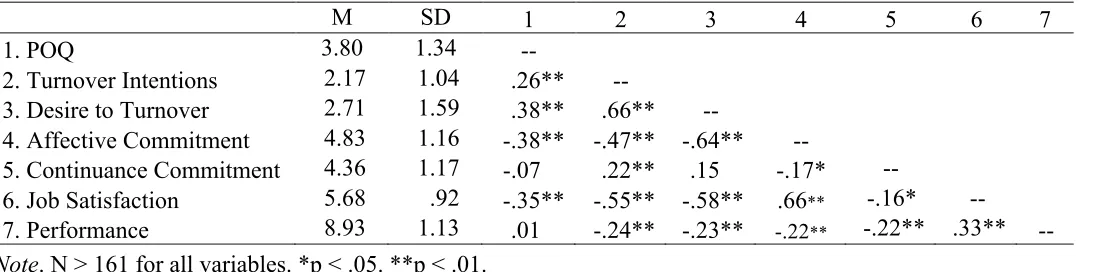
proposed hypotheses. As presented in Table 1, correlations were used to investigate the main
effects of POQ on each work outcome. Hypotheses 1-6 explored these questions, with
Hypotheses 1 and 2 relating to turnover. Both of these hypotheses were supported by the data
with POQ being positively related to both turnover intentions and desire to turnover.
Similarly, Hypothesis 3 was supported as affective organizational commitment was
negatively related to POQ. However, Hypothesis 4 was not supported as POQ was not
significantly correlated with continuance organizational commitment. As expected, in
support of Hypothesis 5, POQ was negatively related to job satisfaction. Lastly, POQ was not
significantly correlated with self-reported performance.
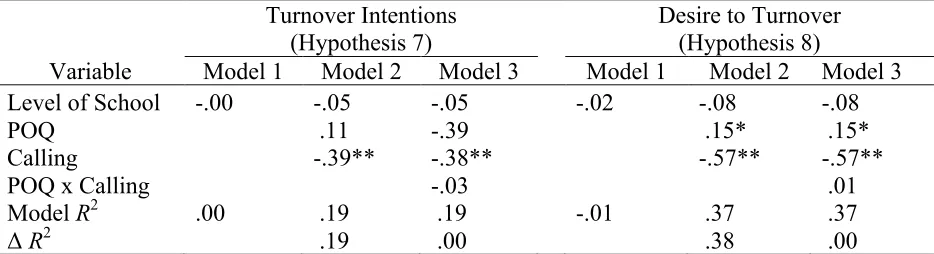
As presented in Table 2, Hypotheses 7-12 involved moderation analyses using
hierarchical moderated regression. Level of school (i.e., elementary, middle, & high) was
entered as a categorical control variable in the regression analyses. In the first regression
were added. To test the moderating effects of calling, a third model included interaction
terms for each relevant hypothesis. Variables were centered in order to reduce
multicollinearity (Yi, 1989).
Hypothesis 7 and 8 explored calling as a moderator between POQ and two types of
turnover attitudes: intentions and desires. Although POQ was positively associated with both,
calling did not significantly moderate either of these variables. Similarly, the data did not
support Hypothesis 9, as calling did not moderate the relationship between POQ and
affective organizational commitment.
However, Hypothesis 10 was supported. The interaction term of calling with POQ
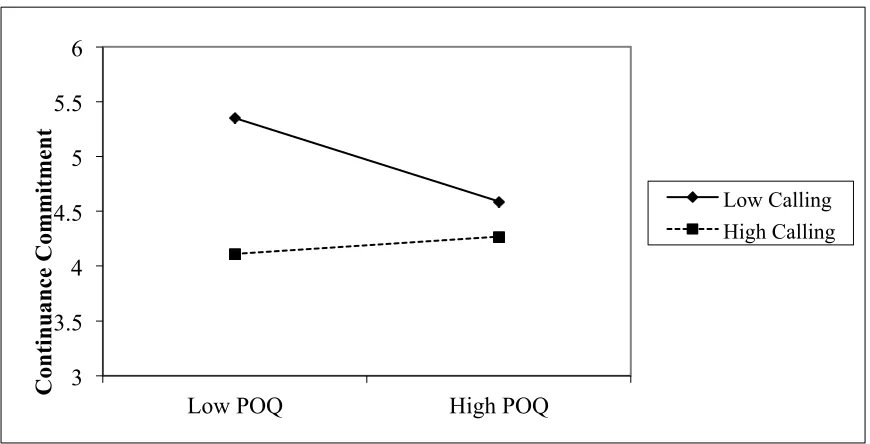
was significant with respect to continuance commitment (b = .17, p < .01). Aiken and West’s
(1991) method was used to plot the interaction; conditional values of the moderator, career
calling, were chosen one standard deviation above and below the mean and are presented in
Figure 1. As POQ increases, for those low in calling, continuance commitment decreases,
while for those high in calling, continuance commitment increases. Nonetheless, as Figure 1
suggests, levels of continuance commitment remain higher for those with low calling than for
those with high calling. As expected, the positive relationship between POQ and
organizational commitment is weaker when calling is high.
Hypothesis 11 was not supported. Although POQ was positively related to job
satisfaction, calling did not moderate the relationship. Nonetheless, the final hypothesis,
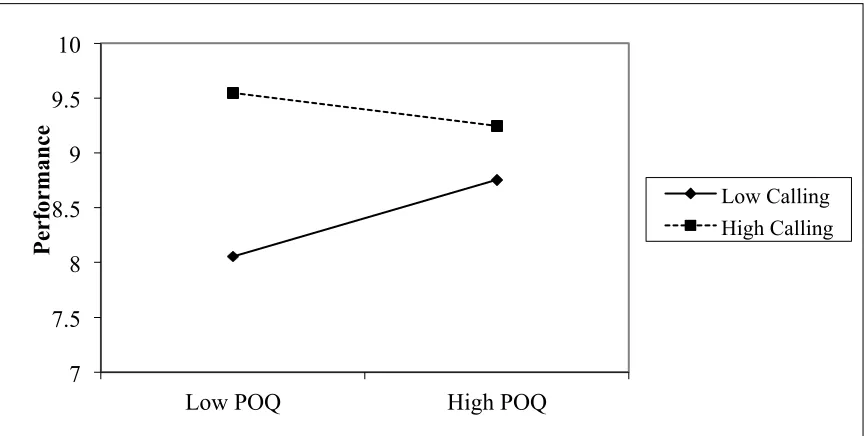
exploring calling as a moderator between POQ and performance was supported with a
Hypothesis 12 emerged despite the lack of support for hypothesis 6; there was no significant
correlation between POQ and performance. Aiken and West’s method (1991) were used to
graph the results, which appear in Figure 2. The figure illustrates that as POQ increases, for
those with high calling, performance decreases while, for those with low calling,
performance increases. Overall, however, those who report high calling have higher
performance than those with low levels of calling.
Discussion
The primary purpose of this study was to investigate the moderating role of career
calling orientation between POQ and important work outcomes. POQ is an emerging topic of
interest (Erdogan et al., 2001) and its relation to calling has received no research attention.
High POQ relates to a number of important outcomes, such as lower job satisfaction (Fine,
2007; Fine & Nevo, 2008; Johnson & Johnson, 2000a, 2000b; Johnson et al., 2002) and
higher turnover intentions (Erdogan & Bauer, 2009; Maynard et al., 2006), so it is important
to understand the variables, such as calling, that may alter one’s experiences at work. As with
previous studies (Fine & Nevo, 2008; Maynard et al., 2006), POQ was related to turnover
attitudes, affective commitment, and job satisfaction. Also, although POQ was not
significantly correlated with continuance organizational commitment and performance, the
interactions between POQ and calling were significant for both outcomes. These findings
offer original contributions to the POQ literature, which will benefit from the exploration of
POQ-Outcome Relationships
In this study, POQ was negatively related to self-reported job satisfaction and
affective commitment, and positively related to turnover intentions and desire to turnover.
These findings may be due to the desire of incumbents to seek challenge through work
(Hackman & Oldham, 1975). In some cases, employees may experience frustration, and thus
lower satisfaction or affective commitment, from not using the knowledge, skills, and
abilities they possess and have worked to acquire. Additionally, the negative relationship
may be due to a mismatch between feelings of self-worth and the value of the position. For
instance, an individual who has been working for two decades in a well-paid, managerial
position who is laid off and forced to accept an entry-level position in another field, with
considerably lower pay and benefits, will experience both underutilization of skills and
negative social comparison with his or her former position (Folger, 1984).
The negative POQ-job satisfaction relationship is consistent with Fine and Nevo's
(2008) study, which revealed a negative relationship between job satisfaction and POQ
among customer service representatives. The results provide further support for this
relationship in a sample of employees from k-12 educational settings. Similarly, it appears
that POQ may lead to negative emotional interpretations (affective organizational
commitment) about one’s work organization and thus decreased desire to stay with the
organization. Both of these findings may be attributable to discontent stemming from
perceived mismatch between one’s sense of self-worth and the importance of his or her work,
This study provides evidence for a positive relationship between POQ and turnover
intentions and desire to turnover, implying that individuals who experience POQ may desire
more challenge through positions for which they feel more adequately qualified. With
turnover being a significant cost for organizations, this finding suggests that employers may
benefit from avoiding hiring job candidates who are overqualified for a particular position.
Alternatively, it may be useful for organizations to consider adopting new practices to better
utilize employees KSAOs and increase the perceived value of even low-level positions. Such
framing may serve to decrease the troubling distance between one’s self-worth and value of
his or her work by improving the perceived importance of the task or job at hand.
Calling as a Moderator
Significant interactions existed between POQ and calling in relation to two outcome
variables: continuance organizational commitment and performance. The results suggest that,
overall, those with low calling had higher levels of continuance commitment than those who
had high calling. Employees who have low levels of calling may be staying at the
organization out of necessity, due to a lack of perceived alternative employment
opportunities. According to the results, for an individual with both low calling and high
POQ, his or her perceived cost of leaving the organization is lower, which may occur do to
an increased expectation regarding the existence of desirable alternatives. These alternatives
may promise to better utilize KSAOs or offer more valuable rewards. Such work
characteristics may be more highly valued by individuals not experiencing the sacrificial
Alternatively, individuals may be in situations marked by high POQ and high calling
because of a lack of alternatives; specifically alternatives that simultaneously offer the highly
valued experience of a calling, as well as low POQ. Therefore a choice is made to stay in the
high calling position, despite the experience of POQ. Continuance organizational
commitment is typically conceptualized as involving a lack of choice and being forced to
stay in a position, however, it is possible that someone with high calling orientation may
experience continuance commitment because they could not pursue the highly valued calling
elsewhere. It is also possible that those who experience POQ, but are unable to leave their
jobs, may resolve associated dissonance by changing their interpretation of the work situation
to that of a calling. Such individuals may search for meaning or purpose in their work as a
way to adapt to their inflexible and undesirable work situations.
The relationship between POQ and performance being moderated by calling also
offers an important contribution to the literature. While some previous research has found
POQ to be related to increased performance (Erdogan & Bauer, 2009; Fine & Nevo, 2008)
some has found evidence of a negative relationship (Bolino & Feldman, 2000), so
researchers agree that the POQ-performance relationship requires additional research
attention in order for it to be fully understood (Bolino & Feldman, 2000; Erdogan & Bauer,
2009; Fine & Nevo, 2008). The findings of this study support the theories of Hall and
Chandler (2005) in that overall those with a high calling orientation report higher
This means that as levels of POQ increase, performance decreased for those with high
calling.
This finding suggests that performance is highest for those with high calling, possibly
due to increased interest and dedication, and low POQ, which contributes a sense of fair
matching between one’s self and the position. However, in the presence of high POQ,
performance is slightly lower for those with a high sense of calling. This finding may be
explained by relative deprivation theory (cf. Mirowsky & Ross, 1989) through which the
experience of negative emotions is due to a discrepancy between actual experience and a
priori expectations. Those who are disappointed with their job match in terms of qualification
levels may not exert as much effort in order to restore equity. Of course, the levels of
performance for those with high calling are still generally higher than for those with low
calling. Alternatively, as levels of POQ increase for those with low calling, performance
increased. It is possible that the individual’s actual qualifications may be more than those
required to do the job, therefore making them better at it and improving their performance. It
is important to note that performance was self-reported, so those who experience POQ may
think or claim they are doing better than those who do not experience POQ.
Implications
Theoretical Implications. This study contributes to the POQ and calling literatures in a number of respects. First, while it confirms previous findings that have been published, it
offers additional theoretical justification for such results based on relative deprivation theory
unpleasant feelings of discrepancy stemming from two sources: 1) underutilized KSAOs, and
2) undesirable work outcomes that signal low status or worth. In either case, there are
inconsistencies between one’s expectations and actual experiences in the workplace. Higher
turnover intentions, higher desire to turnover, lower job satisfaction, and lower affective
commitment are attitudinal variables linked to POQ due to unpleasant feelings of
discrepancy. Employees with high POQ are either frustrated by the underutilization of their
KSAOs or are displeased with the low status of their job, leading to these negative work
attitudes.
This study also sheds light on two additional variables: continuance commitment and
performance. These variables highlight the potential for theoretical advancement of POQ
through the use of moderators. As has been described, while there was no significant
relationship between POQ and continuance commitment, there was a significant interaction
between POQ and calling in predicting continuance commitment, suggesting that such
non-significant relationships cannot be discounted without considering additional variables. The
relationship between POQ and continuance commitment is complex. Continuance
commitment is unaffected by the psychological mechanisms leading to POQ (e.g., low
KSAO usage and a lack of desirable status-related outcomes), possibly because continuance
commitment is less of a subjective attitude or choice, and more of an experience based on
objective costs.
High calling decreases perceived costs, possibly because KSAO usage and status are
the organization because they want to stay, rather than because they have to stay. The
experience of discrepancy, which links POQ to negative work outcomes, is mitigated in the
presence of a calling. Additionally, the results suggest that the link between POQ and
performance must be qualified by calling. While POQ may be connected to higher
performance due to higher ability, not all people who experience POQ are actually
overqualified. Therefore, only under certain psychological conditions can the link be made,
such as in the presence of a calling. These findings support the theories of Hall and Chandler
(2008), which suggest that those who experience callings are better able to perform due to
increased self-confidence, effort, and interest in pursuing challenging goals.
A major theoretical contribution of this study is the idea that calling changes peoples’
interpretations of work in desirable ways, even in the presence of high POQ. Calling may
decrease the negative affective reactions associated with underutilized KSAOs and also
decrease concern associated with a lack of desirable status-related work outcomes. In other
words, the psychological mechanisms through which POQ operates, in turn leading to
negative work outcomes, are mitigated by the experience of a calling.
Organizational Implications. There are a number of practical implications that can be drawn from the findings. First, it is to an organization’s advantage to hire individuals who
experience a calling orientation. However, in the event that there are no job candidates
available who report being called to an available position, it may be strategic to hire
overqualified individuals, as POQ is associated with higher performance than low POQ for
POQ also report lower affective commitment, satisfaction, and stronger turnover attitudes.
Therefore, the duration of the employment opportunity and the goals of the hiring
organization should also be taken into consideration. For short-term employees, where
turnover is expected due to the nature of the position, hiring overqualified individuals is more
advantageous. However, if the organization is more concerned with maintaining low turnover
rates (e.g., high initial training costs) and better morale, it is more strategic to hire individuals
who are not overqualified.
All of these implications are contingent upon practitioners being able to correctly
discern the presence of a calling in potential job candidates. It is possible that educated
interviewers may be able to probe for evidence of a calling orientation by asking pointed
questions and detecting sincere enthusiasm. However, questionnaires may be prone to faking.
Shrewd measurement composition and assessment techniques may mitigate the
disadvantages associated with using the subjective construct for decision-making.
Finally, although callings are personal convictions, it may be to the organization’s
advantage to foster a sense of purpose and meaning in the workplace. There may be
performance-based benefits associated with increasing contact with consumers/customers,
philanthropic activities, and general appreciation for each employee’s contribution to the
organization’s goals. Regular reminders of the organization’s mission and socially
constructive goals, even if not closely linked with each employee’s day-to-day activities, may
cultivate a sense of purpose that reaps some of the psychological benefits associated with the
Limitations and Future Research
While this study is not without limitation, it serves as a platform from which future
research can develop. Measures were self-reported from a single source, introducing
potential common method bias. Due to the personal, psychological nature of the hypotheses
including calling, POQ, turnover intentions and desires, job satisfaction, and commitment,
self-report measures are the only valid means to provide such information. While
performance would have ideally been collected using archival resources, the self-reported
item was based on a frame-of-reference to one’s most recent performance evaluation. This
method has been used effectively and validated in previous research by Schoorman and
Mayer (2008).
Another potential limitation of this study is in participant selection bias. Respondents
were recruited through “cold” emails and participation was voluntary. It is possible that those
who chose to respond to a random email request may have had unique traits or
characteristics, such as other-orientation or an appreciation for research, which quietly
influenced the data and findings. Additionally, the sample was comprised of individuals from
a single county in affluent area of the nation. The demographic make-up of the sample of
teachers, as well as the students they serve, could reduce the generalizability of findings to
less privileged areas. It is possible that education levels and pay may be higher in the sample,
as compared to other regions, affecting rates of POQ. Participation was also limited to those
Future research would benefit from replicating this study among a more diverse
sample to increase generalizability. A survey of educators across the nation and members of
other professions would be useful data points for comparison. Additionally, explorations of
actual overqualification in relation to POQ, as well as actual turnover and objective
performance records, as moderated by calling, deserve research attention.
A full exploration of the mechanisms behind reports of continuance organizational
commitment is needed. Researchers should investigate the different forces that may be
increasing the perceived cost of leaving. A lack of feasible alternatives due to a poor
economy is different from a lack of desirable alternatives due to the unavailability of jobs
that foster the pursuit of one’s calling. The literature would also benefit from comparing
self-reported performance to objective performance records to identify whether or not the
POQ-calling interaction identified in this study is upheld. Additionally, future research is needed to
confirm that, and explore why, those with a high sense of calling report lower performance,
in the event of high POQ.
Summary
This study offers novel contributions to the POQ literature. While providing further
evidence for POQ’s relationship to a number of important work outcomes such as turnover
intentions, desire to turnover, affective commitment, and job satisfaction, it fulfills Erdogan
and Bauer (2009)’s call for the exploration of potential moderating variables by introducing
calling orientation. The results suggest a more intricate relationship between POQ and
significant interaction between calling and POQ in relation to continuance commitment,
which like performance, did not originally result in a significant relationship with POQ. As
expected, the experience of a calling mitigated the negative outcomes in the presence of
POQ. These findings should inspire curiosity regarding the untapped interactions that may
References
Agut, S., Peiró, J. M., & Grau, R. (2009). The effect of overeducation on job content
innovation and career enhancing strategies among young Spanish employees. Journal
of Career Development, 36, 159–182. doi:10.1177/0894845308327738.
Aiken, L. S., & West, S. G. (1991). Multiple regression: Testing and interpreting
interactions. Newbury Park, London, Sage.
Allen, N., & Meyer, J. (1990). The measurement and antecedents of affective, continuance
and normative commitment to the organization. Journal of Occupational
Psychology, 63, 1-18. Retrieved from PsycINFO database.
Bills, D. (1992). The mutability of educational credentials as hiring criteria: How employers
evaluate atypically highly credentialed job candidates. Work and Occupations, 19,
79-95. doi:10.1177/0730888492019001005.
Bolino, M., & Feldman, D. (2000). The antecedents and consequences of underemployment
among expatriates. Journal of Organizational Behavior, 21, 889-911.
doi:10.1002/1099-1379(200012)21:8<889::AID-JOB60>3.0.CO;2-G.
Brayfield, A., & Rothe, H. (1951). An index of job satisfaction. Journal of Applied
Psychology, 35, 307-311. doi:10.1037/h0055617.
Buskist, W., Benson, T., & Sikorski, J. (2005). The call to teach. Journal of Social and
Clinical Psychology,24, 111-122. doi:10.1521/jscp.24.1.111.59167.
Carless, S., Fewings-Hall, S., Hall, M., Hemsworth, P., & Coleman, G. (2007). Selecting
PDI-Employment Inventory. International Journal of Selection and Assessment, 15,
335-340. doi:10.1111/j.1468-2389.2007.00392.x.
Cooper-Hakim, A., & Viswesvaran, C. (2005). The Construct of Work Commitment: Testing
an Integrative Framework. Psychological Bulletin, 131, 241-259.
doi:10.1037/0033-2909.131.2.241.
Craig, S., & Gustafson, S. B. (1998). Perceived Leader Integrity Scale: An instrument for
assessing employee perceptions of leader integrity. The Leadership Quarterly, 9(2),
127-145. doi:10.1016/S1048-9843(98)90001-7.
Dekker, R., de Grip, A., & Heijke, H. (2002). The effects of training and overeducation on
career mobility in a segmented labour market. International Journal of Manpower,
23, 106–125. doi:10.1108/01437720210428379.
Duffy, R., & Sedlacek, W. (2007). The presence of and search for a calling: Connections to
career development. Journal of Vocational Behavior, 70, 590-601.
doi:10.1016/j.jvb.2007.03.007.
Dreher, D., Holloway, K., & Schoenfelder, E. (2007). The Vocation Identity Questionnaire:
Measuring the sense of calling. Research in the Social Scientific Study of
Religion, 1899-120. doi:10.1163/ej.9789004158511.i-301.42.
Elias, S. (2009). Employee in times of change: Assessing the importance of attitudes toward
organizational change. Journal of Management, 35(1), 37-55.
Erdogan, B., & Bauer, T. (2009). Perceived overqualification and its outcomes: The
moderating role of empowerment. Journal of Applied Psychology, 94, 557-565.
doi:10.1037/a0013528.
Erdogan, B., Bauer, T., Peiro, J. M., & Truxillo, D. M. (2011). Overqualified employees:
Making the best of a potentially bad situation for individuals and organizations.
Industrial and Organizational Psychology Perspectives on Science and Practice, 4,
215-232. DOI: 10.1111/j.1754-9434.2011.01329.x.
Feldman, D., Leana, C. R., & Bolino, M. C. (2002). Underemployment and relative
deprivation among re-employed executives. Journal of Occupational and
Organizational Psychology, 75(4), 453-471. doi:10.1348/096317902321119682 Fine, S. (2007). Overqualification and selection in leadership training. Journal of Leadership
& Organizational Studies, 14, 61-68. doi:10.1177/1071791907304291.
Fine, S. & Nevo, B. (2008). Too smart for their own good? A study of perceived cognitive
overqualification in the workforce. The International Journal of Human Resource
Management, 19, 346-355. DOI: 10.1080/09585190701799937.
Folger, R. (1984). Perceived injustice, referent cognitions, and the concept of comparison
level. Representative Research in Social Psychology, 14(2), 88-108. Retrieved from
EBSCOhost.
Gallo, A. (2011, March 3). Should you hire an overqualified candidate? Harvard Business
Review. Retreived from
Hackman, J., & Oldham, G. (1975). Development of the Job Diagnostic Survey. Journal of
Applied Psychology, 60, 159-170. doi:10.1037/h0076546.
Hall, D., & Chandler, D. (2005). Psychological success: When the career is a calling. Journal
of Organizational Behavior, 26, 155-176. doi:10.1002/job.301.
Hall, D. (2008). Reflections on calling and careers in community psychology. Journal of
Prevention & Intervention in the Community, 35, 107-112.
doi:10.1300/J005v35n01_09.
Hardy, C., & Leiba-O'Sullivan, S. (1998). The power behind empowerment: Implications for
research and practice. Human Relations, 51, 451-483.
doi:10.1023/A:1016989830806.
Hechanova-Alampay, R., & Beehr, T. (2001). Empowerment, span of control, and safety
performance in work teams after workforce reduction. Journal of Occupational
Health Psychology, 6, 275-282. doi:10.1037/1076-8998.6.4.275.
Hrebiniak, L., & Alutto, J. (1972). Personal and role-related factors in the development of
organizational commitment. Administrative Science Quarterly, 17, 555-573.
doi:10.2307/2393833.
Johnson, G., & Johnson, W. (1996). Perceived overqualification and psychological
well-being. The Journal of Social Psychology, 136, 435-445. Retrieved from PsycINFO
Johnson, G., & Johnson, W. (1997). Perceived overqualification, emotional support, and
health. Journal of Applied Social Psychology, 27, 1906-1918.
doi:10.1111/j.1559-1816.1997.tb01631.x.
Johnson, G. J., & Johnson, W. R. (2000a). Perceived overqualification and dimensions of job
satisfaction: A longitudinal analysis. Journal of Psychology, 134, 537-555.
doi:10.1080/00223980009598235 PMid:11034134.
Johnson, G. J., & Johnson, W. R. (2000b). Perceived overqualification, positive and negative
affectivity, and satisfaction with work. Journal of Social Behavior & Personality,
15(2), 167-184. Retrieved from PsycINFO database.
Johnson, W. R., Morrow, P. C., & Johnson, G. J. (2002). An evaluation of a perceived
overqualification scale across work settings.Journal of Psychology: Interdisciplinary
and Applied, 136(4), 425-441. Retrieved from PsycINFO database.
doi:10.1080/00223980209604169 PMid:12230145.
Judge, T. A., Bono, J. E., & Locke, E. A. (2000). Personality and job satisfaction: The
mediating role of job characteristics. Journal of Applied Psychology, 85:2, 237-249.
doi:10.1037/0021-9010.85.2.237 PMid:10783540.
Katcher, B. (2010). To hire or not to hire the overqualified, that is the question. Improving
the workplace: Practical advice and insights to both employees and employers.
Kickul, J., Lester, S., & Finkl, J. (2002). Promise breaking during radical organizational
change: Do justice interventions make a difference? Journal of Organizational
Behavior, 23(SpecIssue), 469-488. doi:10.1002/job.151.
Kraimer, M. L., Shaffer, M. A., & Bolino, M. C. (2009). The influence of expatriate and
repatriate experiences on career advancement and repatriate retention. Human
Resource Management, 48, 27–47. doi:10.1002/hrm.20265.
Lee, C. H. (2005). A study of underemployment among self-initiated expatriates. Journal of
World Business, 40, 172–187. doi:10.1016/j.jwb.2005.02.005.
Maynard, D., Joseph, T., & Maynard, A. (2006). Underemployment, Job Attitudes, and
Turnover Intentions. Journal of Organizational Behavior, 27, 509-536.
doi:10.1002/job.389.
McCulloch, M., & Turban, D. (2007). Using Person--Organization Fit to Select Employees
for High-Turnover Jobs. International Journal of Selection and Assessment, 15,
63-71. doi:10.1111/j.1468-2389.2007.00368.x.
McKee-Ryan, F. M., Virick, M., Prussia, G. E., Harvey, J., & Lilly, J. D. (2009). Life after
the layoff: Getting a job worth keeping. Journal of Organizational Behavior, 30,
561–580. doi:10.1002/job.566.
Meglino, B., & Korsgaard, M. (2007). The Role of Other Orientation in Reactions to Job
Characteristics.Journal of Management, 33, 57-83. doi:10.1177/0149206306295308.
Mobley, W. (1977). Intermediate linkages in the relationship between job satisfaction and
employee turnover. Journal of Applied Psychology, 62, 237-240.
doi:10.1037/0021-9010.62.2.237.
Morrow, P. C. (1993). The theory and measurement of work commitment. Greenwich, CT:
JAI Press.
Podsakoff, N., LePine, J., & LePine, M. (2007). Differential challenge stressor-hindrance
stressor relationships with job attitudes, turnover intentions, turnover, and withdrawal
behavior: A meta-analysis.Journal of Applied Psychology, 92, 438-454.
doi:10.1037/0021-9010.92.2.438.
Pinder, C. C. (1998). Beleifs, attitudes, and emotions about work. Work Motivation in
Organizational Behavior. Upper Saddle River, NJ: Prentice-Hall, Inc.
Porter, L., Steers, R., Mowday, R., & Boulian, P. (1974). Organizational commitment, job
satisfaction, and turnover among psychiatric technicians. Journal of Applied
Psychology, 59, 603-609. doi:10.1037/h0037335.
Ryan, R., & Deci, E. (2000). Self-determination theory and the facilitation of intrinsic
motivation, social development, and well-being. American Psychologist, 55, 68-78.
Sagie, A., Birati, A., & Tziner, A. (2002). Assessing the costs of behavioral and
psychological withdrawal: A new model and an empirical illustration. Applied
Psychology: An International Review, 51, 67-89. doi:10.1111/1464-0597.00079.
Salgado, J. F., Viswesvaran, & C., Ones, D. S. (2001). Predictors used for personnel
Ones, D. S., Sinangil, H. K., & Viswesvaran, C. (Eds.), Handbook of Industrial, Work
and Organizational Psychology (pp. 165-199). London: Sage Publications.
Salincik, G. R. (2003). Commitment and the control of organizational behavior and belief. In
B. M. Staw (Ed.), Psychological dimensions of organizational behavior (3rd ed., pp.
287-293). Upper Saddle River, NJ: Prentice Hall.
Sauley, K. S., & Bedeian, A.G. (2000). Equity sensitivity: Construction of a measure and
examination of its psychometric properties. Journal of Management, 26, 885–911.
doi:10.1177/014920630002600507.
Schoorman, F., & Mayer, R. C. (2008). The value of common perspectives in self-reported
appraisals: You get what you ask for. Organizational Research Methods, 11(1),
148-159. doi:10.1177/1094428107307168.
Serow, R. (1994). Called to teach: A study of highly motivated preservice teachers. Journal
of Research & Development in Education, 27, 65-72. Retrieved from PsycINFO
database.
Spector, P. (1985). Measurement of human service staff satisfaction: Development of the Job
Satisfaction Survey. American Journal of Community Psychology, 13, 693-713.
doi:10.1007/BF00929796.
Wrzesniewski, A., McCauley, C., Rozin, P., & Schwartz, B. (1997). Jobs, careers, and
callings: People's relations to their work. Journal of Research in Personality, 31,
Yi, Y. (1989). On the evaluation of main effects in multiplicative regression models. Journal
of the Market Research Society, 31, 133-138. Retrieved from PsycINFO database.
Zimmerman, R. (2008). Understanding the impact of personality traits on individuals'
turnover decisions: A meta-analytic path model. Personnel Psychology, 61, 309-348.
Table 1
Intercorrelations among POQ and self-reported outcomes
Note. N > 161 for all variables. *p < .05. **p < .01.
M SD 1 2 3 4 5 6 7
1. POQ 3.80 1.34 --
2. Turnover Intentions 2.17 1.04 .26** --
3. Desire to Turnover 2.71 1.59 .38** .66** --
4. Affective Commitment 4.83 1.16 -.38** -.47** -.64** --
5. Continuance Commitment 4.36 1.17 -.07 .22** .15 -.17* --
6. Job Satisfaction 5.68 .92 -.35** -.55** -.58** .66** -.16* --
Table 2
Regression Models Testing Career Calling as a Moderator
Variable
Turnover Intentions
(Hypothesis 7) Desire to Turnover (Hypothesis 8) Model 1 Model 2 Model 3 Model 1 Model 2 Model 3
Level of School -.00 -.05 -.05 -.02 -.08 -.08
POQ .11 -.39 .15* .15*
Calling -.39** -.38** -.57** -.57**
POQ x Calling -.03 .01
Model R2 .00 .19 .19 -.01 .37 .37
ΔR2 .19 .00 .38 .00
Table 2
Continued
Variable
Affective Commitment (Hypothesis 9)
Continuance Commitment (Hypothesis 10)
Model 1 Model 2 Model 3 Model 1 Model 2 Model 3
Level of School -.04 .03 .03 -.05 -.07 -.07
POQ -.18** -.19** .15 .16
Calling -.61** .58** -.21* -.25**
POQ x Calling .10 .17*
Model R2 -.01 .44 .44 -.01 .03 .05
ΔR2 .45 .00 .04 .02
Table 2
Continued
Variable
Job Satisfaction (Hypothesis 11)
Performance (Hypothesis 12)
Model 1 Model 2 Model 3 Model 1 Model 2 Model 3
Level of School .07 .14* .14* -.03 -.01 -.01
POQ -.16* -.17** .10 .12
Calling .66** .64** .30** .35**
POQ x Calling .10 -.21*
Model R2 -.00 .51 .51 -.01 .06 .10
ΔR2 .51 .00 .07 .03
Figure 1. Two-way interaction effects for continuance commitment.
3 3.5 4 4.5 5 5.5 6
Low POQ High POQ
C
on
ti
n
u
an
ce
C
ommi
tme
n
t
Figure 2. Two-way interaction effects for performance.
7 7.5 8 8.5 9 9.5 10
Low POQ High POQ
P
er
for
man
ce