Estimation of Deleterious Genomic Mutation Parameters in Natural Populations
by Accounting for Variable Mutation Effects Across Loci
Hong-Wen Deng,*
,†,1Guimin Gao* and Jin-Long Li
‡*Osteoporosis Research Center and Department of Biological Sciences, Creighton University, Omaha, Nebraska 68131, †Laboratory of Molecular and Statistical Genetics, College of Life Sciences, Hunan Normal University,
ChangSha, Hunan 410081, People’s Republic of China and‡Center for Medical Informatics, Yale University School of Medicine, New Haven, Connecticut 06520-8009
Manuscript received April 26, 2002 Accepted for publication August 26, 2002
ABSTRACT
The genomes of all organisms are subject to continuous bombardment of deleterious genomic mutations (DGM). Our ability to accurately estimate various parameters of DGM has profound significance in population and evolutionary genetics. The Deng-Lynch method can estimate the parameters of DGM in natural selfing and outcrossing populations. This method assumes constant fitness effects of DGM and hence is biased under variable fitness effects of DGM. Here, we develop a statistical method to estimate DGM parameters by considering variable mutation effects across loci. Under variable mutation effects, the mean fitness and genetic variance for fitness of parental and progeny generations across selfing/ outcrossing in outcrossing/selfing populations and the covariance between mean fitness of parents and that of their progeny are functions of DGM parameters: the genomic mutation rateU, average homozygous effects, average dominance coefficienth, and covariance of selection and dominance coefficients cov(h, s). The DGM parameters can be estimated by the algorithms we developed herein, which may yield improved estimation of DGM parameters over the Deng-Lynch method as demonstrated by our simulation studies. Importantly, this method is the first one to characterize cov(h,s) for DGM.
T
HE genomes of all organisms are subject to deleteri- standing of Haldane’s rule by the dominance hypothesis (Turelli and Orr 1995). The current experimental ous genomic mutations (DGM) continuously. In spiteapproaches and the estimation methods of the parame-of our increasing knowledge parame-of the molecular
underpin-ters of DGM are summarized and compared (Dengand nings of mutations, little is known about the overall risk
Fu 1998; Deng et al. 1999; Deng and Li 2001). It is exerted on human health and on continuing
survivabil-concluded that under their respective assumptions of ity of other organisms (especially rare and endangered
various approaches, estimation by the Deng-Lynch species) by DGM (Crow1993a,b, 1995). To assess this
method (DengandLynch1996, 1997) in natural popu-overall risk correctly, we need to have a solid knowledge
lations generally results in the best statistical quality in of the genomic mutation rate (U) at which DGM arise
terms of bias and sampling variance (Deng and Fu in the whole genome of an individual and the
distribu-1998). In addition, it has been shown that violation of tion of their effects, such as the mean selection
coeffi-various assumptions [including the mutation-selection cient (s), the mean dominance coefficient (h), and the
(M-S) balance assumption] underlying the Deng-Lynch covariance of dominance and selection coefficients of
method does not seriously undermine its estimation DGM [cov(h,s)]. Estimation of these parameters is also
robustness (Liet al.1999;LiandDeng2000;Dengand important for testing the validity of a number of
evolu-Li2001). tionary theories in genetics (Turelli and Orr 1995;
As with almost all the other estimation methods (ex-and the references withinDenget al.1998, 1999).
cept a maximum-likelihood estimation method for mu-Despite the extreme importance of our knowledge
tation-accumulation experiments; Keightley 1994), of deleterious mutation parameters, few estimates are
the Deng-Lynch method that applies to natural outcross-available (Simmons and Crow 1977; Crow and
Sim-ing or selfSim-ing populations assumes constant fitness ef-mons1983; Kondrashov 1988; Crow 1993a,b, 1995;
fects of DGM. This assumption is well recognized as Bataillon2000). Particularly, no method to estimate
biologically implausible. Although the estimation bias U is not biased by variable mutation effects, and no
introduced by variable mutation effects in the Deng-method to estimate cov(h,s) is important for our
under-Lynch estimation method by assuming constant muta-tion effects is not substantial (Denget al.1999), an estima-tion method that considers variable mutaestima-tion effects may
1Corresponding author: Osteoporosis Research Center, Creighton
reduce estimation bias (although not necessarily always
University, 601 N. 30th St., STE. 6787, Omaha, NE 68131.
E-mail: [email protected] so). Most importantly, the parameters [e.g., cov(h,s)]
acterizing variable effects of DGM can be estimated only nk⫽ Uk/2sk⫽Upk/2sk. (1b) in statistical methods that consider variable mutation
Outcrossing populations: We illustrate our experi-effects.
mental design and estimation method by using popula-In this article, we present a method for estimating
tions capable of selfing. The method may be extended DGM parameters accounting for variable effects across
to outcrossing populations where selfing is not feasible loci in natural outcrossing or selfing populations at M-S
as in the Deng-Lynch method (Deng1998b). The basic balance. We investigate the statistical properties (bias
data structure is outcrossed parents and multiple selfed and sampling variance) of this new method, using
com-progeny from each parent (forming selfed families). puter simulations in comparison with the Deng-Lynch
LetWoandWsbe the mean fitness in the parental and method (Dengand Lynch1996, 1997) that assumed
offspring generations, respectively,2
othe genetic vari-constant mutation effects across loci.
ance of fitness in the parental generation,2
t the total genetic variance of fitness in the selfed progeny
genera-THEORY tion,2
sthe genetic variance of the mean fitness of selfed progeny in selfing families, and cov(wp,ws) the covari-The assumptions are the same as those of the
Morton-ance between the fitness of a parent (wp) and the mean Charlesworth method (Morton et al. 1956;
Charles-fitness of its selfed progeny (ws). Under the above as-worthet al.1990) and the Deng-Lynch method (Deng
sumption for mutation effects that are variable across andLynch1996, 1997;Deng1998b). Namely, the
pop-various intervals at different loci, as inDengandLynch ulation is assumed to be large, randomly mating, highly
(1996), it can be shown that the fitness moments are selfing or outcrossing, at linkage equilibrium, and at M-S
related to the DGM parameters as balance. In addition, the fitness function is assumed to
be multiplicative, which is biologically plausible (Mor- W
o⫽Wmaxexp(⫺U) (2)
tonet al.1956;Crow 1986;Craddocket al.1995;Fu
2
o⫽W2o[exp(Uhs)⫺1], (3)
andRitland1996). Mutations at each locus are assumed
to have constant effectsandh. W
s⫽Wmaxexp{⫺(U/4)[2⫹(1/h˜)]}, (4) In this study, we consider variable mutation effects in
the development of an estimation method for DGM 2
s ⫽W2s{exp[(U/4)(s⫹hs⫹s/(4h))]⫺1}, (5) parameters in natural populations. Under variable
mu-2
t ⫽W2s[exp[U(hs/2⫹s/(4h))]⫺1], (6) tation effects across loci, homozygous effectsfor
muta-tions is a random variable between 0 and 1. We assume cov(wp,ws)⫽WsWo{exp[(1/4)U(2hs⫹s)]⫺1}, (7) that, for a mutation, dominance coefficientshandsare
where the parameters with overbars denote arithmetic functionally related so thath ⫽ h(s). This assumption
mean properties of new DGM parameters,h˜is the har-is supported by the limited data and theory (Simmons
monic mean dominance coefficient of new mutations, andCrow 1977; KacserandBurns1981; Crowand
andWmaxis the expected fitness of a mutation-free geno-Simmons1983). We divide the domain ofs, [0, 1], for
type in an environment where fitness measurements are new mutations into T intervals with each having a
taken.Wmaxserves as a scaling factor so that the fitness width of 1/T.LetIk⫽[k/T,(k⫹ 1)/T] denote thekth
measurement can be on any scale instead of just from interval, and define the probability
0.0 to 1.0 and also so that mean environmental effects pk⫽P(s僆Ik), k⫽0, 1, . . . , T⫺ 1. of experiments do not influence estimation (Dengand
Lynch1996). WhenTis sufficiently large,sandh are approximately
Among Equations 2–7, there are only five indepen-constant within each interval but are variable across
dent equations containing six unknown parameters. By various intervals. LetUkdenote the mutation rate
corre-assuming one of the six parameters known in the estima-sponding to mutations with an effectsfalling into the
tion, estimators of the other parameters can be derived. intervalIk, and thenUk⫽Upk.
This is the strategy employed in the likelihood character-With the assumptions we have, in outcrossing
popula-ization of DGM parameters when variable mutation ef-tions, the number of mutant alleles with mutation effects
fects are considered in estimation (Keightley 1994; s falling into an intervalIkwithin an individual (all in
Denget al.1999;DengandLi2001). Here we assume
the heterozygous state;Mortonet al.1956;Dengand
thatU is known in the estimation for the time being. Lynch1996) follows a Poisson distribution with an
ex-Alternatively, an initial value ofUmay be estimated from pectation
other approaches (Denget al.1999) or may be estimated
nk⫽ Uk/hksk⫽Upk/hksk (1a)
by the current experimental design and data with the Deng-Lynch method (Deng andLynch 1996; see be-(DengandLynch1996, 1997). In selfing populations,
low). (If we assume that one of the parametersh˜,s, and the number of loci homozygous for mutant alleles with
hsis known, similar estimation procedures can be de-an effectsfalling into an intervalIkwithin an individual
be estimated by methods such as that ofDeng1998a.) selection coefficients(from zero to one) into infinitely small intervals so thatscan be treated as constant within Solving these equations jointly yields estimators of h˜,
hs, andsand as each of the intervals but varying across intervals in our
analytical derivation. Again, there are six unknowns (U,
h,hs,s,h2s, and Wmax) in the above five equations. By
h˜ ⫽ 1
2⫺4(y/U), s⫽
4b⫺2x
U , hs⫽
x
U, (8) assuming or estimating one of the six parameters, esti-mators of the other five parameters can be derived. where
Here, as earlier for outcrossing populations, we assume thatUis known in the estimation for illustration.
Alter-x⫽ln
冢
2 o
W2
o
⫹ 1
冣
, y⫽ ln冢
Wo冣Ws, natively, an initial value of U may be estimated from other approaches (Denget al.1999) or may be estimated with the Deng-Lynch method from the same data andz⫽ln
冢
2 s
W2
s
⫹1
冣
, b ⫽ln冢
cov(wp,ws)WoWs
⫹1
冣
. (9)experimental design as the current estimation method (DengandLynch1996). Solving these equations jointly From these estimates, other composite parameters yields estimators ofh,hs, ands,
of DGM, such as the mean number of mutations per genomen, mutational varianceVmper generation, and
h ⫽0.5⫺ (y/U), s⫽2x
U, hs⫽
2b
U, (16)
mean mutation effects on fitness Uhs, can be derived (DengandLynch1996). The covariance ofhandsfor
where mutations cov(h,s) can be approximated, or at least an
upper bound can be estimated, as
x⫽ln
冢
2 p
W2
p
⫹1
冣
, y⫽ln冢
WF1Wp
冣
, cov(h, s)⫽hs⫺ hsⱕ hs⫺h˜s. (10)
This is because for any distribution,hⱖh˜.Letcov(h, s)⫽ z⫽ln
冢
2F1W2
F1
⫹1
冣
, b⫽ ln冢
cov(P, F1)WpWF1 ⫹1
冣
. (17)hs⫺sh˜, where cov(h, s) denotes an upper bound of
cov(h, s). This offers usthe first opportunity to quantify
In selfing populations, we can use Equation 10 to the magnitude and the sign of cov(h, s). It would be
estimate cov(h,s) by the above estimates of h,hs, and impossible to come up with analytical estimators for
s, which are unbiased under variable mutation effects DGM parameters such as cov(h, s) if in the analytical
with a known correct U. The estimators for h and s derivation, variable mutation effects are not considered.
when assuming U is known are the same as those in This is simply because these parameters such as cov(h,s)
DengandLynch(1996) for selfing populations. would be zero and meaningless in an analytical
estima-The above estimation developed herein does not as-tion developed under constant mutaas-tion effects.
sume any specific functional relationship betweensand Selfing populations: Random pairs of highly selfing
h and any specific distribution form for the selection and homozygous parental genotypes (denoted asP
gen-coefficients.Therefore, the estimates are robust to dif-eration) are crossed to obtain outcrossed progeny
(de-ferent unknown forms of the distribution ofs and the noted as F1 generation). Let Wp and2
pbe the mean
functional relationship between s and h. This is true fitness and genetic variance of fitness in theP
genera-despite that we assume specific distributions ofsand a tion, respectively,WF1and2
F1be the mean fitness and
functional relationship betweensandhin the following genetic variance of fitness in the F1generation,
respec-simulation studies to investigate the statistical properties tively, and cov(P, F1) be the covariance between the
of our estimation. mean fitness of the two parents and the fitness of their
F1progeny. Under variable mutation effects across loci,
the fitness moments are related to the DGM parameters SIMULATIONS AND RESULTS as follows:
As withKeightley(1994), we assume thatsfor muta-Wp⫽Wmax exp(⫺U/2), (11) tions follows a gamma distribution, with a density function
2
p⫽W2p[exp(U s /2) ⫺1] , (12) g(s)⫽ ␣s⫺1e⫺␣s/⌫() ,
WF1 ⫽Wmax exp(⫺Uh) , (13) where⌫()⫽ 兰∞
0 y⫺1e⫺ydy.␣andare the scale and shape parameters, respectively.s⫽ /␣and2
s ⫽ /␣2.
2
F1⫽W
2
F1(exp(Uh
2s)⫺1) , (14)
As inDengandLynch(1996), we leth⫽h(s)⫽e⫺As/ 2, whereA⫽13, which is in rough accordance with the cov(P, F1)⫽WpWF1[exp(Uhs/2)⫺1]. (15)
few available data (Gregory1965;Mackayet al.1992; It should be noted that the derivation for Equations DengandLynch1996;DengandFu1998). With these 2–7 and 11–15 assumes mutation effects that are vari- assumptions, the parametersh,h˜,hs, and cov(h,s) can
h ⫽ ␣/[2(A⫹ ␣)] , obtained by random sampling from the Poisson distribu-tion defined above. The fitness of each selfed offspring was obtained by allowing thenkheterozygous loci of a
h˜⫽
冦
(␣ ⫺A)/[2␣] when␣ ⫺ A⬎0
0 when␣ ⫺ Aⱕ0, parent to segregate randomly into theAA,Aa, andaa
genotypes with respective probabilities of 1/4, 1/2, and hs⫽ ␣/[2(A⫹ ␣)⫹1] ,
1/4. Lettingn1kandn2k(k⫽1, . . . ,T) be the numbers cov(h,s)⫽ ⫺A␣⫺1/[2(A⫹ ␣)⫹1]. of heterozygous and homozygous loci containing muta-tions with effects falling into the intervalIkin a selfed These DGM parameters can be used for comparison
offspring, the fitness of the selfed progeny is to examine the estimated values with our estimation
methods in simulations.
Ws⫽Wmax
兿
T
k⫽1
(1 ⫺hksk)n1k(1⫺ sk)n2k. The simulation procedures are the same as those that
have been documented extensively earlier (Deng and
Unless otherwise specified, for each set of parameters Lynch1996;Deng1998b) and are thus not elaborated
(U,␣,, K,M), we performed 1000 simulations. We let
here. In simulations, we assume that the fitnesses of
Wmax ⫽ 1 throughout, as the value of Wmax does not various genotypes can be measured with little error,
influence DGM parameter estimation. which is justifiable in the investigation of estimation bias
For selfing populations, the fitness of an individual and comparison of various estimation methods (Deng
from the parental generation is
et al. 1999). Under the assumptions for the analytical
development of our estimation methods, the number
Wp⫽Wmax
兿
T
k⫽1
(1⫺sk)nk, of mutant alleles corresponding to an interval Ik per
individual follows the Poisson distributions (Equations
where nkis the number of mutation-bearing loci with 1a and 1b) withpkbeing determined as
mutation effects falling into the intervalIkin an individ-ual, and it is obtained by random sampling from the
pk⫽P(s僆Ik)⫽ 1
⌫()
冮I
k␣s⫺1e⫺␣sds, k⫽0, 1, . . . ,T⫺1.
Poisson distribution defined earlier. Each parent mates with another random parent (not in the original set of It can be shown that
K) to produce a total of K progeny (one per family)
with fitness pk⫽ ⫺exp
冢
⫺␣k⫹1
T
冣
⫹exp冢
⫺␣ kT
冣
, when ⫽1;WF1⫽ Wmax
兿
T
k⫽1
(1⫺ hksk)n1k⫹n2k,
pk⫽ ⫺
冤
exp冢
⫺␣k⫹1 T
冣冥冢
␣k⫹1
T ⫹1
冣
⫹冤
exp冢
⫺␣ k T冣冥冢
␣k T⫹1
冣
,where n1kandn2k(k⫽ 1, . . . ,T) are the numbers of homozygous mutant loci in intervalIkin the two parents,
when ⫽2
respectively.
and when ⫽0.5, In the estimation Equations 8 or 16, U must be
known, assumed, or estimated with other approaches
pk⫽ Erf
冢冪
␣k⫹1
T
冣
⫺ Erf冢冪
␣k
T冣, first. In simulations, we experimented and examined two methods to estimate U: (1) by the Deng-Lynch method (DengandLynch1996) and (2) by an empiri-where Erf(x)⫽ (2/√)兰x0e⫺t2
dt (x⬎0). Erf (x) can be
cal regression procedure introduced here. We simu-approximated as
lated parents and their children according to variable
Erf(x)⬇1⫺(1⫹
兺
6
i⫽1
aixi)⫺16 (18) effects for each set of given parameter values of U,␣, and , and obtained the estimates Uˆ1, sˆ1, and hˆ1 by the Deng-Lynch method (DengandLynch1996). (A (Gao1995), wherea1⫽0.0705230784,a2⫽0.0422820123,
circumflex indicates an estimated value throughout.) a3⫽0.0092705272,a4⫽0.0001520143,a5⫽0.0002765672,
We found a strong linear relationship between the pa-a6⫽0.0000430638.
rameter values ofUand the estimatesUˆ1andsˆ1under any To evaluate the performance of our estimation in
fixed . Through a series of simulations, we obtained outcrossing populations in simulations, for each set of
samples under various parameter values of U, ␣, and parametersU,␣, and,Kparents were sampled from
fixed-values, and we obtained estimatesUˆ1andsˆ1with the parental generation, and from each of these, M
the Deng-Lynch method under various fixed -values. selfed progeny were produced. The fitness of an
individ-Then we fit a multiple regression model under each ual from the parental generation is
specific-value,
Wo⫽Wmax
兿
T
k⫽1
(1⫺ hksk)nk,
Uˆ ⫽aˆ1⫹bˆ1Uˆ1⫹ cˆ1sˆ1, (19)
whereUˆ estimatesUwith little bias whenis correctly where nkis the number of mutation-bearing loci with
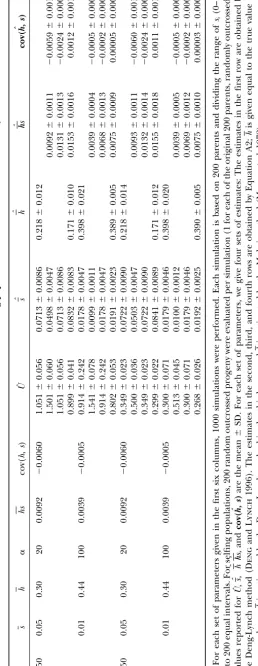
here. The empirical estimation is useful only when the selfing populations, Equation 16 yields the same esti-mates fors andh as those obtained by the Deng-Lynch shape parametercan be estimated using other methods
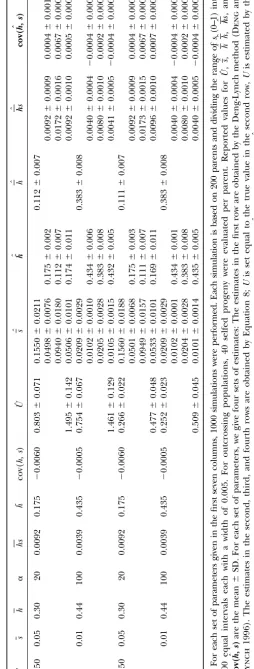
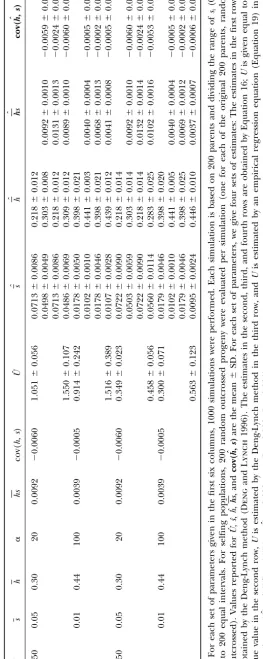
and experimental data (e.g.,Keightley1994). method (Table 2), which is expected as pointed out earlier. The estimates ofs,hs, and cov(h,s) are upwardly The simulation results are represented by the data in
Tables 1–4. The ranges of the values for the parameters biased and estimates ofhare downwardly biased because Uˆ1is downwardly biased, which can be understood from (such as U, h, and s) generally cover those reported
earlier from classical empirical experiments (e.g.,Mukai Equation 16.
Third, in outcrossing populations, the cov(h, s) is
et al. 1972;Lynch et al. 1999). Three general
conclu-sions emerge from our simulation studies under variable correctly estimated to be an upper bound of cov(h,s); however, the sign of cov(h, s) can sometimes be esti-mutation effects. First, whenUis set to equal true values
or when the estimates ofUare obtained via Equation 19 mated to be different from that of cov(h,s). In selfing populations, cov(h,s) can always be estimated with cor-by assuming a correct-value, application of Equation 8
or 16 to both obligate selfing or outcrossing populations rect sign and small estimation bias. yields nearly unbiased estimates for the DGM
parame-ters with small standard deviation. The estimates of U
ROBUSTNESS ANALYSIS by Equation 8 have smaller mean square error despite
larger standard deviation when U is set equal to the In the estimation of the DGM parameters, we need a prior estimate of one of the six parameters (such asU estimates obtained by regression Equation 19 than those
obtained by the Deng-Lynch method. The larger stan- as investigated here) based on some external knowledge obtained from other estimation approaches. The esti-dard deviation may be partly due to the fact that
Equa-tion 19 is established by empirical regression procedures mation bias of this parameter or the bias of an assumed value will cause estimation bias of the other parameters. that involve an additional level of sampling error for
the final estimation. The estimates ofsby Equation 8 Hence, we investigate the sensitivity of estimators to the departures ofU from true value, using computer in outcrossing populations have smaller sampling
vari-ance and smaller bias than those obtained directly by simulations (Figures 1 and 2). We define a relative bias rate (RBR), (estimate ⫺ true value)/(true value), to the Deng-Lynch method,e.g., by comparison of the
esti-mates in rows 1 and 3 for each parameter set in Table measure the sensitivity of estimators to an incorrectly assumed or estimated U value. In examining the ro-1. This is true even when no prior assumption is made
about the magnitude of U, when U is first estimated bustness of the estimator for cov(h, s), the true value used is the parameter value ofcov(h, s)as defined after directly with the Deng-Lynch method, and then the
esti-mate of U is used in the current estimation method, Equation 10 and not cov(h,s).
In simulations for the investigation of the robustness (Equation 8) for the other DGM parameters. The
esti-mates ofh˜ by Equation 8 have smaller or comparable of our current estimation of the other DGM parameters, Uis set equal to a given value (denoted asUgiven), which sampling variance than those obtained directly by the
Deng-Lynch method forh(for each parameter set, com- ranges from 0.5U0to 1.5U0(U0is the true value ofU). This range of the estimate ofU investigated is reason-pare the estimates of the second to fourth rows with
that of the first row in Table 1). The comparison of able given the magnitude of bias that is normally found with the method such as that of Deng and Lynch the estimation quality between the current estimation
method and the Deng-Lynch method changes little with (1996). The changes in the mean relative bias rates (MRBR) of the estimates of the parameter values in the parameter values (Table 1). When ⫽0.5, the bias
of the estimates of the parameters is larger than that 1000 simulations are shown in Figures 1 and 2. It can be seen that when Ugiven ranged from 0.7U0 to 1.5U0 when ⫽1 and 2. This may be due to the approximation
formula 18 used to computepk⫽P(si 僆Ik) when ⫽ (which means that the departure ofUgivenfromU0ranged from⫺0.3U0to 0.5U0), the MRBR of the estimates of the 0.5, while the computation ofpk⫽P(si僆Ik) when ⫽
1 and 2 is exact. parameter values changed smoothly and changed little
in both outcrossing and selfing populations. WhenUgiven Second, whenUis set equal to the estimates (Uˆ1) that
were obtained by the Deng-Lynch method (Dengand ranged from 0.9U0 to 1.2U0, the absolute values of the MRBR of the estimates of parameters [exceptcov(h, s) Lynch1996) and that are downwardly biased, the
esti-mates of the other DGM parameters by Equations 8 and for outcrossing populations when ␣ ⫽20] are⬍0.185 in both outcrossing and selfing populations. For out-16 are biased with small sampling variance (Tables 1 and
2). For outcrossing populations, the estimation Equation 8 crossing populations, when␣ ⫽ 20, ifUgivenⱕ 0.9U0or
Ugivenⱖ1.1U0, the absolute values of the MRBR ofcov(h,
yields less biased estimates with smaller standard
devia-tion forsthan for the Deng-Lynch method (Table 1), s)are⬎1.0 (Figure 1, b and d). (Note the scale differ-ence of they-axis in Figure 1, b and d, with the other and the estimates ofs,hs,cov(h, s)are upwardly biased
and estimates ofh˜are downwardly biased. The result can plots in Figures 1 and 2.) Thus, even whenUis estimated with some bias, if the magnitude is similar to that ob-be understood from Equation 8, sinceUˆ1is downwardly
Figure1.—The changes in RBR of the estimates ofs, h˜, hs, cov(h, s)obtained by Equation 8 in outcrossing populations whenUwere given equal to the values that ranged from 0.5U0to 1.5U0. Each data point was the mean in 1000 simulations with the following sets of parameters and ⫽1.0: (a)U0⫽1.5,s⫽0.01, and␣ ⫽100; (b)U0⫽1.5,s⫽0.05, and␣ ⫽20; (c)U0⫽ 0.5,s⫽0.01, and␣ ⫽100; and (d)U0⫽0.5,s⫽0.05, and␣ ⫽20.
(1996), our current estimation method can generally Importantly, cov(h,s) for DGM can be estimated (Equa-tion 10) from an experiment for the first time. Pre-still yield relatively robust estimates of DGM parameters
(exceptcov(h, s)for outcrossing populations when␣is viously, a negative correlation betweenhandshas long been conjectured from theory only (KacserandBurns as small as 20). In outcrossing populations, the MRBR
changed the sign in the robustness investigation of 1981) and from limited data (SimmonsandCrow1977; CrowandSimmons1983). There has been no formal cov(h, s)whens ⫽0.01 and 0.05, respectively. This is
because the parameter valuecov(h, s)changed the sign statistical analysis and experimental design to character-ize cov(h,s).
from negative to zero and then to positive values under
the functions assumed whenschanges from 0.047 to 0.048. Characterization of cov(h,s) is important, for exam-ple, for testing the validity of the dominance hypothesis (TurelliandOrr1995) in explanation of Haldane’s DISCUSSION
rule. Haldane’s rule states that when one sex is inviable or sterile in the hybrids of two different animal races, We have developed a method in this study for
consid-that sex is often the heterogametic sex. The dominance ering variable mutation effects across loci in the
estima-hypothesis (TurelliandOrr1995) states that alleles tion. The method may yield improved estimation over
decreasing hybrid fitness are partially recessive. For the that ofDengandLynch(1996) as shown by employing
dominance hypothesis to explain Haldane’s rule, it is additional and independent information (such as the
necessary that cov(h, s) is ⬍0. Hence, our estimation covariance between mean fitness of parents and that of
method here may offer the first opportunity to test the their progeny) to that employed inDeng andLynch
Figure2.—The changes in MRBR of the estimates ofs, h, hs, cov(h,s) obtained by Equation 16 in selfing populations when Uwere given equal to the values that ranged from 0.5U0to 1.5U0. Each data point was the mean in 1000 simulations with the following sets of parameters and ⫽1.0: (a)U0⫽1.5,s ⫽0.01, and␣ ⫽100; (b)U0⫽1.5,s ⫽0.05, and␣ ⫽20; (c)U0⫽ 0.5,s⫽0.01, and␣ ⫽100; and (d)U0⫽0.5,s⫽0.05, and␣ ⫽20.
dane’s rule by characterizing the sign of cov(h, s). Al- with the Deng-Lynch method. We present in the appen-dixthe estimators of other DGM parameters whenhis though it would be nice and significant to have
estima-tors for the other DGM parameters as well, such as assumed or estimated and some representative simula-tion results.
variance of s, the observable phenotypic moments of
fitness do not relate to other DGM parameters (includ- It can be seen from Equations 1a and 1b that the mean ofhfor the Charlesworth technique (Charlesworthet ing the variance of s) in our analytical derivation that
considers mutation effects in Equations 2–7 and 11–15. al.1990) in estimatingUin selfing populations should be the arithmetic meanh, and the mean for the Morton In the estimation of the DGM parameters, we need
a prior estimate of one of the six parameters based on technique (Mortonet al.1956) in outcrossing popula-tions should be the harmonic meanh˜.This has seldom, some external knowledge or based on the estimates
obtained from alternative approaches or from the same if ever, been pointed out because the Morton-Charles-worth technique was derived under constant mutation experimental design by using the Deng-Lynch method
as demonstrated here. We provided the estimators of effects. To our knowledge, there has been no method for estimating eitherh˜ orh. Our proposed estimation the other DGM parameters by using Equations 8 and
16 when assuming that U is known or estimated via methods here are able to, again for the first time, allow estimates of h˜ and h with relatively small bias under other approaches. If we assume that one of the
parame-ters s, h˜ (h), or hs is known or estimated from other variable mutation effects.
The majority of earlier estimation methods for DGM approaches, estimators of the other DGM parameters
can be obtained. Among the parameters,s andhs,h˜ (h) assume constant mutation effects. The only exception is the maximum-likelihood estimation developed for analy-can be estimated individually with the analysis methods
Genetic loads and estimates of mutation rates in highly inbred
1994, 1996). Like our current estimation method,
Keight-plant populations. Nature347:380–382.
ley’s maximum-likelihood estimation also needs to as- Craddock, N., V. Khodel, P. V. EerdeweghandT. Reich,1995 sume a parameter value of DGM to estimate the other Mathematical limits of multilocus models: the genetic
transmis-sion of bipolar disorder. Am. J. Hum. Genet.57:690–702.
DGM parameters in his model. Our results (Dengand
Crow, J. F.,1986 Basic Concepts in Population, Quantitative and
Evolu-Li2001) suggest that a method that accounts for variable tionary Genetics.W. H. Freeman, New York.
mutation effects does not necessarily always yield better Crow, J.,1993a How much do we know spontaneous human muta-tion rates? Environ. Mol. Mutagen.21:122–129.
estimation than a method that assumes constant
muta-Crow, J. F.,1993b Mutation, mean fitness, and genetic load, pp.
tion effects even under variable mutation effects. In our 3–42 in Oxford Surveys in Evolutionary Biology, Vol. 9, edited by current estimation, the covariance between mean fitness D. J. FutuymaandJ. Antonovics.Oxford University Press,
Ox-ford, New York.
of parents and that of their progeny is independent of
Crow, J.,1995 Spontaneous mutations as risk factors. Exp. Clin.
the other measurable experimental data (such as the Immunogenet.12:121–128.
means and genetic variance of fitness of the two genera- Crow, J. F.,andM. J. Simmons,1983 The mutation load in Drosoph-ila, pp. 1–35 inThe Genetics and Biology of Drosophila, Vol. 3c, edited
tions across inbreeding/outcrossing) that are used in
byM. Ashburner, H. L. CarsonandJ. N. Thompson.Academic
the Deng-Lynch estimation (Deng and Lynch1996).
Press, London/New York.
This additional and independent information contrib- Deng, H.-W.,1998a Estimating (over)dominance coefficient and discriminating dominance vs. overdominance as the genetic
utes to the improved estimation of our current method
cause of heterosis. Genetics148:2003–2014.
in quality and to our ability to estimate additional DGM
Deng, H.-W.,1998b Characterization of deleterious mutation rate
parameters that could be estimated earlier. and properties in outcrossing populations. Genetics150:945–
956.
For our methods that are applicable to natural
out-Deng, H.-W.,andY.-X. Fu,1998 On the three different methods
crossing populations and selfing-fertilizing populations,
for estimating deleterious genomic mutation parameters. Genet.
M-S balance is assumed to be the mechanism main- Res.71:223–236.
Deng, H.-W.,andJ. Li,2001 Comparison of two estimation methods
taining variation for fitness. Alternatives to M-S balance,
for mutation accumulation experiments: maximum likelihood
such as functional overdominance or overdominance
in-and method of moments. Life Sci. Res.5:189–201.
duced by fluctuating selection, may, in principle, maintain Deng, H.-W.,andM. Lynch,1996 Estimation of the genomic muta-polymorphisms. Most evidence suggests dominance as tion parameters in natural populations. Genetics144:349–360.
Deng, H.-W.,andM. Lynch,1997 Inbreeding depression and
in-heterozygous mutation effects and thus is compatible
ferred deleterious mutation parameters in Daphnia. Genetics
with M-S balance (Houle1989, 1994;Houleet al.1996; 147:147–155.
Deng et al. 1998). However, mechanisms responsible Deng, H.-W., Y.-X. Fuand M. Lynch,1998 Inferring the major
genomic mode of dominance and overdominance. Genetica102/
for the maintenance of genetic variance are complex
103:559–567.
and may differ among populations. If any other
mecha-Deng, H.-W., J. LiandJ.-L. Li,1999 On the experimental designs
nism, such as balancing selection or migration, leads to and data analyses of mutation accumulation experiments. Genet. Res.73:147–164.
the maintenance of genetic variation (Drakeet al.1998;
Drake, J. W., B. Charlesworth, D. CharlesworthandJ. F. Crow,
Keightley 1998), our methods may result in biased
1998 Rates of spontaneous mutation. Genetics148:1667–1686.
estimation. Using approaches (Li et al. 1999; Li and Fu, Y.-B.,andK. Ritland,1996 Marker-based inference about
epis-tasis for gene influencing inbreeding depression. Genetics144:
Deng2000;H.-W. DengandJ. Li, unpublished results)
339–348.
that we have used to investigate the robustness of the
Gao, H.-X.,1995 Statistical Computation. Peking University Press,
Deng-Lynch method in the presence of violation of the Beijing.
M-S balance assumption, we can and we will pursue in Gregory, W. C.,1965 Mutation frequency, magnitude of change and the probability of improvement in adaptation. Radiat. Bot.
our future studies investigation of how robust the
cur-5(Suppl.): 429–441.
rent method is with different degrees of violation of Houle, D.,1989 Allozyme-associated heterosis inDrosophila
melano-M-S balance assumption. gaster.Genetics123:789–801.
Houle, D.,1994 Adaptive distance and the genetic basis of heterosis. We are grateful to anonymous reviewers for their constructive
com-Evolution48:1410–1417.
ments that greatly helped to improve the manuscript. This work is Houle, D., B. MorikawaandM. Lynch,1996 Comparing muta-partially supported by grant R01 GM60402-01A1 from National Insti- tional variabilities. Genetics143:1467–1483.
tutes of Health (NIH). H.W. Deng was also partially supported by Kacser, H.,andJ. A. Burns, 1981 The molecular basis of domi-grants from Health Future Foundation, NIH K01 grant AR02170-01, nance. Genetics97:639–666.
NIH R01 grant AR45349-01, grants from State of Nebraska Cancer Keightley, P. D., 1994 The distribution of mutation effects on and Smoking Related Disease Research Program (LB598), Nebraska viability inDrosophila melanogaster.Genetics138:1315–1322.
Keightley, P. D.,1996 Nature of deleterious mutation load in Dro-Tobacco Settlement Fund (LB692), NIH grant P01 DC01813-07, U.S.
sophila. Genetics144:1993–1999. Department of Energy grant DE-FG03-00ER63000/A00, grants (30025025
Keightley, P. D.,1998 Inference of genome-wide mutation rates and 30170504) from National Science Foundation of China, and
and distributions of mutation effects for fitness traits: a simulation grants from HuNan Normal University and the Ministry of Education
study. Genetics150:1283–1293. of China.
Kondrashov, A. S.,1988 Deleterious mutations and the evolution of sexual reproduction. Nature336:435–440.
Li, J.,andH.-W. Deng,2000 Estimation of parameters of deleterious mutations in partial selfing or partial outcrossing populations
LITERATURE CITED
and in nonequilibrium populations. Genetics154:1893–1906.
Li, J.-L., J. LiandH.-W. Deng,1999 The effects of overdominance
Bataillon, T.,2000 Estimation of spontaneous genome-wide
muta-on characterizing deleterious genomic mutatimuta-ons in natural pop-tion rate parameters: Whither beneficial mutapop-tion? Heredity84:
ulations. Genetics151:895–913. 497–501.
1999 Perspective: spontaneous deleterious mutation. Evolution
53:645–663. U⫽ 4y
2⫺(1/h˜), s⫽
4b⫺2x
U , hs⫽
x
U. (A1)
Mackay, T. F. C., R. F. LymanandM. S. Jackson,1992 Effects ofP
element insertions on quantitative traits inDrosophila melanogaster.
Genetics130:315–332. and in selfing populations,
Morton, N. E., J. F. CrowandH. J. Muller,1956 An estimate of the mutational damage in man from data on consanguineous
U⫽ y
(0.5⫺h), s⫽ 2x
U, hs⫽
2b
U. (A2)
marriages. Proc. Natl. Acad. Sci. USA42:855–863.
Mukai, T., S. I. Chigusa, L. E. MettlerandJ. F. Crow,1972 Muta-tion rate and dominance of genes affecting viability inDrosophila
Simulations are performed similar to that described melanogaster.Genetics72:335–355.
Simmons, M. J.,andJ. F. Crow,1977 Mutations affecting fitness in in the text and with the above estimation for other DGM
Drosophilapopulations. Annu. Rev. Genet.11:49–78.
parameters when h˜ (in outcrossing populations) or h
Turelli, M.,andA. Orr,1995 The dominance theory of Haldane’s
(in selfing populations) is known or estimated. The
rule. Genetics140:389–402.
simulation and the experimental procedures, when h˜
Communicating editor:Z-B. Zeng
(in outcrossing populations) andh(in selfing popula-tions) are estimated by the methods of Deng(1998a) APPENDIX: ESTIMATION OF OTHER DGM orMukaiet al.(1972), are detailed inDenget al.(1998)
PARAMETERS WHENhIS ASSUMED OR and thus are not elaborated here.
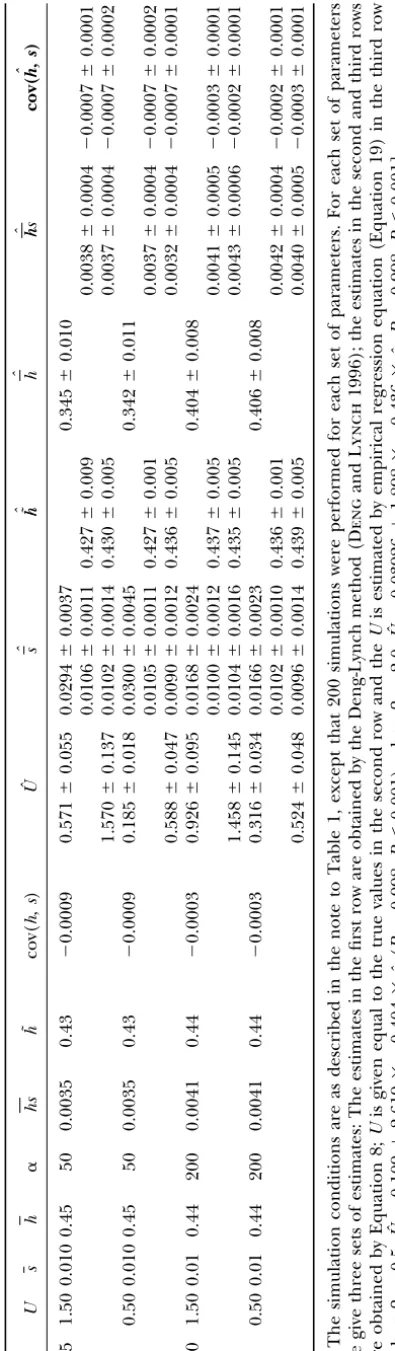
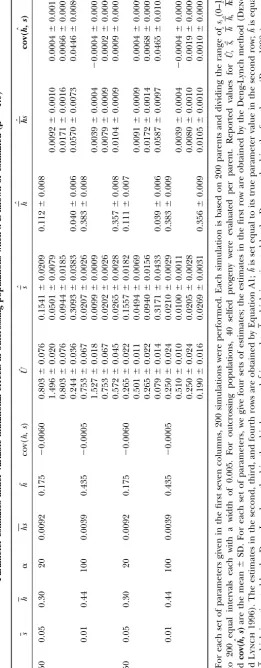
ESTIMATED AND SOME REPRESENTATIVE Some representative results are presented in Tables SIMULATION RESULTS
A1 and A2. It can be seen that, relative to the Deng-Lynch method, the new method developed here can Ifh˜(in outcrossing populations) orh(in selfing
popu-lations) is known by other estimation methods or as- estimate more parameters, such as cov(h,s) and its sign. In an outcrossing population, the sign of cov(h,s) can-sumed at particular values on the basis of some external
knowledge, based on Equations 2–7 and 11–15, we have not be reliably estimated. However, in selfing popula-tions, if the h is estimated first by the Deng-Lynch estimators for other DGM parameters as follows, the
notations being the same as in the text, in outcrossing method and then used in the current method, the sign of cov(h,s) can be characterized correctly.