DOI: 10.1534/genetics.107.073072
Frequency-Dependent Selection and the Maintenance of Genetic
Variation: Exploring the Parameter Space of the Multiallelic
Pairwise Interaction Model
Meredith V. Trotter
1and Hamish G. Spencer
Department of Zoology, Allan Wilson Centre for Molecular Ecology and Evolution, University of Otago, Dunedin 9054, New Zealand Manuscript received March 8, 2007
Accepted for publication April 19, 2007
ABSTRACT
When individuals’ fitnesses depend on the genetic composition of the population in which they are found, selection is then frequency dependent. Frequency-dependent selection (FDS) is often invoked as a heuristic explanation for the maintenance of large numbers of alleles at a locus. The pairwise interaction model is a general model of FDS via intraspecific competition at the genotypic level. Here we use a parameter-space approach to investigate the full potential for the maintenance of multiallelic equilibria under the pairwise interaction model. We find that FDS maintains full polymorphism more often than classic constant-selection models and produces more skewed equilibrium allele frequencies. Fitness sets with some degree of rare advantage maintained full polymorphism most often, but a wide variety of nonobvious fitness patterns were also found to have positive potential for polymorphism. An example is put forth suggesting possible explanations for multiallelic polymorphisms maintained despite positive FDS on individual alleles.
T
HE majority of existing models of natural selectionassume that selection remains constant over time. This use of constant selection coefficients is largely for
mathematical convenience (Kojima 1971), since it is
much more likely that selection pressures in real popu-lations will vary, for example, in space and time. One way to model changing selection is to make fitness frequency dependent: When individuals’ fitnesses de-pend on the genetic composition of the population in which they are found, selection is then frequency dependent. Intuitively, negative frequency dependence (selection against common alleles) should be good at maintaining many alleles at a locus. Conversely, one would expect positive frequency dependence (selection for common alleles) to result in monomorphism. Pos-itive and negative frequency-dependent selection (FDS) are but two extremes along a continuum; there is substantial evidence to suggest that many kinds of FDS are widespread in naturally polymorphic populations. In experiments with cultivated plants, genotypic fit-nesses are affected in a variety of ways by the presence,
number, and genotype of their neighbors (Antonovics
and Ellstrand1984). Studies of predator–prey choice
(Allenet al.1998; Bondand Kamil1998, 2002; Allen
and Weale2005; for reviews see Allen1988; Punzalan
et al.2005) have found evidence for a variety of kinds of FDS. Positive FDS specifically has been implicated in
studies of Mullerian mimicry (Langham 2004).
Nega-tive FDS is found in a wide variety of systems such
as host–pathogen coevolution (May and Anderson
1983; Dybdahl and Lively 1998; Carius et al. 2001;
Trachtenberget al.2003), mate choice (Hugheset al.
1999), and Batesian mimicry (Pfennig et al. 2001;
Cheneyand Cote2005; Andersonand Johnson2006) and is generally used as a heuristic explanation for the
selective maintenance of genetic variation (e.g., Wilson
et al. 1994; Raymond et al. 1996; Yuste et al. 2002; Billiardet al. 2005; Olendorfet al. 2006; Piertney
and Oliver2006).
The abundance of field evidence for FDS (and not only negative FDS) in polymorphic natural systems suggests that we require a more mathematically rigorous explanation for this polymorphism than ‘‘it must be some sort of negative frequency dependence.’’ What kinds of FDS can maintain variation? What kinds of equilibrium allele-frequency distributions does FDS produce? How do systems with positive FDS (predator choice, mimicry, etc.) retain polymorphism? Does FDS produce a detectable signature of selection in popula-tion allele frequencies? To address these and other questions about FDS and polymorphism, we first re-quire a general model of FDS. Here we use the pairwise interaction model (PIM) of selection via intraspecific competition as our general model of FDS.
Ever since Darwin, the concepts of intraspecific com-petition and natural selection have been closely linked. As natural selection is a consequence of the struggle for existence, so can its mirror image, fitness, be considered a consequence of intraspecific competitive interactions. Cockerham et al. (1972) argued that parameterizing
1Corresponding author :Department of Zoology, Allan Wilson Centre for
Molecular Ecology and Evolution, University of Otago, P.O. Box 56, Dunedin 9054, New Zealand. E-mail: [email protected]
fitness as a product of intraspecific competition at the genotype level provides a more biologically reasonable, but still mathematically tractable, framework for mod-eling natural selection. The PIM is such a model: A genotype’s fitness is a function of its frequency in the population, its relative fitness in interactions with the other genotypes, and the frequencies of the other genotypes. Each genotype is assumed to have some constant interaction-fitness value in association with each other genotype in the population, and, assuming random mixing of individuals, the frequencies of inter-actions correspond to the frequencies of the interacting genotypes. The biological motivation for modeling fit-ness as a function of intergenotypic interactions is per-haps most obvious in plant systems, where the genotypes of neighboring plants can have a variety of immediate
impacts on fitness (Antonovicsand Ellstrand1984).
Its general formulation allows the PIM to include all forms of FDS (positive, negative, balancing, disruptive) as well as constant selection as a special case. One could parameterize the model by constructing structured fit-ness sets corresponding to commonly observed forms of FDS in nature or by presuming the frequency depen-dence to be due to some specific biological mechanisms (say, predation) but we are interested in the more gen-eral question of the maintenance of polymorphism un-der all possible forms of FDS.
Most existing models of genotype-level FDS have
focused on a single diallelic locus (Asmussen and
Basnayake 1990; Altenberg 1991; Gavrilets and Hastings 1995; Yiet al. 1999; Asmussen et al. 2004) and/or examine only very special cases of frequency
dependence (Roff 1998; Burger and Gimelfarb
2004; Burger 2005; Schneider2006). Asmussenand
Basnayake(1990) made a full analysis of the potential for maintaining genetic variation in the diallelic PIM and our numerical results for the multiallelic PIM with two alleles agree with those findings. Investigations of the potential for chaos and cycling in the diallelic PIM
have also been undertaken (Altenberg1991; Gavrilets
and Hastings1995). Cycling behavior was observed in
our model, and discussion of this phenomenon will be undertaken elsewhere.
By extending the PIM to the multiallelic case we want to clarify the potential for maintaining many alleles at a locus under FDS. Our analysis is motivated by three central questions: (1) How effective is FDS in general at maintaining genetic variation as compared to other models?, (2) What kinds of FDS are best at maintaining genetic variation?, and (3) What kinds of allele-frequency distributions does FDS produce?
THE MODEL
We use an approach similar to that of Lewontinet al.
(1978) to measure the proportion of PIM parameter
space, for a given number of alleles (n), that has
po-tential to maintain all alleles. We measure the popo-tential of a large number of randomly generated fitness sets to maintain genetic variation as a means to assess the overall potential for genetic variation under the model. Note that the measured potential for variation does not correspond to any sort of ‘‘probability’’ of maintaining variation. The random generation of fitnesses and initial allele frequencies simply allows us to measure the po-tential for variation in all regions of the parameter space. We make no assumptions about the distributions of these fitness values and genotype frequencies in nature. The measurement of overall potential, together with assumptions about the nature of fitness determi-nation and mutational generation of allele frequencies, can give us a clearer idea of the role of FDS in main-taining polymorphisms in nature. This study is con-cerned with the measurement of potential under the PIM; further investigations of fitness determination and mutation in the PIM are currently underway.
Until recently, such an investigation of the potential for permanent genetic variation in PIM with multiple alleles would have been impractical due to limitations with available computational power. With the exception
of special cases (Altenberg 1991; Gavrilets and
Hastings 1995; Asmussenet al. 2004), the systems of recursion equations governing fitness are analytically intractable, and so numerical simulations are required to fully elucidate the behavior of the model.
The general formulation of the PIM (Cockerham
et al. 1972) concerns a single diploid locus under
viability selection withnalleles, in an infinite, isolated
population with random mating, discrete generations, and no mutation. The central assumption of the PIM is
that each genotypeAiAjhas distinct fitnesses in its
inter-actions with the other genotypesAkAlin the population.
These values are referred to individually as interaction
fitnesses (wij,kl) and collectively as fitness sets. Note
that AiAj is assumed to be equivalent to AjAi, and thus
wij;kl ¼wji;kl ¼wij;lk¼wji;lk. Assuming that individuals in
the population mix at random, intergenotypic interactions will occur in proportion to the genotype frequencies.
Allele frequencies are governed by the
transforma-tionpi9¼piwi=w, wherep9denotes the value ofpin the
following generation,piis the frequency of allelei,wiis
the marginal fitness of allelei, andw¼Pn
i¼1piwiis the
mean fitness of the population.
The total fitness of each genotype (wij) is a linear
function of its relative fitnesses in interactions with the other genotypes in the population, weighted by the frequencies of those genotypes:
wij ¼
Xn
k¼1
Xn
l¼1
pkplwij;kl:
The marginal fitness of alleleiis a sum of fitnesses for
wi¼
Xn
j¼1
pjwij:
The properties of the model are invariant to the scaling
of wij;kl-values because their relative rather than
abso-lute values determine the dynamics and equilibrium outcome of a fitness set. We can assume, therefore,
without lack of generality that all wij;kl have values
between 0 and 1. Due to the complexity of the recur-sions, numerical simulations are required to determine the equilibrium state for any given initial conditions
of the system, except in special cases (Asmussenet al.
2004).
Numerical simulations were undertaken for systems of two, three, four, and five alleles. All programs were
written and run in both C11 and Matlab to confirm
results. For eachn, we generated 100,000 random
fit-ness sets, where each wij;kl was a uniform random
number between 0 and 1, using the lagged-Fibonacci
pseudo-random-number generator of Marsagliaet al.
(1990). Assuming a uniform distribution ofwij;kl’s allows
us to visualize the total fitness space as ann(n 1 1)/
2-dimensional hypercube of unit dimensions. The ran-dom generation of fitnesses does not imply any assumption that fitness values in natural systems will be uniformly distributed; it is merely a method for measuring the pro-portion of the total parameter space that can maintain full polymorphism.
In the PIM, the equilibrium state of the system may differ depending on the initial allele-frequency vector
used (Cockerhamet al.1972; Asmussenand Basnayake
1990), for example, if a fixation state and a polymorphic equilibrium are simultaneously stable. For each fitness set allele frequencies were iterated to equilibrium from
at least 10nrandom initial allele-frequency vectors
gen-erated using a broken-stick method (as described in
Marksand Spencer1991). The population was
consid-ered to be at allele-frequency equilibrium if the
maxi-mum change in allele frequency (Dpi) fell below 109.
The proportion of allele-frequency vectors that main-tained full polymorphism for any given fitness set is
henceforth referred to as the potential for genetic
variation (after Asmussen and Basnayake 1990).
Al-leles whose frequencies fell below 105were considered
extinct. Iteration of allele frequencies was stopped when
an extinction (pi , 105 for somei) occurred or the
population reached a fully polymorphic equilibrium (pi
.105for alli). If neither condition had occurred after
104generations, the run was stopped and that fitness set
stored for further investigation. If at least one equilib-rium was reached, the final allele frequencies were re-corded and counters updated for the number of, and potential for, fully polymorphic equilibria given that fitness set.
Fitness sets that maintained full polymorphism from at least one initial allele-frequency vector are referred to
as ‘‘successful.’’ A fitness set is thus successful if and only if its potential is greater than zero. At the end of each successful run, equilibrium allele frequencies, mean fitness, and the successful fitness set were stored. The simulations kept statistics on the proportion of success-ful sets and, for each successsuccess-ful set, the potential for success-full polymorphism. Statistics were also kept of the overall potential for full polymorphism across all fitness sets.
To facilitate comparisons across different values ofn,
we partitioned the interaction-fitness values within each fitness set into nine different fitness classes. Class divi-sions are based on the heterozygosity of, and amount of allele sharing between, interacting genotypes. The class of homozygote-by-like-homozygote interactions,
for example, is characterized by Cii,ii, and the class of
homozygote-by-unlike-homozygote interactions byCii,jj.
For each fitness set, the value of each fitness class is the mean of all the interaction fitnesses belonging to that class. Since the dynamics of the model depend not only on the fitness set but on allele frequencies as well, we also measured fitness classes after weighting each fitness set by its allele frequencies at equilibrium. It is worth
noting that not all classes exist forn,4, as a system with
two or three alleles cannot have
heterozygote-by-unlike-heterozygote (Cij,kl) interactions, etc.
To provide a basis for comparisons, for all n we ran
analogous simulations using constant genotypic fitness
sets (after Lewontinet al. 1978). Since any fully
poly-morphic equilibrium is globally stable for this (Lewontin
et al.1978) form of selection, the proportion of fitness sets that maintain variation and the overall potential for variation are equivalent.
RESULTS
Potential for maintaining genetic variation:We
mea-sured the potential for maintaining genetic variation
under the PIM for a given value ofnusing two different,
nested, methods. First we recorded the proportion of the total number of random fitness sets that maintained all alleles from at least one starting allele-frequency
vector (i.e., the successful fitness sets). For each fitness
set, we also recorded the proportion of allele-frequency starting vectors that maintained all alleles (potential for variation) and then averaged these values across fitness sets to give the overall potential for maintaining var-iation. Both measures are illustrated in Figure 1, while the distributions of the potential for variation for each successful fitness set can be found in Figure 2.
As we know from Lewontin et al. (1978), and
reconfirmed by our own simulations (Figure 1), the proportion of fitness sets that maintain genetic variation
in constant selection models drops off drastically as n
increases and is vanishingly small forn.5. In the PIM
simulations, the proportion of fitness sets maintaining
It would seem then that there are weaker constraints on what kind of PIM fitness set can maintain variation for
any givenn. Due to the sensitivity of equilibrium
con-ditions to initial allele frequencies, the potential for main-taining variation in the PIM drops off more rapidly than does the proportion of successful fitness sets.
Fitness sets that led to more than one distinct poly-morphic equilibrium were relatively rare (1198 cases for
n¼2, 305 whenn¼3, 33 whenn¼4, and 4 whenn¼5),
and almost all of those consisted of cases with two equilibria. There were two fitness sets, both involving three alleles, that led to three distinct polymorphic equilibria. While the vast majority of successful fitness sets maintained their alleles in an equilibrium state, a small subset of fitness sets produced permanent
allele-frequency cycling (0.3367% of cases whenn¼3, 0.370%
whenn¼4, 0.197% whenn¼5). The fitness sets that
led to cycling are included in the measures of total
potential for variation (i.e., Figure 1), but they are not
included in the other analyses in this article.
As the number of alleles in the system increased the mean within-fitness-set potential for variation dropped off (Figure 2). More exactly, as the number of alleles in the system increased the distribution of the proportion of initial allele-frequency vectors that led to a fully polymorphic equilibrium changed from being strongly
skewed toward 1.0 for n¼2 to being strongly skewed
toward 0.0 for n ¼5. This result makes sense if one
considers that, as the number of alleles increases, the number of interaction fitnesses increases drastically and so too does the number of possible evolutionary out-comes, particularly the number of fixation equilibria. Consequently, as numbers of alleles increase, we expect a randomly generated allele frequency vector to be less
Figure1.—Proportion of PIM parameter space
that maintains variation. (A) Proportion of suc-cessful fitness sets (i.e., those with nonzero poten-tial for full polymorphism) forn¼2,. . ., 5. (B) Overall potential for full polymorphism for sys-tems withn ¼ 2,. . ., 5 alleles. Log-transformed data are shown.
Figure2.—Distributions ofP, the potential for
likely to fall within the domain of attraction of a fully polymorphic equilibrium. The overall mean proportion of points converging to a fully polymorphic equilibrium decreases linearly with the number of alleles while the total allele-frequency space increases exponentially. This apparent limitation on systems with large numbers of alleles makes it nearly impossible to find
success-ful fitness sets forn.5 by randomly searching fitness
space.
One might reasonably expect the proportion of vectors that converge to a fully polymorphic equilibrium to be related to the values of the interaction fitnesses. Fitness sets with negative FDS might have larger do-mains of attraction for their equilibria, for example. In the context of the PIM, we consider negative FDS to mean that genotypes have their highest fitness when they are rare, which intuitively should promote poly-morphism by making extinction of alleles difficult. This kind of negative FDS is most likely in fitness sets where
Cii,ii-andCij,ij-values are low relative to the otherCij,kl’s,
where low-fitness self-interactions drive down the fitness of genotypes at high frequencies.
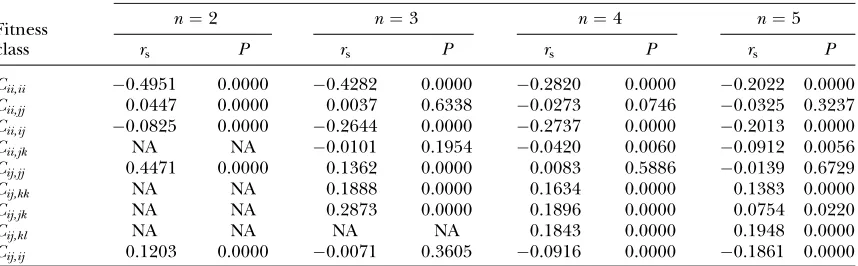
We examined correlations between within-fitness set
potential for variation (P) and the variousCclass values
using Spearman’s nonparametricr(rs).C–Pcorrelations
are summarized in Table 1. Each of the nine fitness
classes was significantly correlated withPfor at least one
n. Due to large sample sizes most fitness classes had
significant correlations withP, but all were weak (rs,
0.5). The only relationship consistent across alln is a
negative correlation betweenPandCii,ii.For alln.2,
P is also negatively correlated with Cii,ij, which also
implies negative FDS since Cii,ij-values will also drag
down the fitness of alleleiwhen it is common. These
cor-relative analyses suggest that fitness sets with some
de-gree of negative FDS (due to low Cii,ii- and/or Cii,ij
-values) do tend to have larger domains of attraction around their polymorphic equilibria.
Distribution of polymorphic equilibria: Centrality of
allele-frequency distributions: For all n, we compared the equilibrium allele-frequency distributions generated by PIM selection, constant selection, and random chance
(i.e., no selection), using the variance of the allele
fre-quencies I ¼Pni¼1ðpi ð1=nÞÞ
2
as a measure of their centrality. The ‘‘random chance’’ allele frequencies were generated using the same ‘‘broken-stick method’’
(as described in Marksand Spencer1991) we used to
produce initial allele frequencies scattered uniformly throughout allele-frequency space.
If all alleles are present at equal frequency,I¼0. If
one allele is common and the others are vanishingly
rare, I ðn1Þ=n, as n increases. Distributions of
I-values from allele-frequency equilibria generated by
the different models are summarized in Figure 3. For all
n, PIM equilibria tend to be less centralized than those
generated by constant selection, but more centralized than randomly generated allele frequencies. At the equilibria maintained by constant selection, heterozy-gote fitnesses are in general greater than those of
homozygotes (Lewontinet al. 1978). Because
hetero-zygotes each affect two allele frequencies equally, the frequencies at equilibrium are likely to be more similar than randomly chosen values. Under FDS, some homo-zygote fitnesses may also be large, so equilibrium allele frequencies tend to be less even than under constant selection (but still more so than randomly selected values). In nature, truly centered allele-frequency
dis-tributions are rare (Keith1983; Keithet al.1985), and
thus the ability of the PIM to generate skewed distribu-tions is an encouraging argument for its plausibility as a model.
Homozygosity test of neutrality:We wished to know if
the kinds of FDS produced by PIM fitnesses leave a de-tectable signature of selection in the equilibrium allele frequencies they produce. The equilibrium allele fre-quencies generated both by the PIM and by the classic
TABLE 1
Correlations (Spearman’sr) between within-set potential (P) and interaction fitness-class means (Cij,kl) for
different numbers of alleles (n)
rscorrelations betweenCclass values andP, the proportion of initial vectors that converged
to a polymorphic equilibrium for that fitness set
n¼2 n¼3 n¼4 n¼5
Fitness
class rs P rs P rs P rs P
Cii,ii 0.4951 0.0000 0.4282 0.0000 0.2820 0.0000 0.2022 0.0000
Cii,jj 0.0447 0.0000 0.0037 0.6338 0.0273 0.0746 0.0325 0.3237
Cii,ij 0.0825 0.0000 0.2644 0.0000 0.2737 0.0000 0.2013 0.0000
Cii,jk NA NA 0.0101 0.1954 0.0420 0.0060 0.0912 0.0056
Cij,jj 0.4471 0.0000 0.1362 0.0000 0.0083 0.5886 0.0139 0.6729
Cij,kk NA NA 0.1888 0.0000 0.1634 0.0000 0.1383 0.0000
Cij,jk NA NA 0.2873 0.0000 0.1896 0.0000 0.0754 0.0220
Cij,kl NA NA NA NA 0.1843 0.0000 0.1948 0.0000
constant selection model, forn ¼2,. . ., 5, were sub-jected to the Ewens–Watterson homozygosity test of
neutrality (Ewens 1979), using the method of Marks
and Spencer(1991). For each set of equilibrium allele
frequencies, we generated 200 multinomial samples of 50, 100, and 200 genes and noted the number of these samples that were rejected by the Ewens–Watterson (EW) test at the 5% level of significance. For a set of truly
neutral allele frequencies, we would expect 5% of
multinomial samples (10 of 200) to be rejected as non-neutral. Each sample, then, represents a single binomial
experiment with a probability of success,p, of 0.05. The
null hypothesis (thatp¼0.05) will be rejected at the 5%
significance level, given 200 trials, if the number of
successes is $18. The Ewens–Watterson test is a
two-tailed test, where smaller values of the homozygosity
statistic,F, indicate an excess of genetic diversity usually
explained by invoking balancing selection, and larger
values of F indicate a dearth of genetic diversity,
ex-plained by directional or purifying selection. Therefore Table 2 records the proportion of PIM equilibrium
allele frequencies that had $18 neutrality rejections
from either rejection region. All observed allele-frequency equilibria had significant numbers of rejections from only one rejection region, but never from both.
Although selection was acting in all cases, the homo-zygosity test detected selection in at most 56% of cases
(n¼5, 2k¼200). For alln, when neutrality was rejected,
it was most often rejected due to an excess of genetic
diversity (lowF). This result aligns with the standard
expectation that FDS is most likely to maintain variation when it is in the form of negative FDS (or balancing
selection). Interestingly, all n also had at least one
equilibrium for which the EW test rejected neutrality
in the high-Frejection region. HighF-values result from
highly skewed allele-frequency distributions (i.e., one
very common allele and many rare alleles) and imply
directional or purifying selection. High-Frejections are
far more numerous in the equilibria produced by PIM than in those produced by constant selection, further evidence that FDS is more apt to produce skewed allele frequencies at equilibrium.
Analysis of fitness sets:Strength of frequency dependence:
For each successful fitness set, and for 50,000 random
fitness sets pern, we calculated within- and among-row
and -column (ANOVA-style) variances. Within-row/ column variances are the means of the variances within rows/columns, and among-row/column variances are the variances of the within-row/column means. In
ran-dom fitness sets, as n increases, the among-row and
among-column variances converge to 0 (as within-row/ column means all approach 0.5) while the within-row
and within-column variances converge on 1
12 0.083
(the variance of the uniform distribution). The mean values of the four fitness set variance measures across all successful and random sets are in Table 3. Of the four metrics, within- and among-row variances differed be-tween successful and random sets while within- and among-column variances were indistinguishable.
In the context of the PIM, within-row variance of fitness sets corresponds to the strength of frequency dependence in the set. If all values in a row are equal, the genotype corresponding to that row will have con-stant (frequency-independent) fitness. Conversely, if
Figure 3.—The
the values within a row are highly variable, the fitness of that row’s genotype will depend more strongly on the frequencies of interacting genotypes, being thus under selection that is strongly frequency dependent.
Among-row variances (variance of within-row means) can be interpreted as measuring the strength of frequency-independent fitness. If the among-row variance is zero, all genotypes will have identical frequency-independent fitnesses. If the among-row variance is large, the genotypes will have widely differing fitnesses independent of fre-quency, being thus under strong frequency-independent selection. We compared both within- and among-row variances of successful sets with their values under ran-dom expectation. Within- and among-row variances for
successful sets are both significantly different (P,0.001
for alln) from their expected values of121 and 0 and from
the values generated by simulation of random matri-ces, respectively. Within-row variances were consistently larger in successful sets, whereas among-row variances were higher in random sets. Successful sets are therefore more strongly frequency dependent and more weakly selected than random chance predicts.
Mean fitness:For all successful fitness sets we recorded
the mean fitness (w) of the population at all equilibria.
For alln, mean fitnesses were normally distributed. The
range of mean fitnesses at equilibrium became more
narrow as n increased, and the average w decreased
from 0.54 atn¼2 to 0.51 atn¼5 (Table 4).
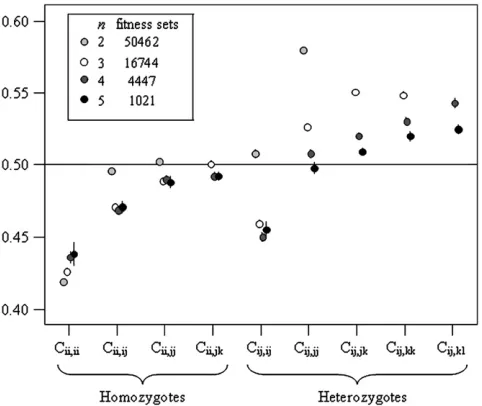
Fitness classes:The general pattern of fitness across all successful fitness sets is summarized in Figure 4. All fitness class values are normally distributed and all but
two are mutually uncorrelated, across all n, the
excep-tion being a weak significant correlaexcep-tion (r¼0.213,P,
0.001) between Cii,iiand Cij,jjwhen n ¼2. Interaction
fitnesses were originally drawn from the uniform
distri-bution½0, 1and each fitness class value was an average
of all fitnesses in that class; thus the expectation across all fitness sets and classes is 0.5. There are two obvious patterns in the fitness set data (Figure 4): heterozygote advantage and negative FDS.
While they are often cited separately as mechanisms for maintaining large amounts of genetic variation, het-erozygote advantage and negative FDS are not mutually exclusive. The results of the PIM simulations suggest
TABLE 2
For different numbers of alleles (n), proportions of the equilibria generated by the constant-fitness model and the PIM that produced significant numbers of rejections of neutrality under the homozygosity test of neutrality
Sample size
50 100 200
n No. of equilibria tested LowF HighF LowF HighF LowF HighF
PIM
2 51,565 0.11252 0.067875 0.22358 0.033046 0.20169 0.02717 3 16,836 0.27940 0.016393 0.29455 0.003326 0.30768 0.000713 4 4,304 0.3223 0.007203 0.3771 0.001394 0.4315 0.000232
5 927 0.303 0.00108 0.393 0 0.561 0
Constant fitness
2 33,091 0.1570 0.04790 0.29981 0.022151 0.2737 0.01837 3 4,292 0.4089 0.0119 0.4303 0.002796 0.4466 0.00117
4 232 0.496 0 0.547 0 0.608 0
5 5 0.4 0 0.4 0 0.4 0
TABLE 3
Overall means of within- and among-row and within- and among-column variances for successful and random PIM fitness sets
Successful sets Random sets
n 2 3 4 5 2 3 4 5
ARV 0.0238 0.0117 0.0074 0.0049 0.0279 0.0139 0.0083 0.0055 WRV 0.0874 0.0854 0.0844 0.0839 0.0832 0.0833 0.0833 0.0833 ACV 0.0279 0.014 0.0083 0.0053 0.0275 0.0139 0.0083 0.0055 WCV 0.0832 0.0832 0.0834 0.0834 0.0835 0.0834 0.0833 0.0834
that the two mechanisms may often act together to
maintain polymorphism. For all n, among successful
PIM fitness sets, the overall mean of heterozygote
fit-nesses,Cij, is on average significantly higher than the
mean homozygote fitness within the same set (P,0.001
for alln).
This pattern is also visible in Figure 4, where the majority of heterozygote fitness classes have means above 0.5, while homozygote fitness class means tend
to fall below 0.5. The exception to the rule,Cij,ij,
be-ing low whenn. 2, suggests that negative FDS is also
often a factor in PIM polymorphism.Cii,ii(alln) andCij,ij
(n . 2) are on average significantly ,0.5 (P , 0.001
for alln.2) and, more importantly, tend to have lower
values than the other C within sets (Figure 4). Low
fitnesses in interactions with like genotypes are an in-dicator of negative FDS, as these will drag down a ge-notype’s total fitness when it is at high frequencies, due to more frequent self-interactions.
Flavors of frequency dependence: The summary data from Figure 4 confirm that negative FDS is a good way to maintain polymorphism, but further analyses suggest it is not the only way. Intuitively, one would expect fit-ness sets with negative FDS or heterozygote advantage to
be most likely to maintain variation, while positive FDS and homozygote advantage should eliminate variation and so be absent from our collection of ‘‘successful’’ fitness sets. We searched the successful sets for various different kinds of selection, using schemes and criteria as listed in Table 5. If a genotype has low fitness in interactions with like genotypes, its fitness will tend to decrease as its own frequency increases. A fitness set is thus considered to be under negative FDS if the fitness
class values for self–self-interactions (Cii,iiandCij,ij) are
the lowest fitness class values. For strict negative FDS, we extend the above definition to include low fitness in interactions between genotypes that share similar alleles (Cii,ii ,Cii,ij,Cii,jj,Cij,jj,Cij,ik,Cij,kk, etc.). We
con-sidered a fitness set to contain heterozygote advantage if all heterozygote fitness class values were greater than all homozygote fitness class values. Positive FDS schemes are the mirror images of the negative FDS schemes, and homozygote advantage is the opposite of heterozygote advantage.
For simplicity, Table 5 lists results only for then¼3
case. Results were nearly identical for all other numbers
of alleles. The only notable difference amongnwas that
for largern, the proportion of sets meeting the negative
FDS criteria increased from 17% forn ¼3 to 20% for
n¼4 and to almost 25% forn¼5. The fitness schemes
we used, while informative, accounted for at most (when
n ¼ 5) 32% of the total fitness sets that maintained
polymorphism. The majority, then, of successful fitness sets had nonobviously quantifiable patterns of fitness. Of the above selection schemes, negative FDS was by far the most common pattern found in successful sets. Neg-ative FDS is commonly cited as a form of balancing selection and therefore might be expected to produce even allele-frequency distributions at equilibrium.
Nei-ther the distributions ofI-values for equilibria from sets
with negative FDS nor any of the other selective sce-narios differ qualitatively from the overall distribution pictured in Figure 3.
Contrary to intuitive expectation, positive FDS oc-curred in 2.7% of successful fitness sets. The maintenance of variation by positive FDS ceases to be surprising when one recalls the multidimensional nature of the PIM. Our conventional definitions of positive (and negative) FDS assume that the fitness of a given allele depends primarily on its own frequency in the population, which is necessarily so in systems with two alleles. While the assumption of self-FDS may be biologically plausible, there is no mathematical reason for it to be valid in the context of the PIM. Alleles may be under positive FDS with respect to their own frequencies, which should elim-inate polymorphism, but this effect can be swamped by the influence of their interactions with other alleles in the system.
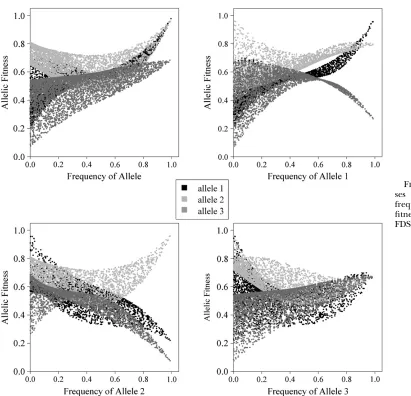
In the following example (Figure 5) data come from a
successful PIM fitness set withn¼3, where the criteria
were met for positive FDS, and a fully polymorphic
Figure4.—Fitness class means with 95% confidence
inter-vals for successful fitness sets withn¼2,. . ., 5.
TABLE 4
Summary statistics for mean fitnesses (w) at allNequilibria produced by the PIM with different (n) numbers of alleles
n N Minimum Maximum Mean Variance
equilibrium is maintained from10% of starting points. The allele interactions responsible for the maintenance of the fully polymorphic equilibrium are apparent if one examines plots of allele fitnesses against the frequency for each allele. While all alleles are under weak positive FDS with respect to their own frequency (Figure 5, top left plot), there is strong negative FDS on alleles 1 and 3 with respect to allele 2 (Figure 5, bottom left plot),
which favors an equilibrium point with allele 2 at very low frequency.
DISCUSSION
Our investigation of the PIM confirmed that, in general, FDS is better at maintaining genetic variation than constant selection. Furthermore, our findings
TABLE 5
Frequencies of selection schemes in successful and random fitness sets
Selection scheme Definition
Proportion PIM sets (n¼3)
Proportion random sets (n¼3)
Negative FDS Cii,iiandCij,ijless than all others 0.17263 0.0803
Positive FDS Cii,iiandCij,ijgreater than all others 0.027413 0.0803
Strict negative FDS More shared alleles, less fitness 0.014160 0.0058 Strict positive FDS More shared alleles, more fitness 0.0007867 0.0058 Heterozygote advantage Cij,__greater than allCii,__ 0.034493 0.0140
Homozygote advantage Cij,__less than allCii,__ 0.0036309 0.0140
Totals All special cases above 0.253114 0.2002
Figure 5.—Allele
uphold the longstanding intuitive hypothesis that neg-ative FDS is the best way to maintain genetic variation. More interesting, however, is the result that a wide range of FDS regimes, including but not limited to the ‘‘obvious’’ negative FDS and heterozygote advantage, can maintain genetic variation. The vast majority of successful fitness sets contain patterns of interaction fitnesses that defy classification into standard selective regimes (Table 4). Our definitions of obvious selective regimes, like negative FDS, all assume that an allele’s fitness depends primarily on its own frequency. While self-FDS is often biologically plausible, in the purely mathematical context of the PIM there is no particular reason why an allele’s fitness should depend more on its own frequency than on the frequencies of other alleles in the system. The tendency to focus on self-FDS is understandable, since—in contrast to more complex scenarios of non-self-FDS like those often produced by the PIM—it is both more amenable to mathematical analysis and easier to identify and test in natural populations. There are indeed very few known exam-ples of this kind of non-self-FDS in nature, with the exception of the rock–paper–scissors dynamic found in some species with alternative male mating strategies (Sinervo and Lively 1996). Whether this sort of nonintuitive FDS is important biologically in multi-allelic systems, or merely a mathematical oddity of the PIM, remains to be seen.
To date, the majority of models of natural selection have focused on the diallelic case of polymorphism. It is intuitively tempting to presume that results from such diallelic models will apply in a general way to
multiple-allele cases. Unfortunately generalizing fromn¼2 to
alln is often unrealistic, as often the two-allele case is
a special case mathematically. In our analysis of the PIM
the results for the n ¼ 2 case were in many ways
qualitatively and quantitatively different from those
forn¼3, 4, and 5. Most notably, forn.2, heterozygote
advantage is neither necessary nor sufficient for the maintenance of fully polymorphic equilibria under
constant selection. To move beyond n ¼ 2, we
inves-tigated the PIM parameter space by generating many random matrices of PIM fitnesses, with different num-bers of alleles, and numerically assessing their potential
to maintain full polymorphism. For alln, a much larger
proportion of PIM fitness space had the potential for full polymorphism than in equivalent constant fitness models. The difference in potential becomes more pro-nounced as the number of alleles increases. For systems with two alleles, PIM selection maintained polymor-phism 1.67 times more often than constant selection, whereas with five alleles PIM maintained polymorphism more than 60 times as often. This marked difference suggests there are far fewer constraints on the kinds of PIM fitnesses that can keep polymorphism.
Among PIM fitness sets allowing fully polymorphic equilibria there was wide variation in the proportion of
initial allele-frequency vectors that converged to equi-librium. We expected to find some correlation between the contents of a fitness set and its potential to maintain full polymorphism. The probability of convergence to a fully polymorphic equilibrium is significantly but weakly
correlated (rs , 0.3) to a slightly different subset of
fitness classes for each n (see Table 1). This
inconsis-tency further underlines one of the complications cre-ated by partitioning fitness sets into classes: Not all
interaction classes can exist forn , 4, and so patterns
of fitness class correlations can be hard to discern. This complication is also highlighted in Figure 4, where in
several places data forn¼2 and 3 do not align with the
strong patterns in the n $ 4 cases. In light of these
observations, it makes more sense to considern¼2 and
n¼3 as distinct special cases of PIM and alln$4 as the
‘‘general’’ case.
The location of polymorphisms in allele-frequency space is at least as interesting as their number. Allele-frequency distributions for naturally occurring poly-morphisms tend to be skewed, with a few common
alleles and many rare alleles (Keith et al.1985). The
tendency for constant-selection models to produce
bal-anced allele-frequency distributions (e.g., Lewontin
et al. 1978; Clark and Feldman 1986) has been used to argue that selection cannot maintain many unevenly
distributed alleles (e.g., Keith et al. 1985). Equilibria
produced by PIM have a tendency to be more skewed than those produced by analogous constant-selection models (Figure 3). The ability of PIM to produce bio-logically reasonable equilibria is a reassuring testament to its biologically motivated underpinnings as an intra-specific competition model. Some of the most skewed allele-frequency vectors were produced by fitness sets with strong negative FDS, suggesting that balancing selection does not necessarily produce balanced allele frequencies.
The partitioning of fitness sets into fitness classes was intended to allow us to make statements about the kinds
of fitness that maintain polymorphism regardless ofn.
Negative FDS was by far the most common pattern ob-served in successful fitness sets (Table 5), which is hardly surprising since it is also the most ‘‘intuitively obvious’’ explanation for polymorphisms in nature. Also intui-tively, one would expect selection against rare alleles to accelerate the loss of alleles and eliminate polymor-phism. Regardless of our intuition, positive FDS is known to occur in a variety of polymorphic natural systems such
as groups of Mullerian mimics (Langham2004),
anti-apostatic predator choice (Lindstromet al.2001), and
mate choice (vanGossumet al.2001) including positive
assortative mating (Nevoet al.2000). The potential for
the frequencies of other alleles in the system than on their own frequency (Figure 5). Strong non-self-FDS is one possible explanation for the ability of fitness sets with positive self-FDS to maintain variation.
While the fitness classes are a useful tool for finding qualitative patterns in the fitnesses that lead to full polymorphism, they do leave much to be desired. The sheer number of intergenotypic interactions involved in the multiallelic PIM results in most fitness sets having fitness relationships too intricate to be described using such simplistic definitions as ‘‘rare advantage’’ or even heterozygote advantage. This relative weakness of con-straint, while supporting the idea of FDS as a strong mechanism for maintaining polymorphism, also makes it impossible to propose any general conditions for polymorphism.
Another obvious shortcoming of this formulation of the PIM is its static equilibrium focus. Natural popula-tions experience drift, mutation, migration, and other forces of dynamic change. Further investigations are underway to incorporate mutation into a more dynamic model of PIM polymorphism.
The authors thank Rick Stoffels, Kristan Schneider, and an anonymous reviewer for helpful discussion and comments on the manuscript. This work was supported by the Marsden Fund of the Royal Society of New Zealand (contract U00315) and by the Allan Wilson Centre for Molecular Evolution and Ecology. M.V.T was the recipient of a scholarship from the Division of Sciences of the University of Otago.
LITERATURE CITED
Allen, J. A., 1988 Frequency-dependent selection by predators.
Philos. Trans. R. Soc. Lond. Ser. B Biol. Sci.319:485–503. Allen, J. A., and M. E. Weale, 2005 Anti-apostatic selection by wild
birds on quasi-natural morphs of the land snail Cepaea hortensis: a generalised linear mixed models approach. Oikos108:335–343. Allen, J. A., H. E. Raisonand M. E. Weale, 1998 The influence of
density on frequency-dependent selection by wild birds feeding on artificial prey. Proc. R. Soc. Lond. Ser. B Biol. Sci.265:1031–1035. Altenberg, L., 1991 Chaos from linear frequency-dependent
selec-tion. Am. Nat.138:51–68.
Anderson, B., and S. D. Johnson, 2006 The effects of floral mimics
and models on each others’ fitness. Proc. R. Soc. Lond. Ser. B Biol. Sci.273:969–974.
Antonovics, J., and N. C. Ellstrand, 1984 Experimental studies of
the evolutionary significance of sexual reproduction. 1. A test of the frequency-dependent selection hypothesis. Evolution 38:
103–115.
Asmussen, M. A., and E. Basnayake, 1990 Frequency-dependent
selection - the high-potential for permanent genetic-variation in the diallelic, pairwise interaction-model. Genetics125:215–230.
Asmussen, M. A., R. A. Cartwright and H. G. Spencer,
2004 Frequency-dependent selection with dominance: a window onto the behavior of the mean fitness. Genetics167:499–512. Billiard, S., C. Faurie and M. Raymond, 2005 Maintenance of
handedness polymorphism in humans: a frequency-dependent selection model. J. Theor. Biol.235:85–93.
Bond, A. B., and A. C. Kamil, 1998 Apostatic selection by blue jays
produces balanced polymorphism in virtual prey. Nature395:
594–596.
Bond, A. B., and A. C. Kamil, 2002 Visual predators select for
crypticity and polymorphism in virtual prey. Nature415:609–613. Burger, R., 2005 A multilocus analysis of intraspecific competition
and stabilizing selection on a quantitative trait. J. Math. Biol.50:
355–396.
Burger, R., and A. Gimelfarb, 2004 The effects of intraspecific
competition and stabilizing selection on a polygenic trait. Genet-ics167:1425–1443.
Carius, H. J., T. J. Littleand D. Ebert, 2001 Genetic variation in a
host-parasite association: potential for coevolution and frequency-dependent selection. Evolution55:1136–1145.
Cheney, K. L., and I. M. Cote, 2005 Frequency-dependent success
of aggressive mimics in a cleaning symbiosis. Proc. R. Soc. Lond. Ser. B Biol. Sci.272:2635–2639.
Clark, A. G., and M. W. Feldman, 1986 A numerical-simulation of the
one-locus, multiple-allele fertility model. Genetics113:161–176. Cockerham, C. C., T. Prout, S. S. Young and P. M. Burrows,
1972 Frequency-dependent selection in randomly mating pop-ulations. Am. Nat.106:493–515.
Dybdahl, M. F., and C. M. Lively, 1998 Host-parasite coevolution:
evidence for rare advantage and time-lagged selection in a natu-ral population. Evolution52:1057–1066.
Ewens, W. J., 1979 Mathematical Population Genetics.Springer, Berlin.
Gavrilets, S., and A. Hastings, 1995 Intermittency and transient
chaos from simple frequency-dependent selection. Proc. R. Soc. Lond. Ser. B Biol. Sci.261:233–238.
Hughes, K. A., L. Du, F. H. Roddand D. N. Reznick, 1999
Famil-iarity leads to female mate preference for novel males in the guppy, Poecilia reticulata. Anim. Behav.58:907–916.
Keith, T. P., 1983 Frequency-distribution of esterase-5 alleles in 2
populations ofDrosophila-pseudoobscura.Genetics105:135–155. Keith, T. P., L. D. Brooks, R. C. Lewontin, J. C. Martinezcruzado
and D. L. Rigby, 1985 Nearly identical allelic distributions
of xanthine dehydrogenase in 2 populations of Drosophila-pseudoobscura. Mol. Biol. Evol.2:206–216.
Kojima, K. I., 1971 Is there a constant fitness value for a given
geno-type - No. Evolution25:281–285.
Langham, G. M., 2004 Specialized avian predators repeatedly attack
novel color morphs of Heliconius butterflies. Evolution 58:
2783–2787.
Lewontin, R. C., L. R. Ginzburgand S. D. Tuljapurkar, 1978
Het-erosis as an explanation for large amounts of genic polymor-phism. Genetics88:149–169.
Lindstrom, L., R. V. Alatalo, A. Lyytinen and J. Mappes,
2001 Strong antiapostatic selection against novel rare apose-matic prey. Proc. Natl. Acad. Sci. USA98:9181–9184.
Marks, R. W., and H. G. Spencer, 1991 The maintenance of
single-locus polymorphism. 2. The evolution of fitnesses and allele fre-quencies. Am. Nat.138:1354–1371.
Marsaglia, G., A. Zamanand W. W. Tsang, 1990 Toward a
un-iversal random number generator. Stat. Probab. Lett.9:35–39. May, R. M., and R. M. Anderson, 1983 Epidemiology and genetics
in the coevolution of parasites and hosts. Proc. R. Soc. Lond. Ser. B Biol. Sci.219:281–313.
Nevo, E., A. Beiles, A. B. Korol, Y. I. Ronin, T. Pavlicek et al.,
2000 Extraordinary multilocus genetic organization in mole crickets, Gryllotalpidae. Evolution54:586–605.
Olendorf, R., F. H. Rodd, D. Punzalan, A. E. Houde, C. Hurtet al.,
2006 Frequency-dependent survival in natural guppy popula-tions. Nature441:633.
Pfennig, D. W., W. R. Harcombe and K. S. Pfennig,
2001 Frequency-dependent Batesian mimicry - predators avoid look-alikes of venomous snakes only when the real thing is around. Nature410:323.
Piertney, S. B., and M. K. Oliver, 2006 The evolutionary ecology of
the major histocompatibility complex. Heredity96:7–21. Punzalan, D., F. H. Roddand K. A. Hughes, 2005 Perceptual
pro-cesses and the maintenance of polymorphism through frequency-dependent predation. Evol. Ecol.19:303–320.
Raymond, M., D. Pontier, A. B. Dufour and A. P. Moller,
1996 Frequency-dependent maintenance of left handedness in humans. Proc. R. Soc. Lond. Ser. B Biol. Sci.263:1627–1633. Roff, D. A., 1998 The maintenance of phenotypic and genetic
var-iation in threshold traits by frequency-dependent selection. J. Evol. Biol.11:513–529.
Schneider, K. A., 2006 A multilocus-multiallele analysis of
fre-quency-dependent selection induced by intraspecific competi-tion. J. Math. Biol.52:483–523.
Sinervo, B., and C. M. Lively, 1996 The rock-paper-scissors game and
Trachtenberg, E., B. Korber, C. Sollars, T. B. Kepler, P. T. Hraber
et al., 2003 Advantage of rare HLA supertype in HIV disease progression. Nat. Med.9:928–935.
van Gossum, H., R. Stoks and L. De Bruyn, 2001 Reversible
frequency-dependent switches in male mate choice. Proc. R. Soc. Lond. Ser. B Biol. Sci.268:83–85.
Wilson, D. S., A. B. Clark, K. Coleman and T. Dearstyne,
1994 Shyness and boldness in humans and other animals. Trends Ecol. Evol.9:442–446.
Yi, T., R. Cressmanand B. Brooks, 1999 Nonlinear
frequency-de-pendent selection at a single locus with two alleles and two phe-notypes. J. Math. Biol.39:283–308.
Yuste, E., A. Moyaand C. Lopez-Galindez, 2002 Frequency-dependent
selection in human immunodeficiency virus type 1. J. Gen. Virol.
83:103–106.