Performance Evaluation of Adaptive MIMO-
System for High Data Rate using
Orthogonal Space Time Block Codes
S. Bhavya1, Ch. Santhi Rani2, K. Naga Sai3, R. Rani4, V.R.K.N. Chakradhar5, P. Sai Raju6 B.Tech Student, Department of Electronics and Communication Engineering, DMS SVH College of Engineering,
Machilipatnam, India1,3,4,5,6
Professor, Department of Electronics and Communication Engineering, DMS SVH College of Engineering,
Machilipatnam, India2
ABSTRACT: The advances in wireless technology lead to the simultaneous growth in data speed with high accuracy in the field of communication. It is well known that, meeting the increased requirements of data rate in 4G technology is a complex task. So in order to meet these requirements a Multiple-Input-Multiple-Output (MIMO) system has been developed. Also MIMO-OSTBC system helps in improving accuracy and providing high data rates using spatial diversity and Spatial Multiplexing techniques respectively. This paper discusses different results obtained after simulation of various transmitting and receiving antennas using MIMO-OSTBC technology. Simulation results conclude that for a two transmitting and two receiving antenna system, the Frame Error Rate (FER) for MIMO-OSTBC system is observed to be 0.1773 at SNR of 6dB, and for two transmitting and four receiving antenna system the FER is 0.03605 at same SNR and for three transmitting and two receiving antenna system the FER is 0.01808 at SNR of 6 dB. It is observed that the Frame Error Rate (FER) for a MIMO system with three transmitting and two receiving antennas is minimum and based on the observed results it is concluded that by implementing both transmit and receive diversity, high data rates can be achieved with reduced FER.
KEYWORDS: MIMO, OSTBC, Spatial multiplexing, spatial diversity, FER, SNR
I. INTRODUCTION
Due to rapid change in technology, there is increasing requirement of people to communicate and to have access to information regardless of location. The increasing demands and requirements for wireless communication systems have led to the need for the design of highly capable wireless systems. “High data rate” and “high performance” are the future trends of wireless communication that create insatiability demand. Since the availability of spectrum is limited, so the challenges in communication system cannot be met without significant increase in spectral efficiency.
In general, the propagation conditions in Single-Input-Single-Output (SISO) technology leads to fading which is caused by destructive interference of multipath signals. MIMO wireless technology provides a solution for the above constraint. The deployment of MIMO in a multipath environment exploits multipath propagation which reduces fading, multiply the capacity and improve the reliability of the channel without actually increasing the total transmission power or bandwidth. MIMO technology plays a key role in wireless communication standards which include IEEE 802.11ac (Wi-Fi), HSPA+ (3G), WiMAX (4G) and LTE (4G).
across a number of antennas. Then at the receiver all the copies are combined in an optimal way to extract as much information from each of them as possible.
II. RELATED WORK
The studies based on the concept of Multiple-Input-Multiple-Output (MIMO) system and MIMO collaborated with Orthogonal Frequency Division multiplexing (OFDM) and Space Time Block Codes (STBC) have been publishing from many years. In [1] the performance of OFDM-OSTBC system under various fading channels using different Doppler Spectra is evaluated. In [2] the performance of STBC system over Rayleigh fading channel is evaluated and the authors concluded that for a four transmitting antenna and two receiving antenna system, the Frame Error Rate (FER) is observed as minimum. In [3] the performance of MIMO-OFDM system including STBC over various fading channels is analyzed. Authors concluded that for a system over Rayleigh channel including STBC, the BER is observed as minimum due to which high performance and high speed can be achieved. This paper presents work on Adaptive MIMO system using OSTBC technique and its performance with various number of transmitting and receiving antennas system under Rayleigh fading channel.
III. MIMO SYSTEM
When there are more than one antenna at either end of radio link, this is termed Multiple input multiple output (MIMO). MIMO can be used to provide improvements in both channel robustness as well as channel throughput. Fig 1 shows a MIMO system with ‘m’ transmitting antennas and ‘n’ receiving antennas.
Fig 1: MIMO SYSTEM
MIMO mainly performs two functions: spatial multiplexing and spatial diversity. They are explained in detail as follows
Spatial multiplexing:
Spatial multiplexing is a transmission technique in MIMO wireless communication to transmit independent and separately encoded data signals, so called streams, from each of multiple transmit antennas. Therefore the space dimension is reused or multiplexed more than one time. If the transmitter is equipped with Nt antennas and the receiver has Nr antennas, the maximum spatial multiplexing.
Ns= min (Nt, Nr)
Spatial Diversity:
Spatial Diversity is any one of several wireless diversity schemes that uses two or more antennas to improve the quality and reliability of a wireless link. Often, especially in urban and indoor environments, there is no clear line-of-sight (LOS) between transmitter and receiver. Instead the signal is reflected along multiple paths before finally being received. Diversity Coding is a particular technique for spatial diversity and is implemented by space time block codes.
Space Time Block Codes:
It is a technique used in wireless communications to transmit multiple copies of data streams across a number of antennas and to exploit the various received versions of data to improve the reliability of data transfer. The fact that the transmitted signal must traverse a potentially difficult environment with scattering, reflection, refraction and so on and may then further corrupted by thermal noise in the receiver means that some of the received copies of data will be better than others. This redundancy results in a higher chance of being to use one or more of received copies to correctly decode the received. In fact, space time coding combines all copies of received signals in an optimal way to extract as much information of them as possible.
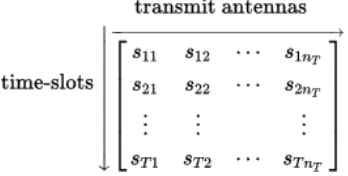
An STBC is usually represented by a matrix:
Each row represents a time slot and each column represents transmit antennas. Here, Sijis the modulated symbol to be
transmitted in time slot (i) from antenna (j). There are to be (T) time slots and (nT) transmit antennas as well as (nr) receive antennas. This block is usually considered to be of ‘length’ T.
STBC’s as originally introduced, and as usually studied, are orthogonal. This means that the STBC is designed such that vectors representing any pair of columns taken from the coding matrix are orthogonal. The result of this is simple, linear, optimal decoding at the receiver. Therefore these are termed as orthogonal space time block codes.
Adaptive MIMO Channel:
The MIMO channel block in the system model shown below is configured as a 4x4 MIMO channel with transmit and receive antenna selection. The MIMO channel block simulates the frequency flat Rayleigh fading MIMO channel from a number of transmit antennas to number of receive antennas. The maximum Doppler shift (Hz) is 100. The system operates with one, two, three or four transmit antennas. The number of transmit and receive antennas are adaptive and can be changed manually based on difference between target and actual Frame Error Rates of the system.
IV. SYSTEM MODEL
Bernoulli Binary Generator
QPSK Modulator
OSTBC Encoder
Adaptive MIMO Channel
AWGN Channel
OSTBC Combiner QPSK
Demodulator Frame Error
Rate Calculation Display
Fig 2: Block Diagram of MIMO-OSTBC System
V. SIMULATION RESULTS
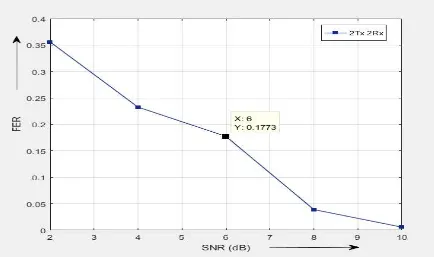
Fig 3 shows the simulation results for the performance of Adaptive MIMO-OSTBC system for two transmitting and two receiving antenna system. The performance of the system with various low SNR values varying from 2dB to 10dB is analysed. The value of FER for SNR of 6dB is 0.1773.
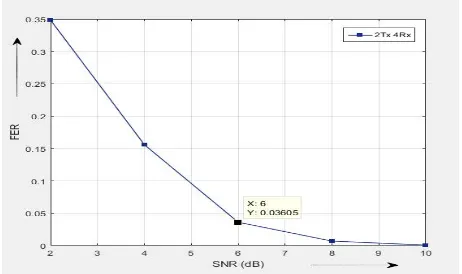
Fig 4: SNR vs FER using 2 transmitting & 4 receiving antennas
In Fig 4, the simulation results for the performance of Adaptive MIMO-OSTBC system for two transmitting and four receiving antenna system has been analyzed. The performance of the system with various low SNR values varying from 2dB to 10dB is analyzed. The value of FER for SNR of 6dB is 0.03605.
Fig 5: SNR vs FER using 3 transmitting & 2 receiving antennas
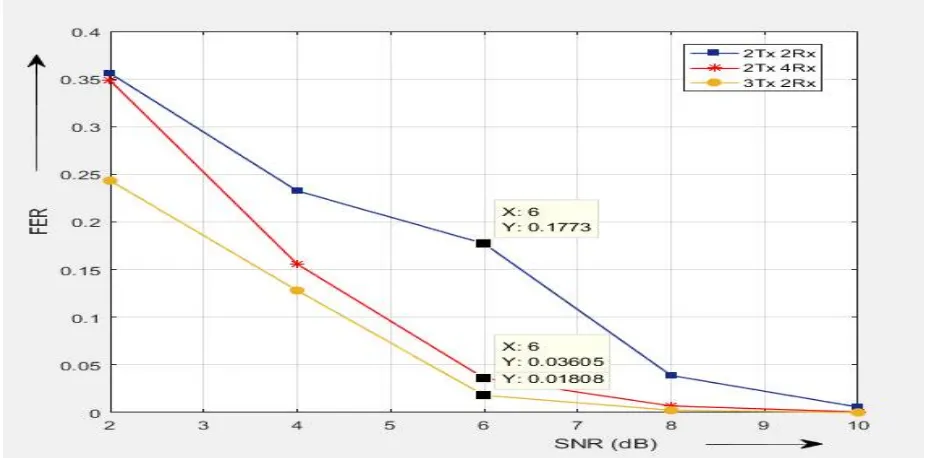
Fig 6 shows the performance analysis of Adaptive MIMO-OSTBC system for various MIMO systems under flat Rayleigh fading channel. It is observed that the FER at SNR equals to 6dB for 2x2 MIMO system is 0.1773, for 2x4 MIMO system is 0.03605 and for 3x2 MIMO system is 0.01808.
VI. CONCLUSION
In this paper, the performance of Adaptive MIMO system employing OSTBC technique for various MIMO systems under flat Rayleigh fading channel with a maximum Doppler shift of 100 (in Hz) has been evaluated. By observing the simulation results it can be concluded that the 3x2 MIMO system performs better with minimum FER of 0.01808 when compared with 2x2 and 2x4 MIMO systems due to which high performance and high data speeds can be achieved.
REFERENCES
[1]. K. Meena Anusha, Ch. Santhi Rani, “Performance analysis of OFDM-OSTBC System under various fading channels using different Doppler Spectra”, in Proc IEEE International Conference on Electrical, Electronics and Optimization Techniques (ICEEOT-2016), pp. 396-399, 2016. [2]. K. Meena Anusha, Ch. Santhi Rani, “Comparison of STBC system and STTC System using various Doppler Spectra”, IJECET, vol. 7, Issue 6., pp. 01-13, 2016.
[3]. Hema Thota, Ch. Santhi Rani, Kiranmayee Kagitha, Anusha Balagam, Anusha Goriparthi, Naga Lakshmi Devarapalli, “A Transmit Diversity Technique for OFDM system”, IJIREEICE vol. 3, Issue 3,2015.
[4]. Mr.Bhavesh Khasdev, Mrs. Angeeta Hirwe, “Performance analysis of Adaptive MIMO OFDM system”, IJARECE vol. 5, Issue 7, 2016. [5]. S. M. Alamouti, “A simple transmit diversity technique for wireless Communication”, IEEE Journal Select. Areas communications, vol. 16, no. 8, pp. 1451-1458, 1998.
[6]. D. A. Gore and A. J. Paulraj, “MIMO antenna subset selection with space-time coding,” IEEE Trans. Signal Processing, vol. 50, no. 10, pp. 2580-2588, 2002.
[7]. “Gigabit wireless,” Proc. IEEE, vol. 92, no. 2, 2004, Special Issue.
[8]. Marco Donald Migliore, Daniele Pinchera, Fulvio Schettino, “Improving Channel capacity using Adaptive MIMO antennas”, in IEEE Trans. Antennas Propag. vol. 54, no. 11, 2006.
[9]. A. Sohail, M.N. Jafri, “Adaptive OFDM over Frequency selective and fast fading channel using Blockwise bit Loading Algorithm”, IEEE International Conference on Wireless and Optical Communication Networks, pp. 1-4, 2007.
[10]. K. K. Wong, R.D. Murch and K.B. Letaief, “Performance enhancement of multiuser MIMO wireless communications, vol. 50, pp. 1960-1970, 2002.