
Mass Attenuation Coefficients of Lead Nitrate
Dilute Solutions for 13.5 cm Thickness at 1173
and 1333 keV
Madhuri Dumpala1, A.S.Nageswara Rao2
Assistant Professor, Department of Physics, OsmaniaUniversity College for Women, koti, Hyderabad , Telangana
State, India1.
Professor, Department of Physics, Kakatiya University, Warangal , Telangana State, India2.
ABSTRACT: The total mass attenuation coefficients determined in deionized water and different concentration lead nitrate dilute solutions at photon energies 1173and1333 keV by using good geometry setup. Gamma ray photons are emitted from source of 60 Co.The measurements has been performed using a gamma spectrometer which contain 2"×2"NaI (Tl) detector connected to 8K Multi-Channel Analyser(MCA). The results are in good agreement with the theoretical calculations of X .COM.
KEYWORDS: Mass attenuation coefficients, deionized water, Lead nitrate dilute solutions, photon energies, Good-Geometry setup, gamma ray spectrometer.
I. INTRODUCTION
Increasing usage of radioactive sources in several fields such as medicine, industry and agriculture etc., the study of gamma ray attenuation measurements in elements, compounds has become important. Accurate data on narrow beam attenuation coefficients for gamma rays are required in many fields, such as tomography, X–ray fluorescence studies and radiation biophysics. Most of the previous measurements of attenuation coefficients have been performed on the materials in their solid and crystalline forms using various techniques. These observations have been compared with the theoretical values calculated from the mixture rule and various tables [1].
II. BACK GROUND OF RELATED WORK
III.PRESENTATION OF THE MAIN CONTRIBUTION OF THE PAPER
In the present work, mass attenuation measurements of different concentration lead nitrate dilute solutions (mixed in deionized water) and deionizedwater have been measured in the energies 1173 and 1333keV for 13.5 cm thickness.
IV.PROPOSED METHODOLOGY AND DISCUSSION
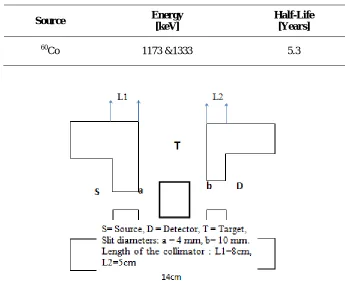
The mass attenuation coefficients were determined by performing transmission experiments in narrow beam geometry as shown in Fig.1. A reasonable amount of lead shielding was used around the source and detector to prevent detection of scattered radiation from surrounding objects. For the low energy measurements the probability of coherent scattering interactions is relatively high and so very good collimation is required to reduce the contribution of Rayleigh scattered photons reaching the detector. Tight collimation reduces the absolute detection efficiency so that high activity sources must be employed that is around 10 mCi strength. At higher energies the probability of elastic scattering becomes much smaller and so scattered radiation is less important which reduces the need for such close collimation. Therefore, source strengths in the range 10-20 µCi were found to be adequate for the higher energy measurements. The radioactive sources of strength around 10µCi were procured from BRIT, Mumbai, India and details of the source are given in Table.1.
Table.1: Table showing the source, energy and half-life period of the radioactive isotope used in the present work.
Source Energy
[keV]
Half-Life [Years]
60
Co 1173 &1333 5.3
Fig. 1 Schematic diagram of the experimental setup.
Whereh1concentration : 210 g of lead nitrate diluted in 300ml of water.
h2concentration : 105 g of lead nitrate diluted in 300ml of water.
h3concentration : 52.5 g of lead nitrate diluted in 300ml of water.
13.5cm thickness glass container is prepared with general method which is used in aquarium shops. This container is used for taking readings with water and dilutes solutions. Thickness of the glass container is measured with vernier calipers. The sample thickness measured in such a way the internal distance of the glass container. Thickness (t) is measured for different areas of thickness of the each container, then the average “t” value was taken and that is 13.5cm. The Table.2 shows the average density and thickness of the different concentration of lead nitrate dilute solutions.Interpolations from tabulated theoretical values of the mass attenuation coefficients for deionized water and different dilute solutions were obtained using X.COM [16].For this we calculated the percentage of lead nitrate and water.
Example
For h1concentration : 210 g of lead nitrate diluted in 300ml of water.
Weight of the compound (Wc) =210g.
Weight of the solution (Ws) =508.9g.
Percentage of lead nitrate (Wc / Ws)=0.413
Percentage of water=0.587
Simultaneouslyh2andh3 concentrations:
For h2 concentration
Percentage of lead nitrate=0.254 Percentage of water=0.746 For h3concentrations
Percentage of lead nitrate=0.149 Percentage of water=0.851
Density of the sample is measured by using common principle, that is Density (ρ) =Mass (M) /Volume (V)
V=M/ρ
Vwater=Vmixture
mixture=Mmixture ×[ water/Mwater]
Mwater= weight of the volumetric flask with water–weight of the empty volumetric flask.
Mmixture = weight of the volumetric flask with mixture –weight of the empty volumetric flask.
Table.2Average density and thickness of lead nitrate dilute solutions and deionized water
Type of sample Thickness
[cm]
Density [g/cm3]
Deionized Water 13.5 13.5±0.27
h1 concentration of lead
nitrate solution 13.5 20.032±0.401
h2 concentration of lead
nitrate solution 13.5 16.606±0.332
h3 concentration of lead
nitrate solution 13.5 15.529±0.311
For each sample, counts were taken in the following sequence, back ground, no sample, sample, sample, no sample, and so on [17]. Different parts of the sample are exposed to the beam. The counting sequence was continued in most cases until counting statistics contributed less than 0.5% error.
=
1
Where ‘t’is the thickness of the sample (cm), and ‘ρ’ is material density (g/cm3), Io and I are the net counts under the
photo peak, without sample and with sample, respectively. Io and I were obtained for same counting time and
experimental conditions. The errors in the present investigations are due to [i] counting statistics, [ii] non uniformity of the sample, [iii] density measurements and [iv] scattered radiation reaching the detector within the accepted maximum angle of scattering. In the present investigation this angle was around 3º and the error due to this factor was about 0.3%. The counting statistics were such that the error was less than 0.5%. The fractional error arising due to non-uniformity of the sample was estimated to be in the order of 0.2%. The error in the density measurement is less than 1%. Therefore, the overall error was estimated to be less than 2.25%.
V. RESULTS AND DISCUSSION
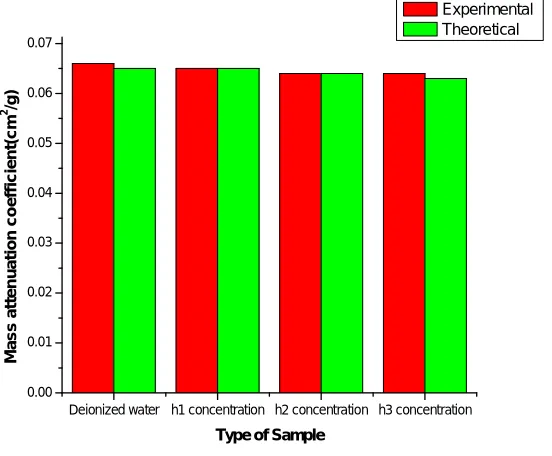
The experimentally measured and calculated values [16] for the mass attenuation coefficients for different concentration of lead nitrate solutions and deionized water sample in the energies 1173 and 1333keV as shown in Table.3. Comparing the experimental and calculated(theoretical) values for the mass attenuation coefficient of deionized water and h1, h2 and h3concentration lead nitrate dilute solutions for 13.5cm, at energies 1173 and
1333keV.There is no deference between theoretical and measured mass attenuation coefficients of deionized water and different concentration of lead nitrate dilute solutions as shown in Fig.2 and Fig.3 and from these Figures mass attenuation coefficients of deionized water and differentconcentraton dilute solutions nearly equal.
Fig. 2 Variation in Mass attenuation coefficients of lead nitrate different concentration dilute solutions and deionized water at 1173 keV for 13.5 cm thickness in cm2/g.
Deionized water h1 concentration h2 concentration h3 concentration 0.00
0.01 0.02 0.03 0.04 0.05 0.06 0.07
M
a
s
s
a
tt
e
n
u
a
tio
n
c
o
e
ff
ic
ie
n
t(
c
m
2 /g
)
Type of Sample
Table.3Mass attenuation coefficients of different concentration dilute solutions of lead nitrate for13.5cm thickness in cm2/g [error≈2.25%]
a = Experimental mass attenuation coefficient b= Theoretical mass attenuation coefficient [16] Fig. 3 Variation in Mass attenuation coefficients of lead nitrate different concentration dilute solutions and
deionized water at 1333 keV for 13.5 cm thickness in cm2/g.
S. No. Type of Sample/Energy 1173keV 1333keV
1 Deionized water
a 0.066 b 0.065 0.062 0.061
2 in 300ml water h210g of Lead nitrate
1 Concentration
0.065 0.065
0.061 0.060
3 300ml water h105g of Lead nitrate in
2 Concentration
0.064 0.064
0.059 0.059
4 in 300ml water h52.5g of Lead nitrate
3Concentration
0.064 0.063
0.059 0.059
Deionized water h1 concentration h2 concentration h3 concentration 0.00 0.01 0.02 0.03 0.04 0.05 0.06 M a s s a tt e n u a ti o n c o e ff ic ie n t (c m 2 /g )
Type of sample
VI.CONCLUSIONS
The change in mass attenuation coefficients is negligible as concentrations of lead nitrate dilute solution increasing for energies 1173 and 1333keV. Mass attenuation coefficients of deionized water is nearly equal to the mass attenuation coefficients of different dilute solutions of lead nitrate that means there is no deviation between deionized water and different dilute solutions of lead nitrate.
REFERENCES
[1]. J.H.Hubbell, Photon mass attenuation and energy absorption coefficients from 1keV to 20MeV, Int.J.Appl.Radiat.Isot. 33, 1269, 1982. [2]. D.A.Bradley, C.S.Chang, A.Shukri, A.A.TajuddinandA.M.Ghose, A new method for the direct measurements of energy absorption coefficients of gamma rays, Nucl.Instrum.Meth.Phys.Res.A, 280392, 1989.
[3]. G.A.Cunningham and H.E.John, Calculation of the average energy absorbed in photon interactions, Med.Phys. 7, 51, 1980.
[4]. J.H.Hubbell, Photon cross sections, attenuation coefficients and energy absorption coefficients from 10keV to 100MeV, NSRDS – NBS, 29, 1969.
[5]. H.A.Jahagirdar, B.Hanumaiah and S.R.Thontadaya, Determination of narrow beam attenuation coefficients from a broad beam geometrical configration for 320keV photon, Appl.Radiat.Isot. 43, 1511, 1992.
[6]. K.Singh, H.K.Bal, I.K.Sohal and S.P.Sud, Measurement of energy absorption coefficients at 662keV in soil samples, Appl.Radiat.Isot. 42, 1239, 1991.
[7]. M.T.Teli, S.S.Malode and L.M.Chaudhari, Study of absorption of 123keV gamma radiation by dilute solutions of zinc sulphate, J.Pure Appl.Phys. 32, 410, 1994a.
[8]. M.T.Teli, L.M.Chaudhari and S.S.Malode, Study of absorption of 123keV gamma radiation by dilute solutions of magnesium chloride, Nucl.Instrum.Meth.Phys.Res.A, 346, 220, 1994b.
[9]. M.T.Teli, L.M.Chaudhariand S.S.Malode, Study of absorption of 123keV gamma radiation by dilute solutions of sodium chloride, Appl.Radiat.Isot. 45, 987, 1994c.
[10]. M.T.Teli, andL.M.Chaudhari, Attenuation coefficients for 662keV gamma radiation, measured in dilute solutions, Appl.Radiat.Isot.46, 369, 1995a.
[11]. M.T.Teli, and L.M.Chaudhari, Attenuation coefficients of 123keV gamma radiation by dilute solutions of ferrous sulphate, J.Pure.Appl.Phys. 33, 395, 1995b.
[12]. M.T.Teli, and L.M.Chaudhari, The attenuation coefficient of ammonium chloride for 662keV gamma radiation, measured for dilute solutions, J.Radiat.Phys.Chem. [1995c].
[13]. M.T.Teli, and L.M.Chaudhari, J.Radiat.Phys.Chem. 47[1996] 365.
[14]. L.Gerward, On the attenuation of X- rays and gamma rays in dilute solutions , Radiat. Phys.Chem. 48, 697, 1996.
[15]. K.Singh, G.Kaur, V.Kumar, A.K.Dhami and B.S.Lark, Measure ments of some dilute solutions at 662keV, Radiat. Phys.Chem. 53, 123, 1998.
[16]. M.J.Berger and J.H.Hubbell Photon cross sections on a personal computer, NBSIR, 87, 1987.
![Table.3Mass attenuation coefficients of different concentration dilute solutions of lead nitrate for13.5cm thickness in cm2/g [error≈2.25%]](https://thumb-us.123doks.com/thumbv2/123dok_us/1642178.1205257/5.595.141.416.206.409/table-attenuation-coefficients-different-concentration-solutions-nitrate-thickness.webp)