Haar Wavelet based Iris Recognition for High
Security Access Environment
Dr. S. B. Patil1 Prof. V. K. Bhangadiya2 Ms. Pranali P. Chavhan3
Professor, Dept. of Electronics & Telecomm. Engg, SSGM College of Engineering, Shegaon, Maharashtra, India1
Asst. Professor, Dept. of Electronics & Telecomm. Engg, SSGM College of Engineering, Shegaon, Maharashtra, India2
PG Student, Dept. of Electronics & Telecomm. Engg, SSGM College of Engineering, Shegaon, Maharashtra, India3
ABSTRACT: With the need for security systems going up, automatic person identification using biometrics has gained a great attention over past few years. Biometric recognition is a technique used to identify individuals by their unique biological characteristics. Iris recognition, identifying a person by the textural pattern of iris of their eyes, is emerging as one of the most important biometric identification method due to its high reliability, ease of use, accuracy, and safety in controlling access to high-security areas reducing the possibility of illegal access. Present paper outlines the iris recognition system, which consists of an automatic segmentation algorithm to localize the iris region using circular hough transform. To have constant dimensions the iris image is normalized and Haar wavelet is used to extract the important features from the iris to generate the biometric template which is then compared using hamming distance with the one stored in database to determine whether two irises are similar or not.
KEYWORDS:Biometrics, Hough Transform, Haar Wavelet Transform, Biometric Template Matching.
I. INTRODUCTION
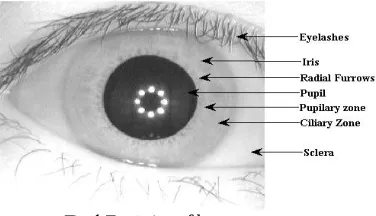
Fig. 1 Front view of human eye
Iris Recognition uses the rich textural pattern present in the iris of human eye which is the most unique and stable biological characteristic of a person because of the large variability of the iris pattern between two persons [1]. Advantages of Iris as a biometric are it is not subject to the effects of aging, the use of glasses or contact lenses has little effect on the representation of the iris and hence does not interfere with the recognition technology [3].
Paper is organized as follows. Section II describes the work done by various researchers in the field of iris recognition. The proposed algorithms for various stages of iris recognition are given in Section III. Finally, Section IV presents conclusion.
II. RELATED WORK
John Dougman [4] has implemented the first automated iris recognition system for person identification based on failure of statistical test of independence. Daugman used integro-differential operator for segmentation of iris from eye image and a multiscale quadrature two- dimentional(2-D) Gabor filter to demodulate phase information of an iris image to create an iriscode for authentication by comparing the Iriscode stored in database. Wildes et. Al. [5] proposed a segmentation algorithm in which edge map is constructed first then hough transform is used to detect the inner and outer borders of the iris also, the upper and lower boundaries of the eyelid are identified using parabolic curves. Encoding was done using Laplacian of Gaussian filter (LOG) and normalized correlation was used for matching. Boles et al. [17] designed a system to handle noisy conditions. Dissimilarity function was used to compare one-dimensional (1-D) signals obtained from zero-crossings of the wavelet transform at various resolution levels over concentric circles on the iris, with model features using different S. Lim [7] has made the use of competitive learning Neural Network for matching of two iris codes, 2-D Haar wavelet is used for encoding purpose. Li Ma [8] uses a bank of spatial filters, whose kernels are suitable for iris recognition, which are used to capture local characteristics of the iris so as to produce discriminating texture features. The nearest center classifier is implied to improve computational efficiency and classification accuracy. Libor Masek[9] proposed a method which involves modified version of Kovesi’s Canny edge detection MATLAB function with hough transform. 1-D log Gabor filter is used for feature extraction and hamming distance for matching. R. Y. Dillak [12] proposed a method which involves preprocessing using amoeba median filter and gaussian filter to enhance the effective area of the iris. And then modified CHT method is used for segmenting the iris area. The features like maximum probability, correlation, contrast, energy, homogeneity, and entropy are then extracted using multiple 3D-GLCM; which is the advanced version of 2D GLCM. Finally, these features are trained using Elman Recurrent Neural Network to obtain the accuracy.
III.IRIS RECOGNITION SYSTEM
2. Iris Segmentation/Localisation 3. Normalisation
4. Feature Extraction 5. Matching/Comparison
Fig. 2 Iris Recognition System
1. Image Acquisition
It is the process of capturing the eye image. Acquiring the images of Iris is the most important stage in the recognition system. Images with good resolution and sharpness are needed with required intensity. There are number of iris databases available e. g. CASIA, UBIRIS, IIT Delhi iris database etc. In this paper we use publicly available Iris database from Chinese academic of science CASIA-IrisV3 (CASIA-Iris-Interval) which has 2639 grayscale images of eye with 259 different eyes and five to seven different images of each eye [14].
2. Iris Segmentation
The process of detecting/locating the iris region in eye image is called segmentation. Different researchers proposed different techniques for extracting the iris region which contains the required information from the acquired image. Here we have used circular Hough transform which is a standard computer vision algorithm used to identify simple geometric objects (lines, circles) in the image. The image is segmented by first applying canny edge detection to generate an edge map. Gradients are biased in the vertical direction for the iris-sclera boundary, and for iris-pupil boundary Vertical and horizontal gradients were weighted equally. Then hough transform is used to detect circles. The Hough transform for the iris-sclera boundary is performed first then for the iris-pupil boundary since the pupil is always within the iris region, to make the circle detection process efficient and accurate. From the edge map, votes are cast in Hough space for the parameters of circles (centre coordinates X and Y, and the radius R) passing through each edge point. Any circle can be defined according to the equation
X2+Y2=R2 (1)
A maximum point in the Hough space will represent the radius and centre coordinates of the circle defined by the edge points. Eyelids were isolated by fitting a line to the upper and lower eyelid using the linear Hough transform. We have to set the maximum and minimum value of radius in hough transform. For the CASIA database, iris radius values ranges from 90 to 150 pixels, while the pupil radius ranges from 28 to 75 pixels [9]. After this we will get the iris, which contains the required information, located in the eye image.
The algorithm automatically generates mask image without user interaction that contains only text regions to be inpainted.
3. Normalization
The iris which is circular in shape can vary in dimensions due to different factors such as pupil dilation caused by different illumination levels, head tilt, rotation of eye within the eye socket, different distance from which image is taken and rotation of camera. Normalization is a process of converting the iris image into fixed dimension image for comparison. Most normalization techniques are based on transforming iris into polar coordinates, known as unwrapping process. Normalization process will unwrap the images and convert all the images into a fixed dimension. For this Dougman’s Rubber sheet model is the best method. This model maps all point within the iris region to polar
coordinates (r, θ), where θ is the angle [0, 2π] and r is on the interval [0, 1].
Image Acquisition
Iris Localisation
Matching Normalisatio
n
Feature
Fig. 3: Normalization process of the Iris
The center of the pupil is taken as a reference point and to convert the points on the Cartesian scale to the polar scale a remapping formula is used which is,
I (x(r, Ө), y (r, Ө)) I(r, Ө) (2) With
x (r, Ө) = (1- r) xp (Ө) + rxi (Ө) (3)
y (r, Ө) = (1- r) yp (Ө) + ryi (Ө) (4)
where, I(x, y) is the iris image with Cartesian coordinates (x, y), (r, θ) are the corresponding normalized polar
coordinates, and xp, yp and xi, yi are the coordinates of the pupil and iris boundaries along the Ө direction.
Normalization produces a 2D array with angular resolution on horizontal dimensions of and radial resolution on vertical dimensions.
4. Feature Extraction
The main part of any biometric system is extraction of the most discriminating information (features) to provide accurate recognition of individual. In this step we have to extract the patterns of the iris taking into account the correlation between adjacent pixels. The recognition rate of Haar wavelet transform is better than other methods and the computation time is also small [7]. So, we have used Haar wavelet for feature extraction of the iris image. The Wavelet transform breaks an image into four sub-sampled images. The results consist of one image that has been low-pass filtered in horizontal and vertical both directions (cA) called approximation coefficients, one that has been high-pass filtered in both directions (cD) called diagonal coefficient, one that has been low-high-pass filtered in the vertical and high-pass filtered in the horizontal (cH) called horizontal coefficient and one that has been low-pass filtered in the horizontal and high-pass filtered in the vertical (cV) called vertical coefficient. We have decomposed the normalized image using the Haar wavelet into five levels. The coefficients that give redundant information should be eliminated. The patterns in cD1, cD2, cD3 and cD4 are almost the same and only one can be chosen from them. Since cD4 is the smallest in size, we can take it as a representative of all the information the four levels carry. The fifth level does not contain the same textures and should be selected as a whole. Similarly, only the fourth and fifth vertical and diagonal coefficients can be taken to express the characteristic patterns in the iris-mapped image. Thus we can represent each image as a combination of matrices cD5, cV5, cH5, cD4 and cV4. Then all these are combined to form a single feature vector.
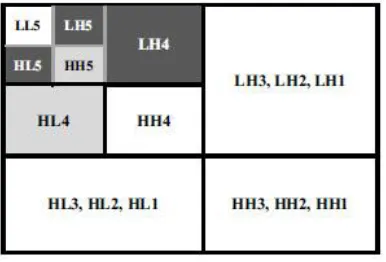
Fig 4: Quantization of feature vector ( black region indicate two level quantization and gray region indicate four level quantization)
r
0 1
The feature vector is then coded into binary form because it is easy to compare two binary codes as compared to numbers. The feature vectore are encoded using two and four level quantization as shown in fig 6. After this we will get a binary template of the iris image which is stored in the database and compared at the time of authentication.
5. Matching
While authenticating a person we have to compare his iris data with the codes stored in database to find out if they represent the same person or not. For this Hamming distance is used which gives the difference between two binary codes using EX-OR operator. The hamming distance between two binary words is calculated as,
HD=
A(i)
⊕
B(i)
(5)Where, A and B are the coefficients of two iris vectors and N is the size of vector. The iris template is shifted right and left by 8 bits to avoid rotation inconsistencies. It may be easily shown that scrolling the template in polar coordinates is equivalent to iris rotation in Cartesian coordinates. John Dougman [4] tested a large iris database and conclude that maximum hamming distance exists between two iris codes of same person is 0.32 which is used as a threshold in the matching process.
If HD<= 0.32 – Same person (6) If HD > 0.32 – different person (7)
IV.RESULTS
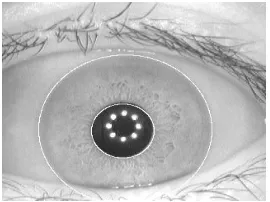
Fig. 5: Localization of Inner and outer boundaries of Iris
Fig. 6: Normalized Iris pattern
V. CONCLUSION
The iris recognition system proves to be very efficient and promising technique as it gives accurate and reliable results to verify the identity of a person. Hough transform with canny edge detector is best suited for segmentation of the iris because of efficient localization. The Haar wavelet transform which is used for feature extraction has a number of advantages, it is simple, fast, memory efficient and reversible compared to other wavelets and the feature vector is small. The Iris recognition system can effectively differentiate various persons by identifying their irises and provide a very good security against intruders.
REFERENCES
[1] John G. Dougman, “How Iris Recognition Works”, IEEE transactions on circuits and systems for video technology, vol. 14, no. 1, january 2004
[2] H. Proença, And A. Alexandre, "Towards Noncooperative Iris Recognition: A Classification Approach Using Multiple Signatures". IEEE Trans. vol. 29, pp. 607-612, 2007.
[3] S. M. Elsherief, M. E. Allam and M. W. Fakhr, “Biometric Personal identification Based on Iris Recogition”, International conference on computer Engineering and Systems, (2006) November, pp. 208-213, 5-7.
[4] John G. dougman,”High Confidence visual Recognition of persons by a test of statistical independence,” IEEE Transactions on Pattern Analysis and Machine Intelligence, vol. 15, no 11,1993.
[5] R. P. Wildes, “Iris recognition: An emerging biometric technology,” Proc. IEEE, vol. 85, no. 9, pp. 1348–1363, Sep. 1997.
[6] W Boles and Boshash, “A human identification technique using images of iris and wavelet transform”, IEEE transc. signal processing,vol 46, no. 4,pp 1185-1188, April 1998.
[7] S. Lim, K. Lee, O. Byeon, and T. Kim, “Efficient iris recognition through improvement of feature vector and classifier,” J. Electron. Telecommun. Res. Inst., vol. 33, no. 2, pp. 61–70, Jun. 2001.
[8] Li Ma, Yunhong Wang, Tieniu Tan and Zhang D. “Personal identification based on iris texture analysis,” IEEE Transactions on Pattern Analysis and Machine Intelligence, vol.25, no.12, 2003.
[9] L. Masek, “Recognition of human iris patterns for biometric identification,” B.S. dissertation, The School of Computer Science and Software Engineering, The University of Western Australia, Crawley WA, Perth, Australia, 2003.
[10] J. Huang, L. Ma, Y. Wang, and T. Tan, “Iris model based on local orientation description,” in Proc. Asian Conf. Comput. Vision, Korea, Apr. 2004, pp. 954–959.
[11] John Daugman, “New Methods in Iris Recognition”, IEEE Transactions On Systems, Man, And Cybernetics—Part B: Cybernetics, Vol. 37, No. 5, October 2007’.
[12] R. Y. Dillak, M. G. Bintiri,” A Novel Approach for Iris Recognition”, 2016 IEEE Region 10 Symposium (TENSYMP), Bali, Indonesia. [13] Mohammed A. M. Abdullah F. H.A.Al-Dulaimi Waleed Al-Nuaimy Ali Al-Ataby, “Smart card with iris recognition for high security
accessenvironment” 978-1-4244-7000-6/11/$26.00 ©2011 IEEE.
[14] Chinese Academy of Sciences – Institute of Automation. Database of 2569 Greyscale Eye Images. http://www.sinobiometrics.com Version 3.0.