Implementation of Virtual Reality in
Construction Industry
Ashok Arjun Avhad1, Dr. G.A.Hinge2
ME Civil (Construction Management) 2nd year Student, Dept. of Civil Engg, TSSMs BSCOER, Narhe, Pune, India Professor & Guide, Dept of Civil Engg. , TSSM’s BSCOER, Narhe, Pune, India
ABSTRACT: Present-day construction projects are characterized by short-term partnerships between multidisciplinary teams with varying levels of process maturity and information handling capability. They involve the planning, Architectural Design and erection of structures of all types. Compared with other industries, the construction sector has relatively poor profit margins and low efficiency levels. The product development process in construction is still structured as a sequential chain of activities in which each activity is separated in time and space and where Architectural Design information is communicated using traditional documents, such as 2D drawings and written specifications. This process is slow and error prone and reflects the functional orientation of the construction project. However, lessons learned from the manufacturing industry have shown that new Architectural Design processes using modern information and communication technology (ICT),tools such as concurrent engineering and virtual reality (VR) can increase efficiency and reduce lead times. So far, VR has been used sporadically in the construction industry, often from the perspective of visualizing the product Architectural Design for the client. The objective of present research has been to investigate how VR (and thereby 3D) can be used during the planning, Architectural Design and realization phase of a construction project with the emphasis on complex building products. What are the main benefits and how should the construction project be organized in order to make use of the potential benefits the technology offers? The main hypothesis during present research has been that the use of digital prototypes visualized using VR technology makes it easier to identify, analyze, coordinate and communicate the product Architectural Design in order to improve the decision-making and thereby the final product. Virtual reality technologies both play vital roles in the construction industry. Virtual reality technologies, however, have a higher benefit when compared to Real. The technology types are discussed,with their similarities and differences explained. The past, present, and future is described. Some benefits of using Virtual reality technology are discussed. The drawbacks are mentioned, with the way to correct them detailed.
KEYWORDS: Virtual Reality (VR),Construction Industry, Augmented Reality (AR)
I. INTRODUCTION
Throughout the 20th century and beyond, the World has seen monumental changes in a wide variety of aspects. In our regard, there has a huge transformation in the construction industry. Through building bigger and better things, the industry has revolutionized means and methods [3].In addition, in order to overcome shortage of competent workforce, the construction industry has taken advantage of technology to better recruit and retain new workers in construction career[8]. One of the technological tool employed by the construction industry is called Virtual Reality, in which a three-dimensional, computer generated environment can be explored and interacted by a person. Virtual Reality shares the same concept, but rather than to interact in a non-existing environment (virtual reality), Virtual reality uses existing environment while implementing virtual elements to appear as if both are together at the same time [6]. The purpose of this review is to explore the changes in the construction industry that are resulting from Augmented and virtual technology.
What is virtual reality?
1.1 Background and motivation
The European construction industry represents around 7-10% of a country’s GDP and is one of the largest sectors in the European Union, employing some 12 million people. The industry is project centered, complex and highly fragmented and covers a wide range of companies from SMEs to multinational corporations. A typical construction project is characterized by short-term partnerships between multidisciplinary teams with varying levels of process maturity and information handling capability.
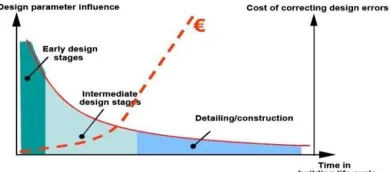
Fig 1 gives us the variation in between the cost of committed design w.r.t design changes to the time
Fig 1. Committed Architectural Design and cost of Architectural Design changes versus time
II. OBJECTIVE AND AIM
1. To learnSoftwaresi.e. AutoCAD,Unity, Photoshop and Revit. 2. Architectural Design of Virtual sample flat in VR APP 3. Architectural Design of existing building in VR APP 4. Developing new affordable cardboard VR models
III. LITERATURE REVIEW
Virtual reality is an exciting innovation slowly being implemented into the construction industry. Virtual reality or VR is “a computer generated simulation of three-dimensional (3D) environment, in which the user is able to both view and manipulate the contents of that environment” [5]. It has many applications that can benefit a project with increased jobsite education and safety, Architectural Design improvement and communication with involved parties from the owner down to the laborer, and help to exceed owner‟s expectations and lower project costs. VR is
broken down into desktop and immersive VR categories [8]. Desktop is displayed on computer monitors or tvs, which is known as Cave Automatic Virtual Environment or CAVE [4]. CAVE consists of multiple monitors joined together to form a large screen that allows the user to feel a part of the virtual world Immersive virtual environment or “IVE will typically have the following features; it will surround its user, obscuring cues from the physical environment and increasing the sense of „presence‟ within the IVE; provide a three-dimensional visual representation of the virtual environment; track the user‟s location and orientation and update the virtual scene to
match the user‟s movements, and give the user some degree of control over the objects in it”[6]. There is great potential for improving all parts of the construction process by implementing this technology.
Virtual Reality- Due to the large amount of popularity surrounding virtual reality, Virtual reality oftentimes tends to be overlooked by the public as a whole. While this may be because of a basic misunderstanding of the topic, Virtual reality certainly holds merit in the world of construction technology, especially when it comes to educational, architectural, and field engineering processes for both students and professionals alike. Virtual reality consists of a live, imitative version of the real world – with the capacity to add certain elements to the simulated landscape. Virtual reality was initially introduced into the gaming world as an entertainment alternative, but the possibility of its educational potential are being thrust into the spotlight by architectural and engineering schools across the globe [9]. “Virtual reality (VR) creates anenvironment where computer generated information is superimposed onto the user‟s
The benefits of this for aspiring architects and field engineers alike are limitless as it allows for the user to see a project in its completed form overlaid onto an empty field. Virtual reality is being used in the world of construction by placing a 3D model in front of the eyes of the user and initiating a learning experience unlike any seen before. In this way, it allows for an individual to interact with real-world projects and deal with defects before they even occur [6]. By creating exposure to a project before it physically exists, Virtual reality creates a unique learning opportunity for the inexperienced and construction-savvy individual alike by presenting the opportunity to locate and fix a project‟s flaws in a safe, risk-free environment all in real time [7]
The scale of the project, the extent to which the modeling tools and VR environments are used, and the very tight project delivery schedule make the project an interesting environment to study the application of VR and 4D modeling. Our aim is to report the practical approach that is applied by the project team to facilitate the scheduling process in the preconstruction stage. We illustrate this approach with a number of VR and 4D models of the project. The impact of these models will only be measured qualitatively since it is difficult to estimate the impact on economy and time in a project such as MK3. We will instead estimate the effect by evaluating how the client and the other stakeholders have been using VR and 4D as alternative forms of communication and also provide the readers with some case examples. We first introduce the concept of virtual prototyping after which we briefly describe the case study project. We then outline and evaluate the application of virtual prototyping in the case study project. Concluding remarks and recommendations for future research follow this section. [8]
IV. USING VIRTUAL REALITY IN REAL ESTATE BUSINESSES
How do the realtors benefit from Virtual reality technologies?AR and VR are becoming extremely popular in real estate businesses because of a number of benefits. These are mainly:
1. Engaging users through visual interactions
When real estate projects limit themselves in 2 dimensions, they seldom offer more information to the customers; thereby, missing that X-factor. 3D architectural rendering makes this information more meaningful. By presenting all such construction projects in Virtual reality, clients are able to get a total visualization of the property from every possible angle. AnVirtual reality app can produce a 3D representation of the property from 2D image. In Virtual reality, the users will be able to do virtually anything with a rendered model. For example, through Virtual reality, a house can be stripped off from the base to reveal the layouts of different floors. Similarly, many more things can be done. Now that’s engaging; isn’t it?
2. Clarity on the product/service offered
A simple example can clear this thing up. Place yourself in the shoes of your customer. Now imagine a scenario. You click on an app on your smartphone and select a property of your choice that you want to check out. In Virtual reality, you’ll be able to hold up your phone and create a window into your selected property. You’ll virtually be able to walk around the property, check out anything as you wish. You’ll also be able to walk down the street and discover new properties on the app. Just point your phone at any house (which is up for sale) of your choice and see several real-time stats on your phone itself, such as the price, status, contact information etc. All such things are possible with Virtual reality. So, you see that VR does provide enough clarity on the products/services offered.
3. Publicity in real estate
The use of Virtual reality in real estate businesses is greatly capable of capturing the attention of the customers.It has been found that customers who have generated enough interest in a specific property viewed through an VR device are more likely to involve in a conversation associated with the company; thereby spreading the word around. Bigger engagements from these campaigns lead to higher excitement, which in turn, results in increased publicity. Customers who have found an affinity to a particular property have a natural tendency of consulting with their family, relatives or friends. That, in turn results in more publicity. And since Virtual reality is an avant-grade form of technology, its inclusion can cause quite a stir among the public.
4. Mobility
5. More customer reach
Mobile applications supporting AR/VR features are readily available on smart mobile devices. Given this ease of access, it can be said that there isn’t any easier way to reach potential customers with all required information on apartment and house availabilities other than this one here. All such project information can be seen anywhere as per convenience in the form of an interactive brochure. All that’s needed is a smart mobile device, an app and the brochure of the company. You can easily and conveniently build up your AR/VR portfolio and refer to all those projects offline as per your requirements. That makes your tasks a whole lot easier in a meeting or in an event where you are required to present some of your sample works or ideas.
6. Cost-saving
Virtual reality, these days is considered to be one of the most cost-effective ways of growing a business and surpass geographical barriers. Overcoming geographical barriers means more potential customers which, in turn leads to better growth in business. Thus, this point alone nods the favour in the direction of VR especially when the business in concern is one that’s based on real-estates.
7. Improved Brand Royalty
Virtual reality is not all about driving sales. It’s one of the most effective ways of improving your brand loyalty. Your customers might be intrigued enough to come back to you again and again.
If you are looking to buy a property, anVirtual or virtual reality app can be immensely beneficial for you to help you make the right decision. With a virtual reality app, you will be able to take virtual tours of any property anywhere on your mobile phone. Through anVirtual reality app, you will be able to scan a banner, a flyer or any sorts of printed material that has an integration of Virtual reality in it. You will simply be able to see the property come to life. Thus, searching becomes much easier.
VR will also make it much easier for you to find the location of the property. It will also help you know the exact distance from your location to that of the property. You will be able to know the details of the property on the app itself like the total area of the property, the price, number of rooms etc. All such information will really be beneficial for you to make your decision accordingly.
V. VIRTUAL REALITY APP SET UP
Virtual Reality Tours from society gate to sample flats from the convenience of your office or from the Smartphone. I. 360° image tour : all images with 360° view
II. Cardboard view of the project III. Totally immersive experience !
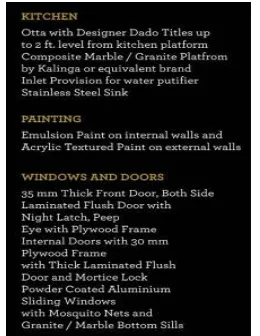
Fig 3Specification Gallery
Fig 4Sports and Recreation Specification
(a)
(b)
(c)
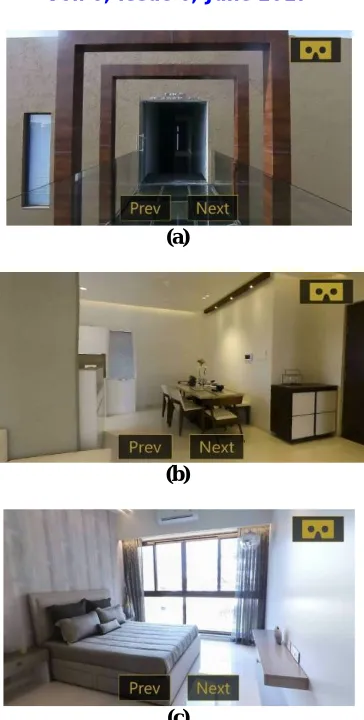
Fig 6a,b,c 3600 View
(b)
(c)
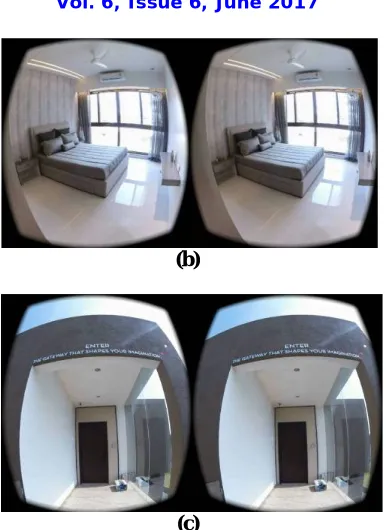
Fig 7a,b,c Cardboard View
App Dash board , 3600 view & cardboard view
Fig. 2 is the main Dashboard for the application VR. It includes all the accessto the View VR, 3600 ,Loacation,amenities provided and specs of the structure.
Further, fig. 3 fig. 4 & fig 5 are the detailed tabs of some of the specification gallery of the structure. Fig 6 includes the some of the 3600 views of the sample flat followed by the Cardboard views in fig. 7
From the consideration of all the above points we conclude that our Virtual reality app is ideal for replacement for the sample flat. For now, real estate companies who want to venture into VR need to buy their own headsets and equipment that’s powerful enough to capture a 3-D video or scan of the property that’s compatible with the headset. Hood has used compatible 3-D scans from Matter port, a 3-D imaging provider that let viewers move from room to room by focusing on a dot that the software projects onto the image of the room. Our app denotes the 3600 view and cardboard view respectively.
VI. CONCLUSION
VII. FUTURE SCOPE
1. Architectural Design of virtual walkthrough of the sample project. 2. Development of the application for the VR using barcode system 3. To study VR in material management
4. To study VR in Safety trainings and skill developments 5. To study VR in inspection and maintenance
6. To study VR in project planning and monitoring
REFERENCES
[1]AjangBehzadi “Using Virtual And Virtual Reality Technology In The Construction Industry” American Journal Of Engineering Research (Ajer) E-Issn: 2320-0847 P-Issn : 2320-0936 Volume-5, Issue-12, Pp-350-353
[2] Dr Jennifer Tichon “A Review Of Virtual Reality As A Medium For Safety Related Training In Mining” Volume 3 Issue 1 July 2011 Journal Of Health & Safety Research & Practice
[3]Fang Li “Architectural Architectural Design Virtual Simulation Based On Virtual Reality Technology” International Journal Of Multimedia And Ubiquitous Engineering Vol.10, No.11 (2015), Pp.1-10 Http://Dx.Doi.Org/10.14257/Ijmue.2015.10.11.01
[4]John I. Messner “Using Virtual Reality To Improve Construction Engineering Education” Proceedings Of The 2003 American Society For Engineering Education Annual Conference & Exposition Copyright © 2003, American Society For Engineering Education
[5] Mohamed-Amine Abidi “Contribution Of Virtual Reality For Lines Production’s Simulation In A Lean Manufacturing Environment” International Journal Of Computer Theory And Engineering, Vol. 8, No. 3, June 2016
[6] Naruo Kano “Construction Management Tools Using 3d-Cad, Virtual Reality, Rfid, And Photography Technologies” Isarc2006
[7] Stefan Woksepp “Virtual Reality In Construction Tools, Methods And Processes” Luleå University Of Technology Department Of Civil, Mining And Environmental Engineering Division Of Structural Engineering
[8] Xiangyu Wang “Using Virtual Reality To Plan Virtual Construction Worksite” Key Centre Of Architectural Design Computing And Cognition, Faculty Of Architecture, Architectural Design& Planning University Of Sydney, Sydney Nsw 2006, Australia Corresponding
[9] Z. Sampaio “Construction Planning Supported In 4d Interactive Virtual Models” Journal Of Civil Engineering And Construction Technology Vol. 2(6), Pp. 125-137, June 2011