ISSN(Online): 2319-8753 ISSN (Print): 2347-6710
International Journal of Innovative Research in Science,
Engineering and Technology
(An ISO 3297: 2007 Certified Organization)
Website: www.ijirset.com
Vol. 6, Issue 6, June 2017
Design and Development of Automatic
Footboard Accident Prevention System
K. Vigneshwaran 1, M. Kanthababu 2
UG Student, Department of Mechanical Engineering, College of Engineering Guindy, Anna University, Chennai, India1
Professor, Department of Manufacturing Engineering, College of Engineering Guindy,Anna University, Chennai, India2
ABSTRACT: A major portion of the population relies on the public transport, particularly buses, for their day-to-day travel. This results in fatal accidents of the passengers especially during travelling in the footboard of the buses. Therefore, there is a need for an automatic footboard accident prevention system in buses for ensuring the passenger safety. The present work, design and development of automatic footboard accident prevention system is carried out to ensure the safety of the passengers from accidents during travelling in the buses. The present system comprises of an ultrasonic sensor, Hall effect sensor, accelerator pedal locking system and alarm indication system. The ultrasonic sensor is attached to the side walls of the footboard of the buses to detect the presence of passengers. The Hall effect sensor is fixed on the steering arm of the front left wheel to detect the motion of the bus. Signals from the ultrasonic sensor and Hall effect sensor enables the accelerator pedal locking system, to restrict the movement of the bus. The signals are also sent to the alarm indication system to warn the driver and the passengers. This present system ensures the safety of the passengers during boarding and deboarding of the buses by preventing the acceleration of the buses if there is any passenger on the footboard during the stationary position of the bus. The hardware of the above system occupies only less space and consumes lesser power.
KEYWORDS:Accident prevention system, Footboard passenger, Hall effect sensor, Ultrasonic sensor
I. INTRODUCTION
A typical bus of public transport can comfortably house 70 passengers at an instant (i.e., 45 sitting passengers and 25 standing passengers). However, the buses are loaded beyond their safe load capacity, especially during peak hours and become dangerous to travel. Footboard travelling has become a usual scenario in major cities. Many accidents have been reported especially on footboard travellers. In India during 2015, totally 41,830 bus accidents was reported in which 10,743 casualties were identified [1]. The safety of the passengers could have been ensured if there was a proper mechanism to prevent accidents in the buses. The current system of operating the pneumatic doors in the buses are found to be often neglected and tampered [2].In this scenario, if an effective footboard accident prevention system is demonstrated, it would be very useful for the passengers. Therefore, in this work, an attempt has been made to ensure the travellers’ safety in the buses by design and development of the automatic footboard accident prevention system. The system will be turned off automatically once the doors of the bus are closed and it is designed to turn on automatically if the bus doors are in open condition.
II. LITERATURE REVIEW
ISSN(Online): 2319-8753 ISSN (Print): 2347-6710
International Journal of Innovative Research in Science,
Engineering and Technology
(An ISO 3297: 2007 Certified Organization)
Website: www.ijirset.com
Vol. 6, Issue 6, June 2017
deceleration of the bus causes traffic problems and discomfort to drivers as well as passengers. The installation procedure of the above system is very complex and the cost is also high.
Lu et al., [3] developed a device for recording the number of boarding passengers in the bus at each stop by ultrasonic detector. The ultrasonic detector consists of an ultrasonic transmitter and an ultrasonic receiver, which is connected to the signal processing circuit through an analog-digital converter. However, this system only records the number of passengers in the bus and does not prevent overcrowding in the bus. It also does not prevent footboard accidents in buses.
Etrometa and Jannis [4] developed a device for automatic detection and recording of passengers during boarding or deboarding of the buses by using oscillator circuits for automatic opening and closing of doors in the buses. However, this system cannot be implemented in buses without doors.
Rohit et al., [5] developed a footboard accident prevention system using accelerator switches and pressure pad sensors. This system allows the bus to accelerate only when there is no presence of passengers on the footboard. However, this system can only be installed in buses with doors and will be not effective in the buses without doors.
Jayalakshmi et al., [6] developed a system to prevent road accidents by using various sensors like LDR sensor, eye blink sensor, load cells and array sensors. This system shuts down the engine automatically if the passengers are detected on the footboard. This causes traffic problems and discomfort to passengers as well as drivers.
III.DESIGN OF THE AUTOMATIC FOOTBOARD ACCIDENT PREVENTION SYSTEM
The automatic footboard accident prevention system consists of a) Ultrasonic sensor
b) Hall effect sensor with neodymium magnets c) Arduino board
d) Accelerator pedal locking mechanism and e) Alarm indication system
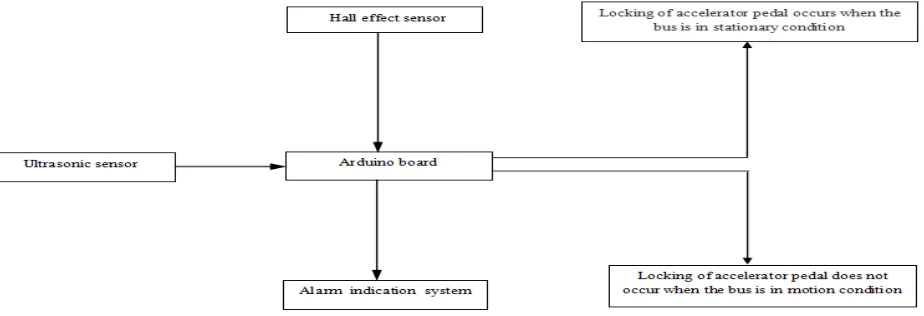
The schematic representation of the footboard accident prevention system is given in Fig.1. The above components are connected by wires, which also can be operated in a wireless radio frequency (RF) network mode.
ISSN(Online): 2319-8753 ISSN (Print): 2347-6710
International Journal of Innovative Research in Science,
Engineering and Technology
(An ISO 3297: 2007 Certified Organization)
Website: www.ijirset.com
Vol. 6, Issue 6, June 2017
The first step of this system is to detect the presence of passengers on the footboard of the bus. The ultrasonic sensor (Model: HC-SR04, Make: Multicomp) is used to detect the presence of passengers in the footboard. It has both a transmitter part and a receiver part. Ultrasonic rays are sent from the transmitter part and receive it in the receiver part. If there is an obstruction (i.e., passengers) in the path of ultrasonic rays, the ultrasonic sensor generates signals and communicates to the arduino board connected to the system.
The second step of the system is to detect, whether the bus is stationary or in motion condition. The Hall effect sensor (Model: US1881, Make: Melexis) is used to sense the movement of the bus. It is fixed on the steering arm of the left front wheel of the bus (it can also be fixed on the steering arm of the right front wheel of the bus). A series of neodymium magnets are attached to the inner rim of the left front wheel of the bus. It is ensured that the Hall effect sensor is in the range of the magnetic field produced by the magnets. Whenever the bus moves, the magnets attached in the wheel also rotates. This rotation creates a variation in the magnetic field, which is sensed by the Hall effect sensor and the signals are communicated to the arduino board.
The arduino board (Model: Uno R3, Make: Mouser Electronics) is manually programmed to receive the signals from the ultrasonic sensor and the Hall effect sensor. The signals are processed by the arduino board and sent to the accelerator pedal locking mechanism (Fig. 2 and Fig. 3) and the alarm indication system.
The accelerator pedal locking mechanism consists of a rack and pinion gear powered by a DC motor (Model: DC30, Make: Mechtex) (Stepper motor or servo motor can also be used). The motor is actuated by the arduino board. The pinion gear is coupled to the motor shaft such that it rotates whenever the motor shaft is rotated. The power is transmitted from the motor to the rack gear through the pinion gear. The locking mechanism is fixed adjacent to the left side of the accelerator pedal (Fig. 2). The right side of the accelerator pedal is fitted with a rack support stand (Fig. 2). This accelerator pedal locking mechanism functions only when the bus is in rest and it will not function when the bus is in motion condition.
Whenever the bus is in a stationary condition and if passengers are detected on the footboard, the motor and the pinion gear rotates in counter clockwise direction. This actuates the rack gear to slide to the right side. Therefore, the rack comes to rest on the rack supporting stand on the other side of the pedal and obstructs the accelerator pedal for acceleration of the bus (Fig. 3). Thus, the accelerator pedal is prevented from being pressed by the driver.
After the passengers board or deboard the bus, the ultrasonic sensor sends the signals to the arduino board, and the motor as well as the pinion gear rotates in the clockwise direction and actuate the rack gear to slide to the left side of the accelerator pedal (Fig. 2). Therefore, the rack gear returns to its original position and the accelerator pedal is unlocked and the bus is free to accelerate.
ISSN(Online): 2319-8753 ISSN (Print): 2347-6710
International Journal of Innovative Research in Science,
Engineering and Technology
(An ISO 3297: 2007 Certified Organization)
Website: www.ijirset.com
Vol. 6, Issue 6, June 2017
1. Rack supporting stand 2. Accelerator pedal 3. Pinion gear
4. Rack gear 5. DC motor
ISSN(Online): 2319-8753 ISSN (Print): 2347-6710
International Journal of Innovative Research in Science,
Engineering and Technology
(An ISO 3297: 2007 Certified Organization)
Website: www.ijirset.com
Vol. 6, Issue 6, June 2017
1. Rack supporting stand 2. Accelerator pedal 3. Rack gear
4. Pinion gear 5. DC motor
Fig.3 Photograph of the accelerator pedal locking mechanism (when there are passengers on the footboard)
IV.WORKINGOFTHEAUTOMATICFOOTBOARDACCIDENTPREVENTIONSYSTEM
ISSN(Online): 2319-8753 ISSN (Print): 2347-6710
International Journal of Innovative Research in Science,
Engineering and Technology
(An ISO 3297: 2007 Certified Organization)
Website: www.ijirset.com
Vol. 6, Issue 6, June 2017
In another preferred working mode of the system, when the bus is in motion condition and if the passengers are present in the footboard, the ultrasonic sensor detects the presence of passengers in the footboard and the Hall effect sensor detects the bus is in motion condition. The signals from the sensors are communicated to the arduino board and the arduino board will actuate only the alarm indication system and the accelerator pedal locking mechanism will not be actuated. This helps to prevent traffic problems.
V. CONCLUSION
In this work, design and fabrication of an automatic footboard accident prevention system is carried out for ensuring the safety of the passengers travelling in the buses. The major components of the system including the ultrasonic sensor, the Hall effect sensor, the accelerator pedal locking mechanism and the alarm indication system are connected with proper electronic circuitry. The hardware of this system occupies less space and consumes lesser power. Installation of this system does not require any design modifications in the existing models of the engines or the accelerators of the buses. The system successfully overcomes the limitations of other systems and ensures the safety of passengers travelling in the buses. The cost of the system is also less. All the components are connected in their respective places to form a circuit.
REFERENCES
[1] Road Accidents in India - 2015, Transport Research Wing, Ministry of Road Transport and Highways, Government of India, http://pibphoto.nic.in/documents/rlink/2016/jun/p20166905.pdf
[2] G. Kalivarathan, R. Prem Sankar, Rohith Rajeev, “Intelligent Footboard Accident Prevention System in Buses”, International Journal of Advanced Research in Biology, Ecology, Science and Technology (IJARBEST), Vol. 1, Issue 2, 2015.
[3] Lu Guonian, Ye Chun, Sun Rujiang, “Equipment using ultrasonic detector to record passenger throughput of bus”, Chinese Patent, Application number – CN 1360288 A.
[4] B.V. Etrometa and J.B Leenhouts, “A device for the automatic detection of passengers getting in and out of public transport vehicles; by applying said device obtained further device for automatic passenger counting and device for automatically opening and closing of vehicle doors”, European Patent, Application number - EP 0077100 A1.
[5] S. Rohit, Shriram K.Vasudevan, S. Lokesh, K. Ajeeth, Vineet Nair, “An Intelligent and Cost Effective Footboard Accident Prevention System”, Information Technology Journal, Vol. 12, Issue 11, pp.2265-2268, 2013.