Improved Audio Watermarking Using
Arnold Transform, DWT and Modified
SVD
Rupali Nayyar 1, Randhir Singh 2, Ritika 3
M.Tech Student, Department of ECE, S.S.C.E.T, Badhani, Pathankot, India1 Associate Professor (HOD), Department of ECE, S.S.C.E.T, Badhani, Pathankot, India2 Assistant Professor, Department ofECE, S.S.C.E.T, Badhani, Pathankot, India3
ABSTRACT: Audio watermarking is becoming popular method in digital image processing because it has capability to secure the audios by injecting watermarks in them. In this paper, various algorithms are discussed which has tried to help the robustness and imperceptibility traits of a good watermarking algorithm by considerably improving the visual quality of the watermarked image and being robust against common signal processing operations and attacks. Different type of multiple attacks will also be considered to evaluate the effectiveness of the various technique include DCT, DWT, SVD, FFT, Arnold transform.
KEYWORDS: Watermarking Scheme, FFT, Arnold transform, SVD technique.
I INTRODUCTION
From a normal standpoint a watermark ensures a link involving the natural data and corresponding information. This link can offer different purposes. Thus the different types of watermarks are categorized as: Key watermarks can be utilized as verification and content reliability mechanisms in a variety of ways. This signifies that the watermark is just a secured link readable only by licensed individuals with the information concerning the secret. Community watermarks behave as a data service with the watermark readable by everybody. These public watermarks may not be detectable or removable by a next party. This requirement could be lowered if these watermarks act as data links. In line with the purpose and the sort of watermark, watermarking methods must possess specific indicate, safety and normal properties.
DESIRED FEATURES OF AUDIO WATERMARKING ALGORITHMS:
Signal processing properties: The watermark should really be perhaps not perceivable by an observer. The watermark should really be effective against intentional or predicted manipulations, e.g. compression, selection, resampling, requantisation, cropping, climbing, etc.
Security properties: The watermarking process should depend on a vital to make sure safety, not on the algorithm's secrecy. The algorithm ought to be published. The watermark ought to be statistically undetectable. The algorithm needs to have a mathematical formulation. The coding process ought to be symmetric or asymmetric (in the sense of people essential cryptographic algorithms), based on the application. Robustness against problems, which use multiple watermarked copies, also known as collusion attacks.
General properties: The algorithm must let real-time processing. The algorithm must be flexible to various degrees of robustness, quality and various numbers of data. The algorithm must certainly be tunable to various presses. The algorithm must support multiple watermarks.
AUDIO WATERMARKING AND APPLICATIONS:
Fingerprinting: In point-to-point circulation conditions details about authenticated consumers could be embedded as key watermarks correct ahead of the protected supply of the data.
Indication of content manipulation: The indication of content manipulation (tamper-proofing) from the authorized state could be detected by means of a public or fragile watermark.
II. RELATED WORK
WATERMARKING TECHNIQUES:
Several watermarking methods are available. But, these methods are generally found in sound watermarking.
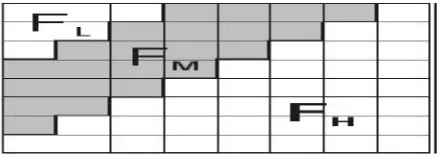
Discrete Cosine Transform: The DCT switches or turns a sign from spatial domain into a frequency domain. DCT is real-valued and offers a much better approximation of a sign with several coefficients. This process reduces how big the standard equations by discarding higher volume DCT coefficients. Crucial architectural information is contained in the paid down volume DCT coefficients. Thus, breaking up the high-frequency DCT coefficient and utilising the light advancement in the low–volume DCT coefficient, it'll purchase and cover the edge information from satellite images. The increased picture is reconstructed by employing inverse DCT and it is act to be sharper with exceptional contrast. DCT is widely found in information force techniques such as for example for instance JPEG and MPEG. The important advantages of DCT contain its large energy compaction houses and accessibility to rapidly calculations for the computation of transform. The energy compaction home of the DCT effects in change coefficients with just several coefficients having rates, thus which makes it acceptable for watermarking.
Fig 1:Discrete Cosine Transform regions
Two-dimensional discrete cosine transformation and its inverse transform are defined as: C(u,v)=α(u)α(v) ∑ ∑ ( , )cos[ ( ) ]cos[ ( ) ] (1)
f(x,y)= ∑ ∑ ( ) ( ) ( , )cos[ ( ) ]cos[ ( ) ] (2) where, u,v = 0,1,2……… N-1
x,y = 0,1,2………N-1 α(u) is defined as follows: α(u) =√1/N u=0;
α(u) =√2/N u=1,2……N-1
Fig 2.Workflow of DWT
Fast Fourier Transform:
FFT algorithm computes the Discrete Fourier Transform (DFT) of a sequence, or their inverse. Fourier examination turns a signal from their distinctive domain to a representation in the volume domain and vice versa. A FFT computes such transformation by factorizing the DFT matrix in to a product of short (mostly zero) factors. An FFT computes the DFT and produces exactly the same impact as examining the DFT classification straight away; probably the most essential huge difference is that the FFT is much faster. (In the present presence of round-off problem, many FFT formulations will also be much more specific than examining the DFT classification straight away.
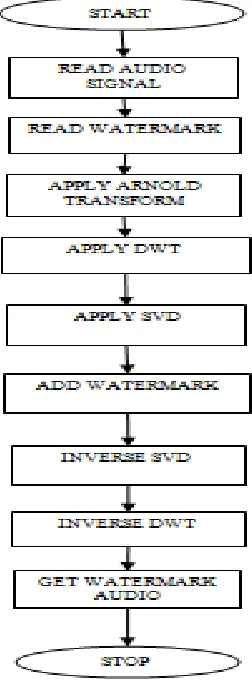
Arnold Transformation: Image scrambling discovers change of the picture, which rearranges the spatial position of the pixels relating to some axioms, and makes picture distortion for the goal of security. If the change axioms and suggestions were not given, the first picture cannot be reconstructed. Frequent practices for scrambling contain Arnold change, miraculous change, Fractal Hilbert fold, Conway game and Graycode change an such like.
III. LITERATURE SURVEY
Wei FOO et al. (2001) [1] offered a flexible algorithm for audio watermarking which uses match hiding method. The algorithm has been split into two parts—encoder style and decoder design. In the encoder section, segmentation is performed on the original audio signal. After which it mask computation and match hiding is performed and watermark data combined with kernel variables are stuck to the audio signal. The portions are prepared and watermark examining is performed to acquire the data in regards to the watermark place and finally following recombining the portions, watermark audio signal is obtained. In the decoder style area of the algorithm, first the audio segmentation is performed on the watermarked audio signal. If two channels are received then peal detection is performed on the remaining and proper channels and the respective answers are compared and if regular portions are received then a portions are combined and then watermark can be used to spot the owner. Various episodes were produced to test the robustness of the process used and it's been configured the robustness against selection is less.
Seok et al. (2002) [2] mentioned the basic needs required for sound watermarking algorithm. An algorithm applying Primary Routine Distribute Selection (DSSS) has been discussed. This algorithm requires benefit of the masking convenience of HAS. This removal is blind strategy which employs brightening procedure. Robustness of watermarked sound is examined applying attacks like mix down, amplitude and data compression.
Tsai et al. (2003) [3] planned a smart sound watermarking algorithm that is depends upon the houses of Individual Auditory System (HAS). It uses the techniques contained in neural communities as properly and works in DCT domain. This is a blind sound watermarking technique. The neural network is used to keep in mind the connection provides between genuine sound file and the watermarked sound file. The sound masking capability of the individual ears has been set to great use here to hide the watermark into the sound signal. The fresh effects show this algorithm provided includes a fair robustness against duplicate right attacks.
random selection of the subband is done. If the square of test data element is more as set alongside the limit value then a watermark has been detected. Following performing the listening checks and the episodes to check on the robustness, it's been determined by the writers this algorithm reveals high robustness.
In- Kwon Yeo et al. (2003) [5] presents the modified patchwork algorithm (MPA), a statistical technique for an audio watermarking algorithm in the transform (not only discrete cosine transform (DCT), but also DFT and DWT) domain. The MPA is an enhanced version of the conventional patchwork algorithm. The MPA is sufficiently robust to withstand some attacks defined by the Secure Digital Music Initiative (SDMI). Experimental results show that the proposed watermarking algorithm is sustainable against compression algorithms such as MP3 and AAC, as well as common signal processing manipulation attacks.
Sriyingyong et al. (2006) [6] offered an algorithm which employs DWT alongside Adaptive Tabu Search (ATS). ATS maintains logs of all measures beginning research to solution. It even has capacity of doing backtracking. Binary picture is developed into 1-D matrix and then encrypted. Sounds indicate is decomposed. Using Db4 and approximation subband therefore received is segmented. After calculating average, each bit of watermark is embedded with the audio signal. Calculation of embedding strength is performed using ATS and by the end Inverse DWT is applied. In the detection algorithm, 5 stages DWT has been applied and from rough approximation coefficient suggest price is calculated.
Ketcham et al. (2007) [7] put forward a genetic algorithm which uses Discrete Wavelet Transform. It is a blind watermarking algorithm. In the embedding part of the algorithm, the 2-D binary image is converted to the 1-D antipodal sequence which is hence encrypted using a random sequence. After the decomposition of the input audio into 5 levels, the division of the coarsest approximation sub-band is segmented into k-segments. After calculation and removal of average value from each segment, one bit at a time are embedded to the previously modified segments. The GA algorithm is used for selecting the position of embedding. Operators like selection, crossover and mutation are used. Finally, the IDWT is performed to obtain the watermarked audio signal. To increase the robustness of the algorithm further, GA has been used on binary image as well. In the detection algorithm, similar steps are performed. The performance is evaluated along with the robustness of the algorithm using the attacks like random noise, filtering, cropping. This algorithm shows fair robustness. An adaptive audio watermarking algorithm using DWT and SVD has been given.
Shijun Xiang et al. (2007) [8] In audio watermarking area, the robustness against desynchronization attacks, such as TSM (Time-Scale Modification) and random cropping operations, is still one of the most challenging issues. In this paper, we present a multibit robust audio watermarking solution for such a problem by using the insensitivity of the audio histogram shape and the modified mean to TSM and cropping operations. We address the insensitivity property in both mathematical analysis and experimental testing by representing the histogram shape as the relative relations in the number of samples among groups of three neighboring bins.
Elshazly et al. (2012) [9] planned an algorithm which uses DWT alongside suggest quantization. Following transforming the segmented sound indicates using DWT and choosing the low energy coefficients, suggest optimization is used on it. The binary picture ,which has been secured and decreased in proportions, is stuck into the sound indicate and then segmented sound indicate is reconstructed and IWDT is put on receive the watermarked sound signal. That algorithm is extremely sturdy against common episodes like reduced move filter, compression, replicate, resampling etc.
tamper. BER and SNR have already been evaluated to get the robustness of the algorithm and it has been concluded that DCT, FFT and DWT could be more robust than this fragile watermarking algorithm.
Yong Xianget al. (2014) [11] It presents a patchwork-based audio watermarking method to resist de-synchronization attacks such as pitch-scaling, time-scaling, and jitter attacks. At the embedding stage, the watermarks are embedded into the host audio signal in the discrete cosine transform (DCT) domain. Then, a set of synchronization bits are implanted into the watermarked signal in the logarithmic DCT (LDCT) domain. At the decoding stage, we analyse the received audio signal in the LDCT domain to find the scaling factor imposed by an attack. Then, we modify the received signal to remove the scaling effect, together with the embedded synchronization bits.
Pranab Kumar et al. (2015) [12] proposes a blind singular value decomposition (SVD) based audio watermarking scheme using entropy and log-polar transformation (LPT) for copyright protection of audio signal. In this scheme, initially the original audio signal is segmented into nonoverlapping frames and discrete cosine transform (DCT) is applied to each frame. Low frequency DCT coefficients are divided into sub band and entropy of each sub band is calculated.
IV. RESEARCH METHODOLOGY
IV. EXPERIMENTAL RESULTS
In this we investigate the watermark scrambling by using the Arnold transform and we compare the existing technique by using the parameters like peak signal to noise ratio, mean square error, root mean square error.
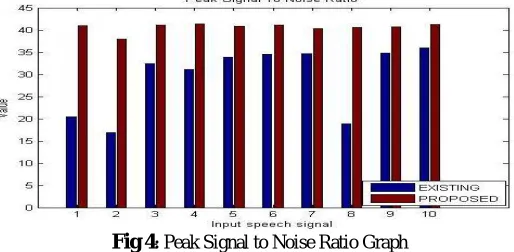
(1)PSNR (Peak signal to noise ratio) - Peak square noise ratio is the ratio between the maximum possible value of the signal and the power of the corrupting noise. It is measured in decibels (db). It can be explained as:
PSNR = 10. log
The average values of all filters are computed in order to calculate percentage improvement. The percentage improvement is expressed as:
% Improvement =
Table 1:Peak Signal to Noise Ratio Comparison Table
Input speech signal
Existing Proposed
1 20.5189 40.9596
2 16.9142 37.9028
3 32.4656 41.1403
4 31.0752 41.3506
5 33.9000 40.8363
6 34.5367 41.1062
7 34.7114 40.3895
8 18.8523 40.5302
9 34.8551 40.7654
10 35.9996 41.2068
This PSNR graph proves that the values of proposed algorithm is low than the existing algorithm, which is as shown in fig 4 below.
Fig 4:Peak Signal to Noise Ratio Graph
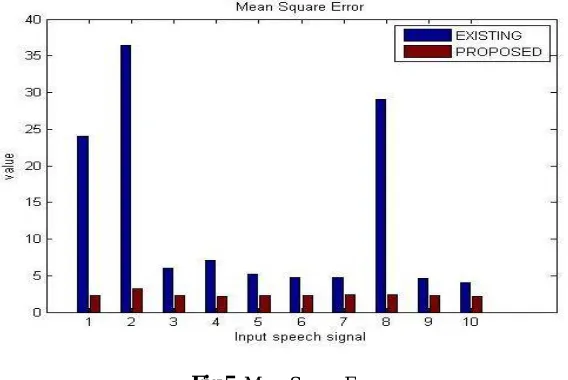
(2)MSE (Mean squared error) - Mean square error is to compute an error signal by subtracting the test signal from the reference, and then computing the average energy of the error signal. It can be explained as:
MSE = ∑ ∑ (f(i, j)−f′(i, j))
The average values of all filters are computed in order to calculate percentage of error detection. The error detection is expressed as:
% Error detection =
Table2:Mean Square Error Comparison Table
This MSE graph proves that the values of proposed algorithm is low than the existing algorithm, which is as shown in fig 5 below
Fig 5:Mean Square Error
(3) RMSE(Root Mean Square Error) - Root-mean-square error is a measure of the differences between values predicted by a model or an estimator and the values actually observed. It can be explained as:
RMSE = ∑ ∑ (f(i, j)−f (i, j))
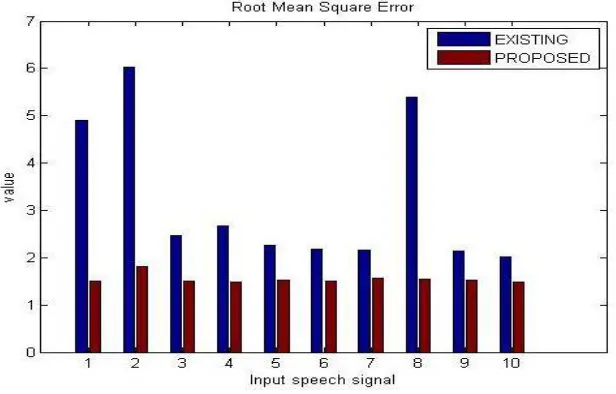
Thevalues ofroot mean square error are given below in the comparison Table 3. As root mean square error of the proposed algorithm need to be less as compared to the existing technique. So the given values have shown that the proposed technique gives efficient results than the existing results.
Input speech signal
Existing Proposed
1 24.0212 2.2833
2 36.3772 3.2464
3 6.0710 2.2363
4 7.1249 2.1828
5 5.1468 2.3159
6 4.7831 2.2451
7 4.6878 2.4342
8 29.1023 2.3990
9 4.6109 2.3349
Table 3:Root Mean Square Error Comparison Table
Input speech signal
Existing Proposed
1 4.9011 1.5111
2 6.0313 1.8018
3 2.4639 1.4954
4 2.6692 1.4774
5 2.2687 1.5218
6 2.1870 1.4984
7 2.1651 1.5615
8 5.3947 1.5489
9 2.1473 1.5280
10 2.0104 1.4897
This RMSE graph proves that the values of proposed algorithm is low than the existing algorithm, which is as shown in fig 6 below.
Fig 6:Root Mean Square Error
V. CONCLUSION
The existence of an invisible watermark is able to turn out to be established employing a suitable watermark origin and diagnosis algorithm. With this particular researching most of us reduce a few of our worry about inconspicuous watermarks. Arnold transform has changed the watermark in such a way that it becomes useless for the hackers or crackers. Different kind of multiple attacks may also be considered to evaluate the effectiveness of the proposed
REFERENCES
[1] FOO, S.W., Yeo, T.H., & Huang, D.Y, “An Adaptive Audio Watermarking System”, Proceedings of IEEE Region 10 International Conference on TENCON, pp. 509-513, 2001.
[2] Seok, Jongwon, Jinwoo Hong, and Jinwoong Kim , "A novel audio watermarking algorithm for copyright protection of digital audio" , etri Journal , Vol.2 No.3 , pp:181-189 , 2002.
[3] Tsai, Hung-Hsu, Ji-Shiung Cheng, and Pao-Ta Yu, "Audio watermarking based on HAS and neural networks in DCT domain." EURASIP Journal on Advances in Signal Processing, Vol. No.3, pp: 764030 , 2003.
[4] Cvejic, Nedeljko, and Tapio Seppanen, "Robust audio watermarking in wavelet domain uses frequency hopping and patchwork method." Image and Signal Processing and Analysis, ISPA 2003. Proceedings of the 3rd International Symposium on. Vol. 1. IEEE, 2003.
[5] In-Kwon Yeo and Hyoung Joong Kim, "Modified patchwork algorithm: a novel audio watermarking scheme," in IEEE Transactions on Speech and Audio Processing, vol. 11, no.4, pp. 381-386, July 2003.
[6] Sriyingyong, N., and K. Attakitmongcol , "Wavelet-based audio watermarking using adaptive tabu search", Wireless Pervasive Computing, 1st International Symposium on. IEEE, 2006.
[7] Ketcham, M., & Vongpradhip, S , “Intelligent audio watermarking using genetic algorithm in DWT domain”. International Journal Of Intelligent Technology, Vol.2 No.2, pp: 135-140, 2007.
[8] S. Xiang and J. Huang, "Histogram-Based Audio Watermarking Against Time-Scale Modification and Cropping Attacks," in IEEE Transactions on Multimedia, vol. 9, no. 7, pp. 1357-1372, 2007.
[9] Elshazly, A. R., M. M. Fouad, and M. E. Nasr, "Secure and robust high quality DWT domain audio watermarking algorithm with binary image" , Computer Engineering & Systems (ICCES), 2012 Seventh International Conference on. IEEE, 2012.
[10] Ghobadi, Alireza, et al. "Blind audio watermarking for tamper detection based on LSB", Advanced Communication Technology (ICACT), 2013 15th International Conference on IEEE, 2013.
[11] Y. Xiang, I. Natgunanathan, S. Guo, W. Zhou and S. Nahavandi, "Patchwork-Based Audio Watermarking Method Robust to De-synchronization Attacks," in IEEE/ACM Transactions on Audio, Speech, and Language Processing, vol. 22, no. 9, pp. 1413-1423, 2014. [12] Dhar, Pranab Kumar, and Tetsuya Shimamura. "Blind SVD-based audio watermarking using entropy and log-polar transformation." Journal of