R E S E A R C H
Open Access
Frequency-domain equalization for OFDMA-based
multiuser MIMO systems with improper
modulation schemes
Pei Xiao
1*, Zihuai Lin
2,5, Anthony Fagan
3, Colin Cowan
4, Branka Vucetic
2and Yi Wu
5Abstract
In this paper, we propose a novel transceiver structure for orthogonal frequency division multiple access-based uplink multiuser multiple-input multiple-output systems. The numerical results show that the proposed frequency-domain equalization schemes significantly outperform conventional linear minimum mean square error-based equalizers in terms of bit error rate performance with moderate increase in computational complexity.
Keywords:OFDMA, multiple-input multiple-output (MIMO), frequency-domain equalization
1 Introduction
Multiple-input multiple-output (MIMO) techniques in combination with orthogonal frequency division multiple access (OFDMA) have been commonly used by most of the 4G air-interfaces, e.g., WiMAX, long-term evolution, IEEE 802.20, Wireless broadband, etc. In the IEEE 802.16e mobile WiMAX standard, OFDMA has been adopted for both downlink and uplink transmission [1,2]. In 3GPP LTE, single carrier (SC) frequency division mul-tiple access (FDMA) is used for uplink transmission, whereas the OFDMA signaling format is exploited for downlink transmission [3]. There are also some proposals on using OFDMA for uplink transmission in the LTE advanced (LTE-A) standard, in which both SC-FDMA and OFDMA can be considered for uplink transmission.
This paper investigates receiver algorithms for the uplink of OFDMA-based multi-user MIMO systems. Fre-quency-domain equalization (FDE) is commonly used for OFDMA. This includes frequency domain linear equaliza-tion (FD-LE) [4], decision feedback equalizaequaliza-tion (DFE) [5,6], and the more recent turbo equalization (TE) [7,8]. FD-LE is analogous to time-domain LE. A zero-forcing (ZF) LE [9] eliminates intersymbol interference (ISI) com-pletely but introduces degradation in the system perfor-mance due to noise enhancement. Superior perforperfor-mance
can be achieved by using the minimum mean square error (MMSE) criterion [9], which accounts for additive noise in addition to ISI. In OFDMA, a DFE results in better perfor-mance than a LE due to its ability to remove past echo ISI. However, a DFE is prone to error propagation when incor-rect decisions are fed back. Consequently, it suffers from a performance loss for long error bursts. The principle that TE employs to improve performance is to add complexity at the receiver through an iterative process, in which feed-back information obtained from the decoder is incorpo-rated into the equalizer at the next iteration. The iterative processing allows for reduction of ISI, multistream inter-ference, and noise by exchanging extrinsic information between the equalizer and the decoder [7,8].
The second-order properties of a complex random pro-cess are completely characterized by its autocorrelation function as well as the pseudo-autocorrelation function [10]. Most existing studies on receiver algorithms only exploit the information contained in the autocorrelation function of the observed signal. The pseudo-autocorrela-tion funcpseudo-autocorrela-tion is usually not considered and is implicitly assumed to be zero. While this is the optimal strategy when dealing with proper complex random processes [11], it turns out to be sub-optimal in situations where the transmitted signals and/or interference are improper complex random processes, for which the pseudo-auto-correlation function is non-vanishing, and the perfor-mance of a linear receiver can be improved by the use of
widely linear processing(WLP) [12]. Such a scenario
* Correspondence: [email protected] 1
Centre for Communication Systems Research, University of Surrey, Guildford, Surrey, GU2 7XH, UK
Full list of author information is available at the end of the article
arises when transmitting symbols with improper modula-tion formats (e.g., ASK and OQPSK) over complex chan-nels. It was shown in Schreier et al. [10] that the performance gain of WLP compared to conventional processing in terms of mean square error can be as large as a factor of 2. MIMO transceiver design was considered in Mattera et al. [13], Sterle [14], where it was shown that when channel information is available both at the trans-mitter and receiver, joint design of the precoder and decoder using WLP yields considerable performance gains at the expense of a limited increase in the computa-tional complexity, compared to the convencomputa-tional linear transceiver in the scenario where real-valued symbols are transmitted over complex channels. By using the same principle, a real-valued MMSE (RV-MMSE) beamformer was developed in Chen et al. [15] for a binary phase shift keying (BPSK)-modulated system and was shown to offer significant enhancements over the standard complex-valued MMSE (CV-MMSE) design in terms of bit error rate performance and the number of supported users.
In this paper, we show that the conventional frequency-domain linear equalizer is suboptimal for improper sig-nals and that performance can be greatly improved by applying widely linear processing and utilizing complete second-order statistics of improper signals.
Notations: we use upper bold-face letters to represent matrices and vectors. The (n, k)th element of a matrix Ais represented by [A]n,k, thenth element of a vectorb is denoted by [b]n, and thenth column of a matrixAis represented by (A)n. Superscripts(·)H,(·)T and (·)* denote the Hermitian transpose, transpose, and conju-gate, respectively. E[·] denotes expectation (statistical averaging).
2 System model
The cellular multiple access system under study hasnR receive antennas at the BS and a single transmit antenna at theith user terminal,i= 1, 2, ...,KT, whereKTis the total number of users in the system. We consider the multi-user MIMO case withK(K≤KT) users being served at each time slot andK=nR. The system model for an OFDMA-based MIMO transmitter and receiver is shown in Figures 1 and 2, respectively. On the transmitter side, the user data block containing N symbols first goes through a subcarrier mapping block. These symbols are then mapped toM(M >N) orthogonal subcarriers fol-lowed by anM-point inverse fast fourier transform (IFFT) to convert to a time-domain complex signal sequence.
There are two approaches to mapping subcarriers among mobile stations (MSs) [3]: localized mapping and distributed mapping. The former is usually referred to as localized FDMA transmission, while the latter is usually called distributed FDMA transmission scheme.
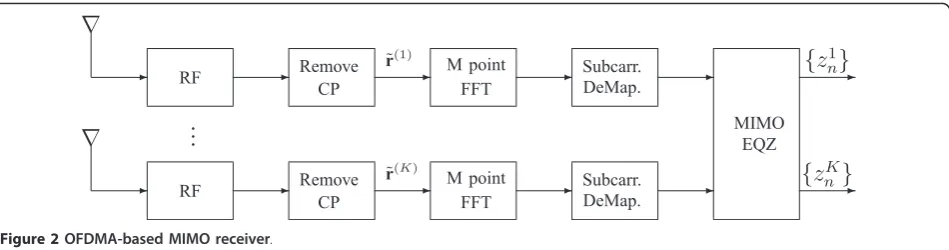
With the localized FDMA transmission scheme, each user’s data are transmitted by consecutive subcarriers, whereas with the distributed FDMA transmission scheme, the user’s data are placed in subcarriers that are distributed across the OFDM symbol [3]. Because of the spreading of the information symbols across the entire signal band, the distributed FDMA scheme is more robust against frequency-selective fading and can thus achieve better frequency diversity gain. For localized FDMA transmission, in the presence of a frequency-selective fading channel, multiuser diversity and fre-quency diversity can also be achieved if each user is assigned to subcarriers with favorable transmission char-acteristics when the channel is known at the transmitter. In this work, we only consider localized FDMA trans-mission. A cyclic prefix (CP) is inserted into the signal sequence before it is passed to the radio frequency (RF) module. On the receiver side, the opposite operating procedures are performed after the noisy signals are received by the receive antennas. A MIMO domain equalizer (FDE) is applied to the frequency-domain signals after subcarrier demapping as shown in Figure 2. For simplicity, we employ a linear MMSE receiver, which provides a good tradeoff between the noise enhancement and the multiple stream interference mitigation [16].
In the following, we letDFM=IK⊗FMand denote by
FM the M × M Fourier matrix with the element
[FM]m,k= exp(−j2Mπ(m−1)(k−1))wherek, m Î {1, ..., M} are the sample number and the subcarrier number, respectively. Here, ⊗is the Kronecker product, and IK
is the K × K identity matrix. We denote by
D−F1
M =IK⊗F
−1
M the KM × KM matrix whereF−M1is the
M × M inverse Fourier matrix with element
[F−M1]m,k= M1 exp(j2Mπ(m−1)(k−1)). Furthermore, we let Fnrepresent the subcarrier mapping matrix of size M × N. Then,F−1
n is the subcarrier demapping matrix of size N×M.
The received signal after the RF module and CP removal becomes ˜r=HD˜ −F1
M(IK⊗Fn)x+w˜, where x= [xT1,. . .,xKT]T∈CKN×1is the data sequence of allK
users, and xiÎ ℂN ×1,i Î {1, ...,K}, is the transmitted user data block for the ith user; w˜ ∈CMnR×1is a
circu-larly symmetric complex Gaussian noise vector with zero mean and covariance matrix N0I∈RMnR×MnR, i.e.,
˜
H;H˜ is thenRM×KMchannel matrix.
The signal after performing the FFT operation, sub-carrier demapping, and employing a MIMO FDE is given by
z=GH(IK⊗Fn−1)DFM˜r=GH(IK⊗Fn−1)DFM(HD˜ − 1
FM(IK⊗Fn)x+w˜)
where
H= (IK⊗F−n1)DFMHD˜
−1
FM(IK⊗Fn)∈C
KN×KN
,
is the channel matrix in the frequency domain andr=
HPs + w; G is the KN × KN equalization matrix;
w∈CnRN×1is a circularly symmetric complex Gaussian
noise vector with zero mean and covariance matrix N0I∈RnRN×nRN, i.e.,w∼CN(0,N0I). The vectorx can
be expressed asx=Ps, wheres= [sT1 · · ·sTK]T andsiÎ ℂN×1
,i Î{1, 2, ..., K}, is the user data block for theith user, andE[sisHi ] =IN. The power loading matrixPÎ ℝKN×KN
is a block diagonal matrix with itsith sub-matrix expressed as Pi= diag
√
pi,1,√pi,2,. . .,√pi,N
∈RN×N andpi,n(iÎ{1, 2, ...,K}) is the transmitted power for the ith user at thenth subcarrier;sÎℂKN×1represents the transmitted data symbol vector from different users with E[ssH] =IKN.
When proper modulation schemes are employed, the conventional equalizerG can be derived from the cost functione= E[z−s2] = E[GHr−s2]. Minimizing
this cost function leads to the optimal solution
G=C−rr1Crs= (HPPHHH+N0I)−1HP, (2)
whereCrr= E[rrH] =HPPHHH+N0Iis the
autocorre-lation matrix of the observation vector r;
Crs= E[rsH] =HPis the cross-correlation matrix between
the observation vectorrand the symbol vectors.
Note that the aforementioned FDE is a joint equaliza-tion algorithm, i.e., the transmitted symbols from differ-ent users are jointly equalized. To achieve spatial multiplexing gain, symbols from different users are assigned to the same subcarriers in the studied OFDMA-based multiuser MIMO system. Due to co-channel interference (causing the co-channel matrixHto be non-diagonal), we need to perform joint equalization for the transmitted symbols from different users.
3 The proposed frequency-domain receiver algorithm
In the previous section, we presented the conventional linear MMSE solution for the uplink of OFDMA-based multiuser MIMO systems. It is designed based on the autocorrelation matrix Crr and the cross-correlation
matrix Crs. It is only optimal for systems with proper
modulation, such asM-QAM andM-PSK, for which the pseudo-autocorrelation C˜rr= E[rrT]and the
pseudo-cross-correlationC˜∗rs= E[r∗sH]are zero when M > 2. However, for improper modulation schemes, such asM -ary ASK and OQPSK (for which both the pseudo-auto-correlation and the pseudo-cross-pseudo-auto-correlation are non-zero), the conventional solution becomes suboptimal becauseC˜rrandC˜
*
rsare not taken into consideration in
the receiver design. In order to utilizeC˜rr and C˜ * rs, we
need to apply widely linear processing [10,12], the prin-ciple of which is not only to process r, but also its
{
x
1n-
}
Subcarr.Mapping
-M point
IFFT - Add CP - RF
∇
{
x
Kn-
}
Subcarr.Mapping
-M point
IFFT - Add CP - RF
...
∇
Figure 1OFDMA-based MIMO transmitter.
{
z
1 n}
{
z
Kn
}
∇
∇
- RF - Remove
CP
-˜r(1)
˜r(K)
M point
FFT
-Subcarr.
DeMap. -
-- RF
...
- Remove
CP
-M point
FFT
-Subcarr.
DeMap.
-MIMO EQZ
conjugated versionr* in order to derive the filter output, i.e.,
z=G0r+G1r∗ =Hy, (3)
where = [G0 G1]H and y= [r r∗]T. It is worth
noticing that the conventional linear MMSE receiver is a special case of the one expressed by (3), when
G0=GHandG1=0.
To derive the improved FDE, we re-define the detec-tion error asε=Hy−s. According to the orthogonal-ity principle [17], the mean-square value of the estimation errorεis minimum if and only if it is ortho-gonal to the observation vectory, i.e.,
E[yεH] = E[y(Hy−s)H] =0,
leading to the solutionn=C−yy1Cys, where
Cyy= E{yyH}= E
r r∗ r
H rT =
CrrC˜rr
˜ C*rrC*rr
, (4)
and
Crr= E{rrH}= E{(HPs+w)(sHPHHH+wH)}=HPE[ssH]PHHH+N0I=HPPHHH+N0I, ˜
Crr= E{rrT}= E{(HPs+w)(sTPTHT+wT)}=HPE[ssT]PTHT=HPPTHT,
Cys= E{ysH}= E
r r*
sH = E
rsH r∗sH
=
Crs ˜
C*rs
=
⎡ ⎣HPE
ssH
H*PEs∗sH
⎤ ⎦=
HP H*P
.
(5)
Based on the above derivations, we can form the opti-mal solution forΨas
=C−1
yyCys=
HPPHHH+N0I HPPTHT H∗P∗PHHH H∗P∗PTHT+N0I
−1 HP H∗P
. (6)
For the proposed FDE, the augmented autocorrelation matrix Cyyand cross-correlation matrix Cysexpressed
in (5), which give a complete second-order description of the received signal, are used to derive the filter coeffi-cient matrixΨ. On the other hand, for the conventional linear MMSE algorithm, the coefficient matrixGis cal-culated using only the autocorrelation of the observation Crr and the cross-correlationCrs. The
pseudo-autocor-relationC˜rrand pseudo-cross-correlationC˜ *
rsare
impli-citly assumed to be zero, leading to sub-optimal solutions.
For proper signals like QAM and PSK, the improved FDE converges to the conventional FDE since
E[ssT] =0, leading to C˜rr= E{rrT}=0 and
˜
C∗rs= E{r∗sH}=0. Therefore,C˜rr=0andCys=
HP 0
in
Eq. (5). The optimal solution ofΨ can be simplified to
=C−1
yyCys=
CrrC˜rr
˜
C∗rrC∗rr
−1 HP 0 =
Crr 0
0 C∗rr
−1 HP 0 =
C−1
rr 0
0 (C∗rr)−
1 HP0
=C−1rrHP= (HPPHHH+N0I)−1HP,
which is exactly the same as Eq. (2) for the conven-tional FDE.
The improved FDE has higher computational com-plexity than the conventional FDE. The difference in complexity lies in the computation of the matrix Gfor the conventional equalizer and the computation of Ψ for the improved equalizer as indicated in Table 1, where we show the number of complex multiplication (×), division (÷), addition (+), and subtraction (-) opera-tions to calculateGandΨ, respectively. In the complex-ity calculation, we use the fact that for a L×Lmatrix, its matrix inversion involves 2L2divisions, 2L3 multipli-cations, and 2L3 subtractions. It should also be noted that the complexity increase by the improved scheme is compensated for the significant performance improve-ment. Furthermore, this issue becomes less critical in slow-fading channels for which the equalizer matrices do not need to be updated frequently.
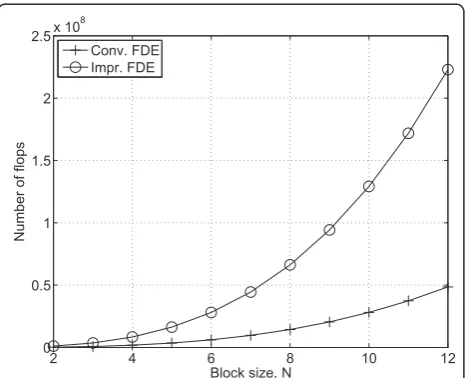
In Figure 3, we show the number of flops required to compute the matrix G(for the conventional FDE) and the matrix Ψ (for the improved FDE) as a function of the data block size N for a 2-user case. One flop is counted as one real operation, which can be addition, subtraction, multiplication, or division [18]. A complex division requires 6 real multiplications, 3 real additions/ subtractions, and 2 real divisions. A complex multiplica-tion requires 4 real multiplicamultiplica-tions and 2 real addimultiplica-tions. It is evident from Figure 3 that the additional operations required by the improved FDE is moderate when the block size is small, e.g., N< 10, and increases signifi-cantly when the block size increases. For example, the number of flops required by the improved FDE is 4.5 times that required by the conventional FDE whenN= 12. Therefore, for efficient implementation, it is neces-sary to break the received data into blocks of moderate sizes before the equalization is applied.
4 The proposed iterative receiver algorithm
In this section, we derive an iterative FDE algorithm by applying WLP and exploiting the complete second-order statistics of the improper signals. Recall that the received signal after CP removal, FFT and subcarrier demapping can be expressed as
r=HPs+w, (7)
where the symbol vector
s= s1 ... sn−1 sn sn+1 ... SN K
T. Let us
assume that symbol sn is to be decoded. By using the iterative interference cancelation technique [8,19,20], the received vector can be expressed as
wherernis the interference canceled version ofr, and
¯ sn=
¯
s1 ... ¯sn−1 0 ¯sn+1 ... ¯sN K
T
, (9)
which contains the soft estimate of the interfering symbols from the previous iteration. Note that (8) repre-sents a decision-directed iterative scheme, where the detection procedure at thepth iteration uses the symbol estimates from the (p- 1)th iteration. The performance is improved in an iterative manner due to the fact that the symbols are more accurately estimated (leading to better interference cancelation) as the iterative proce-dure goes on. For simplicity, the iteration index is omitted, whenever no ambiguity arises.
In order to further suppress the residual interference in rn, an instantaneous linear filter is applied to rn, to obtainzn=gHnrn, where the filter coefficient vectorgnÎ ℂN K× 1
is chosen by minimizingen= E{|wHnrn−sn|2}, under the MMSE criterion. It can be derived as
gn= [HPVnPHHH+N0I]−1(HP)n, (10)
where (HP)nis thenth column of the matrix HP. The matrixVnÎℝN K× 1is formed as
Vn= diag{var(s1). . .var(sn−1) σs2 var(sn+1). . .var(sN K)]}, (11)
whereσ2
s = E[|sj|2], andvar(sj) = E[|sj− ¯sj|2]. Refer to Wautelet et al. [19], Wang and Li [20], and Tuchler et al.
[8] for a detailed description of this conventional iterative algorithm.
The conventional scheme suffers from the problem of error propagation caused by incorrect decisions. As will become evident in Section 5, the error propagation effect can be reduced and the system performance can be improved if we not only processrnbut also its conjugated version r∗n in order to derive the filter output, i.e., zn=anrn+bnr∗n=Hnyn, where n= [an bn]H and
yn= [rTn(r∗n)T]T. The filterΨncan be derived by minimiz-ing the MSE E{|en|2}, whereen=zn−sn=Hnyn−sn. According to the orthogonality principle,
E[yne∗n] = E[yn(nHyn−sn)H] =0,
leading to the solution
n= (E[ynyHn])−1E[yns∗n] =−yy1ys, (12)
where
yy= E{ynyHn}= E
rn
r∗n rHn rTn
=
HPVnPHHH+σn2I HPVnPTHT
H∗P∗V∗nPHHH H∗P∗VnPTHT +σn2I
;
ys = E{yns∗n}= E
rns∗n
r∗ns∗n =
(HP)n (HP)∗n
.
(13)
In what follows, we demonstrate how the vectors¯nin (9) and the matrixVnin (11) can be derived in order to carry out the iterative process. The filter output can be expressed as
zn=Hnyn=μnsn+νn,
where the combined noise and residual interferenceνn are approximated as a Gaussian random variable [21], i.e.,
νn∼CN(0,Nν). The parameters μn, Nν can be
deter-mined as [22]
μn= E{zns∗n}=HnE[yns∗n] =Hnys; Nη=μn−μ2n.
(14)
After computing the values ofμnand Nν, the
condi-tional probability density function (PDF) of the filter output can be obtained as
f(zn|sn=xm) =
1 πNνexp
−|zn−μnxm|2 Nν
,
2 4 6 8 10 12
0 0.5 1 1.5 2 2.5x 10
8
Block size, N
Number of flops
Conv. FDE Impr. FDE
Figure 3Complexity comparison between the conventional FDE and the improved FDE. The number of users is assumed to beK= 10.
Table 1 Complexity for calculating the equalization matrices G andΨ
Operations × ÷ +
-ForG 4K3N3+K2N2+ 2KN 2K2N2 2K2N2-KN 2K3N3
For M-ary PSK, QAM, ASK systems, each symbolsn corresponds to log2 Mbits, denoted asbin,i = 1, ..., log2 M. The log-likelihood ratio (LLR) for theith informa-tion bitbincan be computed as
λ(bi n) = ln
f(zn|bin= 1) f(zn|bin= 0)
= ln
sn∈Si,1f(zn|sn)
sn∈Si,0f(zn|sn)
≈lnexp(− |zn−μns
+
n|2
Nν) exp(− |zn−μns−n|2Nν)
= 1
Nν{|zn−μns −
n|2− |zn−μns+n|2}
= 1
1−μnRe{[2s
+∗
nzn−μn|s+n|2]−[2s−∗n zn−μn|s−n|2]},
(15)
whereSi,1(Si,0)is the set of symbols {xm} whoseith bit
takes the value of 1 (0); s+ denotes the symbol corre-sponding to max{f(zn|sn∈Si,1)}, and s- denotes the symbol corresponding tomax{f(zn|sn∈Si,0)}.
The soft estimate ¯siin (9) and the variance var (si) in (11), respectively, can be calculated as [22]
¯
si= E{si}= M
m=1
xmPr(si=xm);
Var(si) = E[|si|2]− |E{si} |2,
where E[|si|2] =Mm=1|xm|2Pr(si=xm). The a priori probability of each symbol Pr(si) can be calculated as Pr(si) =p=1,...,log2MPr(bpi), where
Pr(bpi = 1) = eλ(bpi)
1 +eλ(bpi)
; Pr(bpi = 0) =
1
1 +eλ(bpi) .
5 Simulation results
We consider a WiMAX baseline antenna configuration, in which two MSs are grouped together and synchronized to form a MIMO channel between the BS and the MSs. We assume a six-path fading channel, and the channel matrix is normalized such that the average channel gain for each transmitted symbol be equal to unity. The fading coeffi-cients for each path are modeled as independent identi-cally distributed (i.i.d) complex Gaussian random variables. The channel is assumed to be fully interleaved, have a uniform power delay profile, and to be a slowly time-varying so that it remains static during the transmis-sion of one frame of data but varies from one frame to another. The block size of the user data is 12, which is also the number of subcarriers in a resource block. The size of the FFT is 256, and the length of the cyclic prefix (CP) is 8. The power loss incurred by the insertion of the CP is taken into account in the SNR calculation.
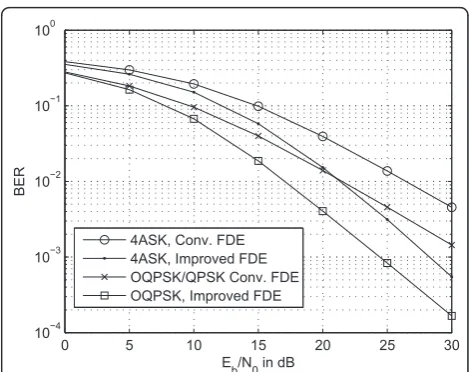
Figure 4 shows the bit error rate (BER) performance comparison between the conventional and the improved receivers for 4ASK and OQPSK systems. The improved receiver scheme significantly outperforms its conventional counterpart, especially at high SNRs. The gap can be over 5-6 dB. The curve for a QPSK system with the
conventional receiver is also provided for a baseline com-parison. Note that for the conventional receiver, the BER performance for an OQPSK system is the same as for a QPSK system [23]. The performance of the QPSK system is superior to the 4ASK system with the conventional recei-ver but is inferior to the 4ASK system with the improved equalizer at high SNRs. Although QPSK modulation itself is more power efficient than 4ASK for using a signal con-stellation of 2 dimensions instead of 1, the 4ASK system can exploit the pseudo-autocorrelation function in the receiver design, whereas the QPSK system does not have this special property to utilize. The overall impact will ren-der an advantageous situation for the 4ASK system. Refer to Sterle [24] for a detailed and quantitative analysis of the performance gain that can be achieved by a widely linear transceiver.
Figure 5 shows the BER performance comparison between the conventional and the improved FDE for 16ASK and 16QAM systems. For the 16ASK system, the improved receiver significantly outperforms its conven-tional counterpart and the performance gain increases as the SNR increases. Figure 5 also shows that the 16ASK system with the improved FDE performs better than the 16QAM system when SNR > 40 dB.
In Figure 6, we compare the performance of the pro-posed iterative FDE introduced in Section 4 with the conventional iterative FDE. The curves are plotted at the second iteration, since it has been observed that the major gain from the iterative process can be achieved with two iterations. The conclusions from previous experiments also hold here: the QPSK system has a bet-ter performance than the 4ASK system with the conven-tional iterative FDE, but it is inferior to the 4ASK
0 5 10 15 20 25 30
10−4 10−3 10−2 10−1 100
Eb/N0 in dB
BER
4ASK, Conv. FDE 4ASK, Improved FDE OQPSK/QPSK Conv. FDE OQPSK, Improved FDE
Figure 4BER performance for the uplink of OFDMA system (K =nR= 2) for the conventional FDE and the improved FDE. The
system with the improved iterative FDE. The perfor-mance gain can be over 4 dB at high SNR. The gain achieved by the iterative process can be determined by comparing Figures 6 to 4. For example, in order to achieve a target BER of 10-3, a SNR value of 28 dB is required for the 4ASK system with the proposed non-iterative FDE, while only 25 dB is required by the pro-posed iterative FDE at the second iteration.
6 Conclusion
In this paper, we derived an improved FDE algorithm for an OFDMA-based multiuser MIMO system with
improper signal constellations. Our simulation results reveal that the proposed scheme has superior BER per-formance compared to the ones with the conventional FDE. We also presented a novel iterative FDE scheme, which utilizes the complete second-order statistics of the received signal. It is shown that this scheme signifi-cantly outperforms the conventional iterative FDE.
Author details
1Centre for Communication Systems Research, University of Surrey, Guildford,
Surrey, GU2 7XH, UK2School of Electrical and Information Engineering, University of Sydney, Sydney, NSW, 2006, Australia3Department of Electronic and Electrical Engineering, University College Dublin, Dublin 4, Ireland 4Institute of Electronics, Communications and Information Technology,
Queen’s University Belfast, Belfast BT3 9DT, UK5Department of
Communication and Network Engineering, Fujian Normal University, Fuzhou 350007, Fujian, China
Competing interests
The authors declare that they have no competing interests.
Received: 8 October 2010 Accepted: 23 September 2011 Published: 23 September 2011
References
1. K Etemad, Overview of mobile WiMAX technology and evolution. IEEE Commun Mag.46(10), 31–40 (2008)
2. F Wang, A Ghosh, C Sankaran, P Fleming, F Hsieh, S Benes, Mobile WiMAX systems: performance and evolution. IEEE Commun Mag.46(10), 41–49 (2008)
3. 3GPP TR 25.814 V7.0.0,Physical Layer Aspects for Evolved UTRA. Technical Report (June 2006)
4. V Pancaldi, GM Bitetta, Block channel equalization in the frequency domain. IEEE Trans Commun.53(1), 110–121 (1995)
5. N Benvenuto, S Tomasin, On the comparison between OFDM and single carrier modulation with a DFE using a frequency domain feedforward filter. IEEE Trans Commun.50(6), 947–955 (2002). doi:10.1109/
TCOMM.2002.1010614
6. N Benvenuto, S Tomasin, Iterative design and detection of a DFE in the frequency domain. IEEE Trans Commun.53(11), 1867–1875 (2005). doi:10.1109/TCOMM.2005.858666
7. C Douillard, M Jzquel, C Berrou, A Picart, P Didier, A Glavieux, Iterative correction of inter-symbol interference: turbo-equalization. Eur Trans Telecommun.6(5), 507–511 (1995). doi:10.1002/ett.4460060506 8. M Tuchler, R Koetter, A Singer, Turbo equalization: principles and new
results. IEEE Trans Commun.50(5), 754–767 (2002). doi:10.1109/ TCOMM.2002.1006557
9. D Tse, P Viswanath,Fundamentals of Wireless Communications, (Cambridge University Press, Cambridge, 2004)
10. P Schreier, L Scharf, C Mullis, Detection and estimation of improper complex random signals. IEEE Trans Inform Theory.51(1), 306–312 (2005). doi:10.1109/TIT.2004.839538
11. F Neeser, J Massey, Proper complex random processes with applications to information theory. IEEE Trans Inform Theory.39(4), 1293–1302 (1993). doi:10.1109/18.243446
12. B Picinbono, P Chevalier, Widely linear estimation with complex data. Trans Signal Process.43(8), 2030–2033 (1995). doi:10.1109/78.403373
13. D Mattera, L Paura, F Sterle, inProceedings of the EUSIPCO. Widely Linear MMSE Transceiver for Real-Valued Sequences Over MIMO Channel (2006) 14. F Sterle, Widely linear MMSE transceivers for MIMO channels. IEEE Trans
Signal Process.55(8), 4258–4270 (2007)
15. S Chen, S Tan, L Hanzo, inProc. IEEE WCNC.Linear Beamforming Assisted Receiver for Binary Phase Shift Keying Modulation Systems 1741–1746 (2006)
16. AJ Paulraj, R Nabar, D Gore,Introduction to Space-Time Wireless Communications, 1st edn. (Cambridge University Press, Cambridge, 2003) 17. S Kay,Fundamentals of Statistical Signal Processing, (Prentice Hall, NJ, 1998)
15 20 25 30 35 40 45 50
10−4 10−3 10−2 10−1
Eb/N0 [dB]
BER
16ASK Conv. 16QAM Conv. 16ASK Impr.
Figure 5BER performance for the uplink of OFDMA system (K =nR= 2) for the conventional FDE and the improved FDE for systems with high-order signal constellations. The users have equal transmit power.
5 10 15 20 25 30 35
10−4 10−3 10−2 10−1
Eb/N0 [dB]
BER
4ASK Conv. QPSK Conv. 4ASK Impr.
18. GH Golub, CF Van Loan,Matrix Computations, 3rd edn. (John Hopkins University Press, Baltimore, 1996)
19. X Wautelet, A Dejonghe, L Vandendorpe, MMSE-based fractional turbo receiver for space-time BICM over frequency-selective MIMO fading channels. IEEE Trans Signal Process.52(6), 1804–1809 (2004). doi:10.1109/ TSP.2004.827198
20. J Wang, S Li, inProceedings of the PIMRC. Reliability Based Reduced-Complexity MMSE Soft Interference Cancellation MIMO Turbo Receiver 1–4 (Sept. 2007)
21. V Poor, S Verdu, Probability of error in MMSE multiuser detection. IEEE Trans Commun.43(3), 858–971 (1997)
22. A Dejonghe, L Vandendorpe, Turbo-equalization for multilevel modulation: an efficient low-complexity scheme. Proc IEEE ICC.3, 1863–1867 (2002) 23. M Simon, MS Alouini,Digital Communication over Fading Channels: A Unified
Approach to Performance Analysis, (Wiley, New York, 2000) 24. M Lipardi, D Mattera, F Sterle, Constellation design for widely linear
transceiver. Eur J Adv Signal Process.2010, 13. (Article ID 176587)
doi:10.1186/1687-6180-2011-73
Cite this article as:Xiaoet al.:Frequency-domain equalization for OFDMA-based multiuser MIMO systems with improper modulation schemes.EURASIP Journal on Advances in Signal Processing20112011:73.
Submit your manuscript to a
journal and benefi t from:
7Convenient online submission 7Rigorous peer review
7Immediate publication on acceptance 7Open access: articles freely available online 7High visibility within the fi eld
7Retaining the copyright to your article