R E S E A R C H
Open Access
Adaptive primary user
’
s signal detection
algorithm based on matrix accumulation
estimation for cognitive radio
Hongjun Wang
1,2*, Guangguo Bi
1*, Zifa Zhong
2, Shuo Zhang
2and Zaichen Zhang
1Abstract
In this article, a new adaptive primary user’s signal detection algorithm for cognitive radio, which integrates frequency-domain block adaptive filtering with a matrix accumulation estimation, is presented with detailed description’ of the concept and process of the algorithm. Then, the performance of the algorithm is analyzed and compared by simulation according to the practical requirement of cognitive radio. The result shows that the proposed detection algorithm can detect weak signals quickly and effectively with higher detection probability.
Keywords:cognitive radio, signal detection, block-FFT adaptive filter, matrix accumulation estimation
1. Introduction
The cognitive radio [1-5] can sense and recognize the changes of the electromagnetic environment and borrow a spectrum-hole to transmit information in real-time manner without bringing about any interference to pri-mary users and other users around. It must release the “borrowed” channels and switch to the next spectrum-hole as soon as primary users appear. The cognition must run through the whole communication process. The chief task of cognitive radio is to scout and deter-mine the spectrum-hole, that is, cognitive radio should have the ability of detecting weak primary user signals from strong background noise [6-8].
Since the digital filters was presented, the adaptive fil-ters technology especially the adaptive least mean square (LMS) filters have been applied widely in scientific and technological domains such as communication systems and signal processing systems. Among the adaptive fil-ters, the adaptive block LMS filters [9-11] is an more efficient and faster scheme to detect signals in back-ground noise. The latest research findings shows the adaptive block filters provide almost the same mean-square-error as the recursive least squares adaptive filter and possesses a superior convergence rate than the
conventional LMS and the normalized LMS filters [12,13]. The block LMS adaptive filter processes data on a block-by-block basis, as opposed to a sample-by-sam-ple basis. Chia-Chang Hu and his collaborators pre-sented an adaptive block DFT-LMS filter to detect users’signals in the impulse radio ultra-wideband (IR-UWB) systems in [12]. Based on the LMS method, Atrouz adopted the partial adaptive scheme and the block processing to complete the jammers cancellation in paper [13]. From the results of the two papers men-tioned above, both algorithms will be difficult to accom-plish the target under -1.2 dB SINR.
Our application scene is GSM mobile system, the aim of the research project is to detect the GMSK mobile signal, find out the idle time slot and borrow it to com-municate among the cognitive transceivers. The SNR is about -5 dB by actual measuring because of the adjacent channel interferences, the co-channel interferences and the SNR walls effect. It’s obvious that the algorithms mentioned above will be difficult to detect the weak pri-mary user’s signal from the strong background noise, and the probability of these detections will be low in low SNR or boundary detection. How to improve the detection probability and detect the primary user’s signal is our chief task.
Because of its low computational complexity and good convergence property, the block-FFT adaptive filtering algorithm is adopted by our new adaptive detection * Correspondence: [email protected]; [email protected]
1
National Mobile Communications Research Laboratory, Southeast University, Nanjing 210096, China
Full list of author information is available at the end of the article
come further the shortcoming of the above-mentioned algorithms.
2. Adaptive detection algorithm of the primary user’s signal
The application scene is the mobile wireless environ-ment. As known to all, the idle rate of time-slots is up to 60% in GSM mobile system at non-dense district or non-dense time. How to use the idle time-slots suffi-ciently is a interesting topic especially to spectrum resource deficiency nowadays. Our objective lies to detect and use the idle time-slots by cognitive technol-ogy. The cognitive radio equipments have multiplex signal detection channels in our design as Figure 1.
In Figure 1, RF Rx. represents the RF receiver chan-nel, which is designed to detect the weak primary user’s signal with the A/D module and the digital sig-nal processor. And RF Trans. stands for the RF trans-mitter channel, which is designed to communicate with other cognitive radio equipments. Each detection channel of the cognitive radio equipments begins to detect the weak primary user’s signal in the frequency-bandwidth assigned by the digital signal processor after startup. Then the idle spectrum is collected as the spectrum-holes. According to stipulation regulation, the cognitive radio equipments may communication between spectrum-holes detected. The detection cessing runs through the whole communication pro-cess. Being confined to the length of the paper, we will only discuss the weak primary user’s signal detection algorithm in detail in the paper.
In most cases, the rate of fading processing is slower than the symbol rate of the signal in GSM mobile sys-tem, so the Rice amplitude fading model is adopted in algorithm simulation in view of the existence of the multipath signals. The binary hypothesis is used to test the algorithm as follows.
where, x(t) is the signal received by the cognitive users, ands(t) is the signal sent by the primary users.h
(t) is the channel fading coefficient, its probability
den-sity function is.
p(r) =
⎧ ⎨ ⎩
r
σ2exp(− r
2σ2) (0≤r≤ ∞)
0 r<0
. n(t) is the
noise. H0 indicates the absence of the primary users,
andH1 indicates the existence of the primary users.
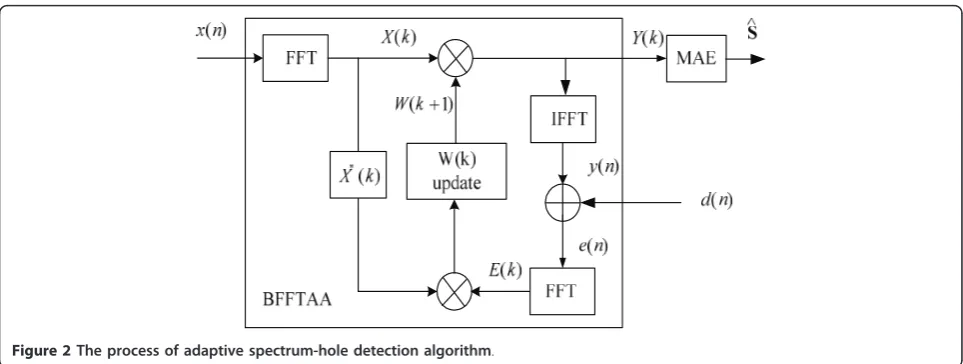
Figure 2 shows the process of our new adaptive detec-tion algorithm to the primary user’s signal which is per-formed in digital signal processor, where BFFTAA is the abbreviation of the Block-FFT adaptive filter algorithm. The MAE represents the matrix accumulation estima-tion, The new algorithm adopts the speediness and degrading-noise advantage of the BFFTAA and the MAE, and is named BFFTAA-MAE algorithm for brevity.
2.1 The block-FFT adaptive filtering algorithm
x(n) is the discrete time data of x(t), and is divided into M segments in BFFTAA-MAE algorithm, and each seg-ment has Nsamples.Nis the number of the filter tap coefficients. In order to express our viewpoint, the itera-tion equaitera-tion of thek-th block data is given as follow-ing.
W(k+ 1) =W(k) +u N−1
i=0
e(kN+i)X(kN+i) =W(k)−1
2u∇(k) (2)
and
y(kN+i) =WT(k)X(kN+i) i= 0, 1,· · ·,N−1 (3)
wherekis the index of the k-th block data,y(kN+i) is the time-domain output of the LMS filters at thek-th
block data, andw(k) is the weight coefficients vector of the filters corresponding to thek-th block data.
W(k) = [w0(k) w1(k) · · · wN−1(k)]T (4)
andX(n) in Equation (2) is the up-to-dateNsamples of the filter input at the n-th instant, which is also regarded as the output of the delay line withNtaps.
X(n) = [x(n) x(n−1) · · · x(n−N+ 1)]T (5)
e(n) is the error sequence in Equation (2), which equals the difference between the expected response d
(n) and the output of the filtery(n) as Equation (6), and
uis the update step of the weight coefficient.
e(n) =d(n)−y(n) (6)
Because of the GSM mobile application scene, the expected responsed(n) may be regarded deterministic. The GMSK signal is adopted as the expected primary user’s signald(n) in subsequent simulation.
On the strength of derivation above, the BFFTAA algorithm is presented hither. In order to reduce the computational complexity of BFFTAA, the overlapped reservation algorithm is adopted in frequency-domain with 50% data overlapped reservation. The overlapped reservation algorithm also increases the efficiency of the primary user’s signal detection algorithm afterwards. The discrete FFT is performed withNsamples per seg-ment, meanwhile the weight coefficients are replaced according to the accumulation result of the error sequence.
The concrete process is to insertNzeros at the tail of
w(k) firstly, then to perform 2N-FFT to obtain the weight coefficients vector of the frequency-domain fil-tering as follows.
[Wk(f)]T=FFT[WT(k) 0 · · · 0] (7)
where, wk(f) is a 2N× 1 vector of thek-th block data, and the length of vector in frequency-domain is twice than the length of vector in time-domain.
ThenXk(f) is obtained firstly by performing 2N-FFT to (k- 1)-th data block andk-th data block, and diagona-lizing the result of FFT as Equation (8)
Xk(f) =diag{FFT[x(kN−N) · · · x(kN−1) x(kN) · · · x(kN+N−1)]} (8)
Finally the result of the BFFTAA algorithm is the last
Nitems of the Equation (9):
Yk(f) = [Yk0(f), Yk1(f),· · ·, YNk−1(f)]T= [Xk(f)Wk(f)]
The last N items
(9)
2.2 Matrix accumulation estimation
Although the BFFTAA algorithm reduces the computa-tion complexity, it does not improve the deteccomputa-tion per-formance. In order to improve the detection performance, the matrix accumulation estimation (MAE) is integrated with the BFFTAA as a whole.
Yk(f) firstly is conjugated, then aN×NHankel matrix is reshaped as follows.
Bk(f) = ⎡ ⎢ ⎢ ⎢ ⎢ ⎢ ⎢ ⎢ ⎣
Yk0(f) Yk1(f) · · · YkN−1(f) Yk1(f) Yk2(f) · · · Yk0(f)
· · ·
· · ·
YkN−1(f) Yk0(f) · · · YkN−2(f)
⎤ ⎥ ⎥ ⎥ ⎥ ⎥ ⎥ ⎥ ⎦
(10)
ThenCk(f) is obtained by a matrix accumulation cal-culation as Equation (11)
Ck(f) = [Yk(f)]T[Yk(f)] (11)
Sk(f)= ⎡ ⎢ ⎢ ⎢ ⎢ ⎢ ⎢ ⎢ ⎣
Sk0,0(f) Sk0,1(f) · · · Sk0,N−1(f)
Sk1,0(f) Sk1,1(f) · · · Sk1,N−1(f)
· · ·
· · ·
Sk
N−1,0(f) SkN−1,1(f) · · · YkN−1,N−1(f)
⎤ ⎥ ⎥ ⎥ ⎥ ⎥ ⎥ ⎥ ⎦ (12)
The matrix multiplication estimation is performed as Equation (13).
Sk(f)=Ck(f)×Bk(f)
=[Yk(f)]T [Yk(f)]×
⎡ ⎢ ⎢ ⎢ ⎢ ⎢ ⎢ ⎢ ⎣ Yk
0(f) Yk1(f) · · · YkN−1(f) Yk
1(f) Yk2(f) · · · Yk0(f)
· · ·
· · ·
Yk
N−1(f) Yk0(f) · · · YkN−2(f) ⎤ ⎥ ⎥ ⎥ ⎥ ⎥ ⎥ ⎥ ⎦ (13)
Equation (13) has the similar expression to the higher accumulation statistic estimation [14].
Sk(f)∼Yk(λ1)·Yk(λ2)·[Yk(λ1+λ2)]∗ (14)
The essence of the Equation (13) is to calculate a matrix about third-order accumulation statistic. The third-order matrix product is computed in the algorithm. The cumulant is a valid method to suppress the noise [15,14], so the noise will be further suppressed in the algorithm, and the SNR will be raised correspondingly. The subsequent simulation will verify our viewpoint.
Then the accumulated product Sˆ is acquired by fre-quency-domain smoothing toSk(f). Its essence is to exe-cute two dimensional convolution to Sk(f) with F(m, n).
The elements ofF(m, n)will be obtained as Equation (15).
F(m,n)= √
3 π3[1−
m2+n2+mn
N2 ] (15)
where F(m, n) is a Rao-Gabr window [15], and
m2+n2+mn ≤ F 2 (m,n)
(N/2)2(m, n) Î G, G is the sets of
sampling points.
Finally, Sˆ, which is the estimated value of the accu-mulated product Sˆ, is derived by operation of Mod as Equation (16).
ˆ S= 1
M M k=1 (1 N
N−1
i=0
|ˆS|) (16)
2.3 The weight-coefficient update
According to the above result, the weight-coefficient update and the primary user’s signal detection are calcu-lated in the meantime in the subsequent process.
Ek(f) = FFT[0 · · · 0 (d(kN)−y(kN)) · · · (d(kN+N−1)−y(kN+N−1))] (17)
Then, the gradient is obtained by extracting the N
items of Equation(18).
∇(k) =−2FFT−1[X∗(k)E(k)] (18)
Finally, the weight-coefficient update formula is gained as follows:
Wk(f + 1) =Wk(f) + 1 2uFFT
⎡ ⎢ ⎢ ⎢ ⎢ ⎢ ⎣
∇(k) 0 .. . 0 ⎤ ⎥ ⎥ ⎥ ⎥ ⎥ ⎦ (19)
Then Sk (f) will be updated in the wake of the itera-tion and renewal to the parameters and data menitera-tioned above.
2.4 Detection determination of the primary user’s signal
The spectral components have a homogeneous distribu-tion in frequency domain after denoising with the adap-tive detection algorithm. Taking into account the protection band between authorized frequency-bands, the noise level may be estimated in upper protection band or lower protection band beyond the frequency-band to be detected. In accordance with the Equation (16), SˆPB is calculated by the BFFTAA-MAE algorithm to the data sampled in the protection band.
Then SˆIB is calculated with the data sampled in-band according to the Equation (16). SˆPB is defined as the
determination threshold. While, SˆIB≥ ˆSPBthe H1
hypothesis is true, and the primary users is supposed to exist. OtherwiseH0 is accepted, and the processed data
is decided as noise. The empirical value of SˆIB is often 0.5 dB greater than SˆPB in order to constrain noise bet-ter, that’s to say, SˆIB≥ ˆSPB+ 0.5. But the adjusted value
cannot be set too great in case the process loses the superabundance information of the primary users.
According to the determination, the cognitive equip-ments will detect the primary user’s signal, and may communicate through the idle channels.
3. Simulation and performance analysis of the algorithm
rate. The Monte Carlo is adopted in simulation. The signals of the primary users are supposed to be the GMSK baseband modulating signal of the GSM mobile system. There are eight time-slots with different nor-mal train sequence in a nornor-mal frame, and each time-slot has 156.25 bits. The eight normal train sequences of the GSM mobile system are applied to format the baseband data of the primary user according the GSM standard. For example, the data of the primary user, which is supposed to be detected in our algorithm, is given as Figure 3. Where the train sequence of the pri-mary user is 00101101110111100010110111, and the 57 information bits, 3 trail bits, and 8.25 guard bits are generated by random generator. The d(n) is certainly obtained with the same train sequence. The 26 bits of
d(n) is used to track and converge the primary signal. In simulation, other seven bursts are continuous to transmit the data according to the different normal train sequences except the train sequence mentioned above. Meanwhile the data of the primary user, which will be detected, is transmitted now and then. That’s to say, the primary user is exit while the data of the primary user is transmitted, otherwise the primary user is absent.
In order to ensure get the whole data of eight time-slots and better simulation result, the data with 8,192 points is adapted in the simulation. Meanwhile in order to reduce the computational complexity and raise the computational speed, the data is divided into 32 blocks for overlapped reservation, and each segment has 64 points. It is well known that the computation burden will obviously increase if the length of the Rao-Gabr window is selected too long, and the effect will be bad if the length of the Rao-Gabr window is selected too short. It is acceptable that the length of the Rao-Gabr window is (7,7) according to the result of simulation. The range ofμ is from 0 to 1. The constringency rate will be reduced ifμ is set too big. It can meet the real-time of the algorithm thatμis set as 0.01 according to the result of simulation. SNR is set from -10 dB to 10 dB, and the white noise is adapted in the simulation. Without loss of generality, the Rice amplitude fading model is applied in simulation.
In order to illustrate the superiority of the BFFTAA-MAE detection, the block DFT filters detection [9] and the block LMS detection [10] are compared by compu-ter simulation under the same condition at the same time. Being confined to the length of the paper, we only compared such three algorithms. We find that -5.8 dB is
the performance watershed of these algorithms in the simulation, so -5.8 dB SNR will be applied while we analyze the performance of these algorithms.
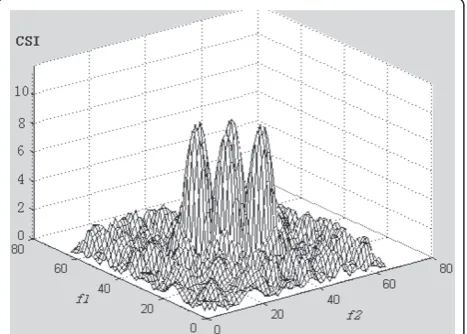
Firstly, we get the spectral-peak figures of three algo-rithms mentioned above at -5.8 dB SNR. CSI means comparative signal intensity in Figures 4, 5 and 6.f1 and
f2 are frequency components (in kHz). Figure 4 is the spectral peak of the block DFT filters detection, and Fig-ures 5 and 6 are the spectral peak corresponding to the block LMS detection and the BFFTAA-MAE detection. From Figures 4 and 6, we can find that the block DFT filters detection algorithm and the block LMS detection algorithm will lose their detection capability under the low SNR condition, and the BFFTAA-MAE detection algorithm will keep better detection capability at the same SNR. Due to adapting the block-FFT adaptive fil-ter algorithm and matrix accumulative algorithm to sup-press noise, the BFFTAA-MAE detection algorithm can detect the weak signal more effectively from the back-ground noise than the block DFT filters detection algo-rithm and the block LMS detection algoalgo-rithm.
Then the performance of the detection algorithm is described in Figure 7 with the Receiver Operating Char-acteristics (ROC). The block DFT filters detection and the block LMS detection should have the proximate per-formance. There is bit error in Figure 7 between the block DFT filters detection and the block LMS detection mainly because of the simulation error. From Figure 7, the BFFTAA-MAE detection still has higher detection probability and lower false alarm probability at -5.8 dB Figure 3The baseband data of the signal.
SNR if the detection probability 80% is taken as the per-formance standard. For uniting the advantage of the BFFTAA algorithm and matrix accumulation estimation, the BFFTAA-MAE algorithm has better performance than the block DFT filters and the block LMS detection. Obviously, the BFFTAA-MAE algorithm can degrade the strong noise to raise the weak signal step by step, and implement the weak signal detection from strong background noise. In comparison, the algorithm can better adapt to the complex radio environment and work in low SNR detection environment, and has advantageous over the performance of other two detec-tion algorithms.
4. Conclusion
Since the cognitive radio can be used widely in commu-nication, the spectrum cognitive algorithm will be given more and more importance. For the requirement of the cognitive radio, the new detection algorithm of the pri-mary user’s signal is introduced for the signal detection
from the background noise in the paper. Its core is to acquire the frequency-domain estimate value Sˆ through matrix accumulative calculation of the data processed by the Block-FFT adaptive filter algorithm. The result of the detection will be obtained by decision to the fre-quency-domain estimate value.
By simulation, it is obvious that the BFFTAA-MAE detection algorithm can solve the problem of the signal detection in low SNR, in other words, the algorithm greatly improves the detection performance. The detection algorithm can detect the primary user’s signal, and collect spectrum-hole for cognitive users to communication. Because of adapting the block-FFT adaptive filter algo-rithm and matrix accumulative algoalgo-rithm, the BFFTAA-MAE detection algorithm can suppress not only the white noise but also colored noise. So the detection algorithm has definite prospect in the cognitive radio field.
5. Competing interests
The authors declare that they have no competing interests.
Author details
1National Mobile Communications Research Laboratory, Southeast University,
Nanjing 210096, China2Key Laboratory of Electronic Restriction, Hefei 230037, China
Received: 21 January 2011 Accepted: 1 September 2011 Published: 1 September 2011
References
1. A Sahai, Some fundamental limits on cognitive radio, inProceedings of Allerton Conference, Monticello(2004)
2. DanijelaČabrić, Shridhar Mubaraq Mishra, Daniel Willkomm, Robert Brodersen, Adam Wolisz, Corvus: a cognitive radio approach for usage of virtual unlicensed spectrum. Berkeley Wireless Research Center White Paper (2004)
Figure 5The spectral peak of the block LMS detection.
Figure 6The spectral peak of the BFFTAA-MAE detection.
3. J Lansford, Universal radio: making new spectrum, inFourth Annual International Symposium On Advanced Radio Technologies, Boulder, CO (2002)
4. D Cabric, SM Mishra, RW Brodersen, Implementation issues in spectrum sensing for cognitive radio, in38th Annual Asilomar Conference on Signals, System and Computers(2004)
5. S Soliman, Cognitive radio: key performance indicators. inQUALCOMM Incorporated(2004)
6. M Ghozz, M Dohler, F Marx, J Palicot, Cognitive radio: methods for the detection of free bands. Comptes Rendus Physique7(7), 794–804 (2006). doi:10.1016/j.crhy.2006.07.009
7. K Jaiswal, Spectral sensing for cognitive radio: estimation of adaptive frequency hopping signal, inIEEE Region 10 Conference (TENCON 2008), Hyderabad, India, 2614–2618 (Nov 19-21, 2008)
8. R Tandra, A Sahai, SNR walls for signal detection. IEEE J Select Top Signal Process.2(1), 4–17 (2008)
9. GA Clark, SK Mitra, SR Parker, Block implementation of digital filters. IEEE Trans Circuits Syst.28(6), 584–592 (1981). doi:10.1109/TCS.1981.1085018 10. ER Ferrara, Fast implementation of LMS adaptive filters. IEEE Trans ASSP.
28(4), 474–475 (1980). doi:10.1109/TASSP.1980.1163432
11. B Farhang-Boroujeny,Adaptives Filters: Theory & Applications(Wiley, UK), (1998)
12. C-C Hu, W-C Jhu, Adaptive block DFT-LMS signal detection in ultra-wideband communications. inProceedings of the 6th IEEE Conference on Consumer Communications and Networking Conference, Las Vegas, NV, USA, 543–544 (2009)
13. B Atrouz, A Alimohad, B Aıssa, An effective jammers cancellation by mean of a rectangular array antenna and a sequential block LMS algorithm: case of mobile sources. Prog Electromagn Res C.7, 193–207 (2009)
14. H-J Zhou, B-H Sun, J-F Li, Q-Z Liu, Efficient optimization and realization of a shaped-beam planar array for very large array application. Prog
Electromagn Res.89, 1–10 (2009)
15. CL Nikias, Signal processing with high-order spectra. IEEE Signal Process Mag.10(3), 10–37 (1993). doi:10.1109/79.221324
doi:10.1186/1687-6180-2011-51
Cite this article as:Wanget al.:Adaptive primary user’s signal detection algorithm based on matrix accumulation estimation for cognitive radio.
EURASIP Journal on Advances in Signal Processing20112011:51.
Submit your manuscript to a
journal and benefi t from:
7Convenient online submission
7Rigorous peer review
7Immediate publication on acceptance
7Open access: articles freely available online 7High visibility within the fi eld
7Retaining the copyright to your article