Chapter 14
HCS12 Memory System
• It has three internal memory blocks:
– Program memory (EPROM or flash memory)
– Data memory (SRAM)
– Data EEPROM
• Many HCS12 members also support external
memory.
Internal Resource Remapping
(1 of 2)
• The on-chip register block, SRAM, EEPROM, and flash
memory have default locations within the 64 KB standard
address.
• On-chip register block, SRAM, and EEPROM can be
relocated to other places.
• It is advisable to explicitly establish these resource
locations during the initialization phase of program
execution to protect the inadvertent modification later.
• Writes to resource remapping registers require one cycle
to take effect.
Precedence Resouce 1
2 3 4 5 6
BDM firmware or register space Internal register space
SRAM block EEPROM flash memory
Remaining external memory Table 14.1 Mapping precedence
7 6 5 4 3 2 1 0 value after
reset: 0 0 0 0 0 0 0 0 0 REG14 REG13 REG12 REG11 0 0 0 REG14~REG11: Internal register map position
These four bits along with bit 7 specify the upper 5 bits of the 16-bit register address. These four bits can be written only once in normal modes and can be written many times in special modes. There is no restriction on the reading of this register.
Figure 14.1 Contents of the INITRG register
base + $11
Register Block Mapping
• The register block may be 1 KB or 2 KB in size.
• Register block remapping is controlled by the
INITRG register.
RAM15 RAM14 RAM13 RAM12 RAM11 0 0 RAMHAL
7 6 5 4 3 2 1 0
0 0 0 0 1 0 0 0
Value after reset:
base+$10
RAM15~RAM11: Internal RAM map position
These bits determine the upper five bits of the base address for the system's internal RAM array.
RAMHAL: RAM high-align
0 = aligns the RAM to the lowest address ($0000) of the mappable space
1 = aligns the RAM to the highest address ($FFFF) of the
SRAM Mapping
• SRAM can be remapped to any 2 KB boundary within the 64 KB
memory space.
• The SRAM remapping is controlled by the INITRM register.
7 6 5 4 3 2 1 0 value after
reset: 0 0 0 1 0 0 0 1
EE15 EE14 EE13 EE12 EE11 0 0 EEON
EE15~EE11: Internal EEPROM map position
These bits specify the upper 5 bits of the 16-bit registers address. These five bits can be written only once in normal modes and can be written many times in special modes. There is no restriction on the reading of this register.
EEON: Internal EEPROM On (Enabled reading). 0 = Removes EEPROM from the map.
1 = Places the on-chip EEPROM in the memory map. Figure 14.3 Contents of the INITEE register
base+$12
EEPROM Mapping
• The EEPROM can be remapped to any 2 KB boundary
within the 64 KB memory space.
• The remapping of the EEPROM is controlled by the
INITEE register.
7 6 5 4 3 2 1 0
reset value:
0 0 0 0 1 1 0 _1
0 0 0 0 EXSTR1 EXSTR0 ROMHM ROMON
EXSTR1~EXSTR0: External access stretch bits 1 and 0 00 = no stretch to external bus cycle
01 = stretch the external bus cycle by one E cycle 10 = stretch the external bus cycle by two E cycles 11 = stretch the external bus cycle by three E cycles
ROMHM: Flash EEPROM or ROM only in second half of memory map 0 = The fixed page (s) of flash EEPROM or ROM in the lower half of the lower half of the memory map can be accessed.
1 = Disable direct access to the flash EEPROM or ROM in the lower half of the memory map. These physical locations of flash memory can still be accessed through the program page window.
ROMON: Enable flash memory or ROM
0 = Disable the flash memory or ROM in the memory map 1 = Enable the flash memory or ROM in the memory map
base+$13 expanded or emulation peripheral or single chip special test
0 0 0 0 1 1 0 1
0 0 0 0 1 1 0 0
Note:
Miscellaneous System Control Register
• This register
enables/disables
the on-chip ROM
and allows one to
stretch the length of
the external bus
cycle.
• The value of the
ROMONE pin is
latched to the
REG_SW0 0 EEP_SW1 EEP_SW0 0 RAM_SW2RAM_SW1RAM_SW0 7 6 5 4 3 2 1 0 -- -- -- -- -- -- -- --reset:
REG_SW0: Allocated system register space 0 = Allocated system register space size is 1 KB 1 = Allocated system register space size is 2 KB
EEP_SW1~EEP_SW0: Allocated system EEPROM memory space 00 = 0 KB
01 = 2 KB 10 = 4 KB 11 = 8 KB
RAM_SW2~RAM_SW0: Allocated system RAM memory space The allocated system RAM space size is as given in Table 14.2.
base+$1C
Figure 14.5 Memory size register zero (MEMSIZ0)
Memory Size Register Zero (MEMSIZ0)
• Read-only
RAM_SW2:RAM_SW0 Allocated RAM space RAM mappable region INITRM bits used RAM reset base address(1)
Table 14.2 Allocated RAM memory space
000 001 010 011 100 101 110 111 2K bytes 4K bytes 6K bytes 8K bytes 10K bytes 12K bytes 14K bytes 16K bytes 2K bytes 4K bytes 8K bytes(2)
8K bytes 16K bytes(2)
16K bytes(2)
16K bytes(2)
16K bytes RAM15~RAM11 RAM15~RAM12 RAM15~RAM13 RAM15~RAM13 RAM15~RAM14 RAM15~RAM14 RAM15~RAM14 RAM15~RAM14 $0800 $0000 $0800 $0000 $1800 $1000 $0800 $0000 Notes:
7 6 5 4 3 2 1 0 ROM_SW1ROM_SW0 0 0 0 0 PAG_SW1 PAG_SW0
-- -- -- -- -- -- -- --reset:
ROM_SW1~ROM_SW0: Allocated system flash or ROM physical memory space 00 = 0 KB
01 = 16 KB 10 = 48 KB 11 = 64 KB
PAG_SW1~PAG_SW0: Allocated off-chip flash or ROM memory space The allocated off-chip flash or ROM memory space size is as given in Table 14.3.
PAG_SW1~PAG_SW0 Off-chip space On-chip space 00 01 10 11 876 KB 768 KB 512 KB 0 KB 128 KB 256 KB 512 KB 1 MB Table 14.3 Allocated off-chip memory options
Figure 14.6 Memory size register one (MEMSIZ1)
base+$1D
Memory Size Register One (MEMSIZ1)
PageNum = SRecAddr / PPAGEWinSize (14.1)
PageWinAddr = (SRecAddr % PPAGEWinSize) + PPAGEWinSTART (14.2) where,
Expanded Memory Mapping
•
The HCS12 uses the PPAGE register to determine which of the 64 possible
16 KB pages is active in the program window.
•
The direct concatenation of the page number and the page offset does not
result in linear addresses.
•
Motorola proposed the following method to address memory above 64 KB:
– Use $00 to $3F as the page numbers for the 64 16-KB pages. – Use higher page numbers to select on-chip flash memory.
– The HCS12 devices with 256 KB flash memory assign $30 to $3F as the page numbers of the 16 on-chip 16 KB pages. Use $00 to $2F as page numbers for external memory
– Use linear addresses to address external memory and also use linear method to address machine codes for S records.
PPAGEWinStart = $8000
(f) Compute SRecAddr from PageNum and PageWinAddr as follows:
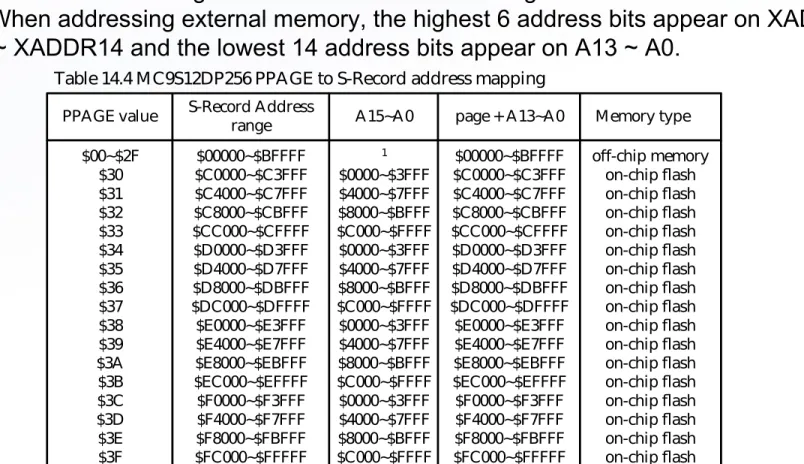
SRecAddr = PageNum PPAGEWinSize + PageWinAddr – PPAGEWinStart (g) When addressing external memory, the highest 6 address bits appear on XADDR19 ~ XADDR14 and the lowest 14 address bits appear on A13 ~ A0.
Table 14.4 MC9S12DP256 PPAGE to S-Record address mapping
PPAGE value S-Record Addressrange A15~A0 page + A13~A0 Memory type $00~$2F $30 $31 $32 $33 $34 $35 $36 $37 $38 $39 $3A $3B $3C $3D $3E $3F $00000~$BFFFF $C0000~$C3FFF $C4000~$C7FFF $C8000~$CBFFF $CC000~$CFFFF $D0000~$D3FFF $D4000~$D7FFF $D8000~$DBFFF $DC000~$DFFFF $E0000~$E3FFF $E4000~$E7FFF $E8000~$EBFFF $EC000~$EFFFF $F0000~$F3FFF $F4000~$F7FFF $F8000~$FBFFF $FC000~$FFFFF 1 $0000~$3FFF $4000~$7FFF $8000~$BFFF $C000~$FFFF $0000~$3FFF $4000~$7FFF $8000~$BFFF $C000~$FFFF $0000~$3FFF $4000~$7FFF $8000~$BFFF $C000~$FFFF $0000~$3FFF $4000~$7FFF $8000~$BFFF $C000~$FFFF $00000~$BFFFF $C0000~$C3FFF $C4000~$C7FFF $C8000~$CBFFF $CC000~$CFFFF $D0000~$D3FFF $D4000~$D7FFF $D8000~$DBFFF $DC000~$DFFFF $E0000~$E3FFF $E4000~$E7FFF $E8000~$EBFFF $EC000~$EFFFF $F0000~$F3FFF $F4000~$F7FFF $F8000~$FBFFF $FC000~$FFFFF off-chip memory on-chip flash on-chip flash on-chip flash on-chip flash on-chip flash on-chip flash on-chip flash on-chip flash on-chip flash on-chip flash on-chip flash on-chip flash on-chip flash on-chip flash on-chip flash on-chip flash Note.
•
Example 14.2
What are the PageNum and PageWinAddr for the SRecAddr
of $E1003?
•
Solution
: Apply equation 14.1 and 14.2 as follows:
PageNum = $E1003 / $4000 = $38
PageWinAddr= ($E1003 % $4000) + $8000 = $1003 + $8000 = $9003
•
Example 14.3
What is the corresponding SRecAddr for the pair of
(PageNum, PageWinAddr) equal to ($20, $A003)?
•
Solution
: Apply equation 15.3 as follows:
On-Chip Flash Memory
(1 of 3)
• The on-chip flash memory size can be 32 KB, 64 KB,
128 KB, 256KB, and 512 KB for the HCS12 devices.
• A flash memory larger than 64 KB is divided into 64-KB
blocks.
• Programming and erasure of flash memory are
performed by sending commands to the command
register.
• The flash memory has a flexible protection scheme
against accidental programming and erasure.
• The flash memory also implements security measures to
prevent the application code from being pirated.
(16 bytes) flash registers register base + $100
··
register base + $10F
Flash protected low sectors 0.5K, 1K, 2K, 4K bytes flash start = $4000
$4200 $4400 $4800
$5000 $3E
12K
$8000
flash array
$C000
16 K paged memory
$38 $39 $3A $3B $3C $3D $3E $3F
Block 1 Block 0
$30 $31 $32 $33 $34 $35 $36 $37
Block 3 Block 2
flash proteected high sectors 2K, 4K, 8K, 16K bytes
$3F
$E000
$F000
On-Chip Flash Memory (3 of 3)
• The memory space from $0000 to $3FFF has been
occupied by I/O registers, EEPROM, and SRAM and is
not available to the flash memory.
• The first 64 KB of the flash memory is referred to as
block 0 and is assigned with page numbers $3C to $3F.
• The pages with addresses from $4000 to $7FFF, $8000
Flash Memory Protection
(1 of 3)
• Flash memory protection is provided to prevent against accidental
erasure or programming.
• Flash protection is controlled by a flash protection register (FPROT).
• For HCS12 devices with multiple flash blocks, there is a separate
flash protection register for each flash block.
• Flash protection registers share a common address, with the active
register selected by the bank select bits of the flash configuration
register (FCNFG).
• During the HCS12 reset sequence (execution of reset start up
routine), the flash protection registers for each flash block are
loaded from the programmed bytes within a flash block.
Flash Memory Protection
(2 of 3)
• The contents of each FPROT register determine whether the entire
block or just a subsection is protected from being accidentally
erased or programmed.
• Each flash block (64 KB) can be entirely protected, or can have one
or two separate protected areas.
– One area to be protected is the lower protected block starting at a point
32 KB below the maximum flash block address and is extensible toward
higher addresses.
– The other area is the upper protected area that ends at the top of the
flash block and is extended toward lower addresses.
• The lower protected area and upper protected area do not meet up.
• To change the flash protection that will be loaded on reset, the
FPOPEN NV6 FPHDIS FPHS1 FPHS0 FPLDIS FPLS1 FPLS0 7 6 5 4 3 2 1 0 reset: F F F F F F F F
FPOPEN: Opens the flash for program or erase
0 = The whole flash block is protected. In this case, bits 5 to 0 have no effect. 1 = The flash sectors not protected are enabled for program or erase.
NV6: Not volatile flag bit.
This bit is available for nonvolatile flag usage
FPHDIS: Flash protection higher address range disable 0 = higher address range protection enabled
1 = higher address range protection disabled FPHS1~FPHS0: Flash protection higher address size 00 = 2 KB
01 = 4 KB 10 = 8 KB 11 = 16 KB
FPLDIS: Flash protection lower address range disable 0 = lower address range protection enabled
1 = lower address range protection disabled FPLS1~FPLS0: Flash protection lower address size 00 = 512 bytes
base+$104
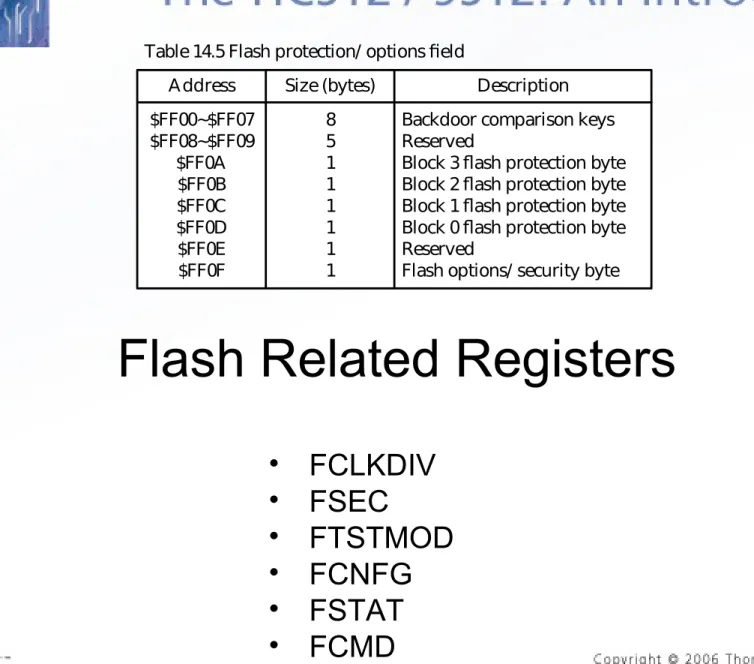
Table 14.5 Flash protection/ options field
Address Size (bytes) Description $FF00~$FF07 $FF08~$FF09 $FF0A $FF0B $FF0C $FF0D $FF0E $FF0F 8 5 1 1 1 1 1 1
Backdoor comparison keys Reserved
Block 3 flash protection byte Block 2 flash protection byte Block 1 flash protection byte Block 0 flash protection byte Reserved
Flash options/ security byte
Flash Related Registers
FDIVLD PRDIV8 FDIV5 FDIV4 FDIV3 FDIV2 FDIV1 FDIV0
7 6 5 4 3 2 1 0
reset: 0 0 0 0 0 0 0 0
FDIVLD: Clock divider loaded 0 = Register has not been written.
1 = Register has been written to since the last reset. PRDIV8: Enable prescaler by 8
0 = The input oscillator clock is directly fed into the FCLKDIV divider.
1 = Enables a divide-by-8 prescaler , to divide the flash module input oscillator clock before feeding into the CLKDIV divider
FDIV[5:0]: Clock divider bits
The combination of PRDIV8 and FDIV[5:0] effectively divides the flash module
base+$100
FCLKDIV Register
• The flash programming and erasure timing is
controlled by this register.
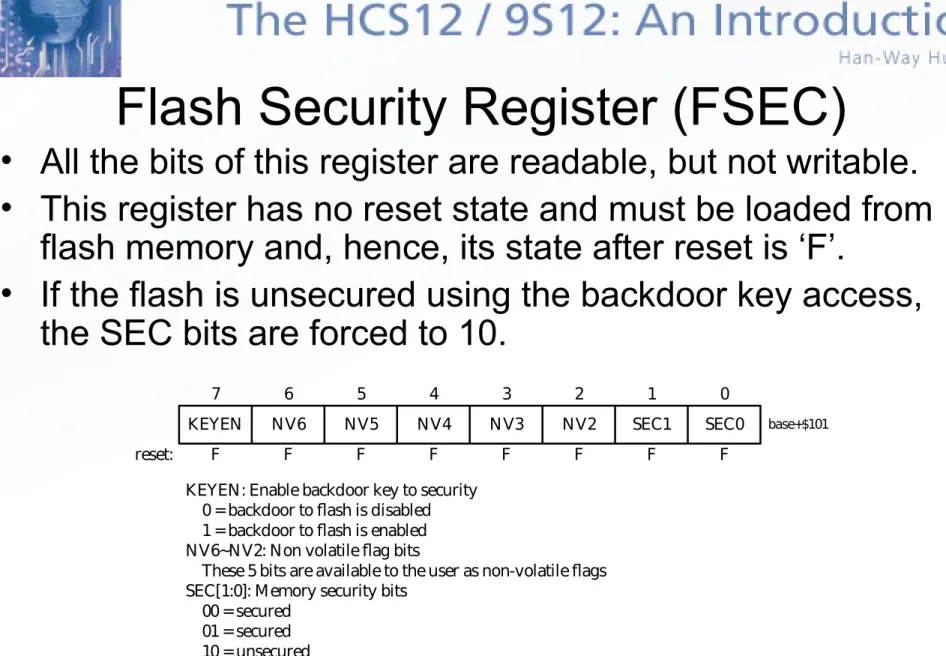
KEYEN NV6 NV5 NV4 NV3 NV2 SEC1 SEC0 7 6 5 4 3 2 1 0 reset: F F F F F F F F
KEYEN: Enable backdoor key to security 0 = backdoor to flash is disabled 1 = backdoor to flash is enabled NV6~NV2: Non volatile flag bits
These 5 bits are available to the user as non-volatile flags SEC[1:0]: Memory security bits
00 = secured 01 = secured 10 = unsecured 11 = secured
Figure 14.11 Flash security register (FSEC)
base+$101
Flash Security Register (FSEC)
• All the bits of this register are readable, but not writable.
• This register has no reset state and must be loaded from
flash memory and, hence, its state after reset is ‘F’.
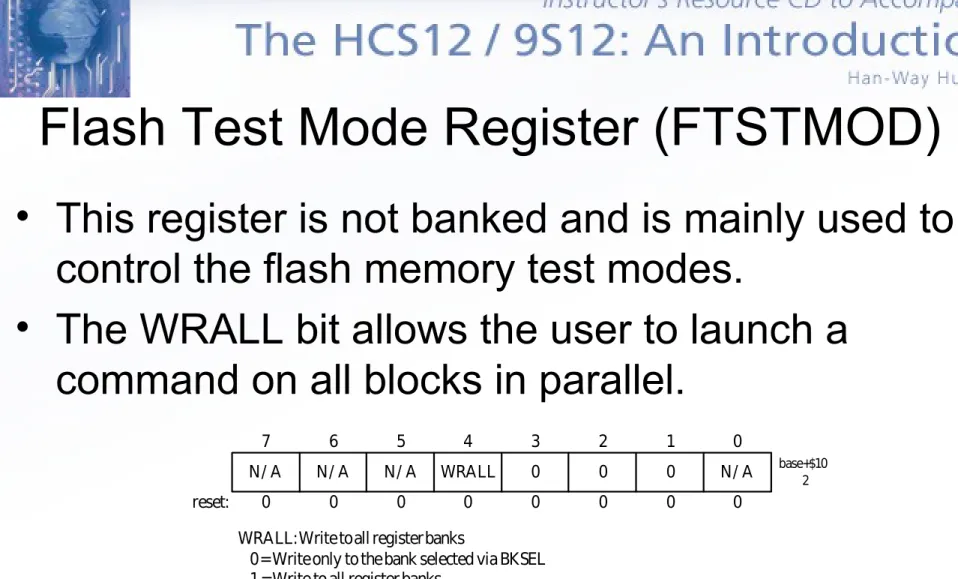
N/ A N/ A N/ A WRALL 0 0 0 N/ A
7 6 5 4 3 2 1 0
reset: 0 0 0 0 0 0 0 0
WRALL: Write to all register banks
0 = Write only to the bank selected via BKSEL 1 = Write to all register banks
Figure 14.12 Flash test mode register (FTSTMOD)
base+$10 2
Flash Test Mode Register (FTSTMOD)
• This register is not banked and is mainly used to
control the flash memory test modes.
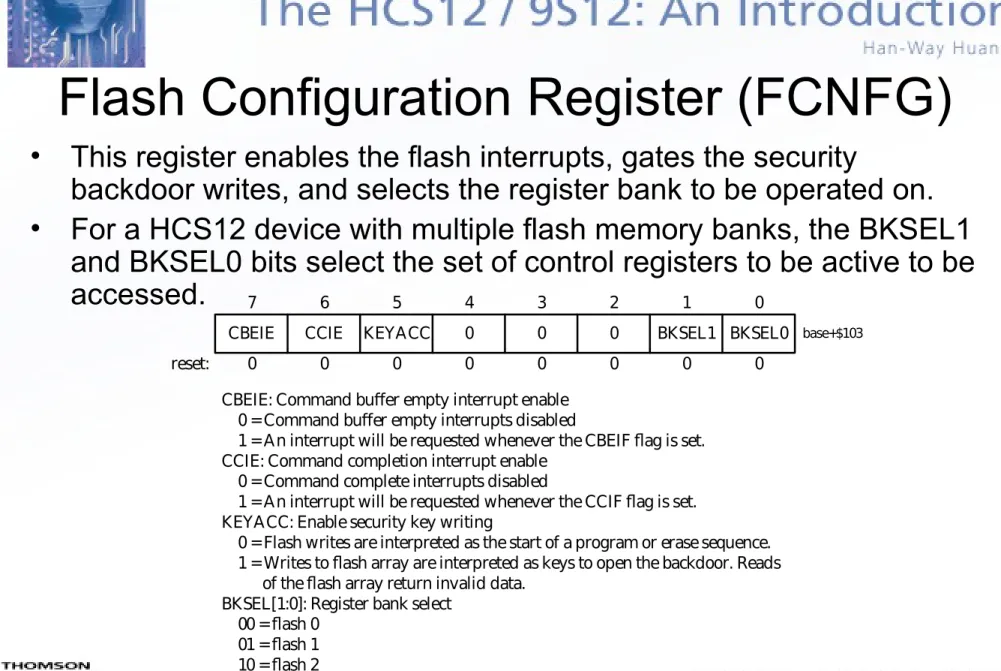
CBEIE CCIE KEYACC 0 0 0 BKSEL1 BKSEL0 7 6 5 4 3 2 1 0 reset: 0 0 0 0 0 0 0 0
CBEIE: Command buffer empty interrupt enable 0 = Command buffer empty interrupts disabled
1 = An interrupt will be requested whenever the CBEIF flag is set. CCIE: Command completion interrupt enable
0 = Command complete interrupts disabled
1 = An interrupt will be requested whenever the CCIF flag is set. KEYACC: Enable security key writing
0 = Flash writes are interpreted as the start of a program or erase sequence. 1 = Writes to flash array are interpreted as keys to open the backdoor. Reads of the flash array return invalid data.
BKSEL[1:0]: Register bank select 00 = flash 0
01 = flash 1 10 = flash 2 11 = flash 3
Figure 14.13 Flash configuration register (FCNFG)
base+$103
Flash Configuration Register (FCNFG)
• This register enables the flash interrupts, gates the security
backdoor writes, and selects the register bank to be operated on.
• For a HCS12 device with multiple flash memory banks, the BKSEL1
CBEIF CCIF PVOL ACCERR 0 BLANK 0 0
7 6 5 4 3 2 1 0
reset: 1 1 0 0 0 0 0 0
CBEIF: Command buffer empty interrupt flag 0 = Command buffers are full
1 = Command buffers are ready to accept a new command CCIF: Command completion interrupt flag
0 = Command in progress
1 = All commands are completed PVOL: Protection violation
0 = No protection violation has occurred. 1 = A protection violation has occurred. ACCERR: Flash access error
0 = No failure
1 = Access error has occurred.
BLANK: Array has been verified as erased
base+$105
Flash Status Register (FSTAT)
• The programming and erase of flash memory is controlled by a finite
state machine.
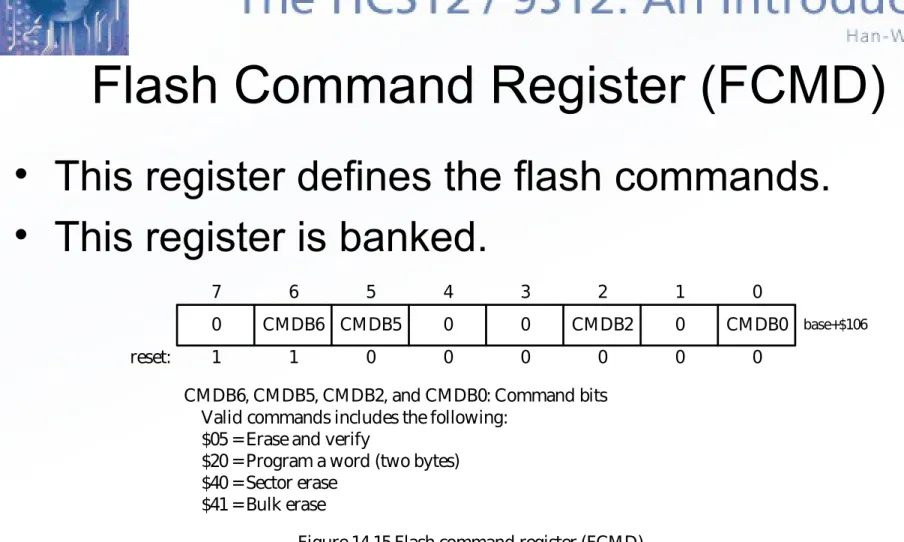
0 CMDB6 CMDB5 0 0 CMDB2 0 CMDB0
7 6 5 4 3 2 1 0
reset: 1 1 0 0 0 0 0 0
CMDB6, CMDB5, CMDB2, and CMDB0: Command bits Valid commands includes the following:
$05 = Erase and verify
$20 = Program a word (two bytes) $40 = Sector erase
$41 = Bulk erase
Figure 14.15 Flash command register (FCMD)
base+$106
Flash Command Register (FCMD)
Procedure to Execute the Flash Command
• Step 1
– Configure the FCLKDIV register properly.
• Step 2
– Make sure the sector to be erased is not protected.
• Step 3
– Erase the word to be programmed and make sure it is not protected.
• Step 4
– Make sure the flash address to be programmed or erased is
word-aligned.
• Step 5
– If the flash address is in the range of $8000 to $BFFF, then make sure
to write into the PPAGE register to select the desired page.
• Step 6
Secure the Flash Memory
(1 of 2)
• The flash memory contents are secured by programming the
security bits within the flash options/security byte at the address
$FF0F.
• On devices that have a memory page window, the flash
options/security byte is also available at the address $BF0F by
setting the value of the PPAGE register to $3F.
• The contents of the $FF0F (or $BF0F) are copied into the flash
security register (FSEC) during the reset sequence.
• The flash sector $FE00 to $FFFF must be erased before the flash
options/security byte is programmed.
• Secured operation takes effect on the next reset after programming
the security bits of the FSEC register to a secure value.
Table 14.6 Effects of secured operations on the HCS12 operation modes
Operation mode effects
normal single chip mode
1. Background debug module operation is completely disabled. 2. Flash and EEPROM commands PROG, bulk erase, sector erase, erase and verify, and sector modify remain enabled.
Special single chip mode
1. BDM firmware commands are disabled.
2. BDM hardware commands are restricted to register space. 3. Flash and EEPROM commands are limited to bulk erase only.
Expanded modes
1. BDM operation is completely disabled.
2. External access to internal flash and EEPROM is disabled. 3. Internal visibility (IVIS) and CPU pipe (IPIPE) information is disabled.
4. Flash and EEPROM commands cannot be executed from external memory in normal expanded mode.
Unsecuring the MCU
with Backdoor Key Access
• In single chip and expanded modes, security can be temporarily disabled by means of the backdoor key access method.
• Backdoor key access requires three actions to be taken:
– Program the backdoor key at $FF00~$FF07 to a valid value.
– Set the KEYEN1 and KEYEN0 bits of the flash option/security byte to “10”.
– In single chip mode, design applications to have the capability to write to the backdoor key locations.
• Backdoor key is not allowed to have the value of $0000 or $FFFF. • The backdoor key access sequence includes:
– Set the KEYACC bit in the flash configuration register (FCNFG). – Write the first 16-bit word of the backdoor key to $FF00.
– Write the second 16-bit word of the backdoor key to $FF02. – Write the third 16-bit word of the backdoor key to $FF04. – Write the fourth 16-bit word of the backdoor key to $FF06.
– Clear the KEYACC bit in the flash configuration register FCNFG.
Reprogramming the Security Bits
• This method can be used only if the
options/security bit is unprotected.
• In normal single chip mode, security can also be
disabled by means of erasing and
reprogramming the security bits within the flash
option/security byte to the unsecured value.
Complete Memory Erase
• The microcontroller can be unsecured in special
single chip modes by erasing the entire
Configuring the FCLKDIV Register
• The FCLKDIV register controls the timing of
programming and erasing of flash memory.
• It is necessary to divide the oscillator frequency down to
within the 150 KHz and 200 KHz range.
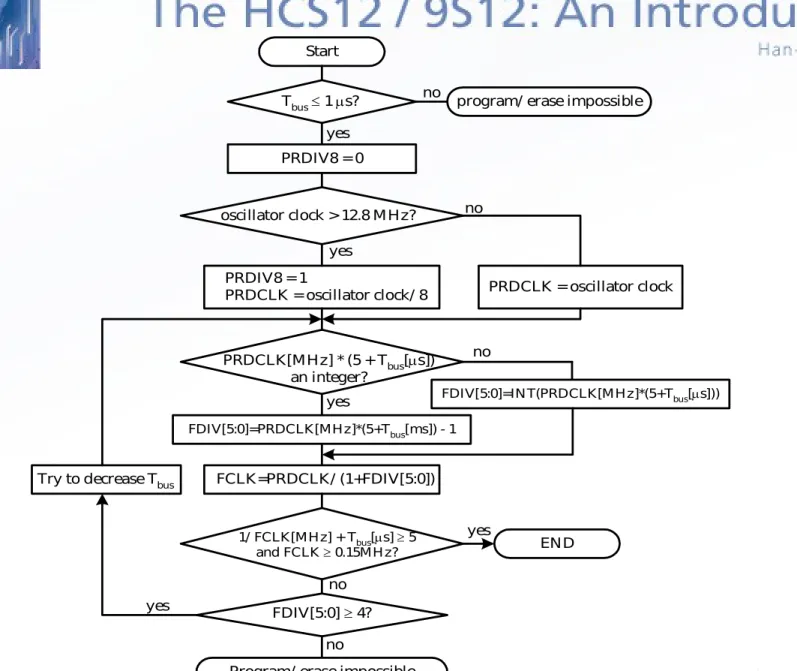
• The algorithm for determining the flash clock dividing
factor is illustrated in Figure 14.16.
• The following notations are used in Figure 14.16:
– FCLK refers to the flash timing clock
– T
BUSrefers to the period of the bus clock.
Start
Tbus 1 s? program/ erase impossible
PRDIV8 = 0 yes
no
oscillator clock > 12.8 MHz?
PRDCLK = oscillator clock no
yes PRDIV8 = 1
PRDCLK = oscillator clock/ 8
PRDCLK[MHz] * (5 + Tbus[s]) an integer?
FDIV[5:0]=INT(PRDCLK[MHz]*(5+Tbus[s])) FDIV[5:0]=PRDCLK[MHz]*(5+Tbus[ms]) - 1
FCLK=PRDCLK/ (1+FDIV[5:0])
1/ FCLK[MHz] + Tbus[s] 5
and FCLK 0.15MHz? END
yes
FDIV[5:0] 4?
Program/ erase impossible Try to decrease Tbus
no
no yes
Figure 14.16 PRDIV8 and FDIV bits determination procedure no
•
Example 14.4
Assume that f
BUS= 24 MHz and f
OSC= 16 MHz,
respectively. Determine an appropriate value to be written into
the FCLKDIV register to set the timing of programming and
erasure properly for the flash memory and EEPROM.
•
Solution
: Follow the logic flow illustrated in Figure 14.16:
- TBUS = 41.7 ns (< 1 ms)
- Initialize the PRDIV8 bit to 0. - fOSC = 16 MHz (> 12.8 MHz)
- Set PRDIV8 to 1 and set PRDCLK to (fOSC / 8) = 2 MHz. - PRDCLK * (5 + 0.0417s) = 10.08 is not an integer
- Set FDIV[5:0] to INT(PRDCLK[MHz] * (5 + TBUS[s])) = 10
Flash Memory Programming
and Erasing Algorithms
• One needs to verify that there is no pending access error
or protection violation in any flash blocks. This initial set
up include the following three steps:
– Verify that all ACCERR and PVIOL flags in the FSTAT register
are cleared in all banks.
– Write to bits BKSEL in the FCNFG register to select the bank of
registers corresponding to the flash block to be programmed or
erased.
Three-Step Procedure for Programming and
Erasing the Flash Memory
• Step 1
– Write the aligned data word to be programmed to the
valid flash address space.
• Step 2
– Write the program or erase command to the
command buffer.
• Step 3
• Example 14.5 Write a function to clear the ACCERR and PVIOL flags in all four blocks in the HCS12 devices with 256 KB of on-chip flash memory.
• Solution:
clearflags bclr FCNFG,$03 ; select bank 0
movb #ACCERR+PVIOL,FSTAT ; clear the ACCERR and PVIOL flags bset FCNFG,$01 ; select bank 1
movb #ACCERR+PVIOL,FSTAT ; clear the ACCERR and PVIOL flags bset FCNFG,$03 ; select bank 3
movb #ACCERR+PVIOL,FSTAT ; clear the ACCERR and PVIOL flags bclr FCNFG,$01 ; select bank 2
movb #ACCERR+PVIOL,FSTAT ; clear the ACCERR and PVIOL flags rts
void clearflags (void) {
FCNFG &= ~0x03; /* select bank 0 */
FSTAT = ACCERR+PVIOL; /* clear the ACCERR and PVIOL flags */ FCNFG |= 0x01; /* select bank 1 */
FSTAT = ACCERR+PVIOL; /* clear the ACCERR and PVIOL flags */ FCNFG |= 0x03; /* select bank 3 */
FSTAT = ACCERR+PVIOL; /* clear the ACCERR and PVIOL flags */ FCNFG &= 0xFE; /* select bank 2 */
•
Example 14.6
Write a function that erases a sector of flash memory.
Index register X contains a word-aligned address within the sector to be
erased. Return a 1 in B if the command buffer is not empty
.
•
Solution:
EraseFSector
brclr FSTAT,CBEIF,err2ES ; erase prohibited if command buffer not empty
std 0,X ; write any data to sector address
movb #SectorErase,FCMD ; write sector erase command
movb #CBEIF,FSTAT ; launch the erase command
brclr FSTAT,ACCERR+PVIOL,OK2ER ; no error flag? err2ES ldab #1 ; return error code of "1"
rts
int EraseFSector(int *pt) {
if (!(FSTAT & CBEIF))
return 1; /* command buffer not empty, erase prohibited */ *pt = 0x00; /* write any data to the sector */
FCMD = SectorErase; /* write sector erase command */ FSTAT = CBEIF; /* launch the erase command */ if (FSTAT & (ACCERR+PVIOL))
return 1; /* return error code 1 */
while(!(FSTAT & CCIF)); /* wait until erase command is completed */ return 0; /* return normal code */
}
•
Example 14.7
Write a function that performs bulk erasure operation to the
flash memory. The index register contains a word-aligned address of a
word inside the sector to be bulk erased. Return a 1 in accumulator B if
bulk erasure is not allowed
.
•
Solution:
BulkEraseF
brset FPROT,FPOPEN+FPHDIS+FPLDIS,doBL ; Is bulk erasure allowed?
ldab #1 ; return error code 1
rts
doBL brclr FSTAT,CBEIF,errBL ; bulk erase prohibited if CBEIF == 0
std 0,X ; write any data to sector address
movb #BulkErase,FCMD ; write bulk erase command
movb #CBEIF,FSTAT ; launch the erase command
brclr FSTAT,ACCERR+PVIOL,OK2BL ; no error flag?
errBL ldab #1 ; return error code of "1"
rts
int bulkeraseF(int *ptr) {
if(FPROT&(FPOPEN | FPHDIS | FPLDIS)!= 0xA4) return 1; /* can't bulk erase */
if(!(FSTAT & CBEIF))
return 1; /* command buffer isn't empty, bulk erase not allowed */ else {
*ptr = 0x00; /* write anything to flash block location */ FCMD = BulkErase; /* write bulk erase command */ FSTAT = CBEIF; /* launch bulk erase command */ if (FSTAT & (ACCERR | PVIOL))
return 1; /* error flag is set, command failed */ while(!(FSTAT & CCIF)); /* wait until command completion */
return 0; }
}
•
Example 14.8
Write a function that programs a block of words to the flash
memory. The number of words to be programmed, the starting address of the flash
memory to be programmed, and the starting address of data are passed to this
function in B, X, and Y, respectively.
•
Solution:
feProgBlok tstb ; check word count
bne doFLprog ; word count is valid
rts ; return if word count is zero
doFLprog pshb ; save the word count in stack
fepwait1 brclr FSTAT,CBEIF,fepwait1 ; wait until command buffer is empty movw 2,y+,2,x+ ; write data word to flash address
movb #Program,FCMD ; write program command
movb #CBEIF,FSTAT ; launch the command
brclr FSTAT,ACCERR+PVIOL,progK ; is there any error? pulb
ldab #1 ; return error code 1
rts
progOK dec 0,SP ; one word less to be programmed
int feProgBlok(char cnt, int *destptr, int *srcptr) {
if(cnt == 0)
return 0; /* if word count is 0, do nothing */ while(cnt){
if(FSTAT & CBEIF){ /* if command buffer is not empty, do nothing */ *destptr++ = *srcptr++; /*write data word to flash location*/
FCMD = Program; /* write program command */ FSTAT = CBEIF; /* launch program command */ if(FSTAT & (ACCERR+PVIOL))
return 1; /* program error? */ cnt--;
} }
while(!(FSTAT&CCIF)); /* wait for the last command to complete*/ return 0;
}
•
Example 14.9
Write a function that performs that erase-and-verify
command to the flash memory. Index register contains a word-aligned
address to the flash block to be erased and verified.
•
Solution:
feraseverify brclr FSTAT,CBEIF,cantE ; command buffer not empty
std 0,x ; write any data to flash sector address
movb #EraseVerify,FCMD ; write the command
movb #CBEIF,FSTAT ; launch the erase and verify command
brclr FSTAT,ACCERR+PVIOL,EVNoErr
ldab #1 ; return error code 1
rts
EVNoErr brclr FSTAT,CCIF,EVNoErr ; wait until command is done brset FSTAT,BLANK,EVFOK ; successful erase and verify?
cantE ldab #1 ; flash is not blank
rts
int feraseverify(int *ptr) {
if(!(FSTAT & CBEIF))
return 1; /* command buffer not empty, returns */ *ptr = 0x00; /* write data to flash sector address */ FCMD = EraseVerify; /* write erase verify command */
FSTAT = CBEIF; /* launch the command */ if(FSTAT&(ACCERR | PVIOL))
return 1; /* errors have occurred */
while(!(FSTAT & CCIF)); /* wait until command is completed */ if(FSTAT & BLANK)
return 0; /* command completed successfully */ else
return 1; }
On-Chip EEPROM
• An HCS12 device may have 1 KB, 2 KB, or 4 KB of
on-chip EEPROM.
• The EEPROM is organized as an array of two-byte
words.
• The erase sector size is two rows or two words.
• The MC9S12DP256 has 4 KB of EEPROM
• The whole EEPROM can be protected by setting the
EPOPEN bit of the EPROT register.
• The protected EEPROM block can be sized from 64 to
512 bytes.
EEPROM_start = $_000
(base+$110) (base+$11B)
EEPROM control registers (12 bytes)
3.5 KB
$_E00 $_E40 $_E80 $_EC0 $_F00 $_F40 $_F80 $_FC0 EEPROM_END = $_FFF
EEPROM protected high sectors 64, 128, 192, 256, 320, 384, 448, 512 bytes
$_FF0~$_FFF, EEPROM protection/reserved field
EDIVLD PRDIV8 EDIV5 EDIV4 EDIV3 EDIV2 EDIV1 EDIV0
7 6 5 4 3 2 1 0
reset: 0 0 0 0 0 0 0 0
EDIVLD: Clock divider loaded 0 = Register has not been written.
1 = Register has been written to since the last reset. PRDIV8: Enable prescaler by 8
0 = The input oscillator clock is directly fed into the FCLKDIV divider.
1 = Enables a divide-by-8 prescaler , to divide the flash module input oscillator clock before feeding into the CLKDIV divider
EDIV[5:0]: Clock divider bits
The combination of PRDIV8 and FDIV[5:0] effectively divides the flash module input oscillator clock down to a frequency of 150KHz~200KHz. The maximum
base+$100
EEPROM Clock Divide Register (ECLKDIV)
• This register controls the timing of EEPROM
programming and erasing.
CBEIE CCIE 0 0 0 0 0 0 7 6 5 4 3 2 1 0 reset: 0 0 0 0 0 0 0 0
CBEIE: Command buffer empty interrupt enable 0 = Command buffer empty interrupts disabled
1 = An interrupt will be requested whenever the CBEIF flag is set. CCIE: Command completion interrupt enable
0 = Command complete interrupts disabled
1 = An interrupt will be requested whenever the CCIF flag is set. Figure 14.20 EEPROM configuration register (ECNFG)
base+$113
EEPROM Protection Register (EPROT)
(1 of 2)
• This register defines which EEPROM sectors
are protected against program or erase.
• This register is loaded from EEPROM at $_FFD
in the reset sequence.
• The EP[2:0] bits can be written any time until the
EPDIS bit is cleared.
EPOPEN NV6 NV5 NV4 EPDIS EP2 EP1 EP0 7 6 5 4 3 2 1 0 reset: F F F F F F F F
EPOPEN: Opens the EEPROM for programming or erasure
0 = The whole EEPROM array is protected. In this case, EPDIS and EP bits within the protection register have no effect.
1 = The EEPROM sectors not protected are enabled for program or erase. NV6~NV4: Not volatile flag bit.
These bits are available for nonvolatile flag usage EPDIS: EEPROM protection address range disable 0 = protection enabled
1 = protection disabled
EP2~EP0: EEPROM protection address size 000 = 64 bytes ($_FC0~$_FFF)
001 = 128 bytes ($_F80~$_FFF) 010 = 192 bytes ($_F40~$_FFF) 011 = 256 bytes ($_F00~$_FFF) 100 = 320 bytes ($_EC0~$_FFF) 101 = 384 bytes ($_E80~$_FFF) 110 = 448 bytes ($_E40~$_FFF) 111 = 512 bytes ($_E00~$_FFF)
Figure 14.21 EPROT register
base+$114
CBEIF CCIF PVIOL ACCERR 0 BLANK 0 0
7 6 5 4 3 2 1 0
reset: 1 1 0 0 0 0 0 0
CBEIF: Command buffer empty interrupt flag 0 = Command buffers are full
1 = Command buffers are ready to accept a new command CCIF: Command completion interrupt flag
0 = Command in progress 1 = All commands are completed PVIOL: Protection violation
0 = No failure
1 = A protection violation has occurred ACCERR: Flash access error
0 = No failure
1 = Access error has occurred.
BLANK: Array has been verified as erased
0 = If an erase and verify command has been requested, and the CCIF flag is set,
base+$115
EEPROM Status Register (ESTAT)
• The bits CBEIF, PVIOL, and ACCERR are readable and
writable, bits CCIF and BLANK are readable but not
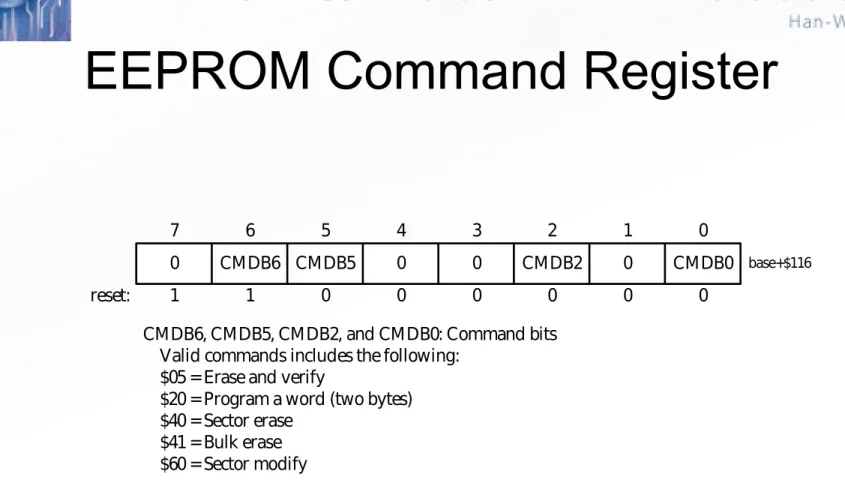
0 CMDB6 CMDB5 0 0 CMDB2 0 CMDB0
7 6 5 4 3 2 1 0
reset: 1 1 0 0 0 0 0 0
CMDB6, CMDB5, CMDB2, and CMDB0: Command bits Valid commands includes the following:
$05 = Erase and verify
$20 = Program a word (two bytes) $40 = Sector erase
$41 = Bulk erase $60 = Sector modify
Figure 14.23 EEPROM command buffer and register (ECMD)
base+$116
Configuring the ECLKDIV Register
Programming and Erasure of EEPROM
Start
Is EDIVLD bit set?
Write ECLKDIV register
Write array address and program data
no yes
Write program command $20 to the ECMD register Write $80 to register ESTAT
to clear the CBEIF bit Bit PVIOL set? Bit ACCERR set? Bit CBEIF set? Bit CCIF set?
Write $20 to ESTAT to clear the PVIOL bit Write $10 to ESTAT to clear the ACCERR bit
•
Example 14.10
Write a function that erase a sector (4 bytes) of
EEPROM. Index register X contains a word-aligned EEPROM address
within the sector to be erased.
•
Solution:
eraseEEsector
movb #ACCERR+PVIOL,ESTAT ; clear error flags
brclr ESTAT,CBEIF,EERErr ; command buffer not empty, return
std 0,X ; write any data to EEPROM sector
movb #SectorErase,ECMD ; write sector erase command
movb #CBEIF,ESTAT ; launch erase command
brclr ESTAT,ACCERR+PVIOL,EEROK ; no error?
EERErr ldab #1 ; error code set to 1
rts
EEROK brclr ESTAT,CCIF,EEROK ; wait until command completion clrb
int eraseEEsector (int *ptr) {
ESTAT = ACCERR | PVIOL; /* clear error flags */ if(!(ESTAT & CBEIF))
return 1; /* command buffer not empty, can't issue new command*/ *ptr = 0x00; /* write any data to EEPROM sector location */
ECMD = SectorErase; /* write sector erase command */ ESTAT = CBEIF; /* launch the command */
if(ESTAT & (ACCERR | PVIOL))
return 1; /* error occurred */
while(!(ESTAT&CCIF)); /* wait for command completion */ return 0; /* command completed correctly */ }
•
Example 14.11
Write a function that performs bulk erasure to the
EEPROM. Index register X contains a word-aligned EEPROM address.
•
Solution:
bulkeraseEE
movb #ACCERR+PVIOL,ESTAT ; clear error flags
brclr ESTAT,CBEIF,EEBEErr ; command buffer not empty, return
std 0,X ; write any data to EEPROM
movb #BulkErase,ECMD ; write bulk erase command movb #CBEIF,ESTAT ; launch bulk erase command
brclr ESTAT,ACCERR+PVIOL,EEBROK ; no error?
EEBEErr ldab #1 ; error code set to 1
rts
EEBROK brclr ESTAT,CCIF,EEBROK ; wait until command completion clrb
•
Example 14.12
Write a function that bulk erases the EEPROM
and verifies if the whole EEPROM is blank. Index register X
contains a valid word-aligned address to the EEPROM.
•
Solution:
eeraseverify
movb #ACCERR+PVIOL,ESTAT ; clear error flags
brclr ESTAT,CBEIF,cantEE ; command buffer not empty
std 0,x ; write any data to EEPROM address
movb #EraseVerify,ECMD; write the command
movb #CBEIF,ESTAT ; launch the erase and check command
brclr ESTAT,ACCERR+PVIOL,EEEVOK
ldab #1 ; return error code 1
rts
EEEVOK brclr ESTAT,CCIF,EEEVOK ; wait until command is done brset ESTAT,BLANK,EVEOK ; successful erase and verify?
cantEE ldab #1 ; EEPROM is not blank
•
Example 14.13
Write a function that programs a word to the EEPROM. X
contains the address of the EEPROM location to be programmed and
double accumulator D holds the data to be programmed. A zero is returned
in accumulator B if the command is performed correctly. Otherwise, a “1” is
returned
.
•
Solution:
eeprogram
movb #ACCERR+PVIOL,ESTAT ; clear error flags
brclr ESTAT,CBEIF,cantPRE ; command buffer not empty
std 0,x ; write data to EEPROM address
movb #Program,ECMD ; write the command
movb #CBEIF,ESTAT ; launch the erase and check command
brclr ESTAT,ACCERR+PVIOL,EEPROK
cantPRE ldab #1 ; return error code 1
rts
EEPROK brclr ESTAT,CCIF,EEPROK ; wait until command is done
clrb ; successful program code is 0
int eeprogram (unsigned int data, unsigned int *ptr) {
ESTAT = ACCERR+PVIOL; /* clear error flag */ if(!(ESTAT&CBEIF))
return 1;
*ptr = data; /* write data to word-aligned address */ ECMD = Program; /* write program command */
ESTAT = CBEIF; /* launch command */ if(ESTAT &(ACCERR|PVIOL))
return 1;
while(!(ESTAT&CCIF)); /* wait for command to complete */ return 0;
}
•
Example 14.14
Write a function that executes the sector-modify
command to change the contents of an EEPROM sector. The index
register X holds the word-aligned address of the first EEPROM word to be
modified. The index register Y holds the word-aligned address of the first
word of data to be programmed.
•
Solution:
eesectormodifymovb #ACCERR+PVIOL,ESTAT ; clear error flags
brclr ESTAT,CBEIF,cantmod ; command buffer not empty
movw 0,Y,0,X ; write data to EEPROM address
movb #SectorModify,ECMD ; write sector modify command
movb #CBEIF,ESTAT ; launch the erase and check command
brclr ESTAT,ACCERR+PVIOL,EEModOK
cantmod ldab #1 ; return error code 1
rts EEModOK
brclr ESTAT,CBEIF,EEModOK ; wait for command buffer to empty
movw 2,Y,2,X ; write second data word to EEPROM
movb #Program,ECMD ; write program command
movb #CBEIF,ESTAT ; launch the program command
brclr ESTAT,ACCERR+PVIOL,EEPR2OK
ldab #1
EEPR2Ok brclr ESTAT,CCIF,EEPR2OK; wait for command completion
clrb ; successful program code is 0
rts
int EESectorModify(unsigned int *src, unsigned int *dest) {
ESTAT = ACCERR | PVIOL; /* clear error flags */ if(!(ESTAT&CBEIF))
return 1; /* command buffer not empty is error */ *dest = *src; /* write first data word */
ECMD = SectorModify; /* write sector modify command */
ESTAT = CBEIF; /* launch the sector modify command */ if(ESTAT&(ACCERR | PVIOL))
return 1; /* command failed */
while(!(ESTAT&CBEIF)); /* wait for command buffer becomes empty */ *(dest+1) = *(src+1); /* write second data word */
ECMD = Program; /* write the program command */
ESTAT = CBEIF; /* launch the program command */
HCS12 External Interface
(1 of 3)
• External memory interface is implemented across four I/O ports (A, B, E, and K). • External memory signal pins are listed in Table 14.7.
• Signals ADDR0…ADDR15 and XADDR14…XADDR19 are used to select a memory location to access and are referred to as the address bus.
• DATA0…DATA15 are used to carry data and hence are referred to as the data bus. • When the external memory is not paged, only the lower 16 address/data pins are
used.
• If expanded memory is enabled, then ADDR14 and ADDR15 are not used. • A0…A15 are used instead of ADDR0…ADDR15.
• D0…D15 are used instead of DATA0…DATA15.
• XA14…XA19 are used instead of XADDR14…XADDR19. • R/W signal is used to indicate the direction of data transfer.
• LSTRB signal is used to indicate whether the lower data bus (D7…D0) carries valid data.
Table 14.7 HCS12 external memory interface signal pins
Signal name Function
ADDR0/ DATA0 ADDR1/ DATA1 ADDR2/ DATA2 ADDT3/ DATA3 ADDT4/ DATA4 ADDT5/ DATA5 ADDT6/ DATA6 ADDT7/ DATA7 ADDR8/ DATA8 ADDR9/ DATA9 ADDR10/ DATA10 ADDT11/ DATA11 ADDT12/ DATA12 ADDT13/ DATA13 ADDT14/ DATA14 ADDT15/ DATA15 XADDR14 XADDR15 XADDR16 XADDR17 XADDR18 XADDR19 R/ W LSTRB
EMI address bit 0 or data bit 0 EMI address bit 1 or data bit 1 EMI address bit 2 or data bit 2 EMI address bit 3 or data bit 3 EMI address bit 4 or data bit 4 EMI address bit 5 or data bit 5 EMI address bit 6 or data bit 6 EMI address bit 7 or data bit 7 EMI address bit 8 or data bit 8 EMI address bit 9 or data bit 9 EMI address bit 10 or data bit 10 EMI address bit 11 or data bit 11 EMI address bit 12 or data bit 12 EMI address bit 13 or data bit 13 EMI address bit 14 or data bit 14 EMI address bit 15 or data bit 15 EMI extended address bit 14 EMI extended address bit 15 EMI extended address bit 16 EMI extended address bit 17 EMI extended address bit 18 EMI extended address bit 19 Read/ write
lower byte strobe
Table 14.8 Access type vs. bus control signals LSTRB A0 R/ W Type of access
1 0 1 0 0 1 0 1 0 1 0 1 0 1 0 1 1 1 0 0 1 1 0 0
8-bit read of an even address 8-bit read of an odd address 8-bit write of an even address 8-bit write of an odd address 16-bit read of an even address 16-bit read of an odd address (low/ high bytes swapped) 16-bit write of an even address 16-bit write of an odd address (low/ high bytes swapped)
HCS12 External Interface
(3 of 3)
•
Aligned 16-bit access takes one E clock cycle to complete.
•
Misaligned external 16-bit access takes two E clock cycles to complete.
•
Misaligned internal 16-bit access takes one E clock cycle to complete.
•
E clock (ECLK) is used as the timing reference for external access.
•
The ECS signal is used as the chip select signal for external memory chips.
This signal can be used to latch address signals so that they stay valid
tr tf
0.9VDD 0.9VDD
0.1VDD 0.1VDD
Figure 14.25 A typical digital waveform
Waveforms of Bus Signals
(1 of 3)
• The waveform of a typical digital signal is shown.
• The rise time (t
r) of a signal is the time needed for a signal
to rise from 10% of the power supply voltage to 90% of the
power supply voltage.
• The fall time (t
f) of a signal is the time needed for a signal
1
0
Figure 14.26 Single signal waveform
1
0
Figure 14.27 Multiple-signal waveform
one or multiple signals change value
Waveforms of Bus Signals
(2 of 3)
• Single bus signal waveform
unknown (a)
unknown
(b)
Figure 14.28 Unknown signals. (a) single signal. (b) multiple signal. signal floating
signal floating (a)
Waveforms of Bus Signals
(3 of 3)
• Unknown signal
Categories of Bus Signals
• Address
• Data
Bus Transactions
• Includes sending the address and receiving or sending the data
• A read transaction (also called read bus cycle) transfers data from
memory to either the CPU or the I/O device.
• A write transaction (also called write bus cycle) writes data to the
memory.
• In a read transaction, the address is first sent down the bus to the
memory, together with the appropriate control signals indicating a
read.
• The memory responds by placing the data on the bus and asserting
a control signal to indicate that the data is valid.
• A read bus transaction is shown in Figure 14.30.
• In Figure 14.30, a read cycle takes one clock cycle to complete. If
necessary, the memory system can delay the assertion of the
End of read transaction
Clock
Address
Data
Read
Address
Data
Read
Request
ACK
Master asserts address
Slave drives data
Figure 14.31 Asynchroous read bus transaction.
Terminology
• Bus master
– A device that can generate
address and control signals
during a bus transaction
• Bus slave
– A device such as a memory
chip that can only respond to
the bus transaction
• Synchronous bus
– A bus that uses a clock
signal to synchronize bus
transactions
• Asynchronous bus
Bus Multiplexing
• It is used to minimize the number of pins used in
a chip.
• Address bus and data bus are often multiplexed.
• Address signals must be stable throughout the
whole bus transaction cycle.
The HCS12 Bus Cycles
• The timing diagrams of a read and a write bus
cycle are combined in Figure 14.32.
• Figure 14.32 shows that a bus cycle starts with
the MCU driving the address signals onto the
address bus.
• The events that occur during a read cycle are
illustrated in Figure 14.33.
35 3 4 1, 2 36 34 33 IPIPE0 IPIPE1 NOACC
30 31 32
29 26 23 22 19 13 11 27 24 25 28 20 21 17 18
12 7 8 14 6
15 16 10
95 ECLK LSTRB R/W ECS XA19: XA14 Addr/Data (write) Addr/Data (read) addr addr data data
Table 14.9 HCS12 expanded bus timing characteristics
Num Parameter name Symbol Min Typ Max Unit
1 2 3 4 5 6 7 8 9 10 11 12 13 14 15 16 17 18 19 20 21 22 23 24 25 26 27 28 29 30 31 32 33
Frequency of operation (E-clock) Cycle time
Pulse width, E low Pulse width, E high Address delay time
Address valid time to E rise (PWEL - tAD) Muxed address hold time
Address hold to data valid Data hold to address Read data setup time Read data hold time Write data delay time write data hold time Write data setup time1(PW
EH - tDDW)
Address access time1(t
cyc - tAD - tDSR)
E high access time1(PW
EH - tDSR)
Non-multiplexed address delay time
Non-muxed address valid to E rise (PWEL-tNAD) Non-multiplexed address hold time
Chip select delay time Chip select access time1 (t
cyc - tCSD - tDSR)
Chip select hold time Chip select negated time Read/ write delay time
Read/ write valid time to E rise (PWEL - tRWD) Read/ write hold time
Low strobe delay time
Low strobe valid time to E rise (PWEL - tLSD) Low strobe hold time
NOACC strobe delay time
NOACC valid time to E rise (PWEL - tN OD) NOACC hold time
IPIPO[1:0] delay time
-1. Set R/ W to read 2. Place address on bus
3. Assert LSTRB if address is odd 4. Assert ECS and XCS if in range
Address the memory
Output the data 1. Decode the address 2. Place data on data bus Microcontroller External memory
1. Latch the data
2. Negate LSTRB if asserted 3. Negate ECS and XCS if asserted
Acquire the data
Terminate the read cycle 1. Remove data from data bus and release to HI-Z
Start the next cycle
1. Set R/ W to write 2. Place address on bus
3. Assert LSTRB if address is odd 4. Assert ECS and XCS if in range 5. Place data on data bus
Address the memory
Input the data 1. Decode the address 2. Store data from data bus Microcontroller External memory
1. Negate LSTRB if asserted 2. Negate ECS and XCS if asserted 3. Remove data from data bus
Terminate write data
Important Data Read Timing Parameters
•
Address set up time: time interval that AD<19:0> valid before the falling
edge of ECS. This parameter is t
20– t
5
8 ns (= 16 ns – 8 ns).
•
Address hold time: amount of time that AD<15:0> remain valid after the
falling edge of ECS. This parameter is t
7+ T
E/2 – t
20(
5 ns).
•
Read data setup time: amount of time that data is valid before the falling
edge of ECLK. This parameter is t
10(
13 ns).
•
Read data hold time: amount of time that data remains valid after the falling
edge of ECLK. This parameter is t
11(
0 ns).
•
Address access time: the delay from the moment that address signals are
valid until data is driven by memory device. This parameter is t
15(> 19 ns).
•
Write data set up time: Write data valid before the W signal goes high. This
parameter is t
14+ t
26
14 ns.
•
Write data hold time: Write data stay valid after the W signal goes high. This
parameter is
0 ns.
– Parameters 1 and 2 are important to make sure that the address signals can be latched correctly by the address latch.
– Parameters 3, 4, and 5 are required by the MCU during a read access.
Issues Related to Adding External Memory
• Memory space assignment
Memory Space Assignment
• Equal size assignment
– The available memory space is divided into blocks of equal size.
– Each block is assigned to a memory device without regarding for
the actual size of
each memory-mapped device.
– Memory space tends to be wasted using this approach because
most memory-mapped peripheral chips need only a few bytes to
be assigned to their internal registers.
• Demand assignment
• Example 14.2 Suppose a designer is assigned to design a HCS12DP256-based embedded product that requires 256 KB of external 16-bit SRAM, 256KB of 16-bit EEPROM, and a parallel peripheral interface (PPI) that requires only four bytes of address space. The only available SRAM to this designer is the 128K 8 SRAM chips (This chip has 128K locations with each location containing 8 bits). The only available EEPROM is the 128K 8
EEPROM chips. Suggest a workable memory space assignment. • Solution:
– Two 8-bit wide memory chips are needed to construct a 16-bit memory module.
- Two 16-bit wide SRAM modules are needed to provide the 512 KB capacity.
- One 16-bit wide EEPROM module is needed to offer the 256KB capacity.
A possible assignment is as follows:
SRAM: 0x00000~0x3FFFF ; 256KB
Address Decoder Design
• Address decoder selects one and only one memory device to
respond to the memory access request.
• All memory devices have control signals such as chip-enable (CE),
chip-select (CS), or output-enable (OE) to control their read and
write operations.
• Two address-decoding schemes have been used:
– Full decoding
– Partial decoding
• Address decoder design is closely related to memory space
assignment.
• The programmable logic devices (PLDs) make full decoding easy
and flexible.
Timing Verification
• In a read cycle, the most critical timing requirements are
the data setup time and data hold time required by the
microcontroller.
• The address setup time and hold time requirements for
the memory devices are also critical.
• In a write cycle, the most critical timing requirements are
the write data setup time and write data hold time
required by the memory device.
• The address setup time and hold time must also be
satisfied.
Memory Devices
The K6R1008C1D
(1 of 4)
• A 128K
8 SRAM asynchronous SRAM from Samsung
that operates with 5V power supply
– Has short access time (10 ns) and three-state output
– Has automatic power-down feature to reduce power
consumption
– The address signals A16-A0 select one of the 128K locations on
the chip.
– The CS signal enables read/write access to the K6R1008C1D.
– The OE signal is the output enable. If OE is high, I/O pins will be
in high-impedance.
A0 A1 A2 A3 CS A4 VCC VSS I/O1 I/O2 I/O3 A5 A16 A15 A14 A13 A11 A12 VSS VCC I/O8 I/O7 I/O6 I/O5 I/O4 K6RC1008C1D 1 2 3 4 5 6 7 8 9 10 11 12 13 14 19 20 21 22 23 24 25 26 27 28 29 30 31 32
Figure 14.35 The K6R1008C1D pin assignment 15 16 18 17 OE A10 A9 A8 A7 A6 WE
tRC
tAA tOH
A ddress
Data Previous Valid Data Valid Data
(a) Read Cycle 1 (OE and CE are asserted in the whole cycle)
tPD tDH tOHZ tRC Address Data CS
OE tOE
tOLZ tLZ(4,5) tPU Valid Data VCC current
(b) Read Cycle No. 2 (OE controlled) tA A
tCO
50% 50%
tHZ(3,4,5)
Notes.
1. WE is high for read cycle.
2. All read cycle timing is referenced from the last valid address to the first transition address.
3. tHZ and tOHZ are defined as the time at which the output achieve the open
circuit condition and are not referenced to VOH or VOL level.
4. At any given temperature and voltage condition, tHZ(max) is less than
tLZ(min) both for a given device and from device to device.
5. Transition is measured ±200mV from steady state voltage with load. This
The K6R1008C1D
(4 of 4)
• In Figure 14.36a and 14.36b, the CS signal must be
asserted (low) for at least t
RCns during a read cycle.
• The signal that is asserted the latest determines the time
that data will become valid.
• In Figure 14.36b, the OE signal is asserted the latest,
data becomes available t
OEns later.
tWC
tAW
tCW
tWP
tDW tDH
tOHZ tA S
tWR
valid data
High-Z Address
OE
CS
WE
Data In
Data Out
K6R1008C1D Write Cycle Timing Diagrams
tWC
tAW tCW
tWP
tDW tDH
tWHZ tAS
tWR
valid data
High-Z
Address
CS
WE
Data In
Data Out
Figure 14.37b K6R1008C1D Write cycle timing diagram (OE tied to low)
tOW
- When both CS and WE are deasserted (goes to high), Data Out pins get out of the high impedance state.
K6R1008C1D Write Cycle Timing Diagrams
tWC
tAW tCW
tWP
tDW tDH
tAS
tWR
valid data Address
CS
WE
Data In
Figure 14.37c K6R1008C1D Write cycle timing diagram (CS controlled)
K6R1008C1D Write Cycle Timing Diagrams
K6R1008C1D Write Cycle Timing Diagrams
(4 of 4)
• The control signal that is asserted the latest controls the writing of the
device.
• In a
CS-controlled
write cycle, the CS signal is asserted after the WE
signal.
– The write pulse width (t
WP) is measured from the moment that the WE
signal goes low until the CS signal goes high.
– The write data must be valid for t
DWns before the CS signal goes high and
remain valid for t
DHns after the CS signal goes high.
• In a
WE-controlled
write cycle, the WE signal is asserted later than
the CS signal.
– The write data must be valid t
DWns before the rising edge of the WE signal
and must remain valid for t
DHns after the rising edge of the WE signal.
– The write pulse width is the duration that the WE signal is low.
Parameter Description tRC tAA tOH tCO tOE tOLZ tOHZ tLZ tHZ tPU tPD
Read cycle time Address to data valid
Data hold from address change CS low to data valid
OE low to data valid OE low to low Z OE high to high Z CS low to low Z CS high to high Z CS low to power up CS high to power down
K6R1008C1D-10 min max 10 -3 -0 -3 -0 -Unit -10 -10 5 -5 -5 -10 ns ns ns ns ns ns ns ns ns ns ns tWC tCW tAW tAS tWP tWP1 tDW tDH t
Write cycle time CS low to write end
Address valid to end of write Address setup to write start WE pulse width (OE high) WE pulse width (OE low) Data setup to write end Data hold from write end WE high to low Z
10 7 7 0 7 10 5 0 3 -ns ns ns ns ns ns ns ns ns Write Cycle Read Cycle
The AT28C010 EEPROM
• 128K
8 capacity
• Access time ranges from 120 ns to 200 ns
Byte Write Operation
• Started by a low pulse on the WE input with the
CE input being low and OE pin being high.
Address input is latched on the falling edge of
WE and data is latched on the rising edge of
WE.
Page-Write Operation
• Started in the same manner as in byte write operation.
• Each successive byte must be loaded within 150
s (t
BLC)
of the previous byte.
• If the t
BLClimit is exceeded, the AT28C010 will cease
accepting data and begin the internal programming
operation.
• All bytes involved in a page-write operation must reside
on the same page as defined by the state of the A16-A7
inputs.
Detecting the End
of an Internal Write Operation
• Poll the I/O7 pin.
• Before internal write is complete, the I/O7 shows
the complement of the value last written into it.
• Successive attempts to read data from the
Data Protection
• Both hardware and software features are provided to
protect the memory against inadvertent write operations.
• Hardware protection method:
– VCC sense. If VCC is below 3.8V, the write function is inhibited.
– VCC power on delay. Once VCC has reached 3.8V, the device
will automatically time out for 5 ms before allowing a write
operation.
– Write inhibit. Holding the OE signal low, or the CE signal high, or
the WE signal high inhibits write cycles.
Software Data Protection
• Enabling method
– Step 1
• Write the value of 0xAA to the memory location at 0x5555.
– Step 2
• Write the value of 0x55 to the memory location at 0x2AAA.
– Step 3
• Write the value of 0xA0 to the memory location at 0x5555. At the
end of write, write protect state will be activated. After this step,
write operation is also enabled.
– Step 4
• Write any value to any location (1 to 128 bytes of data are written).
Method for Disabling
Software Data Protection
• Step 1
– Write the value of 0xAA to the memory location at 0x5555.
• Step 2
– Write the value of 0x55 to the memory location at 0x2AAA.
• Step 3
– Write the value of 0x80 to the memory location at 0x5555.
• Step 4
– Write the value of 0xAA to the memory location at 0x5555.
• Step 5
– Write the value of 0x55 to the memory location at 0x2AAA.
• Step 6
– Write the value of 0x20 to the memory location at 0x5555. After this step, software data protection is exited.
• Step 7
– Write any value (s) to any location(s).
• Step 8
Address
Data Output valid
tCE tOE
Address valid
tACC High Z
tDF tOH
Figure 14.23 AT28C010 read timing diagram CE
OE
Read Timing (1 of 2)
• Three read access times
Symbol Parameter tACC
tCE(1)
tOE(2)
tDF(3)(4)
tDH
Address to output delay CE to output delay OE to output delay OE to output float
Output hold from OE, CE, or address, which occurred first
AT28C010-12 AT28C010-15
unit
Min. Max. Min. Max.
ns ns ns ns ns Table 14.11 AT28C010 Read characteristics
Max. AT28C010-20 Min. 0 0 0 120 120 50 50 0 0 0 150 150 55 55 0 0 0 200 200 55 55 Notes.
1. CE may be delayed up to tACC - tCE after the address transition without impact on tACC. 2. OE may be delayed up to tCE - tOE after the falling edge of CE without impact on tCE or by tACC - tOE after an address change without impact on tACC.
3. tDF is specified from OE or CE whichever occurs first (CL = 5pF). 4. This parameter is characterized and is not 100% tested.
OE
Address
CE
WE
Data In
tDS tDH
tWP tAH tOES
tAS
tCS
tOEH
tCH
(a) WE controlled write timing waveform
OE
Address
WE
CE
Data In
tWP tAH tOES
tAS
tCS
tDS tDH
tCH tOEH
Write Timing (1 of 3)
A0-A12
Data
tAS tAH
Valid Addr.
Valid Data
Byte 1 Byte 2 Byte 3
Byte 0 Byte 126 Byte 127
tWC tBLC
tWPH tWP
tDS tDH
Figure 14.41 AT28C010 Page mode write waveform OE
<