4 06/2010 www.hakin9.org/en 5
EDITOR’S NOTE
6/2010 (31)
4
team
Editor in Chief: Karolina Lesińska [email protected] Advisory Editor: Ewa Dudzic [email protected]
Editorial Advisory Board: Matt Jonkman, Rebecca Wynn, Steve Lape, Donald Iverson, Michael Munt
DTP: Ireneusz Pogroszewski Art Director: Ireneusz Pogroszewski [email protected]
Proofreaders: Michael Munt, Jonathan Edwards, Barry McClain
Top Betatesters: Rebecca Wynn, Bob Folden, Carlos Ayala, Steve Hodge, Nick Baronian, Matthew Sabin, Laszlo Acs, Jac van den Goor, Matthew Dumas, Andy Alvarado
Special Thanks to the Beta testers and Proofreaders who helped us with this issue. Without their assistance there would not be a Hakin9 magazine.
Senior Consultant/Publisher: Paweł Marciniak
CEO: Ewa Łozowicka [email protected] Production Director: Andrzej Kuca [email protected]
Marketing Director: Karolina Lesińska [email protected] Subscription: Iwona Brzezik Email: [email protected] Publisher: Software Press Sp. z o.o. SK 02-682 Warszawa, ul. Bokserska 1 Phone: 1 917 338 3631
www.hakin9.org/en
Whilst every effort has been made to ensure the high quality of the magazine, the editors make no warranty, express or implied, concerning the results of content usage.
All trade marks presented in the magazine were used only for informative purposes.
All rights to trade marks presented in the magazine are reserved by the companies which own them.
To create graphs and diagrams we used program by
The editors use automatic DTP system
Mathematical formulas created by Design Science MathType™
DISCLAIMER!
The techniques described in our articles may only be used in private, local networks. The editors hold no responsibility for misuse of the presented techniques or consequent data loss.
Dear Readers,
We receive from you lots of comments and opinions, most of them positive especially after going online. We are very happy that this decision was enthusiastically welcomed! The point of this change was to make Hakin9 magazine available for everyone having access to the Internet and not limit the audience to US only. And well, the numbers are saying everything:) It was worth to do it!
But coming back to this issue...As you’ve seen on the cover this issue is partially devoted to VoIP and its security, as it was one of the hottest topics lately.
Also, there is a lot of talking about Facebook security in the last days. That is why for this issue, Julian Evans, our ID fraud expert, wrote a great article about Facebook privacy in 2010. Don’t worry - we did not forget about soccer fans! Derek Manky, Cyber Security & Threat Research at Fortinet, gives you a brief view on SEO attacks on FIFA World Cup 2010.
Enjoy! Karolina Lesińska Editor-in-Chief PRACTICAL PROTECTION IT SECURITY MAGAZINE
REGULARS
06 in Brief
Latest news from the IT security world Armando Romeo, eLearnSecurity ID Theft Protect
08 Tools
Secpoint Penetrator Michael Munt
Elcomsoft iPhone Password Breaker Wardell Motley Jr.
11 Book review
Modsecurity Handbook by Ivan Ristic Michael Munt
42 Emerging Threats
FIFA World Cup 2010 – Network Security Advisory Derek Manky, Fortinet
4 06/2010 www.hakin9.org/en 55
BASICS
12 Disclosure Policies
Michael HeinzlHow to proceed with researched vulnerabilities and what or how much information regarding it should be disclosed, has always been a controversial topic and double-edged sword.
16 GPS Tracking with mobile phone
Mauro MeneghinSometimes, back home, I tried to understand which course I did looking at a map, but with 100 doubts on where and when I was exactly. What do you say about using a mobile phone to collect time/position data and visualize the route on computer later on?
ATTACK
20 Hijacking SSL – SSLStrip on Windows
Nilesh KumarThis article is a demonstration of SSL hacking using the SSLStrip tool. It discusses the weakness in the SSL certificate signing request which gets exploited for making fake certificates. Finally, the article shows how to run the SSLStrip tool on Windows and hijack the SSL successfully.
24 Birth of an Evil Twin – Taking Social Engineering to
the Social Web
Tim Kulp
I’d hate to wake up some morning and find out that you weren’t you. This quote from the 1956 movie Invasion of the Body Snatchers has more relevance today than ever. When an email says that it is from one of our friends, we rarely second guess the origin. That mentality has directly followed us from email to social networking, where the claimed identity of an individual is never challenged.
DEFENSE
30 Securing Voice Over Internet Protocol
Gary S. MiliefskyIf you think your telephone is safe from hackers, think again. With wireshark, a tcp/ip dump file and vomit (voice over misconfigured ip telephony) you can play back conversations from your own local area network that took place earlier today – and play these wave files in the privacy of your own home. This is a problem. And in VoIP it’s only the tip of the iceberg.
6/2010 6
In brief
www.hakin9.org/en 7
In brief
More Twitter hacks and one Twitter hacker arrested
He’s 24 years old and not a hacker at all. He had just successfully guessed the answer to the password reset secret question of Obama and other celebrities Twitter accounts. The Frenchman has been arrested thanks to the cooperation of the French police and the FBI and will have to face jail time and a fine of up to €30,000. The young man who, according to Mr. Coquillat, French state prosecutor, had no training in computer, did not post anything on behalf of the hacked personalities and did not try to profit financially of his hack, dated back to April 2009. The Frenchman, whose name is still not public, living in his parents house in Puy-de-Dôme and not even having a lawyer, is a low hanging fruit, but a fruit that had made a lot of noise at the time of the hack. Twitter hacks, however, have been going on and the latest to fall victim is Tory MP Therese Coffey, newly elected member of the British parliament. This time the hacker, who goes by the handle of thegh0st, has posted offensive twit messages on behalf of the deputy targeting prime minister’s wife Samantha Cameron. Miss Coffey has readily apologized from her blog but she’s still trying to get her Twitter back in control.
Source: Armando Romeo, www.elearnsecurity.com
EFF and Tor project team up to bring HTTPS Everywhere
No script and Tor are two add-ons that the cybersecurity savvy cannot do without during web browsing. The first provides protection from a number of script injection and phishing threats, the latter allows the browser to tunnel the connection through a number of nodes that make the originator of the request virtually untraceable. Until now, the use of an encrypted channel was a choice left to the website: Google uses SSL for Gmail but still not for the Search. Same thing
happens with Wikipedia or a number of other sites that do not default to an encrypted connection. EFF, The Electronic Frontier Foundation and the The Tor Project have now announced the availability of the beta version of HTTPS Everywhere. The project aims at redirecting you to the secure versions of each of the major websites on the net (Google, Wikipedia, Facebook…) by rewriting the links in the page towards their secure version. The most visible example of the case addressed by the joint-venture is Google, defaulting its search to HTTP but still providing an HTTPS version of the same feature.
The add-on works through a rule-set that the user can easily beef-up with additional websites not covered in the off-the-shelf Add-on package available from the Eff.org/https-everywhere webpage.
Source: Armando Romeo, www.elearnsecurity.com
AT&T exposure of 114,000 iPad users emails – Hacker arrested In early June a breaking news of a hacking group who had exposed over 114,000 emails from At&t hit all the security websites, magazines and TV. Only 20 days after the author of the hack, or at least the representative of the hacking group responsible, has been arrested and then released after posting $3,160 bond on felony drug possession charges. Andrew Auernheimer, is a 24 years old exponent of the Goatse Security group that had uncovered a small but effective hack in At&t website. Cocaine, Ecstasy and LSD was found in Auernheimer’s house on an FBI’s search that has not yet been clarified if related to the At&t hack or not. The hack gained the group 114,000 email addresses of iPad 3G Subscribers including a number of military officials, politicians among which New York Mayor Michael Bloomberg and White House Chief of Staff Rahm Emanuel. The group at the time of the hack realized that by providing the SIM
card serial numbers to a webpage of the At&t website, allowed gaining the correspondent email address. Since these serial numbers are released in sequential order, running a very simple tool allowed the group to enumerate thousands of emails in no time. Immediate warning was given to the Telco company that admitted and immediately fixed the issue. Although the only information to be gained was the email address related to the iPad user, the hack could allow someone who does the proper research to possibly target iPad 3G users and take over their iPads, and they could sniff traffic, they could act as the user of the iPad according to Goatse analyst Jim Jeffers.
Source: Armando Romeo, www.elearnsecurity.com
Apple quietly secures your Snow Leopard
6/2010 6
In brief
www.hakin9.org/en 7
In brief
tools. This kind of protection is rather sloppy as malware can get through by means of Skype, BitTorrent or other tools that are currently unsupported by Mac OS-X builtin signature-based malware protection.
Source: Armando Romeo, www.elearnsecurity.com
Secure calls and text messages with Moxie’s RedPhone
Moxie Marlinspike is a Pittsburgh hacker and security researcher author of papers and famous tools such as sslstrip, presented at BlackHat DC 2009 and sslsniff. His last venture is a startup, Whisper Systems, that has one precise scope: securing mobile phone calls and text messages storage. RedPhone, the solution proposed by Moxie, is an Android app that uses Phil Zimmerman’s ZRTP encryption protocol to secure VOIP calls on the fly making them hard to eavesdrop. Any two phones with this app installed are enabled to secure communication without ever noticing the app running: as stated by Moxie Our main aim is to make this [secure communication] as easy as possible. The app allows confidentiality by means of encryption and also authentication by means of a passphrase generated from the two peers keys: it is easy, from a user point of view, to verify that no man-in-the-middle is there. The other application, TextSecure addresses the need for having a secure storage of one’s SMS’s. The two applications, still in beta version, will likely remain free, while premium versions could be released for small fees.
Source: Armando Romeo, www.elearnsecurity.com
Fake YouTube pages continue to be a threat
A leading internet security company has identified more than 700,000 web pages which look like they are real YouTube pages (including the YouTube logo to add authenticity). In fact they are fake pages delivering
malware to users computers. The malicious pages claim to contain a hot video associated with the Gulf oil spill, NBA Playoffs, Harry Potter and other popular topics. If a user inadvertently plays the video from one of the fake pages a pop up appears informing them that they need to download and install a media codec file. If the user clicks OK the users browser will be redirected (see: browser redirector) to a malware infected website. The malware infected website promotes scareware and rogue antivirus software. The malware is being propagated using poisoned search results.
World of Warcraft detected as malware
Symantec admitted recently that their Norton Internet Security Suite labels files associated with World of Warcraft as malicious. The security suite deleted the files it thought were malware, causing the game to stop working and computers to crash while booting. Symantec have highlighted that the Norton Internet Security Suite suffers from ten to forty false positives per month – which unfortunately also included World of Warcraft. False positives are looked at by humans, so it’s easy to see why the error occurred. The updated World of Warcraft file (svchost.exe) was analysing the system which made it appear as a suspicious file. Sometimes security products accidentally delete important system files due to false positives but it doesn’t happen that often. There is of course a failsafe in most if not all security software which will not allow removal of critical system files.
Malware targets Windows Mobile Scammers are distributing apps for Windows Mobile-based smartphones that have malware hidden inside that makes calls to premium-rate numbers across the globe, racking up expensive bills unbeknownst to the phone's owner. The apps – 3D Anti-Terrorist
game, PDA Poker Art and codec pack for Windows Mobile 1.0 – are being distributed on as many as nine popular download websites, including DoDownload, GearDownload and Software112, according to John Hering, chief executive and founder of mobile security provider Lookout. Someone has copied the programs and repackaged them with the malware inside, he said. Once the app is installed the virus wakes up and starts dialing premium-rate numbers like in Somalia and the South Pole, Hering said. He added that victims may not know about the problem until they get their phone bill and see that it is $50 (£35) or $100 higher than it should be.
Hacker finds serious SQL injection flaw with website An attacker has discovered a serious flaw in a website set up to encourage the use of smart cards for public transportation in the Netherlands, resulting in the leakage of personal information of more than 168,000 travelers.
The website offered a coupon for a free trip using the OV smart card system and was set up to promote the new system which is being slowly rolled out throughout the region. According to Webwerld, a tech publication based in the Netherlands, the names, addresses and telephone numbers of individuals who signed up were publicly available as a result of the flaw. Information about the flaw was exposed by an anonymous hacker who gave the magazine a video demonstrating the error using a SQL injection attack. The hacker told the magazine that he made the flaw publicly available because there is no excuse for simple website mistakes. The website has since been taken offline. In this instance, the hack appears to have orchestrated with the interests of exposing poor security, rather than stealing users’ data and identities.
6/2010 8
TOOLS
Items Tested:
40GB External USB HDD that has had an extensive amount of files written to it, and then randomly deleted, approximately 16GB in total and has intermittant connection issues to the point that the local machine doesn’t actually register the drive is there.
Once I had the software installed it was time to see how it performs. I plugged the external drive in and then powered up the software. It saw my drive straight away, but it didnt actually state what disk format the drive actually was. This might be due to the fact that the operating system didn’t actually find the drive itself, so it was a pleasant surprise that this program did indeed find it.
You are able to configure what types of files you actually want the program to be searching for during the recovery process, for this test I just left everything as default which means everything was selected.
I selected my external USB Drive and it scanned the partitions first to ensure that it can actually see the drive correctly. Once this part of the process has been completed it then requests that you allow it to scan the whole partition that you have selected, this appears to be a very cpu intensive program so I would suggest to just leave it running on its own if
possible. It took just over an hour to scan through a 40GB hard drive. Once it was finished NTFS Mechanic provides all the data thats on the drive, deleted and non-deleted files. You can select in the right hand menu to only see the recovered files, which makes it a lot easier to see what the program has actually found.
If you look at the properties of the files and folders that have been listed as being recovered, you can actually see the prognosis of each file if you decided to proceed and recover the file completely.
The process for recovery couldn’t be much easier, it’s simply a case of going through the folder list and selecting the files you want to recover and then just say where you want them to be stored.
The program performs really well and managed to recover data from a disk that hasn’t been seen by any of my machines for a little while now which quite impressed me.
I noticed that there were a few area’s within the program that could do with some QA work as there were non english characters in use and some screens weren’t actually needed in my opinion but they arent detrimental to the product.
I would gladly have this tool in my toolbox.
http://recoverymechanic.com/ntfs_recovery/ntfs_ mechanic.php
Partition Recovery Hard Drive Recovery Recover deleted files
by Michael Munt
NTFS Mechanic
Disk & Data Recovery for
NTFS Drives
TOOLS
www.hakin9.org/en 9
T
he Secpoint Penetrator S300 comes in a small form factor Dell Optiplex unit. All you need to do is plug it in as the operating system and programs etc are already pre-configured for ease of use. Just connect to the system via your local machines’ browser and you’re ready to go. Once you are logged in you are presented with the following screen;Auditing
There are two options available to use when auditing; a quick audit or a full scan with an option to schedule your scans. Ideal for those who want to put it into the server room and then to perform a monthly audit of the servers or certain parts of the network. This is also an excellent option for those of you that want to be able to offer this as a managed service to your clients. You are also able to see trends on the audits by comparing each scan against the others that have happened in the past.
Quick Audit
This is a small basic audit that scans the known TCP ports and then performs checks against 20 known vulnerabilities to see if your system is susceptible.
Full Scan
The full scan option will perform an assessment of your requested systems, you have the option to enhance this audit by allowing the system to actually deliver the payload against the machines in question. The Penetrator database of vulnerabilities is currently in excess of 42,000 and is continually growing, as you receive updates throughout the day. Once the audit has completed you are presented with the options on how you would like to view the results.
Reporting
There are two main report options available to you; the Executive summary or the full report (including solutions to the vulnerabilities it has identified). The Executive summary is aimed at the management types and provides enough information concerning the audit, including graphical detail and the amount of vulnerabilities found.
The full scan goes into a lot further detail with information on each vulnerability found and a resolution on how to prevent this from being exploited in the future.
An overall risk factor graphic is provided which gives you an immediate indication as to how secure or insecure you are.
You are able to customise and personalise the reporting so that you can insert your own company logo etc which will enable you to sell these to your customers (this is permitted within the licencing of the unit).
Overall Impressions
Whether you are a professional tester or just starting out this unit is a complete solution for testing your own or your customers’ networks. Its ease of use is a serious advantage as you wouldn’t need to spend time and effort in configuring the system up etc apart from the initial wizards. Once you have scheduled all your audits, you can tuck it away somewhere and forget about it, although you could have it sitting under your desk and would never know it was there, as its almost silent operation had myself checking on more than one occasion to ensure it was turned on.
The sensible clear layout of the menu’s makes it so simple to use, that even complete beginners will be using this within 15 minutes. The help documentation provided is of first rate and clear about what you need to do for each section. If you’re not the “manual” type each section has a video tutorial attached to it as well.
Finally I have to say something about the support I received when I had some difficulties with my unit. I can some it up in one word. Superb! They were very quick on their initial response and kept me up-to date throughout the issue. Even offering to remote in to the machine to double check that I hadn’t made a simple mistake. Once it was all resolved, they still followed up the next day to ensure I was still working properly. This has got to be one of the best levels of support I have received in a very very long time.
Secpoint Penetrator
URL: http://www.secpoint.com/penetrator.html Product SP-S300-8-1YB
Price (Euro’s)949.00
�����������
����������������������
���������������������� �����������������������
�����������������������
��������������������
��������������������
6/2010 10
TOOLS
Options Tab. Here you can select multiple processors to work on your job or select only one if you are in need of the resources for something else.
All in all a great tool and one that I highly recommend adding to your toolkit.
URL: http://www.elcomsoft.com/eppb.html Cost:
Home Edition 79€ Professional Edition 199€
Items Tested
Elcomsoft’s new tool iPhone Password Breaker provides a quick reliable and light weight password breaker. It can be purchased and downloaded from
www.crackpassword.com
Although they do have a free version on the website it does have limitations. It supports password protected backups to iPhone 2G,3G,3GS, and iPod Touch 1st 2nd and 3rd Gen devices.
I recently tested this software on a Windows XP machine on a iPhone 3G encypted backup. The installation process was quick and to the point. Upon startup you will have to browse for the encypted iPhone backup file. In Windows you should be able to find it under C:\Documents and Settings\ YourUserName\Application Data\Apple Computer\ MobileSync\Backup. If you are unable to find it there I would suggest you do a search for “Manifest.plist”.
On another note, if you select a file that isn’t encrypted then it will not work and you will get an error message that tells you the backup isn’t encypted. Once you have found your encypted plist file you will then select a password breaking option either a Brute Force attack or a wordlist attack with the ability to specify a text or dictionary file.
When it comes to wordlist it will depend on how good your password list is, however, if you are doing a brute force on a numbered passcode then it will find it within a matter of seconds if not sooner. It found my
4 digit passcode in 0.83 seconds. In the real world an outright brute force attack against anything with upwards of 5 characters including symbols and upper and lower case characters will take substantially longer but with the iPhone password breaker you will be well on your way to finding that encrytped password. Password Breaker also gives you the ability to select multiple processors under the Recovery -->
Elcomsoft iPhone Password
Breaker
WARDELL MOTLEY JR.
Wardell Motley is a Systems Administrator for a Large clothing Manufactures in Dallas Texas.
Book review
www.hakin9.org/en 11
For those of you who have never heard of Modsecurity, it is in essence an Open Source Web Application Firewall, but this is just a small part of the complete toolkit of what this application really is. Ivan himself refers to it as a HTTP Intrusion Protection tool but admits this still isn’t a true description of what it can do and he should know as he started working on the project in 2002 and still has his hand in today.
I haven’t used this application myself, so I was a bit apprehensive in the beginning especially when I looked at the table of contents (all 14 pages of it, and the book is only 340 pages in total length!) Looking very much like a large manual I was pleasantly surprised at how easy the book was to read, the technical sections are fully explained and well thought out with plenty of examples throughout the book, which are really useful to ensure that the information is retained and understood correctly.
The book is broken down into sections which enable you to either delve into area’s that you need to without having to read it from cover to cover (which you should really do as even the most experienced Modsecurity users will find something new in here I am sure). Right from the beginning of the book you are taken step by step on how to install and configure your Modsecurity
setup all the way down to the little details. When the application is updated and we all know software is updated all the time, the publishers have promised to keep the book information upto date with an electronic online version which I believe is a unique feature for a technical book, and keeps things in touch with the Open Source mindset. This book has actually given me enough enthusiasm to want to go setup and install Modsecurity itself on a system somewhere to have a play and put some of the information imparted to me to some good use.
It was a pleasure to read this book, and I wish there were more authors like this that have such passion about a particular subject that it infects the reader!
by Michael Munt
Modsecurity Handbook
URL: https://www.feistyduck.com/ Author: Ivan Ristic
6/2010
12
BASICS
www.hakin9.org/en
A
questions to which there seems to be often noright or wrong answer, and often requires further investigation before a certain pattern can be followed strictly. Although various approaches addressed to this topic exists, none was yet established, which could please all parties involved. The following will therefore explain the most common methods in more detail and takes up some of the advantages and disadvantages, which occur frequently within discussions on this topic.
Full Disclosure
In Full Disclosure all information regarding a certain vulnerability are disclosed and made publicly available. Here not only the information itself is published, namely that a specific vulnerability was discovered in a particular product and version of it, but also detailed information regarding discovery and exploitation. This way companies and developers should be forced to release a patch or another solution as fast as possible. Otherwise concerned systems are not only longer vulnerable for exploitation, but also a considerable reputation damage and so thoroughly a customer and money loss are likely to happen. Security should therefore be increased, as the time period in which a system is vulnerable, gets shortened.
In Full Dosclosure it's often assumed, that black hats are already aware of a certain vulnerability and exploit it actively. By disclosuing all details to the public, each party can respond early and prepare their own arrangements, which hinder further exploitation of their
systems, as long as no patch is available. This may include such measures as disabling an affected service or changing configuration files, depending on the scenario and vulnerability. Ideally, full disclosure should also lead software manufacturers to invest more effort and time into quality assurance, rather than using end customers as their final instance of beta testing.
Opponents of full disclosure often critizice the fact, that developers are only informed about a vulneraility at the same time as the general public, which results in an enourmous pressure towards companies and developers. As everyone get the information at the same time, a guaranteed time window is created in which a system is vulnerable to exploitation, even when
Disclosure Policies
How to proceed with researched vulnerabilities and what or
how much information regarding it should be disclosed, has
always been a controversial topic and double-edged sword.
What you will learn…
• basic approaches in terms of researched vulnerabilities and their (dis)advantages
What you should know…
• for this article no special requirements are needed
Figure 1. How much should be disclosed?
6/2010
12
BASICS
www.hakin9.org/en
working immediatley after announcement on a solution. Additionally often together with the announcement or shortly after, automated exploitingtools are published, which enables also scriptkiddies to successfully exploit a vulnerable system, even if the background and functionality is not understood.
Non-Disclosure
Non-Disclosure is essentially the opposite of full disclosure. This means that an approach is pursuied, where found flaws in software are kept private, and at best only in a selected circle, often within an internal group, are shared.
In the past it was shown that some vendors and researches have pursued this philosophy and still do, although they have received harsh criticism because of it. From a developer's perspective it's thereby attempted to keep a vulnerability secret until a patch was developed which closes the flaw. Here, however, a big problem arises, which is about the selection of people who should be notified. Is it sufficient that only internal developers are aware of the vulnerability, or should e.g. also operators of critical systems be informed about it (such as hospitals, nuclear plants, etc.)? Who guarantees that the shared information are kept private and are not shared by anyone or published, or even worse, used for one's private benefit?
It may also not be assumed that no one else has already found the same vulnerability, only because nothing was published regarding it. If both, developers and researchers don't publish any information in general, the real problem is not solved and system administrators won't be able to protect their systems. Unfortnately some companies imply that it's sufficient to close a security vulnerability only if it was found by others and further details were released among with it.
Limited Disclosure
6/2010
14
BASICS
Using this disclosure philosophy leads to similar problems as within other disclosure methods. First it has to be assured that the information are only disclosed to ethical people who don't utilize the newly gained knowledge for their personal gain. Also there is too little pressure on the developers to fix the flaw in the shortest possible time, as the general publih is not initially informed about the vulnerability. Since only a very vague announcement is made, many system administrators may not be able to secure their systems until a patch or solution from the vendor is provided. Ultimately here again it can not be assumed that the black hat community is not already aware of the specific vulnerability and exploiting it actively.
Responsible Disclosure
A commonly used policy is known as responsible disclosure. Here the developer or vendor is contacted first, before the full information is released into the public. This should ensure that developers are granted a specific time period in which they can take care of the problem, but the public still gets all the details, even if it's somewhat delayed. In contrast to full disclosure, however, an attached exploit-code is often missing; general information, technical details and ideally a patch but are still published.
How much time is allocated to such an ultimatum differs from case to case, common are often several weeks to months though. Regardless of the time limit given, it should not be extended continously, as some vendors try to delay it as long as possible, often with the goal, to push it so long away until it becomes no longer relevant or another solution has shown; so to say that it is not handled as their primary goal to close the security flaw.
Unfortunately some developers and vendors consider it as a personal insult or attack if a vulnerability or security flaw in one of their products is reported to them. As a result of this it often happens that such messages are just ignored or worse, that the discoverer gets threatened with legal actions. That those two
approaches can't be purposeful may be obious to many readers, but unfortunaly this happens in reality quite often and can be seen over and over. In this case the information is then usually just published to the public without further caring of the vendor.
The concept of responsible disclosure, therefore, is to notify first the vendor so that a patch can be provided as quickly as possible, and only with some delay, the general public. Published information should still include all the details necessary to safeguard ones system, ideally already together with a patch supplied by the developers itself.
Conclusion
The market for exploits and their acquisition, especially for 0-day-exploits, seems to enjoy a steady growth and it can be assumed that it will still increase by a multiple. A standardized policy, which addresses all the needs from all involved parties, would be appreciateable, but seems to be possible in an utopia only.
Which disclosure policy is executed at the end has to be decided by everyone on their own. Many of the existing methods seem to have a right to exist and for some scenarios, some methods are probably not even come into question.
The initial problem, namely the existence of security flaws and breaches, could already be significantly reduced if companies and developers would put more effort into
secure programming and a better quality assurance (or often even could). The implementation seems, however, often difficult, although all parties involved would benefit from a more secure and error-free software.
MICHAEL R. HEINZL
Michael R. Heinzl is engaged with it-security and related areas for some years, especially with penetration testing and reverse code engineering. Contact is possible through http://awesec.com or through the Austrian security website https://defense.at.
Bibliography and further ressources:
• http://www.schneier.com/crypto-gram-0002.html#PublicizingVulnerabilities – Crypto-Gram Newsletter, February 15, 2000, Bruce Schneier
• http://www.schneier.com/crypto-gram-0111.html#1 – Crypto-Gram Newsletter, November 15, 2001, Bruce Schneier • http://www.wiretrip.net/rfp/policy.html – RFPolicy v2.0
• http://www.securityfocus.com/columnists/66 – Responsible Disclosure Draft Could Have Legal Muscle
• http://www.sans.org/reading_room/whitepapers/threats/de�ne-responsible-disclosure_932 – How do we de�ne Responsible Disclosure?
• http://labs.idefense.com/vcp/ – Vulnerability Contributor Program • http://www.zerodayinitiative.com/ – Zero Day Initiative
• http://www.securityfocus.com/archive/ – BugTraq
• http://www.cve.mitre.org/ – Common Vulnerabilities and Exposures • http://osvdb.org/ – The Open Source Vulnerability Database • http://secunia.com/ – Secunia
• http://oss-security.openwall.org/wiki/mailing-lists/vendor-sec – vendor-sec • http://wikileaks.org/ – WikiLeaks
6/2010 16
BASICS
GPS Tracking with mobile phone
www.hakin9.org/en 17
S
ometimes, back home, I tried to understand which course I did looking at a map, but with 100 doubts on where and when I was exactly. Now, luckily, there are satellite navigators, but not all offer the possibility to keep track of the traveled route and have details on exact traveling times.What do you say about using a mobile phone to collect time/position data and visualize the route on computer later on?
Requirements:
• a mobile phone android with GPS and a uSD memory
• a computer with SD reader and an internet connection
• an adapter from uSD to SD
The software to install on mobile phone is GPSLogger, available for free at: http://www.androlib.com/ android.application.com-mendhak- gpslogger-ipxp.aspx or http://apps.doubletwist.com/GPS-Logger-for-Android/-2727505723369031487.
After starting the application go to Menu>Settings
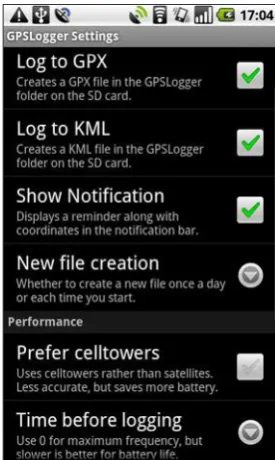
(see Figure 1) and select Log to GPX (in this way logs will be saved on files with .gpx extension inside the uSD memory), then select a value for Time before
logging, so that position will be saved with the preferred frequency (I use 60 seconds and 0 meters as Distance before logging).
Few minutes before going outside home click on Start logging. You'll notice that logging needs a bit of time to start, so be patient. The application is trying to detect
GPS Tracking
Sometimes I like to do mountain excursion, going through
new paths.
What you will learn…
• the use of a GPS application for your mobile phone
• how to see the points received from the GPS of your mobile phone on pc
• how to integrate applications from different systems (mobile phone, pc, web server)
• introduction to Android development and GPS handling (for the advanced part)
• how to parse xml �les with php (for the advanced part) • how to use Google Maps (for the advanced part)
What you should know…
• how to install an application on the mobile phone • how to read the mobile phone uSD from pc • what is an xml �le
• programming understanding of java/php/javascript (for the advanced part)
with mobile phone
6/2010 16
BASICS
GPS Tracking with mobile phone
www.hakin9.org/en 17
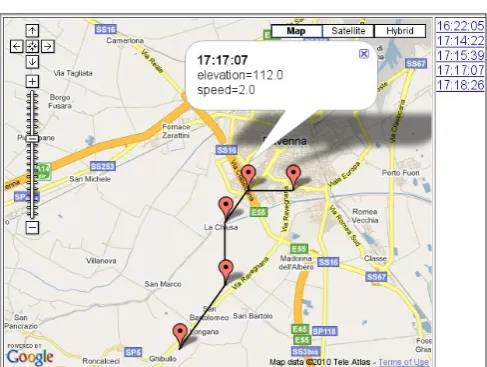
Just upload the file, the script will parse the xml file and extract for each node time, logitude, latitude and, if present, also elevation and speed, and the path is built as you can see in Figure 4.
I've noticed when browsing the sources that the author foresee to deliver a new version of the application with the possibility to visualize the map directly on the mobile phone. For the moment, however, this option is not active. Also, from the sources it seems that the user/password authentication will be required to use this service.
How the code works
Dalvik
Majority of the applications for Android are written in Java. Not every standard java class is available, but you can find many adjunctive classes that allow to develop easily applications using mobile hardware features (like fotocamera, bluetooth, telephony, SMS, GPS, touch screen etc.).
The virtual machine interpreting these applications is called Dalvik. If someone is interested in the development there is an eclipse plugin allowing easy development of applications for Android and an emulator to run and test applications on pc without the need of a connected phone.
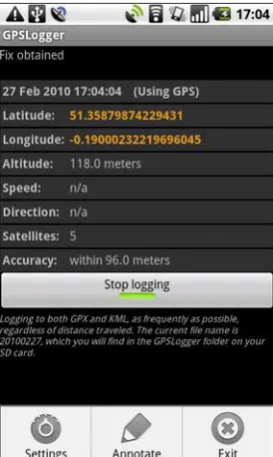
the starting position looking for a GPS signal on many satellites. The more it will find, the better the accuracy will be. You should begin to see the coordinates of your position as shown on Figure 2.
Once back home extract the uSD memory from mobile phone and insert it in a uSD to SD adapter (see Figure 3). Then put the adapter inside the SD slot of the computer. This memory uses a vfat file system, it should be automatically detected (on OpenSuse it's mounted on /media/disk). You'll notice a file like /mount_ dir/GPSLogger/20100413.gpx where the file name matches
the data yearmonthday.gpx when logging.
gpx is an xml file with this format
<?xml version="1.0"?> <gpx … >
<time>2010-04-13T16:22:05+02:00</time> <bounds />
<trk> <trkseg>
<trkpt lat="44.35" lon="12.15"> <ele>121.0</ele>
<src>gps</src> <sat>4</sat>
<time>2010-04-13T16:22:05+02:00</time> </trkpt>
...
where each point (called also track point or in short: trkpt) is saved with 2 attributes lat=latitude, lon=longitude, and other information is presented as
child elements (time, elevation, speed etc)..
To visualize easily these files I made a php script that you can access on my server http://g1ld0.is-a-geek.net/ gps_track/.
Figure 2. GPSLogger getting the current position
Figure 3. The adapter for uSD card to read it from pc.
Table 1. De�nition of track points, <gpx><trk><trkseg><trkpt>
Attribute Child
Element Meaning Mandatory
lat latitude yes
lon longitude yes
ele elevation [m] no
course direction no
speed speed [m/s] no
src gps or wi� data yes
sat number of satellites no
6/2010 18
BASICS
Let's see very quickly how GPSLogger uses the GPS functionality. I used the class android.location. LocationManager is needed to request updates on the current position. Updates on position are sent to a class
GeneralLocationListener implementing the interface andro id.location.LocationListener. Roughly speaking the code
asking updates is this: see Listing 1.
During the logging the function onLocationChanged(Locat ion loc) (http://developer.android.com/reference/android/
location/GpsStatus.Listener.html#onGpsStatusChanged(i nt))of object gpsLocationListener will be automatically called
with new data on current position inside paramter loc. For anyone interested, the official documentation of
android.location.LocationManager can be found here: http:
//developer.android.com/reference/android/location/ LocationManager.html.
PHP Script
In the PHP script for paring the xml file on the web server, once read file content inside string $data, I've
created an $xml object with the function simplexml_load_ string(). Then, I read each <trkpt> node in this way:
// create xml object
$xml = simplexml_load_string($data);
// look for each node <gpx><trk><trkseg><trkpt> foreach ($xml->trk->trkseg->trkpt as $node) {
$lat=$node['lat']; //latitude $lon=$node['lon']; //longitude …
JavaScript and Google Maps
To represent the path with Google Maps, for each node found the php script prints these JavaScript lines (simplifying a bit):
// create the point with latitude lat and longitude lon point = new GLatLng(lat,lon);
// create the point marker marker = new GMarker(point); map.addOverlay(marker); path.push(point);
Also clicking on the track points the JavaScript lets us open a small frame with information such as elevation and speed (if available).
In the end, in order to draw the path with a polyline the Google Maps Api provide the function GPolyline(), that
takes as first mandatory argument the array path with
track points filled before:
var polyline=new GPolyline(path,'#000000',2,1.0); map.addOverlay(polyline);
Conclusion
In the first part we have seen how to use GPSTrack to save the information on the travelled path on the uSD memory of the mobile phone and how to view it on the browser of the pc.
The second part instead deals with programming details of all the components mentioned, from the Android application to the server side script creating the Google Map.
A short description of GPSLogger allowed us to introduce a powerful framework for the development of Android applications. After that we looked on server side at the handling of the generated xml file performed with few lines of Php. This occasion was taken to spend few words also on the usage of the Google Maps Apis to show the travelled path on the web page.
MAURO MENEGHIN
Italian Mechanical Engineer, age 31, actually working as high school teacher. Hobby: software programming and hacking from 10 years.
Figure 4. Screenshot of the track of traveled path
Listing 1. How the telephone acquires GPS positions
android.location.LocationManager gpsLocationManager;
gpsLocationManager = (LocationManager) getSystemService(Context.LOCATION_SERVICE);
gpsLocationManager.requestLocationUpdates(LocationManager.GPS_PROVIDER,minimumSeconds * 1000,minimumDistance,
gpsLocationListener);
6/2010 20
ATTACK
Hijacking SSL: SSLStrip on Windows
www.hakin9.org/en 21
I
t discusses the weakness in the SSL certificate signing request which gets exploited for making fake certificates. Finally, the article shows how to run the SSLStrip tool on Windows and hijack the SSL successfully.What is SSLStrip
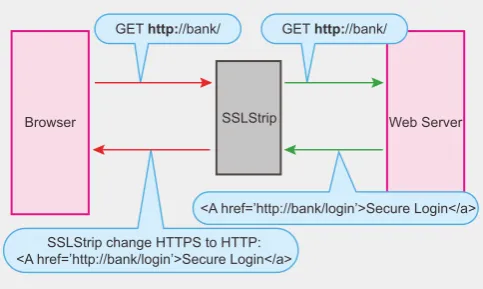
The SSLStrip works by watching http traffic, then by acting as a proxy when a user attempts to initiate an https session. While the user believes the secure session has been initiated, and SSLStrip has connected to the secure server via https, all traffic between the user and SSLStrip is http. The SSLStrip replaces all links with https:// in the page with http://. Warnings usually displayed by the browser don't appear and the session appears normal to the end-user. Login details can then be harvested.
The author of the tool Moxie Marlinspike says: This tool provides a demonstration of the HTTPS stripping attacks that were presented at Black Hat DC 2009. It will transparently hijack HTTP traffic on a network, watch for HTTPS links and redirects, and then map those links into either look-alike HTTP links or homograph-similar HTTPS links. It also supports modes for supplying a favicon which looks like a lock icon, selective logging, and session denial.
An https padlock logo can be spoofed in the URL bar, to further lull the user into a false sense of security.
While SSL is generally accepted as being secure, security researchers have claimed SSL communications can be intercepted. Researcher Mike Perry said he had been in discussions with Google regarding an exploit he planned to release, which would allow a hacker to intercept a user's communications with supposedly secure websites over an unsecured Wi-Fi network.
Weakness of SSL in practice
The main weakness with conventional SSL certificates is that there are no standards for their issuance, nor any rules for what the fields in them are supposed to mean and which are required for authentication. Marlinspike’s SSLStrip attack demonstrated the combination of several attack techniques to exploit the above weaknesses and fool users/client applications into thinking they were using a trusted site/server, when in fact they were using a fake version of that site/server. He combined a number of techniques; including man-in-the-middle, fake leaf node certificates and the null character attack.
SSL heavily rely on X509 certificate structure to prove authenticity. For the SSL it is the common name field of the X509 certificate that is used to identify authentic servers. For example, Paypal will use www.paypal.com in the common name field. The signing process heavily relies on the above convention. The Certificate Authorities will sign www.paypal.com, they don't care whether you are
Hijacking SSL
This article is about a demonstration of SSL hacking using
the SSLStrip tool.
What you will learn…
• What is NULL pre�x attack
• How SSLStrip exploits it to carry out SSL hijacking • How to run SSLStrip on Windows machine • How to mitigate the problem with SSL certi�cates
What you should know…
• Basics of SSL and Certi�cates
6/2010 20
ATTACK
Hijacking SSL: SSLStrip on Windows
www.hakin9.org/en 21
How SSLStrip works
• It does an MITM (Man-In-The-Middle) on the HTTP connection.
• It replaces all the HTTPS links with HTTP ones but remembers the links which were changed.
• Communicates with the victim client on an HTTP connection for any secure link.
• Communicates with the legitimate server over HTTPS for the same secure link.
• Communication is transparently proxied between the victim client and the legitimate server.
• Images such as the favicon are replaced by images of the familiar secure lock icon, to build trust.
As the MITM is taking places all passwords, credentials etc are stolen without the Client knowing.
Performing the Hijack on Windows
The process of using SSLStrip on Windows machine is almost similar to Linux machine. Linux has Firewall management tool iptables for enabling Port Forwarding. The port forwarding utility actually accepts traffic on one port of the machine and redirects to another port on the same machine. Windows machine doesn’t have any inbuilt mechanism for port forwarding.
There are mainly fours steps to perform the experiment:
• Turn your machine into IP forwarding mode. • Setup iptables to redirect HTTP traffic to sslstrip. • Run sslstrip.
• Run arpspoof to convince a network they should send their traffic via your machine.
Prerequisite: Install Python as SSLStrip is a Python based tool. You need two machines running Windows on same LAN- one for attacker, another for victim.
The scenario: see Figure 3.
Attacker’s machine is the machine where the SSLStrip runs. Also this is the machine where you will requesting for anything.paypal.com or something.any
thing.paypal.com – as long as you prove that you are paypal.com.
X509 certificates are commonly formatted using ASN.1 notation. ASN.1 supports many string types but all of them are represented as some variations of PASCAL. In PASCAL character string the NULL characters are treated as normal characters. They don't have any special meaning.
So NULL characters can be included into the common name field of X509 certificates. So a signing request like www.paypal.com\0.fakeorganization.com will be treated valid. The Certificate Authority will ignore prefix and sign the root domain fakeorganization.com.
Now the thing is most contemporary SSL/TLS implementation treat the field in X509 as C strings. And in C '\0' (NULL) means end of the string.
So www.paypal.com\0.fakeorganization.com and www.paypal.com will be treated as identical.
Thus the owner of the certificate for www.paypal.com\ 0.fakeorganization.com can successfully present his certificate to the connections intended for original www.paypal.com.
Here MITM happens on SSL.
You can sign your own certificates using the valid certificate you got from Certificate Authority. Actually there is field in X509 certificates which needs to be set FALSE in order to restrict domain owner to act as a Certificate Authority (see Figure 1).
Most CA's didn't explicitly set basicConstraints:
CA=FALSE
A lot of web browsers and other SSL implementations didn't bother to check it, whether the field was there or not. Anyone with a valid leaf node certificate could create and sign a leaf node certificate for any other domain (see Figure 2).
The blueanarchy.org can create a valid certificate as paypal.com and use it.
Figure 1. The �eld CA=FALSE must be speci�ed to restrict
generating new certi�cates Figure 2. The fake Paypal certi�cate created �������
������ �������
������ �������
���� �����������������
6/2010 22
ATTACK
Hijacking SSL: SSLStrip on Windows
www.hakin9.org/en 23
run the arpspoof command to spoof the traffic from Vitim machine. The port forwarding utility needs to be run on this machine as well.
Step 1:
Enable IP forwarding on Attacker’s Machine Get the hacker machine into acting as a router as it needs to forward all the traffic coming to it to outside internet.
• Start Registry Editor (Regedit.exe).
• In Registry Editor, locate the following registry key: • HK EY _ LOCA L _ M ACHIN E\SYSTEM\CurrentControlSet\
Services\Tcpip\Parameters • Set the following registry value: • Value Name: IPEnableRouter • Value type: REG _ DWORD
• Value Data: 1
• A value of 1 enables TCP/IP forwarding for all network connections that are installed and used by this computer.
• Quit Registry Editor. Restart the PC.
Step 2:
Set a �rewall rule that forwards HTTP traffic from the victim to hacker’s machine for modi�cation This was most challenging and time consuming part of the experiment as I was unable to find single command, tool or utilities to do that. In Unix the an IPtables command would do
that-sudo iptables -t nat -A PREROUTING -p tcp --destination-port 80 -j REDIRECT --to---destination-port 10000
It tells all HTTP traffic from victim, coming on port 80 of hacker’s machine to redirect it on port 10000 on the same hacker’s machine. Port 10000 is used by SSLStrip tool by default.
Tired of not finding any equivalent firewall utility for Windows to perform above rule fortunately I stumbled upon blog of Kenneth Xu (http:// kennethxu.blogspot.com) and I finally found the
following nice Java based TCP/IP port forwarding utility – (Download here http://code.google.com/p/ portforward/downloads/list)
C:\>java -classpath commons-logging.jar;portforward.jar org.enterprisepower.net.portforward. Forwarder 80 localhost:10000
This command forwards all HTTP traffic received on port 80 of Hacker’s machine to port 10000 of the same machine. SSLStrip runs on port 10000 by default.
Step 3:
ARP spoof the target traffic to redirect to hacker’s machine
Suppose the Victim machine’s IP is 192.168.1.10 and IP of the gateway is 192.168.1.1. It will poison the victim machine (192.168.1.10) MAC table and instead of sending the traffic to Gateway (192.168.1.1) it will send to the hacker’s machine falsely assuming it as the real gateway.
Run the following command on attacker’s machine
arpspoof –t 192.168.1.10 192.168.1.1
It will update the ARP table on Vitim’s machine with changed gateway IP of attacker’s machine.
Step 4:
Run SSLStrip on hacker’s machine
Run the following command on Hacker’s machine
python sslstrip.py -f lock.ico
You can see the log file in the SSLStrip installation folder for logged credentials.
The SSLStrip will log all the traffic coming from Victim’s machine and strips the all the SSL link (https://) to http:// between the Victim and Hacker. Thus the traffic between the Victim to Hacker is transparent and in clear text: see Figure 4.
Various options available with the SSLStrip:
Figure 3. The actual scenario
�������� ���������
��������
��������
����������������������������
������
Figure 4. The HTTPS links are converted to HTTP
������� �������� ���������� ���������������� ����������������
������������������������������ ��������������������������������������������
6/2010 22
ATTACK
Hijacking SSL: SSLStrip on Windows
www.hakin9.org/en 23
Options:
• w <filename>, --write=<filename> Specify file to log to (o
• p, --post Log only SSL POSTs. (default) • s, --ssl Log all SSL traffic to and server
• a, --all Log all SSL and HTTP traffic to and from server
• l <port>, --listen=<port> Port to listen on (default 10000)
• f, --favicon Substitute a lock favicon • k, --killsessions Kill sessions in progress • h Print this help message.
Real life examples
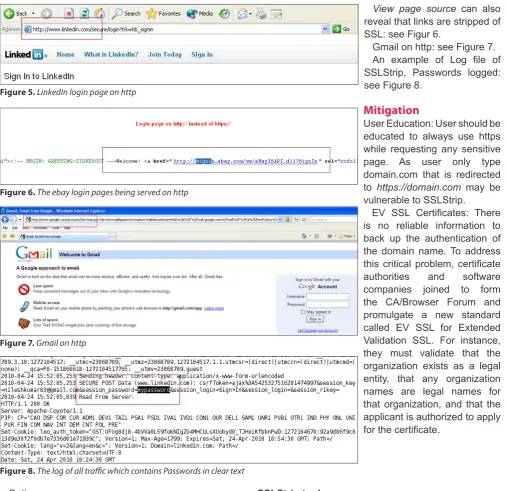
The following page appears on https:// in normal situation but here it is as http:// see Figure 5.
View page source can also reveal that links are stripped of SSL: see Figur 6.
Gmail on http: see Figure 7. An example of Log file of SSLStrip, Passwords logged: see Figure 8.
Mitigation
User Education: User should be educated to always use https while requesting any sensitive page. As user only type domain.com that is redirected to https://domain.com may be vulnerable to SSLStrip.
EV SSL Certificates: There is no reliable information to back up the authentication of the domain name. To address this critical problem, certificate authorities and software companies joined to form the CA/Browser Forum and promulgate a new standard called EV SSL for Extended Validation SSL. For instance, they must validate that the organization exists as a legal entity, that any organization names are legal names for that organization, and that the applicant is authorized to apply for the certificate.
SSLStrip tool:
http://www.thoughtcrime.org/software/sslstrip/
NULL Prefix attack on SSL Certificates:
http://www.thoughtcrime.org/papers/null-prefix-attacks.pdf
Black Hat presentation:
http://www.blackhat.com/presentations/bh-dc-09/Marlin spike/BlackHat-DC-09-Marlinspike-Defeating-SSL.pdf
NILESH KUMAR
Nilesh Kumar is working as an Engineer-Security Analyst with Honeywell Technology Solutions, Bangalore, India. He is primarily focused on Application Security ranging from Code Review to Black Box Testing. Apart from that he shows interest in Network Security and Reverse Engineering.
(Blog: nileshkumar83.blogspot.com)
Figure 5. LinkedIn login page on http
Figure 6. The ebay login pages being served on http
Figure 7. Gmail on http
6/2010
24
ATTACK
Taking Social Engineering to the Social Web
www.hakin9.org/en 25
Evolving Web of Trust
When an email says that it is from one of our friends, we rarely second guess the origin. That mentality has directly followed us from email to social networking, where the claimed identity of an individual is never challenged. Today with the prevalence of blogs, Twitter, Facebook and LinkedIn we are putting data about ourselves on the Internet for anyone to see.
While we are caught up in the self-publishing culture that is fueling Web 2.0 sites, we forget that each piece of information we put out to the world is a data point that can be used against us. In this article we will explore how an attacker can turn our Social Media against us manifesting in an Evil Twin that can be used against us, our family or employer.
An Evil Twin attack, as defined in Seven Deadliest Social Network Attacks by Carl Timms and James Perez, is when a rogue user poses as a legitimate user. This is not new, it has been happening for years on forums and chat rooms where users change their identity to appear as someone else.
Where an Evil Twin gains momentum is from Social Networking sites where the claimed identity of a user is assumed to be true. If I start a Facebook profile and claim that my name is William George, would people who did not know me in person disagree that my name is William George. On the internet a person can be anyone they want – that is part of the appeal
of the internet, it is a chance to reinvent yourself. An Evil Twin occurs when I create a Facebook page for William George with the intent to collect information about the real William George’s family, friends, coworkers, etc… Using an Evil Twin, you claim the identity of a legitimate person in an attempt to gather information, infiltrate a circle of trust (the friends of a specific person), spread malware (via Facebook Applications) or whatever other motivation you can imagine.
Does this sound like Social Engineering to you? It is! An Evil Twin is a tool for Social Engineering. The definition of Social Engineering according to Kevin Mitnick’s Art of Deception :
Social Engineering: using influence and persuasion to deceive people by convincing them that the social engineer is someone he is not or by manipulation. As a result, the social engineer is able to take advantage of people to obtain information with or without the use of technology.
The description of an Evil Twin falls directly into this definition. The Evil Twin is a hybrid of using technology to pose as someone else while also collecting information about the target to facilitate the Evil Twin’s believability.
Creating an Evil Twin is the means to an end, whether that end is spreading malware, discovering information or defamation of character, the Evil Twin is an enabling tool for a Social Engineer.
Birth of an Evil Twin
I’d hate to wake up some morning and find out that you
weren’t you. this quote from the 1956 movie Invasion of the
Body Snatchers has more relevance today than ever.
What you will learn…
• De�nition of an Evil Twin
• Using an Evil Twin for Social Engineering • What an Evil Twin can do
What you should know…
6/2010
24
ATTACK
Taking Social Engineering to the Social Web
www.hakin9.org/en 25
Step 2: Determine the Target
The first thing to do in an Evil Twin attack is to determine the target. Who are you attacking for the end game? The target could be an individual or an organization/ company. If the target is an organization, then you will need to select a person to attack the organization through.
Ask the following questions about your target to assess it’s quality:
• Does your target have some existing Social Media: Try to pick a target with some information already out on the internet. This will make starting your Evil Twin much easier.
• Does your target lack a Social Networking presence: It is ideal for a target to not have a Social Networking site but if they do, simply select a different Social Network and invite the target’s friends. It is not uncommon for people to have multiple Social Networks or profiles on a single network. You can also go with the My other account go hacked method where you siphon connections to a new account.
• Could your target achieve your goal: Make sure the target you choose would be able to achieve your goal. If your goal was physical access codes to an office building in Baltimore, do not select a target in London that probably does not have the Baltimore access codes. Although, the door code might not be a secret within the company, best to focus your efforts on targets that are most likely to be able to obtain the information you seek.
In my Evil Twin attack, GroundTrans Corp is the target and my goal is to get access credentials to steal money from the financial system. Since my target is a company, I need to determine who I am going to impersonate. After reviewing GroundTrans’ website and examining the corporate bios, I cross reference executive bios against LinkedIn to see who has a LinkedIn account. From the group that had LinkedIn accounts, I then looked to see who had their LinkedIn status updates set from Twitter. That narrowed down my selection to two executives of which I chose the CIO, Steve Partmen. Now I had the target to impersonate and knew three places I could pull from for my Evil Twin (the Executive Bio page of GroundTrans’ website, LinkedIn and Twitter).
Step 3:
Collect information about the Legitimate User
After you have a target, collect all the information that you can on him/her. What information is important Social Networking sites are the engine that runs
an Evil Twin with Social Media sites being the fuel. Just to be clear on definitions, a Social Networking site is one that allows users to connect to other users and share parts of their profile (examples: Facebook, LinkedIn, Bebo). A Social Media site is one that allows users to self publish content to the web (examples: Blog, YouTube, Twitter).
While there is a gray area between the two, social networking sites are about connecting while social media sites are about content for the purposes of this article. Many of these sites have privacy settings that will allow your content and information to stay hidden from anonymous or users outside of your circle of trust, but these controls are not always turned on by default. Social Media sites fuel the Evil Twin by telling the attacker all the information they need to know to create a believable persona for the target individual. A Twitter feed that frequently talks about golfing can tell an attacker that this individual is a golfer which can go on the Evil Twin profile as an Interest.
The Evil Twin attack examined
Recently I worked with a company we will call GroundTrans Corp (all names have been changed) to execute an Evil Twin attack and determine how far we could go using Social Networks and Social Media of employees to extract secure data about the company. Throughout the rest of the article we will be examining how I implemented the concepts presented. As a word of warning, being an Evil Twin violates the User Agreement of most Social Networks and Social Media sites. Being the Evil Twin of an unwitting person can land you in serious legal trouble. Do not try this at home without the express permission (written, documented and archived) of the person you are impersonating and the organization you are testing against.
Step 1:
Determine the goal
6/2010
26
ATTACK
Taking Social Engineering to the Social Web
www.hakin9.org/en 27
depends on the Social Network you will be building your Evil Twin in and who your target is. The best place to start is Google. Type in the person’s name and see what comes up. Make sure that you collect information about the correct person as there could be many Steve Partmen’s in the world. Using sites like Blogger, Twitter, LinkedIn, Facebook, etc.. can yield a lot of information. Twitter for example, is used to do updates about what the person is doing or thinking about. You can discover a lot of information by looking at Twitter posts.
The key for collecting data is in the aggregation of that data, not the individual data points. For example, users of Twitter treat each post as a separate entity. In their mind, one post is one piece of information. When you look at all posts and derive information based on not only the total of the user’s Twitter posts but keeping those posts in mind as you explore their other Social Media such as their blog or YouTube postings. If a Twitter user talks about going to play golf often in their posts and you find helpful golf swing hints as a reoccurring section of their blog, you can determine that this person really likes golf and it is more than just a simple hobby for them.
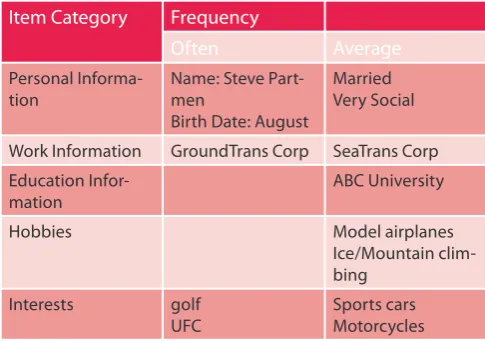
To keep track of all data I find about a user, I place it in matrix represented by Table 1.
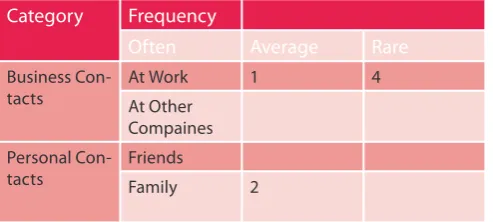
This matrix allows you to place items into categories and then specify the frequency of the item. As you discover an item, you place it in the proper row and analyze how often it appears to determine whether it is Often, Average or Rare. Notice golf is placed as an Interest that appears Often because it is throughout the Twitter posts and appears repeatedly. Rare pieces of information are the most valuable because they represent things that few people know about the individual. These are the data points that will make your Evil Twin the most believable.
In our GroundTrans Corp attack, where the person I was impersonating was Steve Partmen, I analyzed his executive bio on the GroundTrans site. It said that
he use to work for SeaTrans prior to GroundTrans but this did not appear in his LinkedIn profile so I labeled it as Work Informati