Software Distribution Malware Infection Vector
Felix Gr¨obert, Ahmad-Reza Sadeghi, Marcel Winandy
Horst G¨ortz Institute for IT Security
Ruhr-Universit¨at Bochum
Abstract
Software distribution and usage over the Internet has be-come an integral part of our daily life. On the one hand this is an efficient way to make software widely avail-able to users, particularly for the open source and free software. On the other hand it bears the risk of infect-ing computer platforms by malicious software since to-day many software applications are downloaded and in-stalled without appropriate security measures. This sit-uation can obviously be exploited by cyber criminals, and also by Governments intending to deploy spyware against suspects.
In this paper we present an efficient mechanism as well as the corresponding reference implementation for on-the-fly infecting of executable code with malicious soft-ware. Our algorithm deploys virus infection routines and network redirection attacks, without requiring to modify the application itself. This allows to even infect executa-bles with a embedded signature when the signature is not automatically verified before execution. We briefly dis-cuss also countermeasures such as secure channels, code authentication as well as trusted virtualization that en-ables the isolation of untrusted downloads from other ap-plication running in trusted domains or compartments.
Keywords: Malicious code, infection, virtualization,
Trusted Computing
1
Introduction
Today, software applications (tools, plug-in, etc.) are in-creasingly downloaded over the Internet making this me-dia an effective means for software distribution. How-ever, software distribution in an open and complex sys-tem such as Internet is also exposed to threats like mali-cious software that exploits the vulnerabilities of today’s commodity computing platforms (in particular common operating systems) to gain control over the victim’s com-puting platform or spy on it. The financial losses caused by malicious software are enormous and malware is one of the most severe threats to information society. Hence, potentially every single download could have been in-fected during the transmission under certain circum-stances. Particularly, for the free and open source soft-ware it is not common practice to apply corresponding security measures to downloads before executing them. Prominent examples are the browser Firefox and the
me-dia player VLC1.Typical protection mechanisms such as integrity verification and code signing are not applied to the major part of open source application software. In addition new malicious software might not be detected by common anti-malware tools. Moreover, the required organizational and technical infrastructure (e.g., for trust management) either does not exist or seems to be not easy to establish. To infect downloads only an interme-diate network node in the chain of nodes from the client to the download server has to act maliciously on the traf-fic. The network link can be compromised in different ways, e.g., by malicious administrators, a compromised router, or network redirection attacks. This threat gets a new flavor and even more challenging to face when Gov-ernments attempt to exploit malicious code2. Infection techniques similar to those presented in this paper can be considered for this purpose.
In this paper we present an efficient mechanism as well as a reference implementation for on-the-fly infecting of executable code with malicious software. Our algorithm exploits virus infection routines and network redirection attacks, which will be elaborated in Section 2. Our at-tack vector simply adds a malicious payload (malware) to the original application during transmission. There are various techniques to infect a binary executable ap-plication with malware (see, e.g., [24]). Most of these techniques typically modify the original application to include a small malicious code. In contrast we use a binder (also called companion or joiner) to execute the malicious code along the original application. The infec-tion method of the binder just concatenates the binder ap-plication, the malware and the original application. Since original application is not modified one has the advan-tage that the malicious code can be of a larger size, and thus provide more functionality. Then, upon starting the infected application the binder is started. It parses its own file for additional embedded executable files, re-constructs and executes them, optionally invisible for the user. Another advantage of the binder technique is that the adversary does not need to buffer the file because the
1Firefox has 277.000 downloads per day since February 2004
(http://feeds.spreadfirefox.com/downloads/ firefox.xml), and VLC has an average of 100.000
down-loads since February 2005 (http://www.videolan.org/
stats/downloads.php)
2The recent public debate in Germany on the so-called ‘federal
adversary just prepends the original file to the binder and the malware. Other infection techniques modify the orig-inal file and thus require seeking forward and backward inside the target file. This yields a buffering delay com-pared to the binder technique. Such a delay might rise suspicion by the victim or may render the attack useless if the victim manually executes additional file checks, i.e. hash comparison with a authentic reference hash. Under certain circumstances this allows for even infect-ing signed and encrypted executables. If the underlyinfect-ing computer platform does not automatically verify the sig-nature of an executable file before launching it and if it is left to the user to verify it manually. In this case the attack would be successful, since an average user usually does not check whether a binary executable is signed or not.
To mount the attack, the adversary has to infect the binary executable in transmission and at the same time maintain the correctness of the network transmission protocol used for the download, e.g., HTTP. Otherwise the protocol parser of the receiving network node will not accept the infected application as a result of the mal-formed protocol.
Outline: The remainder of this paper is organized as follows: In Section 2 we consider relevant related work. Section 3 presents the adversary and threat model, while Section 4 provides some possible countermeasures against the threats. Section 5 describes our reference im-plementation of the attack and Section 6 concludes with a discussion and outlook.
2
Related Work
There is a large body of literature on network flow redi-rection attacks on the multiple ISO/OSI layer 2 and 3 protocols. For the most commonly used protocols one can refer to802.11Wireless LAN takeovers [34],ARP
injection to reroute traffic [33], DNS poisoning to in-sert fake IP addresses for domain names into name-servers [30], ICMP redirection messages [15], BGPv4
route manipulation attacks [17], IPv6 traffic rerouting attacks [10, 32].
Virus infection routines can be found in many practical tutorials and in textbooks. In [16] a good overview of the
win32 PE3 file format is given and different infection methods are outlined. Additional infection methods are presented in [24]. A more formal view can be found, e.g., in [31].
In [22] the authors demonstrate the man-in-the-middle toolkitettercapand mention the possibility of infect-ing binary executable applications on-the-fly durinfect-ing the
3Windows 32 Bit Portable Executable
download phase. In [27] the author states that a software update server is a significant target, but does not combine this threat with on-the-fly infection routines and network flow redirection attacks.
In [8, 9] security flaws of router firmwares are pre-sented and the author exploits the flaws to modify the router and add an on-the-fly infection routine for
win32 PEfiles downloaded throughHTTP. Their infec-tion method differs from our approach in the follow-ing aspects: firstly, it is limited to add a downloader to the binary file by the modification of the DOS stub4 andPEheader. The downloader then downloads a spe-cific malware and executes it alongside the original ap-plication. We present an on-the-fly infection method, the binder technique, which already binds the malware to the original application and thus overleaps the pro-cess of downloading the malware in a separate malicious connection. This technique is more flexible for the ad-versary. The second difference to our approach is that since our method does not require to modify the origi-nal target application file one can attach malware even to an executable with a embedded signature and still succeed to execute the malware under certain circum-stances. Thirdly, while we underline the usage of net-work flow redirection attacks to gain control over the download link, their approach is limited to the modifi-cation of router firmware.
3
Adversary and Threat Model
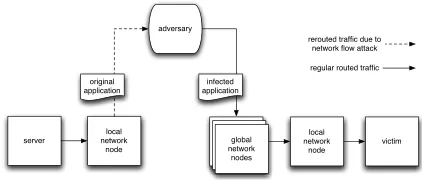
The goal of our attack is to execute malicious code on a target network node. When the target is downloading a binary executable application, our method infects the application during transmission at which we assume that one network node is under control of an adversary (Fig-ure 1). The infection routine adds malicious code (mal-ware) to the binary executable application. Thus, the ma-licious code will get executed by executing the infected application. We do not discuss detectability or features of malware and malware design, and focus on the infec-tion vector, which can be used in different ways. On the one hand, the adversary can mass exploit multiple vic-tims which may request binary executable applications. On the other hand, the adversary can select single victims and infect few applications. A mass exploitation of the attack vector might be suitable to build up a short term botnet. A selection of a few victims is more suitable to lower the chance that the malware “signature” is detected and included in antivirus tools. For launching the attack we make the following assumptions:
Modification of target traffic. In order to infect a
bi-4A small DOS program to warn the user that the application only
server victim adversary
local network
node
local network
node global
network nodes original
application
infected application
global network
nodes global network
nodes
rerouted traffic due to network flow attack regular routed traffic
Figure 1: Malicious network node is inserted into the network link using a network flow redirection attack.
nary executable, the adversary has to have the ability to modify network traffic that contains the application. This implies that the adversary is in control of at least one net-work node which is part of the netnet-work link over which the victim is downloading the file. For this, the adversary has various options of choosing between classic attacks to gain administrative privileges on a network node (e.g., buffer overflows) and network flow redirection attacks to include an additional malicious network node within the corresponding network link (Figure 1). A network flow redirection attack, cf. [10, 15, 17, 29, 30, 32, 34, 33], can redirect the traffic to a host over which the adversary has full control. The third possibility concerns a malicious node that may be under the control of a system adminis-trator or that the adminisadminis-trator was tricked to include the node by social engineering. The fourth option can be the law enforcement pursuing a suspected criminal. The law enforcement is able to force an Internet service provider to deploy a “malicious” node inside the network link of certain users.
Absence of protocol inherent integrity checks. The
protocols containing the target traffic running between the user and the download server do not enforce encryp-tion or integrity verificaencryp-tion of the traffic. The protocol may calculate checksums and add them to protocol pack-ets, but only under the condition that the adversary, i.e., the malicious node, is able to recalculate and adjust the checksums.
Absence of local file integrity verification. The
in-tegrity of the file containing the application is not tographically checked after the transmission using cryp-tographic keys distributed a priori, e.g., a comparison of hash of the downloaded file with a trusted database of hashed files obtained over a secure channel. Such checks must not occur manually by the user, by the software dis-tribution system or by the operating system. Due to the nature of the binder (see Section 3.1) the original appli-cation may embed signatures and decryption algorithms: the binder reconstructs the original application file and creates a process from the original file. Thus the applica-tion will then be in the same state as if the user had ran it
manually.
Detectability. Potential antivirus scanners and host or
network intrusion detection systems do not detect the binder or the malware. This assumption is reasonable under the condition that the malware deployed by our at-tack vector is used in a small scale. Mass exploiting a large network with one single malware would lead to de-tection after some time.
Note that, although the assumptions on the absence of protocol or local integrity verification seem to be very restrictive, this lack of security reflects common practice in commodity operating systems for PC platforms and especially in the context of the distribution of free and open software applications.
3.1
High-Level Construction
The attack vector consist of a set of actions which mod-ify the original application in transmission to deliver a payload functioning as a malware application. There are multiple techniques to infect a binary executable appli-cation [24] with malware. Depending on the operating-system-specific binary executable file loader interprets the data structures in the binary file. A binary executable file consists of several sections and a header [16], thus the infection routine first has to determine the ideal po-sition for the malware code inside the original applica-tion. An infection routine can add new sections to the application, enlarge sections and append or prepend the malicious code, or find several cavity spaces to spread the malicious code inside the application. At some stage the code has to be executed. Therefor the pointer to the entry code instruction and pointers to other code sections have to be modified. Other techniques use hijacking API function pointers or insert jump instructions which jump to the malicious code in specific places. All of the above techniques have in common that the original application file is modified.
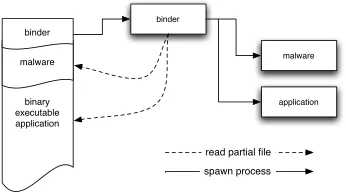
In contrast our approach uses a binder to execute the malicious code along the original application, as illus-trated in Figure 2. The binder extracts and executes mul-tiple binary executable files from the infected application file. Optionally, the binder decrypts itself and attached applications, or it may also execute certain malware ap-plications in an invisible way for the user. It has the ad-vantage that the malicious code can be a malware of large size, and thus have more functionality while the original application file structure is not modified and rebuilt be-fore launching.
ap-binary executable application malware
binder
binder
malware
application
read partial file
spawn process
Figure 2: Binder spawning child processes
plication file is in a integral state, i.e., the same state as if it has not been modified, and the application has to specifically search for the binder to determine if a ma-licious payload was executed alongside the application file. Moreover, there are buffering advantages compared to other infection techniques since they add new sections to a file and modify headers based on those new sections. This requires seeking forward and backward inside the target file, which yields a buffering and computational delay compared to the binder technique. Such a delay might rise suspicion by the victim and may yield the at-tack unsuccessful if the victim would be able to compare a hash of the file with a trusted reference value in a secure manner, and chooses not to execute the file. The binder just concatenates the binder application, the malware and the original application.
The attack has a simple structure shown in the follow-ing algorithms. The contents of the protocol, which is used to transfer the binary executable, are combined to a data stream input to the algorithm 1fixprotocol(). The data stream is read block-wise and the block size and the corresponding logic depends on the underlying protocol. The incoming protocol stream is adjusted, also depending on the protocol, e.g., the checksum or length fields are modified to contain the infected binary exe-cutable and at the same time maintain protocol valid-ity. The protocol fields have to be adjusted because a malformed protocol packet would not be accepted by the victim, who would discard the packet, rendering the at-tack useless. When algorithm 1 fixprotocol() has adjusted the protocol fields and a binary executable is detected on the incoming protocol streaminfect()is called on.
First, infect() validates whether (A, B, M) are known binary executables of the same type and target operating system:infect()buffers 512 bytes from the streamAand the filesB andM and compares the data structure to known data structures of binary executables. This ensures that the malware and the binder can be ex-ecuted and are functional on the victim’s operating sys-tem. If there a mismatch is found, infect()discards
Algorithm 1Protocol Handling Algorithm: fixprotocol() Require: Incoming and outgoing protocol data streamPand
Pinf ected, binderB, malwareM
Ensure: P contains a protocol without cryptographic in-tegrity checks, authentication or confidentiality
whilePblock←read incoming logic block fromPdo
ifPblock=protocol header then
Pblock−inf ected ←fix protocol headers, i.e., adjust length fields to include sizes ofBandM
end if
ifPblock=protocol checksum then
Pblock−inf ected←fix protocol checksum to includeB andM
end if
ifPblock=binary executable application then
Pblock−inf ected←infect(P, B, M)
end if
send Pblock−inf ected to outgoing protocol data stream
Pinf ected
end while
Algorithm 2Infect Binary Executable Application: infect() Require: original and infected binary executable application
data streamAandAinf, binderB, malwareM
Ensure: A,B,Mare binary executables of the same operat-ing system
Ainf ←BkM
whileAblock←read byte fromAdo
Ainf ←Ablock
end while
the application. If not,infect()concatenate the binder
B and the binary executable malwareM and prepends the result to the original applicationA. The result is de-noted byAinf, which is the output data stream and re-turns the bytes tofixprotocol()for further protocol handling.
4
Countermeasures
In this section we consider some countermeasures against infection attacks.
Network Integrity Assurance. A short-term
that the server certificate is invalid, i.e., unsigned by an certificate authority. But certain browsers contain client-side flaws which enable the spoofing of the integrity of aSSLcertificate [20]. If we consider VPN solutions, we have to keep in mind that a VPN only secures a subset of the whole network link, over which the binary executable application is transmitted. The other side of the network link remains insecure. An attacker, who has control over a local network node on the side of the server, or a global network node, would still be able to modify the traffic.
File Integrity Assurance. If the network protocol was
unable to detect the modification of the binary executable application file, software that is already installed has to detect the modification of the received file. In a binary signing and verification system, executable files are cryp-tographically signed and the signature is inserted as a specific data-structure inside the file itself. If the appli-cation is started the OS can verify the signature and op-tionally inform the user. We can deduce that the binder method also works in this case. When the infected ap-plication, e.g., the binder, is launched, it is started in a unsigned context. Although the unsigned context prior or after the launching of the application might raise sus-picion of the security-aware user, it is common that most applications are unsigned. Furthermore on Windows XP the user has to manually check the signature of the file, whereas Windows Vista checks the signature automati-cally before execution. The binder then extracts the orig-inal and signed application, and starts it. Upon start-ing the signed application, the binder has reconstructed the original state of the underlying executable file, and the OS loader will determine that the signature is valid. Hence, to avoid this situation the signature of the down-loaded file must be verified before launching the file, i.e. the binder.
There exist OS approaches that verify executable files before loading and running them. For instance, Trust-edBox [19] is a modified Linux kernel which prohibits the execution of modified program files. However, the verification is only performed in a special trusted state whereas the system has to be booted from a non-writable boot media which contains the reference values for in-tegrity check. Thus, approaches like this are not suit-able for downloadsuit-able applications where the reference values are not known a-priori. In [21] the kernel pro-hibits execution of modified programs. It identifies unau-thorized modifications based on verifying cryptographic signatures which are stored with each application file. However, this approach requires each application to be digitally signed and the secure distribution of signature verification keys. The problem of secure key distribution is out of the scope of this paper. A common misconcep-tion is that the trivial file check using the comparison of
hashes, shown on a HTTP website, does not verify the authenticity since the reference values would have to be obtained through a trusted channel.
Detection. There are various approaches towards
mal-ware detection [12], however, if one makes the assump-tion that the malware, which is delivered along the binder, is not detected, the only possibility for antivirus scanners to detect the attack is to detect the signature or the behavior of the binder (Section 5). This is along the lines of the typical arms-race in the virus vs. antivirus world today. Additionally, the binder can be rewritten and compiled in ways that a current signature could not detect it. Furthermore, the binder can use techniques like metamorphic5 code [23] to evade virus scanners. Also, the usage of another infection technique must be consid-ered [16].
Trusted virtualization. To consider the problem of
in-fection more fundamentally, a promising (and recently rediscovered) approach is towards secure and interopera-ble operating systems. Commodity operating systems do not provide the properties required to reduce the impact of malware due to lack of appropriate security function-ality on the one hand and due to their complexity on the other hand. Moreover, the compatibility to legacy sys-tems is an important requirement for any new system to be widely deployed6. In this context virtualization tech-nology provides an efficient means for isolating poten-tially critical applications from others while allowing the interoperability and re-use of existing operating systems and applications. Virtualization is an already known and probed technology and today it is supported by the new processor generation [11] and [6]. It is rediscovered re-cently, particularly in the context of Trusted Computing. The combination of virtualization and Trusted Comput-ing technologies provides a set of security features such as secure/verifiable boot, and isolation and controlled communication between virtual machines. Some exam-ples in this context are [28, 7, 25, 14, 13]. More con-cretely, [13] gives an implementation based on trusted computing functionalities according to specifications of the TCG (Trusted Computing Group) and a small se-curity kernel aiming at integrating and enhancing solu-tions based on identity providers (like password man-agers [7]), and also at providing protection against mal-ware and interface spoofing like picture-in-picture at-tacks7.
5Code that mutates itself while keeping its intended algorithm intact
6This aspect is a major reason why many secure operating systems
developed during the past 25 years have not been commercially suc-cessful.
Anonymizers. Anonymizers8 like Tor [4] can be de-ployed to support the mentioned means to hide identi-ties in case Governments deploy infection mechanisms to trace suspects. Note that the state can be considered as a very powerful entity with access rights to many re-sources. Typically, law enforcement targets a limited number of suspects, thus we can assume that law en-forcement has to identify the victim before the attack. However, this would be a hard task if the suspects use anonymizers.
5
Implementation
Our proof of concept implementation consists of two parts: cyanid andcalcium. Cyanid is a toolchain (based on [1, 5, 3]) to fetch, filter and modify HTTP
downloads, and calcium is a binder to infect win32 PE binary executables. The implementation allows for adding a chosen malware, e.g., a Trojan, to a binary executablewin32 application which is downloaded via
HTTPby the victim. The malware is executed in a hid-den form, using the Windows API, and in parallel to the original application. The target has to run Windows 98 or newer.
Proxy. Thecyanidproxy toolchain uses existing soft-ware to modifyHTTPbinary downloads. The toolchain consists of Netfilter [1], Transproxy [5] and a patched Privoxy [3]. The Privoxy patch consists of 27 lines of added and modified C code. In analogy to Section 3.1,cyanid implements the algorithmsinfect()and
fixprotocol().
Using Netfilter and Transproxy we are able to place an intercepting ISO/OSI layer 7 proxy between anyTCP
connection which is routed over a network node we con-trol. Netfilter is a framework in the Linux 2.4.x and 2.6.x kernels to support packet filtering, network address and port translation and other packet mangling. We use the NetfilterREDIRECTtarget to redirect specificTCP con-nections, i.e., with destination port 80, to our localhost. On localhost the Transproxy software listens for incom-ing connections and forwards the connection includincom-ing the original destination host to the layer 7 proxy, Privoxy. Privoxy is aHTTP proxy designed to modify traffic. It enhances privacy on the client-side, e.g., by filtering
HTTPcookies, and modifies websites on the server-side, e.g., by filtering advertisements. Thus, Privoxy can be used to filter and rewriteHTTP requests and responses. In order to modify binary data transmitted overHTTP,
8Tools like Tor provide a tunnel, which bypasses local and
state-specific network nodes and provides anonymity for the client half of the network link, and there is no other (outband) information about him available.
we had to patch Privoxy: we enabled a filter rule no-tation to specify binary data (\xNN) and modified the filter rule structure to include NULL bytes in the filter regular expressions. Additionally, we had to enlarge buffer sizes to handle binary data of several megabytes. Then, in the privoxy configuration a filter rule of the type
s-ˆMZ-\x4d\x5a\x00... MZ- is specified. The expressions-ˆMZ-matches awin32executable file by searching for its characteristic byte sequenceMZ. These bytes are replaced by the byte sequence of the binder concatenated with the malware. The last two bytes in the filter rule (MZ) reconstruct the substituted executable sig-nature. This rule results in the following modified binary file: ( (byte sequence of (binderkmalware) )k(original binary file) ). Because the victim uses a unauthenticated protocol, e.g. HTTP, we are able to modify the contents of the protocol.
Binder. Thecalciumbinder implementation parses it-self for additional executable binaries, extracts and exe-cutes the binaries (see Figure 2). It consists of 134 lines of C code and generates a binary of length 18665 bytes, although we expect that the size can be reduced through compiler optimizations. The binder can execute multiple malwares and hides their displayed windows. It’s default configuration parses it’s own executable file for 256 byte long characteristic patterns, extracts the files between the patterns and executes the files. The malware has to be placed between patterns at an odd position proceeding the binder. The visible-started software is also placed between the patterns at an even position. If the con-tent between two patterns is a malware, the binder hides its execution through standard Windows API calls. This may result in the following concatenation of binaries and patterns: (binderkpatternkhidden malware k patternkoriginal softwarek patternk hidden malware). Because the operating system does not verify the structure of the infected executable file, the binder is able to execute the malware in parallel to the original application.
6
Discussion
The currentcyanidtoolchain buffers the complete file, modifies it and then streams it to the users. Depending on the bandwidth and file size a delay is noticeable. Be-cause the calciuminfection routine only prepends the binder to the original file, a better proxy implementation would reduce the lag, which is currently generated by the buffering of the original file inside Privoxy.
The infection implementation —calcium— uses the binder technique to prepend malware ahead of the bi-nary executable file. Other methods [16][24] include header infection withAddressOfEntryPoint modifi-cation, code section prepending, and cavity code, which have all in common that they modify the original file. Although the detection of the binder is very easy for an antivirus engine based on its binary sequence signature, methods exist to evade the antivirus detection, e.g., by encrypting the binder and thus the signature of its code.
A drawback of the current implementation is that the application icon, which is showed by the file browser, is changed to the application icon of the binder. This might raise suspicion by the user. However, the binder may modify its icon on each infection and mimic the application icon by simply copying the image of the icon in the original application file.
In our future work the cyanid implementation will get more targets like Mac OS Xdmgcontainers and tar-balls of source code. The win32 PEmalware routine and the infection function might be enhanced to leave the icon and the file size unmodified.
References
[1] Linux Netfilter.http://www.netfilter.org.
[2] OpenVPN.http://www.openvpn.org.
[3] Privoxy.http://www.privoxy.org.
[4] Tor.http://tor.eff.org.
[5] Transproxy.http://transproxy.sf.net.
[6] Advanced Micro Devices, Inc. AMD64 Virtualization
Code-named “Pacifica” Technology, 33047-rev. 3.01 edition, May.
[7] A. Alkassar, M. Scheibel, C. St¨uble, A.-R. Sadeghi, and
M. Winandy. Security architecture for device encryption and
VPN. In Proceedings of Information Security Solutions Europe
(ISSE 2006), pages 54–63. Vieweg-Verlag, 2006.
[8] Barnaby. Exploiting Embedded Systems. In Blackhat
Amster-dam, 2006.
[9] Barnaby. Exploiting Embedded Systems The Sequel. In
CanSecWest, 2007.
[10] Biondi and Ebalard. Fun with IPv6 routing headers. In
CanSecWest, 2007.
[11] I. Corporation. LaGrande technology architectural overview.
Technical Report 252491-001, Intel Corporation, Sept. 2003.
[12] W. Cui, R. H. Kat, and W. tian Tan. Design and implementation of an extrusion-based break-in detector for personal computers. In Proceedings of the ACSAC, 2005.
[13] S. Gajek, A.-R. Sadeghi, C. St¨uble, and M. Winandy. Compart-mented Security for Browsers – Or How to Thwart a Phisher with Trusted Computing. In ARES 2007: Proceedings of the Second
International Conference on Availability, Reliability and Secu-rity. IEEE, 2007.
[14] T. Garfinkel, B. Pfaff, J. Chow, M. Rosenblum, and D. Boneh. Terra: a virtual machine-based platform for trusted computing. In
Proceedings of the 19th ACM Symposium on Operating Systems Principles (SOSP’03), pages 193–206. ACM, 2003.
[15] Gill. ICMP redirects are bad. In CYMRU, 2002.
[16] Goppit. Portable Executable File Format - A Reverse Engineer View. Code Breakers Journal, 2(2), 2005.
[17] Greene. BGPv4 Security Risk Assessment, 2002. http://
www.cymru.com/Documents/barry2.pdf. [18] IETF. RFC 2818 HTTP Over TLS, 2000.
[19] P. Iglio and F. U. Bordoni. Trustedbox: a kernel-level integrity checker. In Proceedings of the 15th Annual Computer Security
Applications Conference (ACSAC ’99). IEEE Computer Society,
1999.
[20] ISS X-Force. Mozilla SSL certificate spoofing (http://
xforce.iss.net/xforce/xfdb/16796), Multiple
ven-dor SSL intermediate CA-signed certificate spoofing (http:
//xforce.iss.net/xforce/xfdb/9776).
[21] G. Mohay and J. Zellers. Kernel and shell based application in-tegrity assurance. In Proceedings of the 13th Annual Computer
Security Applications Conference (ACSAC ’97). IEEE Computer
Society, 1997.
[22] Ornaghi and Valleri. Man in the middle attacks demos. In
Black-hat US, 2003.
[23] Pearce. Viral Polymorphism. 2003.
[24] Rozinov. PE File Infection Techniques, 2005.
[25] R. Sailer, E. Valdez, T. Jaeger, R. Perez, L. van Doorn, J. L. Grif-fin, and S. Berger. sHype: Secure hypervisor approach to trusted virtualized systems. Technical Report RC23511, IBM Research Division, Feb. 2005.
[26] A. Singh. Understanding Apple’s Binary Protection in Mac
OS X, 2006. http://osxbook.com/book/bonus/
chapter7/binaryprotection.
[27] Skoudis. Don’t discount software distribution sites as attack
vec-tors, 2005.http://SearchSecurity.com.
[28] A. Spalka, A. B. Cremers, and H. Langweg. Protecting the cre-ation of digital signatures with trusted computing platform tech-nology against attacks by trojan horse programs. In Sec ’01:
Pro-ceedings of the 16th International Conference on Information Se-curity: Trusted Information, pages 403–419. Kluwer, 2001.
[29] Spangler. Packet Sniffing on Layer 2 Switched Local Area Net-works. In Packetwatch Research, 2003.
[30] Steinhof, Wiesmaier, and Araujo. The State of the Art in DNS Spoofing. In ACNS, 2006.
[31] H. Thimbleby, S. Anderson, and P. Cairns. A framework for mod-elling Trojans and computer virus infection. Computer Journal, 41(7):444–458, 1999.
[32] van Hauser. Attacking the IPv6 Protocol Suite. In Proceedings
of the 22C3, 2005.http://www.thc.org/thc-ipv6/. [33] Whalen. An Introduction to ARP Spoofing. 2600 Magazine, Fall
2001.