Algebra/Geometry Institute Summer 2009
Faculty Name: Karen HarmonSchool: Presbyterian Day School Cleveland, MS
Grade Level: Fourth Grade
1
Teaching objective(s)
• The student will recognize, explore, model, and continue various patterns. • The student will state a rule to explain a number pattern.
• The student will find the intersection of two patterns.
2
Instructional Activities
Patterns are a repeated design or recurring sequence. They surround us every day. The notes of music are organized into measures; the words into verses and the chorus. Poems are studied by looking for patterns of rhyme, rhythm, and repetition. Seasons change in a
predictable manner. Designs are repeated in quilt blocks and tile floors. (Show quilt.)
The traffic light at an intersection moves through the pattern red, red and yellow, green, green and yellow, red. Knowing what those colors mean and what comes next is very important. Patterns help us understand the world and predict what might happen next. Today we are going to discover the patterns on a hundred chart that occur when we skip count. (Pass out 100 charts and tubs of 1 inch squares in several colors. Attachment 1 will need to be enlarged before copying to the appropriate size according to the size of your counters.)
Activity I
Today you are going to create or extend patterns, describe the rules used to create them, and predict what happens when you extend them. We will start with a hundred chart. I want you to skip count by three and cover each number with a square, using the same color each time. Watch me for an example. Place a transparency of a 100 chart on the overhead (Attachment One copied on a transparency) Count to 3 and cover the space with a square. Repeat with the numbers 6 and 9.
Leave these numbers covered. This time, count by fives and cover each space with a different color tile, like this. (Demonstrate on the overhead 5, 10, and 15.)
When you land on a number already covered, like 15, just stack the new tile on top like a double-decker burger and keep going. Do you have any questions? You may begin. (Observe group work and redirect as appropriate.)
If you covered the fives correctly you should have found a new pattern. Did you? Describe what it looks like. (two vertical columns at the 5 and 10 positions) (Color the transparency with a different color marker. Common multiple squares should be striped with the second color.) What rules would describe this pattern? (+5, skip 4, 5 x 1, 2, 3, etc.) Let’s say the numbers you covered this time. (5, 10, 15, 20, etc.) What did we just say? (multiples of 5) (List and label the multiples of 5 on the white board.)
What do you think the numbers with 2 tiles represent? These numbers are in both groups aren’t they? (Re-write as a Venn diagram and label common multiples of 3 and 5). Each of these double-decker numbers has 3 and 5 as factors. You have just discovered the common multiples of 3 and 5 by applying your understanding of two patterns. Can you think of any way this information will be useful for you? (fractions — common denominators and others.)
Activity II
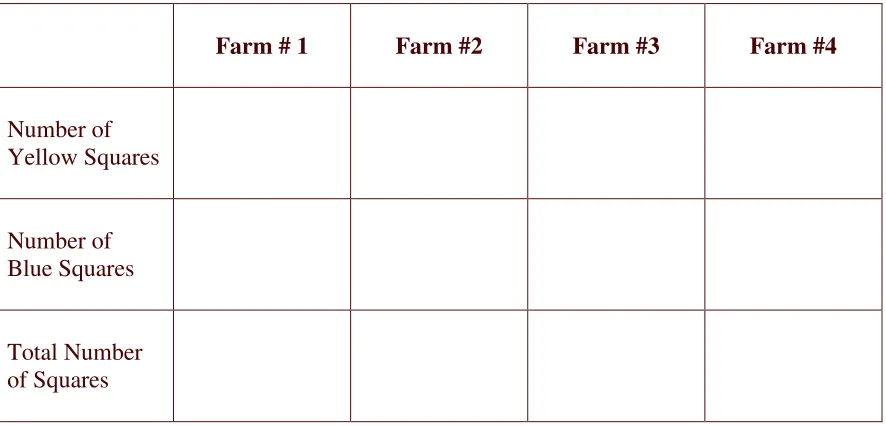
Now we are going on to another application of patterns – a growing pattern. Clear off your table except for your bucket of colored squares. You will be working as a group. Two people will be the builders, one will be the sketcher, and one will be the recorder. You will change roles each time we have a new farm to study. (Pass out centimeter graph paper, colored pencils, and a table – Attachment 2)
Builders, put one yellow square down and surround it by 8 blue squares. The entire farm is square-shaped. The yellow represents Farm #1’s corn field and the blue his catfish ponds. Recorder, fill in the table under Farm #1 with the number of yellow squares, blue squares, and the total number of squares. Sketcher, draw and color the design of the farm on the graph paper. When you have completed your jobs, check to make sure everyone in the groups agrees with what you did, pass the table and the graph paper to the right to switch roles. (Monitor progress of the groups, clarifying and redirecting where necessary)
Farm #2 has four corn fields arranged in a square and surrounded with 12 blue catfish ponds. Builders, make this arrangement on your table next to Farm #1. Recorders, fill in the table under Farm #2 with the number of yellow and blue squares used plus the total number of squares. Sketch and color the arrangement on your graph paper. Check with your group for their agreement, then pass papers to the right to change roles. (Monitor progress of the groups, clarifying and redirecting where necessary)
Look at the three farms on the table and your table information. How are they changing each time? (getting larger, corn fields are the next larger square array) I told you we would be working with a growing pattern. Can you develop a rule for what you are seeing? If I say Farm #4 follows this pattern, how many corn fields and catfish ponds will it have? How are they arranged? Make the farm, fill in the table, sketch and color the design. (Monitor progress of the groups, clarifying and redirecting where necessary).
Follow up with discussion of rules they devised. Some students may see the growth of the square in the center; some may focus on the growth of the perimeter height and width; and some may see the number of the farm (term) has a relationship with the size of the corn fields. Explore all ideas expressed and correct any misconceptions. Let children understand that a pattern may be described in more than one way.
3.
Materials and Resources
• Attachment 1 - Hundreds chart transparency and paper copies • Attachment 2 – Table for Farm activity
• Attachment 3 – Assessment • Quilt
• Overhead projector • White board
• Clear plastic discs in two colors for overhead
• Tubs of one inch squares in several colors including yellow and blue • Centimeter graph paper
• Colored pencils
• http://www.teachers.ash.org.au/jeather/maths/dictionary.html (definition of patterns) • http://www.illuminations.nctm.org/ I modified a lesson idea found under “Illuminations”
on the National Council of Teachers of Mathematics website using an interactive 100 chart and calculator entitled “Patterns on Charts.”
• Cuevas, Gilbert J., & Yeatts, Karol (2001) Navigating through Algebra in Grades 3-5. Reston, Va.: The National Council of Teachers of Mathematics, Inc. I modified a lesson entitled “Tiling a Patio” (pp 18-20).
4
Assessment
• During the presentations, the teacher will monitor student understanding by their responses to her questions.
• During the activities, the teacher will walk around the room observing the work done in each group, checking for comprehension and correct application of the concept.
Attachment 1
Attachment 2 Page 1 of 2
Group Members: ______________________________________________________ ______________________________________________________
Table for Farm Activity
Directions: As you build each farm, count the squares you use and fill in the table.
Farm # 1 Farm #2 Farm #3 Farm #4
Number of Yellow Squares
Number of Blue Squares
Total Number of Squares
Use words to describe how this pattern grows. Consider the size and shape. What changes? What stays the same?
Attachment 2 Page 2 of 2
Key Ideas
Table for Farm Activity
Directions: As you build each farm, count the squares you use and fill in the table.
Farm # 1 Farm #2 Farm #3 Farm #4
Number of
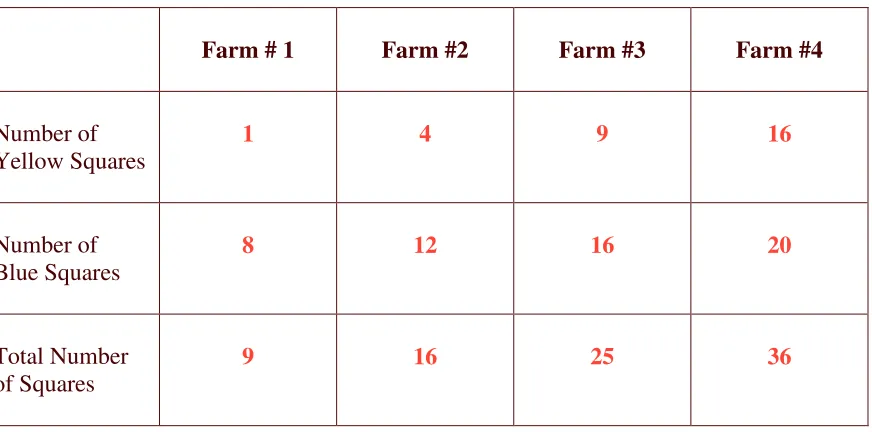
Yellow Squares 1 4 9 16
Number of
Blue Squares 8 12 16 20
Total Number
of Squares 9 16 25 36
Use words to describe how this pattern grows. Consider the size and shape. What changes? What stays the same?
• The corn fields (yellow tiles) are always in a square shape.
• The yellow tiles have the value of the number of the term squared.
• The number of the blue tiles (catfish farm) will be two more than the yellow tiles above and below the corn field, and equal to the yellow tiles on each side. (This relationship may be seen by some children at the two sides being taller by two each time with the top and bottom blue rows being equal to the yellow rows.)
• The total number of squares increases each term to the square of the next sequential counting number.
If there were 25 corn fields, how many catfish ponds would there be?
• Since the corn fields would be arranged in a 5 x 5 square, the top and bottom row of blue tiles would be 7 and the side rows would each be 5.
• (2 x 7 ) + (2 x 5) = 14 + 10 = 24
Attachment 3 Page 1 of 3
Name: __________________________________ Directions:
1. Pick a colored pencil and shade the pattern +4. Pick another color and do the same for pattern +9. If you use the same square for both patterns, draw diagonals with the second color.
2. List the common multiples of 4 and 9. ________________________________________
3. What is another rule that would produce the same results that you got for +4.?
Attachment 3 Page 2 of 3
4. Look at the towers of blocks. Notice how they change and fill in the chart. Tower #1 Tower #2 Tower #3
Tower Tower #1 Tower #2 Tower #3 Tower #4 Number of Blocks Added
Total Number of Blocks
5. Can you describe the pattern using words? What is changing? What is staying the same?
6. Can you think of a rule to describe the growing pattern?
7. Draw the next tower in the pattern.
Attachment 3 Page 3 of 3
Key
1. Evaluate patterns for correctness. The multiples of 4 are: 4, 8, 12, 16, 20, 24, 28, 32, 36, 40, 44, 48, 52, 56, 60, 64, 68, 72, 76, 80, 84, 88, 92, 96, and 100. The multiples of 9 are: 9, 18, 27, 36, 45, 54, 63, 72, 81, 90, and 99.
2. The common multiples of 4 and 9 are: 36, and 72.
3. The patterns are “skip three” or “multiples of 4” (4x1, 4x2, etc.)
Tower Tower #1 Tower #2 Tower #3 Tower #4 Number of Blocks Added 1 2 3 4
Total Number of Blocks 1 3 6 10 4. The pattern is to add another row each time and the number of blocks in the new row
is the same as the number of the term (tower number). The height (number of rows high) also equals the term.
5. To the previous total of blocks add the number of blocks equivalent to the term.
6.