New host resistances to
Pseudocercosporella capsellae
and
implications for white leaf spot management in
Brassicaceae
crops
Niroshini Gunasinghea, Ming Pei Youa, Xi Xiang Lic, Surinder S. Bangad, Shashi K.
Bangad and Martin J. Barbettia,b,*
a School of Plant Biology, Faculty of Science, The University of Western Australia, 35
Stirling Highway, Crawley, WA, 6009, Australia
b The UWA Institute of Agriculture, Faculty of Science, The University of Western
Australia, 35 Stirling Highway, Crawley, WA, 6009, Australia
c Department of Germplasm Resources, Institute of Vegetable and Flowers, Chinese
Academy of Agricultural Sciences, Beijing, People’s Republic of China
d Department of Plant Breeding and Genetics, Punjab Agricultural University, Ludhiana,
India;
*Corresponding author at: School of Plant Biology, Faculty of Science, The University of
Western Australia, 35 Stirling Highway, Crawley, WA, 6009, Australia. Tel.: +61 8
64883924.
E-mail address: [email protected] (M.J. Barbetti)
ABSTRACT
Effective host resistance is the most cost-effective long term prospect for successful
management of white leaf spot disease (Pseudocercosporella capsellae) in Brassicaceae. In two separate field trials, 168 genotypes were screened. In the first trial, lines of Brassica oleracea var. capitata (59), B. napus (34), B. juncea (6) and B. juncea containing wild weedy Brassicaceae introgression(s) (14) were arranged; and in the
5
10
15
20
second, Australian historic and current B. napus (45) and B. juncea (10) varieties were screened. There was wide variation in expression of resistance, from complete
resistance to highly susceptible as assessed by two disease parameters, viz. (i), Area
Under Disease Progress Curve (AUDPC) for percent leaves diseased (values 0 - 221.2)
and (ii) Percent Leaf Collapse Index (%LCI) values for leaf collapse due to disease (0 –
38.7). Brassica oleracea var. capitata was overall the most resistant species, while B. juncea the most susceptible with the majority having AUDPC values >75 and B. napus was intermediate. Five B. oleracea var. capitata genotypes were completely resistant, with 0 AUDPC and %LCI values. Pioneer® 45Y22 (RR) ‘Mystic’ and ‘Wahoo’ were also
highly resistant, with the least %LCI (<3.7) and AUDPC (< 20) of the Australian B. napus varieties. In contrast, ‘Thunder TT’ (AUDPC -133.6; %CLI - 15.6) and ‘Carbine’ (AUDPC – 73.8; %CLI - 12.5) were the most susceptible lines in first and second trials,
respectively. The particularly high susceptibility of newly released B. juncea varieties such as ‘Xceed OasisCL’ highlights the risk of significant losses in such susceptible
varieties when deployed in areas with high degree pressure for white leaf spot disease.
There was no association between AUDPC or % CLI with year of Australian varietal
release, indicating that Australian breeding programs not made improvement for
resistance to white leaf spot over the past two or more decades. Resistant varieties
identified in this experiment can now not only be utilized in breeding programs to
significantly improve overall crop resistance and management of white leaf spot
disease, but also directly deployed to lower the severe inoculum load challenging
current varieties.
Keywords: Brassica; white leaf spot; Pseudocercosporella capsellae; resistance; oilseed rape; mustard; cabbage
30
35
40
45
1.Introduction
White leaf spot (Pseudocercosporella capsellae) occurs across many Brassicaceae including oilseed, vegetable, condiment and fodder Brassica species, and results in significant yield losses worldwide (Barbetti and Khangura, 2000; Crossan, 1954;
Deighton, 1973; Koike et al., 2007; Penaud, 1987; Petrie and Vanterpool, 1978). For example, in France, Penaud (1987) and Amelung and Daebeler (1988) reported white
leaf spot as a major threat to oil seed rape; while in Western Oregon in the USA it
seriously impacts commercial seed fields of forage Brassicas and “field” turnip .
In Australia, yield losses of 15-20% are not uncommon on the more susceptible
oilseed Brassica varieties (Barbetti and Khangura, 2000; Khangura et al., 2014). There, it is common on both oilseed rape (B. napus) and on Indian mustard (B. juncea) (Eshraghi et al., 2007). It also occurs in Brassicaceae on B. rapa and B. juncea vegetable types, some B. oleracea types, such as B. oleracea var. botrytis (Lancaster, 2006) and B. oleracea var. italica (Lancaster, 2006), and on B. campestris var. chinensis, B. campestris var. rapa, and B. napus var. naprobrassica (Shivas, 1989).
Over the past two decades, the significance of white leaf spot has increased in
Australia, particularly since the deployment of the ‘Surpass type’ major gene resistance
against blackleg disease (Leptosphaeria maculans) as these varieties were inherently susceptible to white leaf spot disease (M.J. Barbetti, unpubl.). The prevalence of white
leaf spot significance has also increased in the UK, and global change in climate has
been suggested as a cause due to warmer/wetter winters that favour disease spread
and development (Inman et al. 1997).
Cultural and fungicidal controls remain the focus for management, but they generally
provide inadequate control and are considered cost-prohibitive for managing disease in
broad-acre Brassica production (Inman, 1992). The general increasing severity of this
55
60
65
70
disease has focused research into finding more effective and reliable control measures
to cost-effectively manage this disease. However, breeding for resistance against white
leaf spot has not been given priority in breeding programs due to other pathogens being
considered of greater economic significance (Inman, 1992). This is despite recent field
screening studies in Australia by Eshraghi et al. (2007) and Gunasinghe et al., (2013) having demonstrated opportunities to locate resistance for commercially important
oilseed, vegetable, and weedy Brassica species. Hence, field studies were undertaken to screen 168 Brassica genotypes for their relative resistances to P. capsellae. In one trial, B. oleracea var. capitata, B. napus, B. juncea and also B. juncea genotypes containing introgressions from wild weedy Brassicaceae from Australia, India or China were screened. A second trial included historic and current Australian B. napus and B. juncea commercial varieties.
2. Materials & methods
2.1. Field site details
Two separate field screening trials were undertaken during the Australian 2013
winter/spring cropping season to determine relative host resistances present across
different Brassica species accessed from Australia, India and China. Trials were conducted in a nylon mesh covered area (to exclude insect pests) at the University of
Western Australia Field Station in Shenton Park, Western Australia. Test genotypes
were a arranged in complete randomized block design with four replications. Fifteen
seeds per genotype were sown in single 1m rows with 0.22 m spacing between rows.
Certain genotypes were repeated across both trials to allow comparisons between the
two trials.
80
85
90
95
2.2. Individual field trials
Field trial 1 was sown on 23May 2013 with of 113 genotypes from Australia, China and
India including B. oleracea var. capitata (59), B. napus (34) and B. juncea (20) with B. juncea containing wild weedy Brassicaceae introgressions (14). Field trial 2 was sown on 7June 2013 and with historic and current Australian B. napus (45) and B. juncea (10) varieties.
2.3. P. capsellae Isolates used
Four single spore isolates of P. capsellae were used: UWA Wln-15, UWA Wlra-7, UWA Wlr-8 and UWA Wlj-5 that had been isolated from different diseased host species in
Western Australia. UWA Wln-15 was derived from infected B. napus leaves collected from Calingiri, Western Australia (WA) in 2007; isolate UWA Wlra-7 was from
Raphanus raphanistrum (wild radish) leaves collected in 2005 from West Calingiri, WA; isolates UWA Wlr-8 and UWA Wlj-5 were collected in 2005 from white leaf spot lesions
of B. rapa at Perth, Western Australia, and B. juncea at Shenton Park, Western Australia, respectively. These different isolates were used as they are considered to
represent variation found within P. capsellae populations in Australia (Gunasinghe et al., 2015) and this approach moderates possible pathotype-specific or race-specific responses to the pathogen on test genotypes. Subsequently, isolates of P. capsellae were maintained as lyophilised ampoules until these trials were initiated. Each isolate
was revived by sub-culturing onto freshly made Malt Extract Agar medium (MEA: malt
extract 20.0 g L-1, glucose 20.0 g L-1, agar 15.0 g L-1 and peptone 1.0 g L-1).
5 105
110
115
120
125
2.4. Inoculum preparation and inoculation of plants
A mixture of mycelial fragments (4x 10⁶ mL-1) across the four isolates (used in equal
proportion) was utilised as the inoculum (Eshraghi et al., 2007, Gunasinghe et al., 2013). A mycelial suspension was chosen over a conidial suspension to initiate the
disease epidemic as the pathogen, at best, sporulates poorly on agar media (Crossan,
1954; Miller and McWhorter, 1948).
Isolates sub-cultured on to MEA were incubated at 20oC for at least two weeks and
mycelium scraped from the leading edge of each isolate were aseptically transferred
into Erlenmeyer flasks (250 mL) containing 150 mL of Malt Extract Broth (MEB: malt
extract 20.0 g L-1, glucose 20.0 g L-1, and peptone 1.0 g L-1). The liquid cultures were
incubated on a rotary platform shaker (Innova™ 2100, New Brunswick Scientific) at 150
rpm at 25oC. After 14 days, cultures of all four isolates with were mixed in equal
volumes and blended for 5 min (Kambrook®, Mega Blender) to make the inoculum
mixture of P. capsellae mycelial fragments. The final concentration of mycelial fragments was adjusted to 4 x 10⁶ mL-1 fragments using a haemocytometer. Plants at
the 4-6 leaf stage (approximately 7-8 weeks of age) were inoculated with the mycelial
fragments mixture (4 x 10⁶ mL-1) using a hand-held and hand-operated aerosol sprayer.
Thereafter, another two sequential inoculations were made at two-week intervals.
Inoculum was applied in the late afternoon followed by the conducive, high humidity
environment overnight which would maximise infection.
2.5. Disease assessments
Plants were assessed weekly for white leaf spot disease from approximately 30 days
after the third inoculation for four weeks. Disease incidence and the amount of leaf
135
140
145
150
collapse due to white leaf spot were assessed on each genotype in both field trials as
follows.
First, the percentage leaves diseased was assessed for each of 10 plants per each
row for each genotype using a 0 - 10 disease incidence scale for white leaf spot leaf
(Barbetti, 1987; Eshraghi et al., 2007), where 0 = nil disease, 1 = 1–10%, 2 = 11–20%, 3 = 21–30%, 4 = 31–40%, 5 = 41–50%, 6 = 51–60%, 7 = 61–70%, 8 = 71–80%, 9 = 81–
90%, 10 = 91–100% of leaves diseased. Area under disease progress curve (AUDPC)
values for each genotype were subsequently calculated from these independent
disease incidence scores using the formula Y= ∑ [(Xi + Xi+1)/2] (ti+1 - ti), where Y is the
AUDPC, Xi is the white leaf spot leaf disease incidence of the ith evaluation, Xi+1 is the
white leaf spot score of the i+1th evaluation and (t
i+1 - ti) is the number of days between
two evaluations (Campbell and Madden, 1990). AUDPC was chosen because
resistance against P. capsellae is likely quantitative such that AUDPC provides the most appropriate estimate for where the accumulated disease incidence and/or severity is
assessed multiple times (Vale et al., 2001). Secondly, the extent of leaf collapse caused by white leaf spot disease was assessed on a 0 - 10 scale where 0 = nil collapse and 10
= >90% of leaves collapsed from P. capsellae infection as use by Barbetti and Nichols (2005) for Cercospora zebrina on subterranean clover (Trifolium subterraneum). Subsequently, each 0 - 10 leaf collapse score was converted into Percent Leaf Collapse
Index (%LCI) based on the methods described by McKinney (1923), where:
%LCI = {[(a × 0) + (b × 1) + (c × 2) + (d × 3)+(e × 4) + …….(k x10)] × 100} / [(a + b +
c + d + ……k) × 10)]
and where a, b, c, d, e ……j are the number of plants with leaf collapse scores of 0,
1, 2, 3, 4, …..10, respectively.
2.6. Data analysis
160
165
170
175
For each field trial, the AUDPC values for % leaves diseased and % LCI for leaf
collapse were calculated. Each field trial dataset was then analysed separately using
one-way ANOVA with GenStat Release 14.2 (14th Edition, Lawes Agricultural Trust,
Rothamsted Research, UK). Significant differences between genotypes were separated
using Fisher’s least significant differences (LSDs). Correlations were made between two
disease assessment methods (AUDPC and %CLI) within each field trial dataset and, in
trial 2, also the relationship of AUDPC and %CLI with year of varietal release
determined via significance of r. Further, the relationship of AUDPC and country of origin for varieties of B. napus and B. juncea in field trial one was determined separately by using an unbalanced one-way ANOVA using GenStat Release 14.2.
3. Results
For both field trials, disease symptoms were evident by 15 days post-inoculation (dpi);
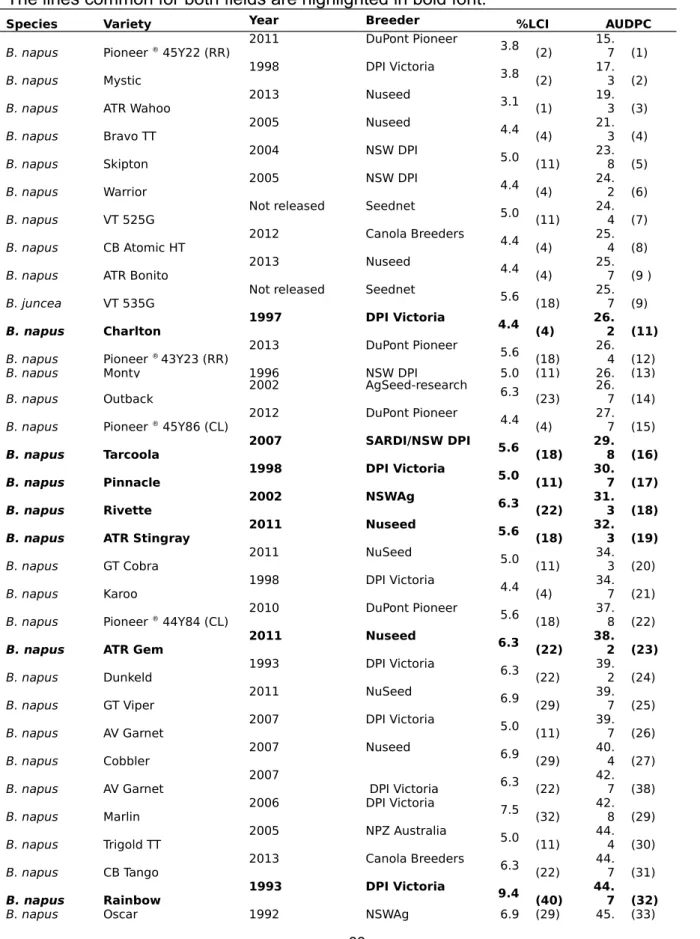
and there were significant differences (P < 0.001) among test genotypes (trial 1, Table 1; trial 2, Table 2).
3.1. Field trial 1
Across the 113 different genotypes from the three Brassica species (B. napus, B. juncea and B. oleracea var. capitata), there was wide variation in AUDPC values, ranging from 0 to 221.2 (Table 1). Fifty nine B. oleracea var. capitata genotypes tested were clearly the most resistant, with AUDPC values ranging from 0 to 68.25. Five
genotypes of B. oleracea var. capitata, viz. V04A0007, V04A0048, V04A0050, V04A0146, and V04A0143, demonstrated complete resistance, having 0 AUDPC value.
185
190
195
200
We believe this is the first high level resistance reported in B. oleracea var. capitata. Nevertheless, B. oleracea var. capitata genotypes V04A0216 and V04A0074 showed the highest disease incidence of this species, with relative resistance rankings 62 and
58 out of 113, respectively. The most susceptible were the 20 genotypes of B. juncea (e.g., Fig. 1A), with AUDPC values ranging from 71.7 to 221.2. Of these, MJBT1033, MJBT1032 and MJBT1097 were the most susceptible, with AUDPC values of 211.7,
218.1 and 221.2, respectively. Thirty four genotypes of B. napus were intermediate in terms of resistance (e.g., Fig. 1B), with AUDPC values ranging from 64.7 to 133.6. Of
these, Rainbow from Australia (AUDPC – 64.7) and YM18 (AUDPC – 65.0) from China
were the most resistant, while Thunder TT, the most susceptible variety with AUDPC
-133.6 (Table 1).
There was strong positive correlation (P < 0.001, r = 0.96) between two different disease assessment methodologies, viz. AUDPC for percentage of leaves diseased
and extent of leaf collapse (% LCI) from disease showing the same general patterns of
resistance or susceptibility across test genotypes. Therefore, considering %CLI, as in
AUDPC values, B. oleracea var. capitata genotypes were the most resistant, having lowest %CLI (range 0-8.1), and with six genotypes with complete resistance (viz.
V04A0007, V04A0048, V04A0050, V04A0147, V04A0071 and V04A0040). The range
of %CLI for highly susceptible B. juncea genotypes was from 18.1 to 38.7. B. juncea genotypes; MJBT1032, MJBT1097 and MJBT1129 were the most susceptible with
%CLI values of 38.7, 36.9 and 35.8, respectively. The %CLI values across B. napus genotypes were intermediate between B. oleracea var. capitata and B. juncea, with values ranging 8.1 to 17.5 (Table 1).
Further, in terms of country of origin, a greater number of resistant genotypes
originated from China and B. juncea genotypes from China were significantly (P < 0.001) more resistant from the genotypes of other two countries, Australia and India.
210
215
220
225
3.2. Field trial 2
In terms of both AUDPC and %LCI, the most resistant with AUDPC < 20 or %CLI < 3.7
were B. napus genotypes, Pioneer® 45Y22 (RR), ATR Wahoo and Mystic (Table 2). In contrast, B. juncea Xceed Oasis CL, Sahara CL and JB0Z-814156 were the most susceptible among the Australian varieties having greatest AUDPC (> 125) and greatest
%CLI (>18) (Table 2). Overall, for both AUDPC and %CLI, B. juncea genotypes were more susceptible compared with B. napus varieties. This was illustrated by 45 varieties of B. napus with AUDPC ranging from 15.7 t0 73.8 and %CLI from 3.7 to 12.5; in comparison with the range for AUPDC and %CLI for the 10 highly susceptible B. juncea varieties of 75.7-159.6 and 13.1-18.7, respectively (Table 2). There was no significant
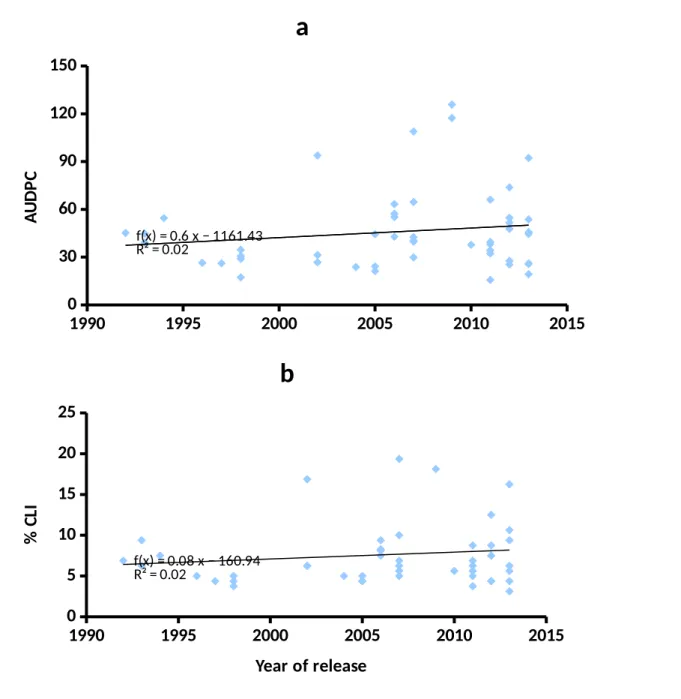
(P > 0.05) correlation between levels of resistance/susceptibility in comparison with year of varietal release in Australia for either AUDPC (R2 =0.023) (Fig 2a) or %CLI (R2
=0.017) (Fig. 2b).
Differences were observed in the level of disease expression across some common
varieties between trials such as Charlton, ATR Stingray, Pinnacle, Thunder TT,
Rainbow, Rivette, Tarcoola and ATR Gem.
3.3. Comparisons of the three Brassica species from combined data across trials 1 and 2
Despite some differences in overall disease levels between the two trials there were
apparent differences in resistance expression between three Brassica species in terms of AUDPC values (Fig. 3) or % CLI (data not shown). Seventy nine selections of B. napus showed the widest range in disease development in terms of AUDPC for
10 235
240
245
250
255
percentage leaves diseased, ranging from 15.7 to 133.6 for B. oleracea var. capitata, 59 selections did not show high variation in AUDPC values, only ranging from 0-68.2.
However, this was overall clearly the most resistant species. In contrast, 30 B. juncea genotypes showed greatest range in AUDPC values (71.7-221.2), and showed overall
greater susceptibility of Indian mustard to white leaf spot disease (Fig. 3).
3. Discussion
The 168 genotypes across three Brassica species over the two field trials, B. napus, B. juncea, and B. oleracea var. capitata, displayed wide range in host resistance reactions to P. capsellae; from complete resistance to highly susceptible. B. oleracea var. capitata was the species with greatest resistance, with five genotypes completely resistant. We believe this is the first report of complete resistance to P. capsellae in B. oleracea. A previous study by Gunasinghe et al. (2013) reported high resistance but not complete resistance in some genotypes of B. oleracea var. capitata; a study where most Asian leafy vegetables such as B. rapa var. rosularis, B. campestris var. chinensis and B. rapa were extremely susceptible to P. capsellae, and as was B. juncea in the current study. This confirms the particularly high value of resistance in B. oleracea var. capitata in the current study. Furthermore, resistances in B. oleracea var. capitata and B. napus in the current study, along with high level resistances in some genotypes of Crambe abyssinica, Eruca sativa and Eruca vesicaria reported earlier by Gunasinghe et al. (2013), together offer prospects for delivering high levels of resistance to white leaf spot
across future oilseed and vegetable Brassicaceae. It is likely that at least some of these resistance sources/types are genetically distinct, further increasing their value to
breeding programs.
265
270
275
280
Overall, while expressions of resistance in B. napus varieties were intermediate compared with B. juncea and B. oleracea var. capitata, B. napus varieties Rainbow, Skipton and Charlton demonstrated strong resistance against white leaf spot disease
both in previous screening studies by Gunasinghe et al. (2013) and Eshraghi et al. (2007), and again in the current study. Some were highly resistant [e.g. ‘Pioneer® 45Y22
(RR)’, ‘ATR Wahoo’, ‘Skipton’] but others highly susceptible (e.g. ‘Thunder TT’,
‘Tranby’). ‘Pioneer® 45Y22 (RR)’ was released in 2011 and ‘ATR Wahoo’ was released
in 2013, the former as a Roundup Ready variety and the latter is a variety with triazine
tolerance (Bucat, 2015; Ware, 2014). That ‘Pioneer® 45Y22 (RR)’ and ‘ATR Wahoo’ are
the most resistant B. napus varieties and are also rated as either in the ‘medium risk’ or ‘no risk’ groups for blackleg disease, respectively (Anonymous, 2013), is fortuitous.
Similarly, ‘Mystic’, released in 1998, also demonstrated consistent high level resistance
against P. capsellae (this study) and against Sclerotinia stem rot (Sclerotinia sclerotiorum) (Uloth et al., 2015; Uloth et al., 2013). Such ‘dual disease’ resistances are of particular value to breeding programs. Also, that Gunasinghe et al., (2013) found B. napus varieties in general were more resistant than B. juncea genotypes is promising for oilseed rape. In contrast, the very high susceptibility of Indian-and Australian-derived
B. juncea varieties and genotypes to white leaf spot disease is of major concern. Currently, India does not have P. capsellae in B. juncea and if it is introduced into India, the outcome could potentially be catastrophic for India’s mustard production in
particular, and perhaps also for some other oilseed and vegetable Brassica species. Similarly, for Australia, that B. juncea ‘Xceed Oasis CL’, the first herbicide tolerant Clearfield tolerant juncea canola released in Australia (Ware, 2014) with a high level of
blackleg resistance (Anonymous, 2013), is highly susceptible to P. capsellae (relative resistance ranking 56/57) is of concern for Australia. This is especially so as several
other recently released B. juncea varieties such as Dune and Sahara CL are also very
290
295
300
305
susceptible. Further, 'Xceed Oasis CL’ is also highly susceptible to S. sclerotiorum (Uloth et al., 2015). Consequently, there is an urgent need to locate effective resistance to P. capsellae, for both India and Australia. For India, as insurance against its accidental introduction there, and in Australia, in order to preserve and exploit the full
potential of B. juncea as an oilseed crop particularly suitable for low rainfall areas across the southern Australian grain-belt (Burton et al., 2003).
In the current study, B. napus from China overall showed greatest expression of resistance. In contrast, in an earlier study by Gunasinghe et al., (2013), B. napus varieties from India were in general more susceptible to P. capsellae than Australian or Chinese genotypes. This is perhaps a legacy from the fact that B. napus genotypes from India were distinctly separated from B. napus genotypes in Australia and China (Chen et al., 2008). However, in the current study, B. juncea, genotypes from China were again more resistant than those from Australia or India as found in a previous
study by Gunasinghe et al. (2013). The extreme susceptibility of B. juncea genotypes MJBT1097, MJBT1032 and MJBT1033 was unexpected, as these genotypes containing
introgression(s) from wild weedy Brassicaceae had shown extremely strong host resistance to Sclerotinia stem rot in the earlier studies of Garg et al. (2010). These and other highly susceptible B. juncea genotypes need to be used with care in breeding programs, for example, where resistance to Sclerotinia stem rot was being targeted, so
as not to increase susceptibility to P. capsellae in an already overall disease-susceptible species.
There was no trend of improvement in resistance to white leaf spot disease in
Australian B. napus canola and B. juncea mustard varieties released since 1998 to date. This is not unexpected, as historically white leaf spot resistance has not been
considered a high priority for inclusion in disease resistance breeding programs for
broad-acre oilseed or horticultural Brassicaceae species either in Australia (Salisbury
315
320
325
330
and Barbetti, 2011), UK, or elsewhere (Inman et al. 1992). Regardless, B. napus varieties with high resistance to white leaf spot were noted among both historical
(Monty, Mystic) and newly released varieties, Pioneer® 45Y22 (RR) (released 20110
and ATR Wahoo (released 2013). As white leaf spot lesions in Australia are generally
mistaken for blackleg, the absence of extremely susceptible varieties in B. napus could also be due to incidental and/or inherent selection occurring over past decades during
which resistance development was focussed against blackleg disease. However,
extreme susceptibility of some of the newly released B. juncea varieties and the greater general susceptibility of B. juncea highlights the value of now including white leaf spot resistance as a secondary priority in future breeding programs, not only for B. napus but particularly for B. juncea.
There were some differences in the level of expression of resistance across some
common varieties between trials, for example, Charlton, ATR Stingray, Pinnacle,
Thunder TT, Rainbow, Rivette, Tarcoola, ATR Gem. Disease development of varieties
such as ATR Stingray and Charlton in two trials (comparatively high disease in trial one
and lower disease in trial two) demonstrates that varieties with intermediate resistance
can achieve improved resistant under warmer and drier conditions less favourable for
disease development as occurred later in the season in trial 2 due to its delayed sowing.
Similarly, Chandler (1965) also noted that while white leaf spot can cause complete
crop loss of turnip under irrigation, it is considered of minor importance in that crop
under less conducive conditions in the absence of irrigation.
The general increase in worldwide significance of white leaf spot over past decades
(Penaud, 1987, Amelung and Daebeler, 1988, Inman, 1992, Khangura et al., 2014, Ocamb, 2014 ), the inability of chemical control to reliably and cost-effectively suppress
this disease (Inman, 1992), and the high level resistances identified in the current study,
together highlight the need for inclusion of host resistance to white leaf spot disease as
340
345
350
355
a priority in varietal recommendations and in breeding programs. This is especially so
for the more susceptible species like B. juncea. The highly resistant genotypes identified in this study are important sources of resistance across oilseed B. napus and B. juncea, and also horticultural B. oleracea, for development of new more resistant varieties. The first immunity to this disease in B. oleracea var. capitata and the range of other high level host resistances such as in B. napus identified in this study should be utilized for new crop resistance to significantly improve management of this disease. Finally,
disease resistance also highlights the potential for significant reductions in fungicide
usage, potentially even eliminating current reliance upon fungicidal controls for
management of white leaf spot disease worldwide through effective breeding to make
the resistance durable.
Acknowledgements
The first author is grateful for the financial assistance of an International SIRF
Scholarship funded jointly by the Australian Government and The University of Western
Australia. We thank the Grains Research and Development Corporation, Canberra, and
the School of Plant Biology, The University of Western Australia, for jointly funding this
work. We are grateful to Phil Salisbury and Allison Gurung for assistance with
organizing supply of seed from China and India, and to commercial seed companies for
providing seed of Australian canola and mustard varieties.
References
15 365
370
375
380
Amelung, D., Daebeler, F., 1988. White spot (Pseudocercosporella capsellae/Ell. et Ev. Deighton) - A new disease of winter rape in the German Democratic Republic.
Nachrichtenblatt fuer den Pflanzenschutz in der DDR 42, 73 - 74.
Anonymous, 2013. Fact sheet Blackleg Management Guide. Grains research and
development coroporation.
Barbetti, M.J., 1987. Effects of three foliar diseases on biomass and seed yield for 11
cultivars of subterranean clover. Plant Dis. 71, 350-353.
Barbetti, M.J., Khangura, R., 2000. Fungal diseases of canola in Western Australia.
Bulletin 4406, 15.
Barbetti, M.J., Nichols, P.G.H., 2005. Field performance of subterranean clover
germplasm in relation to severity of Cercospora disease. Australas. Plant. Pathol. 34, 197-201.
Bucat, J., 2015. Canola variety guide for 2015 cropping season. Department of
Agriculture and Food Western Australia. .
Burton, W., Salisbury, P., Potts, D., 2003. The potential of canola quality Brassica juncea as an oilseed crop for Australia, 13th Australian Research Assembly on Brassicas Tamworth, NSW, Australia, pp. 62-64.
Campbell, C.L., Madden, L.V., 1990. Temporal analysis of epidemics. I. Description and
comparison of disease progress curves., Introduction to Plant Disease
Epidemiology. John Wiley & Sons., New York, pp. 161-202.
Chandler, W.A., 1965. Fungicidal control of anthracnose and white spot of turnip
greens. Plant Dis. Rep. 49, 419 - 422.
Chen, s., Nelson, M.N., Ghamkhar, K., Fu, T., Cowling, W.A., 2008. Divergent patterns
of allelic diversity from similar origins: the case of oilseed rape (Brassica napus L.) in China and Australia. Genome 51, 1-10.
390
395
400
405
Crossan, D.F., 1954. Cercosporella leafspot of crucifers. North Carolina Agricultural Experiment Station Technical Bulletin 109, 23.
Ocamb, C., 2014. White Leaf Spot and Gray Stem in Crucifer Seed Crops in Western
Oregon. OSU-Corvallis, OSU-Corvallis.
Deighton, F.C., 1973. Studies on Cercospora and allied genera. Mycological Papers 133, 42-46.
Eshraghi, L., Barbetti, M.J., Li, H., Danehloueipour, N., Sivasithamparam, K., 2007.
Resistance in oilseed rape (Brassica napus) and Indian mustard (Brassica juncea) to a mixture of Pseudocercosporella capsellae isolates from Western Australia. Field Crops Reserch 101, 37-43.
Garg, H., Atri, C., Sandhu, P., Kaur, B., Renton, M., Banga, S., Singh, H., Singh, C.,
Barbetti, M., Banga, S., 2010. High level of resistance to Sclerotinia sclerotiorum in introgression lines derived from hybridization between wild crucifers and the
crop Brassica species, B. napus and B. juncea. Field Crops Res. 117, 51-58. Gunasinghe, N., You, M.P., Banga, S.S., Barbetti, M.J., 2013. High level resistance to
Pseudocercosporella capsellae offers new opportunities to deploy host resistance to effectively manage white leaf spot disease across major cruciferous
crops. Eur. J. Plant Pathol. 138, 873-890.
Inman, A.J., 1992. The biology and epidomiology of white leaf spot
(Pseudocercosporella capsellae) on oilseed rape., Department of Plant Pathology. The University of London, p. 303.
Inman, A.J., Fitt, B.D.L., Welham, S.J., Evans, R.L., Murray, D.A., 1997. Effects of
temperature, cultivar and isolate on the incubation period of white leaf spot
(Mycosphaerella capsellae) on oilseed rape (Brassica napus). Ann. Appl. Biol. 130, 239-253.
415
420
425
430
Khangura, R., Marcroft, S., Elliott, V., Van de Wouw, A., Lindbeck, K., Ware, A.,
MacLeod, W., Davidson, J., Howlett, B., 2014. National Survey of canola
diseases other than blackleg and Sclerotinia. Proceedings of the National
Meeting on Fungal Diseases of Canola, 19 February 2014, University of
Melbourne, Parkville.
Koike, S.T., Gladders, P., Paulus, A.O., 2007. Vegetable diseases: a color handbook.
Academic Press, San Diego, USA.
Lancaster, R., 2006. Diseases of vegetable brassicas. Farmnote 39/90 4.
McKinney, H.H., 1923. Influence of soil temperature and moisture on infection of wheat
seedlings by Helminthosporium sativum. Journal of Agricultural Research 26, 195-217.
Miller, P.W., McWhorter, F.P., 1948. A disease of cabbage and other crucifers due to
Cercosporella brassicae. Phytopathology 38, 893 - 898.
Penaud, A., 1987. La maladie des taches blanches du colza. Phytoma 95, 23 - 26.
Petrie, G.A., Vanterpool, T.C., 1978. Pseudocercosporella capsellae, the cause of white leaf spot and grey stem of cruciferae in Western Canada. Can. Plant Dis. Surv.
58, 69-72.
Salisbury, P.A., Barbetti, M.J., 2011. Breeding oilseed Brassica for climate change, In:
Yadav, S.S., Redden, R.T., Hatfield, J.S., Lotze-Campen, H., Hall, A. (Eds.),
Crop Adaptation to Climate Change. John Wiley & Sons Ltd., Chichester, West
Sussex, UK., pp. 448-463.
Shivas, R.G., 1989. Fungal and bacterial diseases of plants in Western Australia. J. R.
Soc. West. Aust. 72, 1 - 62.
Uloth, M., You, M., Barbetti, M., 2015. Comparison of host resistance to Sclerotinia
stem rot in historic and current Brassica napus and B. juncea and critical management implications. Crop Pasture Sci. 66, 841-848.
440
445
450
455
Uloth, M., You, M.P., Finnegan, P.M., Banga, S.S., Banga, S.K., Yi, H., Salisbury, P.A.,
Barbetti, M.J., 2013. New sources of resistance to Sclerotinia sclerotiorum for crucifer crops. Field Crops Res. (In Press).
Vale, F.X.R., Parlevliet, J.E., Zambolim, L., 2001. Concepts in plant disease resistance.
Fitopatologia Brasileira 26, 577-589.
Ware, A., 2014. Canola variety sowing guide 2015, 2015 South Australian Research
and Development Institute Sowing Guide. South Australian Research and
Development Institute, Adelaide.
http://www.sardi.sa.gov.au/__data/assets/pdf_file/0011/45965/canola.pdf, p.
3640.
465
470
Table 1: Field trial 1: Genotype responses under field conditions at Shenton Park Field Station, Western Australia, following inoculations of Pseudocercosporella capsellae as measured in Area Under Disease Progress Curve (AUDPC) in relation to the percent leaves diseased and as Percent Leaf Collapse Index (%LCI) for Brassica napus (34), B. oleracea L. var. capitata L. (59) and B. juncea (20) genotypes. A relative ranking score for each genotype (1 to 113, within brackets) was given depending on the level of resistance, with 1 the highest level of resistance and 113 the most susceptible of the genotypes tested. The lines common to both fields are highlighted in bold font.
Species Genotype Country of
Origin %LCI AUDPC
B. oleracea var. capitata V04A0007 China 0.0 (1) 0.0 (1)
B. oleracea var. capitata V04A0048 China 0.0 (1) 0.0 (1)
B. oleracea var. capitata V04A0050 China 0.0 (1) 0.0 (1)
B. oleracea var. capitata V04A0146 China 0.6 (7) 0.0 (1)
B. oleracea var. capitata V04A0143 China 1.7 (21) 0.0 (1)
B. oleracea var. capitata V04A0147 China 0.0 (1) 1.8 (6)
B. oleracea var. capitata V04A0065 China 1.3 (11) 2.3 (7)
B. oleracea var. capitata V04A0071 China 0.0 (1) 2.8 (8)
B. oleracea var. capitata V04A0040 China 0.0 (1) 5.1 (9)
B. oleracea var. capitata V04A0150 China 0.6 (7) 5.1 (9)
B. oleracea var. capitata V04A0033 China 0.6 (7) 6.4 (11)
B. oleracea var. capitata V04A0142 China 1.3 (11) 6.4 (11)
B. oleracea var. capitata V04A0001 China 1.3 (11) 7.1 (13)
B. oleracea var. capitata V04A0193 China 0.6 (7) 9.3 (14)
B. oleracea var. capitata V04A0019 China 1.9 (21) 10.1 (15)
B. oleracea var. capitata V04A0153 China 1.3 (11) 10.6 (16)
B. oleracea var. capitata V04A0035 China 1.9 (21) 10.9 (17)
B. oleracea var. capitata V04A0148 China 3.1 (43) 11.0 (18)
B. oleracea var. capitata V04A0038 China 1.3 (11) 11.8 (19)
B. oleracea var. capitata V04A0045 China 1.7 (21) 11.8 (20)
B. oleracea var. capitata V04A0155 China 2.5 (33) 11.9 (21)
B. oleracea var. capitata V04A0212 China 2.5 (33) 11.9 (21)
B. oleracea var. capitata V04A0215 China 3.8 (50) 12.8 (23)
B. oleracea var. capitata V04A0144 China 1.7 (21) 13.0 (24)
B. oleracea var. capitata V04A0195 China 1.7 (21) 13.5 (25)
B. oleracea var. capitata V04A0063 China 1.3 (11) 14.2 (26)
B. oleracea var. capitata V04A0036 China 1.9 (21) 14.8 (28)
B. oleracea var. capitata V04A0015 China 1.3 (11) 15.4 (29)
B. oleracea var. capitata V04A0194 China 1.3 (11) 15.4 (30)
B. oleracea var. capitata V04A0152 China 1.5 (11) 15.9 (31)
B. oleracea var. capitata V04A0141 China 2.3 (33) 16.4 (32)
B. oleracea var. capitata V04A0037 China 1.9] (21) 16.9 (33
B. oleracea var. capitata V04A0218 China 1.9 (21) 17.3 (34)
B. oleracea var. capitata V04A0017 China 2.5 (33) 19.5 (35)
B. oleracea var. capitata V04A0032 China 1.9 (21) 20.3 (35)
B. oleracea var. capitata V04A0149 China 2.5 (33) 20.5 (36)
B. oleracea var. capitata V04A0151 China 3.1 (43) 21.0 (37)
B. oleracea var. capitata V04A0145 China 1.9 (21) 21.1 (38)
B. oleracea var. capitata V04A0023 China 4.5 (51) 22.0 (39)
B. oleracea var. capitata V04A0027 China 3.1 (43) 22.1 (40)
B. oleracea var. capitata V04A0049 China 5.6 (54) 22.9 (41)
B. oleracea var. capitata V04A0075 China 2.5 (33) 23.0 (42)
B. oleracea var. capitata V04A0214 China 1.9 (21) 23.6 (43)
B. oleracea var. capitata V04A0154 China 3.1 (43) 23.6 (44)
B. oleracea var. capitata V04A0077 China 2.3 (33) 23.8 (45)
B. oleracea var. capitata V04A0072 China 4.4 (51) 23.8 (46)
B. oleracea var. capitata V04A0018 China 3.1 (43) 24.1 (47)
B. oleracea var. capitata V04A0076 China 3.1 (43) 24.1 (47)
B. oleracea var. capitata V04A0073 China 1.3 (11) 25.5 (49)
B. oleracea var. capitata V04A0217 China 2.3 (33) 28.3 (50)
B. oleracea var. capitata V04A0210 China 2.3 (33) 29.3 (51)
B. oleracea var. capitata V04A0011 China 3.1 (43) 30.3 (52)
B. oleracea var. capitata V04A0034 China 5.6 (55) 35.5 (53)
B. oleracea var. capitata V04A0196 China 2.5 (33) 36.1 (54)
B. oleracea var. capitata V04A0211 China 5.0 (53) 49.0 (55)
20 480
B. oleracea var. capitata V04A0192 China 6.9 (57) 50.8 (56)
B. oleracea var. capitata V04A0213 China 6.9 (57) 53.4 (57)
B. oleracea var. capitata V04A0074 China 6.3 (56) 53.6 (58)
B. napus Rainbow Australia 8.1 (59) 64.8 (59)
B. napus YM18 China 8.8 (62) 65.0 (60)
B. napus ZY006 China 10.0 (65) 66.4 (61)
B. oleracea var. capitata V04A0216 China 8.3 (59) 68.3 (62)
B. napus Hyden Australia 8.8 (62) 68.4 (33)
B. juncea Ringot China 13.1 (79) 71.8 (64)
B. juncea B. juncea-#2 China 18.1 (95) 75.0 (65)
B. napus YM04 China 8.1 (59) 76.3 (66)
B. napus ATR Gem Australia 9.4 (64) 76.6 (67)
B. napus CrusherTT Australia 11.9 (70) 80.1 (68
B. napus YM17 China 11.3 (68) 80.6 (69)
B. napus Tarcoola Australia 10.0 (65) 82.1 (70)
B. napus Rivette Australia 11.9 (70) 82.8 (71)
B. napus Grace Australia 11.9 (70) 85.3 (72)
B. napus Mystic#2 Australia 13.1 (79) 89.9 (73)
B. napus NC2 India 11.3 (68) 91.1 (74)
B. napus Charlton Australia 12.5 (73) 91.4 (75)
B. napus Surpass-400 Australia 10.0 (65) 94.3 (76)
B. napus 45C75 Australia 15.0 (84) 95.4 (77)
B. juncea Xinyou 9 China 15.0 (84) 96.8 (78)
B. napus CB Scaddan Australia 15.0 (84) 98.8 (78)
B. napus Jackpot TT Australia 12.5 (73) 99.5 (80)
B. napus 06-6-3792 China 13.1 (79) 99.6 (81)
B. napus NC4 India 16.3 (91) 99.6 (81)
B. napus CB Argyle Australia 12.5 (73) 102.3 (83)
B. napus 43C80 Australia 14.4 (82) 103.1 (84)
B. juncea Montara China 20.0 (96) 105.3 (85)
B. napus 44C73 Australia 15.6 (88) 105.6 (86)
B. napus Beacon Australia 13.8 (81) 106.5 (87)
B. napus 44C79 Australia 12.5 (73) 107.8 (88)
B. napus NC1 India 16.3 (91) 110.0 (89)
B. napus Pinnacle Australia 12.5 (73) 113.5 (90)
B. napus BonanzaTT Australia 15.6 (88) 114.4 (91)
B. napus ATR Stingray Australia 16.9 (93) 119.0 (92)
B. napus FighterTT Australia 12.5 (73) 120.2 (93)
B. napus NC3 India 17.5 (94) 120.9 (94)
B. napus 06-p71-2 China 14.4 (82) 128.1 (95)
B. napus Tranby Australia 15.0 (84) 131.8 (96)
B. napus Thunder TT Australia 15.6 (88) 133.6 (97)
B. juncea MJBA1107 India 23.1 (98) 150.9 (98)
B. juncea MJBT1036 India 26.3 (99) 171.3 (999)
B. juncea MJBA1070 India 27.5 (100) 175.4 (100)
B. juncea MJBT1100 India 27.5 (100) 180.9 (101)
B. juncea JM06018 Australia 28.1 (101) 181.8 (102)
B. juncea MJBA1149 India 28.8 (102) 192.9 (103)
B. juncea MJBT1030 India 30.0 (103) 193.8 (104)
B. juncea MJBT1129 India 35.8 (110) 196.3 (105)
B. juncea JM06006 Australia 32.5 (106) 198.4 (106)
B. juncea MJBT1081 India 34.4 (108) 200.4 (107)
B. juncea MJBT1098 India 35.6 (109) 204.6 (108)
B. juncea MJBT1057 India 31.3 (104) 207.4 (109)
B. juncea MJBA1074 India 32.5 (106) 210.6 (110)
B. juncea MJBT1033 India 31.9 (105) 211.8 (111)
B. juncea MJBT1032 India 38.8 (112) 218.1 (112)
B. juncea MJBT1097 India 36.9 (111) 221.3 (113) L.s.d at P≤ 0.05 = 6.93 41.3
Table 2: Field trial 2: Genotype responses under field conditions following inoculation of Pseudocercosporella capsellae as measured as Area Under Disease Progress Curve (AUDPC) in relation to the percent leaves diseased and as Percent Leaf Collapse Index (%LCI) for 55 Australian varieties of Brassica napus (45) and B. juncea (10). A relative ranking score for each genotype (1 to 55, within brackets) was given depending on the level of resistance; with 1 the highest level of resistance and 55 the most susceptible. The lines common for both fields are highlighted in bold font.
Species Variety Year Breeder %LCI AUDPC
B. napus Pioneer ® 45Y22 (RR) 2011 DuPont Pioneer 3.8 (2) 15.7 (1)
B. napus Mystic 1998 DPI Victoria 3.8 (2) 17.3 (2)
B. napus ATR Wahoo 2013 Nuseed 3.1 (1) 19.3 (3)
B. napus Bravo TT 2005 Nuseed 4.4 (4) 21.3 (4)
B. napus Skipton 2004 NSW DPI 5.0 (11) 23.8 (5)
B. napus Warrior 2005 NSW DPI 4.4 (4) 24.2 (6)
B. napus VT 525G Not released Seednet 5.0 (11) 24.4 (7)
B. napus CB Atomic HT 2012 Canola Breeders 4.4 (4) 25.4 (8)
B. napus ATR Bonito 2013 Nuseed 4.4 (4) 25.7 (9 )
B. juncea VT 535G Not released Seednet 5.6 (18) 25.7 (9)
B. napus Charlton 1997 DPI Victoria 4.4 (4) 26.2 (11)
B. napus Pioneer ® 43Y23 (RR) 2013 DuPont Pioneer 5.6 (18) 26.4 (12)
B. napus Monty 1996 NSW DPI 5.0 (11) 26.4 (13)
B. napus Outback 2002 AgSeed-research 6.3 (23) 26.7 (14)
B. napus Pioneer ® 45Y86 (CL) 2012 DuPont Pioneer 4.4 (4) 27.7 (15)
B. napus Tarcoola 2007 SARDI/NSW DPI 5.6 (18) 29.8 (16)
B. napus Pinnacle 1998 DPI Victoria 5.0 (11) 30.7 (17)
B. napus Rivette 2002 NSWAg 6.3 (22) 31.3 (18)
B. napus ATR Stingray 2011 Nuseed 5.6 (18) 32.3 (19)
B. napus GT Cobra 2011 NuSeed 5.0 (11) 34.3 (20)
B. napus Karoo 1998 DPI Victoria 4.4 (4) 34.7 (21)
B. napus Pioneer ® 44Y84 (CL) 2010 DuPont Pioneer 5.6 (18) 37.8 (22)
B. napus ATR Gem 2011 Nuseed 6.3 (22) 38.2 (23)
B. napus Dunkeld 1993 DPI Victoria 6.3 (22) 39.2 (24)
B. napus GT Viper 2011 NuSeed 6.9 (29) 39.7 (25)
B. napus AV Garnet 2007 DPI Victoria 5.0 (11) 39.7 (26)
B. napus Cobbler 2007 Nuseed 6.9 (29) 40.4 (27)
B. napus AV Garnet 2007 DPI Victoria 6.3 (22) 42.7 (38)
B. napus Marlin 2006 DPI Victoria 7.5 (32) 42.8 (29)
B. napus Trigold TT 2005 NPZ Australia 5.0 (11) 44.4 (30)
B. napus CB Tango 2013 Canola Breeders 6.3 (22) 44.7 (31)
B. napus Rainbow 1993 DPI Victoria 9.4 (40) 44.7 (32)
B. napus Oscar 1992 NSWAg 6.9 (29) 45.2 (33)
B. napus CB Nitro HT 2013 Canola Breeders 10.6 (44) 45.7 (34)
B. napus Archer 2012 Heritage Seeds 7.5 (32) 47.7 (35)
B. napus Pioneer ® (CL) 2012 DuPont Pioneer 8.8 (38) 51.7 (36)
B. napus Nuseed GT50 2013 NuSeed 9.4 (40) 53.7 (37)
B. napus Narendra 1994 DAFWA 7.5 (32) 54.6 (38)
B. napus CB Sturt TT 2012 DuPont Pioneer 7.5 (32) 54.7 (39)
B. napus Opal 2006 DPI Victoria 8.1 (36) 55.2 (40)
B. napus CB Telfer TT 2006 Canola Breeders 8.3 (37) 57.3 (41)
B. napus Thunder TT 2005 Pacific Seeds 9.4 (40) 63.3 (42)
B. napus Tanami TT 2007 NPZ Australia 10.0 (43) 64.6 (43)
B. napus CB Agamax 2011 Canola Breeders 8.8 (38) 66.1 (44)
B. napus Carbine 2012 Heritage seeds 12.5 (45) 73.8 (45)
B. juncea JB0T-907988 Not released Seednet 13.1 (45) 75.7 (46)
B. juncea 397 Not released DPI Victoria/CSIRO 16.3 (49) 88.2 (47)
B. juncea Xceed ® VT X121 CL 2013 Seednet 16.3 (49) 92.3 (48)
B. juncea Mickey 2002 CSIRO 16.9 (51) 93.8 (49)
B. juncea JB0T-907957 Not released Seednet 13.3 (47) 95.5 (50)
B. juncea JB0T-908982 Not released Seednet 15.0 (48) 105.2 (51)
B. juncea Dune 2007 Ag Victoria 19.4 (55) 108.8 (52)
B. juncea Sahara CL 2009 DPI Victoria/Viterra 18.1 (52) 117.3 (53)
B. juncea Xceed Oasis CL 2009 Seednet 18.1 (52) 125.8 (54)
B. juncea JB0Z-814156 Not released Seednet 18.8 (54) 159.6 (55)
Significance (varieties) (P = 0.001)
L.s.d at P≤ 0.05 = 6.453 37.67
Fig. 1. Showing general high incidence and large coalescing lesions and leaf collapse
on a susceptible Brassica juncea genotype (a), and, lower overall incidence and smaller small lesions on a resistant Brassicanapus genotype (b).
19900 1995 2000 2005 2010 2015 30
60 90 120 150
f(x) = 0.6 x − 1161.43 R² = 0.02
a
A
U
D
P
C
19900 1995 2000 2005 2010 2015
5 10 15 20 25
f(x) = 0.08 x − 160.94 R² = 0.02
b
Year of release
%
C
L
I
Fig. 2. Association between varietal release and disease severity as indicated by Area
Under Disease Progress Curve (AUDPC) (2a) or Percentage Leaf Collapse Index (%
CLI ) (2b) across (49) Australian B. napus (41) and B. juncea (8) varieties.
505
0 50 100 150 200 250
B. napus
B. juncea
B. oleracea var. capitata
Number of genotypes
A
U
D
P
C
Fig. 3. Levels of resistance expressed across three Brassica species (168) from combined data of field trial 1 and field trial 2, viz. B. napus (79 genotypes), B. oleracea (59 genotypes) and B. juncea (30 genotypes), as measured by Area Under Disease Progress Curve (AUDPC) of percentage of leaves diseased.
25 515