Thesis by
Paul David Patent
In Partial Fulfillment of the Requirements for the Degree of
Doctor of Philosophy
California Institute of Technology Pasadena, California
1972
ii
ACKNOWLEDGEMENT
I wish to thank Professor Robert P. Dilworth for his interest in my gener-al well being as a graduate student, Professor Martin H. Schultz for suggest-ing my thesis topic and many fruitful ideas concernsuggest-ing its investigation, and Professor Herbert B. Keller for his guidance in the preparation of the thesis itself.
I greatly appreciate the financial support which I have received from California Institute of Technology, the U. S. Office of Education through a National Defense Education Act Fellowship, and the Naval Undersea Research and Development Center through an Advanced Graduate Fellowship.
ABSTRACT
co
iv
CONTENTS
Acknowledgement . . . . ii
Abstract . • . . . . • . . . • . . . • . . iii
Introduction . . . 1
The Least Square Problem in Real Hilbert Space . . . . 3
'The Least Square Problem in L2{0, l] with Respect to Polynomial Spline Spaces . . . . 8
Quadrature Schemes of the Interpolatory Type . . . . 23
Quadrature Schemes of the Filan Type . . . . 39
Numerical Results . . . . 53
References . . . . 78
Appendix A - On an Inequality of E. Schmidt . . . . 80
Appendix B -A Cubic Spline Approximation Program - CSP LlT . . 85
Figures
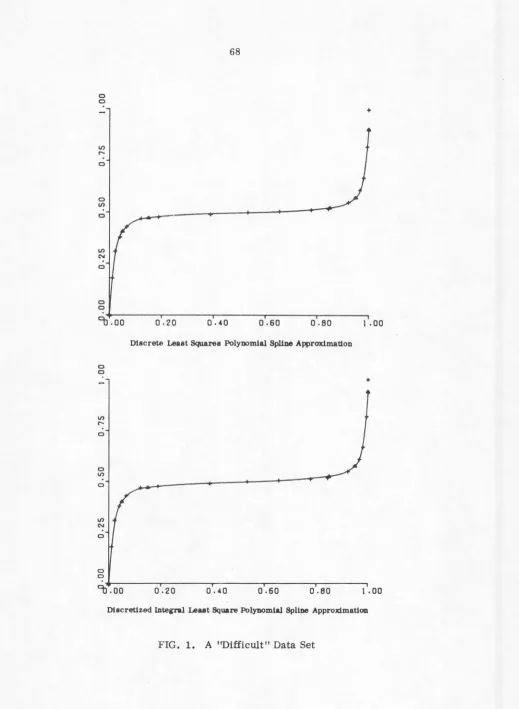
1. A "Difficult" Data Set . . . • . . . 68 2. Data for Ethanol- n-heptane Vapor Pressure • • • • • • • • • • • • • • . • 69 3. Data for Ocean Area Alpha - Winter • • . . • . • • . • • • • . • • • • . • • . 70 4. Data for Ocean Area Alpha - Spring. . • • • • . • • • . . • . • . . • • • . . . 71 5. Data for Ocean Area Alpha - Summer • • • • . • • • . • • • • • • . • • • • . 72 6. Data for Ocean Area Alpha - Autumn. • • • • • . . . • • • . • • • • • . • • • 73 7. Data for Ocean Area Bravo - Winter • • • • • • • . . • . • • . . . • • . • • • 7 4 8. Data for Ocean Area Bravo - Spring • • . • • • • • • • • • • . • . . • • • • • 75 9. Data for Ocean Area Gamma- Winter • • • • • • . • • • • • • • • • . • • • . 76
10. Program Listing for CSPLIT • • • • • • . • • • • • • • . • • • • . • . • . • • . 88 11. Program Listing for Subroutine CINPUT • • • • • • • • • . . • . . • . • . • 89
12. Program Listing for Subroutine PO LEX. • • • • • . • • . . . • • . . • • 90 13. Program Listing for Subroutine CDLS • • . • • • • • • . • • • • • . . • . • • 90 14. Program Listing for Subroutine CEVAL. • • • . • • . • • • • . • . . • . • • 91 15. Program Listing for Subroutine MATINV • . • • . • • • • . • • • • . . • • • 92
16. Progra_m Listing for Subroutine CMTRX . • . • • . . . • . • • • . . 93
vi
Tables
1. Least Square Linear Spline Approximation of the
Exponential Function . . . . • . • • . . . 56 2. Least Square Cubic Spline Approximation of the
Exponential Function . • . • . . . . • . . . • . . . 56
3. Least Square Cubic Hermite Spline Approximation of
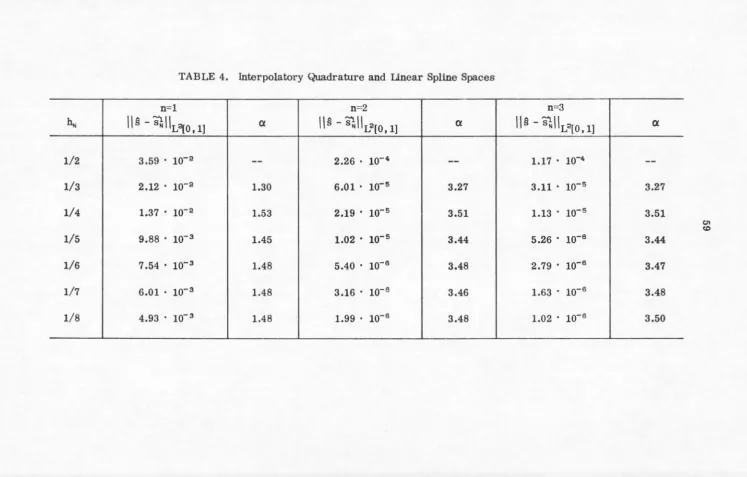
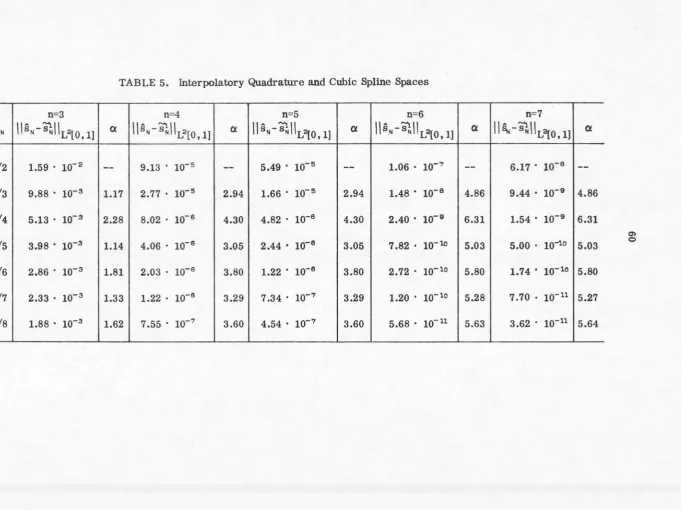
the Exponential Function • . • • . . . • . . • . . . 57 4. Interpolatory Quadrature and Linear Spline Spaces . . . 59 5. lnterpolatory Quadrature and Cubic Spline Spaces . . . 60 6. lnterpolatory Quadrature and Cubic Hermite Spline
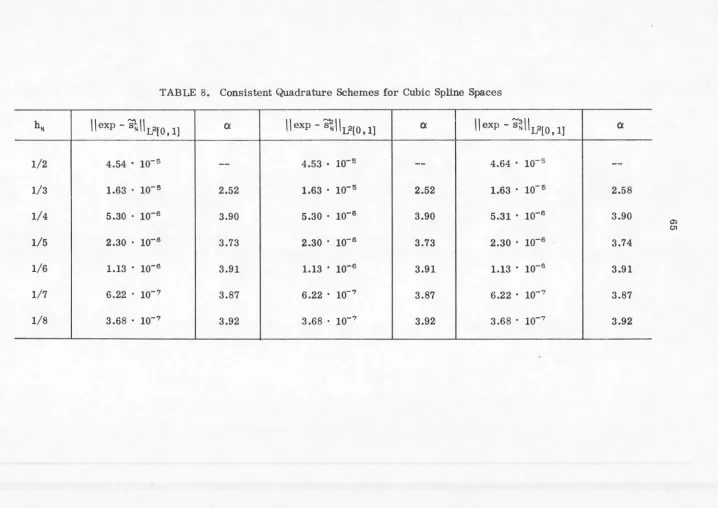
Spaces . • . . . . . . • . . . • • . . • . • . 61 7. Consistent Quadrature Schemes for Linear Spline Spaces . . . . . . 64 8. Consistent Quadrature Schemes for Cubic Spline Spaces • • . . . . • 65 9. Consistent Quadrature Schemes for Cubic Hermite
INTRODUCTION
In this paper we consider polynomial spline approximation t.echniques based on the theory of orthogonal projection in real Hilbert space. Splines are used as the approximations since they have smoothness properties and have been used to int.erpolat.e to large classes of smooth functions with small errors. In
addition, with the proper choice of basis functions, splines give rise to bounded well-conditioned matrices without orthonormalization. The motivation for the use of an integral least square technique is the hope that it might generate ap-proximations which would smooth errors due to "noisy" data. Int.erpolation t.echniques should be avoided, if possible, when attempting to approximate such data sets.
We begin, in Section 1, with a discussion of a least square approximation theory for finite dimensional subspaces of real Hilbert space. In Section 2,
we confine our att.ention to the Hilbe!'t space L2[0, 1] with inner product defined for g,hE:L2[0,1] by
(g,h)
=
j
1g(x) h(x) dx. 0
2
bound the L2-norms of the least square error and its derivatives. We then employ the L2-bounds to derive L00-bounds for the same error functions using a Sobolev type inequality. We discuss the application of techniques based on
1. THE LEAST SQUARE PROBLEM IN REAL HILBERT SPACE
In this section we formulate the least square problem in real Hilbert space.
We demonstrate the equivalence of this problem
to
that of solving an appropriate linear system of equations. The matrix involved is shownto
be positive definite and symmetric thereby guaranteeing that a unique solution to the system ofequa-tions exists. We then conclude that a unique solution to the least square
prob-lem always exists. Finally, we discuss the context in which these concepts are
to be employed in this paper.
Let H be a real Hilbert space with the inner product of two elements f, gEH
denoted by (f, g). This inner product satisfies the following properties for all
f, g, hEH and any real number
a..
i) (a.f, g) ii) (f + g,h)
iii) (f' g)
a
(f, g) (f, h) + (g, h) (g, f)iv) (f, f)
>
0 for ff
0v) (f, f) 0 for f == 0.
(1.1)
Then 11f11 - (f, f)l/2 defines a norm on Hand d(f, g) - 11 f - g 11 defines a metric
4
Let G be any finite dimensional subspace of H. Then, given any f(H, we wish to find an element g(G which minimizes d(f,g)
=
llf - gll. We call this problem the least square problem for f ( H associated with the finite dimensional subspace G of H.Suppose that the elements g1 , &;i, ••• , g11 form a basis for G. Let Ct
=
(t:ici, ••• , a11 ) and defineF~ (1.2)
Clearly, our original problem is equivalent
to
finding an n-tuple&
=(&
1 , ••• , &11) which minimizes F~. Using the definition of the normII· II
and the properties of the inner product ( · , · ) , we find thatF~
is a quadratic function of the
exp
1 s: i s: n. Consequently, the partial derivatives of F with respect to the a 1, 1 s: i s: n, evaluated at such a minimum must equalzero, i.e. , for 1 s: i s: n
oF
& oa@1
n
-2(f, gt) + 2
L:
&J(gp gJ)j=l
We shall write this system of equations, lmown as the normal equations, as
A
Aa. - k 0 (1.4)
where the entries, a1J' of A and the components,
ki'
of£ are defined byA
a1J - (gpgJ), k1 - (f,g1), for 1 s i,j s n. (1.5)
Of course the matrix A is the well known Gram matrix or Gramian of the elements g1 , ••• , ~of H.
The matrix A is symmetric since (gpgJ)
=
(gJ,g1) for alli,j by property (iii) of the inner product. Now given any n-tupleq
= (a.1' ••• ,O!n)(1.6)
6
Applying property (v) of the inner product yields
and, consequently, et 1
=
0 all i, since the g1, 1 ~ i ~ n, are linearly independent.So et 1Acx :?: O with equality only if ex
=
O. Therefore, A is also positive definite. But then A has a unique inverse, A-1, and&
=
A-1~ is the unique solution to the system (1.4). Therefore,is the unique solution to the least square problem for f(H associated with the finite dimensional subspace G
=
span[g1 , ••• gn} of H. This completes the proof of the following well known theorem which is true, in fact, for any closed sub-space G of H and is known as the Projection Theorem.Theorem 1.1-Given any f(H, the least square problem for f associated with G always has a unique solution.
Note that our proof of the theorem also provides a potential means by which such solutions may be obtained.
(g, h) -
£
1g(x) h(x) dx
0
8
2. THE LEAST SQUARE PROBLEM IN L2[0, 1] WITH RESPECT TO
POLYNOMIAL SPLINE SPACES
In this section we first define the concept of polynomial spline spaces and state some standard spline interpolation results. We then examine, in detail, the least square problem in L2[0, 1] with respect
to
these finite dimensional spacesof polynomial splines. We use L2-error bounds for polynomial spline
interpola-00
tion
to
derive both L2- and L -error bounds for least square splineapproxima-tion. We conclude with a discussion of the implementation of this technique.
We begin with the following definitions. For each non-negative integer, N, let 9t[O, 1] denote the set of all partitions,
A,
of the interval [O, 1] of the formA:
o
1. (2.1)00
Moreover, let&>[O, 1]
=
N
Yo
9PN[O, 1].If
A
E&'N[O, 1], dis a positive integer and z is an integer such that -1 s; z s;d - 1, the polynomial spline space, Sp(d,A,
z), is defined to be the set of all real valued functions s(x)Ecz[o,
1] such that, on each subinterval [xpx1+11,
O s; i s; N, of [0,1] determined by A, s(x) is a polynomial of degreed. Here, C-1[0,1] is de-finedto
be the set of all piecewise continuous functions on [O, 1] with each discon-tinuity a simple jump discondiscon-tinuity at one of the points xt' 1 ~ i ~ N. We note that Sp(d, A, z)<;
L2[0, 1] and, since L2[0, 1] is a real Hilbert space with respect(g, h) -
£
1g(x) h(x) dx, 0
we may study the least square problem for any ff:L2[0, 1] with respect t.o the finite dimensional subspace Sp(d,A,z). Theorem 1.1 applies and, consequently, we know that a unique solution t.o this problem always exists.
Note also that, for d = 2m - 1, m ~ 1, and m - 1 s: z s: 2m - 2 = d - 1, the definition of polynomial splines given here agrees with that of deficient splines of [l]. For generalizations of the concept of spline space, the reader is invited t.o study [16]. In fact, the polynomial spline interpolation results to be stated in this section remain essentially unchanged if one allows the integer z t.o depend on the partition points xit 1 s: i s: N, in such a way that
m - 1 s: z(x1) s: 2m - 2.
As in [1], we define the interpolation mappingg.:c•-1[0,l]-Sp(2m - 1,A,z)
by .~f
=
s wheres; k s: 2m - 2 - z , 1 s: i s: N
(2.2)
, i=O,N+l.
The preceding interpolation mapping corresponds t.o the Type I interpolation
mapping of [ 16].
We shall soon need the following basic result on polynomial spline
10
Theorem 2.1-The interpolation mapping given by (2.2) is well defined for all AE.o/'[O, 1], 1 ::;; m, and m - 1 ::;; z ::;; 2m - 2.
Before we state the result which gives bounds for the error in polynomial spline interpolation, we must first make the following definitions. For each positive integer, p, let .KP [O, 1] denote the collection of all real valued functions, f(x), defined on [O, 1] such that f(CP-1[0, 1], DP-1f is absolutely continuous, and DPf(L2[0, 1] where Df
=
df/dx denotes the derivative off. Also, given anyfollowing theorem is a composite of special cases of Theorems 3.5 and 4.1 of [14].
Theorem 2.2 - Let 1 ::;; m, 0 ::;; N, A(&'N[O, 1] and let m - 1 ::;; z ::;; 2m - 2. Then, for any f(l(2m[O, 1] and 0 ::;; j ::;; 2m,
(2.3)
[ (z - 2 + m) !]2
77an - J
[(z - 2 + m) !]2 j !7T:an - J
(z - 2 + m) !
77m if
if 0 $ j $ 2m - 2 - z,
if 2m - 2 - z < j $ m - 1,
m,
=
~
+ [ (z - 2 + m) ! + 2] [ (3m) !JB
(A/
~J
- m , if m + 1 $ j $ 2m - 2,1T 2m J 1T m
U
4m - j ) !2 +[(z -2 +m)! +2]
r.
(3m)!]\A!~m-1
if=
2m - l,(2m - 1) !rr 77m u2m + 1) ! '
1 , if j
=
2m.We note, as does the author of [14], that#.,f is not necessarily in Kl[O,l] for
z + 1 < j $ 2m and, in this case, we must define l!Dl(f -~f)llL
2
[0,l] byThese interpolation results enable us to give bounds for the L2-norms of the error and its derivatives in approximating elements of certain classes of func-tions by polynomial splines using the least square technique of Section 1 of this
paper in the context described at the beginning of this section.
12
(g, h) -
f
1 g(x) h(x) dx. 0As we have noted, L2[0, 1) is a Hilbert space with respect to this inner product since the norm which is induced by this inner product is the V3-norm.
Conse-quently, the least square problem for any fEL2[0, 1] with respect to any finite
dimensional subspace of L2[0, 1) always has a unique solution. In particular,
if the subspace is a polynomial spline space, Sp(d,A,z), AE.o/'[0,1] and
-1 ~ z ~ d - 1, we shall denote the solutions. By definition,
s
is that element of Sp(d,A,z) which minimizeslit-
s\\L2[0,l] over Sp(d,A,z), i.e., for any sESp(d, A, z)(2.5)
Now, if d
=
2m -1, fEI(2m[0,1] s;L2[0,1], and m -1 ~ z ~ 2m - 2, then.~f is a well-defined element of Sp(2m - 1, A, z) and, consequently,Finally, Theorem 2.2 with j
=
0 applied to the right hand side of (2.6) gives us the following theorem in the case that j=
0.Theorem 2.3-Let 1 ~ m, 0 ~ N, AE-~[0,1] and m -1 ~ z ~ 2m - 2. For any function fE.K?n[0,1] s; L2[0,1], ifs is the least square approximation
to
(2.7)
where
c
m,z,J ~zo' ifj =O,' '
K + 2 [ (2m - l) !
]'.:>
K (A//:;,,.\ J if 1 s J. s 2m - 1 ~"In, z, j (2m - j - 1) ! u.lll, z,o ~ '=
l\i~z,2m' if j=
2m, and (2.8)the~ z J are given by (2.4).
'
'
Proof: We assume 1 s j ~ 2m - 1 since we have already established the result of the theorem in the case that j
=
0 and it is immediate in the case that j=
2m since I)2m8=
0 on [O, 1]. We shall need the following lemma which gives an in-equality of E. Schmidt that relates the L2-norm of the derivative of a polynomial to the L2-norm of the polynomial itself. See Appendix A for a proof of this result.Lemma: Let Pm(x) be a polynomial of degree m on [a,b]. Then
11 11 (m + 1
>2
11 11DPm L2[a,b] s b - a Pm L2[a,b] · (2.9)
We now proceed with the proof of the theorem. We first use the triangle inequality to obtain
14
recalling that.~f is a well defined element of the spline space Sp(2m - 1,
A,
z)to which
s
also belongs. Applying (2.9) j times to the second term on the righthand side of the inequality (2.10) we obtain
j
1(
(2m - i)2i=l
s: _ _ @_A_J_ l~f-
sllL2[0,l]
2
[ (2m - l) !
J
A -
J II~f
'"'IIL<2m - j -1)! @ '• - s Vf0,1]
s: 2 [ (2m - 1) !
]21~\-
J114'
9fll
L(2m - j - 1) ! ':=! !'" - •
Vto,
1] •Combining (2.10) and (2.11) we obtain
(2.11)
(2.12)
s:
llDJ(f
'7_f)ll
+2[
(2m -1)!]2
A-J
II . II-.m L2[0,1] L(2m-j-1)! @ f-~f L<l[0,1].
Finally, applying Theorem 2.2 to the terms on the right hand side of (2.12)
(2m - 1) ! - J - an an
[ ]
8
+ 2 (2m - j - 1) ! @
~,z,o(A)
II
D fllL2[0, 1)(2m - 1) ! - J - 2 r J an
{
2 } (2.13)
~,z,J
+ 2f (2m - j - 1)i]
(A/~
Km,z,o (A)II
D fllL2[0, 1)the result of the theorem in the case that 1 s: j s: 2m - 1.
We immediately have the following corollary.
Corollary: Given a sequence of partitions
[AJ}~
=
l
of [O, 1) such thatlim. AJ = O, if
s
J' for each j, is the least square spline approximation in J-a>Sp(2m - 1,A,z), m - 1s:zs:2m - 2,
to
fe"I0'[0,1], then~im
11
f -s
JII
L2[0, l] 0 · J-+00If, in addition, (Al/AJ) s: Mall j, then, for 1 s:k s: 2m - 1,
00
We now introduce a lemma which enables us to derive bounds for the L -norm
of the least square error in terms of our bounds for the L 2-norm of this same
16
Lemma: Let u by absolutely continuous on [a, b] such that Du£ L2[ a, b]. Then
llullLCX)[a,b] s;
J2<P -
af112 llullL::i[a,b] +,/2(b - a)112 llDullL2[a,b].(2.14)
Proof: For any x, x1 £[a, b]
and, consequently,
Squaring the inequality, we obtain
Therefore
and so
from which the result of the lemma follows immediately.
This brings us to the following theorem.
Theorem 2.4- Let 1 $ m, 0 $ N, AEBl'N[O, 1] and m - 1 $ z $ 2m - 2. For any
function frK21'1[0, 1]
S
L8[0, 1], ifs is the least square approximation to fin Sp(2m - 1, A, z), then, for 0 $ j $ 2m - 1,(2.15)
where
(2.16)
sESp(2m - 1,
A,
z) is a polynomial of degree 2m - 1 on each subinterval [xpx1+11
of A, and consequently, nJsE:K1[xp xi+18
But (2.17) immediately implies that
(2.18)
We now apply the results of Theorem 2.3 to the terms on the right hand side of
(2.18) to yield
Again, the corollary is immediate.
Corollary: Given a sequence of partitions [ti.J}~
1
of [O, 1] such that
J-lim. AJ "' 0 and (Al/AJ) s; Mall j, if
sJ,
for each j, is the least square splineJ--+ CXl
-approximation in Sp(2m -1,A,z), m -1s;zs;2m - 2, to f{K2m[0,1], then, for
O s; k s; 2m - 1,
~im
\ID~f
- §J )\ \L oo[O, 1] 0.J--+ CXl
Setting theoretical considerations aside, we now turn to the practical
prob-lem of actually obtaining such approximations. The proof of Theorem 1.1
im-mediately leads us to the question of basis functions for the finite dimensional
space of approximating functions. Let [
s
1
}~~
be a set of basis functions for theNS-dimensional spline space, Sp(d, A, z). We note that NS
=
d + 1 + N(d - z).In fact, the total number of indeterminates required to define an arbitrary
ele-ment of Sp(d, A, -1) is (N + 1) (d + 1) since we must determine the coefficients
of a polynomial of degreed on each of N + 1 subintervals of A and there are no
continuity constraints. In the case that there are constraints, and here we
con-sider the integer z to depend on the interior mesh points x1' 1 ~ i ~ N, continuity
of degree z (x1) at Xp 1 s; i s; N, introduces z(x 1) + 1 constraints and consequently
reduces the number of indeterminates by z(x1) + 1. Therefore,
N
NS (N -+ l)(d + 1) - L(z(x1) + 1)
i=l
d + 1 + Nd -
f
z(x1)20
which reduces to NS = d + 1 t N(d - z) in the case that z(x1)
=
z, 1 s; is; N.Now, for f(L2[0, 1], we have seen that the least square approximation to fin
Sp(d,A,z) is
where
&
=
(Cxl' ••• , &N 5) is the unique solution to the systemA
Aa. - k 0 (2.19)
A A
where the entries, a1 l, of A and the components, k1, of k are defined for
1 :s; i,j :s; NS by
atl
-
£
1
s1(x) sl(x) dx and
0
(2.20)
k1
-
f
1
f(x) s 1(x) dx.
0
Therefore, in order to actually obtain the least square approximation to fin
Sp(d, A, z), i.e., calculate the NS-tuple
& ,
we must have numerical values forthe entries of A and the components of Ras well as an effective technique with
which to solve the system (2.19). Since A is positive definite and symmetric,
the point successive over-relaxation iterative method is guaranteed to converge
and can be used to determine
&
(cf. [17, p. 59]). Another possibility would be towhich indeed is the case when d = 2m - 1, m ~ 1, and m - 1 s; z s; 2m - 2 for
suitably chosen basis functions (cf. [13]), Gaussian elimination can be used to
efficiently solve the system (2.19). In any case, the zero structure of A
deter-mines the technique to be employed and its rate of convergence. In fact, once
the basis functions for Sp(d,
A,
z) are chosen, the entries of A may be calculateddirectly as they are just sums of definite integrals of polynomials over
subin-tervals [x1,x1+1
1,
0 s; is; N, ofA.
Of course, the zero structure of A will then bedetermined and the appropriate technique can be chosen. The possibility of
cal-culating the entries of
k
directly seems remote since we may not have arepresen-tation off which would admit such a calculation. Indeed, in many, if not most,
practical applications, f is a tabulated function, i.e., its value may be known at
only a finite number of discrete points. In such a situation, a quadrature scheme
of some sort must be used to obtain the NS-tuple ~. an approximation to ~. and
we solve the system
0 (2.21)
instead of (2.19). I.et
where
Ci
(ci
1 , • •• ,ex
NS) is the unique solution to (2.21). Recalling that theleast square approximation is denoted
s,
we wish to bound 11s -
s
11 in terms of22
of consistency in the cases that bounds for
11
f - §11
exist. To this end, let Ldenote the integral over [O, 1] and let
L
be the quadrature rule used to determineE'.,
both regarded as bounded linear functionals on C[O, 1]. Then1 s; i s; NS, and
k
1 =Us
1' 1 s; is; NS, and beginning with (1.6), we find thatlls -
sllt21:a,b]
NS
L
(ex
1-a
1)(L[fstl - L[fsd)i=l
(L -
L)[f
f
(Ct
1 - CX1)s~
i=l
~
<L -
L)
[f<s -
s)J.
We shall use this relation in the next sections in order
to
develop our main3. QUADRATURE SCHEMES OF THE INI'ERPOLATORY TYPE
In this section we first consider the concept of interpolatory quadrature and we derive error bounds for such schemes when applied to members of certain classes of functions. We then describe composite quadrature schemes (based on interpolatory formulae) which we shall use to obtain approximate solutions to the least square problems which we discussed in preceding sections. We study the error introduced into the approximation by the use of such a composite scheme. We examine the question of convergence for sequences of such approximations. We then define the concept of consistent quadrature schemes and conclude this section with an application of the discussion to the case at hand.
As in [8, p. 303], let the n + 1 distinct points T 0 < T1 < · ·-< T n be given so that a s: T J s: b for all j. Then, for any function CYEC[a, b], we may construct the interpolation polynomial, Pn(x), of degree at most n such that CY(TJ)
=
Pn(TJ) for all j. We takeas an approximation to
L*CT
lb
C1(X) dx.a
(3 .1)
24
By using the Lagrange form for the interpolation polynomial
where
and
n
P n(x)
L
¢n,J(x) CJ(T j)j
=
O
W0(X)
we obtain from (3.1) the quadrature formula
L
*
a
with the coefficients w n,J given by
(3.3)
(3.4)
Any quadrature formula of this form is called an interpolatory quadrature formula.
We intend to consider the quadrature formula
L
of Section 2 to be a composite rule based on quadrature formulae of the interpolatory type. The following theoremscheme. This result is quite general and sharper bounds exist for special interpolatory schemes such as Gaussian and Newton-Cotes quadrature formulae.
Theorem 3.1- Let
L*
be defined as above. Then, the quadrature error forl<L* - L*)
(]I
I
L*a -L*al
(3.5)
where Q is independent of the length ·of the interval [a, b].
Proof: Clearly (L* -L*) Pn
=
0 for any polynomial Pn(x)ofdegreeatmostn. Consequently, we may employ Peano's Theorem [5, p. 109] to obtain the follow -ing representation for the quadrature errorwhere
and
L*a -
L
*
a
K(t)
l b nn+1a(t) K(t) dt
a
(3.6)
(x - t)! 26
{ (x
0
- t)n , x ~ t
' x <
t.
(3.8)
The notation (L* - L*)x means the error functional (L* - L*) applied to the x-variable of (x - t~. Now, applying the Cauchy-Schwarz inequality to (3.6) we immediately obtain
{ b p12
'lb
)lh!I L*cr - L*cr I
~
Jj \
1)11+ 1cr(t) 12 dt ( ) I K(t) \2 dtl
l
aj
l
aj
We shall complete the proof of the theorem by demonstrating that
/ b K2(t) dt
a
(b - a) ... 3
_£
1
K'(t) dt
(3.9)
(3.10)
where K(t) is the kernel associated with the interpolatory quadrature scheme L* based on the interval [O, 1] corresponding to L* under the change of variables defined by
s t - a
b-a for t€[a,b]
i.e., L* is based on polynomial interpolation at the points
p
1 defined byover the interval [O, 1) .
T1 - a , O
~ i ~
n,
b-a (3.121
Let us first examine the structure of the kernel K(t). (3.7) and (3.8) imply that
n !K(t)
(t - b)n+l
Ln
(-l)n+l _ n + _ 1 + (t )n
wn,J - Tl , Tk-1 < t ~ Tk, 1 ~ k ~ n,
j=k
(t - b)n+l
n + 1
28
Introducing the change of variables defined by (3.11) into the integral
we obtain
f
1K2[a + s(b - a)](b - a) ds
0
(b - a) / 1
K2[a + s(b - a)] ds
0
since dt = (b - a) ds. But (3.13) implies that
(3.14)
n
(a+s(b-a)-b)n+l ""'
n +
1 +
L..J
wn,j(a+s(b-a)-a-pj(b-a))n,j=O
O s s s p0,
n!K[a + s(b - a)]
(a + s(b - a) - bt+1
However, for any U€C[O, 1)
where
(s-l)n+l(b-at+l
n + 1 ' Pn < s ~ 1.
_(s - l)n+ l n+l
n
Pn < 8 ~ 1.
L*a
L
wn,Ja(pj)j=O
1 ~ k ~ n,
(3.15)
1 ~ k ~ n,
30
(3 .17)
and
Wn(x) (x - Po)(X - Pi,)··· (x - Pn), for x([O, 1]. (3.18)
Now (3.16) implies that
1 - t - a
f
b(b - a) a
¢11,.,(~
-
a) dt • 0~
j~
n, (3.19)under the inverse of the change of variables defined in (3.11). But (3.17)
implies that, for t€[a, b],
, 0 ~ j ~ n. (3.20)
Introducing the same change of variables into (3.18), we obtain, for t([a, b],
-I~)
u.ln\b - a
~
(t -
a _
T -
a)
I I
b-a
if-:-i-j =O
Consequently
~('TJ-a
_ 'Tk-a)
II b-a b-a
k=O
k;ij=
Substituting (3.21) and (3.22) into (3.20), we obtain, for tt"[a, b],
- (t -
a)
~\J
b - aand combining (3.4), (3.19), and (3.23), we find that
Repeating the derivation of (3.13) for K{s) instead of K(t), we obtain
(s - l)n+l Ln
+ ~(s -p )n 0 S: s S: Po
n+l . b-a J ' '
J=O
(3 .22)
(3.23)
(3.24)
n!K(s) (-l)n+lS-( 1)11+1 + '°'6n,J n (s-p )11 Pk-1 <SS: n., (3.25)
n + 1 ~ -a J ' MC
J=k
1
s:
k s: n,(S - l)n+l
32
A comparison of (3.15) and (3.25) implies, upon cancellation of n!, that
K(a + s(b - a)) (b - a)n+ 1 K(s)
which, when substituted into (3.14), yields
/ b K2(t) dt a
(b - a)2n+3
£
1K2(s) ds.
0
(3.26)
Combining this with (3.9) gives (3.5), the result of the theorem. Clearly,
J
1ll/2
Q =
(I
K2 (s) ds (3 .27)Given partitions A~ of the form
of the subintervals [xpx1+1], 0 ~ i ~ N, determined by A, we define the com-posite rule
L
by,...,
La
(3.28)in terms of the weights w1 J, 0 ~ j ~ n, of the interpolatory quadratures
n,
L7,
0 ~ i ~ N, defined over the partitions A~· This brings us to the followingTheorem 3 .2 - Let A(~[O, 1], N :=:: 0, and let the partitions A~, 0 ~ i ~ N, of the intervals [x1'x1+1] be given. Let Sp(d,A,z), d ~ n, be a polynomial spline space, i.e., -1::: z::: d-1. For f(cn+1[0, 1]
<;
Kn+1[0, 1]<;
VTO, 1], lets be the least square approximation to fin Sp(d,A,z), i.e., if {s J~~1
form a basis for Sp(d,A,z) thenwhere
&
== (&1, ••• , &Ns) is the unique solution to the system (2.19). Finally, lets
be the discretized least square approximation to f in Sp(d, A, z) defined bywhere
a
- (a~ 1, ••• , °'Ns) ~ is the unique solution to the system (2.21) with k deter-~ mined by the composite schemeL
defined in (3.28). Then(3.29)
where K is a positive constant not necessarily independent of A and, again, A== max (x - x)
O::Oi::ON 1+1 1 •
34
Ila - 8\li.2Co,
11
I
(L -LHf(s -
s)J
I
where Q
=
max , Q1 and where hl = xj+l - Xp 0 s: j s: N. However0~1~N
since f(cn+1[0, 1) implies the existence of the positive constant
(3 .30)
(3.31)
c,
=
maxll
D~\\L1o l] and s,s(Sp(d,1:1,z) implies thats - sis a polynomial of~k~n+ 1 ,
degrees: don each subinterval [X,i,X,t+i] and so
11
Die(§ -s)
I
luix x ]=
0, 0 s: j s: N,l p j+l
d + 1 s: ks: n + 1. Combining (3.30) and (3.31) and applying Schmidt's
in-equality, (2.9)' k times
to
11 Dk(s -
s)I IL2r
1,
0 s: j s: N, 1 s: ks; d, we find LXj,Xj+l::: Q·
c
.
I~
(n
+
1)[
d! J2L (t:i..)n-d+l/2.lls
s11
r l~ k (d-k)!
j
-
L2[0,l]since hJ::: 1, 0 ::: j s N, and
N
I:
hJ i.j=O
(3.32)
Cancelling the factor
\Is
-
s\JL2{0, l] from both sides of (3.32), we obtainwhere
K
-
. .
J~(n
+
l)[
d! ] 21
Q Cr
l
~
k (d - k) !j
36
The following corollary is immediate.
Corollary: Given a sequence of partitions [ AJ} ~=l of [O, l] such that
lim. AJ = O, letsJ, foreachj, betheleastsquareapproximationinSp(d,Al,z), J--+ 00
-1 ~ z ~ d - 1, to fEcn+1[0, l]. Let
.¥
S
~-1
[0, l] be finite. For each j, let sJ be a discretized least square approximation in Sp(d, /::i,.J, z) to f obtained by using acomposite quadrature rule LJ of the form given by (3.28) where all partitions of
the subintervals determined by AJ over which the interpolatory formulae are
defined, when scaled to [O, l], are members of the finite set :¥. Then, if d ~ n
This means, of course, that the errors introduced into the approximation by the
use of composite schemes of this type tend to zero with AJ. These errors may
or may not be small compared to \\f - sJ\\L2[0, l]' Nevertheless, combining the
corollary to Theorem 2.3 with this last corollary, we obtain the following result.
Corollary: If, in addition to the hypothesis of the corollary just given, we
also assume that d
=
2m - 1 and m - 1 ~ z ~ 2m - 2=
d - 1, thenWe proceed to define the concept of the consistency of quadrature schemes
for the approximate solution of the least square problem (cf. [6]). Let d be any
each A E'?J, let Sp(d, A, z) be a space of polynomial splines and let
s.6.,
the least square approximation to ff.V{0,1] in Sp(d,A,z), satisfy(3 .33)
where
I I· I IN
is some norm on L2[0, 1] and.Ytand £are positive constants independentof A. In addition, for each A E'?J, let
s.6.,
that element of Sp(d,.6.,
z) obtained as an approximation tos.6.
using some bounded linear functional1..6.,
satisfy(3.34)
where.Y{' and £'are positive constants independent of!::... Then, the triangle
inequality, (3.33) and (3.34) imply that
for all l::..E'?i since!::.. s: 1. Consequently, if min(£,£ 1
) ~ £, i.e.,
t'
~t,
theorder of accuracy of the splines
s.6.,
l::..f.76, as approximations to f is no worse than the order of accuracy of the spline approximationss.6..
In this case, we say that the choice of functionals,L.6.,
is consistent in the norm 11 •I IN
with the bounds given by (3.33).38
Theorem 3.3 - Let r5=~[O,1], d = 2m - 1, and m - 1::;; z::;; 2m - 2. Let
sc;
~"-1[0, 1) be finite. For each AE75, let the linear functional in (3.28) bedefined in terms of interpolation over partitions of subintervals of A all of which,
when scaled to [O, l], are members of.'¥. Then, forfECn+l[O, 1] and 4(2m-l)::;; 2n-1,
· 8m - 3 2n + 3 th' h · f l' f t· 1 ·
i. e. , n :<!
2 or m ::;; 8 , ls c 01ce o lnear unc lona s ls
con-sis tent in the L2-norm with the bounds for the least square error given by (2. 7).
We note that this result can be improved in those cases in which special
bounds exist for the interpolatory formulae which are employed in the composite
4. QUADRATURE SCHEMES OF THE FILON TYPE
In this section we investigate the use of quadrature schemes of the Filon type
for the approximate solution of the least square problem in L2[0, 1]. Beginning
with a definition of Filon type quadrature, we note its dependence on
interpola-tion. We derive bounds for the error in approximating the solution of the least
square problem by such a technique in terms of the error in the interpolation
used to define the quadrature. This leads us to the derivation of bounds for the
error in piecewise Lagrange interpolation. We discuss the question of
conver-gence for sequences of approximations based on Filon type quadrature schemes
using this type of interpolation and we conclude with a theorem on the consistency
of such Filon type schemes with the least square error.
Just as in the preceding section, we are faced with the problem of
approxi-mating the components of
R,
i.e. , the integralswhere the splines
fs
1
}~~
form a basis for the polynomial spline space Sp(d,b.,z).In the last section we considered interpolating the integrands by polynomials and
integrating the interpolates as approximations to the integrals. This method of
40
representations for them. In this section we consider quadrature rules based
on interpolating the function, f, by a piecewise polynomial, denoted
r,
andusing the representations of the basis functions directly in calculating the
approxi-mations to the integrals in question, i.e., we define the vector
k·
as anapproxi-mation to
~'
by!<, -
L[fs,J " ; :1
f(x) s,(x) dx , 1
<
<
NS. (4.1)Quadrature schemes for integrals of product integrands in which only one of the
factors requires approximation are said to be of the Filon type, (cf. [5, p. 62]).
Since
7
and all the basis functions, Sp 1 s: i s: NS, are piecewise polynomials,each component of
k
is just the sum of definite integrals of polynomials and canbe calculated directly. Here, again, we let
where
a
=
(c(l, .•.
,a,.s)
is the unique solution of the linear system of (2.21) when Eis defined by (4.1). We state and then prove the following theorem whichgive bounds for the L2-norm of the error in approximating the least square spline
approximation to f bys in terms of the Lq-norm, 2
s:
q s: co, of the error inTheorem 4.1-Let AE&'N[0,1], N ~ 0, be of the form (2.1) and let Sp(d,A,z) be a polynomial spline space, i.e., -1::;: z::;: d - 1. For fEC[0,1], let§ be the least square spline approximation to fin Sp(d,A,z), i.e., ifthe splines
[s
1
}~~
form a basis for Sp(d,A,z), thenwhere & == (&1' ••• , &Ns) is the unique solution to the linear system of equations defined by (2.19). Finally let
be the discretized least square approximation
to
f(Sp(d, A' z) wherea
== <a1 ••••,a
NS) is the unique solution to the system (2.21) withR:
determined by the functional L de-fined in (4.1). Then, for 2 ::;: q ::;: '""(4.2)
42
(L - L)[f(s -
s)J
j\f(x) - f(x)] . [s(x) - s(x)] dx 0
Cancelling 11 § - sl IL8[0, 1] from each side yields (4.2).
If bounds for the error in the interpolation can be derived, they can be coupled with the results of Theorem 4.1 to investigate convergence and consistency results analogous to those given at the end of the preceding section. To be more specific, we could discuss the convergence of sequences of discretized least square spline approximations to a function, f, obtained using a Filan type quadrature scheme based on the interpolate to f. And, for collections of such quadrature schemes, we could investigate the question of their consistency with our bounds for the L2
-norm of the least square error.
interpolation in the linear case. Using rather general error bounds for Lagrange interpolation over the interval[a,b] (cf.[12, p. 105]), we are able to derive global error bounds for piecewise Lagrange interpolation.
We begin with the following definition. For any positive integer s, let P8[a, b] be the set of all polynomials of degree at most s defined on [a, b]. Given any func-tion fEC[a, b] and a partifunc-tion A* of [a, b] of the form
let its unique A*-interpolate be the element f*EP6[a,b] such that
This, of course, is the standard definition of Lagrange interpolation.
Because of the local character of piecewise polynomial interpolation, we may focus our attention on the interval [O, 1]. For fixed x0E[O, 1], the error in this interpolation, denoted by F and defined for fEC[O, 1] by F(f) == f(x0) - f*(x
0), is a linear functional on C[O, 1]. We note that the definition of F depends on x0 and A*. Following [12, p. 85] in using Lagrange's interpolation formula,
we see that this error functional is an elementary Stieltjes integral, i.e. , there exists a function µ(x, xo) of bounded variation with respect to xE[O, 1] for each x0E[0, 1] such that for any f EC[O, 1]
F(f)
£
1
f(x) dµ(x, xo) 0
44
In order to give an explicit representation for µ(x,x0), let £.1(x) (P8[0,1], 0 $ i $ s, be defined by
<\,J'
0 $ j $ s,where 61,J is the Kronecker delta function. Then Lagrange's formula for the
A*
-interpolate offr
C[O, 1] is given byf*(x) (4.4)
Consequently, defining µ(x,x0), for 0 $ TJ < x0 < TJ+i $ 1, 0 $ j $ s - 1, by
k
-L
£, 1(Xo) ' T k < x $ Tk+ 1 ' 0 $ k $ j - 1 ' i=O-
~
t,(x,)
,
r,
<
x
<
x,,
k
1 -
L
£1(x0) , Tk < x $ Tk+l, + 1 $ k $ s - 1, i=Os
1 -
L
1, 1 (x0 ) , T 8 < x $ 1 ,so that µ(x,x0) is a step function with simple jump discontinuities of magnitude 1 at x0 and -£ j(xo) at T J' 0 s j s s, we immediately obtain
f
1 f(x) dµ(x,x0) 0s
f(x0) -
L
f(T j) £ j(X0)j=O
This representation implies that Fis a bounded linear functional on C[O, 1]. How-ever, we also have, for any gEP slO, 1],
F(g) 0
since g certainly interpolates itself over
A
*
and interpolation overA
*
is unique. We are now in the position to apply the Peano Kernel Theorem (cf. [12, p. 25]) to the functional F.We must first generalize the spaces KP[O, 1] defined in Section 2. For any positive integer p and any extended real number r, 1 s r s ex>, let KP, r[a, b] be the collection of all real valued functions, f(x), defined on [a, b] such that f(CP-1(a, b], DP-1f is absolutely continuous, and DPfE U[a,b]. Note that, for allpositiveintegers p, K1'•2[0,1] = KP[0,1] as defined in Section 2.
Theorem 4.2- For 1 s p s s + 1, given any fEKP,r[o, 1], then, for any fixed x0E[O, 1], the functional of (4.3) can be expressed as
46
where
f
1 (x - t)1'-1t (p - 1) ! dµ(X,Xo)• (4. 7)
We remark that Fx in (4.7) means the application of F to [(x-t)r1/(p - 1)!}
considered, for fixed t, as a function of x, and, as usual,
x :<>: t,
The explicit representations (4.4) and (4.5) allow us to determine the kernels
K6 ., P(t,x0) although they are by no means uncomplicated in all but the linear case.
Formula (4.5) implies that µ(x,x0) is of bounded variation on [O, 1], uniformly
with respect to x0E:[O, 1], i.e., there exists a constant K dependent on
D..
*butindependent of x0 such that Var µ(x,x0) s: Kall x,x0E:[O, 1]. Thus, as I (x-t)P-11
is bounded on [O, 1] x [O, 1], it follows from (4.7) that the kernel, K6.,P(t,x0), is
uniformly bounded on [0,1] x [0,1]. Consequently, if 1/r + 1/r' = 1, then the
function
Then, applying Holder's inequality to (4.6) gives
(4.8)
and integrating the q-th power of both sides of(4.8)with respect to x0 gives, with the definition of c"* Pr q, the following corollary toTheorem4.2 (cf. [12, p. 105)).
w'
' '
Corollary: For 1 s p s s + 1, given any f(KP,r[o, 1], then
for 1 s q, r s c:o.
We now obtain the analogous result for the interval [a, b]. For any f(KP,r[a, b], 1 s p s s + 1, (4.6) can be written as
*
f(a+x0[b-a])-f (a+x0[b-a])
where 0 s x0 s 1. Consequently, we have a second corollary to Theorem 4.2.
Corollary: For 1 s p s s + 1, given any f(KP,r[a, b], then
for 1 s q, r s c:o •
48
We are now in the position to estimate the global error in piecewise Lagrange interpolation. Given a partition t:..T of the interval [a, b] of the form
b
and partitions A~ of the subintervals [xpx1+1], 0 s: is: N, of the form
A* i
we define the (AT) *-interpolate to fEC[a, b] by
where f7 is the A:-interpolate to fas defined earlier in this section. Note that
f
need not be continuous at the points Xi, 1 S: i S: N, although continuity at Xi isguaranteed by T i-i,s
=
x1=
T i,o·In the following theorem, we give bounds for the global error in (i::..T) * -interpolation.
Theorem 4.3 - For 1 s: p s: s + 1, given any fEKll,r[a, b], if r is the (AT)* -interpolate to f as defined above, then
for any q ~ r, and, if 1 s: q .,;;: r,
max
O:S t:SN c6.* i' ll ' r,q. \\Dllf\\Lr[ b] ' .
a,
(4.9)ll
f - r11T'[a,b] .,;;: (l::..T)ll-1/r+l/q. (b - a)<r-q)/rq. max CA* • \\Dllf\\.1..i' o:Si:SN ,_,.i,p,r,r Lr[a, b]'
Proof: With the definition of KP,r(a, b] and the hypothesis of the theorem, it is clear that DPf E U[a, b] and f -
r
E L"[a, b] for 1 ~ q ~ co. For 0 ~ i ~ N, letand
Then, from the second corollary to Theorem 4.2, we have, for O ~ i ~ N,
...- (x ~ - x )p-l/r-1/q • c • W 1+1 1 '"* p r q 1 •
uu ' '
Here, the constants c"* P r " are interpreted to be the normalized constants
de-u 1, ' '
50
(4.11)
For q ~ r, Jensen's inequality [ 2 , p. 18] gives
(4.12)
"
{f.b
i
IJ'f(t)
i·
dtf"
i
1
D"fl lura.b] .
Combining (4.11) and (4.12) gives (4.9), the first result of the theorem. Namely, for q ~ r,
(4.9)
which, when combined with (4.9) in the case q = r, gives (4.10), the second result
of the theorem. That is, for 1 s q s r,
This completes the proof of the theorem.
As a corollary to Theorems 4.1 and 4.3, we have the following result. We
do not employ these theorems in their greatest generality. We assume q
=
2in the first theorem and q
=
r=
2 in the second.Corollary: Let AE:.1'[0, 1] and lets be the least square spline approximation
in Sp(d, A, z) to frlQl[O, 1]. Given a finite subset
Jc;;_
.f'9_1[0, 1] and a sequence ofpartitions [A~t
1 of [O, 1] such that lim. A~ = O, let
sJ,
for each j, be aJ
=
J-CDdiscretized least square approximation in Sp(d, A, z) to f obtained using a Filon
type quadrature scheme based on (A~r-interpolation where the partitions of the
subintervals of A~, scaled to the interval [O, 1], are all elements of the finite
set.:/:. Then, if p s s + 1,
This result tells us that the L2-errors introduced into the approximation by
the use of these Filon type schemes tend to zero with A~. These errors may or
may not be small compared to
11
f - sII
L2f
0, l]° By combining the corollary to
52
co
Corollary: let {AJ}j=l be a sequence of partitions of [O, l] such that
lim. A J = 0 and let § ,, for each j, be the least square spline approximation in
J-= •
Sp(2m - 1, AJ, z), m - 1 ~ z ~ 2m - 2, to f£P[O, l]. Given a finite subset
,7c .9',-1(0, l] and a sequence of partitions {A~}'.'°
1 of [O, 1] such that lim. A~ = 0,
- J= J-=
let sJ, for each j, be a discretizedleastsquareapproximation inSp(2m - l,Al,z)
to
f obtained using a Filon type quadrature scheme based on (At)* -interpolationwhere the partitions of the subintervals of A~ , scaled to the interval [O, l], are
all elements of the finite set S. Then, if 2m ~ s + 1,
Ulr final result of this section deals with the concept of the consistency of
collections of such schemes as defined at the end of the preceding section and fol-lows from Theorems 2.2, 4.1, and 4.3.
Theorem 4.4-1..et 'f5 =8f'[O,l], Jts;g>4 _2[0,l], . .¥finite, m - 1~z~2m-2 and, for A £'t-?, consider approximating the least square approximation in
Sp(2m -1,A,z) to f£K2-[0,l] using a linear functional of the form (4.1) based
on (AT)*-interpolation with AT s A and the partitions of the subintervals of AT, scaled
to
the interval [O, l], all in$. Then this choice of linear functionalsis consistent in the L2-norm with the bounds for the least square error given
5. NUMERICAL RESULTS
In this section we present our numerical results based on FORTRAN codes
of the techniques which we have considered in this paper. Listings of some of
these codes and descriptions of their uses are included in Appendix B. We begin
with a documentation of experiments designed to test the validity of some of the
theoretical results. We follow with examples of least square spline
approxima-tions to data sets which are generally considered to be difficult to approximate with polynomials. We conclude with least square spline approximations to em-pirically determined data sets which are of practical interest. Wherever it
seems appropriate, we include comments of computational interest. It seems
appropriate now to mention that all numerical results were computed on a UNIVAC 1108.
Let /:1~ be the uniform partition of [O, 1] with mesh length hN
=
1/(N + 1). Fix m = 1 or 2 and let m - 1 s z s 2m - 1. We begin with an examination of theerrors in approximating the exponential function, exp(x)
=
eX, over [O, 1] by elements of the spline space Sp(2m - 1, aN
,
z) using four different techniques.We define the splines SN,
s;;.
s~. and ~(Sp(2m - 1,1:1N,z) as follows:~ - Least square approximation to exp as defined in Section 2,
S'li
-
Discretized least square approximation to exp based on a composite interpolatory quadrature scheme as defined in Section 3,~2
s" - Discretized least square approximation to exp based on a Filon type
quadrature scheme using piecewise Lagrange interpolation as defined
and
54
~ _ Least squares approximation to exp based on the standard discrete
t.echnique.
We not.e that
s
N can be obtained since, for the exponential function, we can comput.enumerical values for the components of the vector ~of the syst.em (2.19). The
discretized least square approximations, ~ and 8~. are obtained by solving the
"'
syst.em (2.21) where .15_, an approximation to .15_, in each case is determined by the
appropriat.e quadrature scheme. The standard discrete least squares t.echnique,
which is used to obtain ~. can be discussed in the cont.ext of Section 1 with only
slight modifications. A (discret.e) semi-inner product is employed instead of an
inner product, i.e., property (iv) of (1.1), the defining relations for an inner
product, is not satisfied, and the only loss the theory suffers is that the matrix
involved cannot be guarant.eed to be positive definit.e. Of course, the pot.ential
instability in solving the corresponding syst.em must be considered when
em-ploying this purely discret.e technique.
Theorems 2.3, 2.4, 3.2, 4.1, and 4.3 are employed to obtain the following
CD
appraisals where K, K , K,_, and ~are all positive constants independent of hN.
(5.1)
(5.2)
(5.3)
where n is the order of int.erpolatory quadrature in t.erms of which s~ is defined,
(5.4)
where s is the degree of piecewise Lagrange interpolation employed in the Filon
quadrature in terms Of which S~ is defined and hT is the mesh width for the
distri-bution of data for this interpolation technique. Combining (5.1) with (5.3) yields
(5.5)
and (5.1) with (5.4) yields
We have no bounds for the error in the fourth approximation. However, for certain
weighted discrete techniques, the results of Section 3 are valid. Explanatory
re-marks are in order. We observe, for example, that the interpolatory schemes
of order n employed in Section 3 are exact for polynomials of degree s:n.
Con-sequently, if n::?: 4m - 1, composite interpolatory schemes of order n are exact
for products of splines in Sp(2m - 1,A,z) and, in particular, for the entries of
the least square matrix defined in (2.20). Then, for the discrete technique
with weights from the composite interpolatory scheme, Theorem 3.2 holds and
we have appraisals in these special cases.
CUr first numerical results are presented in Tables 1, 2, and 3. We give
approximate numerical values for the quantities
II
exp - sNllL2[0,l] and56
TABLE 1. Least Square Linear Spline Approximation of the Exponential Function
hN I I exp - §NI I
vico'
1] Ct \\exp - §N l \L..,[O, 1] Ct1/2 1.68 . 10- 2
--
5.00 . 10- 2--1/3 7.44. 10-3 2.01 2.31 . 10- 2 1.90
1/4 4.18 . 10-3 2.00 1.33 . 10-2 1.92
1/5 2.68. 10- 3 2.00 8.63 . 10-3 1.94
1/6 1.86 . 10- 3 2.00 6.04. 10-3 1.95
1/7 1.36 . 10- 3 2.00 4.47 . 10- 3 1.96
1/8 1.04 . 10-3 2.00 3.44 • 10-s 1.97
TABLE 2. Least Square Cubic Spline Approximation of the Exponential Function
hN \\exp - sN l \L2[0, l] Ct \lexp - sNllL..,[0,1] Ct
1/2 4.53. 10-~
--
1.82 . 10-4--1/3 1.63 . 10-5 2.52 3.11 . 10-5 4.36
1/4 5.30 . 10-s 3.90 1.09 . 10- 5 3.66
1/5 2.30. 10-s 3.73 4.81. 10-s 3.65
1/6 1.13 . 10-6
3.91 2.40 . 10-e 3~82
1/7 6.21 . 10-? 3.87 1.35 . 10-e 3.74
hN
1/2
1/3
1/4
1/5
1/6
1/7 1/8
TABLE 3. Least Square Cubic Hermite Spline Approximation of the
Exponential Function
llexp - sN\\L2[0,l]
a
11
exp - § N \ \ L~[
0 ' 1]4.25 • 10-s
--
1.48. 10-41.16 . 10-5
3.20 3.74. 10-s
4.32 . 10-s 3.44 1.31 . 10-s
1.94. 10-s 3.60 5.65 . 10-6
9.87 . 10- 7 3.69 2.81. 10-6
5.53. 10- 7 3.75 1.55 . 10- 6
3.33. 10-7 3.79 9.24 . 10- 7
°'
--3.38
3.65
3.77
3.83
3.86
58
for N
=
1, 2, ... , 7. Following [ 6], for each pair of consecutive entries, wehave included the quantity
defined in t:erms of successive values of the mesh spacing, hn
1
>
hn2• Themotivation for the definition (5. 7) is the fact that as hn ... 0 we have
for some constants
a
and .Y{ depending on the norm11 • 11,
but not on hw Then fortwo successive values of h, hn
1
>
h~,from which the definition of
a
follows. In the tables enough values of hare givento see that the comput:ed exponents of (5. 7) in the L2-norm are converging to the
asymptotic values given by (5.1), i.e.,
a ,....,
2m. The loss predicted by (5.2) ofCX)
1/2 of an order of accuracy in moving from the L2-norm to the L -norm is
ap-parently not realized in this case.
Tables 4, 5, and 6 include, for several values of n, approximate numerical
values for the quantities 11 §N - s~ I IL2[0, 1] where
S?i
is an approximation inSp(2m - 1,~N,z), m
=
1,2,m - 1~z~2m - 2, to §N determined by a composit:eint:erpolatory formula based on n+l-point open Newton-Cotes quadrature formulae.
Again, we include the quantity
a.
The order of accuracy predict:ed by (5.3) as an=l n=2
~ lls -
~llv110,11
ex
!Is
-
~llL2[0,
l] (X1/2 3.59 • 10-a
--
2.26 • 10-4--1/3 2.12 • 10-a 1.30 6.01 • 10-5 3.27
1/4 1.37 • 10-2 1.53 2.19 • 10-5 3.51
1/5 9.88 . 10-3
1.45 1.02 • 10-5
3.44
1/6 7.54 • 10-3 1.48 5.40 • io-6 3.48
1/7 6.01 • 10-3 1.48 3.16 · 10-6 3.46
1/8 4.93 · io-3 1.48 1.99 . 10-6 3.48
n=3
lls -
~llL2[0,l]
1.17 • 10-4
3.11 · 10-5
1.13 · 10-5
5.26 ' 10-6
2.79 . 10-6
1.63 . 10-6
1.02 · 10-6
(X
--3.27
3.51
3.44
3.47
3.48
3.50
CTI
TABLE 5. Interpolatory Quadrature and Cubic Spline Spaces
n=3 n=4 n=5 n=6
bN llsN-81llL2(0,1)
ex
11 §N - 81IIL2[0'1]ex
llsN-8111L2[0,1)ex
llsN-8111L2(0,1)1/2 1.59 . 10- 2
--
9.13 · 10-s--
5.49 · 10-s--
1.06 . 10-71/3 9.88 . 10-3 1.17 2.77 • 10-s 2.94 1.66 • 10-s 2.94 1.48 • 10-e
1/4 5.13 . 10-3 2.28 8.02 · 10-6
4.30 4.82 • 10-0 4.30 2.40 • 10-9
1/5 3.98 • 10-3
1.14 4.06 · 10-6
3.05 2.44 • 10-6
3.05 7 .82 • 10-10
1/6 2.86 . 10-3 1.81 2.03 . 10-0 3.80 1.22 · 10-s 3.80 2.72 . 10-10
1/7 2.33 . 10-3 1.33 1.22 . 10-0
3.29 7.34 . 10-7
3.29 1.20 . 10-10
1/8 1.88 • 10-3
1.62 7 .55 • 10-7
3.60 4.54 . 10-7
3.60 5.68 • 10-11
n=7
a
ll~-8111L2[0,l]
--
6.17 · 10-e4.86 9.44 • 10-9
6.31 1.54 • 10-9
5.03 5.00 · 10-io
5.80 1.74 • 10-10
5.28 7.70 . 10-11
5.63 3.62 . 10-11
ex
--4.86
6.31
5.03
5.80
5.27
5.64
n=3 n=4 n=5 n==6
hN
llsN-~llL2[0,1)
a
llsN-~llL2(0,
1)a
llsN-s~lle[o,
11
a
llsN-s~llL2[o,
11
a
1/2 5.9.0 . 10- 2
--
3.82 • 10-4--
2.30 . 10-4--
4.63 . 10-7--1/3 3.62 . 10- 2 1.21 1.05 . 10-4 3.19 6.30 ' 10-5
3.19 5.66 · 10-9 5.19
1/4 2.60 . 10- 2 1.15 4.26 · 10-s 3.13 2.56 · 10-5 3.13 1.29 · 10-9 5.13
1/5 2.03 · 10- 2 1.12 2.13 · 10-5
3.11 1.28 • 10-5 3.11 4.14 • 10-9 5.11
1/6 1.66 · 10- 2 1.11 1.21 • 10-5 3.10 7.26 · 10-s 3.10 1.63 • 10-9 5.10
1/7 1.40 · 10-2 1.09 7.51 · 10-s 3.09 4.51 · 10-6 3.09 7.46 . 10-10 5.09
1/8 i.21 · 10- 2 1.09 4.98 • 10-e 3.08 2.99 · 10-s 3.08 3.78 . 10-10 5.09
n=7
I
I
SN-~I
IL2[0, 1]2.96 . 10-7
3.61 · 10-9
8.26 • 10-9
2.64 • 10-9
1.04 . 10-9
4. 76 · 10-10
2.41 . 10-10
a
--5.19
5.13
5.11
5.10
5.09
5.09
O'l
62
discrepancies between the observed and predicted values of the order of
accu-racy of this technique in the L2-norm. For the linear spline spaces, Sp(l, AN, 0),
we observe the values of 1.5, 3.5, and 3.5 for the limiting values of
a
whenn
=
1, 2, and 3, respectively, and yet the values predicted by the theoreticalresuits are 0.5, 1.5, and 2.5. We observe, however, that special error bounds
can be derived for odd point (even values of n) Newton-Cotes formulae which
yield an additional order of accuracy. Consequently, we observe a constant
discrepancy of one between the predicted and observed orders of accuracy in
approximating the least square linear spline approximation to the exponential
function using this type of discretized technique. We note that the corresponding
table in the L co -norm reflects the loss of a half of an order of accuracy predicted
by theoretical considerations. However, we have not included this table in this
presentation of our numerical results. In the cubic case, i.e., m
=
2 and z=
2,we observe the numbers of 1.5, 3.5, 3.5, 5.5, and 5.5 for the limiting values of
a
when n = 3, 4, 5, 6, and 7 and again find discrepancies with the predicted valuesof 0.5, 1.5, 2.5, 3.5, and 4.5. Considering the additional order of accuracy for
odd point Newton-Cotes formulae, we again observe a constant discrepancy of one
order of accuracy between the computed and predicted values of
a.
We also notethat a predicted loss of a half an order of accuracy can be observed when the
corresponding table in the Leo-norm is computed. Finally, for the cubic Hermite
spline spaces, i.e., m = 2 and z = 1, the observed values of
a
are tending to1.0, 3.0, 3.0, 5.0, and 5.0 for n = 3, 4, 5, 6, 7 and the predicted values based on
5.5, and 5.5 just as in the cubic case. However, here we observe the constant
discrepancy of one half of an order of accuracy between the predicted and observed
values for
a..
In this case, the loss of a half order of accuracy predicted by theo-retical considerations when using La-error bounds and Sobolev type inequalitiesto generate L
=
error bounds is not observed. These same discrepancies wereobserved in least square approximation of the function sin (2x), 0 s: x s: 1. The
analogous tables for the Filon type quadrature schemes show no discrepancies
between the predicted and observed values of ex. Consequently, we omit them
from this presentation of numerical results.
Corresponding to the spline spaces Sp(l,A,.,O), Sp(3,Ai,2), and Sp(3,~,1),
respectively, in Tables 7, 8, and 9, we present approximate numerical values
for the quantities \\exp -
~\\V'{O,
l]' \\exp -s~llL2[0,
l]' and !lexp -s~l\Vl[O,
l]where the quadrature schemes used to determine the discretized spline
approxi-mations are chosen to be consistent with the L2-bounds for the least square error
as given by (5.1). Specifically, the composite interpolatory formula employed to
determine $1£ Sp(2m - 1,AN,z) is based on (4m - 1) - pt open ended Newton-Cotes
formulae and the Filon scheme used to determine s~ is based on piecewise Lagrange
interpolation of degree 2m - 1. For any fixed value of N, the data points used to determine the approximations are the same for each technique. Again the quantity,
ex, as defined in previous tables is included. We note that both discretized
approxi-mations, ~and~. exhibit the consistent behavior predicted by our theoretical
considerations. We also note that the standard discrete least square technique
TABLE 7. Consist.ent Quadrature Schemes for Linear Spline Spaces
hN
\\exp -~\IL2[0,
1]ex
\\exp -~I
IL2[0, 1]ex
\\exp -s~\\L2[0,
1]1/2 1.68 . 10- 2
--
1.72 . 10- 2--
1.69 . 10-21/3 7.48 . 10-3 2.01 7.62 . 10-3 2.00 7.5