Introductory Statistics
ECON1005
I
I
Descriptive Statistics (PART
Descriptive Statistics (PART
I)
I)
Introduction
INTRODUCTION
INTRODUCTION
What is Statistics?
Basic Definitions
Summarising & Describing
What is Statistics?
•
Statistics
is a group of methods
used to collect, analyse, display and
interpret data and to make
Branches of Statistics
STATISTICS
DESCRIPTIVE STATISTICS (characterise attributes of sample
&/or population)
INFERENTIAL STATISTICS (make generalisations about
•
Used to collect, organize, display and analyse
data
•
There are two types:
1. Numerical
Involves the computation of a statistic (eg. the
average)
2. Graphical
Involves representing the data using pictures
Eg.
Summary of Statistics Grades
A 42%
B+ 13% B
2% C
Inferential Statistics
•
Uses sample results to make generalizations,
inferences and predictions about a wider
population
•
There are two types:
▫ Estimation
sample is used to estimate a parameter
▫ Hypothesis Testing
a "hypothesis” is put forward and it is determined
Descriptive vs. Inferential Statistics
•
Descriptive
Descriptive
Statistics
Statistics
▫ Collect
▫ Organize
▫ Summarize
▫ Display
▫ Analyze
•
Inferential Statistics
Inferential Statistics
▫ Predict and forecast
values of a population
▫ Test hypotheses about
values of a population
Basic Definitions I
•
Population
:
▫ A population is the collection of all items whose characteristics are being studied.
N represents the population size
▫ Values calculated using population data are called
parameters
•
Sample:
Sample
▫ A sample is a portion of the population selected for study.
n represents the sample size
Basic Definitions II
•
Data:
Data
▫ numbers or measurements that are collected
•
Variables:
Variables
▫ characteristics or attributes that enable us to distinguish one individual from another
▫ they take on different values when different individuals are observed (e.g. height)
•
Element:
Element
Summarising & Describing Data
•
Describing the observed patterns in data
is an important part of statistics
•
Distribution of a single variable
Describing Data
S
Shape
What is the overall shape of the distribution?(symmetric or skewed / Mounded or flat)U
Unusual
(errors, outliers or influential points)Are there any unusual points?M
Middle
Where is the centre of the distribution?(mean, median, mode)Organizing and Graphing Data
Organizing and Graphing Data
Introduction
Frequency Distributions
Bar Charts
Introduction
• There are two main types of data:
▫ Quantitative
This is information presented in the form of numbers,
percentages or statistics
It answers in numerical terms such questions as "how often" and "how many“
▫ Qualitative
Records a thought, observation, opinion, or words
A frequency distribution lists all
Frequency Distributions
• A frequency distribution:▫ a table in which measurements are tallied
▫ then the frequency or total number of times that each item occurs is recorded
• Usually measurements are arranged in ascending or descending order
• A frequency distribution has 3 columns
▫ the data categories or classes
▫ the tally column (for raw data) ▫ the corresponding frequencies
Examples
•
Quantitative
•
Qualitative
CATEGORY TALLY FREQUENCY
Yes 23
No 13
Undecided 4
Total 40
10M - 14M 25
15M - 19M 15
20M - 24M 19
25M - 29M 8
Total 77
Frequency Distribution Cont’d
•
two main types of frequency distributions:
▫Ungrouped data
▫Grouped data
Ad. expenditure (J$M) Tally Number of Firms (Frequency)5M - 9M 10
10M - 14M 25
15M - 19M 15
20M - 24M 19
25M - 29M 8
Total 77
Ages Tally Frequency
•
Class Intervals/Limits
Class Intervals/Limits
▫largest or smallest numbers which can
actually belong to each class
▫each class has a
lower class limit
and an
upper class limit
Ad.expenditure (J$M)
Tally Number of Firms
5 - 9 10
10 – 14 25
15 – 19 15
20 – 24 19
25 - 29 8
Total 77
Class Limits
Lower Class Limit
▫ the numbers which separate classes
▫ given by the midpoint of the upper limit of one
class and the lower limit of the next class
Ad. expenditure (J$M) Class Boundaries Tally Number of Firms
5 - 9 10
10 – 14 9.5 – 14.5 25
15 – 19 15
20 – 24 19
25 - 29 8
Total 77
Lower class boundary for 2nd class
(10 – 14):
2 2 class for limit class lower 1 class for limit class
upper
5 . 9 2 10 9
Upper class boundary for 2nd class (10 – 14):
2 3 class for limit class lower 2 class for limit class
upper
•
Class Mark (Midpoint)
Class Mark (Midpoint)
▫ found by taking the average of the class limits (or
class boundaries)
Ad. expenditure (J$M) Class Boundaries Midpoints Number of Firms5 - 9 4.5 – 9.5 7 10
10 – 14 9.5 – 14.5 25
15 – 19 14.5 – 19.5 15
20 – 24 19.5 – 24.5 19
25 - 29 24.5 – 29.5 8
Total 77
Class 1 - Using Class Limits
2 1 class for limit class upper 1 class for limit class
lower
7 2 9 5
Class 1 - Using Class Boundaries
2 1 class for boundary class upper 1 class for boundary class
lower
•
Class Width
Class Width
▫ aka: class size, class width, class length ▫ Two ways of calculating
▫ Method 1: the difference between corresponding class limits
▫ Method 2: the difference between two class boundaries
Ad. expenditure (J$M) Class Boundaries Midpoints Number of Firms
5 - 9 4.5 – 9.5 7 10
10 – 14 9.5 – 14.5 12 25
15 – 19 14.5 – 19.5 17 15
20 – 24 19.5 – 24.5 22 19
25 - 29 24.5 – 29.5 27 8
Total 77
Using Class Limits
1 limit class lower -2 limit class lower 5 5
10
Using Class Boundaries
1 boundary class lower -1 boundary class upper 5 5 . 4 5 .
•
Found by dividing the frequency of a
category/class by the sum of all frequencies
▫ The sum of the relative frequencies MUST add to 1
▫ Sometimes expressed as a percentage
Ad. expenditure (J$M) Class Boundaries Number of Firms Relative Frequency
5 - 9 4.5 – 9.5 10 0.13
10 – 14 9.5 – 14.5 25
15 – 19 14.5 – 19.5 15
20 – 24 19.5 – 24.5 19
25 - 29 24.5 – 29.5 8
Total 77 1.00
General Formula Total Frequency Frequency Relative Class 1 13 . 0 77 10 Total Frequency Frequency
Distributions
1. The classes must be “mutually exclusive” - no element can belong to more than one class
2. Even if the frequency is zero, include each and every class
3. Make all classes the same width (open ended classes may be inevitable)
4. Target between 5 and 20 classes, depending on the range and number of data points
Consider the following data set:
2.3 4.2 2.8 6.7 4.7 1.6 2.0 1.4 1.0
2.8 1.8 5.2 6.0 5.2 3.5 1.0 3.6 5.1
1.9 7.3 2.5 5.6 3.3 3.4 2.9 3.0 1.8
2.1 3.1 2.8 2.1 4.3 7.1 4.9 1.6 2.2
4.5 6.3 2.7 8.3
a. Group these figures into a frequency distribution having
the classes: 1.0 – 1.9, 2.0 – 2.9, 3.0 – 3.9, 4.0 – 4.9, 5.0 – 5.9, 6.0 – 6.9, 7.0 – 7.9, and 8.0 – 8.9
b. Calculate the class boundaries
c. Calculate the class midpoints
d. Calculate the class width
Graphical Representation
•
When presenting
Quantitative Data
use:
▫histograms
▫frequency polygons
▫cumulative frequency polygons (O-give)
•
When presenting
Qualitative Data
use:
▫ A graphical way of presenting
qualitative data
•
Bars (columns) are separated from each other
and have the same width
•
Categories are placed on the horizontal axis and
frequencies (or relative frequencies)on the
▫ A graphical way of presenting
qualitative data
•
Pie Chart is a circle divided into portions that
represent the relative frequencies belonging to
different categories.
•
To construct pie chart:
Qualitative Example
The following are the results for a third year
statistics course:
A - 41
B+ - 12
B - 2
C - 22
F - 19
▫ Calculate the relative frequencies
▫ Construct a bar chart
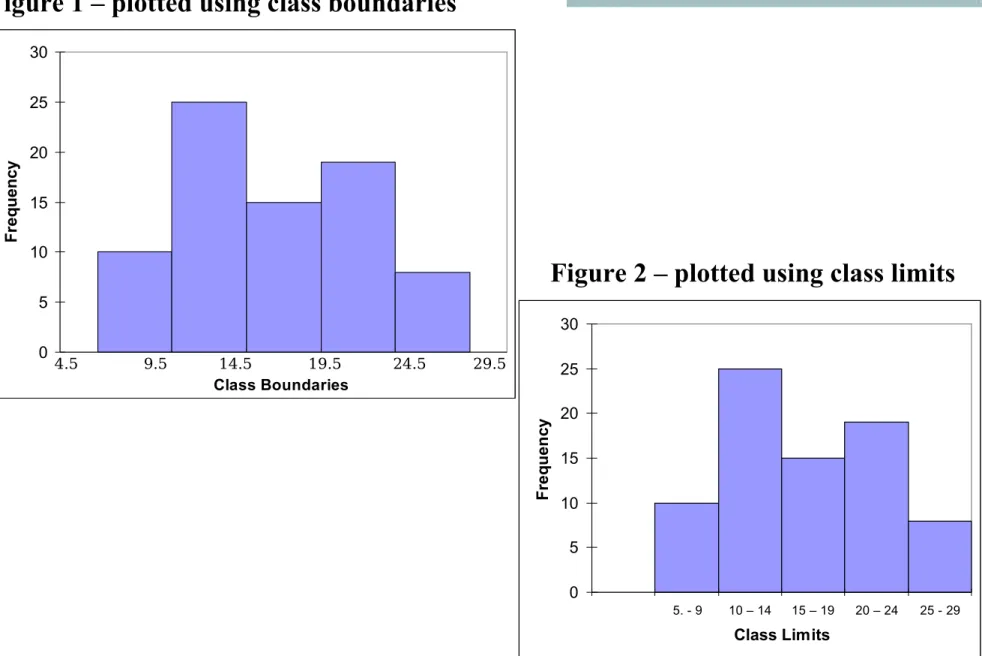
• A graphical way of presenting qualitative data
• Divide data into classes of equal width and the number of
observations in each class is counted (information would be presented in a frequency table)
• Class is on the x-axis (horizontal)
▫ Can plot using either:
Class Limits
Class Boundaries
• Frequency (or relative frequency) is on the y-axis (vertical)
• Bars are drawn where the base of each bar covers the
class and the height of each bar covers the frequency
Figure 2 – plotted using class limits 0 5 10 15 20 25 30
5. - 9 10 – 14 15 – 19 20 – 24 25 - 29
Class Limits F re q u en cy 0 5 10 15 20 Class Boundaries F re q u en cy
4. Frequency Polygons
•
A
Frequency Polygon
is a line graph joining
the midpoints of the bars of a histogram
•
To construct a frequency polygon:
▫ Plot the midpoint of each class (on horizontal) with
its corresponding frequency/relative frequency (on
vertical)
0 5 10 15 20 25
5. - 9 10 – 14 15 – 19 20 – 24 25 - 29
Class Limits
F
re
q
u
en
cy
• Examines how many observations lie below a certain class boundary
• Plotted against the upper class boundaries
Using Frequencies
• The first value in the distribution is ALWAYS zero
• The last value in the distribution is ALWAYS the total
number
Using Relative Frequencies
• The first value in the distribution is ALWAYS zero
• The last value in the distribution is ALWAYS 1
Using Percentages
• The first value in the distribution is ALWAYS zero
0 10 20 30 40 50 60 70 80 90
4.5 9.5 14.5 19.5 24.5 29.5
Class Boundaries F re q u en c y expenditure (J$M) Upper Class Boundaries Number
of Firms Cumulative Frequency
4.5
5 - 9 9.5 10
10 – 14 14.5 25
15 – 19 19.5 15
20 – 24 24.5 19
25 - 29 29.5 8
-• Examines how many observations lie above a certain class boundary
• Plotted against the upper class boundaries
Using Frequencies
• The first value in the distribution is ALWAYS the total
number
• The last value in the distribution is ALWAYS zero
Using Relative Frequencies
• The first value in the distribution is ALWAYS 1
• The last value in the distribution is ALWAYS zero
Using Percentages
• The first value in the distribution is ALWAYS 100
Ad. expenditure (J$M) Upper Class Boundaries Number of Firms More Than Cumulative Frequency 4.5
5 - 9 9.5 10
10 – 14 14.5 25
15 – 19 19.5 15
20 – 24 24.5 19
25 - 29 29.5 8
Total - 77
-0 10 20 30 40 50 60 70 80 90
4.5 9.5 14.5 19.5 24.5 29.5