CHAPTER 10
BIPOLAR DISORDER
STEVE JONES, DOMINIC LAM & ELIZABETH TYLER
CASE EXAMPLE
Sarah is a 38 year old woman with a diagnosis of bipolar I disorder. She reported a difficult
childhood with a mother who struggled with low mood. Her parents separated when she
was 10 years old and she was raised by her mother with very little contact with her father.
At initial assessment she described feeling very different from her peers at school and
often felt lonely and isolated. She experienced some bullying and by the age of 14 she
was regularly skipping classes. She left school at 16 with very few qualifications and
began working as a waitress in a local restaurant. It was here that she began to form
friendships and described feeling accepted and liked for the first time.
Sarah was diagnosed with bipolar disorder at the age of 27 after being hospitalised
for a manic episode. Prior to this she had recently moved down to London to live with
some friends. She had been experimenting with a number of substances such as cocaine,
ecstasy and acid (LSD), and was a regular user of cannabis and alcohol. During the next
three years Sarah experienced a number of episodes of both mania and depression. She
had various jobs such as waitressing and bar work. However, she struggled to maintain a
squat houses and on the street, Sarah re-contacted her mother and asked if she could
move back to the family home.
Sarah moved back to the north of England where she was referred to a community
mental health team and received support from her care coordinator – a community
psychiatric nurse (CPN). Sarah and her CPN worked together to develop an early warning
sign and coping plan which she found useful at times. However she still was experiencing
fluctuations in her mood and was worried about experiencing an acute episode again.
Sarah had taken up a job in a local chain restaurant in the neighbouring town and was on
track for a promotion to management.
When Sarah arrived at therapy she already had acquired some knowledge about
her bipolar experiences due to the work she had carried out with her CPN. However, the
early warning sign and coping plan developed with her CPN was very medically focused.
Coping strategies included taking more medication and calling the psychiatrist. There were
still periods of time where she experienced fluctuations in her mood, which worried her.
There were also other areas of her life that she did not feel happy with, in particular her
ability to form new relationships.
She was currently single and her last relationship was three years ago. She felt that
her past episodes of bipolar disorder had made it difficult for her to maintain a stable
relationship. She had gained two stone in weight and this made her feel unattractive and
gym and being involved in local community arts projects. However since moving back to
her home town she had not pursued any of her previous interests.
CLINICAL FEATURES
Bipolar disorder is characterised by episodes of mania or hypomania and depression.
Much of the clinical research on bipolar disorder has been based on cases diagnosed
using criteria in DSM-IV-TR (American Psychiatric Association, 2000) and these criteria
will therefore be described below. It is of note that these criteria have recently been
updated in DSM-5 (American Psychiatric Association, 2013). Where these changes
significantly impact on criteria this is highlighted in the text. Diagnostic criteria for bipolar
disorder from DSM-5 and ICD-10 are given in Figure 10.1. Depression in bipolar disorder
has the same diagnostic criteria as in unipolar major depression. These criteria are given
in Table 9.1 in chapter 9. The client has to have five (or more) of the following symptoms
present during the same two-week period and these symptoms must represent a change
from previous functioning: depressed mood, marked diminished interest or pleasure,
significant weight loss when not dieting (or weight gain) or decease or increase in appetite,
insomnia or hypersomnia, psychomotor agitation or retardation, loss of energy, feelings of
worthlessness or excessive guilt, impaired concentration or indecisiveness, recurrent
thoughts of death or recurrent suicidal ideation. These symptoms have to be present most
of the day and nearly every day. At least one of the symptoms has to be either depressed
distinct period of abnormally and persistently elevated, expansive or irritable mood, lasting
for one week(DSM-5 requires the presence of increased energy or activity alongside any
of these mood symptoms.)During the period of mood disturbance, three (or more) of the
following have to be present to a significant degree: inflated self-esteem or grandiosity,
decreased need for sleep (e.g. feel rested after only three hours of sleep), more talkative
than usual or pressure of speech, flight of ideas or subjective experience that thoughts are
racing, distractibility, increase in goal-directed activity or psychomotor agitation, and
excessive involvement in pleasurable activities that have a high potential for painful
consequences. One of the symptoms has to be either inflated self-esteem or irritability. If
irritability is the persistent mood, then four other symptoms have to be present. For a
hypomanic episode, the criteria are similar to a manic episode with the exception that the
duration is at least four days. If an episode lasts at least a week and is not severe enough
to cause marked impairment in social or occupational functioning, then it is classified as
hypomania, not mania. If there are psychotic features or the client has to be admitted to
hospital, the episode is classified mania, not hypomania
For a mixed episode, the criteria for both a manic episode and for a major
depressive episode have to be fulfilled nearly every day for at least a two-week period.
Furthermore, the mood disturbance has to be sufficiently severe to cause marked social or
occupational impairment or the episode necessitates hospitalisation to prevent harm to
self or others, or there are psychotic features. Mixed bipolar episodes are rare according
mixed episode. Instead DSM-5 makes provision for a mixed specifier, which can be
applied to either manic or depressive episodes. A mixed specifier can be added to manic
or hypomanic episodes when at least three depressive symptoms are experienced during
the episode. Conversely, the mixed specifier can be added to a depressive episode when
at least three manic/hypomanic symptoms are present during the episode Rapid cycling is
defined as at least four episodes of a mood disturbance in the previous 12 months that
meet criteria for a major depression, manic, mixed or hypomanic episode. There are two
main subtypes for bipolar disorder. For clients to suffer from bipolar I disorder, there has
to be at least one manic episode or mixed episode and one major depressive episode.
For clients to suffer from bipolar ll disorder, there has to be at least one hypomanic
episode and one major depressive episode but no manic or mixed episodes.
EPIDEMIOLOGY
Bipolar disorder is relatively common. Prevalence studies in the UK, continental Europe
and the US indicate a prevalence rate of 1-1.9% of clients meeting formal diagnostic
criteria for bipolar disorder (Bebbington & Ramana, 1995; Merikangas, Akiskal, Angst,
Greenberg, Hirshfiled, Petukhova et al., 2007; Ten Have, Vollebergh, Bijl & Nolen, 2002;
Weissman, Leaf, Tischler & Blazer, 1988). Angst and colleagues have argued that in fact
current diagnostic criteria for bipolar disorder incorrectly exclude people with illnesses that
fit within a bipolar spectrum; when these clients are included, prevalence rates increase to
include clients who experienced symptoms of euphoria, overactivity and irritability for
shorter periods than in current DSM-IV-TR criteria, but who exhibited a significant change
in functioning. In addition to this being a relatively common mental health problem, by no
means all people meeting criteria for bipolar disorder are involved in psychiatric services.
Ten Have and colleagues reported that in their population-based prevalence study, 25.5%
of clients with bipolar disorder had never sought any form of professional help (Ten Have
et al., 2002).
Historically bipolar disorder was seen as being characterised by periods of mania
and depression interspersed with periods of ‘normality’. Contrary to this view, Judd and
others have conducted a series of long term follow-up studies in which individuals with
bipolar I and II disorders spend 32-50% of time in between episodes experiencing
significant mood symptoms primarily depression-related (Post et al., 2003; Judd et al.,
2002, 2003). Such subsyndromal symptoms are associated with increased problems in
functioning and interpersonal relationships and increased risk of future relapses (Judd et
al., 2002; Morriss et al., 2013). Furthermore, there is evidence that, if anything, the course
of bipolar disorder can become more severe with age (Goodwin & Jamison, 1990). Clients
later on in the illness course require only relatively modest external stressors to trigger a
mood episode (Post, Rubinow & Ballenger, 1986; Ambelas, 1987). There are
consequently reductions in inter episode periods with increasing age (Kessing et al.,
Bipolar disorder is associated with high risk of self-harm and suicide. Tondo,
Isacsson and Baldesserini (2003) in a review reported an annual rate of suicide in bipolar
clients of 0.4%, which is twenty times higher than in the general population. A 34-38 year
follow-up study of people with bipolar disorder reported a twelve-fold increase in
successful suicide attempts, which although somewhat lower that that found by Tondo et
al. (2003) still represents a substantially elevated risk (Angst, Stassen, Clayton & Angst,
2002). Estimates vary for rates of suicide attempts. Thirty-four percent of bipolar clients
within the Stanley Bipolar Research Network were found to have a history of suicide
attempts (Leverich et al., 2003), whilst a Dutch study found that 20% of its bipolar sample
had attempted suicide and 59% experienced suicidal ideation (Ten Have et al., 2002).
Risk of completed suicide is also higher for people meeting criteria for bipolar disorder with
recent service contacts than for those who meet criteria for other forms of severe mental
health problem (Clements et al., 2013).
Family studies consistently estimate a higher morbid risk for relatives of bipolar
clients to develop the disorder than the general population (Baldessarini et al., 2012),
ranging from 2-10 times increased risk (Craddock & Jones, 2001; Gershon, Berrettini,
Nurnberger, & Goldin 1989). It is of note that figures for increased depression in family
members are substantially higher than those for bipolar disorder (Craddock & Jones,
2001: Goodwin & Jamison, 1990). A large twin study by McGuffin and colleagues (2003)
estimated 85% heritability for bipolar disorder. They found that most of the genetic liability
non-shared environmental correlations between mania and depression. It is, however,
worth noting that the concept of heritability can be problematic. There is an assumption
that high heritability means that a particular outcome is genetically predetermined and that
findings can be readily generalised across samples. This is not the case, because
heritability estimates are based on the assumption that environment and genes do not
interact which is rarely true (Visscher, Hill & Wray, 2008: Joseph, 2003).
There are a number of co-morbid conditions, especially personality, substance use
and anxiety disorders, that need to be considered with respect to bipolar disorder.
Personality disorders
Personality Disorders have been estimated to occur in 10-13% of community samples
(Samuels, 2011; Weissman, 1993). A replication of the National Comorbidity Survey in US
based on a community sample of 5692 adults reported an odds ratio of 9.8 for risk of any
personality disorder in participants with bipolar disorder, with figures particularly elevated
for the presence of comorbid antisocial or borderline personality disorder (Lenzenweger et
al., 2007). The presence of a personality disorder has been associated with more severe
residual mood symptoms in adults (George, Miklowitz, Richards, Simoneau & Taylor,
Substance misuse
The US Epidemiological Catchment Area study reported that 61% of clients with bipolar I
disorder also met lifetime criteria for substance use disorders (Regier et al., 1990). High
rates of substance use disorders among those with bipolar disorder have been reported in
numerous studies across a range of different populations in different countries (Strakowski
& DelBello, 2000; Cassidy, Ahearn & Carroll, 2001). The recent updated NICE guidelines
for bipolar disorder reported a lower, but still elevated, substance use disorder rate of 40%
in people meeting criteria for bipolar I or II disorders (NICE, 2014).
Anxiety
Many people who live with bipolar disorder also experience significant anxiety symptoms.
Lifetime anxiety disorders have been reported in 93% and concurrent anxiety disorders in
32% of individuals with bipolar disorder (McIntyre et al., 2006; Otto et al., 2006). The
presence of comorbid anxiety is associated with a range of issues including poorer
treatment response and greater risk of further episodes of mania and depression (Feske
et al., 2000: Rucci et al., 2002). These findings have led Provencher et al. (2011), among
others, to call for the development of psychological approaches to addressing anxiety in
the context of bipolar disorder. A current trial by our team is therefore evaluating the
benefits of delivering an integrated CBT intervention for both bipolar disorder and anxiety
Co-morbid personality disorders, anxiety disorders and alcohol and drug problems
are all associated with poorer therapeutic outcomes, potential difficulties with therapeutic
engagement, higher levels of symptomatology and more frequent hospitalisations. Each
of these issues can also elevate risks of self-harming and suicidal behaviours.
In addition to consideration of the role of co-morbid conditions, there is also the
issue of distinguishing bipolar disorder from other disorders, especially schizoaffective
disorder. Structured interview approaches indicate that it is possible to reliably diagnose
bipolar I and bipolar II disorders (Andreasen, Grove et al., 1981; Rice et al., 1992;
Simpson et al., 2002). The main diagnosis that overlaps significantly with bipolar disorder
is schizoaffective disorder. With DSM diagnostic criteria psychotic symptoms can occur in
extremes of mania or depression. The difference between psychotic symptoms associated
with bipolar disorder and schizophrenia-spectrum diagnoses, such as schizoaffective
disorder, is that in bipolar disorder psychotic symptoms abate when mood symptoms
resolve. Some diagnostic confusion can occur when the bipolar disorder is chronic, as the
psychotic symptoms may then appear to be persistent.
ASSESSMENT
A comprehensive assessment is a prerequisite for therapy. There is also an interaction
between assessment and therapy processes. In many cases, the information drawn
together through a proper assessment will provide the client with their first opportunity to
previously recalled as separate events. This alone will potentially be therapeutic, as well
as enhancing engagement with the therapeutic process. Also, although much of the
assessment will occur early in therapy, there will be times later in therapy when
opportunities to acquire additional information may occur, such as through meetings with
third parties. This interaction between therapy and assessment is a characteristic of
successful therapy with bipolar clients.
Individual and family history
The assessment process should begin with an interview designed to elicit information
about the history of the individual and their family. We know from research that many
people with bipolar disorder will have other family members who present with affective
disorders of various types. Where there has been affective disorder amongst the client’s
parents, this may have caused disruption during their development due to parenting style
being affected by mood. For example, when the affected parent was depressed, they may
have been more cold and critical and when they were high, they may have been less
responsible with their financial affairs or less involved with their children. Identifying this,
and their perception of its impact on the client’s life, is an important part of assessment. In
general, as with other forms of cognitive therapy, the aim of history taking is to get a sense
of how the individual has come to his or her own particular beliefs about the world, self
Mental health history is also a crucial part of assessment. Many clients will have
experience of psychiatric interviews and may not immediately see the relevance of
reviewing this area. The key difference for a psychological assessment is that you are
working with the client to identify their own perception of mood fluctuations, whether or not
these amounted to ‘psychiatric symptoms’ at the time. Once information concerning mood
change is collected, it is helpful to lay it out chronologically on a life chart, on which is also
included information about life events, medication, education and occupation. The
development of a life chart, drawn up collaboratively with the client, may show
interrelationships between mood and other important factors. It can provide an important
summary of key episodes. It may also help clients look for patterns of illness, stresses,
educational and occupational achievements. This information also serves to illustrate that
often mood change occurs within a context, rather than being an event that occurs out of
the blue. Furthermore, by linking medication, mood, episodes and academic/occupational/
personal achievements, clients are helped to see that all these factors are linked and have
potentially important roles in helping clients’ to manage their bipolar disorder. Life charts
can help to provide evidence for which of these elements are most important in influencing
clients’ mood and in achieving better occupational and social functioning.
A life chart for Sarah, the subject of the case study at the start of this chapter, is
presented in Figure 10.1. This life chart illustrates significant mood variability prior to
Sarah’s first diagnosed manic episode. It also demonstrates how changes in her mood
A further important issue is that clients will have views about both medication and
diagnosis. Clients will often have mixed feelings about the medication that they have been
prescribed. Considering these views and feelings in relation to the life chart can prove a
useful introduction to later sessions at which adherence issues are discussed. Clients will
also vary in their views of their diagnosis and exploring this may be an important factor.
Some people will feel that their diagnosis is helpful to explain and validate their mood
experiences and may provide a pathway to appropriate treatment. In contrast, other clients
will believe that the diagnosis is a label that they do not accept, as it is associated with
stigma and a loss of identity. In both cases awareness of the client’s perception will be key
to the development of shared therapy goals and avoiding harmful conflicts within therapy.
Other areas which assessment can usefully address include current mood state,
initial information on coping with early warning signs of the onset of manic or depressive
episodes, levels of dysfunctional beliefs and experience of stigma. In addition, given the
patterns of self-harm and suicide risk associated with bipolar disorder, it is important to
assess hopelessness and suicidality during a preliminary evaluation and subsequently.
Information can also be obtained on the resources at the individual’s disposal, both in
terms of social skills and sources of professional and informal support. All of this
information can be helpful in understanding each client’s experience of personal recovery
and quality of life. For each of these areas, it important to use careful questioning within
and observer-rated measures to provide a comprehensive picture. Useful measures are
considered below.
Self Monitoring
During assessment it is explained that self-monitoring is an important part of treatment. It
is emphasised that a lot of the important aspects of therapy will happen between session
and having information about how the client is feeling and what they are doing between
sessions is important in ensuring that they achieve the best possible outcome for the
intervention. Initially clients will complete brief mood measures. As therapy proper
progresses, monitoring of activities, mood and thoughts becomes increasingly important.
Standardised Measures
There are a number of measures that we have found helpful in initial and ongoing
assessment during therapy. These are discussed in turn below. In each case the
information from these measures is used in combination with information from assessment
and questioning of the client regarding the issue under consideration.
Current mood state measures
Beck Depression Inventory (Second Edition), (BDI-II; Beck & Steer, 1987; Beck, Steer & Brown, 1996). This is a 21 item self-report inventory that assesses for
depression), 14-19 (mild depression), 20-28 (moderate depression), and >29
(severe depression).
The Beck Hopelessness Scale (BHS; Beck & Steer, 1988). This is a 20-item self-report measure. Beck self-reported that scores of 9 or above were significantly
predictive of eventual suicide in individuals with suicidal ideas followed up over up
to 10 years (Beck et al. 1985). Score ranges are: 0–3 normal, 4–8 mild, 9–14
moderate and >14 severe.
The Internal States Scale (ISS; Bauer et al., 1991, 2000). On this instrument clients use visual analogue scales to rate 16 different internal states covering
perceived conflict, activation, well-being, depression and global bipolar.
The Altman Self Rating Mania Scale (ASRM; Altman et al, 1994). This is a self-report questionnaire for measuring manic symptoms. It consists of five groups of
five statements. Clients are required to read each group of statements and chose
one statement from each group that describes the way they have been feeling for
the past week. A total score of 5 or more indicates mania.
Recovery
The Bipolar Recovery Questionnaire (BRQ; Jones et al, 2012). This is a 36-item self-report measure, developed through extensive consultation with individuals with
lived experience of bipolar disorder. It is designed to assess personal experiences
Quality of life
The Brief Quality of Life in Bipolar Disorder (QoL.BD; Michalak & Murray, 2010). This is a 12-item disorder-specific quality of life measure in bipolar disorder.
Early warning signs and coping
The Coping with Prodromes Interview (Lam et al., 2001). This provides a helpful initial indication of the individual’s approach to mania and depression early warning
signs. It allows the clinician to capture the individual nature of each person’s early
warning signs. This information is then included in the assessment of prodromal
coping as part of the cognitive therapy intervention. It can also be helpful to use a
checklist of the sort developed by Lobban et al (2011) to facilitate the identification
of early warning signs. These are particularly helpful if the client is finding it difficult
to identify or articulate the symptoms which they experience.
Clinical rating scales
Observer rated measures can provide a useful was of evaluating a client’s current mood
state. Training is required to administer them correctly. The following may be suitable:
depression), 10-13 (mild depression), 14-17 (mild to moderate depression) and >
17 (moderate to severe depression).
Mania Rating Scale (MRS; Bech, Rafaelsen et al., 1978). This assess 11 symptoms of mania or hypomania based on observations during the clinical
interview. The total MRS score is categorised as follows: 0-5 (no mania), 6-9
(hypomania), 10-14 (probable mania) and >15 (definite mania).
A small battery of tests can usefully be employed at the beginning and end of therapy,
which includes the BRQ, QoLBD and the BHS. If necessary, the BDI and ISS may be
employed on a sessional basis to obtain essential clinical information.
TREATMENT FOR BIPOLAR DISORDER
Bipolar disorder has traditionally been perceived as a genetic and biological illness, with
medications such as lithium prescribed as the main source of treatment. However over the
past 15 - 20 years the importance of psychological treatment for bipolar disorder has been
recognised. Structured psychological therapies are now recommended in the UK National
Institute of Clinical Excellence guidelines (NICE, 2014) for the treatment of bipolar
disorder.
There is increasing evidence that psychological and social factors have an
important impact on the onset and course of bipolar disorder. A number of studies have
demonstrated the relationship between life events (e.g. stress) and the onset, severity and
Psychotherapy for bipolar disorder is often carried out in conjunction with
pharmacotherapy. Stress which precipitates the onset of episodes of depression or mania
does not have to be an acute upsetting life event. It can be a build up of life’s hassles.
The way an individual responds to these life hassles can alleviate or exacerbate them.
Psychotherapy may help clients to examine strategies that help them deal with the stress
that may present in their life. In addition to a biomedical approach, there are four major
approaches to psychotherapy for bipolar disorder: psychoeducation (Colom et al., 2006),
cognitive therapy or cognitive-behaviour therapy (CT or CBT, Lam et al. 2010),
interpersonal and social rhythm treatment (IPSRT, Frank, 2005) and family focused
treatment (FFT, Miklowitz, 2008). These approaches will be described below, with
particular emphasis on CBT clinical practice with clients with bipolar affective disorder.
Psychoeducation is a common element for all of these approaches, and will briefly be
discussed first.
PSYCHO-EDUCATION
Psycho-education is based on the rationale that treating a condition such as bipolar
disorder is not just about prescribing medication. It assumes that with more information
about bipolar disorder clients will be able to engage more actively with their own treatment
and therefore improve their clinical outcomes. Colom reported a randomised controlled
study of 120 bipolar clients. The treatment group received medication and 20 sessions of
medication and 20 non-structured group sessions. Group sessions were 90 minutes each
and each group consisted of eight to twelve euthymic clients (Young Mania Rating Scale <
6, Hamilton Depression Rating Scale <8). The therapists’ style was directive but also
encouraged clients’ participation. Topics included in the psychoeducation group included
prompting illness awareness, medication adherence, early detection of prodromes and
prompting life style regularity. There was a significant impact on relapse rates and
number of episodes in participants in the psychoeducation group both during therapy and
at two-year follow-up (Colom et al., 2003). This study is unusual in finding objective
evidence of increased medication adherence in the psychoeducation group at follow-up.
The gains were still present at five year follow-up. The psycho education group had fewer
recurrences of any type and spent less time acutely ill (Colom et al., 2009). There are two
potential problems with this approach. First, its expense, as it was delivered by senior
clinicians. Secondly, clients have to be very stable with minimal symptoms for six months
prior to the start of the group. It is unclear how easy it is to gather such a group of bipolar
clients in routine practice, as most experience significant levels of subsyndromal
symptoms and how well this directive approach would be received in settings different to
the specialist treatment centre where the research was conducted. Morriss et al. (2011)
are in the process of evaluating a multi-centre trial to determine the clinical and cost
effectiveness of delivering a joint expert patient and health professional led 21-week group
BIOMEDICAL APPROACHES
The treatment for bipolar disorder in the past three decades has been predominantly
pharmacological. There are several pharmacotherapy treatment guidelines for bipolar
disorder This include the second edition of the American Psychiatric Association Practice
(2010) Guideline for the Treatment of Patients with Bipolar Disorder, the World Federation
of Societies of Biological Psychiatry (WFSBP) Guidelines for Biological Treatment of
Bipolar Disorders, Part 1: Treatment of Bipolar Depression (Grunze, Kasper et al., 2002),
the Evidence-based guideline for treating bipolar disorder: recommendations from the
British Association for Psychopharmacology (Goodwin, 2003), as well the recently
updated UK NICE (2014) guidelines for bipolar disorder which makes specific
pharmacological and psychological recommendations for each phase of bipolar disorder.
Readers are recommended to refer to these guidelines for more details when necessary.
This section summarises the recommendations.
Pharmacotherapy in bipolar disorder can be divided into treatment of acute manic,
depressive, or mixed episodes, as well as long-term preventive treatment. For severe
acute manic or mixed episodes, an antipsychotic or mood stabiliser such as haloperidol,
olanzapine, quetiapine or risperidone is suggested. For less severe manic episodes,
lithium may also be used as a short-term therapeutic agent. If the client is taking
NICE recommends fluoxetine and olanzapine as the first line pharmacological with an
alternative option of quetiapine.
For long-term treatment, a number of agents are used to prevent relapses, which
require careful serum level monitoring. Based on current evidence lithium is recommended
as the first line medication for long-term relapse prevention. Alternatives if this proves
ineffective or unacceptable to the client are valproate or olanzapine.
Twenty to 40% of bipolar clients do not appear to benefit from lithium (Prien &
Potter, 1990; Goodwin, 2003).This may be due to both difficulties with adherence as well
as limitations in the effectiveness of the medication itself. Non-adherence rates for lithium
have been estimated at between 18-53% (Goodwin & Jamison, 1990; Maj, 2003). Lithium
has a narrow therapeutic band, meaning that therapeutic and toxic levels of lithium are
quite close to each other. Although many other new mood stabilizers are commonly used
in clinical practise (Moncrieff, 1995; Solomon et al., 1995), it was recently concluded that
‘the only medication with incontrovertible proof of efficacy in multiple maintenance-phase
studies is lithium’ (Gnanadesikan, Freeman & Gelenberg, 2003). With regard to the newer
mood stabilizers, olanzapine is more effective in preventing mania whereas lamotrigine
has been found to have a long-term role in delaying or preventing the recurrence of
depressive episodes. (Calabrese, Shelton, Rapport, Kimmel & Elhaj, 2002).
Other antipsychotics such as clozapine are also used clinically but more research is
needed as the adverse side effects associated with antipsychotics may outweigh the
COGNITIVE BEHAVIOURAL APPROACH
Rationale for the cognitive behavioural approach
The manifestation of bipolar disorder is predominately affective, cognitive and behavioural.
Clinically, it has been observed that mania can fuel itself. The chaotic and disruptive
lifestyle which occurs during manic episodes can lead to more episodes. This suggests
that psychotherapy targeting these areas can be useful. Some individuals with bipolar
disorder who have frequent relapses often engage in striving behaviour to “make up for
lost time”. Hence, it is important to help clients develop good daily living routines and to
target their extreme striving or goal-attainment beliefs, and related behaviours. Early
detection of early warning signs of manic or depressive episodes and application of
effective coping strategies during the prodromal phases are also important in preventing
the development of a full-blown episode. Both promoting a good daily routine and helping
clients detect and cope with early warning signs or manic or depressive episodes involve
self-monitoring and self-regulation. These skills are learned in CBT.
CBT is based on the assumption that our thoughts, mood and behaviour affect
each another. Therapists work with clients to develop a formulation and set of goals for
therapy. Following this a range of cognitive and behavioural techniques are utilized to
monitor, examine and change patterns of unhelpful thinking and behaviour that are
associated with undesirable mood states. Hence, CBT is well suited to helping bipolar
A number of randomized controlled trials of individual CBT have been published
(Ball et al, 2006; Jones et al, 2015; Lam et al., 2003, 2005; Meyer et al, 2012; Miklowitz et
al, 2007; Perry et al, 1999; Scott et al, 2001, 2006; Zaretsky et al, 1999). These studies
show that CBT has been most effective in preventing episodes for individuals who are
euthymic and in the reduction of depressive symptoms (Lam et al., 2010).
A study by Lam et al. (2003) illustrates the positive effect of cognitive therapy (CT)
on bipolar disorder. Lam et al. conducted a randomised controlled study of 103 DSM-lV
bipolar I clients who were experiencing frequent relapses whilst taking prescribed
commonly used mood stabilisers. Participants were randomised into a CT group or a
control group. Both groups received mood stabilisers and regular psychiatric follow-up.
The CT group received, on average, 14 sessions of CT during the first six months and two
booster sessions in the second six months. Over the 12-month period, the CT group had
significantly fewer bipolar episodes, days in a bipolar episode and admissions. They also
had significantly higher social functioning and showed less mood symptoms on monthly
mood questionnaires as well as less fluctuation in manic symptoms. In a two year
post-therapy follow-up there remained a significant effect in favour of post-therapy for relapse
prevention of depressive but not manic relapses. However, the impact on relapse was
restricted to the first 18 months of follow-up (Lam et al., 2005). The findings indicate that
CT specifically designed for relapse prevention in bipolar affective disorder is a useful
intervention in conjunction with mood stabilisers. It was suggested that the effect of
relapse beyond the 18-month follow-up period. Both Scott et al. (2001) and Ball et al.
(2006), using a similar approach with bipolar patients, reported improvement mainly in
depressive episodes.
Not all controlled trials of CBT for bipolar disorder have found it to be helpful. In a
study of 253 participants, Scott et al (2006) did not find any beneficial effects of the
addition of CBT to routine medication. However, participants were at various stages of
illness. Thirty-two percent of the sample were in an acute episode of depression, mania,
hypomania or mixed state. Lam (2006) argued that there were inherent difficulties with the
study design, which included the therapeutic techniques that were utilized at different
phases of illness, meaning that it was hard to interpret what was being evaluated. More
recently, Jones et al (2015) compared CBT designed to enhance personal recovery
outcomes in individuals with recent bipolar disorder (<5 years) with treatment as usual.
This study of 67 individuals found evidence of significant improvements in personal
recovery and increased time to relapse of depression or mania over up to 15 months
follow-up.
Coping with bipolar early warning signs
In bipolar disorder, the early warning sign period extends from the time of the first
appearance of symptoms to the time when a full-blown episode is evident. The phrase
“early warning sign” is often used as shorthand for the symptoms at this early stage of an
disorder can detect early warning signs (Joyce, 1985; Lam & Wong, 1997; Molnar, Feeney
& Fava, 1988; Smith & Tarrier, 1992), a finding confirmed in a longitudinal study by Perry
et al. (1999) that evaluated the effectiveness for people with bipolar disorder of an
intervention for identifying early warning signs and the development of action plans.
They reported a significant reduction in manic episodes, which was maintained at
18-month follow-up. Lobban et al. (2010) used a cluster RCT design and trained
care-coordinators to deliver enhanced relapse prevention in their multidisciplinary
environments. This study found that time to relapse was increased in people receiving the
intervention and social and occupational functioning was improved.
There is a consensus that each client's pattern or combination of early warning
signs and symptoms may be unique. Hence using a checklist to elicit early warning signs
has the inherent problem of losing some of the more idiosyncratic early warning signs.
Asking for spontaneous reports of early warning signs has the advantage of personalising
the early warning signs in the individual's context. Some examples of idiosyncratic early
warning signs are “Thought for the Day” on Radio 4 seemed to convey a special message
to the client or the client’s family dog became evil. However checklists can be helpful at
times as a starting point if a client is struggling to detect idiosyncratic signs (e.g., Lobban
et al., 2011; Smith & Tarrer, 1992).
Studies have found that 25 - 30% of bipolar clients could not detect early warning
signs of depression whereas only 7.5% could not detect early warning signs of mania
detect depression early warning signs could be due to its insidious onset. Another
problem for many bipolar clients is that some depression early warning signs are not
qualitatively different from their residual symptoms. This makes the detection of such
early warning signs more difficult. Across the studies that listed individual early warning
signs, there was strong agreement about early warning signs of mania. Six most often reported early warning signs of mania were sleeping less, more goal-directed behaviour,
irritability, increased sociability, thoughts starting to race and increased optimism. The
most common early warning signs of depression reported across studies were loss of
interest in activities or people, not able to put worries or anxieties aside, interrupted sleep,
and feeling sad or wanting to cry. Clients reported fewer depression early warning signs and there seemed to be diversity in the report of prodromal signs and symptoms of
depression.
Lam, Wong and Sham (2001) reported that bipolar clients could reliably report
mania and depression early warning signs eighteen months apart. The duration of manic
or depressive early warning stages varies from individual to individual. However, it is
encouraging that most clients have a reasonable period for early intervention prior to a
full-blown episode. For example, Smith and Tarrier (1992) reported that in their study, average
duration of early warning signs of depression was 19 days (Standard Deviation = 19 days)
and average duration of mania early warning signs was 29 days (Standard Deviation = 28
signs lasted on average 20.5 days (with a range from 1 to 84 days) whereas average
length of depression early warning signs was 11 days (with a range from 2 to 31 days).
Ratings of how clients coped with mania early warning signs contributed
significantly to the clients’ level of functioning at baseline after clients’ depression and
mania symptoms were controlled for statistically (Lam & Wong, 1997). These also
predicted clients’ manic symptoms eighteen months later and whether clients had
relapsed during the eighteen months after the levels of mood symptoms at baseline were
controlled for (Lam, Wong, & Sham, 2001). The most common good coping strategies for
early warning signs of mania employed by participants were: ‘modifying high activities and
restraining themselves', ‘engaging in calming activities', ‘taking extra time to rest or sleep'
and ‘seeing a doctor'. Poor coping strategies included ‘continuing to move about and
take on more tasks', ‘enjoying the feeling of high', and ‘going out more and spending
money’. It is interesting to note that the spontaneous coping strategies reported by clients
are behavioural. The most common coping strategies for depression early warning signs
were ‘getting myself organised and keeping busy', ‘getting social support and meeting
people', ‘distracting myself from negative thoughts by doing more’ and ‘recognising
realistic thoughts and evaluating if things are worth worrying about'. Poor coping strategies
included ‘staying in bed and hoping it would go away', ‘doing nothing' and ‘ taking extra
Dysfunctional attitudes
Despite the encouraging outcome in developing CBT for bipolar affective disorder (Lam, et
al., 2010; Lam, Watkins et al., 2003; Scott, Garland & Moorhead, 2001), very little is
known about whether there are any differences in dysfunctional attitudes between unipolar
clients, bipolar clients and normal controls. The cognitive model for bipolar
disorder postulates high goal striving as a risk factor for bipolar disorder (Lam et al., 2010;
Wright and Lam, 2003). Scott and colleagues (2001) found that euthymic bipolar clients
showed significantly higher scores on the Dysfunctional Attitudes Scale (DAS) as well as
the “Need for Approval” and “Perfectionism” subscales than healthy control. Lam, Wright
et al. (2004) in a principal component analysis of the 24-item short DAS of 143 bipolar 1
clients found three factors: factor 1 “Goal-attainment”, factor 2 “Dependency” and factor 3
“Achievement”. No significant differences were found when the validation sample of 143
bipolar 1 clients was compared with 109 clients suffering from unipolar depression on any
of the three factors. When participants who were likely to be in a major depressive episode
were excluded, the scores of bipolar clients were significantly higher than euthymic
unipolar clients in factor 1 “Goal attainment”. Goal-attainment also correlated with the
Clinical practice: cognitive therapy techniques Engagement
As with any form of psychological therapy, engagement is crucial for good therapeutic
outcomes. For a cognitive therapy approach to bipolar disorder, it is important that the
client understands and accepts a version of our basic vulnerability-stress model of bipolar
disorder. However, like all other aspects of therapy with this client group, this cannot be
achieved in a didactic fashion. Engaging clients with the model needs to be achieved in a
collaborative manner, which makes sense to them in terms of their own individual
experience. There are several approaches to this that we normally take in therapy.
Written information
We usually provide the client with written information about cognitive therapy for bipolar
disorder and the model on which it is based. This is typically done in the first or second
session. The handout which we use has been published elsewhere (Lam et al., 2010). The
client is asked to read this and to give feedback on the elements of this information that is
helpful and less helpful. The client is given clear permission to disagree with some or all of
the information, so that we can engage in a genuine discussion about the approach.
There are two issues that can arise, either following discussion of the handout
Mental health difficulties on a continuum
Some clients do not believe that the diagnosis that they have been given is correct. They
may either think that their experiences are just part of who they are and therefore not an
illness; or sometimes that there is an illness present but not bipolar disorder. Where this
issue arises, it is not helpful to get into a debate about the rights and wrongs of diagnosis.
Usually it is helpful to have a discussion about the psychological approach to mental
health/illness that assumes that an individual’s' propensity for different mental health
problems is arrayed across continua. Therefore, if an individual can acknowledge that they
are having some problems in living which they would like help with, it is usually possible to
engage in therapy even if they deny that they have bipolar disorder per se.
Integrating medical and psychological models of illness
Some clients are over-compliant with a medical model of illness. This means that they see
their illness in terms of a chemical imbalance that requires pharmacological correction.
This is not surprising, as clients often report that this is the message they have taken from
their meetings with their psychiatrists. It can often be helpful in this situation to engage in a
discussion about the interaction between psychological and social factors in a wide range
of medical problems including asthma, arthritis and diabetes. This can help the client to
see that there is a false dichotomy between medical and psychological aspects of both
physical and mental health problems and that optimal outcomes are often achieved by an
Engagement as a process
Engagement is not something that happens in the first few sessions of therapy and is then
safely ignored. Although you need to engage clients to begin therapy, you also need to
maintain this as therapy continues. For individuals with strong achievement motivation and
perfectionism, characteristic of many bipolar clients, the overall cognitive behavioural
approach is very helpful in maintaining engagement. Taking a genuinely collaborative
problem-solving stance in therapy can help therapists to avoid getting locked into conflicts
or battles of wills with the client. It is crucial to respect the client’s own perspective even
when this does not seem to be correct therapeutically, but also to explore this with
Socratic questioning and other cognitive techniques. This balance is important, as in our
experience bipolar clients are very alert to when therapists are using questioning in a more
Life charts and shared account of symptom development
Life charts are a common part of cognitive behaviour therapy. An example of a life chart
for Sarah, the subject of the case study described at start of this chapter, is given in Figure
10.1. Life charts are especially crucial for engagement and therapy with bipolar clients.
The process of developing and applying life chart information is dealt with in detail later in
the chapter. At this stage it is useful to highlight that working with the client to generate
accounts of the interaction between mood episodes, psychological factors, behaviour, life
events, medication and substance use is crucial to engagement. When the client is aware
that there is a pattern to their experiences it also indicates that this pattern can potentially
be changed. Many individuals will initially see their episodes as coming out of the blue.
The realisation that this is not the case is often a key moment in engaging clients with the
therapeutic intervention.
Formulation
CBT for bipolar disorder is best delivered on the basis of an individual formulation. The
client and therapist work together to build an initial formulation and set of goals for
therapy. This includes information gathered during the assessment phase such as
symptom and life histories and also from formal psychometric measures, which are
detailed in the previous section. Generating a large, detailed formulation can sometimes
be overwhelming for the client. It can therefore be helpful to start with simple, maintenance
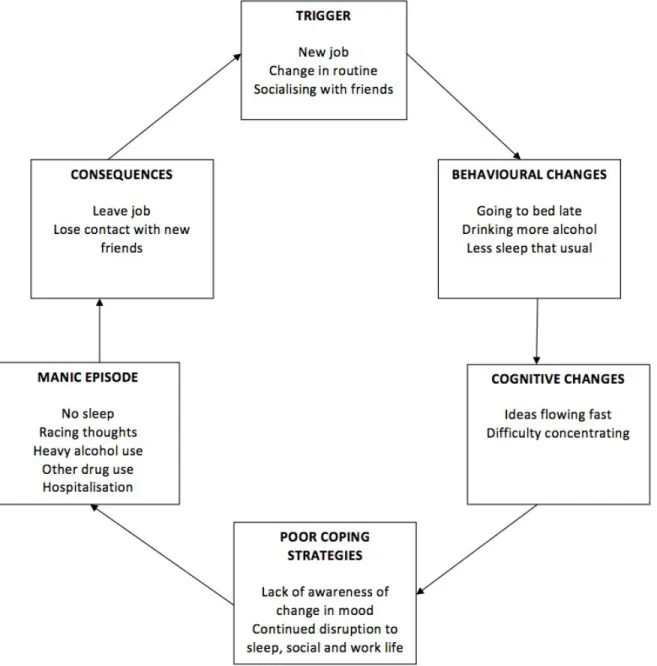
A simple formulation presented in Figure 10.2 was developed for Sarah, mentioned
in the case study at the start of the chapter. The formulation is based on a past episode of
mania. When Sarah returned from London she started work at a bar in her nearest town.
The bar was short-staffed so Sarah took on extra shifts and was working almost every
day. She also began to stay late as there was a culture of staff drinks after closing hours.
She enjoyed the social aspects of the job as everyone was a similar age and shared
common interests. The change to Sarah’s social and sleep routine triggered the early
warning sign phase. As Sarah was unaware of the change in her mood she continued to
engage in activities which further disrupted her sleep, social and work routine, which
eventually led to a full blown manic episode.
Building a formulation of this type allows the client to begin to see how specific
elements of CBT (including intervention during the early warning sign stage) can impact
on their own pattern of thoughts, feelings and behaviours.
Goal Setting
The setting of agreed goals is a further important part of cognitive therapy. There are a
broad range of goals that clients might report and some of the main areas are discussed
below. It is important the therapist and client work together to identify the goals which are
important for the client. Therapists therefore need to be alert to goals which are generated
for others or because the client ‘feels they should’. As with other client groups, unless the
made substantially more difficult. Areas for goal setting include both symptom reduction,
and pursuing valued life goals.
Symptom reduction
Clients will often highlight a desire to learn cognitive therapy techniques to help them to
reduce and control symptoms of mania or depression. Sometimes initial goals are
unrealistic, for example, ‘to never feel low again’ or ‘to be happy whatever happens’.
Clearly it is important to acknowledge that such goals are understandable but also
unrealistic. This can lead onto a discussion of what could be reasonably expected in these
areas.
Whilst Sarah (mentioned in the case study at the start of the chapter) had not
experienced an acute episode of depression or mania for the past three years, she still
was experiencing fluctuations in her mood, in particular depression. Sarah was due a
promotion to management. Because of her past experiences she was worried that this
might trigger an acute episode. She identified a goal of increasing control over her mood
symptoms so they had less impact upon her life. This would be achieved by further
exploration of her early warning signs and the development of a detailed coping plan.
Life goals
Whilst some clients will highlight symptom issues from the outset, others will not. Many
on practical aspects of their life. This may be in terms of family relationships, work, study
or other areas. This frustration will often be associated with a desire to fix problems totally
and immediately. Again this should be discussed in an open way. With functional goals it
will often be important to work out what might be realistically achievable within therapy and
then to break down the steps towards such large valued life goals.
Sarah was currently single and her last relationship was three years ago prior to her
last manic episode. She had gained two stone in weight and this made her feel
unattractive and low in confidence. She had previously been a very active person who
enjoyed going to the gym and being involved in local community arts projects. Sarah’s
goals for therapy were to lose weight through both diet and exercise, take up drawing
again and become more involved in the local art community. She felt this would give her
the confidence to seek out a new relationship, which was her long-term goal. Sarah and
the therapist worked together in a collaborative manner to evaluate each of these goals.
They discussed over what time scale each goal might be realistically possible and the
circumstances which might enhance or impede progress. From there it was possible to
identify specific steps with respect to each goal.
In addition to symptom reduction, and pursuing valued life goals additional goals
may include medication adherence, building social networks, challenging dysfunctional
beliefs, introducing structure and routine into one’s life, reducing risky behaviour,
identifying early warning signs for relapse, and working with unrealistic positive thoughts.
Medication adherence
Evidence to date indicates that cognitive therapy is effective for bipolar disorder in
conjunction with appropriate medication. Therefore adherence to medication regimes may
be identified as therapeutic goal. The target here would be to work with the client to
identify an adhere to an optimum system of pharmacological treatment. This involves the
client being supported in working actively with their psychiatric team to address limitations
of current medications and for clients to have a clear say in their own treatment. In our
experience, it is important for clients to identify a prescribing clinician with whom they can
develop a collaborative relationship (including use of PRN (as needed) medication to
address prodromal changes).
Building social networks
As indicated in the assessment section above, many bipolar clients, even when remitted,
will have some social difficulties. These are often made worse by having a limited social
network. Sometimes this network will have been reduced over time as a consequence of
episodes of illness. Working with the client to build up a combination of formal and
informal support can be important in maintaining therapy gains.
One of Sarah’s goals for therapy was to become more involved in the local arts
community. She had tried going to events in the past but was very nervous about arriving
and Sarah identified a local drawing group. Sarah felt anxious about the first session but
the pros and cons of attending were evaluated. The therapist and Sarah discussed her
past experience of attending events and brainstormed ideas so that she felt more in
control of managing the situation. This included staying until the end of the group where
there was time to initiate conversations with people. With this support Sarah was able to
attend the drawing class and by the end of therapy had taken a small role in the
organisation of a local arts and craft event.
Challenging dysfunctional beliefs
There is no evidence that dysfunctional beliefs have a causal role in the onset of bipolar
illness. Indeed they may act as a coping mechanism. However, it is postulated that these
beliefs may interact with the illness and predispose bipolar clients to have a more severe
course of illness. Clinically it is observed that clients with highly driven beliefs are more at
risk of further episodes, sometimes through lack of routine and structure and at other
times through disappointment. These beliefs can be tackled by traditional cognitive
therapy techniques. A list of pros and cons of such extreme beliefs can help clients to
step back and examine the drawbacks of such beliefs. In doing so, it is important to
acknowledge the advantages of having such beliefs. A life chart (such as that given in
Figure 10.1) can also be a very useful tool for both the client and the therapist for clarifying
the nature and effects of past coping behaviour. It is important that further behaviour
altering dysfunctional beliefs and establishing more functional behaviour. For example,
having understood that “catching up for lost time” is part of very driven behaviour which
can be counter-productive, clients can be encouraged to have more regular work and rest
patterns that may lead to more stable mood, which in turn lead to more productive work
results.
Structure and routine
Vulnerability-stress models note the importance of daily structure and routine for
individuals with bipolar disorder. The development of structure is an important part of
cognitive therapy. Clients record their patterns of activity from early on in therapy,
completing an activity schedule that covers 24 hours a day. This is important as many
clients will not have a stable routine when they enter therapy. They may have very erratic
sleep patterns and may be more active at night than during the day. Working to improve
this situation is not as simple as it may first appear. Many individuals with bipolar disorder
are highly motivated, driven people. If they feel that they are being asked to engage in
behaviour that they see as restrictive or limiting, they will not engage. The information
used from the assessment process is employed to look at the extent to which chaos may
have been associated with previous mood history. There then follows a baseline period of
activity recording to establish current patterns. Normally the client will also record their
mood on the same chart for each day between -10 (lowest ever) and +10 (highest ever). It
The process of increasing daily structure and routine is best done as an experiment to see
whether it has an impact on mood and mood stability. When planning this, the therapist is
aiming to increase the predictability of key markers in the day, such as sleep, wake and
main meal times. It also provides an opportunity to plan for a balance of activities during
the week between domestic, leisure and work tasks. Although clients may be initially
sceptical about this process, they often find that it has significant benefits. They often
report being more productive and creative when their routine is less chaotic. There is also
the potential for planning for periods when disruption is unavoidable. For instance when a
client is going to undertake transatlantic travel, it is important that they plan their activities
to allow them to cope with the circadian disruption that this causes. The outcome of this
planning is often that individuals are able to cope with a broader range of activities and
challenges than when routine seemed more spontaneous.
When producing the life chart in Figure 10.1 with Sarah it became apparent that the
majority of her past episodes had been triggered by loss of structure and routine.
Following her last episode of mania (described above in the formulation section) Sarah
stopped working and spent a lot of time at home. She lost contact with all of her new
friends and decided that she needed to try to avoid any sources of stress. If she had
disturbed sleep during the night, she would spend the next day in bed to compensate for
this. If she had tasks to do, she would put them off in case they caused any more pressure
for her. The experience of being at home alone, with little to do, led to a period of
activities that she had avoided because she was fearful of becoming unwell again. They
gradually re-introduced some activities into Sarah’s life, which included applying for a new
job. Sarah was successful in her application and was currently on track for a promotion.
Sarah had voiced her worries to the therapist about becoming unwell and the importance
of maintaining a stable routine was highlighted. This included making sure she had two
days off a week, not working for more than eight hours in a row and ensuring that if she
was working the following morning that she was in bed by 11pm the previous night.
Moderating risky behaviour and avoiding risky situations
A particular important component of cognitive therapy is to examine risky behaviour or
risky situations that have led to manic or depressive episodes in the past and so may lead
to relapses in the future. This is very idiosyncratic and is best done by going through the
client’s life chart, like that in Figure 10.1. The aim is to identify any situations that may lead
to risky behaviour such as use of street drugs or excessive alcohol, preparing for
examinations, or engaging in work situations that involve the client switching into a
disorganised daily routine or a state of sleep deprivation. Work involving long hours and
extensive travel requirements can be associated with onset of prodromal symptoms. It is
therefore important that the individual acts to moderate these areas as far as is possible.
A balanced life style, which involves regular and consistent work hours, often in fact
enhances work output and performance in the long run. Furthermore, risky behaviour
technique for controlling impulsivity. It is not unusual for risky, impulsive behaviour to be
an early warning sign of the onset of a relapse, in which case, delaying tactics can be
used as part of coping.
Early warning signs and coping
To define the individual’s pattern of early warning signs, clients are asked to describe what
aspects of their behaviour, thinking or mood in their experience suggests they are entering
a manic or depressive episode. It is important to consider that the symptoms have to be
specific and easily detectable. Often it is helpful to ask them to anchor their early warning
signs in a social context, for example in their social interaction with others and comments
from other people. Each individual early warning sign is written on a piece of paper. Clients are encouraged to sort the pile of papers into three groups: the early, middle and
late stages. Most clients find it useful to sort the pile of papers first into early and late
stages and the rest go into the middle stage. The therapist and client then further fine-tune
the pattern of early warning signs to make sure there is no ambiguity in wording. Mood
states are difficult to gauge. Hence, they are often carefully defined and anchored in the
clients’ social context if possible. The behaviour linked to the mood state should be
mapped out. Often behaviour is easier to monitor. For example, if irritability is an early warning sign, therapists can ask how the irritability shows itself. One client was able to
say that he is usually irritable with his wife and picks on her at the very early stage of an
stage, he is irritable with almost anyone. In practice, the last stage is almost a full-blown
manic or depressive episode for most clients. However, it is important to distinguish it
from the full-blown episode. Sometimes clients find the transition into the full-blown
episode quite blurry and usually move from the late stage of mania early warning signs to
a full-blown episode within a day. The signs of these three stages are copied onto an early
warning signs form. Next, the therapist ask clients to estimate the time intervals they have
before the very early stage becomes the middle stage and the middle stage becomes the
late stage. The therapist then discusses with the client ways of coping with bipolar early
warning signs using cognitive and behavioural techniques. The cognitive model of
emotional disorder about the way thinking, behaviour and mood can affect each other is
used. Some examples of coping strategies of mania early warning signs are: avoiding
stimulation, engaging in calming activities, resisting the temptation to engage in further
goal-directed behaviour and prioritising tasks. Cognitive behavioural techniques of routine,
prioritising, pleasurable and mastery activities and challenging of negative thoughts have
an important part in coping with depression early warning signs. During the depression
early warning sign stage, activating the client’s social network for support is important.
Social companionship and shared activities can prevent clients from ruminating about their
depression leading to an increase in depression symptoms (Lam et al., 2003;
Nolen-Hoeksema, 1991) . Most clients find it helpful to discuss unrealistic worries with a close
companion. An empathic confidant can inject some reality into clients’ overwhelming and
coping strategies. Making good use of hospital and professional help is part of clients’
coping strategy. It is very important for clients to have a mutually respectful and trusting
relationship with their psychiatrists. A significant proportion of bipolar clients obtain their
medication from general practitioners. It is often helpful for clients to show their key
workers or prescribing doctors their record of “Coping with Early Warning Sign Form”. It
may be a good practice to enclose this record in the discharge report. How early
professionals should be called upon to help depends on the clients’ resources as well as
how long the stages are for that particular client. It is important to bear in mind that each
list of coping strategies is idiosyncratic and is tailored to the client’s circumstances and
needs rather than being an idealised list of ‘perfect’ strategies. Sarah had developed an
early warning sign and coping plan with her care coordinator. However, she felt that this
was very medically focused. The main coping strategies were calling her psychiatrist and
taking more medication. One of her goals for therapy was to develop a more detailed plan
that explored the use of a range of coping strategies in response to early warning signs.
Box 10.1 shows an example of “Coping with Manic Early Warning Signs Form from
Sarah”.
There are several considerations to bear in mind when eliciting early warning signs.
First, the decision of where the early warning sign stage ends and a full-blown episode of
illness begins can be difficult where onset is more gradual. The onset of mania is often
more acute and is less of a problem. However, a depressive episode may gradually
to experience residual symptoms, which may be similar to early warning signs. Where this
is the case, it is even harder to define when residual symptoms change to the early
warning sign stage. As mentioned above, some clients find it hard to detect early warning
signs spontaneously, particularly for depression. Consistent with the ethos of monitoring
and regulating, therapists should take every opportunity to map out the details of individual
patterns of early warning signs whenever clients are in this stage and help clients to
practice a more adaptive way of coping. For clients who truly cannot list early warning
signs spontaneously, it is often helpful to suggest that they should discuss them with close
companions or family members. As a last resort, a list of common early warning signs can
be presented to help clients to identify those that are applicable to them. However, great
care should be taken that these early warning signs identified are then elaborated and
anchored in the client’s idiosyncratic context. Lastly, bipolar clients can experience
frightening psychotic symptoms at an early stage and as the episode deepens. These
psychotic experiences can become increasingly bizarre. Often clients find it helpful to
discuss these frightening experience with someone who is treating them with empathy and
understanding. These experiences can be very “lonely” if clients cannot share them even
with their intimate partners or close friends.
In working out coping strategies, it is important to consider the clients’ resources as
well as problems. Therapists should rely on Socratic questioning and guided discovery
rather than prescribing coping strategies. If therapists rely on persuasion or prescribing