Human Language Technologies: The 2010 Annual Conference of the North American Chapter of the ACL, pages 948–956,
Probabilistic Frame-Semantic Parsing
Dipanjan Das Nathan Schneider Desai Chen Noah A. Smith School of Computer Science
Carnegie Mellon University Pittsburgh, PA 15213, USA
{dipanjan@cs,nschneid@cs,desaic@andrew,nasmith@cs}.cmu.edu
Abstract
This paper contributes a formalization of frame-semantic parsing as a structure predic-tion problem and describes an implemented parser that transforms an English sentence into a frame-semantic representation. It finds words that evoke FrameNet frames, selects frames for them, and locates the arguments for each frame. The system uses two feature-based, discriminative probabilistic (log-linear) models, one with latent variables to permit disambiguation of new predicate words. The parser is demonstrated to significantly outper-form previously published results.
1 Introduction
FrameNet (Fillmore et al., 2003) is a rich linguistic resource containing considerable information about lexical and predicate-argument semantics in En-glish. Grounded in the theory of frame semantics (Fillmore, 1982), it suggests—but does not formally define—a semantic representation that blends word-sense disambiguation and semantic role labeling.
In this paper, we present a computational and statistical model for frame-semantic parsing, the problem of extracting from text semantic predicate-argument structures such as those shown in Fig. 1. We aim to predict a frame-semantic representation as a structure, not as a pipeline of classifiers. We use a probabilistic framework that cleanly integrates the FrameNet lexicon and (currently very limited) available training data. Although our models often involve strong independence assumptions, the prob-abilistic framework we adopt is highly amenable to future extension through new features, relaxed in-dependence assumptions, and semisupervised learn-ing. Some novel aspects of our current approach include a latent-variable model that permits disam-biguation of words not in the FrameNet lexicon, a unified model for finding and labeling arguments,
TRANSITIVE_
ACTION
Agent
Patient Event
Cause Place
Time
CAUSE_TO_
MAKE_NOISE
Agent
Sound_maker Cause
Place
Time
MAKE_NOISE
Noisy_event Sound
Sound_source Place
Time
cough.v, gobble.v, ring.v, yodel.v, ... blare.v, play.v,
ring.v, toot.v, ... —
Inheritance relation Causative_of relation Excludes relation
[image:1.612.319.538.162.301.2]Purpose
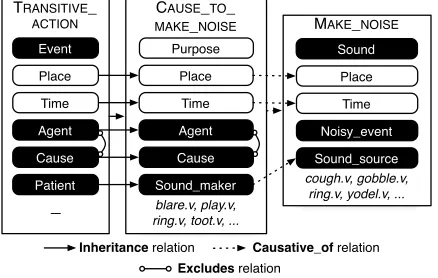
Figure 2. Partial illustration of frames, roles, and LUs related to theCAUSE TO MAKE NOISEframe, from the FrameNet lexicon. “Core” roles are filled ovals. 8 addi-tional roles ofCAUSE TO MAKE NOISEare not shown.
and a precision-boosting constraint that forbids ar-guments of the same predicate to overlap. Our parser achieves the best published results to date on the SemEval’07 FrameNet task (Baker et al., 2007).
2 Resources and Task
We consider frame-semantic parsing resources.
2.1 FrameNet Lexicon
The FrameNet lexicon is a taxonomy of manu-ally identified general-purposeframesfor English.1 Listed in the lexicon with each frame are several lemmas (with part of speech) that can denote the frame or some aspect of it—these are called
lexi-cal units(LUs). In a sentence, word or phrase
to-kens that evoke a frame are known astargets. The set of LUs listed for a frame in FrameNet may not be exhaustive; we may see a target in new data that does not correspond to an LU for the frame it evokes. Each frame definition also includes a set of frame el-ements, orroles, corresponding to different aspects of the concept represented by the frame, such as par-ticipants, props, and attributes. We use the term
ar-1Like the SemEval’07 participants, we used FrameNet v. 1.3
bell.n ring.v
there be.v enough.a
LU
NOISE_MAKERS
SUFFICIENCY
Frame
EXISTENCE
CAUSE_TO_MAKE_NOISE .
bells
N_m
more than six of the eight
Sound_maker Enabled_situation
ring to ringers
Item
enough
Entity Agent
n't are still there But
Figure 1. A sentence from PropBank and the SemEval’07 training data, and a partial depiction of gold FrameNet annotations. Each frame is a row below the sentence (ordered for readability). Thick lines indicate targets that evoke frames; thin solid/dotted lines with labels indicate arguments. “N m” underbellsis short for theNoise makerrole of theNOISE MAKERSframe. The last row indicates thatthere. . . areis a discontinuous target. In PropBank, the verb
ringis the only annotated predicate for this sentence, and it is not related to other predicates with similar meanings.
FRAMENETLEXICON V. 1.3
lexical exemplars
entries counts coverage
8379 LUs 139K sentences, 3.1M words 70% LUs 795 frames 1 frame annotation / sentence 63% frames 7124 roles 285K overt arguments 56% roles
Table 1. Snapshot of lexicon entries and exemplar sen-tences. Coverage indicates the fraction of types attested in at least one exemplar.
gumentto refer to a sequence of word tokens
anno-tated as filling a frame role. Fig. 1 shows an exam-ple sentence from the training data with annotated targets, LUs, frames, and role-argument pairs. The FrameNet lexicon also provides information about relations between frames and between roles (e.g., INHERITANCE). Fig. 2 shows a subset of the rela-tions between three frames and their roles.
Accompanying most frame definitions in the FrameNet lexicon is a set of lexicographicexemplar
sentences(primarily from the British National
Cor-pus) annotated for that frame. Typically chosen to il-lustrate variation in argument realization patterns for the frame in question, these sentences only contain annotations for a single frame. We found that using exemplar sentences directly to train our models hurt performance as evaluated on SemEval’07 data, even though the number of exemplar sentences is an order of magnitude larger than the number of sentences in our training set (§2.2). This is presumably because the exemplars are neither representative as a sample nor similar to the test data. Instead, we make use of these exemplars in features (§4.2).
2.2 Data
Our training, development, and test sets consist of documents annotated with frame-semantic struc-tures for the SemEval’07 task, which we refer to
col-FULL-TEXT SemEval’07 data
ANNOTATIONS train dev test
Size (wordssentences documents)
all 43.3K1.7K 226.3K 251 42.8K120 3
ANC(travel) 3.9K154 2 .8K 32 11.3K 67 1
NTI(bureaucratic) 32.2K1.2K 155.5K 219 31.5K 53 2
PropBank(news) 7.3K325 5 0 0 0 0 0 0
Annotations (frames/wordovert arguments/word)
all 0.230.39 0.220.37 0.370.65
Coverage of lexicon (% frames% roles % LUs)
all 64.127.4 21.0 34.010.2 7.3 29.3 7.7 4.9
Out-of-lexicon types (framesroles LUs)
all 14 69 71 2 4 2 39 99 189
Out-of-lexicon tokens (% frames% roles % LUs)
all 0.7 0.9 1.1 1.0 0.4 0.2 9.811.2 25.3
Table 2.Snapshot of the SemEval’07 annotated data.
lectively as the SemEval’07 data.2 For the most part, the frames and roles used in annotating these documents were defined in the FrameNet lexicon, but there are some exceptions for which the annota-tors defined supplementary frames and roles; these are included in the possible output of our parser.
Table 2 provides a snapshot of the SemEval’07 data. We randomly selected three documents from the original SemEval training data to create a devel-opment set for tuning model hyperparameters. No-tice that the test set contains more annotations per word, both in terms of frames and arguments. More-over, there are many more out-of-lexicon frame, role, and LU types in the test set than in the training set. This inconsistency in the data results in poor re-call scores for all models trained on the given data split, a problem we have not sought to address here.
2http://framenet.icsi.berkeley.edu/
Preprocessing. We preprocess sentences in our dataset with a standard set of annotations: POS tags from MXPOST (Ratnaparkhi, 1996) and depen-dency parses from the MST parser (McDonald et al., 2005) since manual syntactic parses are not available for most of the FrameNet-annotated documents. We used WordNet (Fellbaum, 1998) for lemmatization. We also labeled each verb in the data as havingAC -TIVE or PASSIVE voice, using code from the SRL system described by Johansson and Nugues (2008).
2.3 Task and Evaluation
Automatic annotations of frame-semantic structure can be broken into three parts: (1)targets, the words or phrases that evoke frames; (2) the frame type, defined in the lexicon, evoked by each target; and (3) the arguments, or spans of words that serve to fill roles defined by each evoked frame. These cor-respond to the three subtasks in our parser, each described and evaluated in turn: target identifica-tion (§3), frame identification (§4, not unlike word-sense disambiguation), and argument identification (§5, not unlike semantic role labeling).
The standard evaluation script from the SemEval’07 shared task calculates precision, recall, and F1-measure for frames and arguments;
it also provides a score that gives partial credit for hypothesizing a frame related to the correct one. We present precision, recall, and F1-measure
microaveraged across the test documents, report labels-only matching scores (spans must match exactly), and do not use named entity labels. More details can be found in Baker et al. (2007). For our experiments, statistical significance is measured us-ing a reimplementation of Dan Bikel’s randomized parsing evaluation comparator.3
2.4 Baseline
A strong baseline for frame-semantic parsing is the system presented by Johansson and Nugues (2007, hereafter J&N’07), the best system in the SemEval’07 shared task. For frame identifica-tion, they used an SVM classifier to disambiguate frames for known frame-evoking words. They used WordNet synsets to extend the vocabulary of frame-evoking words to cover unknown words, and then
3
http://www.cis.upenn.edu/˜dbikel/ software.html#comparator
TARGETIDENTIFICATION P R F1
Our technique (§3) 89.92 70.79 79.21
Baseline: J&N’07 87.87 67.11 76.10
Table 3. Target identification results for our system and the baseline. Scores in bold denote significant improve-ments over the baseline (p <0.05).
used a collection of separate SVM classifiers—one for each frame—to predict a single evoked frame for each occurrence of a word in the extended set.
J&N’07 modeled the argument identification problem by dividing it into two tasks: first, they classified candidate spans as to whether they were arguments or not; then they assigned roles to those that were identified as arguments. Both phases used SVMs. Thus, their formulation of the problem in-volves a multitude of classifiers—whereas ours uses two log-linear models, each with a single set of weights, to find a full frame-semantic parse.
3 Target Identification
Target identification is the problem of deciding which word tokens (or word token sequences) evoke frames in a given sentence. In other semantic role labeling schemes (e.g. PropBank), simple part-of-speech criteria typically distinguish predicates from non-predicates. But in frame semantics, verbs, nouns, adjectives, and even prepositions can evoke frames under certain conditions. One complication is that semantically-impoverished support
predi-cates (such as make in make a request) do not
evoke frames in the context of a frame-evoking, syntactially-dependent noun (request). Further-more, only temporal, locative, and directional senses of prepositions evoke frames.
We found that, because the test set is more com-pletely annotated—that is, it boasts far more frames per token than the training data (see Table 2)— learned models did not generalize well and achieved poor test recall. Instead, we followed J&N’07 in us-ing a small set of rules to identify targets.
For a span to be a candidate target, it must ap-pear (up to morphological variation) as a target in the training data or the lexicon. We consider multiword targets,4unlike J&N’07 (though we do not consider
4
de-FRAMEIDENTIFICATION exact frame matching partial frame matching
(§4) targets P R F1 P R F1
Frame identification (oracle targets) ∗ 60.21 60.21 60.21 74.21 74.21 74.21 Frame identification (predicted targets) auto§3 69.75 54.91 61.44 77.51 61.03 68.29
[image:4.612.92.524.63.127.2]Baseline: J&N’07 auto 66.22 50.57 57.34 73.86 56.41 63.97
Table 4.Frame identification results. Precision, recall, andF1were evaluated under exact and partial frame matching; see§2.3. Bold indicates statistically significant results with respect to the baseline (p <0.05).
discontinuous targets). Using rules from §3.1.1 of J&N’07, we further prune the list, with two modi-fications: we pruneallprepositions, including loca-tive, temporal, and directional ones, but do not prune support verbs. This is a conservative approach; our automatic target identifier will never propose a target that was not seen in the training data or FrameNet.
Results. Table 3 shows results on target
identifica-tion; our system gains 3F1points over the baseline.
4 Frame Identification
Given targets, the parser next identifies their frames.
4.1 Lexical units
FrameNet specifies a great deal of structural infor-mation both within and among frames. For frame identification we make use of frame-evokinglexical
units, the (lemmatized and POS-tagged) words and
phrases listed in the lexicon as referring to specific frames. For example, listed with the BRAGGING
frame are 10 LUs, includingboast.N,boast.V, boast-ful.A,brag.V, andbraggart.N. Of course, due to pol-ysemy and homonymy, the same LU may be associ-ated with multiple frames; for example,gobble.Vis listed under both theINGESTIONandMAKE NOISE
frames. All targets in the exemplar sentences, and most in our training and test data, correspond to known LUs (see Table 2).
To incorporate frame-evoking expressions found in the training data but not the lexicon—and to avoid the possibility of lemmatization errors—our frame identification model will incorporate, via a latent variable, features based directly on exemplar and trainingtargetsrather than LUs. LetLbe the set of (unlemmatized and automatically POS-tagged) tar-gets found in the exemplar sentences of the lexi-con and/or the sentences in our training set. Let Lf ⊆ Lbe the subset of these targets annotated as
struction.N. In the SemEval’07 training data, there are just 99 discontinuous multiword targets (1% of all targets).
evoking a particular frame f. Let Ll and Ll f de-note the lemmatized versions ofL and Lf respec-tively. Then, we writeboasted.VBD ∈ LBRAGGING andboast.VBD ∈ LlBRAGGING to indicate that this in-flected verbboastedand its lemmaboasthave been seen to evoke theBRAGGINGframe. Significantly, however, another target, such astoot your own horn, might be used in other data to evoke this frame. We thus face the additional hurdle of predicting frames for unknown words.
The SemEval annotators created 47 new frames not present in the lexicon, out of which 14 belonged to our training set. We considered these with the 795 frames in the lexicon when parsing new data. Pre-dicting new frames is a challenge not yet attempted to our knowledge (including here). Note that the scoring metric (§2.3) gives partial credit forrelated frames (e.g., a more general frame from the lexicon).
4.2 Model
For a given sentencexwith frame-evoking targetst, letti denote theith target (a word sequence). Lettli denote its lemma. We seek a listf = hf1, . . . , fmi of frames, one per target. In our model, the set of candidate frames for ti is defined to include every framef such thattl
i ∈ Llf—or iftli 6∈ Ll, then every known frame (the latter condition applies for 4.7% of the gold targets in the development set). In both cases, we letFi be the set of candidate frames for theith target inx.
To allow frame identification for targets whose lemmas were seen in neither the exemplars nor the training data, our model includes an additional vari-able, `i. This variable ranges over the seen targets inLfi, which can be thought of as prototypes for the expression of the frame. Importantly, frames are predicted, but prototypes are summed over via the latent variable. The prediction rule requires a prob-abilistic model over frames for a target:
fi ←argmaxf∈Fi
P
We adopt a conditional log-linear model: forf ∈ Fi and`∈ Lf,pθ(f, `|ti,x) =
expθ>g(f, `, ti,x) P
f0∈Fi
P `0∈L
f0expθ
>g(f0, `0, t
i,x) (2)
where θ are the model weights, andg is a vector-valued feature function. This discriminative formu-lation is very flexible, allowing for a variety of (pos-sibly overlapping) features; e.g., a feature might re-late a frame type to a prototype, represent a lexical-semantic relationship between a prototype and a tar-get, or encode part of the syntax of the sentence.
Previous work has exploited WordNet for better coverage during frame identification (Johansson and Nugues, 2007; Burchardt et al., 2005, e.g., by ex-panding the set of targets using synsets), and others have sought to extend the lexicon itself (see§6). We differ in our use of a latent variable to incorporate lexical-semanticfeaturesin a discriminative model, relating known lexical units to unknown words that may evoke frames. Here we are able to take advan-tage of the large inventory of partially-annotated ex-emplar sentences.
Note that this model makes a strong independence assumption: each frame is predicted independently of all others in the document. In this way the model is similar to J&N’07. However, ours is a single conditional model that shares features and weights across all targets, frames, and prototypes, whereas the approach of J&N’07 consists of many separately trained models. Moreover, our model is unique in that it uses a latent variable to smooth over frames for unknown or ambiguous LUs.
Frame identification features depend on the pre-processed sentence x, the prototype ` and its WordNet lexical-semantic relationship with the tar-getti, and of course the framef. Our model instan-tiates 662,020 binary features; see Das et al. (2010).
4.3 Training
Given the training subset of the SemEval’07 data, which is of the form hx(j),t(j),f(j),A(j)iN
j=1
(N = 1663 is the number of sentences), we dis-criminatively train the frame identification model by maximizing the following log-likelihood:5
5We found no benefit on development data from using anL 2 regularizer (zero-mean Gaussian prior).
max
θ N X
j=1
mj
X
i=1
log X
`∈L f(j)
i
pθ(f
(j)
i , `|t
(j)
i ,x
(j)) (3)
Note that the training problem is non-convex be-cause of the summed-out prototype latent variable
` for each frame. To calculate the objective func-tion, we need to cope with a sum over frames and prototypes for each target (see Eq. 2), often an ex-pensive operation. We locally optimize the function using a distributed implementation of L-BFGS. This is the most expensive model that we train: with 100 CPUs, training takes several hours. (Decoding takes only a few minutes on one CPU for the test set.)
4.4 Results
We evaluate the performance of our frame identifi-cation model given gold-standard targets and auto-matically identified targets (§3); see Table 4.
Given gold-standard targets, our model is able to predict frames for lemmas not seen in training, of which there are 210. The partial-match evalua-tion gives our model some credit for 190 of these, 4 of which are exactly correct. The hidden vari-able model, then, is finding related (but rarely exact) frames for unknown target words. The net effect of our conservative target identifier on F1 is actually
positive: the frame identifier is far more precise for targets seen explicitly in training. Together, our tar-get and frame identification outperform the baseline by 4F1points. To compare the frame identification
stage in isolation with that of J&N’07, we ran our frame identification model with the targets identified by their system as input. With partial matching, our model achieves a relative improvement of 0.6%F1
over J&N’07 (though this is not significant). While our frame identification model thus per-forms on par with the current state of the art for this task, it improves upon J&N’s formulation of the problem because it requires only a single model, learns lexical-semantic features as part of that model rather than requiring a preprocessing step to expand the vocabulary of frame-evoking words, and is prob-abilistic, which can facilitate global reasoning.
5 Argument Identification
f = hf1, . . . , fmicorresponding to each target, ar-gument identification is the task of choosing which of eachfi’s roles are filled, and by which parts ofx. This task is most similar to the problem of semantic role labeling, but uses frame-specific labels that are richer than the PropBank annotations.
5.1 Model
LetRfi = {r1, . . . , r|Rfi|}denote framefi’sroles (named frame element types) observed in an exem-plar sentence and/or our training set. A subset of each frame’s roles are marked as core roles; these roles are conceptually and/or syntactically necessary for any given use of the frame, though they need not be overt in every sentence involving the frame. These are roughly analogous to the core arguments A0–A5 and AA in PropBank. Non-core roles— analogous to the variousAMs in PropBank—loosely correspond to syntactic adjuncts, and carry broadly-applicable information such as the time, place, or purpose of an event. The lexicon imposes some additional structure on roles, including relations to other roles in the same or related frames, and se-mantic types with respect to a small ontology (mark-ing, for instance, that the entity filling the protag-onist role must be sentient for frames of cogni-tion). Fig. 2 illustrates some of the structural ele-ments comprising the frame lexicon by considering theCAUSE TO MAKE NOISEframe.
We identify a setSof spans that are candidates for filling any roler ∈ Rfi. In principle,Scould con-tain any subsequence ofx, but in this work we only consider the set of contiguous spans that (a) contain a single word or (b) comprise a valid subtree of a word and all its descendants in the dependency parse produced by the MST parser. This covers 81% of ar-guments in the development data. The empty span is also included in S, since some roles are not ex-plicitly filled; in the development data, the average number of roles an evoked frame defines is 6.7, but the average number of overt arguments is only 1.7.6 In training, if a labeled argument is not a valid
sub-6
In the annotated data, each core role is filled with one of three types ofnull instantiationsindicating how the role is con-veyed implicitly. E.g., the imperative construction implicitly designates a role as filled by the addressee, and the correspond-ing filler is thusCNI(constructional null instantiation). In this work we do not distinguish different types of null instantiations.
tree of the dependency parse, we add its span toS. Let Ai denote the mapping of roles in Rfi to spans inS. Our model makes a prediction for each Ai(rk)(for all rolesrk∈ Rfi) using:
Ai(rk)←argmaxs∈Sp(s|rk, fi, ti,x) (4)
We use a conditional log-linear model over spans for each role of each evoked frame:
pψ(Ai(rk) =s|fi, ti,x) = (5)
expψ>h(s, rk, fi, ti,x) P
s0∈Sexpψ>h(s0, rk, fi, ti,x)
Note that our model chooses the span for each role separately from the other roles and ignores all frames except the frame the role belongs to. Our model departs from the traditional SRL literature by modeling the argument identification problem in a single stage, rather than first classifying token spans as arguments and then labeling them. A constraint implicit in our formulation restricts each role to have at most one overt argument, which is consistent with 96.5% of the role instances in the training data.
Out of the overt argument spans in the training data, 12% are duplicates, having been used by some previous frame in the sentence (supposing some ar-bitrary ordering of frames). Our role-filling model, unlike a sentence-global argument detection-and-classification approach,7 permits this sort of argu-ment sharing among frames. The incidence of span overlapamong frames is much higher; Fig. 1 illus-trates a case with a high degree of overlap. Word tokens belong to an average of 1.6 argument spans each, including the quarter of words that do not be-long to any argument.
Features for our log-linear model (Eq. 5) depend on the preprocessed sentence x; the target t; a role r of frame f; and a candidate argument span
s∈ S. Our model includes lexicalized and unlexi-calized features considering aspects of the syntactic parse (most notably the dependency path in the parse from the target to the argument); voice; word order-ing/overlap/distance of the argument with respect to the target; and POS tags within and around the argu-ment. Many features have a version specific to the frame and role, plus a smoothed version incorporat-ing the role name, but not the frame. These features
7
are fully enumerated in (Das et al., 2010); instanti-ating them for our data yields 1,297,857 parameters.
5.2 Training
We train the argument identification model by:
max
ψ N X
j=1
mj
X
i=1 |R
f(j) i
|
X
k=1
logpψ(A(ij)(rk)|fi(j), t(ij),x(j))
(6) This objective function is concave, and we globally optimize it using stochastic gradient ascent (Bottou, 2004). We train this model until the argument iden-tificationF1 score stops increasing on the
develop-ment data. Best results on this dataset were obtained with a batch size of 2 and 23 passes through the data.
5.3 Approximate Joint Decoding
Na¨ıve prediction of roles using Eq. 4 may result in overlap among arguments filling different roles of a frame, since the argument identification model fills each role independently of the others. We want to enforce the constraint that two roles of a single frame cannot be filled by overlapping spans. We dis-allow illegal overlap using a 10000-hypothesis beam search; the algorithm is given in (Das et al., 2010).
5.4 Results
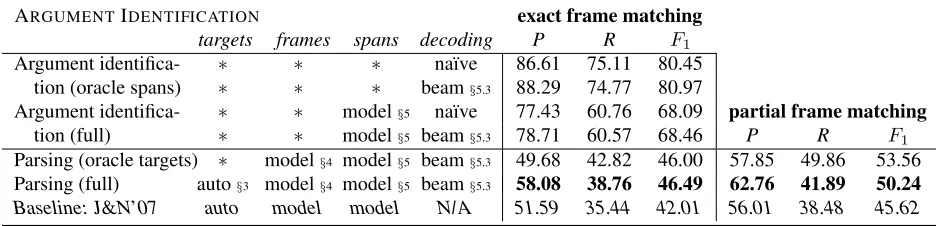
Performance of the argument identification model is presented in Table 5. The table shows how per-formance varies given different types of perfect in-put: correct targets, correct frames, and the set of correct spans; correct targets and frames, with the heuristically-constructed set of candidate spans; cor-rect targets only, with model frames; and ultimately, no oracle input (the full frame parsing scenario).
The first four rows of results isolate the argu-ment identification task from the frame identifica-tion task. Given gold targets and frames and an ora-cle set of argument spans, our local model achieves about 87% precision and 75% recall. Beam search decoding to eliminate illegal argument assignments within a frame (§5.3) further improves precision by about 1.6%, with negligible harm to recall. Note that 96.5% recall is possible under the constraint that roles are not multiply-filled (§5.1); there is thus con-siderable room for improvement with this constraint in place. Joint prediction of each frame’s arguments
is worth exploring to capture correlations not en-coded in our local models or joint decoding scheme. The 15-point drop in recall when the heuristically-built candidate argument set replaces the set of true argument spans is unsurprising: an estimated 19% of correct arguments are excluded because they are nei-ther single words nor complete subtrees (see§5.1). Qualitatively, the problem of candidate span recall seems to be largely due to syntactic parse errors.8 Still, the 10-point decrease in precision when using the syntactic parse to determine candidate spans sug-gests that the model has trouble discriminating be-tween good and bad arguments, and that additional feature engineering or jointly decoding arguments of a sentence’s frames may be beneficial in this regard. The fifth and sixth rows show the effect of auto-matic frame identification on overall frame parsing performance. There is a 22% decrease inF1 (18%
when partial credit is given for related frames), sug-gesting that improved frame identification or joint prediction of frames and arguments is likely to have a sizeable impact on overall performance.
The final two rows of the table compare our full model (target, frame, and argument identification) with the baseline, showing significant improvement of more than 4.4F1points for both exact and partial
frame matching. As with frame identification, we compared the argument identification stage with that of J&N’07 in isolation, using the automatically iden-tified targets and frames from the latter as input to our model. With partial frame matching, this gave us an F1 score of 48.1% on the test set—significantly
better (p < 0.05) than 45.6%, the full parsing re-sult from J&N’07. This indicates that our argument identification model—which uses a single discrim-inative model with a large number of features for role filling (rather than argument labeling)—is more powerful than the previous state of the art.
6 Related work
Since Gildea and Jurafsky (2002) pioneered statis-tical semantic role labeling, a great deal of
com-8
ARGUMENTIDENTIFICATION exact frame matching
targets frames spans decoding P R F1
Argument identifica-tion (oracle spans)
∗ ∗ ∗ na¨ıve 86.61 75.11 80.45
∗ ∗ ∗ beam§5.3 88.29 74.77 80.97
Argument identifica-tion (full)
∗ ∗ model§5 na¨ıve 77.43 60.76 68.09 partial frame matching
∗ ∗ model§5 beam§5.3 78.71 60.57 68.46 P R F1
Parsing (oracle targets) ∗ model§4 model§5 beam§5.3 49.68 42.82 46.00 57.85 49.86 53.56
Parsing (full) auto§3 model§4 model§5 beam§5.3 58.08 38.76 46.49 62.76 41.89 50.24
[image:8.612.71.539.63.176.2]Baseline: J&N’07 auto model model N/A 51.59 35.44 42.01 56.01 38.48 45.62
Table 5. Argument identification results. ∗indicates that gold-standard labels were used for a given pipeline stage. For full parsing, bolded scores indicate significant improvements relative to the baseline (p <0.05).
putational work has investigated predicate-argument structures for semantics. Briefly, we highlight some relevant work, particularly research that has made use of FrameNet. (Note that much related research has focused on PropBank (Kingsbury and Palmer, 2002), a set of shallow predicate-argument annota-tions forWall Street Journalarticles from the Penn Treebank (Marcus et al., 1993); a recent issue ofCL (M`arquez et al., 2008) was devoted to the subject.)
Most work on frame-semantic role labeling has made use of the exemplar sentences in the FrameNet corpus (see §2.1), each of which is annotated for a single frame and its arguments. On the probabilis-tic modeling front, Gildea and Jurafsky (2002) pre-sented a discriminative model for arguments given the frame; Thompson et al. (2003) used a gener-ative model for both the frame and its arguments; and Fleischman et al. (2003) first used maximum entropy models to find and label arguments given the frame. Shi and Mihalcea (2004) developed a rule-based system to predict frames and their argu-ments in text, and Erk and Pad´o (2006) introduced the Shalmaneser tool, which employs Na¨ıve Bayes classifiers to do the same. Other FrameNet SRL systems (Giuglea and Moschitti, 2006, for instance) have used SVMs. Most of this work was done on an older, smaller version of FrameNet.
Recent work on frame-semantic parsing—in which sentences may contain multiple frames to be recognized along with their arguments—has used the SemEval’07 data (Baker et al., 2007). The LTH system of Johansson and Nugues (2007), our base-line (§2.4), performed the best in the SemEval’07 task. Matsubayashi et al. (2009) trained a log-linear model on the SemEval’07 data to evaluate argument identification features exploiting various
types of taxonomic relations to generalize over roles. A line of work has sought to extend the coverage of FrameNet by exploiting VerbNet, WordNet, and Wikipedia (Shi and Mihalcea, 2005; Giuglea and Moschitti, 2006; Pennacchiotti et al., 2008; Tonelli and Giuliano, 2009), and projecting entries and an-notations within and across languages (Boas, 2002; Fung and Chen, 2004; Pad´o and Lapata, 2005; F¨urstenau and Lapata, 2009). Others have applied frame-semantic structures to question answering, paraphrase/entailment recognition, and information extraction (Narayanan and Harabagiu, 2004; Shen and Lapata, 2007; Pad´o and Erk, 2005; Burchardt, 2006; Moschitti et al., 2003; Surdeanu et al., 2003).
7 Conclusion
We have provided a supervised model for rich frame-semantic parsing, based on a combination of knowledge from FrameNet, two probabilistic models trained on SemEval’07 data, and expedi-ent heuristics. Our system achieves improvemexpedi-ents over the state of the art at each stage of process-ing and collectively, and is amenable to future ex-tension. Our parser is available for download at http://www.ark.cs.cmu.edu/SEMAFOR.
Acknowledgments
References
C. Baker, M. Ellsworth, and K. Erk. 2007. SemEval-2007 Task 19: frame semantic structure extraction. In
Proc. of SemEval.
H. C. Boas. 2002. Bilingual FrameNet dictionaries for machine translation. InProc. of LREC.
L. Bottou. 2004. Stochastic learning. InAdvanced Lec-tures on Machine Learning. Springer-Verlag.
A. Burchardt, K. Erk, and A. Frank. 2005. A WordNet detour to FrameNet. In B. Fisseni, H.-C. Schmitz, B. Schr¨oder, and P. Wagner, editors, Sprachtech-nologie, mobile Kommunikation und linguistische Re-sourcen, volume 8. Peter Lang.
A. Burchardt. 2006. Approaching textual entailment with LFG and FrameNet frames. InProc. of the Sec-ond PASCAL RTE Challenge Workshop.
D. Das, N. Schneider, D. Chen, and N. A. Smith. 2010. SEMAFOR 1.0: A probabilistic frame-semantic parser. Technical Report CMU-LTI-10-001, Carnegie Mellon University.
K. Erk and S. Pad´o. 2006. Shalmaneser - a toolchain for shallow semantic parsing. InProc. of LREC.
C. Fellbaum, editor. 1998. WordNet: an electronic lexi-cal database. MIT Press, Cambridge, MA.
C. J. Fillmore, C. R. Johnson, and M. R.L. Petruck. 2003. Background to FrameNet. International Journal of Lexicography, 16(3).
C. J. Fillmore. 1982. Frame semantics. InLinguistics in the Morning Calm, pages 111–137. Hanshin Publish-ing Co., Seoul, South Korea.
M. Fleischman, N. Kwon, and E. Hovy. 2003. Maximum entropy models for FrameNet classification. InProc. of EMNLP.
P. Fung and B. Chen. 2004. BiFrameNet: bilin-gual frame semantics resource construction by cross-lingual induction. InProc. of COLING.
H. F¨urstenau and M. Lapata. 2009. Semi-supervised se-mantic role labeling. InProc. of EACL.
D. Gildea and D. Jurafsky. 2002. Automatic labeling of semantic roles.Computational Linguistics, 28(3). A.-M. Giuglea and A. Moschitti. 2006. Shallow
semantic parsing based on FrameNet, VerbNet and PropBank. InProc. of ECAI 2006.
R. Johansson and P. Nugues. 2007. LTH: semantic struc-ture extraction using nonprojective dependency trees. InProc. of SemEval.
R. Johansson and P. Nugues. 2008. Dependency-based semantic role labeling of PropBank. In Proc. of EMNLP.
P. Kingsbury and M. Palmer. 2002. From TreeBank to PropBank. InProc. of LREC.
M. P. Marcus, M. A. Marcinkiewicz, and B. Santorini. 1993. Building a large annotated corpus of English: the Penn Treebank.Computational Linguistics, 19(2). L. M`arquez, X. Carreras, K. C. Litkowski, and S. Steven-son. 2008. Semantic role labeling: an introduction to the special issue.Computational Linguistics, 34(2). Y. Matsubayashi, N. Okazaki, and J. Tsujii. 2009. A
comparative study on generalization of semantic roles in FrameNet. InProc. of ACL-IJCNLP.
R. McDonald, K. Crammer, and F. Pereira. 2005. Online large-margin training of dependency parsers. InProc. of ACL.
A. Moschitti, P. Mor˘arescu, and S. M. Harabagiu. 2003. Open-domain information extraction via automatic se-mantic labeling. InProc. of FLAIRS.
S. Narayanan and S. Harabagiu. 2004. Question answer-ing based on semantic structures. InProc. of COLING. S. Pad´o and K. Erk. 2005. To cause or not to cause: cross-lingual semantic matching for paraphrase mod-elling. InProc. of the Cross-Language Knowledge In-duction Workshop.
S. Pad´o and M. Lapata. 2005. Cross-linguistic projec-tion of role-semantic informaprojec-tion. In Proc. of HLT-EMNLP.
M. Pennacchiotti, D. De Cao, R. Basili, D. Croce, and M. Roth. 2008. Automatic induction of FrameNet lexical units. InProc. of EMNLP.
A. Ratnaparkhi. 1996. A maximum entropy model for part-of-speech tagging. InProc. of EMNLP.
D. Shen and M. Lapata. 2007. Using semantic roles to improve question answering. InProc. of EMNLP-CoNLL.
L. Shi and R. Mihalcea. 2004. An algorithm for open text semantic parsing. InProc. of Workshop on Robust Methods in Analysis of Natural Language Data. L. Shi and R. Mihalcea. 2005. Putting pieces together:
combining FrameNet, VerbNet and WordNet for ro-bust semantic parsing. In Computational Linguis-tics and Intelligent Text Processing: Proc. of CICLing 2005. Springer-Verlag.
M. Surdeanu, S. Harabagiu, J. Williams, and P. Aarseth. 2003. Using predicate-argument structures for infor-mation extraction. InProc. of ACL.
C. A. Thompson, R. Levy, and C. D. Manning. 2003. A generative model for semantic role labeling. InProc. of ECML.